
Update 2: Reader Jesse Michael forwarded me this animated image above, which does a better job than the flawed NASA image or it’s replacement I found below. It takes about a minute to complete the whole sequence, patience.
While looking for something else, I came across this image from the NASA visualization website. I located the hires TIFF image and annotated it as seen below. I also made a desktop wallpaper out of the TIFF file for those interested. It reminded me to remind you all about perspectives, so here is some perspective on size, solar luminosity, and on our planetary energy budget.
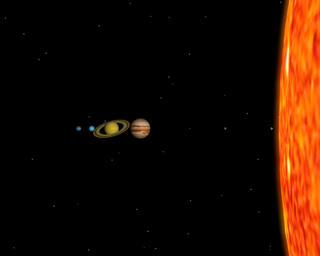

Click here for a larger (TIFF format without annotation) image from NASA
Click here for a desktop wallpaper image (1280×1024 JPEG)

UPDATE: It appears that the NASA provided image above , the source of which is from this NASA page, unbelievably, is wrong. As reader Erik points out, the sun is too large. I initially had some misgivings about the solar size also, but figured NASA wouldn’t possibly botch such a basic comparison. Shades of the Hubble mirror fiasco.
Here is another image from NASA JPL that appears to be correct:

Click for larger image from JPL
Note: image above is L-R mirrored for comparison to first image.
Note that distance is not to scale, but planetary and solar size is. To get an idea of distance scale, read this excellent example from Kitt Peak Observatory.
A few factoids:
- It would take about 109 earths to equal the width of the suns diameter (Sun=1.39 million km Earth=12,700 km)
- Over 1 million Earths would fit inside the Sun’s volume
- The sun has a total luminosity output of 386 YottaWatts
(386,000,000,000,000,000,000,000,000 watts, some background here and here)
- The total luminous energy output received by earth from the sun is 174 PETAWATTS (174,000,000,000,000,000) watts.
- A 0.1% increase in luminosity dumps an extra 174 trillion watts (174,000,000,000,000) watts into our planetary energy balance.

Data source for graph: http://www1.ncdc.noaa.gov/pub/data/paleo/climate_forcing/solar_variability/lean2000_irradiance.txt
Note: In the graph above, the low flatline from 1645-1715 is the Maunder Minimum, a period of virtually no sunspots, where the historical reports from the northern hemisphere tell a story of dramatic climate change: harsh winters, cools summers, crop failures, famine and disease.
From the abstract referenced above: “Estimated increases since 1675 are 0.7%, 0.2% and 0.07% in broad ultraviolet, visible/near infrared and infrared spectral bands, with a total irradiance increase of 0.2%. “
So its not just 0.1 %, it is 0.2% which translates to a 348 TeraWatts global irradiance increase.
Now lets put 348 trillion watts into perspective:
Hurricanes: the heat energy released by a hurricanes category 1-5 equals about 50 to 200 trillion watts or about the same amount of energy released by exploding a 10-megaton nuclear bomb every 20 minutes.
Katrina, released about 200 trillion watts over its life cycle.
Now imagine double that amount of extra energy being added to earth’s atmosphere every second by small increases in the suns output that have been documented to exist. That’s what the increase in solar irradiance is doing. Since 1675, after the depths of the Maunder Minimum, we’ve seen an increase in solar irradiance of about 2.5 watts per square meter.
Climate modelers say that the extra CO2 equates to a forcing of about 2 watts per square meter, which totals about 1.12 Petawatt (1,120,000,000,000,000 watts). The problem is, they can’t always recreate that reliably between all of the different models out there, with the positive and negative feedback mechanisms, and other variables involved. There’s disagreement on the total contribution. A lot of it. Nonetheless they seem all to agree that CO2 makes some contribution, and that’s likely true. But compared to the sun, I believe it’s minimal.
Now lets look at us: 13.5 TeraWatts is the average total power consumption of the human world in 2001.
Compared to solar variance, do you think we could change the planets atmospheric energy balance with that if we squeezed all the power we made that year together and radiated it into our atmosphere ?
What is very clear though, when you look at history, and the graph above, is that our earths atmosphere and resulting climate is extremely sensitive to variations in solar output. The sweet center point seems to be about 1365 watts per square meter of irradiance…what we consider as “normal” climate. Take 1.5 watts/sq. meter away, and we get significant cooling, harsh winters, cool summers, and increases in ice and glaciers. Add 1.5 watts,/sq. meter and we get hotter summers, mild winters, and melting of ice and glaciers.
Now irradiance aside, as it’s only one component, there’s also the chnage in the suns dynamic magnetic field and solar wind, which according to Svensmark, which modulates the number of cosmic rays that enter our atmosphere (I think there may be some possible effect also due to modulation of the earth’s magnetic field), which modulates the number of clouds that form, hence changing the net surface irradiance. Plots of changes in the suns magnetic field line up very well with climate change.
Here is a little more on perspective and our place in the universe:
There’s a tendency to view ourselves, our endeavors, and our accomplishments as the pinnacle. Yet, compared to whats in our solar system, whats in our galaxy, and whats in our universe, we are but a mere speck in the vastness of time, space, mass, and energy.


Note that distance is not to scale,
Whew! Had me quite worried there for a minute – about NASA. If scaled, Earth should be about 3,000 X farther away, I believe.
Thanks, Anthony!
cohenite “Antares; isn’t that the sun where “Altair-4″, the planet from “Forbidden Planet”, was orbiting”
No, Altair 4 in “Forbidden Planet” was the 4th planet in orbit around the star Altair, a normal type A main sequence star larger, brighter and younger than the sun. You can see Altair rising in the East after sunset.
This perspective, and the corresponding posting on cooling and speculations on LIA raises the question: is there any research being done of how one could stop an ice age? Anybody know any links?
Off hand I would expect this should be one of NASAs projects. ( Hansen has said once that CO2 will not allow the next ice age, but I do not mean this)
Suppose total irradiance reaching the earth is the problem. As a physicist I would study a la science fiction opening huge aluminum reflectors in geostatic orbits where the famous climate models ( lets hope they improve soon) say it would do most good. These will reflect back the escaping energy much better than any green house. Or they could reflect the sun.
I would also think of raising the albedo of the moon, maybe by some gas or other that would need to be replenished but would do the job.
Suppose it is anomalous cloud circulations or water circulations. Focus on the spots with converging mirrors and boil away the disturbance. These numbers show there is plenty of energy available .
Here is somebody who had a go at the calculations for the moon:
http://answers.yahoo.com/question/index?qid=20070723043632AA54FeE
Seems the moon’s albedo is only 12%.
These are just off the cuff ideas, but instead of sitting and thinking ” woe, another LIA would be disastrous” we should at least be actively studying how to use the large means available to combat it, instead of wasting money chasing non existent CO2 boogie men. Such a study, and a study of the cloud injection sailing ships would give humanity a control of the climate both ways for the first time.
REPLY: “Hansen has said once that CO2 will not allow the next ice age…”
Anna do you have a reference as to where he said that?
Some time back I saw or received something about how the Russians (or perhaps Bush) used a weather control machine to create/direct Katrina into NO. Looking at the energy levels, a friend had but one question: Where would you plug it it?
Hurricanes happen a lot. Far more power than anything humans can manage. And the biggest storm isn’t a spec of dust compared to that big orange thing.
So why is Congress so concerned about converting to CFL’s ?
REPLY: Better yet, where would you covertlky obtain and distribute that much energy? I put weather control up at the absurdity top of scale like the 911 Turth movement, please no discussion here.
Well, let’s see. The global alarmists are willing to destroy the economy to prevent global warming. anna v is willing to take drastic steps to prevent a new ice age.
But what about cosmic catastrophes that we have absolutely no control over such as a gamma ray bursters within 8000 light years or a super nova within 100 light years? Add to that the threat from the Yellowstone super volcano which could destroy the US when it pops.
Now if there is no Creator, then we are freaking doomed, as the Mogambo would say, by any number of cosmic disasters, so why sweat it? “Eat drink and avoid gloom for surely we are doomed”.
But if there is a Creator, is it likely that He would wish us to spend so much time and energy on threats we may have no control over? Particularly when we still have major problems just getting along with each other?
I read somewhere that if we had a weather station in every cubic foot of the atmosphere that it would still be impossible to predict the weather for more than a couple of weeks in advance. I know, weather is different from the global climate but still this should humble us a bit, don’t you think?
There is a rule in bridge that if it is only possible to win a hand if the cards lay a certain way, then the logical thing to do is ASSUME they lie that way.
This is Sunday so forgive the God talk, please.
Bring on the abuse.
Hansen, Schneider: catastrophic new ice age by 2021
U.S. Scientist Sees New Ice Age Coming
Washington Post and Science magazine
The world could be as little as 15 or 25 years away from a disastrous new ice age, a leading atmospheric scientist predicts. Dr. S. I. Rasool of the National Aeronautics and Space Administration and Columbia University used a computer program by his colleague, Prof. James Hansen, that studied clouds above Venus.
By 2021, fossil-fuel dust injected by man into the atmosphere could screen out so much sunlight that the average temperature could drop by six degrees, resulting in a buildup of new glaciers that could eventually cover huge areas.
(July 1971)
Sorry. I do not have a link with Hansen’s CO2 will not allow next ice age. It was back at the end of last year when I was not really very skeptical, and took it in my stride.
I was reminded of it by a comment on one of the other threads, where somebody else made the same claim in a lecture. I could try searching if you think it is important.
From: When Will the Next Ice Age Begin?
“That insulating blanket has a bigger climatic influence than the slight flux in incoming solar energy from changes in Earth’s orientation relative to the Sun, said Dr. James A. Hansen, the director of NASA’s Goddard Institute for Space Studies.
“We have taken over control of the mechanisms that determine the climate change,” he said.”
http://www.nytimes.com/2003/11/11/science/11ICE.html?ex=1383886800&en=f88e6d42c112b4ca&ei=5007&partner=USERLAND
So here he says it to a science reporter. I seem to remember a talk, but it has not turned up on the search,
Richard Mackay’s literature review titled Rhodes Fairbridge and the idea that the solar system regulates the Earth’s climate was published in the Journal of Coastal Research last year.
The Australian scientist Rhodes Fairbridge developed theories on the relationship between the Sun, solar system, Earth’s climate over three decades before passing away in 2006. Fairbridge emphasized that the answer to the question “Does the Sun affect the Earth’s climate?” has to be in terms of three processes. 1) “variations in the quantity, intensity and distribution over the earth of the solar output, inlcuding electromagnetic radiation, matter and the sun’s electromagnetic field; 2) the variable gravitation force the sun exerts on the earth, the moon and the earth as a system; 3) and interactions between some or all of these processes.”
The affect of solar system gravitational fields on the earth’s climate is interesting.
The article is a good review of who is doing what in solar climate physics. Henrik Svensmark is strangely absent from the list.
The link is below.
http://www.griffith.edu.au/conference/ics2007/pdf/ICS176.pdf
anna v:
Interesting idea. I wonder how large they would have to be. My guess is HUGE. Because of that, it would also be fascinating to figure out how to keep them in orbit. Light pressure and solar wind would be a constant force pushing them away from the sun changing the orbit to elliptical. This would likely reduce their effectiveness and also likely contribute to their early demise.
Whether or not there is a “creator” is irrelevant. Our instincts are to survive. And if we cripple economies and outlaw carbon emissions, we’ll never get off this planet.
Anthony,
“I think there may be some possible effect also due to modulation of the earth’s magnetic field”
Actually, as mentioned above there is no known modulation. Neither would one matter if it existed. A total shut-off of earths magnetic field wouldn’t matter much to cloudiness as the sun is soo much more efficient in controlling the flow of GCR at the energies that matter (above 10 GeV). Earths magnetic field on the other hand is much too weak to affect these particles and hence variation in earths magnetic field doesn’t really matter to cloudiness, lest there is another (unknown) mechanism.
PoetSam
There is an ancient greek saying: With the help from the goddess Athena, still use your hands.
Kismet is what the east believes in: fate. In the west we are different, there is even a poem
Under the bludgeonings of chance
My head is bloody, but unbowed.
I am the master of my fate;
I am the captain of my soul.
-W.E. Henley (1849-1903)
in Invictus
Nothing like the very latest and current data to illustrate the point that major level solar wind ram pressure spikes and possible associated joule heating may also affect our climate
During May 2008, there were no major solar wind ram pressure spikes over 10 nPa. There was an average of 2- 3 spikes in the high temperature anomaly months during the record setting year of 2005. Also during May 2008, there was only one spike over 5 nPA, namely 6 nPa. There were an average of 9 spikes of > 5 nPa in the high temperature anomaly months during 2005. UAH reported that the temperature anomaly for May 2008 was the 4th coldest since 1979.
Here is the summary for the first 5 months of this year which has been colder than normal.
There were only 2 spikes of 10 nPA or more for the first 5 months of this year By May 2005 there had already been 13. During the first five months of 2008 there were 16 spikes of 5 nPa or more By May 2005 there had been 30 spikes. The CRUTEM 3 [global air/land] temperature anomaly which I use will not be available until late June but the temperature anomaly for the first 4 months is O.437.May will bring it down more, The average for the first 5 months temperature anomaly for 2005 was 0.726
JANUARY –MAY 2008
AVERAGE NUMBER OF SPIKES [10 & >] nPa PER MONTH 0.4 [TO DATE 2]
AVERAGE NUMBER OF SPIKES [5 & >] nPa PER MONTH 3.2 [TODATE 16]
MONTHLY GLOBAL LAND AIR TEMP ANOMALY PER CRUTEM3 [0.437 up to April only] [MAY not available yet but is expected to be cold]
Compare this with the record temperature year like 2005
YEAR 2005[12 months]
AVERAGE NUMBER OF SPIKES [10 & >] nPa. PER MONTH 2.75 [YEARLY 33]
AVERAGE NUMBER OF SPIKES [5 & >] nPa. PER MONTH 9.3 [YEARLY 112]
YEARLY GLOBAL LAND AIR TEMP ANOMALY PER CRUTEM 3 0.745 C
The solar wind ram pressure spikes are based Omniweb hourly plots
No one argues that the sun is not an enormously important part of the climate system. Indeed, there is strong evidence that a good portion of early-20th century warming is in part caused by increasing TSI.
The important question, however, is about trends. And there seems to be no trend in TSI or cosmic rays over the past forty years that could explain the modern warming trend. I wrote an article on this a few weeks back (and had it reviewed by Judy Lean, the source of your TSI data): http://www.yaleclimatemediaforum.org/ccm/0508_solar.htm
Anthony, Anna,
The claim that CO2 would prevent another ice-age is one that Hansen, Broecker, and others have repeatedly made (though, unfortunately, I heard these statements in talks, there are no links available that I can find). There is a New Scientist article on this subject available here: http://environment.newscientist.com/channel/earth/energy-fuels/mg19526183.000-fossilfuel-hangover-may-block-ice-ages.html
The gist is that Milankovitch cycles that catalyze ice ages involve relatively small perturbations in the distribution of solar energy that trigger an important ice-albedo feedback. However, by 2100 we will likely have an atmospheric CO2 concentration that is modeled to produce an amount of radiative forcing that exceeds that of Milankovitch cycles. If CO2 levels remain high indefinitely, the arguement goes, it would be nearly impossible for a new ice age to occur (barring something unseen in the climatic history of the past few million years).
That said, by the time Milankovitch cycles would lead to the next ice age (estimated to be around 15k to 20k years from now), who knows what the atmospheric concentration of CO2 and other GHGs will be…
The daily solar irradiance figures can be obtained from the two currently working TSI instruments PMOD and SORCE. PMOD has declined quite a bit in the last few months while SORCE is recording what is to be expected at the very bottom of the solar cycle.
What is very interesting, however, is that the most recent Solar Flux number from today, June 8th, was 64.8, which is the second lowest daily measurement ever recorded since the records began in 1950. The record low for any one day is 64.4 .
Sorry, Anthony, I screwed up on the name. The computer remembered my previous nom-de-plume.
Update: You are correct. Unbelievably, the NASA image I first used is wrong. I’ve provided a second one. I initially had a bit of misgivings about it, but then I figured that NASA wouldn’t make such a basic mistake in a web presentation. But they did, yikes!
Ah, Anthony, you now understand the logical fallacy of “recourse to authority”.
Now, Jim Hansen works for NASA; go figure….
Sorry, Anthony, I must ask the obvious question; the stupid one. I’m just venting.
Point: The Earth receives so much radiation and warms up, according to Stephan-Boltzmann, to the point where it will radiate the same amount of radiation.
Thus: CO2 can NOT “heat up” the planet. The source of heat for the planet is only the Sun.
If: CO2 warms up the surface of the Earth by absorbing and re-admitting “infra-red radiation”, would it not also do the same to incoming like radiation?
REPLY: I’ll let commenters chime in on this.
anna v
I too am the captain of my soul. It’s just that the crew are a pack of mutinous drunkards with no sense of direction.
On the topic; yes, all those stars and planetty things are very big and completely beyond our control, but I’m not so sure our perspective is all that faulty. If your dog just died, then from your perspective that’s probably a more significant fact than the diameter of Antares. Nothing wrong with it unless you think you can bring the dog back, or ‘tackle’ the climate.
“the next ice age (estimated to be around 15k to 20k years from now”
Any links to that estimate? My understanding was that it was overdue, i.e. the Holocene was now longer than most (many?) interglacials.
So, Zeke, if it isn’t the sun causing climate change, then it must be C02, or more specifically, man’s contribution of C02? Correct? First it is the sun, then suddenly it’s man’s C02 causing warming? Neat trick, that. Please explain. We’re all ears.
NASA
Never A Straight Answer.
Sad but true………
Hmmm…. so do I. You have to realize that a lot of the images and websites are generated by PR people who don’t always check their graphics, etc before publication.
The second image isn’t much better than the first. At least the asteroid belt gap is there in the first although Mercury seems to be missing and the gap between Venus and earth is too large. The planets are (very) roughly equally spaced logarithmically. There’s an obvious gap at the asteroid belt. Table
Showing relative size and keeping proper distance scale may be incompatible. Could be why the second image isn’t to distance scale.
Robert Wood (14:40:01) :
Think of it as a blanket. A blanket keeps you warm by preventing the loss of heat. You also need to realize that the incoming and outgoing energy differ in wavelength. This may be of help. This is the first time I’ve seen it but after a quick read, I think it’s probably right insofar as radiation/absorption is concerned.