Still no global warming at all for 18 years 8 months
By Christopher Monckton of Brenchley
To the growing embarrassment of the world-government wannabes who are preparing to meet in Paris next month to inflict upon the world a Solomon Binding treaty that will, in all but name, create an all-powerful global tyranny-by-clerk for the first time, the central pretext for the entire venture – global warming – continues to be conspicuous by its prolonged absence.
One-third of Man’s entire influence on climate since the Industrial Revolution has occurred since February 1997. Yet for 224 months since then there has been no global warming at all (Fig. 1). With this month’s RSS temperature record, the Pause equals last month’s record at 18 years 8 months.

Figure 1. The least-squares linear-regression trend on the RSS satellite monthly global mean surface temperature anomaly dataset shows no global warming for 18 years 8 months since February 1997, though one-third of all anthropogenic forcings have occurred during the period of the Pause.
We are now entering the northern-hemisphere autumn. That is traditionally the time when an el Niño begins to make itself felt. It is becoming ever more likely that the temperature increase that usually accompanies an el Niño will begin to shorten the Pause somewhat, though a subsequent La Niña would be likely to bring about a resumption and perhaps even a lengthening of the Pause.
Beware: the year or two after an el Niño usually – but not always – brings an offsetting la Niña, cooling first the ocean surface and then the air temperature and restoring global temperature to normal.
For amusement, watch the recent Senate Judiciary Committee hearing at which Senator Cruz cross-examined the hapless head of the Sierra Club, who had testified that global warming was dangerous but was not aware that there had not been any for more than 18 years, a point that Senator Cruz put to him several times. The reply, repeated half a dozen times as a zombie-like mantra, was that 97% of scientists thought the world was “cooking up, heating, and warming”. The Pause is beginning to claim its first victims.
The hiatus period of 18 years 8 months is the farthest back one can go in the RSS satellite temperature record and still show a sub-zero trend. The start date is not cherry-picked: it is calculated. And the graph does not mean there is no such thing as global warming. Going back further shows a small warming rate. And yes, the start-date for the Pause has been inching forward, though rather more slowly than the end-date, which is why the Pause continues on average to lengthen. And, like it or not, so long a stasis in global temperature is simply inconsistent not only with the extremist predictions of the computer models but also with the shrieking panic whipped up by the rent-seekers rubbing their hands with glee in Paris.
The UAH dataset shows a Pause almost as long as the RSS dataset. However, the much-altered surface tamperature datasets show a small warming rate (Fig. 1b).

Figure 1b. The least-squares linear-regression trend on the mean of the GISS, HadCRUT4 and NCDC terrestrial monthly global mean surface temperature anomaly datasets shows global warming at a rate equivalent to a little over 1 C° per century during the period of the Pause from January 1997 to July 2015.
Bearing in mind that one-third of the 2.4 W m–2 radiative forcing from all manmade sources since 1750 has occurred during the period of the Pause, a warming rate equivalent to little more than 1 C°/century is not exactly alarming.
As always, a note of caution. Merely because there has been little or no warming in recent decades, one may not draw the conclusion that warming has ended forever. The trend lines measure what has occurred: they do not predict what will occur.
The Pause – politically useful though it may be to all who wish that the “official” scientific community would remember its duty of skepticism – is far less important than the growing discrepancy between the predictions of the general-circulation models and observed reality.
The divergence between the models’ predictions in 1990 (Fig. 2) and 2005 (Fig. 3), on the one hand, and the observed outturn, on the other, continues to widen. If the Pause lengthens just a little more, the rate of warming in the quarter-century since the IPCC’s First Assessment Report in 1990 will fall below 1 C°/century equivalent.

Figure 2. Near-term projections of warming at a rate equivalent to 2.8 [1.9, 4.2] K/century, made with “substantial confidence” in IPCC (1990), for the 307 months January 1990 to July 2015 (orange region and red trend line), vs. observed anomalies (dark blue) and trend (bright blue) at just 1 K/century equivalent, taken as the mean of the RSS and UAH v.6 satellite monthly mean lower-troposphere temperature anomalies.

Figure 3. Predicted temperature change, January 2005 to July 2015, at a rate equivalent to 1.7 [1.0, 2.3] Cº/century (orange zone with thick red best-estimate trend line), compared with the near-zero observed anomalies (dark blue) and real-world trend (bright blue), taken as the mean of the RSS and UAH v.6 satellite lower-troposphere temperature anomalies.
I apologize that these two graphs showing prediction against reality have not been updated in recent months, but UAH is still bedding in its new version of the global-temperature dataset and the file structures and names keep changing. It is a lot of work to reprogram to keep pace with these changes, so I shall wait till things settle down.
The Technical Note explains the sources of the IPCC’s predictions in 1990 and in 2005, and also demonstrates that that according to the ARGO bathythermograph data the oceans are warming at a rate equivalent to less than a quarter of a Celsius degree per century.
Key facts about global temperature
These facts should be shown to anyone who persists in believing that, in the words of Mr Obama’s Twitteratus, “global warming is real, manmade and dangerous”.
Ø The RSS satellite dataset shows no global warming at all for 224 months from February 1997 to September 2015 – more than half the 441-month satellite record.
Ø There has been no warming even though one-third of all anthropogenic forcings since 1750 have occurred since the Pause began in February 1997.
Ø The entire RSS dataset from January 1979 to date shows global warming at an unalarming rate equivalent to just 1.2 Cº per century.
Ø Since 1950, when a human influence on global temperature first became theoretically possible, the global warming trend has been equivalent to below 1.2 Cº per century.
Ø The global warming trend since 1900 is equivalent to 0.75 Cº per century. This is well within natural variability and may not have much to do with us.
Ø The fastest warming rate lasting 15 years or more since 1950 occurred over the 33 years from 1974 to 2006. It was equivalent to 2.0 Cº per century.
Ø Compare the warming on the Central England temperature dataset in the 40 years 1694-1733, well before the Industrial Revolution, equivalent to 4.33 C°/century.
Ø In 1990, the IPCC’s mid-range prediction of near-term warming was equivalent to 2.8 Cº per century, higher by two-thirds than its current prediction of 1.7 Cº/century.
Ø The warming trend since 1990, when the IPCC wrote its first report, is equivalent to 1 Cº per century. The IPCC had predicted close to thrice as much.
Ø To meet the IPCC’s central prediction of 1 C° warming from 1990-2025, in the next decade a warming of 0.75 C°, equivalent to 7.5 C°/century, would have to occur.
Ø Though the IPCC has cut its near-term warming prediction, it has not cut its high-end business as usual centennial warming prediction of 4.8 Cº warming to 2100.
Ø The IPCC’s predicted 4.8 Cº warming by 2100 is well over twice the greatest rate of warming lasting more than 15 years that has been measured since 1950.
Ø The IPCC’s 4.8 Cº-by-2100 prediction is four times the observed real-world warming trend since we might in theory have begun influencing it in 1950.
Ø The oceans, according to the 3600+ ARGO buoys, are warming at a rate of just 0.02 Cº per decade, equivalent to 0.23 Cº per century, or 1 C° in 430 years.
Ø Recent extreme-weather events cannot be blamed on global warming, because there has not been any global warming to speak of. It is as simple as that.
Technical note
Our latest topical graph shows the least-squares linear-regression trend on the RSS satellite monthly global mean lower-troposphere dataset for as far back as it is possible to go and still find a zero trend. The start-date is not “cherry-picked” so as to coincide with the temperature spike caused by the 1998 el Niño. Instead, it is calculated so as to find the longest period with a zero trend.
The fact of a long Pause is an indication of the widening discrepancy between prediction and reality in the temperature record.
The satellite datasets are arguably less unreliable than other datasets in that they show the 1998 Great El Niño more clearly than all other datasets. The Great el Niño, like its two predecessors in the past 300 years, caused widespread global coral bleaching, providing an independent verification that the satellite datasets are better able than the rest to capture such fluctuations without artificially filtering them out.
Terrestrial temperatures are measured by thermometers. Thermometers correctly sited in rural areas away from manmade heat sources show warming rates below those that are published. The satellite datasets are based on reference measurements made by the most accurate thermometers available – platinum resistance thermometers, which provide an independent verification of the temperature measurements by checking via spaceward mirrors the known temperature of the cosmic background radiation, which is 1% of the freezing point of water, or just 2.73 degrees above absolute zero. It was by measuring minuscule variations in the cosmic background radiation that the NASA anisotropy probe determined the age of the Universe: 13.82 billion years.
The RSS graph (Fig. 1) is accurate. The data are lifted monthly straight from the RSS website. A computer algorithm reads them down from the text file and plots them automatically using an advanced routine that automatically adjusts the aspect ratio of the data window at both axes so as to show the data at maximum scale, for clarity.
The latest monthly data point is visually inspected to ensure that it has been correctly positioned. The light blue trend line plotted across the dark blue spline-curve that shows the actual data is determined by the method of least-squares linear regression, which calculates the y-intercept and slope of the line.
The IPCC and most other agencies use linear regression to determine global temperature trends. Professor Phil Jones of the University of East Anglia recommends it in one of the Climategate emails. The method is appropriate because global temperature records exhibit little auto-regression, since summer temperatures in one hemisphere are compensated by winter in the other. Therefore, an AR(n) model would generate results little different from a least-squares trend.
Dr Stephen Farish, Professor of Epidemiological Statistics at the University of Melbourne, kindly verified the reliability of the algorithm that determines the trend on the graph and the correlation coefficient, which is very low because, though the data are highly variable, the trend is flat.
RSS itself is now taking a serious interest in the length of the Great Pause. Dr Carl Mears, the senior research scientist at RSS, discusses it at remss.com/blog/recent-slowing-rise-global-temperatures.
Dr Mears’ results are summarized in Fig. T1:

Figure T1. Output of 33 IPCC models (turquoise) compared with measured RSS global temperature change (black), 1979-2014. The transient coolings caused by the volcanic eruptions of Chichón (1983) and Pinatubo (1991) are shown, as is the spike in warming caused by the great el Niño of 1998.
Dr Mears writes:
“The denialists like to assume that the cause for the model/observation discrepancy is some kind of problem with the fundamental model physics, and they pooh-pooh any other sort of explanation. This leads them to conclude, very likely erroneously, that the long-term sensitivity of the climate is much less than is currently thought.”
Dr Mears concedes the growing discrepancy between the RSS data and the models, but he alleges “cherry-picking” of the start-date for the global-temperature graph:
“Recently, a number of articles in the mainstream press have pointed out that there appears to have been little or no change in globally averaged temperature over the last two decades. Because of this, we are getting a lot of questions along the lines of ‘I saw this plot on a denialist web site. Is this really your data?’ While some of these reports have ‘cherry-picked’ their end points to make their evidence seem even stronger, there is not much doubt that the rate of warming since the late 1990s is less than that predicted by most of the IPCC AR5 simulations of historical climate. … The denialists really like to fit trends starting in 1997, so that the huge 1997-98 ENSO event is at the start of their time series, resulting in a linear fit with the smallest possible slope.”
In fact, the spike in temperatures caused by the Great el Niño of 1998 is almost entirely offset in the linear-trend calculation by two factors: the not dissimilar spike of the 2010 el Niño, and the sheer length of the Great Pause itself. The headline graph in these monthly reports begins in 1997 because that is as far back as one can go in the data and still obtain a zero trend.

Fig. T1a. Graphs for RSS and GISS temperatures starting both in 1997 and in 2001. For each dataset the trend-lines are near-identical, showing conclusively that the argument that the Pause was caused by the 1998 el Nino is false (Werner Brozek and Professor Brown worked out this neat demonstration).
Curiously, Dr Mears prefers the terrestrial datasets to the satellite datasets. The UK Met Office, however, uses the satellite data to calibrate its own terrestrial record.
The length of the Great Pause in global warming, significant though it now is, is of less importance than the ever-growing discrepancy between the temperature trends predicted by models and the far less exciting real-world temperature change that has been observed.
Sources of the IPCC projections in Figs. 2 and 3
IPCC’s First Assessment Report predicted that global temperature would rise by 1.0 [0.7, 1.5] Cº to 2025, equivalent to 2.8 [1.9, 4.2] Cº per century. The executive summary asked, “How much confidence do we have in our predictions?” IPCC pointed out some uncertainties (clouds, oceans, etc.), but concluded:
“Nevertheless, … we have substantial confidence that models can predict at least the broad-scale features of climate change. … There are similarities between results from the coupled models using simple representations of the ocean and those using more sophisticated descriptions, and our understanding of such differences as do occur gives us some confidence in the results.”
That “substantial confidence” was substantial over-confidence. For the rate of global warming since 1990 – the most important of the “broad-scale features of climate change” that the models were supposed to predict – is now below half what the IPCC had then predicted.
In 1990, the IPCC said this:
“Based on current models we predict:
“under the IPCC Business-as-Usual (Scenario A) emissions of greenhouse gases, a rate of increase of global mean temperature during the next century of about 0.3 Cº per decade (with an uncertainty range of 0.2 Cº to 0.5 Cº per decade), this is greater than that seen over the past 10,000 years. This will result in a likely increase in global mean temperature of about 1 Cº above the present value by 2025 and 3 Cº before the end of the next century. The rise will not be steady because of the influence of other factors” (p. xii).
Later, the IPCC said:
“The numbers given below are based on high-resolution models, scaled to be consistent with our best estimate of global mean warming of 1.8 Cº by 2030. For values consistent with other estimates of global temperature rise, the numbers below should be reduced by 30% for the low estimate or increased by 50% for the high estimate” (p. xxiv).
The orange region in Fig. 2 represents the IPCC’s medium-term Scenario-A estimate of near-term warming, i.e. 1.0 [0.7, 1.5] K by 2025.
The IPCC’s predicted global warming over the 25 years from 1990 to the present differs little from a straight line (Fig. T2).

Figure T2. Historical warming from 1850-1990, and predicted warming from 1990-2100 on the IPCC’s “business-as-usual” Scenario A (IPCC, 1990, p. xxii).
Because this difference between a straight line and the slight uptick in the warming rate the IPCC predicted over the period 1990-2025 is so small, one can look at it another way. To reach the 1 K central estimate of warming since 1990 by 2025, there would have to be twice as much warming in the next ten years as there was in the last 25 years. That is not likely.
But is the Pause perhaps caused by the fact that CO2 emissions have not been rising anything like as fast as the IPCC’s “business-as-usual” Scenario A prediction in 1990? No: CO2 emissions have risen rather above the Scenario-A prediction (Fig. T3).

Figure T3. CO2 emissions from fossil fuels, etc., in 2012, from Le Quéré et al. (2014), plotted against the chart of “man-made carbon dioxide emissions”, in billions of tonnes of carbon per year, from IPCC (1990).
Plainly, therefore, CO2 emissions since 1990 have proven to be closer to Scenario A than to any other case, because for all the talk about CO2 emissions reduction the fact is that the rate of expansion of fossil-fuel burning in China, India, Indonesia, Brazil, etc., far outstrips the paltry reductions we have achieved in the West to date.
True, methane concentration has not risen as predicted in 1990 (Fig. T4), for methane emissions, though largely uncontrolled, are simply not rising as the models had predicted. Here, too, all of the predictions were extravagantly baseless.
The overall picture is clear. Scenario A is the emissions scenario from 1990 that is closest to the observed CO2 emissions outturn.

Figure T4. Methane concentration as predicted in four IPCC Assessment Reports, together with (in black) the observed outturn, which is running along the bottom of the least prediction. This graph appeared in the pre-final draft of IPCC (2013), but had mysteriously been deleted from the final, published version, inferentially because the IPCC did not want to display such a plain comparison between absurdly exaggerated predictions and unexciting reality.
To be precise, a quarter-century after 1990, the global-warming outturn to date – expressed as the least-squares linear-regression trend on the mean of the RSS and UAH monthly global mean surface temperature anomalies – is 0.27 Cº, equivalent to little more than 1 Cº/century. The IPCC’s central estimate of 0.71 Cº, equivalent to 2.8 Cº/century, that was predicted for Scenario A in IPCC (1990) with “substantial confidence” was approaching three times too big. In fact, the outturn is visibly well below even the least estimate.
In 1990, the IPCC’s central prediction of the near-term warming rate was higher by two-thirds than its prediction is today. Then it was 2.8 C/century equivalent. Now it is just 1.7 Cº equivalent – and, as Fig. T5 shows, even that is proving to be a substantial exaggeration.
Is the ocean warming?
One frequently-discussed explanation for the Great Pause is that the coupled ocean-atmosphere system has continued to accumulate heat at approximately the rate predicted by the models, but that in recent decades the heat has been removed from the atmosphere by the ocean and, since globally the near-surface strata show far less warming than the models had predicted, it is hypothesized that what is called the “missing heat” has traveled to the little-measured abyssal strata below 2000 m, whence it may emerge at some future date.
Actually, it is not known whether the ocean is warming: each of the 3600 automated ARGO bathythermograph buoys takes just three measurements a month in 200,000 cubic kilometres of ocean – roughly a 100,000-square-mile box more than 316 km square and 2 km deep. Plainly, the results on the basis of a resolution that sparse (which, as Willis Eschenbach puts it, is approximately the equivalent of trying to take a single temperature and salinity profile taken at a single point in Lake Superior less than once a year) are not going to be a lot better than guesswork.
Unfortunately ARGO seems not to have updated the ocean dataset since December 2014. However, what we have gives us 11 full years of data. Results are plotted in Fig. T5. The ocean warming, if ARGO is right, is equivalent to just 0.02 Cº decade–1, equivalent to 0.2 Cº century–1.

Figure T5. The entire near-global ARGO 2 km ocean temperature dataset from January 2004 to December 2014 (black spline-curve), with the least-squares linear-regression trend calculated from the data by the author (green arrow).
Finally, though the ARGO buoys measure ocean temperature change directly, before publication NOAA craftily converts the temperature change into zettajoules of ocean heat content change, which make the change seem a whole lot larger.
The terrifying-sounding heat content change of 260 ZJ from 1970 to 2014 (Fig. T6) is equivalent to just 0.2 K/century of global warming. All those “Hiroshima bombs of heat” of which the climate-extremist websites speak are a barely discernible pinprick. The ocean and its heat capacity are a lot bigger than some may realize.

Figure T6. Ocean heat content change, 1957-2013, in Zettajoules from NOAA’s NODC Ocean Climate Lab: http://www.nodc.noaa.gov/OC5/3M_HEAT_CONTENT, with the heat content values converted back to the ocean temperature changes in Kelvin that were originally measured. NOAA’s conversion of the minuscule warming data to Zettajoules, combined with the exaggerated vertical aspect of the graph, has the effect of making a very small change in ocean temperature seem considerably more significant than it is.
Converting the ocean heat content change back to temperature change reveals an interesting discrepancy between NOAA’s data and that of the ARGO system. Over the period of ARGO data, from 2004-2014, the NOAA data imply that the oceans are warming at 0.05 Cº decade–1, equivalent to 0.5 Cº century–1, or rather more than double the rate shown by ARGO.
ARGO has the better-resolved dataset, but since the resolutions of all ocean datasets are very low one should treat all these results with caution.
What one can say is that, on such evidence as these datasets are capable of providing, the difference between underlying warming rate of the ocean and that of the atmosphere is not statistically significant, suggesting that if the “missing heat” is hiding in the oceans it has magically found its way into the abyssal strata without managing to warm the upper strata on the way.
On these data, too, there is no evidence of rapid or catastrophic ocean warming.
Furthermore, to date no empirical, theoretical or numerical method, complex or simple, has yet successfully specified mechanistically either how the heat generated by anthropogenic greenhouse-gas enrichment of the atmosphere has reached the deep ocean without much altering the heat content of the intervening near-surface strata or how the heat from the bottom of the ocean may eventually re-emerge to perturb the near-surface climate conditions relevant to land-based life on Earth.

Figure T7. Near-global ocean temperatures by stratum, 0-1900 m, providing a visual reality check to show just how little the upper strata are affected by minor changes in global air surface temperature. Source: ARGO marine atlas.
Most ocean models used in performing coupled general-circulation model sensitivity runs simply cannot resolve most of the physical processes relevant for capturing heat uptake by the deep ocean.
Ultimately, the second law of thermodynamics requires that any heat which may have accumulated in the deep ocean will dissipate via various diffusive processes. It is not plausible that any heat taken up by the deep ocean will suddenly warm the upper ocean and, via the upper ocean, the atmosphere.
If the “deep heat” explanation for the Pause were correct (and it is merely one among dozens that have been offered), the complex models have failed to account for it correctly: otherwise, the growing discrepancy between the predicted and observed atmospheric warming rates would not have become as significant as it has.
In early October 2015 Steven Goddard added some very interesting graphs to his website. The graphs show the extent to which sea levels have been tampered with to make it look as though there has been sea-level rise when it is arguable that in fact there has been little or none.
Why were the models’ predictions exaggerated?
In 1990 the IPCC predicted – on its business-as-usual Scenario A – that from the Industrial Revolution till the present there would have been 4 Watts per square meter of radiative forcing caused by Man (Fig. T8):

Figure T8. Predicted manmade radiative forcings (IPCC, 1990).
However, from 1995 onward the IPCC decided to assume, on rather slender evidence, that anthropogenic particulate aerosols – mostly soot from combustion – were shading the Earth from the Sun to a large enough extent to cause a strong negative forcing. It has also now belatedly realized that its projected increases in methane concentration were wild exaggerations. As a result of these and other changes, it now estimates that the net anthropogenic forcing of the industrial era is just 2.3 Watts per square meter, or little more than half its prediction in 1990 (Fig. T9):

Figure T9: Net anthropogenic forcings, 1750 to 1950, 1980 and 2012 (IPCC, 2013).
Even this, however, may be a considerable exaggeration. For the best estimate of the actual current top-of-atmosphere radiative imbalance (total natural and anthropo-genic net forcing) is only 0.6 Watts per square meter (Fig. T10):

Figure T10. Energy budget diagram for the Earth from Stephens et al. (2012)
In short, most of the forcing predicted by the IPCC is either an exaggeration or has already resulted in whatever temperature change it was going to cause. There is little global warming in the pipeline as a result of our past and present sins of emission.
It is also possible that the IPCC and the models have relentlessly exaggerated climate sensitivity. One recent paper on this question is Monckton of Brenchley et al. (2015), which found climate sensitivity to be in the region of 1 Cº per CO2 doubling (go to scibull.com and click “Most Read Articles”). The paper identified errors in the models’ treatment of temperature feedbacks and their amplification, which account for two-thirds of the equilibrium warming predicted by the IPCC.
Professor Ray Bates gave a paper in Moscow in summer 2015 in which he concluded, based on the analysis by Lindzen & Choi (2009, 2011) (Fig. T10), that temperature feedbacks are net-negative. Accordingly, he supports the conclusion both by Lindzen & Choi (1990) (Fig. T11) and by Spencer & Braswell (2010, 2011) that climate sensitivity is below – and perhaps considerably below – 1 Cº per CO2 doubling.

Figure T11. Reality (center) vs. 11 models. From Lindzen & Choi (2009).
A growing body of reviewed papers find climate sensitivity considerably below the 3 [1.5, 4.5] Cº per CO2 doubling that was first put forward in the Charney Report of 1979 for the U.S. National Academy of Sciences, and is still the IPCC’s best estimate today.
On the evidence to date, therefore, there is no scientific basis for taking any action at all to mitigate CO2 emissions.
Finally, how long will it be before the Freedom Clock (Fig. T11) reaches 20 years without any global warming? If it does, the climate scare will become unsustainable.

Figure T12. The Freedom Clock edges ever closer to 20 years without global warming
Even if the data from the ground based system was pristine and complete, we still couldn’t use it to say anything meaningful regarding the earth’s average temperature.
The reason is simple, we don’t have enough of them, and most of the ones we do have are clustered in two areas of the planet. N. America and Europe. (And even those two continents aren’t evenly covered, with the N. American contingent clusted on the east and west coasts of the US and Europe’s are clustered in Germany, France and Great Britain.)
We would need to increase the number of sensors by at least a factor of 20 to 30 and ensure that they were properly distributed before we could begin to say that the land’s surface was properly covered.
And then there are the oceans …
“…increase the number of sensors by at least…”
And also increase their precision to at least .01 C
Oh, and also stop people from tampering with their output to suit their preconceived ideas of what the climate should be doing.
I’ve yet to see someone, anyone, explain what on earth the “average” temperature of air and water is supposed to mean in a physics based calculation. ?w=800
We are being invited to see a similarity between the growing CO2 and the growing “average” temperature, implying that the radiative “forcing” is causing temps to rise.
But you cannot add temperatures of totally different media.Water has a specific heat capacity about three orders of magnitude greater than that of air.
It’s like discussing the ‘average temperature’ of a volume of 30% feathers and 70% lead. The idea of averaging the two is meaningless and blatantly stupid.
You can add ( and hence average ) heat, ie. thermal energy, but you cannot add temperatures.
Near surface land air temps have a variability, in both directions, about twice that of the oceans’ surface. Adding the two is just trick (TM) Mann 1998 to inflate the rate of change and has not physical meaning.
https://climategrog.wordpress.com/?attachment_id=219
Our friendly, neighbourhood peer of the realm has a very sharp intellect. I don’t understand why he falls for this con job and includes it in his analyses.
Spot on Mike. I have been trying to get someone, anyone, from either side of this interminable debate to give me a scientific definition of global temperature or global average temperature. The response has always been “look it up”. I have and there is none that I can find. The fall back response is that the concept of Anomaly has been introduced because the absolute terms are not precise.
If it can’t be defined, it cant be measured. If it can’t be measured, changes can’t be estimated.
The discussions about likely cause and likely effect usually descend to use of such undefined scientific-sounding terms and it seems even the smartest analysists fall for them.
So can you calculate the thermal energy if you have temperature, pressure, and humidity readings, and then average that?
Most weather stations have that data.
I tried to do this myself but the equations wouldn’t come out right. There was all these funky curves from air conditioning engineering but they didn’t apply all that well.
Peter
“Our friendly neighbourhood peer of the realm” as you put it, a master of the craft who all but the dumbest Warmist’s fear & refuse to debate , frequently employs the solum argumentum method for showing up Warmist arguments for what they really are. ie. mostly just nonsense , even if you give them the benefit of almost every doubt going.
It is well understood that globally averaged temperature is very much a political construct with very little meaning in physical reality.
Why can’t we just go a step further and integrate the temperature of the Earth as seen by the geostationary satellites? Surely that is the definitive temperature and then we can watch for a trend.
I know it isn’t being done so there must be some really good reason but I just don’t get it.
I suspect what you suggest is invalid if the result sought from integration (of Temperature) is to be the total Heat Content of the matter contained below the satellites (solid, liquid and vapour).
Temperature is a human devised arbitrary parameter that can’t be puchased in a shop in a bag. It leads to the notional but unmeasurable human sensory parameters hot, cold, warm, cool. We have yet to devise a methodology for measuring and recording temperature throughout a large volume of matter instantly. To do so over time merely invites radiation, convection and conduction to distort the attempt.
Thanks for the response Grumps, it does make sense.
Well the satellite systems, are scanning systems, so they do in fact give quite good global coverage, if you are thinking of Nyquist requirements. And those are what is documenting the stoppage.
The surface measuring stations are a big joke; specially that one at the University of Arizona, or Arizona State whichever it is.
g
The big joke is that at this time in history, temperature records should be sacrosanct. But from 1990, the number of ground stations have been more than halved, from 12,000 to less than 6,000. The remaining ones are concentrated in low lying urban heat areas, with readings of up to 2 degrees higher than in those in higher, cooler and rural areas where thousands of stations were ‘lost’. Who ‘lost’ them? Surely many more stations are needed – not less. Strange days indeed.
Tim,
“Who ‘lost’ them? Surely many more stations are needed – not less. Strange days indeed.”
But where is the money going to come from? After doling out umptity billions to those who promised to provide Siantific evidence for the various horrors global warming might cause to every component of the ecosystems and people of the world, some belt tightening surely needed to be done at doling headquarters . . thermometers don’t have mouths to feed or mortgage payments to make . . Where’s your compassion for your fellow mann?
True it basic stuff , if you cannot measure it accurately , they all you can do is at best ‘guess it ‘ fairly accurately , which simply cannot lead to ‘settled science ‘
Its not just the AGW theory has failed on its basic premise, that increase levels of CO would lead to a increase in temperature, but also that their is real way of meaningfully knowing the temperature for the vast majority of earths history and so no way no knowing if what we see now it in anyway unusual.
Precisely. There is a lot of focus on the land sensors because it seems those are in the hands of the most aggressive adjusters who can find any reason to adjust temps in the past down. Most may not realize but a lot of the work of these adjusters is finding reasons to keep lowering the temps of the past because it is harder and harder and more obvious when they attempt to adjust current temps. Homogenization is particularly bizarre. There are numerous examples of how homogenization produces stupid results that make no sense and is responsible for a significant reduction in past temps. Then there is time of measurement adjustment which introduces significant errors. There are 5 adjustments they’ve come up with so far and each causes the past to be cooled. These adjustments make the 30s when dustbowls, drought and most of the high temperature records were set look like pretty much the rest of the decades around it. The adjustments erase the cooling from 1945 to 1975 and make it look more like a continuous rise even though at the time everybody was talking about a coming ice age because it was getting colder. Our past is systematically being erased by adjusters who seem to know that none of these things really happened. The middle ages warming period never happened, the little ice age never happened according to Mann. I was told by modeling director at Lawrence Livermore the El Nino’s would go away and the AMO and PDO would go away. He told me the MWP and LIA were regional never explaining how regions as big as this could be degrees warmer or cooler than the rest of the planet for centuries. Now that idea is debunked with dozens of papers showing it wasn’t regional. There is a bias and ability of these people to disregard and form the world to their conception. Using adjustments, arguments and reanalysis over and over till all data and past corresponds with their made up models. It is the proverbial upside down data is fact and models are theory. In this world models are fact and data is theory.
In figure T1, in what year were the 33 IPCC models run? In other words, how much of the graph represents predictions of future temperatures and how much is just predicting the past after having fudged the models to match what was already known?
For CMIP5, initial conditions were either 1/1/2006 or the average for December 2005. Tuned to hindcast 30 years (first required run). So 2006 on are projections.
Which is why I always suggest these graphs need a bright vertical line on the date of the model run – so that it’s obvious what is tuned hindcasting and what is truly projection of the unknown.
RSS scientists should stick to making measurements and not have preconceptions about how those measurements are going to change. Can we really trust RSS data when their scientists have invested so much emotion in proving some people wrong?
Yes they are trustworthy. The science of the satellite data is not emotion, it’s real measurement data calibrated and validated against Radiosonde balloon data . Perhaps it’s your emotion about being in the cAGW camp and being wrong that you should examine.
Sun Spot, here is what Dr Spencer had to say about RSS back when he was using his version 5.6 (which showed a warming trend unlike the current version6.0): “John Christy showed me trends since 1997 from 5 data sets, including radiosondes and reanalyses, and RSS is the only one with a cooling trend”
behind all the assumed reasons for the biases of others it should be noted that RSS are not a team of climate sceptics !
Spencer and Christy are, yet their retrievals based of the same satellite data, are slightly warmer that the RSS dataset.
This is a testament to the honesty and objectivity of both teams.
The raw data, the methods, the reasons for the adjustments, and the adjusted data are all there for you to peruse should you so desire.
If you believe that they can’t be trusted, please, show how anything that has been done to the data is underhanded.
Instead you will just whine that they can’t be trusted.
Mark, before uah version 6.0 came out Dr Spencer thought there would be little difference from version 5.6 … At some point a couple commenters at his blog pointed out that there was something wrong with the land portion of his data (showing too much warming) starting in late 2005. He said he’d check into it and lo ‘n behold they were right. Thus 6.0 looks very different from 5.6 (and very much like rss now). Were it not for the vigilance of a couple commenters at his blog that would not be the case. Which begs the question, how many other errors in the satellite record have gone unnoticed by the team at uah or for that matter the team at rss?
Judging by the truly absurd answers given by the head of the Sierra Club that ’20 years and no warming’ clock will not be *allowed* to happen. He was both an hilarious joke and an absolute disgrace. And to think ‘his’ side have called for RICO prosecutions. Quite unreal.
Nice work as ever Lord M. I don’t suppose your extra-special lifetime ban has been lifted to allow you a hearing in Paris, eh?
very nice, very thorough.
along the lines of thoroughness, it would be great to see a comprehensive comparison of the various datasets that all the various factions are talking about…..various satellite and land sets, both raw and with the various adjustments. one has to hunt around to find bits and pieces of these data, and it would be good to see them in an apples vs apples comparison.
also along these lines, whatever happened to the long-promised blue-ribbon committee which was studying the methods (theoretical, statistical) of the adjustments to the land data?
Some problems with the funding grant application, perhaps?
“Still no global warming at all for 18 years 8 months” According to my spreadsheet the UAH global temperature data yields a pause almost as long. A zero slope (4 decimal places) trend line for the last 18 years and 6 months.
The pause is not only live and prospering but on several continents are cooling not warming.
North America land temperature anomalies show the greatest trend down since 1997 except summers. North America is actually cooling, not warming
• WINTER -0.54 C/ decade (cooling)
• SPRING -0.08 C/ decade (flat)
• SUMMER +0.23 C / decade (warming)
• FALL -0.03 C/ decade (flat)
• ANNUAL -0.10 C/ decade (cooling)
Asia temperature anomalies also show cooling trend since 2005
• WINTER -0.35 C/decade (cooling)
• SPRING + 0.42 C/decade (warming)
• SUMMER + 0.08 C/decade (flat)
• FALL -0.57 C /decade (cooling)
• ANNUAL -0.13 / C decade (cooling)
US temperature anomalies have been trending down the most since 1998 or 18
years except spring and summers
• ANNUAL -0.48 C/decade (cooling)
• WINTER -1.44 C/decade (cooling)
• SPRING +0.11C/decade ( flat)
• SUMMER +0.23 C/decade (warming)
• FALL -0.50 C/ decade (cooling)
All above data per NOAA CLIMATE AT A GLANCE web page)
Canada is ding the same as United States , cooling SINCE 1998 per Environment Canada data
ANNUAL- DECLINING
Winter trend TEMPERATURE DEPARTURES ARE DECLINING
Spring trend TEMPERATURE DEPARTURES ARE DECLINING
Summer trend RISE IN TEMPERATURE DEPARTURES
Fall trend TEMPERATURE DEPARTURES ARE FLAT
Nice analysis, herkimer. It suggests that any claims of global warming this year are based on higher SSTs, not land temperatures.
Ron Clutz
Yes , I agree
What we have today is not global warming but a steady slight warming of the southern continents , cooling of the major parts of the Northern Continents like Asia and North America , extra warming of the North Pacific due to a temporary ” blob” and the extra warming from the temporary presence of an El Nino in the central Pacific
This not “global “warming induced by man at all but a mixture of warm and cold regions which just happen to net out warmer than normal or an hiatus due to the temporary events in the Pacific. The use of single global temperature is very misleading as it distorts what is really happening.. Hemispheric temperatures are still too gross an area I have been urging for some time now the reporting of CONTINENTAL TEMPERATURES rather than a single global temperature.. NOAA and BERKELEYEARTH are doing this but we need RSS and UAH to join in to confirm the surface measured temperatures which can be manipulated.. .
Southern continents have a greater influence from ocean temperatures. (they better reflect sea surface temps than the northern hemisphere) They also dovetail nicely with carbon growth which has been slightly higher in recent years:
http://www.woodfortrees.org/plot/esrl-co2/from:1959/mean:24/derivative/plot/hadcrut4sh/from:1959/scale:0.22/offset:0.10
It’s been dubiously stated that co2 is natures thermostat. It looks, rather, like co2 is natures thermometer…
Taking the derivative of the CO2 readings removes the trend in the data.
..
http://www.woodfortrees.org/plot/esrl-co2/from:1959/mean:24/derivative/plot/esrl-co2/from:1959/mean:24/normalise
…
Your conclusion is erroneous.
Steve, would you mind elaborating on your point here? (i haven’t got a clue as to what you’re getting at) Carbon growth has been lock step with temperature since the inception of the MLO data set (with the lone exception of pinatubo). Where ever temperature goes so also goes the rate at which carbon grows in the atmosphere…
Fonzarelli, the point I’m trying to get across to you is that YOUR graphic is comparing the noise in the CO2 data with the SH Hadcru data. Your plot takes the derivative of the CO2 data which removes the trend. leaving noise. My graphic shows how the derivative function in the WFT system removes the trend in CO2 data. Your graphic does not show any “growth” in the MLO data, because using the derivative function removes the trend.
..
Look at what your graphic looks like when the “derivative” function is removed.
..
http://www.woodfortrees.org/plot/esrl-co2/from:1959/mean:24/plot/hadcrut4sh/from:1959/scale:0.22/offset:0.10
…
See the slope of the two lines is extremely different.
Apologies, steve… My orgional comment said carbon growth, perhaps i should have said carbon growth rate. That’s why in my follow up comment i said, “the rate at which carbon grows in the atmosphere”. (i oft assume people get it when they often don’t) The ipcc issues the same “derivative plot” under the simple title of “carbon dioxide growth rate at mauna loa”. And more than being just “noise around the trend” (you sound an awful lot like ferdinand here…) it is in lock step with temperature.
Fonzarelli, the issue I have with your statement ” it is in lock step with temperature” is the observation that global temperatures have not changed much in the past 15/18 years (as per Moncton) , but CO2 levels have risen from 370 ppm to 400 ppm (8%).
…and as any child knows it’s the Sea Surface temps that lag behind when the cooling starts.
Ah, yes, but steve, the carbon growth rate has not changed much EITHER in the last 15/18 years. While co2 levels have indeed risen over that time, we’ve been stuck at a growth rate of about 2 ppm per year. It is the GROWTH RATE that is in lock step with temperature and has been so for the entire length of the MLO record…
Steve, here’s a graphic from noaa which shows the yearly totals. You can see that they’ve got the average for last decade pegged at 2 ppm. Recent years average a little bit higher than that which may be an indicator that we’re seeing some warming…
http://www.esrl.noaa.gov/gmd/webdata/ccgg/trends/co2_data_mlo_anngr.png
“It is the GROWTH RATE that is in lock step with temperature and has been so for the entire length of the MLO record…”
No it hasn’t because during the 1960’s and 1970’s global temperature declined with a growth rate. During the 1980’s and 1990’s global temperatures increased with a rate decline.
Since 2001 the growth rate has increased while global temperatures have not warmed or only warmed very slightly recently, due to recent medium/strong El Nino’s.
Matt G, see my original comment above (oct 8 7:08pm). Northern hemisphere temps are not reflective of the globe as a whole. Southern hemisphere temps have a greater influence from the oceans and so are a better indicator of global temperature. (see my graph showing sh temps in lock step with carbon growth rate) Satellite data also shows the same thing though it only goes back to 1979 and not the to the 1959 inception of the mauna loa record.
The southern hemisphere (SH) shows the same temperature trends as the northern hemisphere (NH), just that the latter are more pronounced. What relevance does NH CO2 have with southern oceans? if you are wanting to see how CO2 behaves with southern oceans, you don’t pick NH CO2 emissions in Hawaii. Before you ask, CO2 emissions are not the same over the planet.
“It is the GROWTH RATE that is in lock step with temperature and has been so for the entire length of the MLO record…”
Therefore no it hasn’t because in the southern hemisphere during the 1960’s and 1970’s ocean temperatures declined with a growth rate. During the 1980’s and 1990’s SH ocean temperatures increased with a rate decline.
http://www.woodfortrees.org/plot/esrl-co2/from:1940/derivative/plot/hadsst3sh/from:1940
Since 2001 the growth rate has increased while SH ocean temperatures have not warmed or only warmed very slightly recently, due to recent medium/strong El Nino’s.
SH land and ocean temperatures have also behaved the same way as ocean SH temperatures.
http://www.woodfortrees.org/plot/esrl-co2/from:1940/derivative/plot/hadcrut4sh/from:1940
Matt G. That correspondence is not surprising since Hadcrut4 includes Hadsst3, and for the SH the land is a very small proportion.
http://www.woodfortrees.org/plot/esrl-co2/from:1959/mean:24/derivative/plot/hadcrut4sh/from:1959/scale:0.22/offset:0.10
I brought the link down here where you can see it… It shows the co2 growth-rate in lock step with temperature with the lone exception of pinatubo in the early 90’s (which, located at 15 degrees north latitude was a northern hemisphere event) Yes, i could have used hadsst3 and it would’ve shown the exact same thing. (thanx, ron for the tip; i’d be glad to hear you elaborate on that…) There are many co2 stations that all show virtually the same thing. The exception, of course, being the land locked northern hemisphere stations which show seasonal variations. Here’s a nifty little youtube video that demonstrates that mauna loa is not exceptional:
I know what HADCRUT4 uses in the data set and nothing changes that the temperature trends are not matching increasing or decreasing rates with CO2. The temperature is doing it’s own thing and CO2 follows by one to ten months shown below. The R2 of CO2 since 1979 = 0.004 meaning almost completely random and more CO2 is shown to be released during medium/strong El Ninos.
http://i772.photobucket.com/albums/yy8/SciMattG/Derivative%20RSSvCO2_zps6tiwpduo.png
Matt G., I understand and agree that CO2 rate does not match temperature changes. I was only pointing out that in the SH, about 80% of surface temps are SSTs.
“I understand and agree that CO2 rate does not match temperature changes. I was only pointing out that in the SH, about 80% of surface temps are SSTs.”
I agree surface SST’s in SH do have a large influence on overall temperatures and I was acknowledging that, thanks. It was a reply to two different responses.
The “blob” is breaking up.
http://www.ospo.noaa.gov/data/sst/anomaly/2015/anomnight.10.8.2015.gif
It’s that damn global humidity!
If we could just get more water in the air, I’m sure it would happen.
“If we could just get more water into the air…”
Also know as spitting into the wind. OK everyone on the count of three!
Please wait a moment while I position myself to be upwind of all of you
And while you are at it, don’t tug on Superman’s cape.
The next milestone will be for the pause to reach legal drinking age.
It can vote now.
“Go home Pause, Your Drunk!“
The dips for the two volcanoes give a clue that that part was hindcasting. Imagine how high the model predictions would be without that insight, err hindsight?
The legal drinking age here in Alberta (Canada) is 18, so it’s legal!
Based on this wikipedia article (https://en.wikipedia.org/wiki/Legal_drinking_age) it is legal throughout most of the world.
It can get as drunk as a skunk here in the UK
Thanks, Jeff and David – I’m sure the pause will be right along and would appreciate if you could by it a drink.
It has in Europe, for some considerable time.
In Austria, Belgium, Denmark, Liechtenstein and Portugal, the legal age for purchasing beer and wine is 16 (spirits is 18). In Sweden, there is no age restriction in purchasing low alcohol drinks (less than 2.5%) such as shandy (beer and lemonade), In most European countries there is no age restriction for drinking alcohol, merely the purchase of alcohol.
I can recall my first trip abroad without my parents. I was in park in Nice (Southern France), and there was a young couple (about 25) having a picnic with their daughter who was a toddler of about 18 to 24 months. The young Mum gave the Toddler a beaker with a lid which she filled with red wine and water. I do not know how much red wine she put in it, but I guess that it was made like a cordial (squash) like drink with about 10 to 15% wine and the rest water. People drink at a young age in Europe.
It is very difficult to understand the rationale behind being legally permitted to drive (which can potentially kill people, including innocent 3rd parties) and vote, but not being permitted to drink/purchase alcohol. Someone seems to have got their priorities wrong somewhere down the line.
In the UK we had a similar perversity, in which young soldiers aged 17, were allowed to serve their country in Northern Ireland, yet were banned from consuming alcohol in pubs because they were under 18! Fortunately after a few tragicc insidents no soldier under 18 was allowed to serve on the “front line”.
It’s a peak, not a pause.
John Silver on October 8, 2015
at 11:16 am
It’s a peak, not a pause.
____
send selfies from the 17 peaks you’ve climbed last, John Silver.
17 selfies tell more than 7 words.
What??
Maybe it is, but until temperatures begin to fall to a significant extent, we cannot say that it is a peak; a peak requires a descent.
I think I’ll have one of whatever you are drinking. Then I may understand what temperature you want to show a peak. There is no scientific meaning to the one preached in the holy Church of Global Warming. Strong beliefs perhaps but belief does not trump fact.
grumpyoldman22 October 8, 2015 at 9:48 pm
I do not require any specific temperature, but rather a temperature that is significantly warmer than what has gone before it, and significantly warmer than that following it. To be significantly warmer, at the very minimum it must exceed the measurement errors, since until it exceeds the measurement errors, we cannot be sure that the putative peak is truly warmer than what came before it, and what has come after it. In a noisy time series, it will be necessary to remove short term spikes when considering statistically significant trends.
For the sake of argument, let us assume that the 2015/6 El Nino turns out to be stronger than the 1997/8 El Nino so that the temperature anomaly in early 2016 spikes at a higher anomaly than that of 1998. This is then followed by a La Nina in 2017, and following that over the next 15 or so years there is steady cooling at a rate of say 0.1degc per decade. So by 2032 (or so), the temperature anomaly has dropped by about 0.15 to 0.16 degC. This will have removed more than half the warming presently seen in the RSS data of about 0.25deg C which occurs not linearly but as a one off and isolated step change coincident upon the 1997/8 El Nino.
In the above scenario if looking at the RSS temperature data in say 2032, one would no doubt say that temperatures peaked in 1998 even though there was a short lived spike in 2016. You would in this scenario be able to see a statistically significant cooling trend of about 33 (or so) years duration going back to1998.
All I am saying is that we do not know what it is until we know the future. If the future is a strong 2015/6 El Nino followed by 20 years of warming at the rate of 0.1 degC per decade, no one will be suggesting that temperatures peaked by 2015.
Let’s see how the future pans out and we will then know whether temperatures have peaked, or merely paused, or that there was merely a slow down in the rate of warming. All will become clear in the fullness of time.
There are many significances behind the pause, in particular it shows that climate sensitivity is less than the alarming figures claimed by the warmists, and it has bought us time. At the very least we have gained another 15 years to study matters. It would be sensible to avail ourselves of that opportunity before doing something rash.
Since realizing the absolutely non-optional and consequential nature of gravity in addition to Top of Atmosphere spectrum in determining planetary surface temperature , it becomes clear that any “model” which does not include the computable effect of gravity is incomplete , to say the least .
Does “Stephens et al. (2012)” include that significant factor ?
I don’t think they model gravity. What they do model is “radiative forcing”. Probably the most important of the heat transfer mechanisms, convection, is completely ignored. That is probably the major reason that they are so bad at predictions.
The “close” following of the previous record just shows how carefully their creators tuned them to fit the past.
This is one of those situations which evokes my standard request : Show us your equations .
I have yet to see in all these years the equations to quantitatively explain how “radiative forcing” creates the temperature gradient from the value given by Solar irradiance and the Top of Atmosphere spectrum and the surface . In fact I don’t think it possible for a symmetric process like radiant absorption and re-emission to do it .
Only gravity provides the needed asymmetry and is precisely known . It is therefore unconscionable to not include it .
But somehow , at least since Hansen , it has dropped from the equations and even the consideration of “climate science” .
But Hansen’s claim for Venus is a quantitative absurdity , while HockeySchtick’s computation for the effect of gravity is within 2% of NASA’s value for its surface temperature .
That leaves very little unexplained variance for a “greenhouse effect” to explain .
The other reason why the “Starting in 1997” claim is fallacious is that the double La Nina of 1999/2000 effectively cancelled out the 1998 El Nino as far as the trend goes.
Even the Met Office acknowledged this in 2013:
The start of the current pause is difficult to determine precisely. Although 1998 is often quoted as the start of the current pause, this was an exceptionally warm year because of the largest El Niño in the instrumental record. This was followed by a strong La Niña event and a fall in global surface temperature of around 0.2oC (Figure 1), equivalent in magnitude to the average decadal warming trend in recent decades. It is only really since 2000 that the rise in global surface temperatures has paused.
https://notalotofpeopleknowthat.wordpress.com/2015/04/10/the-global-temperature-standstill-simply-explained/
And of course if we check the RSS trend since the ENSO neutral year of 2001, it actually shows cooling, not a pause.
http://www.woodfortrees.org/plot/rss/from:2001/plot/rss/from:2001/trend
Sorry. You cannot claim cooling with the plot from woodfortrees you showed.
If you want to claim a cooling trend, do like Lord M. does:
1. Run a least squares linear regression analysis
2. Give us the R-sq value
No more and no less. Back up your claim with proper statistical analysis.
Just by looking at your plot: there is NO trend.
According to Woodfortrees, the least squares trend is down by 0.002C a year. I am not arguing this is statistically significant, simply stating a fact.
I am not aware that anyone has questioned WFT’s graphs in the past. On the contrary, they seem to be well accepted on both sides.
Time to question the woodfortrees plots.
I have absolutely no objection to using the site to rapidly look at data. Nice to have such.
However, NOT sufficient to draw conclusions on this site.
If you want to draw conclusions about trends, do what is required: regression analysis. No more and no less.
You are not stating a fact.
You want us to believe there is a cooling trend.
Look at what you wrote: ” it actually shows cooling, not a pause.”
You concluded that there is cooling, not a pause.
This is FALSE. There is NO cooling.
Enough nonsense.
Also, look at what Rick C PE wrote below.
This is 2015. Enough nonsense.
Hi Christopher. Typo alert.
You wrote: “Finally, how long will it be before the Freedom Clock (Fig. T11) reaches 20 years without any global warming?”
Should be (Fig. T12).
Cheers
“The facts shall set you free.”
Thank you, Lord Monckton.
I did not do that crime.
As an old engineer with more than a passing familiarity with statistical analysis (and a degree in mathematics with a specialization in probability and statistics), I’d like to make a couple of observations. The data presented by Lord Monckton is essentially time series data. When a regression is conducted on this type of data it is more important to look at the R-Squared value (or its square root known as the correlation coefficient) than the slope of the curve fit. A low Rsqrd value indicates random variation. In fact a near zero Rsqrd is evidence that the measured parameter is behaving in an almost completely random manner. If one were to generate a set of random numbers (bounded by any specific set or upper and lower limits) a linear regression will result in a slope of near zero and an Rsqrd also near zero. So what this data shows me is that for nearly 2 decades, the so called global temperature anomaly shows essentially random behavior. The theory that atmospheric CO2 concentration affects temperature would be supported if the CO2 concentration, which has been increasing steadily (if the data are reliable), correlated with the temperature anomaly data. But of course it is impossible for there to be a correlation between an independent variable that is changing steadily and a dependent variable that is behaving randomly. Thus, the data record falsifies the theory.
Now don’t get me started on the very concept of determining a monthly or annual “average global temperature” and the magnitude of uncertainty such massive averaging must involve. Let’s just say that even in the laboratory it requires very careful procedures to measure the temperature of anything with an uncertainty of less than 0.1 C.
Rick C’s comment is very useful. The r-squared of zero is exactly what you get when the trend is so very close to zero that the fluctuations either side of the line are close to random, from which one may conclude either that there is no particular perturbation of the temperature in either direction or that the positive forcing driven by CO2 is exactly offset by some natural counter-forcing, such as a decline in solar activity, or a decreasing Nino/Nina ratio, or the cooling phase of the PDO. But if that is the case, the warming effect of CO2 must be very small. The Pause matters more than its critics would have us believe.
There is no pause. What we have observed, and this shows up in all the different ways of “measuring” the global mean temperature anomaly, is a profound change in seasonal trends. The NH winter trend, centered around February, shows cooling. This boreal winter trend is so strong in either flattens the annual mean, or makes it slightly cooling, it depends on the start date of course.
It’s unmistakable, it shows up in the regional satellite data, and it is evident in the snow extent data from microwave sensing, as well as surface snow and ice data.
Looking at the annual mean covers up the seasonal trends. Using global rather than regional trends hides the changes which are actually happening. These trends show up, even in the adjusted data.
Given the fact that the warming effect of 400+- ppm of atmospheric CO2 can’t be measured ….. then it has to be smaller than the little end of nothing.
The big question is, …. why no thermometer based graphs or satellite imagery showing the warming effect of atmospheric H2O vapor?
Is it because NO ONE wants them to be available for comparison to the CO2 based imagery?
Must be one of those “out of sight, out of mind” thingys.
Indeed. Well presented.
Thank you.
Figure T10 shows Top-of-atmosphere imbalance 0.6 +/- 0.4 W / m2
However from the previous story “A Short Summary of Soon, …” we have:
The satellites disagree by 1%, which IMHO, is reasonable. Figure T10 claims an accuracy 35 times better. The alarmist radiation budgets rely on accuracies that I have a lot of trouble believing.
Those are different things. The latter is asserted (I did not check the references or read the paper) measurement discrepancy of insolation. The former is the difference between insolation and outbound energy flux (albedo reflected SWR plus radiated OLR).
If you do not know the inbound energy to within +/- 1%, you cannot calculate the difference between it and the outbound energy any more accurately.
I can imagine an instrument that would directly measure the difference but I don’t think that’s what they are doing. AFAICT they measure the inbound, measure the outbound, and take the difference. Of course that’s the simplified version. 🙂
In the great gaudy “We’re All Gonna Die!” man-made global climate change panic, the majority of True Believers (as opposed to the National Socialist politicians, grant-sucking charlatans, and publicity-whore quacks who are actively concerting to perpetrate this fraud), we’ve got a population utterly incapable of perceiving – much less being persuaded by – lucidly articulated and evidence-based persuasion predicated on the facts pertinent to this subject.
Pardon the length, but this fair-use extract from a recently published book is worth reading, and I strongly recommend the book itself as an insight into the mindset, objectives, and tactics of the progtard Watermelons pushing the AGW crapfest:
agreed. we’re all mostly dialectic geeks here…..how about some lessons in preaching nonsense?
. . .OH NO , The next Ice Age is just around the corner…and it will bring back all the dinosaurs….WE ARE DOOMED !!!!!!!!
Did I win ????
Well done sir. This is indeed why the circus rolls on to the City of Lights in November. It is simply another example of the hypnotic power of Extra-ordinary popular delusions. I greatly respect the good Lord Monckton, and his work is exemplary. Yet being a political veteran as well as an incisive scientific commentator, I am sure he realizes very well that as far as public perceptions go, his appeals to good sense are as one crying in the wilderness. All the irreducible, sobering facts are to being swept away in the madness of the climate change melee. Despite our best efforts, we really have not laid a glove on the UN juggernaut.
It’s like the Energizer Bunny; It just keeps on going and going. Despite their attempts to do away with it and/or explain it away.
The interesting aspect is that warmists are stuck on warming as their scary mantra something assisted by skeptics who for whatever reason feel obliged to admit that the world is warming but not dangerously.when the warming slowed to such an extent they knew they are in trouble they convert the term warming to climate change . When that fails because major climactic events (tornados etc) have slowed they just throw their hands up and say that 97 percent of scientists agree. The reality is that they cannot squirm the way out of the anecdotal evidence. They used to say after 5 years of pause , that you needed 10 years. After 10 years you need 15 to discredit the warming mantra. After 18 years they now say 30 years. They refuse to give up. The irony is that their inability to get the future they predict has meant they now try to change the past. Historical data at bureaus have clearly been manipulated not just in Australia but globally.
The more that skeptics are able to debate warmists in the public domain the quicker the public will realise that the warmist cliches are just religious mantra. Sometimes I think we are winning the war and then I just despair. Let’s hope that a vocal skeptic gets into the White House and maybe this evil religion might finally be identified for what it is. A dangerous cult.
Yes and we need a good one sentence retort to counter the constant 97% reference other than just saying it’s “bogus”, (which has been proven) I wish I had a good suggestion.
When the climate STOPS changing , THEN we should be worried !!!!
how about ‘97% of nill leaves nill.’
____
J. Philip Peterson on
October 8, 2015 at 2:19 pm
Yes and we need a good one sentence retort to counter the constant 97% reference.
Regards. Hans
A picture is worth a thousand sentences:
http://www.climate4you.com/images/HadCRUT4%20GlobalMonthlyTempSince1958%20AndCO2.gif
“we need a good one sentence retort to counter the constant 97% reference other than just saying it’s ‘bogus.'”
How about, “Yes, and they’ve been 97% wrong.”
(Actually more like 93%, as regards atmospheric temps, but let’s not quibble.)
The best thing to do is to refer them to the 2008 George Mason U. survey, at http://stats.org/stories/2008/global_warming_survey_apr23_08.html, surveyed 489 randomly selected members of either the American Meteorological Society or the American Geophysical Union. It did not cherry pick the respondants who gave them the answer they wanted, and it asked more sophisticated questions, below:
Under its “Major Findings” are these paragraphs:
“Ninety-seven percent of the climate scientists surveyed believe “global average temperatures have increased” during the past century.
“Eighty-four percent say they personally believe human-induced warming is occurring, and 74% agree that “currently available scientific evidence” substantiates its occurrence. Only 5% believe that that human activity does not contribute to greenhouse warming; the rest [11%] are unsure.
“Scientists still debate the dangers. A slight majority (54%) believe the warming measured over the last 100 years is NOT “within the range of natural temperature fluctuation.”
“A slight majority (56%) see at least a 50-50 chance that global temperatures will rise two degrees Celsius or more during the next 50 to 100 years. (The United Nations’ Intergovernmental Panel on Climate Change cites this increase as the point beyond which additional warming would produce major environmental disruptions.)
“Based on current trends, 41% of scientists believe global climate change will pose a very great danger to the earth in the next 50 to 100 years, compared to 13% who see relatively little danger. Another 44% rate climate change as moderately dangerous.”
IOW, 59% doubt the “catastrophic” potential of AGW. I suspect that number would be higher now, after seven more flat years.
There’s a 3% chance that the 97% of concerned scientists, are actually qualified scientists.
There’s a 97% chance the “Pause” will continue past a 20 yr. cycle.
An admirable idea, but the problem is that the horse has already bolted. Remember the old saying that a lie travels half way round the world before the truth has a chance to put it’s pants on? So what that means is that we are continually forced to play defense, which of itself simply adds legitimacy to the lie. My view is that we should adopt the Saul Alinsky tactic of ‘critical thinking’. This is going to sound heretical, but I believe that we should abandon our approach based on facts, reason, and logic. Rather we should “attack” them personally just like they do to us. We should call out Gore and Suzuki and Flannery for their greed, their hypocrisy, and their lust for power. We have to make it personal for every voter by telling them that Al Gore has made millions that came out of their hard-earned wages. We have to tell people that Suzuki demands that they reduce their consumption while he enjoys a multi-millionaire life paid for by their weekly taxes Forget the science, because people are just not listening to it, or they just don’t understand it.
But your idea of a one sentence retort is correct, it is a sound, well tested propaganda device. My off the cuff suggestion would be, “97% of scientists WANT YOUR MONEY!” That suggestion is ridiculous isn’t it? Of course it is. It is stupid, it is idiotic, but crucially, it puts the onus on THEM to refute it, which in turn gives legitimacy to the lie!. They are now the ones playing defense!!
So far, the only one I’ve heard is Senator Ted Cruz. If there are others, have them speak up!
/Mr Lynn
Well, the earth is in an interglacial period during which…it WARMS…until it doesn’t. Then back into an ice age. So what is the problem with admitting that the earth is warming…a LITTLE…NOT catastrophic … and NOT a problem requiring global government.
It is interesting to look at British science fiction over the years, and its inclusion of not only one global earth government but a Foundation for all inhabited planets. See: Asimov, Isaac. And the mindset in the European university crowd is similar. See: Euro, collapse of.
Your despair is justified. I am of the view that no matter how much conclusive scientific evidence we present, no matter how many of the battles we are winning, we are still at the same time, losing the war.
Well, eighteen years and eight months: It appears the pause is close to leaving its teenage adolescent years and entering adulthood. Now, if only our climate eco-warriors could do the same.
The Pause has attained the age of majority and can now vote. Which party will it choose?
Early springs we were told. Maybe someone should have told European trees.
So the pause can “have a drink” in Europe and much of the World but will have to wait, i.e. pause some more, until 21 for the USA.
Ha ha
https://en.wikipedia.org/wiki/Legal_drinking_age
In the USA, age can be homogenized just like temperature when you need it, up or down.
So CAGW theory is going to need a tummy tuck and boob job soon then…
If the hottest years on record have all happened since the year 2000, how is there a pause in global warming? I’m a skeptic on global warming and am genuinely curious. Thanks
I expect one of the experts on this thread will point out that if you put realistic error bars around all the claimed record temperatures the tenths of degrees alarmists are pointing to are essentially meaningless.
There is no simple answer to your question.
If you are curious, go to the site below and explore how many temperature records are available and draw your conclusions. Also, global warming is really not the issue. The issue: can an increase in atmospheric CO2 result in an increase in global temperature? The site below will show you the data available for CO2 since 1959 and how the temperature varied with this increase in CO2. You can then draw your conclusions.
http://www.climate4you.com/
Victoria on October 8, 2015 at
2:56 pm
If the hottest years on record have all happened since the year 2000, how is there a pause in global warming?
____
so you’ve grown up ever needing taller shoe size.
would’nt you like to stop records.
Won’t happen. Thats life.
Victoria, imagine yourself climbing up onto a mountain ridge. Here’s a picture of one of my favourites:
http://intheclag.org.uk/images/club_outings_page/cuillin_ridge.JPG
As you climb up from the base you will almost always be going up steeply. Once you reach the top of the ridge and start walking along it you will frequently being going up and down as you cross the individual peaks. Some of these will likely be higher than all previous ones. (You may not know the highest until afterwards.) It is reasonable to say that all this time you are still very high up above the valley floor, but you would not really say that you are ascending significantly. It may not be obvious which peak is highest until you are standing on an adjacent one looking backwards or forwards.
Victoria,
There have been plenty of much warmer years in the past. Right now we’re at the colder end of the range (right side of the graph):
http://www.kogagrove.org/sams/agw/images/paleomap.png
[click in charts to embiggen]
The Holocene we’re in now has had many warmer years:
http://i.snag.gy/BztF1.jpg
To put everything in perspective:
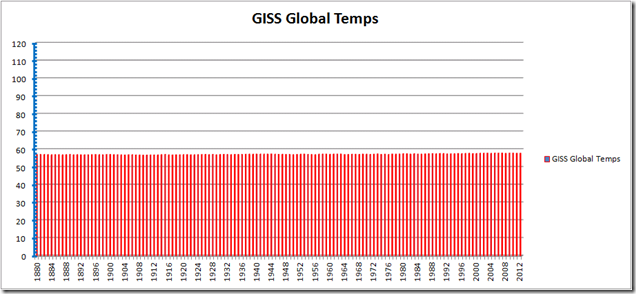
Finally, even GISS shows that we shouldn’t be alarmed about anything:
And if you were to present that final graph on the Kelvin scale, it would look even less alarming.
A useful summary of data, to which you could add the reconstruction of CO2 and temperature
I’m sure if you went to your doctor complaining of a fever, and he plotted your last week’s temperature on a scale which started at absolute zero, he would send you home again.
And purely a linguistic question.
Is “embiggen” an American word. Here in the UK we have a word “enlarge”, which seems to imply the same thing.
Victoria – it’s a bit like my son Dan’s height. He had pretty well stopped growing by 2000. Yet most all of his tallest years have been since that year.
Victoria, the responses above are better than mine here, but I just note that you are assuming that its a fact that those years are the hottest years on record based on press releases, some that come from NOAA/NASA.
But if my information so far is correct, how credible is NOAA or NASA when they claim a year (2014) is the hottest year on record with such fanfare, with major press releases, knowing the public will accept it like you did as a credible fact…..when it turns out their fine print says that there is a 62% chance (NOAA) that its NOT the hottest year on record?
I’d get an F on a paper in 8th grade science if I tried to sell to the teacher an entire paper as showing I had having measured something earth shattering, with public announcements…when in fact my own paper said it was likely not true. The teacher would be correct in thinking I made a big deal of nothing because I wanted it to be true. I’m biased. She would correctly want to question all of my other research, measurements, conclusions, if I am that biased to make a big deal out of nothing.
How credible would I be if I claimed to the world that I detected the god particle, but my own fine print said there was a better chance that I hadn’t?
The storyline should have read “62% chance that 2014 is NOT the hottest year on record, we just don’t know what year has a better chance than 2014”
If it sounds meaningless, it is. But they issued the press release making the earth shattering news headlines on purpose, did it anyway because they were so excited to find the hottest year on record. That’s not an agency I trust with any of the data.
The 1930’s also goes back and forth with them as to whether it is the hottest years. Every year, they change the data a little on the 1930’s. When will they know what the temperature was in 1935? They don’t really have a clue, most of the ‘measurements’ are not measurements, but are estimations or revisions and statistics. Not measurements.
Just another response. (Reserve the right to refine when shown contrary data. I only know what i have time to read)
Further to your very valid point is the fact that even if every year of this century were the hottest on record but only differed by a tenth of a degree across them all there would still be no trend and so the “pause” continues.
Keitho:
However, the “pause” does not have the significance that it appears to have. Supposedly it is a period of time in which the “global warming” has been nil. While the “global warming” has been nil in this period it has also been NOT nil. This is possible because the “global warming” in a given period is multi-valued. I’ve proved this contention several times in this blog.
A temperature change has the properties of a measure, one of which is being single valued. The “global warming” lacks this property. The name that has been assigned to the “global warming” makes it appear as though it is a temperature change but this appearance is false and misleading.
That the “global warming” can be nil and NOT nil in a given period violates the logical law called “non-contradiction.” This is a possibility because global warming climatologists have thus far failed to impose logic upon their field of study.
If I understand your kind response correctly Terry, you are saying that there are far more unknowns about the climate than just “knowing” what the temperature is doing. In other words temperatures are going up and going down from all causes and all we see is a net result. The net result causes shouting and pointing from all sides in the debate because we are all essentially ignorant about what is going on and have no clue what it means. I am with you 100%.
Thanks
Keitho:
That’s not exactly the message that I wish to convey to you. My message addresses the validity of the theory that there has been a pause in the “global warming” aka “pause theory.” In logical terms “There has been no global warming in the period of the pause” is an example of a proposition. Let this proposition be designated by A. NOT A is another example of a proposition where NOT represents the logical operator of the same name.
Under a theorem that was proved by me and published in this blog, A and NOT A are both true. That they are both true negates the law of non-contradiction (LNC). Under the LNC, the proposition NOT [ ( A AND ( NOT A ) ] is true where AND represents the logical operator of the same name.
That a premise of pause theory is false yields negation of the LNC with the result that the proposition A AND ( NOT A ) is true. The premise is that the “global warming” in a given interval of time is single valued. In a given interval of time, a temperature change is single valued but though “the global warming” sounds like a kind of temperature change it is multi valued. Thus, pause theory is overthrown.
Q.E.D.
I am glad to see ongoing mathematical analyses and open minded discussion regarding the climate change concept. I am neutral on climate change. It’s the data underlying the analysis that interests me more.
Yesterday I learned that Ducks Unlimited which was colocated inside our Environment Canada Office is likely funded by the Pew Family Trust. Please look at http://s3.amazonaws.com/offsettingresistance/offsettingresistance.pdf.
page 24.
This suggests my former Environment Canada Office was working with the oil industry within our office.
In other words we were not doing independent research on behalf of our Federal Government and Canadian taxpayers. Very disappointing.
At least we managed to collect the data, for monitoring, modelling and planning purposes, all those decades before a lot of our extensive regional and national systems were severely cutback.as in the USA too.
Observing flooding, earthquakes and tsunamis makes me a pragmatist but the long term view is interesting too. I enjoy the discussion here. Thank You
s.