Global temperature update: the Pause is now 18 years 2 months
By Christopher Monckton of Brenchley
Since December 1996 there has been no global warming at all (Fig. 1). This month’s RSS temperature shows a sharp uptick to warmer worldwide weather than for two years, shortening the period without warming by a month to 18 years 2 months.

Figure 1. The least-squares linear-regression trend on the RSS satellite monthly global mean surface temperature anomaly dataset shows no global warming for 18 years 2 months since December 1996.
The hiatus period of 18 years 2 months, or 218 months, is the farthest back one can go in the RSS satellite temperature record and still show a sub-zero trend.
As papers continue to appear in the literature claiming that the climate models were right all along except that they were wrong, the widening of the divergence between excitable prediction and unalarming reality continues (Fig. 2).

Figure 2. Near-term projections of warming at a rate equivalent to 2.8 [1.9, 4.2] K/century, made with “substantial confidence” in IPCC (1990), January 1990 to January 2015 (orange region and red trend line), vs. observed anomalies (dark blue) and trend (bright blue) at less than 1.4 K/century equivalent, taken as the mean of the RSS and UAH satellite monthly mean lower-troposphere temperature anomalies.
A quarter-century after 1990, the global-warming outturn to date – expressed as the least-squares linear-regression trend on the mean of the RSS and UAH monthly global mean surface temperature anomalies – is 0.34 Cº, equivalent to just 1.4 Cº/century, or a little below half of the central estimate of 0.70 Cº, equivalent to 2.8 Cº/century, in IPCC (1990). The outturn is well below even the least estimate.
Remarkably, even the IPCC’s latest and much reduced near-term global-warming projections are also excessive (Fig. 3).

Figure 3. Predicted temperature change, January 2005 to January 2015, at a rate equivalent to 1.7 [1.0, 2.3] Cº/century (orange zone with thick red best-estimate trend line), compared with the near-zero observed anomalies (dark blue) and zero real-world trend (bright blue), taken as the average of the RSS and UAH satellite lower-troposphere temperature anomalies.
In 1990, the IPCC’s central estimate of near-term warming was higher by two-thirds than it is today. Then it was 2.8 C/century equivalent. Now it is just 1.7 Cº equivalent – and, as Fig. 3 shows, even that is proving to be a substantial exaggeration.
On the RSS satellite data, there has been no global warming statistically distinguishable from zero for more than 26 years. None of the models predicted that, in effect, there would be no global warming for a quarter of a century.
Key facts about global temperature
Ø The RSS satellite dataset shows no global warming at all for 218 months from December 1996 to January 2014 – more than half the 432-month satellite record.
Ø The global warming trend since 1900 is equivalent to 0.8 Cº per century. This is well within natural variability and may not have much to do with us.
Ø Since 1950, when a human influence on global temperature first became theoretically possible, the global warming trend has been equivalent to below 1.2 Cº per century.
Ø The fastest warming rate lasting ten years or more since 1950 occurred over the 33 years from 1974 to 2006. It was equivalent to 2.0 Cº per century.
Ø In 1990, the IPCC’s mid-range prediction of near-term warming was equivalent to 2.8 Cº per century, higher by two-thirds than its current prediction of 1.7 Cº/century.
Ø The global warming trend since 1990, when the IPCC wrote its first report, is equivalent to below 1.4 Cº per century – half of what the IPCC had then predicted.
Ø Though the IPCC has cut its near-term warming prediction, it has not cut its high-end business as usual centennial warming prediction of 4.8 Cº warming to 2100.
Ø The IPCC’s predicted 4.8 Cº warming by 2100 is well over twice the greatest rate of warming lasting more than ten years that has been measured since 1950.
Ø The IPCC’s 4.8 Cº-by-2100 prediction is almost four times the observed real-world warming trend since we might in theory have begun influencing it in 1950.
Ø From September 2001 to November 2014, the warming trend on the mean of the 5 global-temperature datasets is nil. No warming for 13 years 3 months.
Ø Recent extreme weather cannot be blamed on global warming, because there has not been any global warming. It is as simple as that.
Technical note
Our latest topical graph shows the least-squares linear-regression trend on the RSS satellite monthly global mean lower-troposphere dataset for as far back as it is possible to go and still find a zero trend. The start-date is not “cherry-picked” so as to coincide with the temperature spike caused by the 1998 el Niño. Instead, it is calculated so as to find the longest period with a zero trend.
The RSS dataset is arguably less unreliable than other datasets in that it shows the 1998 Great El Niño more clearly than all other datasets (though UAH runs it close). The Great el Niño, like its two predecessors in the past 300 years, caused widespread global coral bleaching, providing an independent verification that RSS is better able to capture such fluctuations without artificially filtering them out than other datasets. Besides, there is in practice little statistical difference between the RSS and other datasets over the 18-year period of the Great Pause.
Terrestrial temperatures are measured by thermometers. Thermometers correctly sited in rural areas away from manmade heat sources show warming rates appreciably below those that are published. The satellite datasets are based on reference measurements made by the most accurate thermometers available – platinum resistance thermometers, which provide an independent verification of the temperature measurements by checking via spaceward mirrors the known temperature of the cosmic background radiation, which is 1% of the freezing point of water, or just 2.73 degrees above absolute zero. It was by measuring minuscule variations in the cosmic background radiation that the NASA anisotropy probe determined the age of the Universe: 13.82 billion years.
The RSS graph (Fig. 1) is accurate. The data are lifted monthly straight from the RSS website. A computer algorithm reads them down from the text file, takes their mean and plots them automatically using an advanced routine that automatically adjusts the aspect ratio of the data window at both axes so as to show the data at maximum scale, for clarity.
The latest monthly data point is visually inspected to ensure that it has been correctly positioned. The light blue trend line plotted across the dark blue spline-curve that shows the actual data is determined by the method of least-squares linear regression, which calculates the y-intercept and slope of the line via two well-established and functionally identical equations that are compared with one another to ensure no discrepancy between them. The IPCC and most other agencies use linear regression to determine global temperature trends. Professor Phil Jones of the University of East Anglia recommends it in one of the Climategate emails. The method is appropriate because global temperature records exhibit little auto-regression.
Dr Stephen Farish, Professor of Epidemiological Statistics at the University of Melbourne, kindly verified the reliability of the algorithm that determines the trend on the graph and the correlation coefficient, which is very low because, though the data are highly variable, the trend is flat.
RSS itself is now taking a serious interest in the length of the Great Pause. Dr Carl Mears, the senior research scientist at RSS, discusses it at remss.com/blog/recent-slowing-rise-global-temperatures.
Dr Mears’ results are summarized in Fig. 4:

Figure 4. Output of 33 IPCC models (turquoise) compared with measured RSS global temperature change (black), 1979-2014. The transient coolings caused by the volcanic eruptions of Chichón (1983) and Pinatubo (1991) are shown, as is the spike in warming caused by the great el Niño of 1998.
Dr Mears writes:
“The denialists like to assume that the cause for the model/observation discrepancy is some kind of problem with the fundamental model physics, and they pooh-pooh any other sort of explanation. This leads them to conclude, very likely erroneously, that the long-term sensitivity of the climate is much less than is currently thought.”
Dr Mears concedes the growing discrepancy between the RSS data and the models, but he alleges “cherry-picking” of the start-date for the global-temperature graph:
“Recently, a number of articles in the mainstream press have pointed out that there appears to have been little or no change in globally averaged temperature over the last two decades. Because of this, we are getting a lot of questions along the lines of ‘I saw this plot on a denialist web site. Is this really your data?’ While some of these reports have ‘cherry-picked’ their end points to make their evidence seem even stronger, there is not much doubt that the rate of warming since the late 1990s is less than that predicted by most of the IPCC AR5 simulations of historical climate. … The denialists really like to fit trends starting in 1997, so that the huge 1997-98 ENSO event is at the start of their time series, resulting in a linear fit with the smallest possible slope.”
In fact, the spike in temperatures caused by the Great el Niño of 1998 is largely offset in the linear-trend calculation by two factors: the not dissimilar spike of the 2010 el Niño, and the sheer length of the Great Pause itself.
Curiously, Dr Mears prefers the much-altered terrestrial datasets to the satellite datasets. However, over the entire length of the RSS and UAH series since 1979, the trends on the mean of the terrestrial datasets and on the mean of the satellite datasets are near-identical. Indeed, the UK Met Office uses the satellite record to calibrate its own terrestrial record.
The length of the Great Pause in global warming, significant though it now is, is of less importance than the ever-growing discrepancy between the temperature trends predicted by models and the far less exciting real-world temperature change that has been observed. It remains possible that el Nino-like conditions may prevail this year, reducing the length of the Great Pause. However, the discrepancy between prediction and observation continues to widen.
IPCC’s First Assessment Report predicted that global temperature would rise by 1.0 [0.7, 1.5] Cº to 2025, equivalent to 2.8 [1.9, 4.2] Cº per century. The executive summary asked, “How much confidence do we have in our predictions?” IPCC pointed out some uncertainties (clouds, oceans, etc.), but concluded:
“Nevertheless, … we have substantial confidence that models can predict at least the broad-scale features of climate change. … There are similarities between results from the coupled models using simple representations of the ocean and those using more sophisticated descriptions, and our understanding of such differences as do occur gives us some confidence in the results.”
That “substantial confidence” was substantial over-confidence. For the rate of global warming since 1990 – the most important of the “broad-scale features of climate change” that the models were supposed to predict – is now below half what the IPCC had then predicted.
Is the ocean warming?
One frequently-discussed explanation for the Great Pause is that the coupled ocean-atmosphere system has continued to accumulate heat at approximately the rate predicted by the models, but that in recent decades the heat has been removed from the atmosphere by the ocean and, since globally the near-surface strata show far less warming than the models had predicted, it is hypothesized that what is called the “missing heat” has traveled to the little-measured abyssal strata below 2000 m, whence it may emerge at some future date.
Yet to date no empirical, theoretical or numerical method, complex or simple, has yet successfully specified mechanistically either how the heat generated by anthropogenic greenhouse-gas enrichment of the atmosphere has reached the deep ocean without much altering the heat content of the intervening near-surface strata or how the heat from the bottom of the ocean may eventually re-emerge to perturb the near-surface climate conditions that are relevant to land-based life on Earth.
Most ocean models used in performing coupled general-circulation model sensitivity runs simply cannot resolve most of the physical processes relevant for capturing heat uptake by the deep ocean. Ultimately, the second law of thermodynamics requires that any heat which may have accumulated in the deep ocean will dissipate via various diffusive processes. It is not plausible that any heat taken up by the deep ocean will suddenly warm the upper ocean and, via the upper ocean, the atmosphere.
If the “deep heat” explanation for the hiatus in global warming is correct (and it is merely one among dozens that have been offered), then the complex models have failed to account for it correctly: otherwise, the growing discrepancy between the predicted and observed atmospheric warming rates would not have become as significant as it has.
Besides, the 3500 automated Argo bathythermograph buoys have a resolution equivalent to taking a single temperature and salinity profile in Lake Superior less than once a year: and before Argo came onstream in the middle of the last decade the resolution of oceanic temperature measurements was considerably poorer even than that, especially in the abyssal strata.
Finally, though the ARGO buoys measure ocean temperature change directly, before publication NOAA craftily convert the temperature change into zettajoules of ocean heat content change, which make the change seem larger. Converting the ocean heat content change back to temperature change reveals just how little ocean warming is occurring.
Is some underlying rate of global warming captured by the ocean temperature measurements? Well, the terrifying-sounding heat content change of 260 ZJ from 1970 to 2014 is equivalent to just 0.2 K/century of global warming.

Figure 5. Ocean heat content change, 1957-2013, in Zettajoules from NODC Ocean Climate Lab: http://www.nodc.noaa.gov/OC5/3M_HEAT_CONTENT. The heat content has been converted back to the ocean temperature changes in fractions of a Kelvin that were originally measured. NOAA’s conversion of the minuscule temperature change data to Zettajoules, combined with the exaggerated vertical aspect of the graph, has the effect of making a very small change in ocean temperature seem considerably more significant than it is.
“This month’s RSS temperature shows a sharp uptick to warmer worldwide weather than for two years, shortening the period without warming by a month to 18 years 2 months.”
What exactly is being said here? Did last month show warming or not?
“The RSS satellite dataset shows no global warming at all for 218 months from December 1996 to January 2014 – more than half the 432-month satellite record.” ???
Cheers
Roger
http://www.rogerfromnewzealand.wordpress.com
Yes, there was warming during the last month. Every time there is an up spike, there is warming and every time there is a down spike, there is cooling. However one way of looking at the last 18 years and 2 months is that the area above the 0 line is more or less equal to the area below the zero line. So the warmings and coolings balanced out over the last 18 years and 2 months.
Well done. Thank you.
Thanks, Lord Monckton.
Is this period after the global warming since 1975 a pause? A maximum?
If the Solar influence dominates the Earth’s climate at this time, then we’ll see a maximum. If CO2 dominates, we’ll see a pause that ended. But if ENSO dominates, we’ll see what it brings.
The three largest spikes in Figure 3 occurred in 2007, 2010, and 2013. Are we due for another spike in 2016? Or is the three years between spikes just a coincidence?
Yes. A moderate El Nino for the fall of 2016 into winter 2017 is quite possible. But an intervening La Nina is also more likely THIS fall (2015) to winter 2016 which will keep the record flat. After 2017, all bets are off as the solar cycle minima is approached in 2021… beyond that will there be a credible cycle 25? or a Maunder or a Dalton minima. No one knows. No current model can predict where the Sun is headed after the current Cycle 24 hits bottom around 2020-21. And it is the sunlight that fuels the El Ninos and those spikes in the temperature anomaly record you mention.
I believe that the heat absorbed into the oceans (mostly UV) is what drives the climate on our planet. The potential heat in the ocean dwarfs anything in the atmosphere. I believe the people studying the ocean oscillation cycles and how they intersect over time are much closer to being able to describe and predict what is happening in the climate and how it is likely to change over the coming years. The solar cycles govern how much heat goes into the oceans. Understanding both of these in tandem will likely be the greatest avenue to understanding what has happened and what will happen as we move forward.
Great post.
Spot on with the ARGO data — barely 10 years of data from extremely sparsely populated collection points — points from buoys that are free floating and never take the temperatures in the same place twice and could never predict a trend.
HADCRUT likes to post global temperature back to 1850, roughly the start of the Industrial Revolution, but the oceans comprise roughly two thirds of the surface of the Earth, and there are no temperature recording for these areas. Add to this the poles and other wilderness not occupied by humans and the actual Global LST coverage is probably 25%.
Whether there is slight warming or not, the point to be taken is that the catastrophic warming predictions of the modellers, 1980s, 90s and 2000s failed. The concept that CO2 is the control knob on the global thermostat is, as of yet, totally unproven.
I tried to post a carefully crafted refutation of the IPCC models prediction on Climatecentral.org yesterday to an over-hyped alrmaist temperature scenario article they posted. It never got out of moderation. They squashed it. In actual practice, it is Climatecentral.org, and hyperwarmist-alarmist crowd are the de***rs.
100%
They also often are the same people who pretend to be athiests, yet believe more strongly than any religious person I’ve met, including every priest I’ve known.
” It never got out of moderation.” Your effort had value nonetheless. It is always interesting to read about these attempts to get through.
I’m curious why you used RSS to build your figure. RSS is known to have the lowest global land and ocean temperatures and thus the graph paints a bit of a biased picture. Granted some of the other datasets are biased on the other end of the spectrum. Wouldn’t the case against warming be stronger if the analyses wasn’t so biased and included a proper analysis of all of the data?
Using all data and averaging it, as GISS, HARCRUT does, does not provide better data. I’m curious why you think that it might?
Excluding the satellite data, there is no global temperature data. I’m curious why you don’t think so.
The thing about the RSS data is that they are comprised of warmist sympathizers. Ben Santer, Frank Wentz, etal, cannot be accused of being right wing deniers, so the data they provide is very informative. They are cooler in their analysis than UAH which is manned by people deemed as skeptics such as John Christy and Roy Spencer. In fact, UAH is supposedly recalibrating their process to account for their seeming bias towards warming.
The funny thing with all this no warming, is when I facetiously ask people “so when does the global warming kick in?” the stock answer is now about storms becoming more extreme and that it never had to do with warming. I’m sure though, that if the temperature ever started to rise again (as per the data, at least) they’ll be back on the warming bandwagon quicker than the melting Antarctic propaganda.
Exactly. The entire issue was tied to human production of CO2 and that this gas was warming the planet. It’s funny how quick they have run away from that to calling it carbon pollution, etc. So, if CO2 doesn’t cause global warming, what does it cause. Apparently, it now causes climate disruption, more snow, less snow, more rain, less rain, bla bla bla. There is no end to their dissembling. But you are right, if warming returns then that will validate that more CO2 caused it.
Silly Christopher. CO2 is the Magic Gas. It can disrupt the climate with nary a whisper of temperature fluctuation. And if the industrialized countries will give at least $100 Billion every year from now through 2022 to the developing world (administered by impeccably honest UN bureaucrats) the UN will then petition the climate fairies for forgiveness of our sins.
It’s been over 18 years of 0 global warming for over a year now and I still haven’t seen that reported on CNN, NBC,CBS,ABC,NYT, Etc. What’s going on???
You never will, and you already knew that
The 2014 RSS spike this year can easily be explained by the considerable increase in PDO index spike during the 2014 quasi-El Nino (aka the 2014 El Nada).
The PDO spike was very impressive, making it one of the largest one-year spikes since 1900:
http://www.climate4you.com/images/PDO%20AnnualIndexSince1900%20With7yearRunningAverage.gif
It seems likely that the 2014 El Nada is likely to switch to a La Nina later this year:
http://www.bom.gov.au/climate/enso/sub_surf_mon.gif
If a La Nina does occur later this year, global temps may well spike downward for the next two years, which will drive the CAGW zealots completely crazy…
The poor CAGW zealots were so looking forward to a strong El Nino last year… but Mother Nature had other plans…
We’ll see soon enough.
If a La Nina happens and the temps follow suit, this will drive the temps downward. Now, if the AMO goes negative,(Im not sure if it is now or headed that way) how far will the temps drop then?
Nice graph on the PDO, that is useful info. The peaks on the graph correspond well to the 2 warming trends in the 1900s. I also have the impression that the next phase of ENSO is going to be a multi year La Nina, lasting to late 2017, or early 2018..
All surface temperature data GISS, NOAA, NDCD ect), has been fraudelently adjusted. You may want to read P Homewood, Goddard, Mahorasy ect., its all over the internet and even MSM news..L Monckton’s analysis is accurate as it only includes 1979 satellite onwards. Most surface data before has been adjusted to show massive warming which means there is no current pause, the pause has probably been going on for about 1200 years by now. The oft quoted 0.7, 0.8C ect of warming is probably way way off. I reckon about 0Co is accurate which also means that all the analysis done by WUWT, Mcintyre ect is now meaningless
Some adjustments indeed. BEST adjustments after 1979 reduces the warming trend. Same for the GHCN_v3 adjustments. Same goes for after 1997.
Some fraud and conspiracy. They adjust the temperatures down to show massive warming.
rooter,
BEST left off the flat part of the chart:
Here is a link to Paul Homewood’s article about how GISS has fiddled with ALL of Paraguay’s surface temp data, reversing the trends to show warming. Scandalous is an understatement.
https://notalotofpeopleknowthat.wordpress.com/2015/01/26/all-of-paraguays-temperature-record-has-been-tampered-with/#more-12774
That article has gotten 23,000 comments so far.
The nagging question for me with all these “facts and figures” tbat still won’t go away is,
if you remove all the adjustments and homogenisation.
How much of their global warming is left?
I’m working on answering that question (spent all day working with matrices and file conversions, already have an equal-area grid system (versus the lazy 5×5 or 1×1 coordinate cell systems commonly used), and have most station data up to 11/2013 ready for analysis). Now just to get it all to work together…
My first move, of course, is simply to recreate the current datasets to validate my system. From there, I can start doing some really in depth examinations on the data on any scale I desire (all this code will be open source, as will all source data).
Should make for interesting reading.
But you do know, if you lower the planets temperature you will be “wrong”?
I undertook the task of comparing raw data with adjusted and homogenized data a while back. It turns out that if you average all the station data without regard to location you get the same trend GISS gets from all of their processing. Just doing an average isn’t valid, of course, but the effect of their data analysis on the temperature anomaly trend seems to be nil.
http://sextant.blogspot.com/2010/01/climate-science.html
Monckton says:
“The RSS dataset is arguably less unreliable than other datasets in that it shows the 1998 Great El Niño more clearly than all other datasets (though UAH runs it close).”
Monckton seems to be unaware of the evaporation and latent heat transport during ninjos. Heat is transported into the troposphere when the tropical SST ramps up during ninjos. Illustrates how tropospheric temperatures varies more because of enso. Also more downturn during ninjas. Illustrates how surface and troposphere differ.
Some basic knowledge does not hurt.
The increase from 1997 to 1998 in RSS is 0.59 deg C. The increase from 1997 to 1998 in UAH is 0.65. So the statement that RSS shows the 1998 ninjo more clearly is wrong. If that is the how to pick the least unreliable dataset UAH must be the chosen one.
Some simple fact checking does not hurt.
So is this the reason for divergence of satellite and surface temperature measurements — evaporation and latent heat transport during Nino events, causing spikes in the satellite measurements?
http://wattsupwiththat.com/2014/12/16/no-records-highs-possible-in-the-satellite-temperature-datasets-in-2014-now-includes-november-data-except-for-hadcrut4/
Can anyone explain the recent divergence of RSS and UAH?
http://www.drroyspencer.com/wp-content/uploads/Yearly-global-LT-UAH-RSS-thru-Sept-2014.png
?? Doesn’t seem to help you much, you poor, confused fellow.
(A wasted posting effort by a banned sockpuppet. Comment DELETED. -mod)
Hey genius, what is it since 1990, 0.8 or 1.4? D’oh!
(A wasted posting effort by a banned sockpuppet. Comment DELETED. -mod)
The cherries wre ripe today ??
(A wasted posting effort by a banned sockpuppet. Comment DELETED. -mod)
icouldnthelpit
This sub-thread initiated when you made false claims about global temperature trends. It took off when you falsely claimed I was arguing with Viscount Monckton and added this untrue claim
Every time a claim you made was refuted you responded with another false claim, but you now assert
I strongly suggest that you seek help because the only person who fails to see your self-delusions is you.
Global warming stopped more than 18 years ago, and your false claims don’t change that, so live with it.
Richard
icouldnthelpit
Using your method one can also show that global warming is reducing.
For example, using the HADCRUT3 data the 40-year trend from 1905 has a slope of 1.46 degrees per century and the 100-year trend has a slope of 0.72. The warming trend in the early part of the 20th century is twice that of the whole century!
The IPCC AR4 also presented the same misrepresentation as you and several people – including me – objected to it. Indeed, this thread is discussing the above article by Lord Monckton so I provide this link to his address of the issue on WUWT.
Richard
(A wasted posting effort by a banned sockpuppet. Comment DELETED. -mod)
Hadcrut4 1905 – 1945 trend 1.3 deg/century. The last 40 years Hadcrut4 is 1,7 deg/century. And almost half of those last 40 years (18+ years) is supposed to have no warming.
Acceleration Richard?
Is that what Richard said? I don’t think so.
(A wasted posting effort by a banned sockpuppet. Comment DELETED. -mod)
Mods
Please look for my several vanished posts. The misrepresentation of me in this sub-thread has stood unanswered for most of the day because my response is one of them.
Richard
[Reply: Sorry Richard, nothing in the spam folder. Kindly re-submit. ~mod.]
icouldnthelpit and rooter
My post explained that the assertion of icouldnthelpit is bollocks.
(a)
His/her/their/its method is said by icouldnthelpit to indicate that global warming is increasing
and (b)
my post demonstrated that the method can be used to indicate that global warming is reducing.
A method which provides direct opposite – and mutually exclusive – results is wrong.
I said using the method is “misrepresentation” that several people – including me – objected to when the IPCC adopted it.
icouldnthelpit and rooter, your replies to my post demonstrate that you cannot read, or you don’t understand the word “misrepresentation”, or both: I suspect both. And your posts also demonstrate that you did not use the link I provided in my post.
Richard
Mods
I have made another submission and it has vanished, too.
Please search the bins and tell me if it is not there.
Richard
Mods
Thankyou
Richard
(A wasted posting effort by a banned sockpuppet. Comment DELETED. -mod)
icoudnthelpit says:
You are not arguing with me, you are arguing with Monckton.
No, YOU are arguing with Lord Monckton, and with most everyone else here.
Richard Courtney is correct. If you refuse to read his links, your mind is made up. There are others like you. Fortunately, they are in the minority. The reason is because Planet Earth is telling us that the CO2=AGW conjecture is becoming more questionable as time goes by.
At what point will you accept what the planet is telling us? Or will you never accept it?
icouldnthelpit
I wrote
You have replied saying that in your case my points are correct in every detail.
Furthermore you assert this falsehood to me
NO! The two methods are fundamentally different!
Viscount Monckton’s method is valid and the method you have asserted is not valid.
But you say you refuse to read explanations of your errors so as well as being stupid you must remain ignorant of the methods.
Richard
Mods
I don’t know why this is happening to me but another of my replies has vanished.
Richard
(A wasted posting effort by a banned sockpuppet. Comment DELETED. -mod)
icouldnthelpit
Global warming stopped more than 18 years ago and dbstealey asked you
Your reply is the latest example of your lunacy in this sub-thread and says
Global warming and my growth in height both stopped in the 20th century. Knowing that does NOT require as many months of my height being below its average in the 20th century as there are months that are above its average in the 20th century.
Atmospheric CO2 concentration has continued to rise but global warming stopped nearly two decades ago. As dbstealey says
Richard
OK. My post supporting dbstealey appeared so I will again try to an answer the post addressed to me.
Icouldnthelpit
Your latest daft post addressed to me says in total
Your method is NOT Viscount Monckton’s and – as my link demonstrates – he has objected to your method.
Your method is very, very wrong and is fundamentally different to Viscount Monckton’s correct method. And you say you don’t understand this because you refuse to read Viscount Monckton’s words.
Simply, your post says you don’t know what you are talking about and you are so stupid that you refuse to read the facts of what you are talking about to correct your error.
Richard
Great. My first reply has now appeared when I have now provided another. Ho hum.
Anyway, I thank the Mods for finding my first one.
Richard
(A wasted posting effort by a banned sockpuppet. Comment DELETED. -mod)
icouldnthelpit
You say to me
Taking your last point first,
dbstealey asked you a question and I explained your reply is a daft answer.
If my analogy is not “good” then please say why because I think it is precise.
Determination that a parameter has ceased to increase does NOT require that the parameter must fall to below some arbitrary past average for some arbitrary time.
Richard
(A wasted posting effort by a banned sockpuppet. Comment DELETED. -mod)
icouldnthelpit
global temperature has been rising from the Little Ice Age (LIA) and stopped rising in the 20 th century.
My height has been rising from infancy and stopped rising in the 20 th century.
But you say to me
Do you have a reason for what you say you “expect” or is your expectation a result of a brain condition?
Richard
(A wasted posting effort by a banned sockpuppet. Comment DELETED. -mod)
icouldnthelpit
I said
You have replied to that by saying in full
I am not sure I can report your idiocy more clearly.
Only you is claiming that global temperature did not rise in the 20 th century.
This thread is about global temperature having stopped rising. It is NOT about global temperature falling except in your delusion.
My analogy is precise and I strongly suggest that you have a lie down while you try to understand it.
Richard
(A wasted posting effort by a banned sockpuppet. Comment DELETED. -mod)
icouldnthelpit
My response to your latest untrue claim has appeared above. This link jumps to it. Sorry it is in the wrong place.
Richard
icouldnthelpit,
Thanks for answering. Would you mind saying what “many monts” constitutes?
Is it 3 months? Seven months? Ten months? How many?
(A wasted posting effort by a banned sockpuppet. Comment DELETED. -mod)
(A wasted posting effort by a banned sockpuppet. Comment DELETED. -mod)
icouldnthelpit
You said you would agree that global temperature has stopped rising
You now explain that by saying
But nobody claims temperature stopped rising so became “basically flat” at the middle of the 20th century. After then global temperature rose until it stopped rising about 18 years ago. So, only an idiot would claim there would recently be as many outliers above average {20th century global temperature} as below.
And you assert
Clearly, only you is “quite simple”. If you are making no claims because you are not using your figures then you have only wasted space on the thread by posting words that say nothing!
Richard
In British Columbia Canada the south west coastal area has been hit with a succession of weather phenomena called the pineapple express. Basically a tropical system from the area of Hawaii. This has caused a mostly mild winter over most of Southern BC and poor skiing on the Vancouver area mountains, also a record snow fall in the Kitimat, Terrace area. A news media outlet in Canada, Global TV, its national and regional news programs report some”climate change” topic almost nightly. They are as predictable as a dog onto a bone. Tonight they were commenting on the “weather extremes” in this small part of the world and had a climate researcher from the University of British Columbia,UBC. confirming with global warming we can expect more weather extremes. There have been other climate researchers from this area on the news program confirming “climate change”, read CAGW. This is also the stomping grounds of David Suzuki and Andrew Weaver, need I say more.
Lord Monckton the world is warming bringing with it the increasing the rate and intensity of extreme weather, poor skiing on the mountains of Vancouver is all the proof one needs. Climate researchers at UBC and Simon Fraser University have used these mountains as proof of CAGW. Children born in Vancouver today may not get to experience snow skiing.
sarc off.
@nc: It is acceptable to use the changes to specific areas of the world to prove warming and/or cooling if those conditions continue for long periods of time of say 200 years. To use examples of cooling or warming for short periods of time of say one year to 50 years are not climate changes that are valuable to make long lasting predictions.
The River Tornio in Finland has been monitored and data recorded from 1693 to 2000 for the earliest ice break up. I like this data since it began before warming groups or skeptics entered the issue of man made climate change. Thus, I consider it unbiased. The data presented by this 307 year record shows that indeed the northern hemisphere and probably the world has been warming on average since 1693. It should also be obvious that the earth has warmed since the ice age with cycles of cooling and warming since the ice age. The climate warming groups attempt to use this data by claiming that the warming is due to humans and CO2. However, when the graph furnished is examined, it shows a straight line of continuous average warming for the 307 years. What is significant is that the graph does not show any change of the rate of warming as would be expected from the 1940’s to the present due to the industrial and human increase in the burning of fossil fuels.. There is no inverted “hockey stick”. None, Nata, zilch. Thus, it shows that warming is true but doesn’t show that humans and increased CO2 have any significant warming affect.
If the warm conditions of warming continue in British Columbia exists for an extended period of time, it will only prove that the earth climate is getting warmer on average. It will not prove that CO2 is the significant driver of that warming.
And todays record high for this day was 1962. So… probably not much skiing over 50 years ago either during the month of Feb. 1962
“Besides, there is in practice little statistical difference between the RSS and other datasets over the 18-year period of the Great Pause.”
RSS is the only series with flat trendline for the chosen period. Including SST. Monckton prefers the outlier.
rooter
No, you are wrong and Lord Monckton is right.
You dispute his correct statement that
There is no discernible difference from zero at 95% confidence for the trend of each data set over the period. So, Lord Monckton understates the matter when he says “in practice little statistical difference between the RSS and other datasets”: there is no statistical difference between the RSS and other datasets at 95% confidence.
And, for the same reason, your assertion of an “outlier” is plain wrong.
Richard
You mean the trend for these records might actually be higher? You know the +- in the confidence intervals.
Thanks for pointing that out.
Yet another of my posts has vanished. This is the third today and two posted to this thread have completely disappeared.
Richard
Mods.
I have tried to make a resubmission here, too. It has also vanished.
Please tell me if it is in the bins
Richard
The others still show a pause – almost flat is not runaway global warming.
Positive trend is “pause”.
It has been a “pause” since LIA then.
GISS shows less than 0.1c warming – PANIC BUTTON 🙂
http://woodfortrees.org/plot/gistemp/from:1997/plot/gistemp/from:1997/trend
rooter
Yest again you demonstrate that you cannot read.
Whatever you think “may be” is not relevant to the fact that the trends are statistically the same and cannot be discerned as being different from zero at 95% confidence.
I understand that having a computer in your bedroom is fun, but please [trimmed] because at present they are wasting space on threads.
Richard
“Terrestrial temperatures are measured by thermometers. Thermometers correctly sited in rural areas away from manmade heat sources show warming rates appreciably below those that are published.”
No support for this claim provided of course. Because it is just not true. If anything, the thermometers located in rural areas show greater warming than all stations:
http://scitechnol.com/2327-4581/images/2327-4581-1-104-g005.gif
http://scitechnol.com/2327-4581/images/2327-4581-1-104-t001.html
From here:
http://scitechnol.com/2327-4581/2327-4581-1-104.php
“Terrestrial” temperatures, rooter? Can you spot the problem with that?
Use satellite data. Problem eliminated!
“”it is hypothesized that what is called the “missing heat” has traveled to the little-measured abyssal strata below 2000 m, whence it may emerge at some future date.””
I think I understand enough to make a rough calculation of the energy in joules required to raise the temperature in the abyssal strata below 2000 m by say 0.001C but am at a total loss as to how this energy can be later transferred to raise the surface temperature.
I too believe 2015/2016 will be cooler. Cold water continues to develop in the eastern equatorial
Pacific typical of developing La Nina conditions. We`ll see.
“The satellite datasets are based on reference measurements made by the most accurate thermometers available – platinum resistance thermometers, which provide an independent verification of the temperature measurements by checking via spaceward mirrors the known temperature of the cosmic background radiation, which is 1% of the freezing point of water, or just 2.73 degrees above absolute zero.”
Guess that is why the sensors and satellites must be replaced. And then theres is diurnal drift that must be adjusted for. And then there is adjustments for clouds. And adjustments for the effect of stratospheric cooling to the LT. Etc. No dataset is more adjusted than the MSU/AMSU LT.
rooter,
So you cherry-pick which adjustments you like, and which ones you don’t like? That’s your confirmation bias at work again.
(A wasted posting effort by a banned sockpuppet. Comment DELETED. -mod)
icouldnthelpit,
I admit, it does give me great solace to give you wild-eyed climate alarmists a good spanking. So far all you’ve got are baseless scares.But I’m not scared. Now what are you gonna do?
Eighteen years, two months and counting…
Takes one to know one I guess. Except for the fact that I do not pick the outlier.
(A wasted posting effort by a banned sockpuppet. Comment DELETED. -mod)
icouldnthelpit,
This has been explained many times here. Please use the archives and read the answer. I for one am tired of explaining that the start year is the alarmists’ choice, not skeptics’ choice.
icouldnthelpit
You ask
No. The difference between the indication of last month and this month is a function of the variance of the data.
Lord Monckton is assessing what the data indicates each month. I know this is a hard concept for you, but such analysis of empirical data is something called ‘science’ and it refutes your superstitious belief in global warming during this century.
Richard
(A wasted posting effort by a banned sockpuppet. Comment DELETED. -mod)
icouldnthelpit
I was glad to help. If there is anything else I can “clear up” for you then please don’t hesitate to ask.
Richard
“Since December 1996 there has been no global warming at all”
Rubbish! Surface data shows warming. The RSS outlier may show no warming.
Even GISS shows only about 0.12 degrees over 20 years according to
the Wood for Trees plot Eric provided above. The year to year random jumps up
and down are 0.6 to 0.7 degrees many times over that 20 years so ~5-6 times larger.
Thus when you ask if the change is statistically significant, you get numbers that say,
even with the warmest data set, that the pause is ~12+ years.
http://woodfortrees.org/plot/gistemp/from:1997/plot/gistemp/from:1997/trend
Oh, ‘rubbish’ yourself. RSS is satellite data, the most accurate data there is. Unlike land-based data, it does not ignore 71% of the planet’s surface.
Village Idiot, what is this “data” to which which you refer. Do you mean the surface temperature estimates provided by UKMO, NOAA, and NASA? If so, then these estimates do not deserve to be known as “data”. It appears that the data base for estimates of global surface temperatures reached a peak at sometime between 1960 and 1980, after which it declined sharply.
http://data.giss.nasa.gov/gistemp/station_data/stations.gif
http://data.giss.nasa.gov/gistemp/station_data/
This casts doubt on the credibility of more recent estimates of global surface temperatures.
You could of course add stations.
http://i.imgur.com/0GagWlu.gif
And see what happens. More credibility for more warming?
Rooter, you have made the best point possible from Nick’s three graphs. Mosher has made the same point many times here. However, one can’t help noticing that you only address the middle graph out of the three.
The number of stations reporting drop essentially to zero in the 19th century, and the coverage is worse. What that means is that we really don’t have any sort of global temperature record for more than about 100 years.
Is a 1.5 degree variation in 100 years a little, or a lot? Especially since there has been no significant change for the past 20 years. Are attempts at remediation of changes of that magnitude really worth the evisceration of our liberties and a cost of trillions of dollars?
Village Idjot, could you possibly make a point without being an out and out liar.
Mears’ use of the term ‘denialists’ indicates a closed mind, closed to the indisputable fact that the IPCC climate models, based on GISS’ work, have got ALL basic radiative, IR and aerosol optical physics wrong.
The models are numerical tricks; a Perpetual Motion Machine of the 2nd kind; 40% increase of energy input means no ‘missing heat’. They exaggerate lower atmosphere warming 66%, upper atmosphere cooling 36% and the increased humidity is from using ~35% more low level cloud albedo than reality in hind-casting.
This gives more cooling than warming since the last Ice Age Maximum, exaggerates evaporation yet keeps the mean at the real level; subtle cheating only discovered in 2010. The rest of the fiddling is done by different groups so they can replicate the past; it is no predictor of the future.
The real answer is that the water cycle keeps CO2-AGW near zero by keeping real net surface IR warming of the atmosphere near zero, also minimising radiation entropy production rate. The real AGW was the ~4% fall in cloud area in 1983, a proxy for aerosols from Asian industrialisation reducing cloud albedo (Sagan’s aerosol optical physics gives the wrong sign for the AIE). Apparent cloud area recovered in 1997.
The only warming now is in the Southern ocean where its cloud area has decreased. This is probably from lower phytoplankton feedback as Antarctic pack ice area increases. Sorry IPCC modellers and Climate Alchemists; you are dinosaurs to be wiped out within 5 years.
“However, over the entire length of the RSS and UAH series since 1979, the trends on the mean of the terrestrial datasets and on the mean of the satellite datasets are near-identical. Indeed, the UK Met Office uses the satellite record to calibrate its own terrestrial record.”
After denouncing the surface records Monckton suddenly states that they agree with the satellites…
Does Monckton know what he has written? This is how well do the records agree for Monckton’s 18 years:
http://woodfortrees.org/graph/gistemp/last:218/offset:-0.35/mean:12/plot/hadcrut4gl/last:218/offset:-0.26/mean:12/plot/rss/last:218/mean:12/offset:-0.10/plot/uah/last:218/mean:12/plot/uah/last:218/trend/plot/gistemp/last:218/offset:-0.35/trend/plot/hadcrut4gl/last:218/offset:-0.26/trend/plot/rss/last:218/trend/offset:-0.10
This is a bit outdated. Hadcrut is not updated to the end of 2014 and shall have higher trend. And the version of UAH is not the version used now. UAH shall also have higher trend. Anyhow, perhaps Monckton is capable of spotting the outlier?
The statement that UKMET uses the satellites to calibrate it own terrestial records is just wrong again. Try some basic fact checking.
rooter,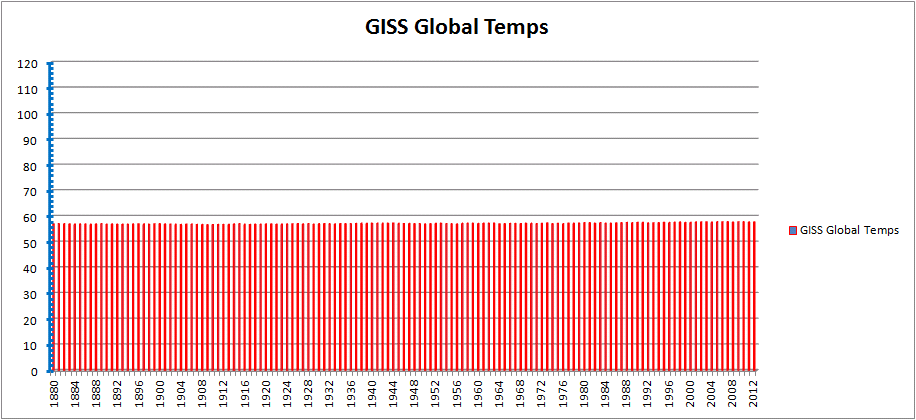
You want GISS? I’ll give you GISS:
All the running around in circles and clucking you do over tenths and hundreths of a degree is like Mediaeval priests counting angels dancing on pinheads. The reality is that the planet/climate has been unusually benign for the past century and a half.
But alarmists cannot accept that good news and be happy about it. They always see the glass as half empty. They want doom, gloom, and pessimism, when it isn’t warranted.
There is nothing unusual or unprecedented happening, no matter how much you wish there was. <–Falsify that statement — if you can.
I guess the next time dbstealey innfills the whole planet with the gisp2 proxy he will use the same scale for the y-axis. No MWP, RWP, MWP.
(1) 1997 annual global surface temperature = 16.92°C.
http://www.ncdc.noaa.gov/sotc/global/1997/13
(2) 2014 annual global surface temperature = 14.59°C
http://www.ncdc.noaa.gov/sotc/global/2014/13
Falsify either of these two claims if you can.
This is consistently far and away the most hilarious ‘global warming’ graph of all time. It humiliates alarmists at a single glance. Beautiful.
Why are you afraid of 1/10ths of a degree changes over decades? Do you really believe billions of $$ should be spent on this year in and year out? Do you believe that there should be no change? Do you prefer a colder planet with more ice? Why?
Although the trend line for the past 18 years is flat , there are considerable deviations from it during that period .
In particular I see that the early months of 2011 and 2012 show large negative anomalies . Yet mid- year 2012 was the period of greatest arctic sea ice loss , as the pro- AGW camp sites constantly point out as proof of accelerating global warming.
Both observations are real and unquestioned , but are they compatible ? A cooled world , but increased Arctic sea ice loss .
Is Arctic sea ice loss not actually a good indicator of global climate changes being dependent on local temporary factors such as wind direction and velocity? .
mikewaite
Yes, your observations are correct: The greater the loss of Arctic sea ice from today’s levels, the greater the planet cools.
Look at September, 2012: Record low Arctic sea ice.
October-Nov-Dec 2012.
Massive loss of extra heat from the additional (excess!) newly exposed Arctic ocean back into space.
Jan-Feb-March 2013.
Record high arctic sea ice extents! Massive gain of sea ice over the winter season.
http://arctic.atmos.uiuc.edu/cryosphere/IMAGES/seaice.anomaly.arctic.png
Same thing happened in 2007. Very Low ice extents in September, 2007. Followed by massive heat loss from the Arctic Ocean that winter, and tremendous sea ice gains in Jan-Feb-March 2008, the following year.
And several other years as well.
But the Super-El Nino year of 1998?
Nothing. No effect on Arctic sea ice at all! The year prior to the El Nino (1997) the El Nino year itself (1998), the next year, or the next two years. Global average temperature changes made NO CHANGE in Arctic sea ice extents.