Global Temperature Update By Christopher Monckton of Brenchley
The RSS monthly satellite global temperature anomaly for September 2014 is in, and the Great Pause is now two months longer than it was last month. Would this year’s el Niño bite soon enough to stop the psychologically-significant 18-year threshold from being crossed? The official answer is No.
Globally, September was scarcely warmer than August, which was itself some distance below the 18-year trend-line. Therefore, taking the least-squares linear-regression trend on the RSS satellite monthly global mean surface temperature anomalies, there has now been no global warming for 18 years 1 month.
Dr Benny Peiser, our good friend at the Global Warming Policy Foundation in the UK, had anticipated the official crossing of the 18-year threshold by a day or two with an interesting note circulated to supporters on the ever-lengthening period without any global warming, and featuring our 17-years-11-months graph from last month.
The Great Pause is the longest continuous period without any warming in the global instrumental temperature record since the satellites first watched in 1979. It has endured for a little over half the satellite temperature record. Yet the Pause coincides with a continuing, rapid increase in atmospheric CO2 concentration.

Figure 1. RSS monthly global mean lower-troposphere temperature anomalies (dark blue) and trend (thick bright blue line), September 1996 to September 2014, showing no trend for 18 years 1 month.
The hiatus period of 18 years 1 month, or 217 months, is the farthest back one can go in the RSS satellite temperature record and still show a sub-zero trend.
RSS itself is now taking a serious interest in the length of the Great Pause. Dr Carl Mears, the senior research scientist at RSS, has a long and intriguing discussion of the Pause, and of the widening divergence between the models’ excitable predictions and the mundane reality in the RSS blog, at remss.com/blog/recent-slowing-rise-global-temperatures.
Dr Mears’ results are summarized in Fig. 2:

Figure 2. Output of 33 IPCC models (turquoise) compared with measured RSS global temperature change (black), 1979-2014. The transient coolings caused by the volcanic eruptions of Chichón (1983) and Pinatubo (1991) are shown, as is the spike in warming caused by the great el Niño of 1998.
Dr Mears writes:
“The denialists like to assume that the cause for the model/observation discrepancy is some kind of problem with the fundamental model physics, and they pooh-pooh any other sort of explanation. This leads them to conclude, very likely erroneously, that the long-term sensitivity of the climate is much less than is currently thought.”
Dr Mears’ regrettable use of the word “denialists”, with its deliberate overtones of comparison with Holocaust deniers, reveals Dr Mears as what we may call a “liarist” – one who is prone to push the evidence in the profitable direction of greater alarm than is scientifically justified.
Interestingly, therefore, the RSS data, which show less recent warming than all other datasets, are under the management of a liarist, while the UAH data, which (until v. 6 becomes available at any rate) continue to show more warming than the others, are managed by sceptics.
Dr Mears admits the discrepancy between the RSS data and the models’ exaggerations, but he echoes various trolls here in alleging the supposed “cherry-picking” of the start-date for the global-temperature graph:
“Recently, a number of articles in the mainstream press have pointed out that there appears to have been little or no change in globally averaged temperature over the last two decades. Because of this, we are getting a lot of questions along the lines of ‘I saw this plot on a denialist web site. Is this really your data?’ While some of these reports have ‘cherry-picked’ their end points to make their evidence seem even stronger, there is not much doubt that the rate of warming since the late 1990s is less than that predicted by most of the IPCC AR5 simulations of historical climate. … The denialists really like to fit trends starting in 1997, so that the huge 1997-98 ENSO event is at the start of their time series, resulting in a linear fit with the smallest possible slope.”
It is time to deal with this nonsense about start-dates very firmly. The spike in temperatures caused by the Great el Niño of 1998 is largely offset in the linear-trend calculation by two factors: the spike of the 2010 el Niño, and the sheer length of the Great Pause itself.
To demonstrate this, I replaced all the monthly RSS anomalies for 1998 with the mean anomaly value of 0.55 K that obtained during the 2010 el Niño. Then I recalculated the trend from September 1996 [not Dr Mears’ “1997”] to September 2014. All that happened is that the trend values “–0.00 C° (–0.00 C°/century)” shown in the unaltered data (Fig. 1) became “+0.00 C° (+0.00 C°/century)” in the recalculated graph. Not exactly a major difference. That is the end of that climate-liarist canard.
The length of the Great Pause in global warming, significant though it now is, is of less importance than the ever-growing discrepancy between the temperature trends predicted by models and the far less exciting real-world temperature change that has been observed.
IPCC’s First Assessment Report predicted that global temperature would rise by 1.0 [0.7, 1.5] Cº to 2025, equivalent to 2.8 [1.9, 4.2] Cº per century. The executive summary asked, “How much confidence do we have in our predictions?” IPCC pointed out some uncertainties (clouds, oceans, etc.), but concluded:
“Nevertheless, … we have substantial confidence that models can predict at least the broad-scale features of climate change. … There are similarities between results from the coupled models using simple representations of the ocean and those using more sophisticated descriptions, and our understanding of such differences as do occur gives us some confidence in the results.”
That “substantial confidence” was substantial over-confidence. A quarter-century after 1990, the outturn to date – expressed as the least-squares linear-regression trend on the mean of the RSS and UAH monthly global mean surface temperature anomalies – is 0.34 Cº, equivalent to just 1.4 Cº/century, or exactly half of the central estimate in IPCC (1990) and well below even the least estimate (Fig. 3).

Figure 3. Near-term projections of warming at a rate equivalent to 2.8 [1.9, 4.2] K/century , made with “substantial confidence” in IPCC (1990), January 1990 to August 2014 (orange region and red trend line), vs. observed anomalies (dark blue) and trend (bright blue) at less than 1.4 K/century equivalent, taken as the mean of the RSS and UAH satellite monthly mean lower-troposphere temperature anomalies.
The Great Pause is a growing embarrassment to those who had told us with “substantial confidence” that the science was settled and the debate over. Nature had other ideas. Dr Mears, rightly, says the Pause is probably attributable to several factors rather than one. But the one factor he hastily rules out is any major error in the physics of the models.
Though more than 50 more or less implausible excuses for the Pause are appearing in nervous reviewed journals, the possibility that the Pause is occurring because the computer models are simply wrong about the sensitivity of temperature to manmade greenhouse gases can no longer be dismissed.
Remarkably, even the IPCC’s latest and much reduced near-term global-warming projections are also excessive (Fig. 3).

Figure 4. Predicted temperature change, January 2005 to August 2014, at a rate equivalent to 1.7 [1.0, 2.3] Cº/century (orange zone with thick red best-estimate trend line), compared with the observed anomalies (dark blue) and zero real-world trend (bright blue), taken as the average of the RSS and UAH satellite lower-troposphere temperature anomalies.
In 1990, the IPCC’s central estimate of near-term warming was higher by two-thirds than it is today. Then it was 2.8 C/century equivalent. Now it is just 1.7 Cº equivalent – and, as Fig. 4 shows, even that is proving to be a substantial exaggeration.
On the RSS satellite data, there has been no global warming statistically distinguishable from zero for more than 26 years. None of the models predicted that, in effect, there would be no global warming for a quarter of a century.
The Great Pause may well come to an end by this winter. An el Niño event is underway and would normally peak during the northern-hemisphere winter. There is too little information to say how much temporary warming it will cause, though. The temperature spikes of the 1998, 2007, and 2010 el Niños are evident in Figs. 1-4.
El Niños occur about every three or four years, though no one is entirely sure what triggers them. They cause a temporary spike in temperature, often followed by a sharp drop during the la Niña phase, as can be seen in 1999, 2008, and 2011-2012, where there was a “double-dip” la Niña that is one of the excuses for the Pause.
The ratio of el Niños to la Niñas tends to fall during the 30-year negative or cooling phases of the Pacific Decadal Oscillation, the latest of which began in late 2001. So, though the Pause may pause or even shorten for a few months at the turn of the year, it may well resume late in 2015 . Either way, it is ever clearer that global warming has not been happening at anything like the rate predicted by the climate models, and is not at all likely to occur even at the much-reduced rate now predicted. There could be as little as 1 Cº global warming this century, not the 3-4 Cº predicted by the IPCC.
Key facts about global temperature
Ø The RSS satellite dataset shows no global warming at all for 217 months from September 1996 to September 2014. That is more than half the 429-month satellite record.
Ø The global warming trend since 1900 is equivalent to 0.8 Cº per century. This is well within natural variability and may not have much to do with us.
Ø The fastest measured warming trend lasting ten years or more occurred over the 40 years from 1694-1733 in Central England. It was equivalent to 4.3 Cº per century.
Ø Since 1950, when a human influence on global temperature first became theoretically possible, the global warming trend has been equivalent to below 1.2 Cº per century.
Ø The fastest warming rate lasting ten years or more since 1950 occurred over the 33 years from 1974 to 2006. It was equivalent to 2.0 Cº per century.
Ø In 1990, the IPCC’s mid-range prediction of near-term warming was equivalent to 2.8 Cº per century, higher by two-thirds than its current prediction of 1.7 Cº/century.
Ø The global warming trend since 1990, when the IPCC wrote its first report, is equivalent to below 1.4 Cº per century – half of what the IPCC had then predicted.
Ø Though the IPCC has cut its near-term warming prediction, it has not cut its high-end business as usual centennial warming prediction of 4.8 Cº warming to 2100.
Ø The IPCC’s predicted 4.8 Cº warming by 2100 is well over twice the greatest rate of warming lasting more than ten years that has been measured since 1950.
Ø The IPCC’s 4.8 Cº-by-2100 prediction is almost four times the observed real-world warming trend since we might in theory have begun influencing it in 1950.
Ø From August 2001 to August 2014, the warming trend on the mean of the 5 global-temperature datasets is nil. No warming for 13 years 1 month.
Ø Recent extreme weather cannot be blamed on global warming, because there has not been any global warming. It is as simple as that.
Technical note
Our latest topical graph shows the RSS dataset for the 217 months September 1996 to September 2014 – just over half the 429-month satellite record. This is as far back as it is possible to go in the global instrumental record and find a zero trend. The start-date is not “cherry-picked” so as to coincide with the temperature spike caused by the 1998 el Niño: it is calculated so as to find the longest period with a zero trend.
Furthermore, the length of the pause in global warming, combined with the offsetting effect of the 2010 el Niño on the calculation, ensures that the distortion of the trend caused by the proximity of the 1998 el Niño to the 1996 start date for the trend is barely discernible.
Terrestrial temperatures are measured by thermometers. Thermometers correctly sited in rural areas away from manmade heat sources show warming rates appreciably below those that are published. The satellite datasets are based on measurements made by the most accurate thermometers available – platinum resistance thermometers, which not only measure temperature at various altitudes above the Earth’s surface via microwave sounding units but also constantly calibrate themselves by measuring via spaceward mirrors the known temperature of the cosmic background radiation, which is 1% of the freezing point of water, or just 2.73 degrees above absolute zero. It was by measuring minuscule variations in the cosmic background radiation that the NASA anisotropy probe determined the age of the Universe: 13.82 billion years.
The graph is accurate. The data are lifted monthly straight from the RSS website. A computer algorithm reads them down from the text file, takes their mean and plots them automatically using an advanced routine that automatically adjusts the aspect ratio of the data window at both axes so as to show the data at maximum scale, for clarity.
The latest monthly data point is visually inspected to ensure that it has been correctly positioned. The light blue trend line plotted across the dark blue spline-curve that shows the actual data is determined by the method of least-squares linear regression, which calculates the y-intercept and slope of the line via two well-established and functionally identical equations that are compared with one another to ensure no discrepancy between them. The IPCC and most other agencies use linear regression to determine global temperature trends. Professor Phil Jones of the University of East Anglia recommends it in one of the Climategate emails. The method is appropriate because global temperature records exhibit little auto-regression.
Dr Stephen Farish, Professor of Epidemiological Statistics at the University of Melbourne, kindly verified the reliability of the algorithm that determines the trend on the graph and the correlation coefficient, which is very low because, though the data are highly variable, the trend is flat.
“El Niños occur about every three or four years, though no one is entirely sure what triggers them. They cause a temporary spike in temperature,”
El Nino’s do not “cause a temporary spike in temperature”
They are associated with a temporary spike in temperature.
El Nino is itself an observation of a temperature rise.
The cause for the heat is currents and cloud and sun, as always.
Otherwise spot on.
angech says: “El Nino is itself an observation of a temperature rise. The cause for the heat is currents and cloud and sun, as always.”
That’s a limited definition. You’re also shifting topics between temperature and heat.
A more complete definition would be, An El Niño is part of coupled ocean-atmosphere processes—involving winds, currents, clouds, sun, etc.—that cause temporary spikes in surface and lower troposphere temperatures. Strong El Niños (not all El Niños) can also cause long-term warming of surface and lower troposphere temperatures in some parts of the globe, a result of residual (leftover) warm waters from those strong El Niños.
More to follow.
Angech, and here’s the more that follows
Angech says: “El Nino’s do not ’cause a temporary spike in temperature’ They are associated with a temporary spike in temperature.”
Your statements contradict decades of research by meteorologists and climatologists.
In the real world, El Niño events do cause temporary spikes in the surface temperatures of the East Pacific, as warm waters from below the surface of the West Pacific Warm Pool flood into the eastern tropical Pacific and rise to the surface.
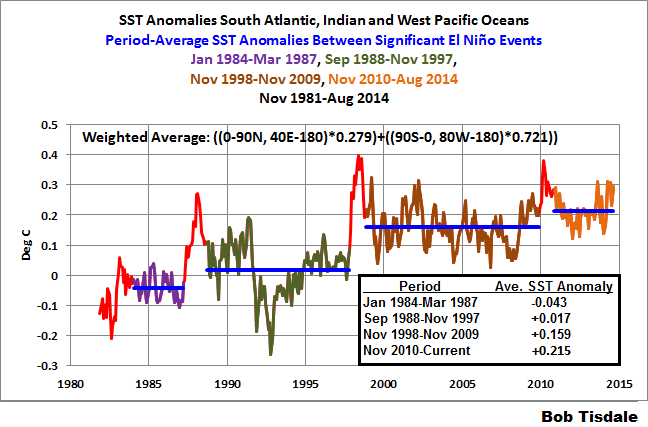
And the instrument temperature records show that the residuals (the leftover warm waters) of strong El Niño events (like those in 1986/87/88 and 1997/98) caused the long-term warming of the sea surfaces of the South Atlantic, Indian and West Pacific Oceans (aka Trenberth “Big Jumps”).
But this post is a discussion of lower troposphere temperatures (TLT). In the tropics, an El Niño causes a temporary spike in TLT. When all of that warm water floods into the eastern tropical Pacific, evaporation and convection cause vast amounts of moisture to rise into the atmosphere. When that moisture condenses, it releases latent heat to the lower troposphere, temporarily raising its temperature. Atmospheric circulation carries that heat poleward, raising the temperatures at higher latitudes.
You can watch the temporary increase in TLT in the tropics in the following animation. The top cell is sea surface temperature. The bottom cell is TLT. The graph to the right is of East Indian-West Pacific SSTa and scaled (0.15) NINO3.4 SSTa. You’ll note that there is a temporary warming of tropical TLT that lags the rise in sea surface temperatures.
http://bobtisdale.files.wordpress.com/2012/02/with-tlt2.gif
Note: To simplify this reply, I’ve overlooked teleconnections.
The graphs are from the August sea surface temperature update:
http://bobtisdale.wordpress.com/2014/09/08/august-2014-sea-surface-temperature-sst-anomaly-update/
And the gif animation is Animation 6.6 from this post:
http://bobtisdale.wordpress.com/2012/09/03/animations-discussed-in-who-turned-on-the-heat/
Cheers. Gotta go upload a post about the California drought for later this morning.
Very grateful to Bob Tisdale for his distinguished and profoundly knowledgeable contributions to this thread on the ENSO phenomenon.
http://www.king5.com/story/tech/science/environment/2014/10/02/arctic-warming-study/16615409/
KING5 news in Seattle did not get the memo: “It’s official: no global warming for 18 years 1 month
SEATTLE – A mission to the Arctic is now underway aboard a sophisticated high tech weather plane to continue study of the melting of ice and the warming of the Arctic Ocean.
The mission aboard a Lockheed P-3 Orion aircraft will be based out of Fairbanks, Alaska, for the next three weeks. On board are some of the nation’s top scientists on climate change.
“There’s a continuous loss of ice,” said Dr. James Overland, a research oceanographer with the Pacific Marine Environmental Laboratory in Seattle. Overland, the P-3 and its crew are with of the National Oceanic and Atmospheric Administration, under the U.S. Department of Commerce.
The problem is a simple one. Ice reflects rays from the sun. Open water absorbs those rays as heat, and Overland says temperatures measured in exposed sections of the Arctic Ocean have increased about nine degrees Fahrenheit. The ice is also becoming thinner.
“We’ve actually lost 60 percent of the total amount of ice that used to be there 15 to 20 years ago,” he said, in large part because what ice there is, is also thinner. And he fears the process of less ice and warming Arctic water is accelerating.
Overland has been at this a long time. He says where he walked on ice floes 20 years ago, there is now open ocean. Not only does the atmosphere transmit that heat as it passes over the warmer or less cold waters of the Arctic Ocean, but he says the warming of the Arctic Ocean also alters ocean currents.
“Unless you take direct measurements, we can’t really evaluate our models and fully understand what’s going on,” said Dr. Nick Bond of the University of Washington and JISAO- the Joint Institute for Study of the Atmosphere and Ocean.
The weather plane known as Kermit is equipped to perform those direct measurements. For much of the year the Tampa, Florida,-based Lockheed P-3 flies as a hurricane hunter using those instruments to gather data as it flies through the big storms.
Far from the hurricane belt, the plane will drop special buoys into the ocean that will measure temperature and salt content. Disposable tubes called drop sonds will be ejected from the bottom of the plane at altitude, and report back air temperatures, direction and other weather data as they float by parachute down to the ocean surface.
Other instruments can measure and photograph snow and ice crystals; a large radar in a dome below the plane can see out 250 miles in all directions. And there is a lot more.
“The work we’re doing now is understanding the effects of the Arctic on the whole climate system,” said Bond.
Ha! Liarist, that’s perfect.
Unfortunately, no. The term “denier” is repugnant and Mears wears a suit of intellectual excrement by using it. That said, “liarist” is simply a childish way to avoid using the word liar.
Why avoid the word liar? I can’t see it being used in this manner here, as I see no blatant lie, but avoiding the word “liar”, when appropriate is just political correctness ( which is more detestable than lying IMO)
Chill, dude, chill. I think Monckton of Brenchley our guest commentator is serving as a “witist.”
A “liar” is someone who tells one or more lies. A “liarist” is someone who makes a career or follows an ideology based on or necessitating the telling of lies. It’s an important distinction that, among other things, helps us to more easily discern the the existence of the pseudoscientific field of climate liarism, which is such an important feature of today’s world that deserves its own annual prize.
RSS for September came in at 0.206. This lowers the average to 0.252 so 2014 would rank as 7th warmest if it stayed this way.
I hope it stays warm, Werner. It’s the cold that kills. Ask my tomatoes.
Love the “liarist” line. 🙂
Temperature has never followed CO2, it’s not following it now, and it never will. The “climate sensitivity” of the doubling of CO2 is, has been, and always will be zero.
There are now people of voting age in the United States who have never experienced global warming.
I think it’s an interesting thought.
18 year old adults don’t know what global warming is.
I’m nearly four times that age, and I can honestly say that I’ve never experienced “global warming” either. What is it? How would I know? And does it really matter anyway?
“18 year old adults don’t know what global warming is.”
Because of the efforts to “educate” them, they certainly know what it is AND what causes it.
Global warming IS real, just ask young person or late night “news comedian.
Be careful Paul, you should add a “/sarc” as there are CAGW believers that would think you are one of them.
Let me re-phrase.
18 year old adults have never experienced global warming (except in school).
Up until 1999, when James Hansen started “adjusting” the historical U.S. temperature record, there was NO historical warming for the continental U.S. So for those of us who are American and dubious about GISS machinations, there has been no warming regardless of our age.
http://www.giss.nasa.gov/research/briefs/hansen_07/
True, but what “recent extreme weather”? More hurricanes? No. More tornadoes? No. More wildfires, floods, droughts? No trends there. Sea ice? Seems to be increasing slightly. I don’t see anything in the last few decades that would indicate there are increasing trends in extreme anything. Well, at least not related to climate.
Time to put that myth to bed too.
More Niceweather perhaps?
We always have ” extreme weather” . A particularly big storm qualifies.
It is an increase in number or severity of same that we don’t have. Technically he is correct.
I have just skipped through Dr Mears paper. Can somebody please explain to me why under the heading “internal variability ” he states that the hiatus could be caused by “bad luck” . Bad luck for what? That the planet hasn’t warmed for 18 years? What have I missed?
Bad luck for delusional believers in AGW.
Thanks for that,so I did have it right. They are praying for warming to say “we told you so” but not oh,that’s good news,we aren’t going to fry to death,because the planet isn’t warming.
Bad luck for what? That the planet hasn’t warmed for 18 years? What have I missed?
The same thinking that lead Trenberth to say in the climategate emails that they couldn’t find the missing heat and that it was a “tragedy” that they couldn’t. So invested are they in their belief system, that they would actually prefer the catastrophe of global warming to being wrong.
Trenberth said “travesty”, not tragedy.
And the same thinking that led Phil Jones to state that only after 15 years of no warming would they have to “worry”.
When no global warming is your “bad luck”, and when no global warming is your reason to “worry”, it is pretty clear that you consider the threat of catastrophe to be desirable.
Bad luck for wannabe technocrat rulers of the planet. Obviously Mears is more concerned about him dominating the planet than about humanity. Freudian slip; haul him to the science communication re-education seat immediately.
And buckle him in.
http://wmbriggs.com/blog/?p=13721
Mears has used the “bad luck” line before…and apparently his bad luck in finding the missing “heat flux” continues!
“Bad Luck. By Bad Luck, I mean that the last decade is cooler than normal due to the random occurrence of some pattern of unforced internal variability. Most climate model simulation exhibit decade-long periods of little or no warming, as shown by Eastering and Wehner (2009). And in general, climate models, even though they tend to have too much year-to-year variability (as mentioned by John in his initial post), often show too little variability on multidecadal on longer scales. There is an interesting discussion of this topic in a recent issue of the AGU newsletter (Lovejoy, 2013). So, for multidecadal time periods, I would expect the real world to be bumpier (on multidecadal time acales) than a typical model simulation, and much bumpier than the mean of many simulations. Thus I think that there is some possibility part of the cause the current discrepancy may be just bad luck. Though the time period is getting long enough, and the discrepancy is getting large enough that we should be able to begin to understand something about what is going on. In other words, even if it is due to a random fluctuation, we should be able to see the fluctuation in other variables or parts of the system, such as heat flux into either the ocean or into space.” http://www.climatedialogue.org/the-missing-tropical-hot-spot/
I have often seen the term ” most climate models have not predicted…..” Isn’t it more accurate to say ” NO climate models have predicted…”?
A vain attempt to save something from the disaster ” climate science” has become?
Using that logic,would it not be correct to say that the initial warming period observed and wiggle matched to train the models was not also a pattern of unforced internal variability?
It seems to me that the excuse simply reinforces the null hypothesis that all this is normal and not anthropegenic at all.
When questioned by the BBC about the pause Dr. Phil Jones of the CRU kept replying “we won’t worry until the pause reaches…” What was he worried about? The concept behind the CRU was to mitigate the effects of global warming! Why would evidence that it wasn’t warming worry him? By the way, the pause has exceeded the length before they’d worry.
“It doesn’t matter how beautiful your theory is, it doesn’t matter how smart you are. If it doesn’t agree with experiment, it’s wrong.” – Richard Feynman.
The above quote should be required reading for climate modelers and AGW pundits. Sic Semper Ignoti.
A brief look at UAH and RSS side by side gives an interesting comparison
1. UAH started lower than RSS, and was barely climbing before 1997, while RSS, climbed a bit faster.
2. both took approximately the same jump at the 1998 EL Nino event, that settled down by about the beginning of 2001.
3 Since then, RSS has cooled slightly and UAH has warmed slightly to bring them to about the same current anomaly.
http://woodfortrees.org/plot/uah/from/plot/rss/from/plot/uah/from:2001/trend/plot/rss/from:2001/trend/plot/uah/from:1979/to:1997/trend/plot/rss/from:1979/to:1997/trend
But wait for UAH v6.0. Apparently it will track closer to what RSS shows.
If Dr Mears doesn’t like 1997 for a start-date, why don’t we make him happy by using 1998, instead?
You gotta feel a bit sorry for him, but it’s more important that he continue his work without the kind of ‘adjustments’ we see in some places.
Surely the start date is now.
We are counting backwards, aren’t we?
Back to when there was significant warming – then we stop counting.
Even if it were only 1 year of cooling, it still flies in the face of what we were told to expect.
I love mother nature. She, too, hates Al Gore.
The discrepency with UAH is pretty eye-catching, though:
http://i1172.photobucket.com/albums/r565/Keyell/from-1995_zps917dc537.png
Something is clearly happening in the latter half of 2005. Before, the two curves follow each other remarkably well. And after, they do the same, only now with UAH tracking 0.1 degree above RSS. There is no gradual deviation, no ‘drift’. There is only the sudden shift in late 2005. Check it out for yourself …
Read my post above. Only your offset makes it seem like there is an issue.
In actual fact, UAH was playing catch-up.
Yes, but it’s much simpler than your graph suggests. There is no ‘catch-up’ involved.
RSS and UAH track each other tightly from the start (1979) till 1992. Then UAH makes a sudden step down of about 0.07 degrees Celsius relative to RSS. If you realign the two datasets after this time, you will see that they once again follow each other without any real deviation down to late 2005. Then there’s a new abrupt step change. UAH all of a sudden lifts up relative to RSS, this time by 0.1 degree. Realign the two once more, and they track intimately a third time around all the way down to today.
http://woodfortrees.org/graph/rss/to:2005.67/plot/rss/from:2005.67/offset:0.1/plot/uah/to:1992/offset:0.07/plot/uah/from:1992/offset:0.14
So between 1979 and 2014, there is but two sudden shifts separating the two major global satellite datasets: one in the beginning of 1992 and one in the second half of 2005.
Apart from these two step changes – clearly of methodological origin – the RSS and UAH timeseries are actually remarkably congruent. The only thing that needs to be sorted out to fully align them is to determine which of the two is up for adjustment. Or maybe they both are …? (The figure above is just a suggestion.)
They are aware of the divergence,
too bad the keepers surface station data weren’t as conscientious.
They’re aware of ‘something’, but seemingly not of what the discrepancy in fact boils down to: just two methodological step changes, one in 1992 and one in 2005. Nothing of import happens at any other time from Jan 1979 to Sep 2014.
They talk about ‘decaying orbits’. That’s not it. UAH and RSS track each other impressively close all the way since 2005/6. There is no gradual divergence at all. The only reason why UAH has a positive trend and RSS a negative since 2001 is that abrupt 0.1 degree shift taking place in 2005:
http://woodfortrees.org/graph/rss/from:2001/offset:-0.14/plot/uah/from:2001/plot/rss/from:2001/offset:-0.14/trend/plot/uah/from:2001/trend
http://woodfortrees.org/graph/rss/from:2001/offset:-0.04/plot/uah/from:2001/plot/rss/from:2001/offset:-0.04/trend/plot/uah/from:2001/trend
Kristian’s graph is well observed. I’ll ask Roy Spencer about it.
I had the good fortune to meet you very briefly two years ago. You were most gracious and went out of your way to introduce yourself to everyone who wanted to meet you. You treated everyone with the same level of respect whether they agreed with you or not. I was very impressed. Needless to say you made a very good first impression. Please keep up the good work.
Mr Maher is very kind. I very much regret that this subject has become as politicized as it has. Science should – as far as possible – be free of politics: and the defiance of rational argument on the part of the climate liarists is a denial of that which marks us out most plainly from the beasts and brings us most closely in resemblance to our Creator: the faculty of reason.
I was just thinking….
First the tree rings diverged from the temperatures.
Then, the temperatures diverged from the models.
Are the temps and the tree rings hooking up somewhere? Is that what has gotten the models hot? They’ve been scorned?
The trees had it right all along; it was not warming.
The apprent warming, in the land based temperature record, was an illusion of the homogenisation adjustments, station drop outs, and UHI etc.
The satellite data between say 1979 and 1997 was also essentially flat with no warming.
Accordng to the satellite data, there has been only one isolated warming event, namely in and around the 1998 Super El Nino, which resulted in a step change. If you remove that event (and no one seriously claims that that was caused by CO2) the temperatures have been approximately flat throughout the satellite period. Certainly no first order correlation with CO2 is apparent.
Are you implying that the trees are smarter than Mann?
The trees are smart enough to grow faster BECAUSE of the extra CO2 in their atmosphere since 1945 …
Thereby making Mann-made global warming since 1945 appear in tree rings at ever-increasing tree-growth rates!
Ergo, ifso fatso, the trees are smarter than Mann-made global warming!
> Big D in TX
> October 2, 2014 at 10:08 pm
>
> There are now people of voting age in the United States who have
> never experienced global warming.I think it’s an interesting thought.
Our children will grow up not knowing what global warming looks like. Won’t someone please think of the children?
When I was a kid, and there was a cold snap, there would always be some old codger telling us that it was nothing compared to the winter of 19-whatever.. Now that I;m starting to approach the old codger stage, I’ll have to tell today’s kids that the heat they’re seeing is nothing compared to the summer of 19-whatever. Speaking of old codgers, who remembers these ads…
http://www.popandroll.com/coke-art/Coca-Cola_Art_Pause2.jpg
From just the quotes on this post I think Dr. Carl Mears is not well informed about the argument regarding “global warming” that causes him to describe folks as de—–sts. The issue is whether or not people that believe liberty is important should allow that liberty to be taken away and handed to the UN based on an idea, namely catastrophic anthropogenic global warming, that isn’t happening.
Beyond that, those of us that believe in life, liberty, and the pursuit of happiness believe others on Earth that do not share this sort of existence should be allowed, encouraged, and aided in achieving it. Why does Dr. Mears wish for people’s lives to be poor, nasty, brutish, and short?
That ad is definitely a keeper. Reminds me of the German “Mach mal Pause”.
“Denialists .”
1 Corinthians 13:11 King James Version (KJV)
11 When I was a child, I spake as a child, I understood as a child, I thought as a child: but when I became a man, I put away childish things.
Somebody needs to grow up. stop throwing temper tantrums and accept observed truths.
Like a serious, adult scientist should.
Don’t you mean ‘temperature’ tantrums?
Unfortunately Lord Monkton is responding in kind and that only legitimizes Dr Mear’s childish behavior. Instead of being two educated men discussing an issue, they both appear to be no better than elementary school boys exchanging insults and observers can’t tell the difference.
Jeez! Lighten up, dude.
Our children won’t know what climate change is.
Well, as it has been redefined, no one does.
Have the liarists come up with a mechanism (serious question, as I must have missed it) how the oceans are storing up temperature? If I fill a bath with cold water, and the room is heated to 20 degrees c, the water will absorb that heat energy (from the air in the room) and slowly warm the water. However, it does require the room to be topped up with heat that it has just lost to the water. So the water temp is lagging behind the room temp. But, if the room doesn’t receive heat, then the water temp won’t increase. Do I have that right? So, how can oceans continue to absorb warmth, when the air above the ocean isn’t increasing in warmth?
If the air in the room was continually circulated then eventually both the water and air would reach the same temperature as dictated by the second law of thermodynamics (entropy always increases). However, more realistically, the air above the bath would remain cooler than the air above due to cooler air being denser.
The scenario you describe bares little relationship to the world since it is receiving energy from the sun and it is this radiant energy that warms the oceans not the air above it. A better question is if global warming only increases ocean heat content by 1/100 of a degree how can this hidden heat then come out and warm the air multiple degrees? IMO, that would be impossible.
Vince, thanks, but if it is the Sun (radiation) that is warming the oceans, why is the ocean heat content (OHC) increasing? Surely, the ocean would have reached a temperature and remained pretty stable? Atmospheric and land surface temps showed a rise that is now stable. But OHC is still on the up. How so?
In practical terms, in a real room with a real bathtub, the water would always be cooler than the average room temperature.
Heat would leave the room by conduction. Especially at the top. It would be heated by condensation of water vapour. The water vapour would be replaced by evaporation of water from the tub. Condensed water would run down the walls.
This can be witnessed in a real bathroom. For a long time, the floor would gain water, the air would be in circulation transporting water vapour from the tub and the tub water would be cooler than the air.
If a light was on in the room the process would continue with the water now on the floor always being cooler than the air. Warm oceans heat air very effectively. Hot air warms water really poorly, from above
As long as the atmosphere is warmer (due to the sun) then since the oceans are very big I don’t see a problem with them continuing to take up heat for years, perhaps 100’s of years, as they in fact have done for the 200-300 years.
Don’t you mean about 4 billion years?
Even after all that time the ocean temp is only about an average of approximately 3 degC.
steveta, this isn’t what Vince is saying. He’s saying it is radiation, not conduction. Personally, I have an understanding-problem with this. Surely, it’s both, isn’t it?
Excellent as ever M’Lord. My wife and I will crack open the bubbly tonight to celebrate (and release lots of lovely CO2 into the kitchen in the process). Love the ‘liarist’ term. Brilliant.
Here’s a thought. In about one month from now (and lasting about a week), many gullible ‘liarists’ and their families will attend various organised bonfire events in the UK. They will go ‘ooh and ahh’ to incredibly expensive pyrotechnical displays and enjoy being almost deafened by the ‘boooof’ of mortar rockets. They’ll stand around watching huge bonfires burn all that carbon, their children will breath in all the smoke and sooty particulates – and they’ll all go home agreeing that they had a fabulous time and must do the same thing again next year. Am I being obtuse or are ‘liarists’ a bunch of complete hypocrites when it comes to 5th November?
5th of November? Oh I remember –
Guy Fawkes — “The Only Man Ever To Enter Parliament With Honest Intentions”
How many opposed the bill on “climate fools day” as the first October snow in 70 years blanketed the House? Not may honest folk were there…
3 in fact.
Mr. Christopher Chope
Mr. Peter Lilley
Mr. Andrew Tyrie
according to Hansard
And in our cups freshly remember’d those happy (3) few on St. Crispin’s day.
For the rest? Vicious and sustained public floggings. You know it’s the only solution…
Sorry to ask a stupid question but I notice that the temperatures per the models dip at the time of the El Chichon and Pinatubo eruptions and seem to be generally more accurate up to around 1997 than afterwards. Does this indicate that many of the models have been adjusted in light of reality or is this what they were showing before the various events?
In response to Mr Nottingham, the models (after adjustment for hindsight factors) seem uncannily brilliant at backcasting, but uncommonly useless at forecasting. Cant’ think why.
I can accurately predict the results of every Superbowl back to the first. But I am lousy at predicting the future ones,.
Thanks for this
You have carried out an experiment where you replaced the 1998 peak with figures from teh 2010 peak, Can you say how long the pause would have been with those figures, usign the same calculation basis?
In answer to AndyL, the period without warming would have been exactly 18 years if the 1998 el Nino had been no warmer than the 2010 el Nino. The Pause is real, and is not a mere artefact of the 1998 outlier.
Thanks Christopher,
I didn’t think the pause was an artifact of 1998, but had guessed that the pause would be of the order of 16 years with a lower 1998 peak.
A good way to see that 1998 has little impact is to show the trend from both the start of the pause and the year 2000. The trends are almost identical.
http://www.woodfortrees.org/plot/rss/from:1996.66/plot/rss/from:2000/trend/plot/rss/from:1996.66/offset:0.01/trend
That’s an admirable test. If only the liarists would do science by asking questions like this.
My grand daughter is a victim of this. She is 10 and believes the crap her teachers tell her. Even though global warming stopped before she was born. My only recourse is to say just believe grandpa, The propaganda is hard to overcome.. When you are just learning science,, how do you overcome Climate Science inc?This is a big problem and will not go away soon.
Show her the graph. Print it and have her color it with her crayons.
Make it “her” graph each month.
Great idea! Better still, let her go on the woodfortrees website and let her run the numbers herself. One run through with the parents’ help should be enough to start her thinking. Let her print the chart and let her color it. Running the data herself is far more convincing than having someone hand her a chart. Convincing her is the first problem. All the students at her school have been indoctrinated as well. Dealing with her classmates may pose yet another problem.
Your lordship has the “start date” backwards. The start date is the latest month with complete data, always, and therefore cannot be cherry picked because its selection follows a rule. The end date is the earlier, since we’re going backwards to get our Pause length. No cherry picking argument possible.
Precisely. !
The pause is now old enough to vote.
and serve in the military
And get married. And drive a car.
In my home town it’s old enough to drink.
“Terrestrial temperatures are measured by thermometers. Thermometers correctly sited in rural areas away from manmade heat sources show warming rates appreciably below those that are published. The satellite datasets are based on measurements made by the most accurate thermometers available – platinum resistance thermometers, which not only measure temperature at various altitudes above the Earth’s surface via microwave sounding units but also constantly calibrate themselves by measuring via spaceward mirrors the known temperature of the cosmic background radiation, which is 1% of the freezing point of water, or just 2.73 degrees above absolute zero. It was by measuring minuscule variations in the cosmic background radiation that the NASA anisotropy probe determined the age of the Universe: 13.82 billion years.”
This paragraph is filled with gross errors.
Below find the real description of how its done. Please note the adjustments and corrections to the raw data
http://www.remss.com/measurements/brightness-temperature
when you finish that you will understand what RSS themselves say
“A similar, but stronger case can be made using surface temperature datasets, which I consider to be more reliable than satellite datasets “
The quotation given by Mr Mosher does not appear anywhere in the reference he cites. Since he is, as usual, nit-picking, he should have started by making it clear that the quotation did not come from the reference given.
The quote come from the ARTICLE YOU LINKED TO! did you not read it!
http://www.remss.com/blog/recent-slowing-rise-global-temperatures
Measurement Errors:
As a data scientist, I am among the first to acknowledge that all climate datasets likely contain some errors. However, I have a hard time believing that both the satellite and the surface temperature datasets have errors large enough to account for the model/observation differences. For example, the global trend uncertainty (2-sigma) for the global TLT trend is around 0.03 K/decade (Mears et al. 2011). Even if 0.03 K/decade were added to the best-estimate trend value of 0.123 K/decade, it would still be at the extreme low end of the model trends. A similar, but stronger case can be made using surface temperature datasets, which I consider to be more reliable than satellite datasets (they certainly agree with each other better than the various satellite datasets do!). So I don’t think the problem can be explained fully by measurement errors.
NEXT,
Every time you publish this you repeat the same nonsense
“Terrestrial temperatures are measured by thermometers. Thermometers correctly sited in rural areas away from manmade heat sources show warming rates appreciably below those that are published. The satellite datasets are based on measurements made by the most accurate thermometers available – platinum resistance thermometers, which not only measure temperature at various altitudes above the Earth’s surface via microwave sounding units but also constantly calibrate themselves by measuring via spaceward mirrors the known temperature of the cosmic background radiation, which is 1% of the freezing point of water, or just 2.73 degrees above absolute zero. ”
That is NOT how it is done. The temperatures are the result of a RTM. a radiative transfer model.
First the calibration
“Only some of the radiometers need hot load thermal gradient corrections. The determination of TB from counts for microwave radiometers is completed using two known temperatures to infer the Earth scene temperature. For each scan, the antenna feedhorns view a mirror that reflects cold space (a known temperature of 2.7 K) and a hot absorber measured by several thermistors. Assuming a linear response, the Earth scene temperatures are then determined by fitting a slope to these two known measurements (hot and cold). This 2-point calibration system continuously compensates for variations in the radiometer gain and noise temperatures. This seemingly simple calibration methodology is fraught with subtle difficulties. The cold mirror is relatively trouble-free as long we note when the moon intrudes on the cold space view and remove moon-affected values. The hot absorber has been more problematic. The thermistors often do not adequately measure thermal gradients across the hot absorber. For example, a hot load correction is required for AMSR-E because of a design flaw in the AMSR-E hot load. The hot load acts as a blackbody emitter and its temperature is measured by precision thermistors. Unfortunately, during the course of an orbit, large thermal gradients develop within the hot load due to solar heating making it difficult to determine the average effective temperature from the thermistor readings. The thermistors themselves measure these gradients and may vary by up to 15 K. Several other radiometers have had similar, but smaller, issues.”
and
“Calculating TB from raw radiometer counts is a complex, multi-step process in which a number of effects must be accurately characterized and adjustments made to account for them. These effects include radiometer non-linearity, imperfections in the calibration targets, emission from the primary antenna, and antenna pattern adjustments. RSS TB are consistently calibrated so that the TB measurements for all sensors can be used to construct a multi-decadal time series. A rain-free ocean is used as the absolute calibration reference and our state-of-the-art radiative transfer model (RTM) of the ocean and intervening atmosphere in the absence of rain can predict the top-of-the-atmosphere TB to a high degree of accuracy. A complete description of the calibration of all SSM/I is available. Though the document describes on SSM/I sensors, the approach applies to the other radiometers.”
RTM is a radiative transfer model.
More here in the calibration report
http://images.remss.com/papers/rsstech/2012_011012_Wentz_Version-7_SSMI_Calibration.pdf
Your description of the accuracy of this platform is wrong. I refer you to page 2 of the calibration report.
Mears, rightly, gives precedence to the surface measurments. he should know. All the documentation on the accuracy supports this. The RSS temperatures are the result of a model. RTM without a model of radiative physics, there is no temperature there is only brightness at the sensor. Brightness at the sensor is TRANSFORMED into temperature at the troposphere by applying a physics model.
Actually my understanding is that the satellites measure the temperature using a microwave sensing radiometer, the radiometer is calibrated by having it measure the temperature of an onboard reference whose temperature is measured by the Pt wire thermometer, and the Cosmic background. The Onboard temp being the Hot target, the Cosmic background being the Cold traget,
I just hate it when Steven Mosher is right, but this is one of those times.
LMAO, only because RSS has not been showing any warming. Are you really that naive? I am sure the longer Monckton stays on this, the more energy they will invest in an “adjustment” to make the pause disappear from RSS.
Reliable in what sense?
Accurate?
Precise?
Representative?
Start by reading more and commenting less.
1. Start by reading the ATBD for all of the platforms used in RSS.
2. read RSS documents– especially the calibration report.
3. When you finish your homework you can ask a question.
No says “Carl Mears” a team member of RSS,
http://www.remss.com/blog/recent-slowing-rise-global-temperatures
Didn’t you read the page?
Obviously they don’t want anyone using their data (RSS) to make a skeptic argument since they have invested so much time in attacking UAH and Dr. Christy.
Not to mention Mears second favorite co-author is alarmist Ben Santer,
http://www.remss.com/about/profiles/carl-mears
Yeah, I think we are going to keep using RSS data to make our point.