
Image Credit: WoodForTrees.org
Guest Post By Werner Brozek, Edited By Just The Facts
With apologies to John Gray, it can be seen from the above graph that the two data sets often either go in opposite directions or are different in other ways. Looking at the first 11 months, there are three months where the jumps are similar, namely May, October and November. However even for November, where both went in the same direction, there is a small discrepancy with respect to the ranking of their respective November anomalies. As we know, November on GISS at 0.77 was the warmest November ever. However the HadCRUT4 November at 0.596 was the third warmest November ever.
Here are the November 2013 rankings on the following other data sets with respect to all other Novembers: HadCRUT3 (1), Hadsst3 (2), UAH (8), and RSS (13). An earlier post on WUWT asked “Claim: November 2013 is the ‘warmest ever’ – but will the real November 2013 temperature please stand up?”
In my opinion, the best answer would be how WTI ranks this November. (WTI is a combination of Hadcrut3, UAHversion5.5, RSS, and GISS. It could be argued that WTI would be more meaningful with UAH version 5.6 as well as Hadcrut4 data instead of Hadcrut3. However until that change is made, I have to go with what I have.) WTI gives the November 2013 average as 0.212. This would rank it 7th. It is below the following years, from highest to lowest: 2009 (0.296), 2005, 2010, 2001, 2012, and 2004 (0.219).
One thing to keep in mind is that we are talking about anomalies in November. In terms of actual temperatures, the global change varies from 12.0 C in January to 15.8 C in July. An excellent explanation of this is given at this site. So regardless how high the anomaly was in November, the earth was not sizzling hot. The coldest July since 1850 was still way warmer than this November, as far as actual temperatures are concerned.
As well, as davidmhoffer has often noted, it takes very little energy to raise the temperature of dry, cold air by a certain amount versus raising hot moist air by the same amount. “For easy figuring, it takes about 1.8 w/m2 to raise the temperature in the Antarctic from 200K to 201K, or 1 degree. But that same 1.8 w/m2 in the tropics at 303K only raises the temperature by less than 0.3 degrees!”
Apparently all anomalies are only accurate to 0.1 degrees if I am not mistaken. If that is the case, then some months are really pushing the limits. For example, for the month of March, the difference between Hadcrut4 and GISS is 0.195. However for the month of July, there is no difference. In September, the difference is 0.198. While these differences are technically just within the error bars, they do not inspire confidence in their accuracy.
To put these numbers into perspective, the warmest year in HadCRUT4 is 2010 where the anomaly was 0.547. Subtracting 0.198 from this gives 0.349. An anomaly of 0.349 would rank only 15th! Would you trust GISS or HadCRUT4 or neither if you had to make trillion dollar decisions?
In the parts below, we will present you with the latest facts. The information will be presented in three sections and an appendix. The first section will show for how long there has been no warming on several data sets. The second section will show for how long there has been no statistically significant warming on several data sets. The third section will show how 2013 to date compares with 2012 and the warmest years and months on record so far. The appendix will illustrate sections 1 and 2 in a different way. Graphs and a table will be used to illustrate the data.
Section 1
This analysis uses the latest month for which data is available on WoodForTrees.com (WFT). All of the data on WFT is also available at the specific sources as outlined below. We start with the present date and go to the furthest month in the past where the slope is a least slightly negative. So if the slope from September is 4 x 10^-4 but it is – 4 x 10^-4 from October, we give the time from October so no one can accuse us of being less than honest if we say the slope is flat from a certain month.
On all data sets below, the different times for a slope that is at least very slightly negative ranges from 8 years and 11 months to 17 years and 3 months.
1. For GISS, the slope is flat since September 2001 or 12 years, 3 months. (goes to November)
2. For Hadcrut3, the slope is flat since June 1997 or 16 years, 6 months. (goes to November)
3. For a combination of GISS, Hadcrut3, UAH and RSS, the slope is flat since December 2000 or exactly 13 years. (goes to November)
4. For Hadcrut4, the slope is flat since December 2000 or exactly 13 years. (goes to November)
5. For Hadsst3, the slope is flat since December 2000 or exactly 13 years. (goes to November)
6. For UAH, the slope is flat since January 2005 or 8 years, 11 months. (goes to November using version 5.5)
7. For RSS, the slope is flat since September 1996 or 17 years, 3 months (goes to November). RSS has passed Ben Santer’s 17 years.
The next graph shows just the lines to illustrate the above. Think of it as a sideways bar graph where the lengths of the lines indicate the relative times where the slope is 0. In addition, the sloped wiggly line shows how CO2 has increased over this period.

When two things are plotted as I have done, the left only shows a temperature anomaly.
The actual numbers are meaningless since all slopes are essentially zero and the position of each line is merely a reflection of the base period from which anomalies are taken for each set. No numbers are given for CO2. Some have asked that the log of the concentration of CO2 be plotted. However WFT does not give this option. The upward sloping CO2 line only shows that while CO2 has been going up over the last 17 years, the temperatures have been flat for varying periods on various data sets.
The next graphs shows the above, but this time, the actual plotted points are shown along with the slope lines and the CO2 is omitted.

Section 2
For this analysis, data was retrieved from Nick Stokes moyhu.blogspot.com. This analysis indicates for how long there has not been statistically significant warming according to Nick’s criteria. Data go to their latest update for each set. In every case, note that the lower error bar is negative so a slope of 0 cannot be ruled out from the month indicated.
On several different data sets, there has been no statistically significant warming for between 16 and 21 years.
The details for several sets are below.
For UAH: Since January 1996: CI from -0.024 to 2.445
For RSS: Since November 1992: CI from -0.008 to 1.959
For Hadcrut4: Since August 1996: CI from -0.005 to 1.345
For Hadsst3: Since January 1994: CI from -0.029 to 1.697
For GISS: Since June 1997: CI from -0.007 to 1.298
Section 3
This section shows data about 2013 and other information in the form of a table. The table shows the six data sources along the top and other places so they should be visible at all times. The sources are UAH, RSS, Hadcrut4, Hadcrut3, Hadsst3, and GISS. Down the column, are the following:
1. 12ra: This is the final ranking for 2012 on each data set.
2. 12a: Here I give the average anomaly for 2012.
3. year: This indicates the warmest year on record so far for that particular data set. Note that two of the data sets have 2010 as the warmest year and four have 1998 as the warmest year.
4. ano: This is the average of the monthly anomalies of the warmest year just above.
5. mon: This is the month where that particular data set showed the highest anomaly. The months are identified by the first three letters of the month and the last two numbers of the year.
6. ano: This is the anomaly of the month just above.
7. y/m: This is the longest period of time where the slope is not positive given in years/months. So 16/2 means that for 16 years and 2 months the slope is essentially 0.
8. sig: This the first month for which warming is not statistically significant according to Nick’s criteria. The first three letters of the month is followed by the last two numbers of the year.
9. Jan: This is the January, 2013, anomaly for that particular data set.
10. Feb: This is the February, 2013, anomaly for that particular data set, etc.
21. ave: This is the average anomaly of all months to date taken by adding all numbers and dividing by the number of months. However if the data set itself gives that average, I may use their number. Sometimes the number in the third decimal place differs slightly, presumably due to all months not having the same number of days.
22. rnk: This is the rank that each particular data set would have if the anomaly above were to remain that way for the rest of the year. It may not, but think of it as an update 55 minutes into a game. Due to different base periods, the rank is more meaningful than the average anomaly. A “!” indicates a tie for that rank.
| Source | UAH | RSS | Had4 | Had3 | Sst3 | GISS |
|---|---|---|---|---|---|---|
| 1. 12ra | 9th | 11th | 9th | 10th | 9th | 9th |
| 2. 12a | 0.161 | 0.192 | 0.448 | 0.403 | 0.346 | 0.57 |
| 3. year | 1998 | 1998 | 2010 | 1998 | 1998 | 2010 |
| 4. ano | 0.419 | 0.55 | 0.547 | 0.548 | 0.416 | 0.67 |
| 5. mon | Apr98 | Apr98 | Jan07 | Feb98 | Jul98 | Jan07 |
| 6. ano | 0.66 | 0.857 | 0.829 | 0.756 | 0.526 | 0.93 |
| 7. y/m | 8/11 | 17/3 | 13/0 | 16/6 | 13/0 | 12/3 |
| 8. sig | Jan96 | Nov92 | Aug96 | Jan94 | Jun97 | |
| Source | UAH | RSS | Had4 | Had3 | Sst3 | GISS |
| 9. Jan | 0.504 | 0.439 | 0.450 | 0.392 | 0.292 | 0.63 |
| 10.Feb | 0.175 | 0.192 | 0.479 | 0.425 | 0.309 | 0.51 |
| 11.Mar | 0.183 | 0.203 | 0.405 | 0.387 | 0.287 | 0.60 |
| 12.Apr | 0.103 | 0.218 | 0.427 | 0.401 | 0.364 | 0.48 |
| 13.May | 0.077 | 0.138 | 0.498 | 0.475 | 0.382 | 0.56 |
| 14.Jun | 0.269 | 0.291 | 0.457 | 0.425 | 0.314 | 0.60 |
| 15.Jul | 0.118 | 0.222 | 0.520 | 0.489 | 0.479 | 0.52 |
| 16.Aug | 0.122 | 0.166 | 0.528 | 0.490 | 0.483 | 0.61 |
| 17.Sep | 0.294 | 0.256 | 0.532 | 0.519 | 0.457 | 0.73 |
| 18.Oct | 0.227 | 0.207 | 0.478 | 0.443 | 0.391 | 0.60 |
| 19.Nov | 0.110 | 0.131 | 0.596 | 0.556 | 0.427 | 0.77 |
| Source | UAH | RSS | Had4 | Had3 | Sst3 | GISS |
| 21.ave | 0.198 | 0.224 | 0.486 | 0.455 | 0.380 | 0.60 |
| 22.rnk | 7th | 9th! | 8th | 6th | 6th | 6th! |
If you wish to verify all of the latest anomalies, go to the following links, For UAH, version 5.5 was used since that is what WFT used, RSS, Hadcrut4, Hadcrut3, Hadsst3,and GISS
To see all points since January 2013 in the form of a graph, see the WFT graph below.

Note that the satellite data sets often go in the opposite direction to the others. Can you think of any reason for this? As you can see, all lines have been offset so they all start at the same place in January.
Appendix
In this part, we are summarizing data for each set separately.
RSS
The slope is flat since September 1996 or 17 years, 3 months. (goes to November) RSS has passed Ben Santer’s 17 years.
For RSS: There is no statistically significant warming since November 1992: CI from -0.008 to 1.959.
The RSS average anomaly so far for 2013 is 0.224. This would rank as a two way tie for 9th place if it stayed this way. 1998 was the warmest at 0.55. The highest ever monthly anomaly was in April of 1998 when it reached 0.857. The anomaly in 2012 was 0.192 and it came in 11th.
UAH
The slope is flat since January 2005 or 8 years, 11 months. (goes to November using version 5.5)
For UAH: There is no statistically significant warming since January 1996: CI from -0.024 to 2.445.
The UAH average anomaly so far for 2013 is 0.198. This would rank 7th if it stayed this way. 1998 was the warmest at 0.419. The highest ever monthly anomaly was in April of 1998 when it reached 0.66. The anomaly in 2012 was 0.161 and it came in 9th.
Hadcrut4
The slope is flat since December 2000 or exactly 13 years. (goes to November)
For HadCRUT4: There is no statistically significant warming since August 1996: CI from -0.005 to 1.345.
The Hadcrut4 average anomaly so far for 2013 is 0.486. This would rank 8th if it stayed this way. 2010 was the warmest at 0.547. The highest ever monthly anomaly was in January of 2007 when it reached 0.829. The anomaly in 2012 was 0.448 and it came in 9th.
Hadcrut3
The slope is flat since June 1997 or 16 years, 6 months. (goes to November)
The Hadcrut3 average anomaly so far for 2013 is 0.455. This would rank 6th if it stayed this way. 1998 was the warmest at 0.548. The highest ever monthly anomaly was in February of 1998 when it reached 0.756. One has to go back to the 1940s to find the previous time that a Hadcrut3 record was not beaten in 10 years or less. The anomaly in 2012 was 0.403 and it came in 10th.
Hadsst3
For Hadsst3, the slope is flat since December 2000 or exactly 13 years. (goes to November).
For Hadsst3: There is no statistically significant warming since January 1994: CI from -0.029 to 1.697.
The Hadsst3 average anomaly so far for 2013 is 0.380. This would rank 6th if it stayed this way. 1998 was the warmest at 0.416. The highest ever monthly anomaly was in July of 1998 when it reached 0.526. The anomaly in 2012 was 0.346 and it came in 9th.
GISS
The slope is flat since September 2001 or 12 years, 3 months. (goes to November)
For GISS: There is no statistically significant warming since June 1997: CI from -0.007 to 1.298.
The GISS average anomaly so far for 2013 is 0.60. This would rank as a 3 way tie for 6th place if it stayed this way. 2010 was the warmest at 0.67. The highest ever monthly anomaly was in January of 2007 when it reached 0.93. The anomaly in 2012 was 0.57 and it came in 9th.
Conclusion
Different data sets can give very different anomalies for any given month. As well, there can be spikes in any given month from some data sets, but not in others. Surface data sets have all kinds of issues such as UHI and poor stations that the satellite data sets do not have. On the other hand, satellites measure slightly different things.
One cannot lose perspective either. While this November was very warm on some data sets, the rankings for 2013 on the six data sets I discuss varies from 6 to 9 after 11 months. Some of these rankings are ties or very close to other years so a departure in December from the current average could easily change these rankings by a small amount. However a record warm year for 2013 is totally out of reach on all data sets.
Just for the fun of it, if you want to know what it would take to set a record, take the value in row 4 of the table, (0.67 for GISS), and subtract the value in row 21 of the table (0.60 for GISS). This gives 0.07 for GISS. Multiply this by 12 and add to the number in row 21 of the table. So GISS would need a December anomaly of 0.07 x 12 + 0.60 = 1.44 to tie a record.
Shouldn’t GISS be from Venus?
November and December have been warm in NZ. When the data from the seven suspect surface stations is used to infill most of the south pacific I’m not surprised to see the result.
So the weird weather is caused by a conjunction of Mars and Venus and not CO2.
Makes as much sense.
Great job, I love graphs. I too keep up with the UAH and Hadcrut4 data sets and this is my favorite one to show others how the last 17 yrs have been flat in spite of rising CO2.
http://cosmoscon.files.wordpress.com/2013/11/co2-vs-cru.jpg
Can Steve Goddard perhaps explain why GISS may show higher values than HADCRUT?
http://stevengoddard.wordpress.com/2013/12/21/thirteen-years-of-nasa-data-tampering-in-six-seconds/
Note that the satellite data sets often go in the opposite direction to the others. Can you think of any reason for this?
My guess is the difference is systemic. The satellite data sets derive their data from almost the exact same satellites. My recollection is there is only one that is different. Since their data is pretty much the same, most of the difference between them (not all) can be attributed to processing approaches. Hence no surprise that they move in tandem with each other.
The land/ocean based sets on the other hand are from weather station and ship.buoy based sst measurements. Again, my understanding being that they use almost the exact same data, it is no surprise that their results move in tandem with one another, and most of the difference (not all) is again processing approach.
Not that anyone can say for certain that one is right and the other wrong, but the land/ocean based temperature sets are subject to everything from siting issues to station moves to station drop out to UHI changes and so on. Plus, at end of day, the best that can be said about their coverage is that it sucks. The satellites have pretty good coverage, and while they are affected by drift and other factors, these are increasingly known and understood and corrected for. Their coverage isn’t perfect, but by comparison to land/ocean data, it is excellent in terms of both coverage and consistent data gathering.
Conclusion: A “global temperature” is physically meaningless. Anomalies of same are equally meaningless.
The similarity/differences are even more apparent if one takes just a slightly longer view.
http://www.woodfortrees.org/plot/rss/from:2010/plot/gistemp/from:2010/plot/uah/from:2010/plot/hadcrut4gl/from:2010
Soon one set or the other is going to turn a corner and make for the others. The question re they going up or down!
John Peter says:
December 22, 2013 at 2:37 pm
Can Steve Goddard perhaps explain why GISS may show higher values than HADCRUT?
The main reason GISS if higher here is due to a different baseline. As for “adjustments” I am not convinced HadCRUT is less guilty. For one thing, they switched from HadCRUT3 to HadCRUT4. And guess which has the longer time for a flat slope. And not too long after the new and improved HadCRUT4 came out, it needed more adjusting. See:
http://wattsupwiththat.com/2013/05/12/met-office-hadley-centre-and-climatic-research-unit-hadcrut4-and-crutem4-temperature-data-sets-adjustedcorrectedupdated-can-you-guess-the-impact/
A comment I made there was:
Werner Brozek says:
May 13, 2013 at 3:56 pm
dwr54 says:
May 13, 2013 at 8:27 am
I was surprised that people were making allegations of “corruption” against the HadCRUT4 producers
From 1997 to 2012 is 16 years. Here are the changes in thousandths of a degree with the new version of Hadcrut4 being higher than the old version in all cases. So starting with 1997, the numbers are 2, 8, 3, 3, 4, 7, 7, 7, 5, 4, 5, 5, 5, 7, 8, and 15. The 0.015 was for 2012. What are the chances that the average anomaly goes up for 16 straight years by pure chance alone if a number of new sites are discovered? Assuming a 50% chance that the anomaly could go either way, the chances of 16 straight years of rises is 1 in 2^16 or 1 in 65,536. Of course this does not prove fraud, but considering that “HadCRUT4 was introduced in March 2012”, it just begs the question why it needed a major overhaul only a year later.
I believe people should not wonder why suspicions are aroused as to whether or not everything is kosher.
Tillman ==> Yes….
The silliness of watching a global temperature figure (silly enough on its own) on a MONTLY basis is beyond the great beyond. Not only doesn’t this possibly qualify as climate, it barely qualifies as anything other than a game played with numbers on big computers.
It should be mentioned that the satellite and ground based temperature data sets SHOULD BE different from one another. The satellites measure the temperature 14,000 feet above the ground whereas the ground measurements record 6 or 7 feet above the ground. If the atmosphere is warming, the satellites should measure a greater anomaly than the ground measurements because of the tropospheric hot spot but they measure a lesser anomaly which proves that the tropospheric hot spot does not exist (climate science 101 is invalidated or someone is lying about the Glob Warming). This point should be emphasized every time the data sets are mentioned together.
Kip Hansen says:
December 22, 2013 at 3:03 pm
The silliness of watching a global temperature figure (silly enough on its own) on a MONTHLY basis is beyond the great beyond.
At one time, the Met office predicted: “Half of years from 2009-2014 predicted to be hotter than 1998”. If you are curious as to whether 2013 will be one of those years, then you may want to look at the monthly numbers and see what the chances are of that happening. (At this point, there is no chance that HadCRUT3 will beat 1998.) If heads of state were to be more up to date with what is happening, they may not make stupid blunders.
The surface “trend” is at variance with satellite derived data from both UAH and RSS. Physically,
that is quite impossible. Trouble! .
Scott Scarborough says:
December 22, 2013 at 3:29 pm
Just to be clear on this point, the supposed hot spot is 10 to 12 km up and not 14,000 feet.
I agree that on a monthly basis, there are reasons for differences between 14,000 feet and 6 feet, however when taking slopes over 16 years, they should show very similar things. For example, over a 16 year period, you would not expect the 14,000 foot area to show steadily rising temperatures while temperatures are dropping at the 6 foot level over 16 years. The laws of thermodynamics would not allow this.
Global temperature is meaningless? Ah yes there was no mwp or lia.
For those of us who still have trouble counting on our fingers, is there a quick and easy definition of “not statistically significant”. For example, does it mean “within the error bars”, or “you won’t see your ice-cream melt any faster”?
Rob says:
December 22, 2013 at 4:06 pm
The surface “trend” is at variance with satellite derived data from both UAH and RSS. Physically,
that is quite impossible. Trouble! .
What is odder still is why RSS is so different from UAH, GISS and HadCRUT4 from 1998. See:
http://www.woodfortrees.org/plot/gistemp/from:1998/trend/plot/hadcrut4gl/from:1998/trend/offset:0.09/plot/rss/from:1998/trend/offset:0.23/plot/uah/from:1998/trend/offset:0.39
Scott Scarborough says: December 22, 2013 at 3:29 pm Remote Sensing Systems (RSS) – Microwave Sounding Units (MSU) – Click the pic to view at source[/caption]
 University of Alabama – Huntsville (UAH) – Dr. Roy Spencer – Click the pic to view at source[/caption]
The satellites measure the temperature 14,000 feet above the ground whereas the ground measurements record 6 or 7 feet above the ground.
That’s not accurate.
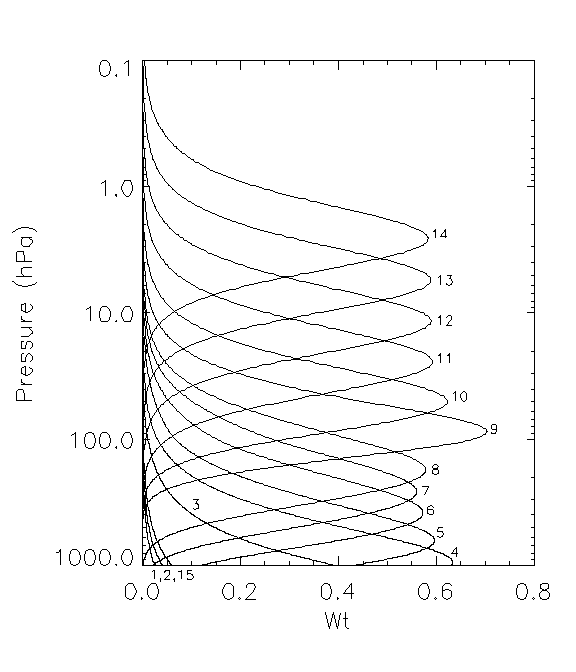
RSS measures Lower Troposphere temperature from the ground up to approximately 12km on a weighted basis:
[caption id="" align="alignnone" width="578"]
Here’s the paper it’s based upon:
http://images.remss.com/papers/rsspubs/Mears_JTECH_2009_TLT_construction.pdf
UAH Troposphere temperature also uses a weighing that extends to the ground;
[caption id="" align="alignnone" width="578"]
and is described in detail here:
http://www.drroyspencer.com/2010/01/how-the-uah-global-temperatures-are-produced/
According to the EPA Surface “Air temperatures are usually measured at about 5 feet (1.5 meters) above the ground, where standard weather observations are taken.”
http://www.epa.gov/hiri/about/measuring.htm
The NOAA NWS “Proper Siting” page states that “Temperature sensor siting: The sensor should be mounted 5 feet +/- 1 foot above the ground”
http://www.nws.noaa.gov/om/coop/standard.htm
Also “all USCRN stations are equipped with a standard set of core sensors attached to a 10-foot (3-meter) mast.”
https://www.ncdc.noaa.gov/crn/elements.html
Please remember that statistical significance is only measuring the probability of the results being what they are due to random error based upon sample size. It says nothing about error due to poor measurements, poor systems, poor transmission, or, in the case of surface temperatures, UHI issues or substitution of data where none exist, or changes in data to purposely effect the results. Calling these ranges “error bars” is therefore misleading as they only reflect one type of error and with the measurements of “anomalies” being such small increments it is even more misleading with a tendency towards making mountains out of mole hills.
And no modern “global” warming.
RoHa says:
December 22, 2013 at 4:28 pm
For those of us who still have trouble counting on our fingers, is there a quick and easy definition of “not statistically significant”.
Climate science has decided that in order to be statistically significant, you need to be at least 95% certain something is going to happen with respect to climate. So if there are 19 different groups of people measuring global temperature, and if one says there is cooling but 18 say there is warming, then the warming is NOT considered to be statistically significant. But if there are 21 different groups of people measuring global temperature, and if one says there is cooling but 20 say there is warming, then the warming IS considered to be statistically significant.
On the other hand, note this quote:
“The way the SPM deals with uncertainties (e.g. claiming something is 95% certain) is shocking and deeply unscientific. For a scientist, this simple fact is sufficient to throw discredit on the whole summary. The SPM gives the wrong idea that one can quantify precisely our confidence in the [climate] model predictions, which is far from being the case.” This is from:
http://www.climatechangedispatch.com/celebrated-physicist-calls-ipcc-summary-deeply-unscientific.html
After billions upon billions of US Dollars we still cant measure the Earth’s temperature. Yet we can send a man to the moon. It must be more difficult than we previously thought.
UAH temperature plots, The ones that they produce every month, used to come from satellite measurements that were labeled “14,000 feet.” If they are no longer doing that it would be really odd because they are appending the monthly data to the same plot that they have always shown. That is correct that that is a little low for the tropospheric hot spot – it would be at the bottom of it (the hot spot visually runs from 4km to 16km above the surface) . But that level should still warm faster than the surface (whether the surface is defined as 5,6,or 10 feet above the ground).
UAH measures several different levels but the plot that they publish and update every month and everyone talks about (even in this article) is from 14,000 feet.
Scott Scarborough says:
December 22, 2013 at 5:00 pm
But that level should still warm faster than the surface
Take a look at the following. Depending on whether you have an El Nino or a La Nina, it both warms faster and cools faster. It also shows greater extremes. See:
http://www.woodfortrees.org/plot/rss/from:1980/offset:0.2/plot/hadcrut4gl/from:1980