 Reposted from Jo Nova’s site
Chinese 2485 year tree ring study shows shows sun or ocean controls climate, temps will cool til 2068
A blockbuster Chinese study of Tibetan Tree rings by Lui et al 2011 shows, with detail, that the modern era is a dog-standard normal climate when compared to the last 2500 years. The temperature, the rate of change: it’s all been seen before. Nothing about the current period is “abnormal”, indeed the current warming period in Tibet can be produced through calculation of cycles. Lui et al do a fourier analysis on the underlying cycles and do a brave predictions as well.
In Tibet, it was about the same temperature on at least 4 occasions — back in late Roman times — blame the chariots, then again in the dark ages — blame the collapse of industry; then in the middle ages — blame the vikings; in modern times — blame the rise of industry. Clearly, these climate cycles have nothing to with human civilization. Their team finds natural cycles of many different lengths are at work: 2-3 years, 100 years, 199 years, 800 years, and 1324 year. The cold periods are associated with sunspot cycles. What we are not used to seeing are brave scientists willing to publish exact predictions of future temperatures for 100 years that include rises and falls. Apparently, it will cool til 2068, then warm again, though not to the same warmth as 2006 levels.
On “tree-rings”
Now some will argue that skeptics scoff at tree rings, and we do — sometimes — especially ones based on the wrong kind of tree (like the bristlecone) or ones based on small samples (like Yamal), ones with abberant statistical tricks that produce the same curve regardless of the data, and especially ones that truncate data because it doesn’t agree with thermometers placed near airconditioner outlets and in carparks. Only time will tell if this analysis has nailed it, but, yes, it is worthy of our attention.
Some will also, rightly, point out this is just Tibet, not a global average. True. But the results agree reasonably well with hundreds of other studies from all around the world (from Midieval times, Roman times, the Greenland cores). Why can’t we do good tree-ring analysis like this from many locations?
Jo
Amplitudes, rates, periodicities and causes of temperature variations in the past 2485 years and future trends over the central-eastern Tibetan Plateau [Chinese Sci Bull,]
 Figure 5 Prediction of temperature trends on the central-eastern Tibetan Plateau for the next 120 years. Blue line, initial series; orange line, calibration series, 464 BC–834 AD; purple line, verification series, 835–1980 AD; red line, forecasting series, 1980–2134 AD. (Click to enlarge)
There are beautiful graphs. Have a look at the power spectrum analysis and the cycles below…
ABSTRACT:
Amplitudes, rates, periodicities and causes of temperature variations in the past 2485 years and future trends over the central-eastern Tibetan Plateau
Amplitudes, rates, periodicities, causes and future trends of temperature variations based on tree rings for the past 2485 years on the central-eastern Tibetan Plateau were analyzed. The results showed that extreme climatic events on the Plateau, such as the Medieval Warm Period Little Ice Age and 20th Century Warming appeared synchronously with those in other places worldwide. The largest amplitude and rate of temperature change occurred during the Eastern Jin Event (343–425 AD), and not in the late 20th century. There were significant cycles of 1324 a, 800 a, 199 a, 110 a and 2–3 a in the 2485-year temperature series. The 1324 a, 800 a, 199 a and 110 a cycles are associated with solar activity, which greatly affects the Earth surface temperature. The long-term trends (>1000 a) of temperature were controlled by the millennium-scale cycle, and amplitudes were dominated by multi-century cycles. Moreover, cold intervals corresponded to sunspot minimums. The prediction indicated that the temperature will decrease in the future until to 2068 AD and then increase again.
…
Figure 1 Tree-ring-based temperature reconstruction for the central-eastern Tibetan Plateau during the past 2485 years (gray line), the 40-year moving average (thick black line) and the 40-year running standard deviation (thin black line); the horizontal line is the mean temperature for the 2485 years. (Click to enlarge)
…
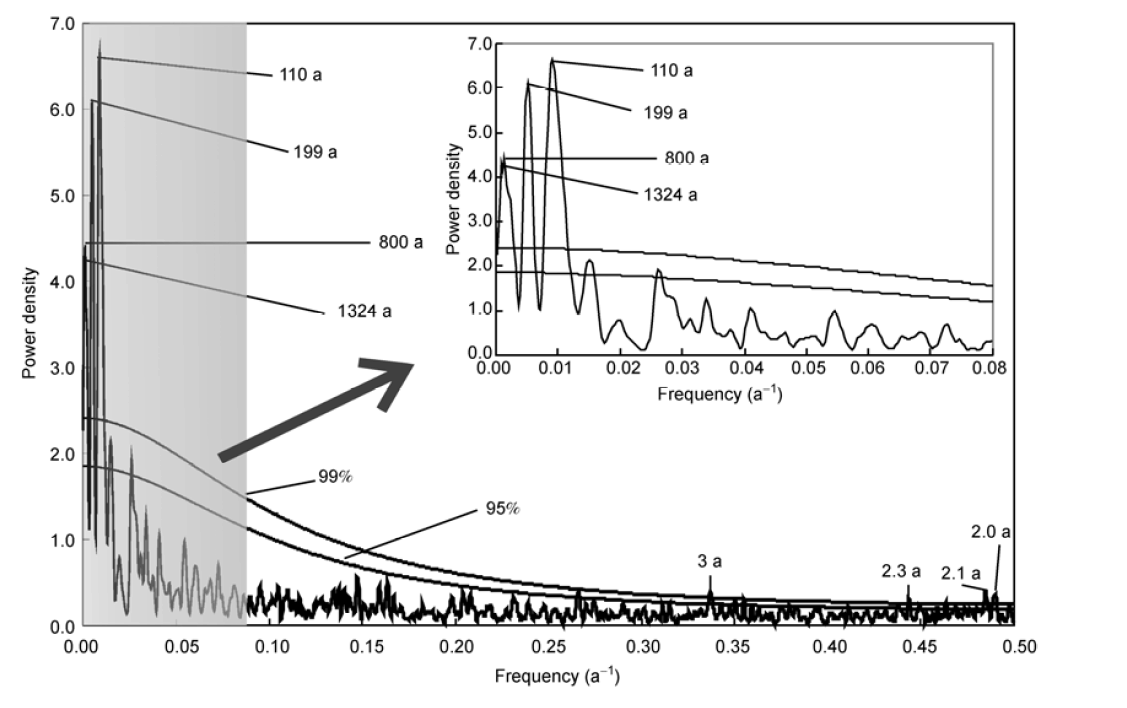 Figure 2 Power spectrum analysis of the 2485-year temperature series. (Click to enlarge)
…
 Figure 3 Millennium-scale cycle in the temperature variation during the last 2485 years. (Click to enlarge)
…
 Figure 4 Decomposition of the main cycles of the 2485-year temperature series on the Tibetan Plateau and periodic function simulation. Top: Gray line,original series; red line, 1324 a cycle; green line, 199 a cycle; blue line, 110 a cycle. Bottom: Three sine functions for different timescales. 1324 a, red dashed line (y = 0.848 sin(0.005 t + 0.23)); 199 a, green line (y = 1.40 sin(0.032 t – 0.369)); 110 a, blue line (y = 1.875 sin(0.057 t + 2.846)); time t is the year from 484 BC to 2000 AD. (Click to enlarge)
…
…
Conclusions
Climate events worldwide, such as the MWP and LIA, were seen in a 2485-year temperature series. The largest Figure 6 Temperature comparison between the forecast and observation data taken from seven stations on the central-eastern Tibetan Plateau (seven stations: Delingha, Dulan, Golmud, Lhasa, Nagqu, Dachaidan and Bange). amplitude and rate of temperature both occurred during the EJE, but not in the late 20th century. The millennium-scale cycle of solar activity determined the long-term temperature variation trends, while century-scale cycles controlled the amplitudes of temperature. Sunspot minimum events were associated with cold periods. The prediction results obtained using caterpillar-SSA showed that the temperature would increase until 2006 AD on the central-eastern Plateau, and then decrease until 2068 AD, and then increase again. The regularity of 600-year temperature increases and 600-year decreases (Figure 3) suggest that the temperature will continue to increase for another 200 years, since it has only been about 400 years since the LIA. However, a decrease in temperature for a short period controlled by century- scale cycles cannot be excluded. Obviously, solar activity has greatly affected temperature on the central-eastern Plateau. However, there are still uncertainties in our understanding of climate change, and the concentration of CO2 affects the climate. Further investigations are thus needed. –
————————–
REFERENCES
Liu Y, Cai Q F, Song H M, et al. Amplitudes, rates, periodicities and causes of temperature variations in the past 2485 years and future trends over the central-eastern Tibetan Plateau. Chinese Sci Bull, 2011, 56: 29862994, doi: 10.1007/s11434-011-4713-7 [ Climate Change over the Past Millennium in China.] … Hat Tip: Geoffrey Gold.
Maybe this is why China is looking forward so avidly to the IPCC’s 5AR.
Please keep in mind that tree rings will only show trends in summer temperatures and then it will only show early summer — June and July. The main factors in tree rings are the onset of summer growth and June/July temperatures. The onset of growth is generally constrained by when the snow melts. So a late slow melt can delay initiation of growth for the year and reduce the overall size of the annual ring for that year.
http://academic.engr.arizona.edu/HWR/Brooks/GC572-2004/readings/vaganov-nature-siberia-tree-snow.pdf
But generally, summer temperatures will trend with general climate, though not always. Since 1998 in the continental US, for example, summer temperatures are flat while winter temperatures have been plummeting. Overall annual temperatures are in decline but summer temperatures are flat. Tree rings in North America probably do not show the decline that the instrument record does in annual average temperature observations show (NCDC’s website).
Fourier analysis on time series may be a lot of fun but until physical background of identified cycles is demonstrated it’s not more than just playing with numbers with zero predictive potential.
Hmm, this validates a hunch I had for a 700+ year cycle in the data that was presented last week in a comment thread where we were looking at spectrum analysis of the CET temperatures. A very similar waveform showed up but the analysis was only for periods <100 years.
sombody should tell our so called australian prime minister about no hockey sticks. the goose has her head in the sand
Ahh, here it is:
http://www.vukcevic.talktalk.net/CET-NVa.htm
Basically reaches the same conclusion with a different data set (CET). Only this one shows temperatures declining to 2040-ish before rising again, but not to the current level before again dropping off. I would say this adds more weight to the notion that we are likely to see a fairly significant multidecadal drop in temperatures.
Oh and the manufacture Solar and wind turbines. They haven’t come out to say there will be no warming or cooling, just in case. They picked a high altitude country too. Nevertheless, they have agreed on one point, it ain’t unusual….IF temps fall suddenly in the Northern Hemisphere that will be telling. Look as a kid in UK, both north and south, it was always cold and raining. We didn’t always have snow at Christmas time, but certainly Jan and Feb, even as late as Easter.
And for the next chapter, see what the other think of it.
I just heard a loud popping noise. I suspect Michael Mann’s head has exploded. Is there a direction from which he isn’t catching fire?
Wow. Science.
This is absolutely beautiful. The data is spectacular in it’s beauty. The presentation is simple, concise and credible. It sets-out to destroy the hockey stick, re-instate the LIA and MWP as world-wide occurrences, and completely buries the CAGW hypothesis in cherry blossoms. Sweetly devastating.
Brilliant!
Tree rings also show growth can be effected by drought or lack of rain, sunshine, etc.
Well, I sort of agree with that to some extent in that yes, it would be nice to know what enables each of these periodic cycles but if it proves out to be correct, we don’t need to know what enables them to accept that they are there. We learned there were 11 year (and other longer) sunspot cycles before we had any indication of what caused them and in some cases still don’t know why some of them are there. We still don’t know what causes Markowitz wobble (though several ideas have been put forward) but we know it’s there and accept it.
True but there are ways of mitigating that. For example, select trees that live in areas that generally get very little / no rain at all during their growing season or trees that generally get way more than enough rain. Edge of treeline trees at high altitude work well because they don’t get a lot of rain anyway, most of their water is from snow melt, the trees are not close together and don’t shade each other, and temperature appears to be the primary growth limiting factor. Though they do stupid things like core strip bark bristlecones sometimes.
I don’t favor trees as temperature proxies because at best they only proxy for 2 (sometimes 3) out of the 12 months of the year.
Crosspatch I agree. But as most people live in the Northern Hemisphere, it will be there that most of the impact of cold weather will be felt mainly affecting the growing seasons.We must act now because we could have a several years of poor agricultural economy and that will cause problems. A hungry lion is more dangerous than a fat content one.
Europeans can do it too:
http://www.vukcevic.talktalk.net/CET-NVa.htm
Does Bull stand for bulletin or bullshit? – I mean, where’s the magic word? Is it peer reviewed, is this a respected publication outside China? You were furious about Muller, obviously, because you didn’t like the conclusion. And now? Obviously, this time you like the conclusion – but what about peer review?
I noticed when you posted on this last week that your analysis only looked for components with a period of 100 years or less. I remember noticing at the time that there seemed to be a component somewhat longer than 700 years and this analysis out of China finds an 800 year component. I asked in that thread if the 100 years was a limitation of your analysis software but maybe you answered me after I stopped following the thread or thought it was a nonsensical question given the length of the CET series.
Yes, we must act now. Tell you what. If you can convince the government to give me a grant of only five million dollars, I will maintain a temperature series that I shall keep adjusting so that I make the cold go away.
In all seriousness, you can adapt to a 1 degree temperature rise quite easily. You can’t adapt to a 1 degree global average decline unless frequent fasting is major part of your adaptation strategy.
Kasuha: “Fourier analysis on time series may be a lot of fun but until physical background of identified cycles is demonstrated it’s not more than just playing with numbers with zero predictive potential.”
It is more than just fun, Kasuha. The fourier analysis is done to show the dominant frequencies in the time series. That is a clue for where to look with regard to what is causing those dominant freqencies.
The hypothesis is that CO2 is a dominant driver of climate. This study provides a test for that hypothesis, as the CO2-driver is already in the timeseries. All we have done is increase the amount of CO2 and if it is dominant we should see it in the near future. Just by looking at the graph one sees that a rapid rise of temperature has always been followed by an immediate rapid decline of the same magnitude. I think that should give pause to all of us, really. If that is where we are heading, I’m off to buy some more coats.
I’m guessing they must have an exceptionally long historical record to support some, most, or maybe even all of this. Not confirm the early parts but at least support them.
Why have the Chinese decided to issue this particular set of lies at this particular time?
crosspatch says:
December 7, 2011 at 11:49 pm
……………..
Yes, I did post it for you, but you wandered off to elsewhere. It’s more like 600, but analysis with less than 1 cycle available is very questionable.
http://www.vukcevic.talktalk.net/CETsp.gif
“The regularity of 600-year temperature increases and 600-year decreases (Figure 3) suggest that the temperature will continue to increase for another 200 years, since it has only been about 400 years since the LIA.”
Is this part: “about 400 years since the Little Ice Age” a typo?
I am inclined to treat this with some validity. So far I have seen similar analysis by two different people using two different time series of two different types (one using tree ring cores in Tibet and the other using the CET temperature record) and they both generally agree. Both analyses found similar period cycles in the data. Both analyses provide the same prognosis for what lies ahead. I think there is likely some validity to this. The chances of two completely different sorts of data from two completely different regions of the planet done independently by different groups of people present the same general result is beyond the realm of chance, in my opinion.
You can check out who the authors ( LIU Yu, CAI QiuFang, SONG HuiMing,
AN ZhiSheng, Hans W. LINDERHOLM ) for:
are and their status in the academic/scientific world, together with some of the
citations they have in hand at:
http://csb.scichina.com:8080/kxtbe/EN/abstract/abstract504775.shtml
Not only was the study peer reviewed, but they did some of
field work too !