 Power for the people
You cannot champion the poor, but support anti-energy policies that perpetuate poverty
Guest post by Paul Driessen
In a scene reminiscent of Colonial Williamsburg, for 16 years Thabo Molubi and his partner had made furniture in South Africa’s outback, known locally as the “veld,” using nothing but hand and foot power. When an electrical line finally reached the area, they installed lights, power saws and drills. Their productivity increased fourfold, and they hired local workers to make, sell and ship far more tables and chairs of much higher quality, thereby also commanding higher prices.
Living standards soared, and local families were able to buy and enjoy lights, refrigerators, televisions, computers and other technologies that Americans and Europeans often take for granted. The area was propelled into the modern era, entrepreneurial spirits were unleashed, new businesses opened, and hundreds of newly employed workers joined the global economy.
People benefited even on the very edge of the newly electrified area. Bheki Vilakazi opened a small shop where people could charge their cell phones before heading into the veld, where instant communication can mean life or death in the event of an accident, automobile breakdown or encounter with wild animals.
Thousands of other African communities want the same opportunities. But for now they must continue to live without electricity, or have it only sporadically and unpredictably a few hours each week. Over 700 million Africans – and some two billion people worldwide – still lack regular, reliable electricity and must rely on toxic wood and dung fires for most or all of their heating and cooking needs.
Mothers with babies strapped on their backs must bend over open fires, breathing poisonous fumes and being struck down by debilitating, often fatal lung diseases. Homes, schools, shops and clinics lack the most rudimentary electrical necessities. Impoverished families must live in mud-and-thatch or cinderblock houses that allow mosquitoes to fly in, feast on human blood and infect victims with malaria. And parents and children must carry and drink untreated water that swarms with bacteria and parasites which cause cholera, diarrhea and river blindness. When the sun goes down, their lives shut down.
The environmental costs are equally high. In Rwanda gorilla habitats are being turned into charcoal, to fuel cooking fires. In Zambia, entrepreneurs harvest trees by the thousands along highways, selling them to motorists heading back to their non-electrified homes in rural areas and even parts of cities. As quickly as First World charities hold plant-a-tree days, Africans cut trees for essential cooking.
If eco-activists have their way, it will be like this for decades to come.
In his DotEarth blog for the New York Times, columnist Andrew Revkin lamented this intolerable situation. “Access to the benefits that come with ample energy trumps concerns about their tiny contribution of greenhouse gas emissions,” he wrote. But despite agreeing with the Committee For A Constructive Tomorrow on this central issue, Revkin took issue on several items.
CFACT’s “Stop energy poverty” slogan is clever, he wrote. But where are its “substantive proposals for getting affordable energy” to those who don’t have it? Africa sits on vast deposits of natural gas and liquid condensates. Perhaps CFACT could find a business model that can lead to capturing, instead of flaring, those “orphan fuels,” Revkin suggested, while wondering why the Committee offers solar ovens to a Yucatan village and uses its slogan in part to challenge global warming scares.
Converting orphan fuels to productive uses is a terrific idea. That’s why CFACT opposes restrictions on using these fuels and wants to help find investors and build local support for gas-fired power plants that can electrify and modernize homes and businesses, create jobs, improve health and living standards, purify water, and launch companies that can build modern homes. Non-orphan deposits of oil, “tight oil,” natural gas, shale gas and coal could do likewise.
Unconventional US shale gas reserves alone are now estimated at about 57 trillion cubic meters (2000 trillion cubic feet) – enough for 100 years at current US consumption rates, on top of conventional reserves. Africa almost certainly has large gas, oil, coal and uranium deposits of its own, lying untapped beneath numerous poor countries, waiting to fuel an economic boom – if environmentalists, self-interested companies and government agencies would stop using global warming and other scares to justify their opposition to large-scale generating plants.
Until then, the Committee will continue providing interim measures – solar ovens, used laptops and small solar-powered charging systems – while also training people in computer and business skills, and assisting Yucatan and Ugandan villagers with tree farm and other projects.
All these are akin to the help that first responders provide, before getting disaster victims to hospitals. They are important steps toward individual and community empowerment that comes from having property rights, free enterprise, and full access to modern technologies that improve, enhance and safeguard lives. But none of this is possible without reliable, affordable energy to power those technologies.
“If abundant, affordable, clean energy and water were readily available to everyone, all the other problems would become much easier to solve,” Nobel Laureate Richard Smalley observed. Of course, “clean” does not have to mean non-carbon dioxide emitting, though Mr. Revkin seems reluctant to support energy that comes from fossil fuels, notes CFACT executive director Craig Rucker. “However, you cannot champion the poor, while supporting policies that perpetuate poverty,” Rucker emphasizes.
Modern coal-fired power plants are far cleaner than their predecessors, posing few environmental or health problems, except in the minds and propaganda of eco-activists. They are infinitely cleaner than the open fires that provide pitiful, polluting, often deadly energy for the barest necessities. Gas-fired plants are cleaner still, and safe, modern nuclear plants could also support major economic booms.
To suggest that impoverished nations must worry more about CO2 than about tuberculosis, cholera or malaria is absurd. To tell them their energy options must be limited to expensive, unreliable, insufficient wind and solar power is immoral. To impose anti-hydrocarbon restrictions on poor countries ensures that they will remain poor and diseased, with life expectancies in the low forties.
As Dambisa Moyo and others suggest, it is time for rich Western nations to provide less aid, fewer restrictions – and much more trade, investment and banking expertise and opportunity; business, agricultural and property rights know-how; and energy technologies that will harness and utilize abundant, reliable, affordable hydrocarbon energy. They also need to stop propagating scare stories and imposing restrictions on the use of hybrid and genetically modified seeds to reduce malnutrition, and insecticides to reduce disease.
CFACT’s goal is simple, says Rucker. “Give poor families, communities and nations the same opportunities we had, the same freedoms to chart their destinies, the same rights to create and manage their own wealth, develop their own free and healthy institutions, solve their own environmental and health challenges – and even make their own mistakes along the way.”
Brazil, China, India and Indonesia are not about to stop building new coal-fired power plants; nor are developed countries going to tear their plants down or abandon their fossil fuel-powered vehicles. Africa and other poor regions need to adopt the same attitude – and also seek investors and trade opportunities, rather than just more aid that is often merely life support for corrupt dictators and bureaucrats.
CFACT’s plan is also simple, Rucker adds. Help now with solar ovens, laptops and other first aid. Challenge and change harmful, immoral, lethal policies that limit access to energy and other modern technologies, hobble job creation, impair health and kill millions. And help persuade investors and Third World communities to provide the energy technologies that will make health and prosperity happen.
“We hope Andrew Revkin and millions of other caring people will join us in supporting a global energy quest that advances human progress, while limiting actual environmental risks.”
while I endorse giving them power, the claims re fires being toxic to cook on is crap!
why not show them how to make simple flues to direct smoke away, ah but then traditionally the smoke also keeps the mozzies away and fumigates seed stored indoors and cures fish and meats. not ll old fashioned stuff is bad.
I prefer woodstoves for cooking personally, and thats choice not duress.
until 1st world barons manage to buy up the land they wont be willing to develop it, ie the china eu and russians are using arfra as a food bowl ,employing few, taking water and access from locals, and shipping it out. ditto chinas buy up of massive fishing rights while the africans starve.
but Paul….
…what you’re describing is capitalism
Well said – I hope that you can allow me to quote you on occasions!
I am hopeful, however. Leaders in developing countries get this more and more, and pay only lip service to the pointless activist agendas coming through developed world institutions (and the limited funds available from the “mechanisms”).
Thank you for encouraging me to keep battling western politicos on this critical point. But when the African Development Bank is forced to focus on climate change rather than economic supply it can be tough going! Fortunately the increasingly effective leaders in developing countries will finally drive the agenda.
I strongly agree and was therefore dismayed when Christian Aid – and other charities I have long supported – campaigned last year (fortunately without success) to block a World Bank loan to enable South Africa to build a modern coal-fired power station. They failed because China, India and other developing countries supported the loan.
I think it immoral that many of the world’s most vulnerable and deprived people – especially children – can have their hope of a better life prejudiced because comfortable people in the West, people who take the benefits of reliable energy for granted, are obsessed by the unverified CAGW hypothesis.
That CFACT has reached Revkin is good. Too bad his blinders were on. I have tried the same argument with greenies I know and get kind of a blank stare along with some counter argument about capitalism or big oil being the “real” culprit. Forty years of well package propaganda in our schools is going to take a while to reverse.
President Obama should go on national TV and/or before Congress and tell them
exactly what Mr. Driessen is saying in this piece. Unfortunately, Obama is a green Lefty himself, so this isn’t going to happen. That makes Obama part of the problem — and a significant part of the tragedy.
Above it says: “But for now they must continue to live without electricity, or have it only sporadically and unpredictably a few hours each week.”
This is why battery technology is so important . . . I like the Steve Jobs approach . . smaller and smaller holds more and more . . .
And we need the smaller and more now . . . not fed slowly so that you are buying the same thing over and over again . . . and like used clothes we should “recycle”. . .
Latitude says: …”what you’re describing is capitalism” “Capitalism is an economic system in which the “means of production are privately owned” and operated for profit.”
Where I sit . . . it’s called sharing . . . constructive knowledge . . .
The question I ask often is: Is one trying to make a living, or is he trying to make a “killing”! Profit: http://en.wikipedia.org/wiki/Profit_(economics)
Communicating what I MEAN. . . is difficult for me . . .
Energy – Electricity is a “means of production” . . .
Greenis go to bed at night with the gnawing fear of healthy, happy, prosperous
dar-skinned people. I have said this for years and beleive it ….
Watch what happens whan a local Indian Tribe gets a casino ,or a powerplant, or a mine or oil…..
Robin Guenier says:
April 2, 2011 at 8:55 am
“I strongly agree and was therefore dismayed when Christian Aid – and other charities I have long supported – campaigned last year (fortunately without success) to block a World Bank loan to enable South Africa to build a modern coal-fired power station. They failed because China, India and other developing countries supported the loan.”
That’s great news!
Bowen says:
April 2, 2011 at 9:20 am
“Latitude says: …”what you’re describing is capitalism” “Capitalism is an economic system in which the “means of production are privately owned” and operated for profit.””
What’s your problem with that? As long as the formation of monopolies is prevented – by the state, through laws and regulations -, competition will drive down the prices and erode the profits; driving companies to innovate and create better products. How will your “Sharing Of Knowledge” provide affordable products?
Modern coal-fired power plants are far cleaner than their predecessors, posing few environmental or health problems, except in the minds and propaganda of eco-activists. They are infinitely cleaner than the open fires that provide pitiful, polluting, often deadly energy for the barest necessities
Ross McKitrick has a very similar view, one which I agree completely with:
2 minute video
The problem with bringing people up to first world energy and education standards is that large numbers of educated, energy wealthy people pose a serious threat to the existing dictatorship style of governing. They end up wanting to have a say in how the country is run and who runs it. Look at the Middle East.
@ur momisugly DirkH who said
“As long as the formation of monopolies is prevented – by the state, through laws and regulations -, competition will drive down the prices and erode the profits; driving companies to innovate and create better products.”
Thankyou for sharing that . . . it’s important given the “political climate” . . .
houses that allow mosquitoes to fly in, feast on human blood and infect victims with malaria
30,000,000 people have died from the ban on DDT. We have very comfortable lives in the Western world. After we get done eating popcorn from our microwave while watching a Blu-Ray movie on our big screen HD tv (or playing Wii video games on it) it’s easy to forget there are people living with the danger of dying from malaria. We don’t give mosquito bites a second thought.
Michael Crichton with an excellent summary on why DDT should have never been banned:
4:36 video
sdollarfan,
President Obama wants to bankrupt the coal industry:
sadly, the one thing that has to be done before any of these measures can help is to get rid of the corrupt and rapacious governments most impoverished countries have.
Africa taking the brunt again.
http://blogs.telegraph.co.uk/news/jamesdelingpole/100082087/climate-change-the-new-eugenics/
“The important point to note is that 100 years ago, work like Galton’s was at the cutting edge of scientific research. Racism wasn’t some backward-looking reactionary ideology: it was the state of the art and people then believed in it as readily as people today BUY the theory of man-made climate change.”
From the channel 4 series, Civilization: Is the West History?
http://www.channel4.com/programmes/civilization-is-the-west-history/episode-guide/series-1/episode-4
Capitalism is what naturally happens when you have free men and women. Men and women that are living under a code of laws that prevents forceful efforts to control them. Under such a rule of law, only the government can enforce a monopoly for if a company tries, they will have competition. The higher the price, the great the competition will be.
Amino Acids in Meteorites: don’t say “ban on DDT”. It is not true, and easily rebutted.
Instead, say “decades of multinational environmental advocacy group effort to minimize the manufacture and use of DDT, in which advocacy/campaigners dedicated every waking moment to, among others:
– influencing UN policy statements and funding criteria to be anti-DDT
– influencing first world aid policies and funding criteria to be anti-DDT
– advocating for aid spending on any form of malaria control that did not include DDT while actively undermining any form of malaria control that included even a smidgeon of DDT
– campaigning at senior levels of aid recipient countries to ensure those countries adopted non-DDT control practices and programs, ensuring those countries understood they would get more aid that way
– demonizing any company that continued to manufacture DDT”
and of course I could continue the list. Never in my life have I seen a group of people work so hard to achieve an outcome – minimization of DDT usage, to levels that amounted to a de facto “ban” – and then work so hard to spin the message “there was no ban”. What they are saying, under the rhetoric, is “although we worked really, really hard to get rid of DDT, we failed, so there was no ban, so there!”
I think most of the posters here need to be sent to sustainability re-education camps. Don’t you know the millions of people in South Asia and Africa who don’t have electricty, access to clean water, or medical care are living in sustainable societies. What is wrong with an avergae life expectancy of less than 45 years. Oh, and the prohibition on DDT killing 30,000,000 people, what a benefit it the planet. It can’t sustain as many people as it already has. How would it cope with even more.
More seriously, I think articles like these need to be given the widest circulation possible. It is amazing how many sustainability conferences are held each year where they trot out some “expert” who extolls the virtues of living in villages without safe water and electricty.
Sam Hall says: “Capitalism is what naturally happens when you have free men and women” . . .
Say what you like. . . some people think it is their “God Given Right” to be free to be a “Huckster” . . . . Thus, coined the “huckster syndrome”. . . Al Gore has/had it . . so did Mr. Ponzi . . .
Some people think it is their “God Given Right” to be “free” to be to micro-manage private actions of citizen through myriad of methods. And there are plenty out there say . . here, here!!
It (Liberty AND Justice) is the never ending balancing act of “humpty dumpty” who sits on that fence.
And it will take all a countries “horses & men” (resources) to put that humpty dumpty back together again!
This is one of the hardest subjects to discuss . . . because of varying needs & wants of individuals . . and relative scarcity of resources not to mention economies to scale . . . (in my opinion of course).
“Mothers with babies strapped on their backs must bend over open fires…”
Oh come on. They can’t put the baby down even when they cook dinner? Give me a break.
This is a rhetoric, a blatant attempt to sway the emotions, not an attempt to persuade or inform.
Sam Hall – pretty much squares with Rand, but Rand’s extreme idealism – if only it were justified – depends on levels of integrity that are alien to the great majority of human beings. The freedom that capitalism depends on tends to attract and enrich the greedy, dishonest, and outright exploitative, usually at the expense of the hard working, trusting and honest.
So far as concerns the west’s attitude towards giving Africans a leg up is concerned, they’d rather bomb Afghanistan back to the Stone Age than take, or even encourage with support, the basic steps necessary to empower the poorest of Africa and bring them into the age of electricity.
My experience of life has taught me that there are many good people out there, working away quietly in the main, but that they rarely have access to the levers of power, for obvious reasons unfortunately. It was ever thus and will remain so I suspect.
Rand mistakenly believed that we are born tabula rasa, and therefore that men could be made better by the best example . . . perhaps a justified error in her time, but it renders a great deal of her thinking – not all of it – obsolete . . . But we can dream . . Capitalism as she saw it would be a very fine system indeed . . . but it’s an ideal that’ll never be realised because of human nature. And Africa’s ascent – if that’s a fair way to describe the moral changes that will occur along the way – will be a long struggle while western – and now eastern – governments, as well as big business, serve their own interests first and with little real concern for anyone who gets in their way.
If anyone is still inclined to question Mr. Driessen’s premise, I suggest you peruse this graph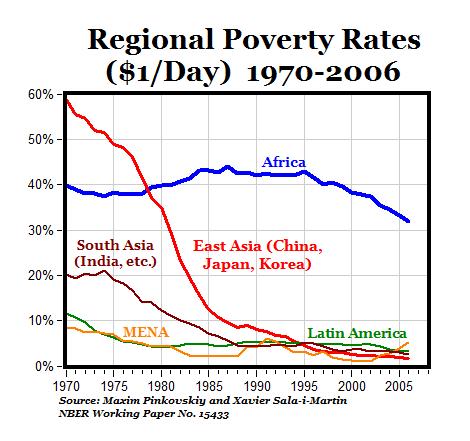
If the countries of Africa had, since the 70s, embraced a path similar to China and India of easing restrictions on people working for their own personal benefit and aggressively expanding energy production we would be rapidly approaching the point where the elimination of human poverty might actually look like an achievable goal. As it is, the development of the economies of China and India means that for the first time in human history we are living in a world in which a majority of the human population can reasonably be classified as middle class. Where middle class is defined as possessing sufficient income beyond subsistence levels, that they have significant discretionary money.
If Africa had been allowed to develop similarly, many of the world’s real crises would be well on the way to solution. Since achieving middle class status is accompanied by a dramatic decline in birth rates, we’d be looking at arriving at a stable world population much nearer in the future and at a much lower level than the 9-10 billion which is now usually projected. This could be happening even with expanding life spans, which would likely be occurring do to improving medical care and declining disease, especially in Africa.
Instead we have had 40 years of UN dominated antidevelopment development which, if we lived in any reasonable kind of world, should classified as a crime against humanity on par with the worst perpetrated by Hitler, Stalin or Mao. If we allow ourselves to be cowed into continuing this criminal path, based on some fanciful demonization of CO2, posterity will rightly classify us with all those “good Germans” who were willing to acquiesce to Hitler’s murderous schemes and we will richly deserve our fate.
dlr says:
April 2, 2011 at 12:00 pm
“Mothers with babies strapped on their backs must bend over open fires…”
Oh come on. They can’t put the baby down even when they cook dinner? Give me a break.
This is a rhetoric, a blatant attempt to sway the emotions, not an attempt to persuade or inform.
I presume you haven’t lived in Africa, or any of the other 3rd/4th world countries. Babies are rarely put down, you will see mothers hoeing gardens, cooking, collecting water with their baby in a sling on their back at all times. They don’t have cribs/bassinets/chairs to put babies in, most have a bare hut with a straw pallet to sleep on.
Instead of letting your bias loose on the keyboard, go live there, then come back and you will understand why I, and others in this forum promote cheap electricity for 3rd world countries as a priority, and not just the tinker toy solar panels so they have light bulbs, but full scale generating plants.