Sorry no graphics, no abstract or paper (not published yet, due Friday the 27th, I hate it when they do this) the Penn State press release was rather spartan. So I’ll provide this one showing Mann’s previous work where the Medieval Warm Period doesn’t much show up at all:
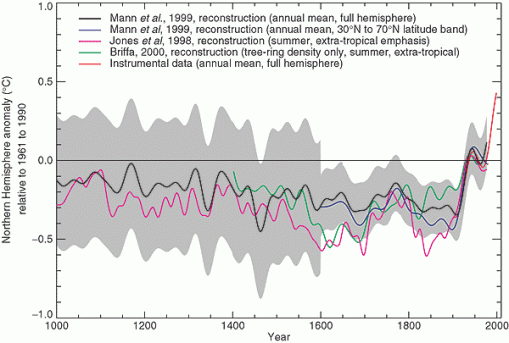
So here’s the question, the press release below mentions sediments. Place your bets now on whether the Tiljander sediment series remains inverted or not. (h/t to Leif Svalgaard) – Anthony
Past regional cold and warm periods linked to natural climate drivers
Intervals of regional warmth and cold in the past are linked to the El Niño phenomenon and the so-called “North Atlantic Oscillation” in the Northern hemisphere’s jet stream, according to a team of climate scientists. These linkages may be important in assessing the regional effects of future climate change.
“Studying the past can potentially inform our understanding of what the future may hold,” said Michael Mann, Professor of meteorology, Penn State.
Mann stresses that an understanding of how past natural changes have influenced phenomena such as El Niño, can perhaps help to resolve current disparities between state-of the-art climate models regarding how human-caused climate change may impact this key climate pattern.
Mann and his team used a network of diverse climate proxies such as tree ring samples, ice cores, coral and sediments to reconstruct spatial patterns of ocean and land surface temperature over the past 1500 years. They found that the patterns of temperature change show dynamic connections to natural phenomena such as El Niño. They report their findings in today’s issue (Nov. 27) of Science.
Mann and his colleagues reproduced the relatively cool interval from the 1400s to the 1800s known as the “Little Ice Age” and the relatively mild conditions of the 900s to 1300s sometimes termed the “Medieval Warm Period.”
“However, these terms can be misleading,” said Mann. “Though the medieval period appears modestly warmer globally in comparison with the later centuries of the Little Ice Age, some key regions were in fact colder. For this reason, we prefer to use ‘Medieval Climate Anomaly’ to underscore that, while there were significant climate anomalies at the time, they were highly variable from region to region.”
The researchers found that 1,000 years ago, regions such as southern Greenland may have been as warm as today. However, a very large area covering much of the tropical Pacific was unusually cold at the same time, suggesting the cold La Niña phase of the El Niño phenomenon.
This regional cooling offset relative warmth in other locations, helping to explain previous observations that the globe and Northern hemisphere on average were not as warm as they are today.
Comparisons between the reconstructed temperature patterns and the results of theoretical climate model simulations suggest an important role for natural drivers of climate such as volcanoes and changes in solar output in explaining the past changes. The warmer conditions of the medieval era were tied to higher solar output and few volcanic eruptions, while the cooler conditions of the Little Ice Age resulted from lower solar output and frequent explosive volcanic eruptions.
These drivers had an even more important, though subtle, influence on regional temperature patterns through their impact on climate phenomena such as El Niño and the North Atlantic Oscillation. The modest increase in solar output during medieval times appears to have favored the tendency for the positive phase of the NAO associated with a more northerly jet stream over the North Atlantic. This brought greater warmth in winter to the North Atlantic and Eurasia. A tendency toward the opposite negative NAO phase helps to explain the enhanced winter cooling over a large part of Eurasia during the later Little Ice Age period.
The researchers also found that the model simulations failed to reproduce the medieval La Nina pattern seen in the temperature reconstructions. Other climate models focused more specifically on the mechanisms of El Niño do however reproduce that pattern. Those models favor the “Thermostat” mechanism, where the tropical Pacific counter-intuitively tends to the cold La Niña phase during periods of increased heating, such as provided by the increase in solar output and quiescent volcanism of the medieval era.
The researchers note that, if the thermostat response holds for the future human-caused climate change, it could have profound impacts on particular regions. It would, for example, make the projected tendency for increased drought in the Southwestern U.S. worse.
Other researchers on the project were Zhihua Zhang, former postdoctoral fellow in meteorology now at the National Oceanic and Atmospheric Administration; Scott Rutherford, Roger Williams University; Raymond S. Bradley, University of Massachusetts; Malcolm K. Hughes and Fenbiao Ni, University of Arizona; Drew Shindell and Greg Faluvegi, NASA Goddard Institute for Space Studies, and Caspar Ammann, National Center for Atmospheric Research.
The National Science Foundation, the U.S. Department of Energy, NOAA, and NASA supported this work.
Discover more from Watts Up With That?
Subscribe to get the latest posts sent to your email.

However, a very large area covering much of the tropical Pacific was unusually cold at the same time
My understanding was that the Pacific was warm at the same time as northern Europe. That’s why the Polynesians were able to settle as far apart as Hawaii, New Zealand and Easter Island during this period. Then the cold spell set in and the travel was too difficult.
So Mann is telling us that the Polynesians settled the Pacific during the cold period (bringing warm weather vegetables such as Kumara) and then lost contact during the warm period? It doesn’t seem to fit at all well.
A few snippets aside, this sounds a lot like what “the deniers” have been saying for the last few years
It appears there might be a real hockey stick, after all.
http://boy-on-a-bike.blogspot.com/2009/11/my-version-of-hockey-stick.html
Sort of.
I have just noticed on YouTube that the video featuring Mann in “Hide the decline” http://www.youtube.com/watch?v=nEiLgbBGKVk has been removed from the “Most Viewed List”.
It was in the top 10 earlier today and with 163000 views should now be at the top.
What goes on ?
Will
I wonder how Mike’s work was reviewed?
Based on past examples (below) I am guessing something like this:
Phil Jones says (from original leaked document-review_mannetal.doc)
The paper is generally well written. I recommend acceptance subject to minor revisions. I will leave it to the editor to check that most of my comments have been responded to.
Phil Says (from original leaked document review_schmidt.doc)
My recommendation is that the paper be accepted subject to minor revisions. It is certain that this paper will get read by a particular type of climatologist, so it ought to be as clear as possible. I’m happy if all the thoughts are ignored.
“I’m happy if all the thoughts are ignored.”!!!
(nudge nudge, wink wink-say no more-in it goes)
Phil Says (from original leaked document Review of Wahl&amman.doc)
This paper is to be thoroughly welcomed and is particularly timely with the next IPCC assessment coming along in 2007. The availability of the data and the programs on a website will go a long way to silencing the critics. I suspect though that this will not be the last word on the subject.
Phil Says (from original leaked document SanteretalSciecnereview.doc )
This manuscript is expertly written, which isn’t a surprise given the number of authors and the internal reviewing now applied by many of the institutions involved. My comments are mainly minor ones of clarification. My recommendation is that it should be accepted subject to minor revision.
Meanwhile: peer review standard for non mates:
Phil Says:
I can’t see either of these papers being in the next IPCC report. Kevin and I will keep them out somehow – even if we have to redefine what the peer review literature is!
Cheers
Phil (Jones)
http://www.eastangliaemails.com/emails.php?eid=419&filename=1089318616.txt
They have certainly re-defined peer review in the echo chamber of climate science!!!
“It would, for example, make the projected tendency for increased drought in the Southwestern U.S. worse.”
Let’s see how AGW is affecting rainfall and drought Down Under.
http://gustofhotair.blogspot.com/2007/10/more-rain-and-no-change-in-drought-and.html
Well, I, uh, ahem. Move along, nothing to see there.
I will say this one more time.
If the tropical Pacific cools when the northern climes warm…that means the Earth’s energy budget system NORMALIZES itself. It means there is NO THREAT of runaway warming…it means warm forcing has NEGATIVE FEEDBACK…and it means the AGW crowd has been crowing about NOTHING for years.
In an early, pre-Ph.D. paper, “Greenhouse warming and changes in the seasonal cycle of temperature: Model Versus Observation” (http://www.meteo.psu.edu/~mann/shared/articles/MannPark1996GRL.pdf) Mann closes with this sentence:
“Discrepancies between the observed and model-predicted trends must be resolved before a compelling connection can be drawn between 20th century changes in the behavior of the annual cycle in temperature, and anthropogenic forcing of the climate.”
From what I have learned here about Dr. Mann over the past week or so, it appears that his research program has always been to create computer models that would demonstrate an a priori truth, “anthropogenic forcing of the climate.” The anthropogenic forcing is a given, not something to be demonstrated or disproved. You start with a postulate, use the postulate to filter data, and then claim that the data proves the postulate. In the humanities fields in which I was trained, we called this “circular reasoning.” This program has made Dr. Mann a very influential and powerful academic figure over a very short time period, and I suspect that nothing short of a successful criminal prosecution or lawsuit will slow him down.
How often does Michael Mann acknowledge any role of sol in these paleo reconstructions? Is this progress?
… What’s this? Mann using the Goldilocks method for picking climate theories…. This one is too hot. That one is toooo cold. And this one is Juuust riiiiight….
Now just sit back and watch the funding just roll in. Climate gravy outta a gooey porridge of data!
“The researchers found that 1,000 years ago, regions such as southern Greenland may have been as warm as today. ”
The researchers didn’t discover anything at all that has not always been known by historians or by anybody taking a walk in uphill parts of Europe and wondering why all those farms have been abandoned ( because it used to be warmer and farming there us to be feasable when now it is not ).
“we prefer to use ‘Medieval Climate Anomaly”
First of all, why is everything an anomaly???
Secondly, is this simply a case of, “if we don’t call it warm, people won’t put two and two together”?
Thirdly, who are “we”. Is this the Royal “we”, or the group associated with the leaked Hadley emails?
Come *on*, Professor, stop moving the goalposts and be straight with people.
It appears peer review looked far more like the “star chamber” (of popular movie fame) – a cabal.
*sigh*
I wonder how long Mann was sitting on thie friggin’ report before he produced it? It cannot be a coincidence that this is coming out now. Mann is trying to rise above the rest of the AGW crowd and save his own skin.
I hate this…what tricks will they employ next?
more hanky panky
http://network.nationalpost.com/np/blogs/fpcomment/archive/2009/11/26/skewed-science.aspx
This sounds a lot like: “They want a Medieval Warm Period? Let’s give ’em one! But our way!”. It will be a Medieval Warm Period not as warm (globally) as it is today. It will look like an ordinary bump in the temps. Their word «offset» wrt the temps due to their southern hemisphere ‘cooling’ will do the job. This is my bet!
“The researchers found that 1,000 years ago, regions such as southern Greenland may have been as warm as today.”
“However, these terms can be misleading,” said Mann. “Though the medieval period appears modestly warmer globally in comparison with the later centuries of the Little Ice Age…”
Two can play at that game!
Though the Modern Warm Period appears modestly warmer globally in comparison with the previous centuries of the Little Ice Age….
Chris
Norfolk, VA, USA
“…a very large area covering much of the tropical Pacific was unusually cold at the same time, suggesting the cold La Niña phase of the El Niño phenomenon.”
Is not La Niña a relatively short term phenomenon? Is not the “Medieval Warm Period” (excuse me, it is the ‘Medieval Climate Anomaly’) a long term event?
Maybe La Niña events lasted for 10s or 100s of years back then. Will they explain this in the published paper?
In other words, just like it is now.
The problem then for Mann is, as Dr Svaalgard says, if the sun was a major player then, it’s a major player now, so they can’t say the sun isn’t having as much influence in modern times.
It has struck me, in all of Mann’s hockey-stick recreations and versions, that that EVERY hockey stick creates both the Little Ice Age AND the Medieval Warming Period – You just have to look not at Mann’s “little black line” (of temperatures that he wants you to see); but rather the error bars (that he is desperate that you will see.)
Little Ice Age: All of the error bars are very close together, leading one to conclude that the data is “good” and has little disagreement. All of the error bars are “below” today’s “0.0” reference point – so Mann is proving graphically that the climate during this period WAS SIGNIFICANTLY COLDER than now = exactly the point that “skeptics” have claimed for years. (His “hockey stick” is dead wrong, but temperatures were significantly lower then than now. The real curve is a long 800 year sinusoid cycle)
Medieval Warm Period: The error bars are larger – three to four times larger than during the Little Ice Age. It’s easy (and correct!) to conclude that the general temperatures were hotter than during the LIA; almost as hot as now, if not hotter than now.
But Mann creates the IPCC’s hockey stick by excluding the error bars (in published graphs) and drawing HIS line through middle (and bottom) of the MWP error bar “group”.
Now, the real question. How “many” error bars (lines of data from different studies) are at what point in what year? Mann presents a long vertical “bar” – but how many data lines are “high” in that single anoymous bar?
How many of Mann’s studies show that the temperatures were “high” during the MWP, against those (one, two ?) that he chose showing that they were “low”? We know he drew his hockey stick through the :low” studies – but what exactly were the points in those studies? Did he “lie” in creating the hockey stick? Or was Mann just very “tricky” – as he phrases it in today’s email releases – in choosing what to publish for his “peer review” papers?
Curious:
“We made use of the University of East Anglia (Norwich, UK) Climatic Research Unit instrumental surface-air temperature data from 1850 to 2006” Mann etal 2008
http://www.ncbi.nlm.nih.gov/pmc/articles/PMC2527990/
“We have sent all our data to GHCN, so they do, in fact, possess all our data.”
http://camirror.wordpress.com/2009/11/25/willis-eschenbachs-foi-request/#more-75
“The vast majority of the data in the HadCRU records is publicly available from GHCN”
http://www.realclimate.org/
Apparently Mann wanted this “small %” of protected NMS data, and got it from CRU.
If that be the case, Mann would know how to and did obtain permission from all the nasty Icelanders and Russians and such.
“Mann and his team used a network of diverse climate proxies such as tree ring samples, ice cores, coral and sediments to reconstruct spatial patterns of ocean and land surface temperature over the past 1500 years.”
Also, Mann and his team used a network of close-knit “peers” (friends) such as Keith Briffa, Phil Jones, Caspar Ammann, et al…to fiddle, fudge, cherry-pick, and conspire as they please, data that only supports their pre-supposed (and circularly-arrived at) theory that humans are inducing climate change.
Chris
Norfolk, VA, USA
I’m so confused. First they tell us we’re going to be incinerated in some thermocalypse (I’m obviously excluding those poor Nebraskans who will get to smell the hot ocean spray moments before they drown). Now they’re saying that the earth has been warmer and then cooler in the past but some warm parts were actually cooler and some cool areas were warmer.
I wish I was a McDLT. Keep the hot side hot and the cold side cold.
Mann’s work is not relevant to any serious discussion of anything. He is too compromised by transparently bad work.
Now he mumbles something about the MWP…that wasn’t really an MWP.
Repudiate the hockey stick, accept that the past predictions of future climate catastrophe wree bunk, and apologize to those he has so rudely and unprofessoinally denigrated, and then maybe he will have some credibility.
Otherwise, this is just another trash study by a proven fraud.