The Week That Was: 2026-04-25 (April 25, 2026)
Brought to You by SEPP (www.SEPP.org)
The Science and Environmental Policy Project
Quote of the Week: “The ignorant person affirms, the scientist doubts, the wise person reflects.” — Aristotle [H/t Ole Humlum]
Number of the Week: +3 to 5 °C warming
THIS WEEK:
By Ken Haapala, President, Science and Environmental Policy Project (SEPP)
Scope: This TWTW begins by further discussing the “How Science Works” chapter of the Reference Manual on Scientific Evidence, Fourth Edition and for comparison discusses a paper by John Christy “Declines in hot and cold daily temperature extremes in the conterminous US, 1899–2025” as an example of how physical science works. TWTW discusses the current work of the Attribution Science Committee of the National Academies of Science, Engineering and Medicine. TWTW discusses the missing greenhouse gas in the IPCC’s Third Assessment Report and concludes with the presentation of the 2025 Frederick Seitz Memorial Award trophy.
*********************
How Science Really Works: Over the past two weeks TWTW presented objections to the Reference Manual on Scientific Evidence, Fourth Edition, by the Federal Judicial Center and the US National Academies of Science, Engineering, and Medicine. TWTW outlined possible conflicts of interest of Michael Weisberg, the principal author of the “How Science Works” chapter, whose academic biography states he is “an expert on the climate needs of small island developing states.” The chapter ignores that in physical science, physical evidence is needed to support any idea, no matter who has it. Physical evidence, particularly observation, is the ultimate and final judge in physical science.
Sea levels have risen about 400 feet (120 meters) over the past 20,000 years. About 280 feet (85 meters) of this rise occurred prior to 11,700 years ago, the end of the sudden cooling and warming period known as the Younger Dryas, the cause of which is not known. [Interestingly, some publications are now claiming that the last ice age ended with the end of the Younger Dryas and are claiming that the rise in sea level since the last ice age was only 125 feet (38 meters) “New Data Reveals Sea Levels Rose 125 Feet After Last Ice Age.” Note that the claim is only about terminology, specifically the date of the “end” of the ice age (glacial cycle), not about the fact that sea level rose 400 feet since 20,000 years ago. https://scitechdaily.com/new-data-reveals-sea-levels-rose-125-feet-after-last-ice-age/]
The important scientific issue is separating the influence of increasing carbon dioxide on temperatures and the consequences of this increase from an increase in temperatures from natural variation and the consequences of natural variation. The UN Intergovernmental Panel on Climate Change (IPCC) has failed to make this important distinction and so has the bulk of the climate science community, especially the global climate modelers. Without such a distinction one cannot attribute the current rate of sea level rise to increased atmospheric carbon dioxide and can attribute all the rise to natural variation.
On April 18, the journal Theoretical and Applied Climatology published a paper by atmospheric scientist John Christy “Declines in hot and cold daily temperature extremes in the conterminous US, 1899–2025.” The US has long been considered the gold standard of surface temperature records, though in the late 20th and early 21st centuries its trustees at NOAA introduced retroactive changes for unjustified reasons without keeping records of what these changes are. The abstract of Christy’s paper states:
“Knowledge of temperature extremes, and their potential changes within a climate system of increasing greenhouse gases, is of vital interest for humans and the infrastructure which supports them. To produce a better understanding of how daily extreme temperatures have changed over time in the conterminous US (CONUS), the United States Historical Climate Network (USHCN) database was extended back to 1899 and forward to 2025. The original 1,218 stations, selected in the 1980s by NOAA as capable of addressing climate concerns, have since been neglected – almost half of the stations have closed since 2000. Incomplete station records were supplemented with nearby stations with high correlation and removeable biases to provide time series for 1,211 of the stations with at least 92% of data present. Extreme temperature metrics for summer daily maximum temperatures and winter daily minimum temperatures were calculated. The general result is that metrics for extreme summer heat, e.g., hottest values, number of heatwave days, etc., show modest negative trends since 1899. Extreme cold temperature metrics also indicate a decline in their occurrences especially since the 1990s. In sum, instances of both hot and cold extreme metrics have declined since 1899. To demonstrate an application of this dataset we examined the claims of one source regarding changing temperature extremes, The National Climate Assessment 5.”
Christy’s paper discusses the importance of extreme temperatures on high-impact weather events; and the importance of a relatively long-term observational dataset in which the observations are consistent, not influenced by external surroundings, and taken at numerous locations. It further states:
“The study period begins with the US winter of Dec 1898-Mar 1899 and ends with the summer of 2025. This first winter was selected because this season included the mid-February 1899 Great Arctic Outbreak that set more daily record low temperatures in the CONUS than any other event since that time (Kocin et al. 1988). This was also near the beginning of the effort to standardize US weather observations as stations were being established by the federal (civilian) US Weather Bureau which was instituted in 1890 and began the general operations of data collection, printing, and archiving within a few years.
With such a dataset many questions about extreme events may be answered. Such questions as, when did the hottest or coldest temperatures occur? What was the magnitude of the hottest or coldest temperature relative to the expected value in each year? What is the occurrence of continuous runs of hot or cold days over a specific timeframe (i.e., heat or cold waves)? Our goal is to construct time series to answer questions about whether changes over time may be detected. We shall discuss and draw conclusions from the answers to these questions regarding long-term changes which will include some information on systematic, non-climatic influences which likely have influenced the results to a minor extent. We shall close the discussion section by examining claims about extreme temperatures made by the National Climate Assessment 5.”
Christy states [citations omitted here]:
“The observed metrics of interest here are daily maximum temperatures (TMax) for May-Sep and daily minima (TMin) for Dec-Mar which represent the hottest and coldest temperatures. Because the fundamental metric is measured in integer degrees Fahrenheit (°F) we shall depart from conventional scientific notation and use °F as our basic unit with Celsius (C) in parentheses.
The most time-consuming portion of this project was devoted to completing the record for each of the 1,218 stations. This included identifying gaps, extending records for stations which had closed (almost half) and extending several time series back-in-time to Dec 1898.
This study will utilize the unaltered daily data from these stations and should not be confused with the often-used monthly-averaged USHCN temperature datasets which have had adjustments applied to account for various changes over time.
The daily data for still-active stations are updated in the USHCN daily database and available for convenient access at https://www.ncei.noaa.gov/pub/data/ghcn/daily/hcn. To this dataset are added the observations from the NCEI-identified “threaded” stations which considerably increases the available observations for 208 of these stations and were accessed primarily from the State Climatologist Applied Climate Information System (SC ACIS v2) archive provided by the Northeast Regional Climate Center. The final dataset consists of over 40 million observations, 90.0% of which represent the NCEI-identified observations and 10.0% supplemented by this effort.
Christy discusses the selection of nearby stations for completion of a time series, to include estimating missing data. Then he addresses basic questions in writing and in graphs: 1) When did the all-time record hottest and coldest temperatures occur?; 2) When did the extreme high (low) temperatures occur for each day of the season?; 3) How extreme were year-by-year extremes?; and 4) When have heat waves and cold waves occurred since 1899?
Christy discusses that the US National Climate Assessment Climate 5 (NCA5, 2023) made bold claims that human emissions of greenhouse gases are causing extreme weather such as:
“The evidence for warming across multiple aspects of the Earth system is incontrovertible, and the science is unequivocal that increases in atmospheric greenhouse gases are driving many observed trends and changes.”
Yet the physical evidence does not support these claims at least for the United States, which is the subject of the US National Climate Assessment. Using his data, Christy tests other claims in NCA5 which are found lacking physical evidence. The conclusions of the paper are [citations omitted here, Boldface added]:
“In the field of climate change, attention has been drawn to extreme metrics occurring in the last several years as evidence for human influences through increasing GHGs (e.g., [latest National Climate Assessments]). Examining this aspect of climate and weather is appropriate since human thriveability is often constrained by the magnitude of the extremes that we experience. We describe here a dataset constructed to examine the occurrence through time of extreme temperature metrics in the CONUS for the coldest winter and hottest summer days since Dec 1898. The dataset is based on the 1,218 USHCN stations 1,211 of which have been supplemented to be “complete”, i.e., each station having at least 92% of days available for analysis. The results indicate that extremes in heat-related metrics for daily TMax in the summer have not increased and in fact often show modest declines since 1899, due mostly to the early heat events during 1925–1954. This is consistent with Seneviratne et al. 2021 (IPCC AR6, their Fig. 11). Cold-related extreme events based on winter TMin show evidence of decreasing occurrences, two causes of which were proposed, (1) increasing human development around weather stations, and (2) an early response to increasing GHGs as they warm the coldest air first. When taken together, the occurrences of heat and cold extremes have declined over the past 127 years in the CONUS, i.e., the climate over the CONUS has become less impacted by temperature extremes to this point. Relating this reduction of extreme events to increasing GHGs would be difficult as the magnitude of the regional natural variability of weather and climate is considerable in comparison to a small GHG-induced temperature rise.
The impact of Non-Climatic Influences was considered in the temperature evolution of one USHCN station, Fresno California, as an example of a clear and large response to forcings unrelated to the increasing GHGs. In this case, the urbanization impact on TMin of 5 °F (~ 3 °C) is clearly apparent, while summer TMax (with urbanization) indicates a trend not significantly different from zero. Voluminous research has and will be performed on this aspect of surface temperature records as these types of influences need to be identified and removed so that changes in the background climate due to GHGs may be estimated with more confidence. We also demonstrated that one must be cautious when interpreting official statements about extreme weather events for the CONUS.”
Christy gives an example of how physical science works through careful examination of the best physical evidence obtained through careful observation and experimentation. Anthony Watts reviewed the report and wrote:
“So where does this leave us? The key takeaway from this paper is not that nothing is changing, but that the story of temperature extremes in the U.S. is more complicated than often presented.
There are declines in cold extremes, some regional increases in heat extremes, and an overall reduction in the frequency and magnitude of the most severe events when viewed over the full 127-year record.
There are also substantial uncertainties related to measurement practices, station environments, and data completeness, all of which can influence the results. And perhaps most importantly, there is the persistent influence of natural variability, which can produce swings in extremes that rival or exceed those associated with long-term trends.”
The chapter “How Science Works” in the Reference Manual on Scientific Evidence, Fourth Edition is a substandard description of actual physical sciences in explaining how we acquire knowledge about the physical world, though it may be suitable sociology or psychology. See links under Challenging the Orthodoxy.
*********************
Sinking Lower: The private organization Government Accountability & Oversight (GAO) had an article stating the private organization:
“GAO sees that EENews, a Politico organ, intends to publish a story next week indignant that members of the public [are] less enthusiastic about the climate litigation industry than EENews/Politico [and] would dare ask questions about a National Academies of Science, Engineering and Medicine “Attribution Science” Committee.”
This prompted TWTW to examine the current work of the Attribution Science Committee of the National Academies of Science, Engineering and Medicine. Its website states:
“Topics:
Event attribution seeks to tease out the influence of human-caused climate change on specific weather and climate events. This study will update and expand on the 2016 National Academies report, Attribution of Extreme Weather Events in the Context of Climate Change, by considering current scientific understanding and capabilities for extreme event attribution. The committee will identify research priorities to advance event attribution capabilities, consider ways to extend attribution science to data-limited regions, and provide guidance for engaging stakeholders with the findings of attribution science.
Description:
An ad hoc National Academies of Sciences, Engineering, and Medicine committee will examine current scientific understanding of attribution of extreme weather events and their impacts to climate change and consider user needs and opportunities to improve attribution science capabilities. Specifically, the committee will:
- Provide an updated assessment since the previous National Academies’ report of current scientific understanding and capabilities for attribution of extreme weather events to climate change.
- Discuss the value of attribution science and identify the utility of attribution for different applications, including for management decisions, adaptation planning, and assessment of future risk.
- Assess current capabilities for the attribution of impacts, including from cascading events and extreme weather and climate events.
- Examine methodologies of extreme event attribution, including rapid/real-time attribution and attribution beyond extremes; identify challenges and opportunities for improvement; and provide guidance for best practices.
- Assess the maturity of both research and operational efforts to produce predictive probabilistic forecasts of future extreme events at lead times of days to seasons and provide guidance on the potential for forecasts to improve extreme event attribution science.
- Provide guidance about how to extend the application of attribution science to regions experiencing extreme events without well-established capacity, including overcoming data gaps, and incorporating local stakeholders and knowledge.
- Provide guidance for methods to engage different stakeholders with the results of attribution science; and
- Identify research priorities for improving extreme event attribution methods and modeling, including uncertainty quantification, and overcoming data limitations.”
Organizations such as World Weather Attribution (WWA) assign probabilities of events occurring after they occur, producing meaningless statistics. They claim that without human-caused global warming (a highly questionable premise) certain extreme weather events would not have occurred e.g., “Record-shattering March temperatures in Western North America virtually impossible without climate change.” https://www.worldweatherattribution.org/record-shattering-march-temperatures-in-western-north-america-virtually-impossible-without-climate-change/
Yet the March temperatures in Canada were extremely cold. Apparently, WWA does not consider Canada as part of North America.
Such organizations ignore weather and climate history to prepare a record (which ignores the scientific method) for future litigation against fossil fuel companies using claims such as “public nuisance.” Now the National Academies of Science, Engineering and Medicine are preparing to do the same? How far they have fallen! They will probably ignore Christy’s new paper or personally attack him or attack it ignoring the physical evidence. See links under Defending the Orthodoxy and Litigation Issues.
*********************
Missing Evidence: In the January 2025 Energy Advocate, AMO physicist Howard Hayden has a section on Radiative Forcing as described by the UN IPCC. Hayden wrote:
BEGIN QUOTE
“The heat balance of the earth—like that of every planet and moon—is determined by precisely three variables: sunlight at orbit, albedo (reflectivity), and the amount of IR going to space. All of them involve radiation, either visible light from the sun or invisible IR. The IPCC defines radiative forcing not as the quantities of these radiative contributions, but as changes in them from some reference point (typically the 1850-1900 period, but sometimes the present).
In the IPCC’s musings, the sun remains constant, so there are only two classifications of forcing. For example, melting of snow (exposing darker earth beneath) and changes in land use can change planetary albedo. Changes in greenhouse gases can temporarily alter the amount of IR going to space, but in due time that quantity must equal the net absorbed sunlight.
Let us look at the radiative forcing chart from IPCC’s Third Assessment Report (TAR); see Figure 2. All the formulas are approximations that are fairly good from half present concentrations of the gases to double concentrations. Plug in the present (or 1850) concentrations (C, M, N, X, with subscript 0)) and hypothetical future concentrations into the formulas, and you get the forcing in watts per square meter.
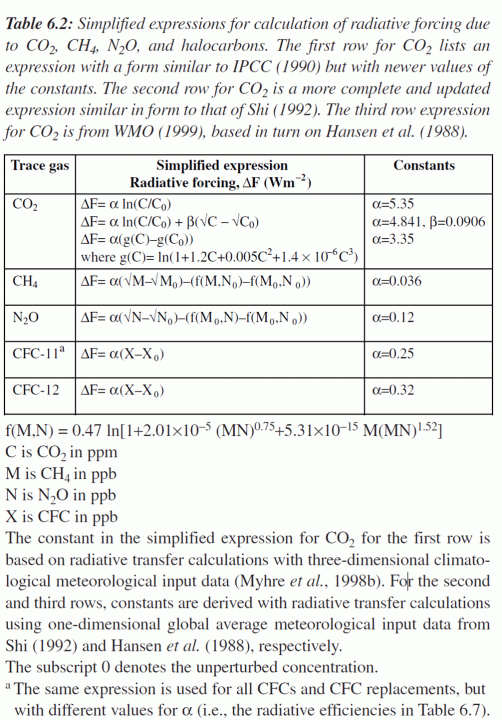
Figure 2: Radiative forcing table from TAR. [2001]
Did you notice anything missing from the chart in Figure 2? Even the IPCC contributors know that H2O is the most important greenhouse gas, yet there is no reference to it whatsoever.”
END QUOTE
In 1863 John Tyndall stated that based on experiments using early spectroscopy water vapor is the most important greenhouse gas. No one has produced evidence contradicting that statement. Yet, in calculating Radiative Forcing, the IPCC does not consider water vapor because it is not a “well mixed” greenhouse gas. Further water vapor changes the radiative forcing of CO2,CH4 (Methane), and N2O (Nitrous Oxide).
Emissions from modern agriculture of the latter two gases have been attacked by followers of the IPCC as well as attacks on emissions from the oil and gas industries for emissions of methane. Yet, the IPCC makes no effort to distinguish separate effects from water vapor. See Section 6.3.4 of the IPCC Third Assessment Report (TAR) https://www.ipcc.ch/site/assets/uploads/2018/03/WGI_TAR_full_report.pdf
*********************
2025 Frederick Seitz Award: At the Heartland Conference, on April 8th Ken Haapala presented Peter Ridd (via Zoom) with the trophy symbolizing his courage for speaking out against the false claims that carbon dioxide caused global warming is destroying the Great Barrier Reef in the Coral Sea off the coast of Australia. A professor of physics at James Cook University and member of the Australian Institute of Marine Science, Ridd has been studying the Reef since 1984 and boldly spoke out against claims that global warming was destroying the Reef. Officials at James Cook University dismissed him for his support of the scientific method. The presentation and Ridd’s acceptance are on the video of the Lunch Keynote Session following West Virginia’s Governor Patrick Morrisey’s address at about one hour twenty-two minutes after it began. See link under Challenging the Orthodoxy.
*********************
SEPP’S APRIL FOOLS AWARD
THE JACKSON
SEPP is conducting its annual vote for the recipient of the coveted trophy, The Jackson, a lump of coal. Readers are asked to nominate and vote for who they think is most deserving, following these criteria:
- The nominee has advanced, or proposes to advance, significant expansion of governmental power, regulation, or control over the public or significant sections of the general economy.
- The nominee does so by declaring such measures are necessary to protect public health, welfare, or the environment.
- The nominee declares that physical science supports such measures.
- The physical science supporting the measures is flimsy at best, and possibly non-existent.
Ursula von der Leyen, President of the European Commission, was the 2025 recipient. Past recipients are not eligible. See list at https://www.sepp.org/april-fools-award.cfm
The committee that makes the selection prefers a candidate with a national or international presence. The voting will close on July 31. Please send your nomination and a brief reason why the person is qualified for the honor to Ken@SEPP.org.
*********************
Number of the Week: +3 to 5 °C warming. Nature Geoscience journal published a paper “Deglaciation of the Prudhoe Dome in Northwestern Greenland in Response to Holocene Warming.” The abstract states, in part:
“Our results point to a substantial response of the northwest Greenland ice sheet to early Holocene warming, estimated to be +3–5 °C from paleoclimate data. This range of summer temperatures is similar to projections of warming by 2100 CE.”
Earth has been cooling since the early Holocene warming, and CO2 emissions will not result in a +3 to 5 °C warming. Based on current evidence, a doubling of Carbon Dioxide would result in a total warming of less than 1 °C. See link under Changing Climate.
NEWS YOU CAN USE:
Challenging the Orthodoxy — NIPCC
Climate Change Reconsidered II: Physical Science
Idso, Carter, and Singer, Lead Authors/Editors, Nongovernmental International Panel on Climate Change (NIPCC), 2013
Summary: https://www.heartland.org/_template-assets/documents/CCR/CCR-II/Summary-for-Policymakers.pdf
Climate Change Reconsidered II: Biological Impacts
Idso, Idso, Carter, and Singer, Lead Authors/Editors, Nongovernmental International Panel on Climate Change (NIPCC), 2014
http://climatechangereconsidered.org/climate-change-reconsidered-ii-biological-impacts/
Climate Change Reconsidered II: Fossil Fuels
By Multiple Authors, Bezdek, Idso, Legates, and Singer eds., Nongovernmental International Panel on Climate Change, April 2019
http://climatechangereconsidered.org/climate-change-reconsidered-ii-fossil-fuels/
Why Scientists Disagree About Global Warming
The NIPCC Report on the Scientific Consensus
By Craig D. Idso, Robert M. Carter, and S. Fred Singer, Nongovernmental International Panel on Climate Change (NIPCC), Nov 23, 2015
http://climatechangereconsidered.org/why-scientists-disagree-about-global-warming/
Nature, Not Human Activity, Rules the Climate
S. Fred Singer, Editor, NIPCC, 2008
http://www.sepp.org/publications/nipcc_final.pdf
Challenging the Orthodoxy – Radiation Transfer
The Role of Greenhouse Gases in Energy Transfer in the Earth’s Atmosphere
By W.A. van Wijngaarden and W. Happer, Preprint, Mar 3, 2023
Dependence of Earth’s Thermal Radiation on Five Most Abundant Greenhouse Gases
By W.A. van Wijngaarden and W. Happer, Preprint, December 22, 2020
https://wvanwijngaarden.info.yorku.ca/files/2020/12/WThermal-Radiationf.pdf?x45936
Net Zero Averted Temperature Increase
By Richard Lindzen, William Happer, and William A. van Wijngaarden, CO2 Coalition, June 2024
Radiation Transport in Clouds
By W.A. van Wijngaarden and W. Happer, Klimarealistene, Science of Climate Change, January 2025
Challenging the Orthodoxy
The 16th International Conference on Climate Change
Videos, April 8 & April 9
Declines in hot and cold daily temperature extremes in the conterminous US, 1899–2025
By John Christy, Theoretical and Applied Climatology, Apr 18, 2026 [H/t Bernie Kepshire]
https://link.springer.com/article/10.1007/s00704-026-06200-3
New paper: U.S. temperature extremes have declined since 1899, challenging assumptions about increasing heatwaves
By Anthony Watts, WUWT, Apr 21, 2026
Earth Energy Imbalance: The Sun versus CO2
By Andy May, WUWT, Apr 24, 2026
1. The average photon energy in GHG IR (greenhouse gas infrared) is less than the photon energy in solar radiation because energy goes up as frequency increases (Planck-Einstein relation).
2. Greenhouse gas-induced infrared radiation is absorbed almost entirely in the ocean’s top micrometers to one millimeter. This is the upper part of the thermal skin layer or “TSL,” and called the electromagnetic skin layer. Incoming solar radiation—particularly blue-green visible wavelengths—penetrate much deeper, typically over 10 meters (and up to 100+ meters in very clear waters), before being absorbed and heating the water column (Wong & Minnett, 2018).
3. The atmosphere, on average, is cooler than the bulk ocean which is the essence of the “cool skin effect” (Fairall et al., 2026). Heat flows normally from the ocean to the atmosphere.
4. The infrared energy from greenhouse gases absorbed in the thermal skin layer cannot be conducted downward into the bulk ocean since the net heat flux is upward. Instead, it adjusts the ocean’s thermal skin layer temperature profile, reducing upward conduction from the bulk ocean (Wong & Minnett, 2018).
[SEPP Comment: Item #3 asserts that the atmosphere immediately above the ocean is warmer than the ocean skin.]
Broadly Stable Atmospheric CO2 and CH4 Levels Over the Past 3 Million Years
By Julia Marks-Peterson, Nature, Mar 18, 2026 [H/t Bernie Kepshire]
https://www.nature.com/articles/s41586-025-10032-y
Short Summary of Observations Until March 2026
By Ole Humlum, Climate4you, Accessed April 25, 2026
Fossil Fuel Emissions from 1750 to Today Caused No Harm
By William Happer, Princeton University, Apr 23, 2026
file:///C:/Users/Owner/Downloads/Happer%20Fossil%20Fuel%20attribution%204-23-26.pdf
Biography William Happer, Ph.D. (Princeton): The Consequential Climate Physicist
By G. Shanmugam, CO2 Coalition, Apr 22, 2026
Fossil fuels, Climate Change, and the Vital Role of CO2 Plays in Thriving People and Plants on Planet Earth
By G. Shanmugam, Bulletin of the Mineral Research and Exploration, Vai CO2 Coalition, Apr 22, 2026
The Peer-Review Problem: A Sedimentological Perspective
By G Shanmugam, CO2 Coalition, Journal of Indian Association of Sedimentologists, Apr 20, 2026
[SEPP Comment: Sedimentologists are geologists who specialize in studying sediments and sedimentary rocks to understand their formation, composition, and the processes that shape them. From Wikipedia.]
Challenging the Orthodoxy — RIP
Vale Tom Quirk — a great mind and a true gentleman
By Jo Nova, Her Blog, Apr 20, 2026
https://joannenova.com.au/2026/04/vale-tom-quirk-a-great-mind-and-a-true-gentleman
Link to tribute page: Thomas William Quirk
27/04/1939 – 11/04/2026
Tom Quirk was one of the first to show one of the biggest flaws with the Australian wind turbine fleet, was that rather than randomly not working, they will all stop working together across several states of Australia. Tom did some very original work showing that phytoplankton are a much bigger source and sink of CO2 than most people realize
Defending the Orthodoxy
Don’t Make Me Tap the Sign
By Staff, Government Accountability & Oversight, Apr 23, 2026
Link to justification: Attribution of Extreme Weather and Climate Events and their Impacts
By James W. Hurrell, et al., Attribution Science Committee, National Academies of Science, Engineering and Medicine, In Progress
https://www.nationalacademies.org/projects/DELS-BASCPR-23-02
[SEPP Comment: GAO exposing a threat to the scientific method.]
Earth Day report: Almost half of US population breathes unhealthy air
By Sarah Davis, The Hill, Apr 22, 2026
https://thehill.com/policy/energy-environment/5843173-air-pollution-state-of-the-air
Link to report: State of the Air
By Staff, American Lung Association, 2026
[SEPP Comment: A donation-soliciting report showing that since 2004 the percentages of the population with F Grades for Ozone, PM2.5 are down.]
Questioning the Orthodoxy
The ‘Climate Change’ Bottom Line
By Robert Bradley Jr., Master Resource, Apr 24, 2026
Reports Bjorn Lomborg:
“Climate-related disaster deaths have declined 97.5% over the century (1920-2025). Richer, smarter, and more resilient societies reduce disaster deaths. This swamps any potential climate signal.”
The Paper That Breaks Climate Economics
Part 1 of 2 on a damning new paper that takes on the top-down climate-economics literature — “The empirically inscrutable climate-economy relationship”
By Roger Pielke Jr., His Blog, Apr 20, 2026
Link to: The empirically inscrutable climate-economy relationship
By Finbar Curtin and Matthew G. Burgess, Department of Economics, University of Wyoming, Apr 20, 2026, Preprint
Cargo Cult Climate Economics
Part 2 of 2 on a damning new paper that takes on the top-down climate-economics literature — “The empirically inscrutable climate-economy relationship”
By Roger Pielke Jr., His Blog, Apr 23, 2026
Real World Energy Flows Negate CO2 Hysteria
By Ron Clutz, His Blog, Apr 20, 2026
From: How Increased CO 2 Warms the Earth-Two Contexts for the Greenhouse Gas Effect Mini Review Article Information
By Donald Rapp, 1gMin Research, Oct 24, 2024
From the abstract: It is concluded that almost all discussions of the greenhouse effect are based on the fundamental greenhouse gas effect, which is a hypothetical construct, while the current greenhouse gas effect is what is happening now in the real world. Adding CO2 does not add much to a “thermal blanket” but instead, drives emission from the Earth to higher, cooler altitudes
ECS, EffCS, and the 25-year Paradox, What CERES tells us
By Andy May, WUWT, Apr 22, 2026
Defining ECS [Equilibrium Climate Sensitivity]
To understand what CERES can and cannot tell us, we need to revisit how ECS is currently defined and how the definition shifted after AR5 (IPCC, 2013). The definition of ECS used by the IPCC through AR5 probably originated with Gunnar Myhre (Myhre et al., 1998).
The UK and EU Increasingly Resemble the Soviet Union With Their Sham Democracy and Rigid Ideology
By Tilak Doshi, His Substack, Apr 22, 2026
After a week of mass protests, Ireland was brought to a standstill. Farmers, truckers and haulers blockaded motorways, ports and the country’s only oil refinery, leaving a third of petrol stations dry. The immediate trigger was a sharp spike in global fuel prices caused by the US-Israel military operations against Iran and the resulting disruptions in the Strait of Hormuz. But the deeper grievances were plain. Protesters demanded not only a fuel-price cap but the suspension of planned carbon-tax increases — policies that had already turned energy into a luxury for many households.
Resourceful Earth Day: Fred Smith on Julian Simon
By Robert Bradley Jr., Master Resource, Apr 22, 2026
Editor’s Note: Today has been celebrated since 1970 as Earth Day. With the Progressive Left all but abandoning its significance, the opportunity is to rebrand April 22nd as Resourceful Earth Day. Human ingenuity, despite Statism, has proven optimist/realist Julian Simon correct, as noted by CEI founder and longtime head Fred Smith in this 1999 tribute.
“The problems of famine, overpopulation, poverty, and disease are resolvable. In fact, they have been resolved in the United States and other places where human ingenuity is free to solve them.”
Earth Day News: The planet is still doing great. It’s the climate cult that’s broken
By Ron Clutz, His Blog, Apr 22, 2026
From: The planet is still doing great. It’s the climate cult that’s broken
By Jason Isaac, Steve Milloy, Washington Examiner, Apr. 21, 2026
Tidbits
By John Robson, Climate Discussion Nexus, Apr 22, 2026
All meetings all the time: we hear from COP Whatever via email that “Next week Green Transformation (GX) Week gets underway on Monday 20 April in tandem with UN Climate Week 3 (CW3), which kicks off on Tuesday 21 April.” And apparently a highlight will be UN Climate Change Executive Secretary Simon Stiell saying what he always does, with this new wrinkle: “Clean energy is the antidote to fossil fuel cost chaos, because it is cheaper, safer and faster-to-market.” Right. Which is why countries that traded their domestic oil and gas production capacity for windmills are laughing off the Iran War while those who foolishly went in for drilling and fracking are… uh…
Problems in the Orthodoxy
Scientists Rethink Extreme Warming After Surprising Ocean Discovery
By Staff, MARUM – Center for Marine Environmental Sciences, University of Bremen, Science Tech Daily, April 18, 2026 [H/r Graeme Phippsandass]
Link to paper: Coccolith clumped isotopes reveal modest rather than extreme northern high latitude amplification during the Miocene
By Luz María Mejía, et al. Nature Communications, Dec. 9, 2026
Article opens with: Researchers have applied a temperature proxy to exceptionally well-preserved fossil phytoplankton for the first time.
[SEPP Comment: This is not the first time. It verifies what earlier research showed.]
Earth Day 2026: “Our Power, Our PlanetTM, Our Propaganda” Redux
By Benjamin Zycher, Real Clear Energy, Apr 21, 2026
Cracks Appear in Climate Consensus as Germany’s Energy Minister Admits Renewable Energy is Ruining the Country
By Tilak Doshi, Via TWTW, Apr 18, 2026
Guardian: At 1.5C 90% of Coral Reefs will Die
By Eric Worrall, WUWT, Apr 23, 2026
“Coral reefs are nearing extinction. 2026 must mark a turning point.”
Social Benefits of Carbon Dioxide
#DoEDeepDive: Climate change and agriculture
By John Robson, Climate Discussion Nexus, Apr 22, 2026
Alas reality is tricky, as Thomas Sowell observed. And as the DoE team point out, a problem with all these studies is they ignore the direct effects of CO2 and only look at how temperature might impact agriculture. So the team turned to laboratory and field studies, drawing on findings from our old friends at CO2Science.org among others. Based on studies in that archive and other evidence published by the National Bureau of Economic Research they concluded that CO2 boosts the growth of important agricultural crops.
The effect of CO2 on the Gum Arabic tree
By John Robson, Climate Discussion Nexus, Apr 22, 2026
From the CO2Science archive:
Seeking a Common Ground
ENSO Predictability From Combined Wyrtki and Hasselmann Memory in a Cyclostationary Linear Inverse Model
By Yuxin Wang, et al., Geophysical Research Letters, Apr 14, 2026 [H/t Bernie Kepshire]
From plain language summary: Here we build on a data-driven method called the Linear Inverse Model (LIM), which uses past climate observations to predict future changes. Our updated design incorporates two sources of predictability: (1) “Wyrtki memory,” the recharge/discharge of equatorial Pacific upper-ocean heat that drives ENSO, and (2) “Hasselmann memory,” the persistence of sea surface temperatures outside the tropical Pacific that interact with ENSO. By combining these processes within a seasonally aware framework, the new LIM produces forecasts that extend more than a year ahead and compare well with the most skillful models available today. It also predicts strong ENSO events and explains why earlier LIMs fail to maintain skill beyond about 12 months.
The Washington Post Gets It Right on Typhoon Sinlaku
By Anthony Watts, Climate Realism, Apr 17, 2026
Models v. Observations
The CO2 Problem: Climate Models vs. Field Measurements
By G. Shanmugam, Department of Earth and Environmental Sciences, The University of Texas at Arlington, Arlington, Texas, Via CO2 Coalition, Apr 22, 2026
Measurement Issues — Surface
The Urban Heat Island and Urban Cool Island: A Few Examples for U.S. Major Metropolitan Areas
By Roy Spencer, His Blog, Apr 23, 2026
March 2026 Mild Warming SSTs Continue
By Ron Clutz, His Blog, Apr 24, 2025
Changing Weather
El Nino To The Rescue?
By Tony Heller, His Blog, Apr 24, 2026
The US is experiencing the worst springtime drought on record
[SEPP Comment: The US Drought Monitor started in 1999 as a federal, state, and academic partnership. The Palmer drought index began after meteorologist Wayne Palmer published his simple water balance model in 1965. So “the record” does not go back to the 1930s, a period of severe drought in the US.]
Changing Climate
Deglaciation of the Prudhoe Dome in Northwestern Greenland in Response to Holocene Warming
By Caleb K. Walcott-George, et al., Nature Geoscience, Jan 5, 2026 [H/t Bernie Kepshire]
From the abstract: Our results point to a substantial response of the northwest Greenland ice sheet to early Holocene warming, estimated to be +3–5 °C from palaeoclimate data. This range of summer temperatures is similar to projections of warming by 2100 CE.
[SEPP Comment: Earth has been cooling since the early Holocene warming, and CO2 emissions will not result in a +3–5 °C warming.]
Changing Earth
Global subsidence of river deltas
By L. O. Ohenhen, et al., Nature, Jan 14, 2026 [H/t Bernie Kesphire]
From abstract: Here we present spatially variable surface-elevation changes across 40 global deltas using interferometric synthetic aperture radar. Using this dataset, we quantify delta surface-elevation loss and show the prevalence and severity of subsidence in river deltas worldwide. Our analysis of three key anthropogenic drivers of delta elevation changes shows that groundwater storage has the strongest relative influence on vertical land motion in 10 of the 40 deltas. The other deltas are either influenced by multiple drivers or dominated by sediment flux or urban expansion.
Changing Seas
Gray whales (Eschrichtius robustus) in San Francisco Bay experience high mortality and have limited affiliation to known foraging groups
By Josephine M. Slaathaug et al., Frontiers in Marine Science, Apr 12, 2026 [H/t Bernie Kepshire]
From abstract: A coastal marine species that undertakes a long migration between breeding and foraging ranges, the Eastern North Pacific (ENP) population of gray whales (Eschrichtius robustus) is especially vulnerable to changes. Subgroups of ENP gray whales, including the Pacific Coast Feeding Group and the (Puget) Sounders, have adapted to exploit alternative feeding grounds as prey availability declines in the Arctic. Novel to known migration phenology, gray whales have been observed seasonally since 2018 in San Francisco Bay (SF Bay), California. We evaluated subgroup identity and mortality of gray whales in SF Bay from 2018–2025 using photo-identification.
[SEPP Comment: The eastern Pacific Gray Whale population has rebounded since whaling ended, but it is subject to periods of setback.]
Lowering Standards
Govt Cover Up Inconvenient Winter Excess Deaths Data
By Paul Homewood, Not a Lot of People Know That, Apr 24, 2026
It has long been known that many more people in the UK die in winter months than at other times of year. It has never been a secret.
Year after year, the ONS, Office for National Statistics, published the data to prove it.
Miraculously, excess winter deaths have fallen from tens of thousands to just 2544!
Communicating Better to the Public – Use Yellow (Green) Journalism?
Wrong, The Independent, the Atlantic Current Isn’t on the Brink of Collapse
By Anthony Watts, Climate Realism, Apr 20, 2026
What a 5,000-mile-long marine heat wave means for summer in the US
By Ben Noll, Washington Post, No Date [H/t Bernie Kepshire]
[SEPP Comment: Fear the El Niño that has never appeared before! It was observed by natives prior to the arrival of Europeans.]
Will 2026 Be An Above-Normal Wildfire Year in Washington State?
By Cliff Mass, Weather Blog, Apr 20, 2026
Virtually every spring, some media and activists claim that the upcoming summer will bring above-normal wildfire activity over the Pacific Northwest because of global warming/climate change…
The Seattle Times Climate Lab consistently predicts above-normal fire risks.
No, WHYY, a Heat Wave Is Not a ‘Fingerprint of Climate Change’
By Linnea Lueken, Climate Realism, Apr 16, 2026
Stop Protecting Insurance Profiteers, San Francisco Chronicle, Climate Change Is Not Responsible for California’s High Cost of Living
By Linnea Lueken, Climate Realism, Apr 21, 2026
Communicating Better to the Public – Exaggerate, or be Vague?
Synergistic Impact of Marine Heat Waves and Rapid Intensification Exacerbates Tropical Cyclone Destructive Power Worldwide
By Soheil Radfar, et al;., Science Advances, Apr 10, 2026 [H/t Bernie Kepshire]
From introduction: Human activities have led to unprecedented global warming, making tropical cyclones (TCs) stronger over the past four decades.
[SEPP Comment: There is nothing unprecedented about recent warming if one considers history. The Global Tropical Accumulated Cyclone Energy (ACE) index has not increased since 1994 (global data was incomplete in the 1970s)]
IEA chief: ‘We are facing the biggest energy security threat in history’
By Rachel Frazin, The Hill, Apr 23, 2026
[SEPP Comment: Who’s we? In the 1970s the OPEC embargo was far worse which led to the formation of the IEA.]
Communicating Better to the Public – Do a Poll?
Just like that: Most Australians want to drill, baby, drill for oil and gas, and don’t care about “Net Zero”
By Jo Nova, Her Blog, Apr 23, 2026
A few weeks of high fuel prices have destroyed 20 years of climate propaganda, pfft!
Australians have barely mentioned drilling for oil in Australia in the last twenty years. It was unthinkable. But two new polls show a dramatic awakening. Suddenly Australian voters want more oil and gas. In the first poll, 65% supported more drilling for oil and gas, and in the second poll, it was 57%. These are whopping majorities. And we’ve barely started to discuss it.
Communicating Better to the Public – Use Propaganda
The Dying Embers of Net Zero Propaganda
By David Turver, The Daily Sceptic, Apr 29, 2026 [H/t Bernie Kepshire]
A quick glance at the headlines reveals we are in the midst of one of the worst energy crises in history. Both oil and gas prices have spiked because of the effective closure of the Strait of Hormuz. UK electricity prices have gone up too.
This has led Ember (the same people who came up with Ed Miliband’s promise to cut energy bills by £300) to claim that renewables have cut gas generation compared to March 2021 and saved us £7 million per day.
Questioning European Green
Britain’s Skyrocketing Green Energy Prices are Forcing Internet Providers to Ration Access
By Eric Worrall, WUWT, Apr 23, 2026
From Express News
“Energy costs are continuing to surge with prices increasing by 70% in recent years. The closure of the Strait of Hormuz has caused the price of electricity to rise by 33% since the start of the war in Iran.”
Questioning Green Elsewhere
The dirty secret behind our clean green future aired on mainstream TV
By Jo Nova, Her Blog, Apr 22, 2026
[SEPP Comment: The video begins with cobalt mining in the Congo and goes from there.]
Suddenly, Climate is Yesterday’s Crisis
By Michael Kile, Quadrant.au, Apr 23, 2026
In all my discussions with myself, I could not identify one country around the world that could tell me precisely how renewable energy will improve a regional, national or global climate, let alone ensure fuel security along the way. We are arguably already a vassal state of China, and now a casualty of Middle East conflict again. So much for Future Made in Australia.
By the way, how confident should we be are [believe?] about the science of climate change? Let’s ask the CSIRO.
Non-Green Jobs
FAA Levels Up Recruiting: Gamers Targeted for Air Traffic Control Jobs
Effective new ad results in 6,000 application submissions.
By Leslie Eastman, Legal Insurrection, Apr 22, 2026
Funding Issues
National Science Foundation’s future in limbo as Trump eyes cuts
By Fiona Bork, The Hill, Apr 19, 2026
Not complicated
By John Robson, Climate Discussion Nexus, Apr 22, 2026
It seems a very long time since Joe Biden was president and the US government was throwing bazillions of dollars at the climate crisis in expensively ineffective ways via the “Inflation Reduction Act”.
Litigation Issues
Good News: Fifth Circuit Says Government’s Tax Power Is Not Designed to Control Behavior
By Gary Abernathy, Real Clear Energy, April 24, 2026
A somewhat under-the-radar decision by the U.S. Court of Appeals for the Fifth Circuit earlier this month is, on its surface, focused on the issue of home alcohol distilling. But the appeals court’s reasoning could have a big impact on other businesses and various walks of life, including the energy industry.
In short, McNutt vs. U.S. Department of Justice focused on a federal law that banned – through the government’s taxation power – the private home distillation of alcohol. But the Fifth Circuit ruled that using the power to tax as a reason to ban something is an improper abuse of power. This line of constitutional thinking could have much larger implications.
Climate Change as Public Nuisance
A Backdoor Scheme to Dictate America’s Energy Policy
By Rea S. Hederman Jr., et al, The Buckeye Institute, Apr 9 2026
Plaintiffs rely on so called “attribution science” to assess fossil fuel companies’ liability for any costs the locality claims to have incurred due to climate change—from needing a new water treatment plant to declining tourism.
This “novel claims would financially cripple energy companies, inflict significant economic harm, and turn the limited public nuisance theory into a boundless tort action available for economic engineering.” [Defendants]
City of Birmingham Retirement and Relief System v Rex Tillerson, et al.
By Russell Cook, GelbspanFiles.com, Apr 19, 2026
Massachusetts was filed on Oct 24, 2019, Birmingham was filed just 39 days later on Dec 2, 2019. Coincidence? Or one more indicator that there’s a behind-the-scenes shared template among all these supposedly unrelated law offices?
The Climate Litigation Swindle
A flood of lawsuits utilizing junk science seeks to bankrupt energy companies and undermine the basis of American power.
By Heather MacDonald, City Journal, Spring 2026
Very long essay.
EPA and other Regulators on the March
The End of EPA’s Endangerment Finding Is a Bigger Deal Than the Iran War
By William Murry, WUWT, Apr 21, 2026
Energy Issues – Europe
Giant Yorkshire Gas Field ‘To Mine Bitcoin Instead of Boosting British Energy’
By Richard Eldred, The Daily Sceptic, Apr 19, 2026
Bitcoin mining is one of the most energy-intensive of all digital activities. A power station would need to burn around 150,000 cubic metres of gas – the volume of 50 Olympic swimming pools – to generate the electricity needed to create one Bitcoin.
Reabold’s West Newton gas field is so large that it could theoretically power the creation of 50,000 Bitcoins.
Record Low Carbon Power Is A Problem, Not An Achievement
By Paul Homewood, Not a Lot of People Know That, Apr 24, 2026
Following the hoopla from NESO [UK National Energy System Operator] about record “low carbon electricity” yesterday, it is worth looking at the overall picture for the day:
We can see immediately that there is a massive problem – there is a huge surplus of power in the middle of the day, indeed from 9am through to 5pm. In theory it should be possible to store all of this surplus during the day and use it to fill the shortages at night.
But the cumulative surplus during the day builds up to 150 GWh, which is much higher than the storage we currently have available. According to NESO Future Energy Scenarios, we just have 10 GW, with storage of 37 GWh. Even their forecast for 10 years’ time is still only 65 GWh:
The weather yesterday was by no means unusual, and it is certain that power surpluses will be considerably higher on days in mid-summer.
There is another problem with the “storage solution”. Battery storage operators, particularly those linked to solar farms, need to make money. Their business model is to sell the stored electricity when prices are high. For a solar farm, that means higher than their CfD strike price. There is no point in just discharging the batteries at night, if market prices then are not high enough to cover energy losses, depreciation and other costs.
Record Breaking? Hardly!
By Paul Homewood, Not a Lot of People Know That, Apr 24, 2026
At that precise moment. the grid still needed 46.9% of proper, reliable generation.
Miliband Doubles Down on Net Zero
By Paul Homewood, Not a Lot of People Know That, Apr 24, 2026
And as we know, the actual payments to older renewables, including ROC subsidies, is much higher than the price of gas power. If Miliband really wanted to bring down bills, the first thing he would do is abolish carbon taxes, which inflate the very market price he says is too high.
Activist Yorkshire Councillor Demands the British Government make Fossil Fuel Extraction More Difficult
By Eric Worrall, WUWT, Apr 24, 2026
Energy Issues – Australia
A sick grid! In the rush to electrify Victoria, voltage falls too low for EV Chargers, microwaves and cooktops
By Jo Nova, Her Blog, Apr 24, 2026
It’s just another hiccup on the road to Utopia
Two years ago the Victorian government banned new houses adding a gas connection. The houses had to be built “all electric”. It’s all part of a smooth and efficient transition, the government said. (And you ‘vill save money whether you like it or not.*).
However the demand for electricity in some areas is so high that the voltage falls, and some householders can only use one hotplate on the stove at a time, or they can’t get the heat pump to work at all. And naturally, they can’t charge their electric vehicle. But it’s all for a good cause — pagan weather control.
Check, mate
By John Robson, Climate Discussion Nexus, Apr 22, 2026
Australia’s “Climate Change and Energy Minister”, didn’t actually pose in front of the flames engulfing Viva Energy’s Geelong facility and say “What fire?” But he did babble these silly talking points: “This is not a good development when it comes to what we’re managing, but we’re managing it. This in and of itself – because Viva have told us that they’re very confident they can replace the petrol with imports – won’t lead to a change in the status of the four-point fuel plan.” Ah, the four-point fuel plan. The one where you point in all four directions rhetorically then scuttle out the back door? Or the one where you close your eyes, click your heels together three times and say “Green Energy Transition” and then just keep your eyes shut? Including to the increasingly glaring contradiction between “Climate Change Minister” and “Energy Minister”.
Australia has a gas problem
Canberra must get serious about domestic reserves and natural resources
By Alan Moran, Spectator Australia, Mar 25, 2026
Energy Issues – Elsewhere non-US
Wind and solar focus threaten America’s and South Africa’s economy
By Ronald Stein, et al., America Out Loud News, Apr 20, 2026
Link to: Integrated Resource Plan 2025
By Staff, Department of Mineral Resources & Energy, Republic of South Africa, 2025
Canada’s new old government pirouettes
By John Robson, Climate Discussion Nexus, Apr 22, 2026
As a result we are now last in the G7 in capital investment. And we are not moving at any kind of speed to fix the barriers to investment. Not least because we are complacent to the point of self-parody.
Thus on the question of a temporary partial break on gas taxes Prime Minister Carney also said:
“When Canadians are facing financial pressures, they carefully manage their expenses. They expect their government to do the same.”
Hoo hah! In the first place, his government’s management of expenses is at once frivolous and frightening. In the second, no Canadian who’s been watching government finances over the last two decades could possibly expect their government to do anything other than live far beyond its means.
In the third, it is the declared purpose of this administration, to the extent that its mumblings can be deciphered, to jack up the price of fossil fuels so we all stop using them. It is why his “Memorandum of Understanding” with Alberta made higher industrial carbon taxes a precondition for pretending to approve new pipelines. But as G.K. Chesterton wisely observed:
“Men always mean something, even when their words mean nothing.”
And Mark Carney means to push through the Green Energy Transition through whatever means grease the skids.
Energy Issues — US
The Chance of Blackouts
By Kevin Kilty, WUWT, Apr 24, 2026
Link to: Long-Term Reliability Assessment
By Staff, North American Electrical Reliability Council, January 2026
If analysis by the North American Electrical Reliability Council is to be taken seriously, unplanned outages may soon become common in much of the U.S.
America Is Producing More Energy Than Ever. Our Supply Chains Are Not Keeping Up.
By Fedor Zakusilo, Real Clear Energy, Apr 21, 2026
Link to press release: EIA releases the Annual Energy Outlook 2026
By Staff, EIA, Apr 8, 2026
Link to report: Annual Energy Outlook 2026
By Tristan Abbey et al., EIA, Apr 8, 2026
From article: Part of the answer, as API President Mike Sommers recently pointed out, is infrastructure and permitting. The Marcellus Shale – one of the most productive natural gas formations on the planet – sits 100 miles from New York City, and yet communities across the Northeast still cannot reliably access that gas when demand spikes, because we haven’t built the pipelines to connect supply to need. He’s right, and Washington should act.
You Can’t Regulate Your Way to More Electricity
By Vladlena Klymova, Real Clear Energy, April 23, 2026
The power grid’s capacity is projected to increasingly lag behind demand in many areas over the next decade. One reason is that new power plants and transmission lines are not being built fast enough; another is that large consumers such as data centers, which prioritize fast and reliable energy over lower rates, have almost no alternatives to the conventional grid. Underlying both, however, are pervasive rules and restrictions at all three levels of government: federal, state, and local.
[SEPP Comment: Another problem is state and local onerous regulations promoting unreliable wind and solar.]
Update On New York Climate Act Negotiations: Details Starting To Emerge
By Francis Menton, Manhattan Contrarian, Apr 23, 2026
This whole crowd — [Gov.] Hochul, the legislative leaders and the climate activists — are united in two fundamental assertions: (1) blaming President Trump for wrecking their ability to meet the Climate Act mandates because he withdrew federal subsidies via the One Big Beautiful Act or otherwise, and (2) claiming that wind and solar electricity generators are somehow cheaper than the existing hydrocarbon (fossil fuel) alternatives and would bring down consumer costs if only they could be built.
Fermi Troubles: A Warning for the Texas Grid
By Bill Peacock, Master Resource, Apr 23 2026
“A properly functioning market … simply needs clear price signals, enforceable property rights, and the freedom for buyers and sellers to contract with one another…. The Public Utility Commission of Texas effectively imposed a $26.3 billion monopoly tax on Texans by overriding the market signals the Legislature had said should govern the system.”
America Can’t Reindustrialize on Chinese Batteries
By Craig Singleton, Real Clear Energy, April 24, 2026
How we pay for solar subsidies – Comparing recent electric bills from Florida and Massachusetts
By Reiner Kuhr, His Blog, Mar 21, 2026 [H/t Bernie Kepshire]
Almost 2/3 of Massachusetts’ current electricity bills are driven by state energy policies whose potential benefits need to be carefully examined to ensure that higher costs are justified.
The next Project Vault should protect America’s power grid
By Dan Giamo, CFACT, Apr 20, 2026
Washington’s Control of Energy
Trump Could Help Stabilize the Price of Gas With This Simple Federal Preemption
By Sam Raus, Real Clear Energy, Apr 20, 2026
The Trump administration could move more quickly by federally preempting state low-carbon fuel standards (LCFS), which require oil and gas refiners to purchase credits from alternative fuel producers.
Yes, We Do Need Persian Gulf Oil
By Gary J. DiElsi, Real Clear Energy, Apr 22, 2026
In fact, over the years many US refineries were designed for specific heavy crudes.
But this custom design for heavy crudes usually means that the refinery is set for a specific proportion of the lighter and heavier components expected from the chosen crude (within limits), with more heavy components expected than light components. If you distill a much lighter crude in this refinery, the proportions of light and heavy components you get are out of balance with the design – much more light, much less heavy. The refinery’s overall heavy capability will not be fully taxed, but its light capability may be overloaded. If so, you have to reduce the crude volume back down, so you don’t exceed your refinery’s light capability.
[SEPP Comment: The Gulf of America (Mexico) has the heavy crude needed, but the previous administration throttled the development of these resources.]
Trump’s Jones Act Waiver Is a Fossil Fuel Handout
By Ethan Brown, Real Clear Energy, April 23, 2026
[SEPP Comment: Is waiving a hundred-plus year law which creates obstacles for interstate commerce is a handout (subsidy)?]
Nuclear Energy and Fears
Chernobyl at 40: The World’s Worst Nuclear Power Accident and Where It Stands Now
By Alice Marchuk, Jack Goras, and Aaron Larson, Power Mag, Apr 1, 2026
It remains the only accident in the history of commercial nuclear power reactors where radiation-related fatalities occurred, and its consequences—human, environmental, political, and technical—continue to reverberate four decades later.
[SEPP Comment: At an identical reactor in St Petersburg, there was almost a similar accident several years before the Chernobyl accident. Information about that near disaster did not get to Chernobyl because the KGB kept it secret.]
Alternative, Green (“Clean”) Energy — Other
Reality takes wing
By John Robson, Climate Discussion Nexus, Apr 22, 2026
Under the snide headline “Climate unfriendly skies” Bloomberg Green complains that “Delta Air Lines Inc. quietly scrubbed a pair of key environmental targets from its sustainability web page”, namely by dropping its plan for hitting 10% of “sustainable aviation fuel” by 2030 and rephrasing Net Zero by 2030 as an “aspiration” not a “goal”.
We do not go so far as to say that corporations were only pretending to embrace Net Zero. But we do say that a shortage of the fuel they said they planned to stop using anyway reveals once again that it is easy to indulge luxury beliefs, but they do not hold up in hard times. It was easy to pretend it was dispensable when there was no real prospect of having to dispense with it, but it is impossible to deny that it is crucial when it started running short.
Alternative, Green (“Clean”) Energy — Storage
In the rushed home battery boom 60% of installations were substandard, and maybe 3000 “unsafe”
By Jo Nova, Heer Blog, Apr 21, 2026
Alternative, Green (“Clean”) Vehicles
Major Fire At Norfolk Lithium Battery Recycling Plant
By Paul Homewood, Not a Lot of People Know That, Apr 24, 2026
Carbon Schemes
Carbon discredit
By John Robson, Climate Discussion Nexus, Apr 22, 2026
As Gelles also wrote, with untouching naivete:
“Microsoft has been the biggest supporter of the much-hyped market for carbon removal technologies, which are designed to remove a key planet-warming gas from the atmosphere.”
We won’t get sidetracked by “a key planet-warming gas” here. But we will note “designed to remove” because it’s not the same thing as “effective at removing”. Nor is “hyped” the same as “proven.” Which might explain why there weren’t a lot of buyers and now “the outlook for the hundreds of companies looking to sell those credits is grim.”
And surely when a whole lot of people are lining up to sell something nobody is lining up to buy, it ought to raise suspicions. Alas, climate alarmists seem not to have good filters for nonsense.
California Dreaming
The Abundance Alliance
By Edward Ring, California Policy Center, Apr 22, 2026
California’s high-tech entrepreneurs are no longer just designing chips and software. They are becoming industrialists. SpaceX, Tesla, and Anduril are dramatic early examples. Every imaginable industrial sector is on the cusp of another leapfrogging revolution, lowering costs and increasing productivity not by percentages, but by multiples. Software and chips were largely exempt from hyper-regulation. Industry, on the other hand, is not. The tech giant has been awakened.
Other Scientific News
Stradivari’s violins and the Maunder minimum
By John Robson, Climate Discussion Nexus, Apr 22, 2026
Link to paper: Tracing the origins of Stradivari’s resonance wood
By Mauro Bernabel, et al, Dendrochronologia, February 2026
BELOW THE BOTTOM LINE
The Guardian’s most idiotic article ever? “Are OnlyFans models the best way to explain the climate crisis?”
By Eric Worrall, WUWT, Apr 21, 2026
ARTICLES
1. America’s First Commercial Nuclear-Power Projects in a Decade Just Broke Ground
Bill Gates-backed TerraPower and Google partner Kairos are building nuclear plants in Wyoming and Tennessee
By Jennifer Hiller, WSJ, April 23, 2026
TWTW Summary: The articles begins with:
“The first commercial nuclear-power projects in a decade are now under construction in the U.S., a potential turning point for a segment of the power industry that has been stuck in neutral for years.
A project by TerraPower, a company founded by Bill Gates almost 20 years ago, started construction Wednesday in Wyoming, while Kairos Power broke ground last week in Tennessee on a plant that intends to sell power to Google.
For years, nuclear power’s would-be revival has been more concept than reality, dominated by designs and climate pledges, but with little under construction. The renewed interest comes alongside the biggest jump in electricity demand in a generation, much of it driven by the need to power data centers for artificial intelligence. That has sent the tech industry on the hunt for towering amounts of energy.
TerraPower and Kairos are among the developers trying to prove that smaller streamlined reactor designs can overcome the problems the industry is known for: cost overruns and delays that contributed to a loss of enthusiasm for the technology. Most of the nuclear power plants in U.S. were built before 1990.
‘This isn’t a test reactor,’ said Chris Levesque, president and chief executive of TerraPower. ‘This is a grid-scale nuclear reactor that will be built in 42 months.’
Federal regulators last month gave TerraPower the greenlight for construction of a nuclear plant on a site where it had been building nonnuclear support facilities for nearly two years. It was the first such license in years for a commercial project, though the company will need a separate approval to load fuel and begin operations.
People in hard hats breaking ground with shovels at Kairos Power Hermes 2 site.
The Kairos Power groundbreaking event in Oak Ridge, Tenn., last week. Kairos Power
Getting to this point required the work of 1,000 engineers, Levesque said. ‘It’s going to take a lot more persistence going forward,’ he said. ‘It’s really not a business for the faint at heart.’
The project will employ up to 1,600 construction workers. Once operating, it expects to have about 250 employees.
Traditional U.S. reactors use water to cool the reactor core. TerraPower will use liquid sodium, which has a higher boiling point and allows operations at lower pressures with a more streamlined design than conventional projects. The 345-megawatt plant will include an energy-storage system that could boost output to 500 megawatts during times of peak electricity demand.
The TerraPower reactor will deliver electricity into utility PacifiCorp’s multistate transmission system. The reactor is part of a public-private partnership with the Energy Department’s Advanced Reactor Demonstration Program, a 50-50 cost share that has authorized up to $2 billion in federal funding for the project.
Earlier this year, Facebook parent Meta Platforms said it would provide capital to accelerate the development of up to eight additional TerraPower units. Locations haven’t yet been announced.”
After discussing the involvement of Gates, the article concludes with:
“In Oak Ridge, Tenn., the first Kairos plant will supply up to 50 megawatts of electricity to the Tennessee Valley Authority, a federal utility. The Kairos reactor is licensed for research and development but is still allowed to produce and sell electricity.
Supplying power to TVA will help to offset the carbon emissions of Google data centers in Tennessee and Alabama. The tech company agreed in 2024 to buy power generated by several Kairos reactors and hopes to receive up to 500 megawatts of nuclear power over the next 10 years.
Kairos uses molten fluoride salt as a coolant, allowing it to operate at low pressures and high temperatures, and it also has a smaller demonstration reactor under construction in Oak Ridge.
The adjacent locations allow the same contractors and crews to move from one site to the next. Kairos has tried to mirror the rapid prototyping of the aerospace industry by building engineering test units at a factory in New Mexico.
‘Virtually nothing’ for the latest project will be first of a kind, said Mike Laufer, CEO of Kairos. ‘We understood the iterative process was going to be really valuable for the reactor system and for hardware and those components. We did not anticipate how powerful it could be on the civil construction side.’
About 20% of U.S. power comes from nuclear plants. The two most recent commercial reactors built in the U.S. were larger-scale projects that began construction in Georgia in 2013. One was finished in 2023 and the other in 2024, with total project costs that rose well over $30 billion.
Smaller-scale reactors are considered less of a risk than large projects, but still must prove themselves commercially.
‘In more than a decade we have not broken ground on a new commercial nuclear project and now we have two under way,’ said Adam Stein, director for nuclear energy innovation at the Breakthrough Institute, a think tank that advocates for expanding nuclear power..
‘It’s very significant,’ he added. ‘These are both long planned projects that didn’t just materialize in the last year or two.’”
