Via SpaceWeather.com A full-halo CME is heading for Earth following a long-duration X1.9-class solar flare on Jan. 18th. The CME’s arrival on Jan. 20th could spark strong geomagnetic storms with auroras at mid-latitudes.
Sunspot 4341 erupted on Jan. 18th (1809 UTC), producing an X1.9-class solar flare. The explosion lasted for hours, which makes this flare even more powerful than than its “X1.9” rating would suggest. This video from NASA’s Solar Dynamics Observatory says it all: (animation may take a few seconds to load)

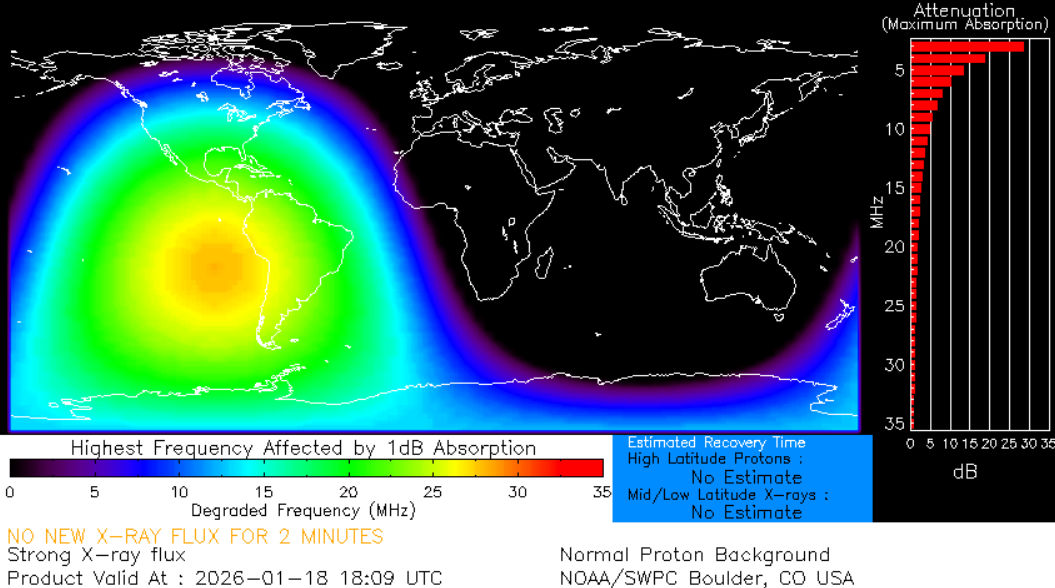
Radiation from the flare ionized Earth’s atmosphere over the Americas, especially South America. This caused a shortwave radio blackout that may have lasted more than an hour at frequencies below 10 MHz.
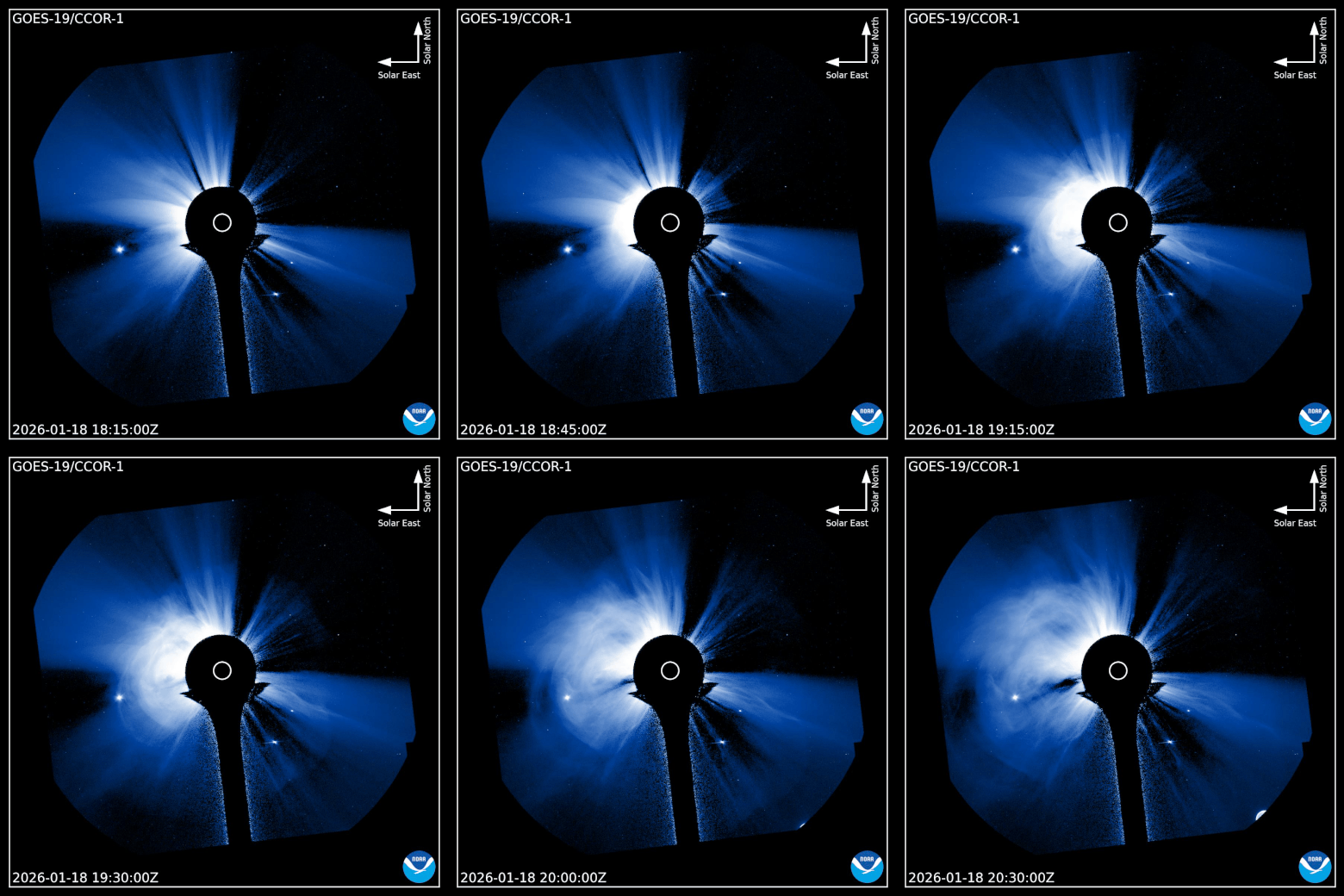
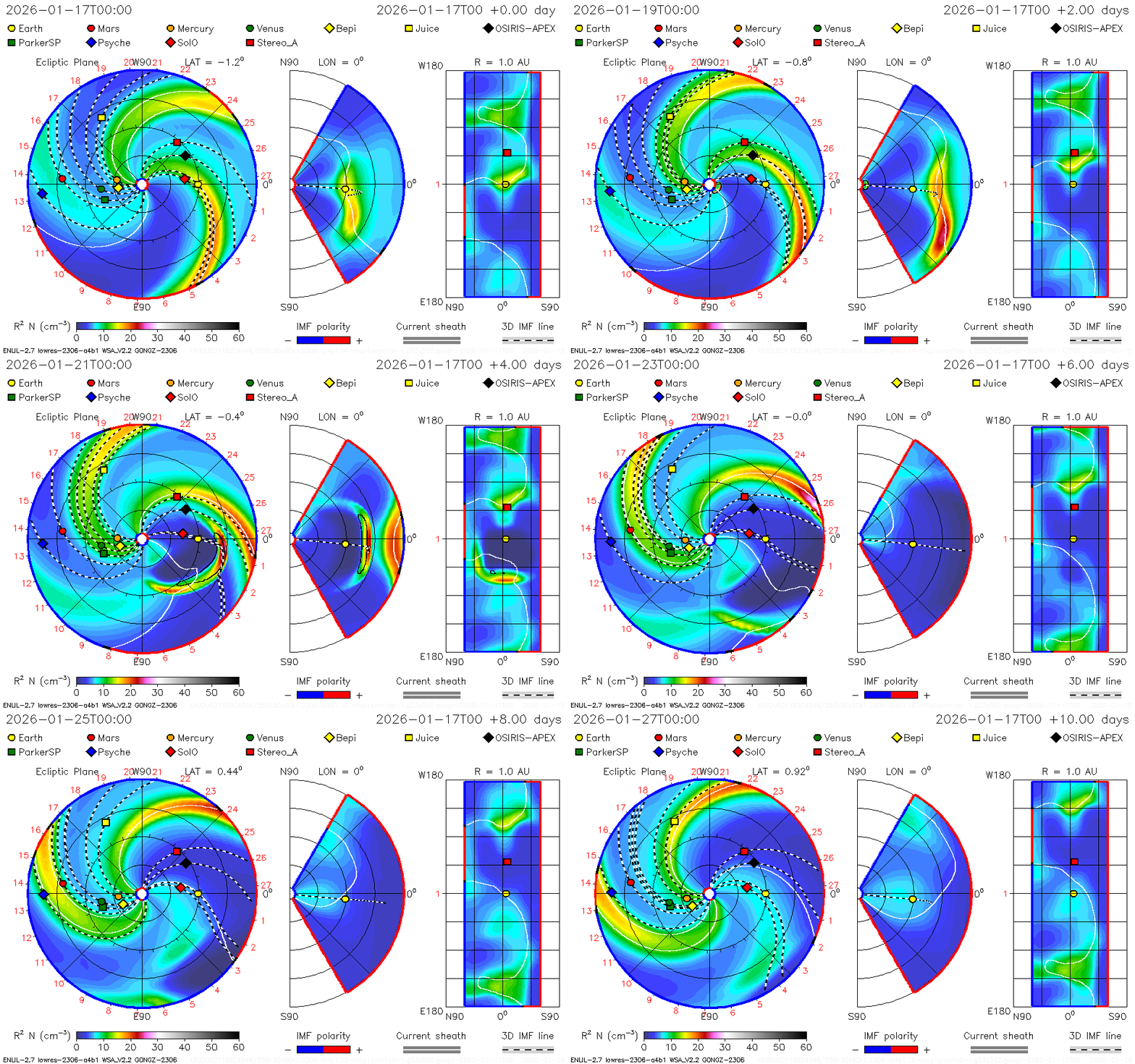
Of greater interest is the CME. The explosion launched a full halo CME with a significant Earth-directed component. NASA models predict that it will reach Earth during the early hours of Jan. 20th. The impact could cause a strong G3-class geomagnetic storm with mid-latitude auroras. Stay tuned for updated forecast models.

Crew members aboard the ISS have been evacuated, ostensibly because of illness…
But only four, not all.
And the evacuation order for those four was issued well before solar flare/CME of yesterday.
First call was on January 7th.
1966, I think, the principal’s wife pulled the fire alarm in the girl’s dorm so we could see the northern lights in southern Ohio. The best I have ever seen.
I saw the northern lights when I was about 10 years old. Had no f*cking idea what I was looking at. Totally freaked me out. Seen it a few times since and enjoy it very much.
I saw some in the 60s, while living in Topsfield. I enjoy your posts about Mass.
My best memory of the Toppsfield Fair is Maple Sugar cotton candy. Sweet.
In 1962 when I was in 9th grade in northern Minnesota, I participated with a group that recorded and mailed in reports of Auroras. We would draw maps of their locations and times in the sky. I likely saw a dozen, or so. We were told that they occurred about every several days in our location. However, it would be cloudy or daylight more than half the time, so we would likely only see them every couple of weeks or so. We would lay out in the lawn in sleeping bags to keep warm looking for them. The sun set there in the winter at 4:30 PM, so we had lots of dark hours to look.
Just curious if this X-class solar flare “headed toward Earth” will be a BOHICA event . . . you know, something on the order of the Carrington event that peaked 1-2 September 1859?
Reference: https://en.wikipedia.org/wiki/Carrington_Event
This flare at X1.9 is much smaller than the Carrington event which may have been X80.
From the second paragraph of the above article, with my bold emphasis added:
“The explosion lasted for hours, which makes this flare even more powerful than than its “X1.9” rating would suggest.”
Hence my question.
No, that one was an X45 event. There is about a 12% chance of that type of event happening this century.
See also our https://wattsupwiththat.com/2020/09/03/the-carrington-event_-september-1-1859/
Hoping for clear skies!
Geomagnetic events always seem to put a few of our CCTV cameras out of action.
They’re PoE powered (Power over Ethernet).
Disconnecting the camera to control / storage drive box and reconnecting brings the cameras back online.
I have no idea how this happens or why the disconnect / reconnect action works.
You really should include Coronal Mass Ejection early in your post, Anthony.
I concur…I looked it up before I got to this comment.
I have an S5 Fog Event 600 feet deep. The GOES-WEST Visible image for Washington State will show the extent. Perhaps a “rain” of protons will clear this out.
The X-flare first energized the d-region with a proton storm, followed by a strong cross polar cap potential jump.
Refresh the page to update images as the storm ensues.
Can’t see it because of fog. But right now there is a beautiful red aurora over Austria.
https://www.foto-webcam.eu/webcam/kleinfleisskees/
Note this update at Spaceweather.com:
THE CME HAS ARRIVED–A SEVERE STORM IS UNDERWAY: Arriving earlier than expected, a CME struck Earth’s magnetic field on Jan. 19th (1930 UT). The impact has sparked a G4-class (severe) geomagnetic storm. Sky watchers at all latitudes should be alert for auroras after local nightfall. There is a chance that this storm could escalate to category G5 (extreme) in the hours ahead.
I have an antique chemical balance with a sliding door to eliminate drafts in the interior while weighing samples. Inside, I have a small alnico magnet with an attached sewing needle, hanging from a thread. It is about 21:47 Eastern Time, and the magnet and needle are moving perceptibly. No wild gyrations, but the Earth’s field does appear to be experiencing perturbations. The night is still young.
Are you using the Method of Long Swings to measure the perturbations?
Northern lights in The Netherlands!
Obviously caused by anthropogenic CO2 emissions.
I read to expect a G4 on spaceweather last night, with possibility of auroras as far as Arizona.
Not seeing that today – mentions of G1-G3 and mid-latitudes, more like reported here.
Funny how fast things can change