From NOT A LOT OF PEOPLE KNOW THAT
By Paul Homewood
h/t Ian Magness

A wildlife charity has declared 2025 “the Year of the Blooming Octopus” after record numbers were spotted off the south-west coast of England.
In its annual marine review the Wildlife Trusts says octopus numbers were this summer at their highest level since 1950.
Warmer winters, which are linked to climate change, are thought to be responsible for the population spike, which is known as a “bloom”.
The charity’s findings are backed up by official figures which show that more than 1,200 tonnes of octopus was caught by fishermen in UK waters in the summer of 2025.
It’s a dramatic increase on previous years. Only once since 2021 has more than 200 tonnes of octopus been landed.
Experts say most of those spotted are Octopus vulgaris a species commonly seen in the warmer Mediterranean Sea. Wildlife Trusts volunteers in Cornwall and Devon reported an increase in sightings of more than 1,500 percent on 2023 figures along one stretch of the south coast.
“It really has been exceptional,” says Matt Slater from the Cornwall Wildlife Trust. “We’ve seen octopuses jet-propelling themselves along. We’ve seen octopuses camouflaging themselves, they look just like seaweeds.
“We’ve seen them cleaning themselves. And we’ve even seen them walking, using two legs just to nonchalantly cruise away from the diver underwater.”
https://www.bbc.co.uk/news/articles/c709gz3k9k9o
Of course, it is all down to climate change! But if numbers are the highest since 1950, what happened back then?
Geo TV reported in August:
Bryce Stewart, a University of Plymouth marine scientist leading the probe, noted past blooms in Britain — in 1950, the 1930s and 1899 — were all preceded by similarly “ideal” warmer-than-usual waters.
However, Stewart suspects octopuses are now breeding in local waters — an unprecedented situation that could also explain their sudden disappearance.
Both male and female Atlantic longarm octopus — which typically only live about 18 months — tend to die not long after breeding.
“They eat everything, they’re ferocious, and they start to breed. It’s like the ultimate live fast, die young life cycle,” he explained.
He said he is constantly asked if the octopuses are here to stay. His answer? “Probably.”
Warmer waters in the 1930s? What could have caused that?
In fact, Olly the Octopus never went away!
Far from walking along the bottom of the sea all the way from Spain, octopus rarely travel more than a hundred yards or so.
The blooms are due to higher survival rates for eggs and larvae in milder winters. As Bryce Stewart points out, the adults die soon after breeding, a natural way of keeping population under control.
Tucked away at the bottom of the BBC article is this little gem:

Puffins have, of course, been thriving for years on those little islands off the Pembrokeshire coast, in stark contrast to the prognostications of the doom and gloom lobby.
Puffins, like most of the life on earth, thrive on warmer weather. The reason why they have been in decline in the North Sea is the industrial fishing of sand eels there. In contrast, there is ample supply of their favourite food around Skomer.
Discover more from Watts Up With That?
Subscribe to get the latest posts sent to your email.
There was no change in climate prior to the present, trust us!
Well, actually global warming is caused by greater numbers of octopuses.
Yes,
their ink is making the sea darker, making it more absorbent to infrared, thus causing the oceans to boil, which should create more hurricanes that will carry heat to the poles & melt the ice-caps, drowning most of humanity … then … the octopuses will take over; Cunning buggers !!
Great correlation!
The BBC has repeatedly run Octopus warming seas stories.
https://www.bbc.co.uk/news/uk-england-cornwall-61987374.amp
https://www.bbc.co.uk/news/world-europe-guernsey-55086236.amp
As I’ve posted before, they were called ‘devil-fish plagues’ historically.
2025 seems to be producing heavy catches but of course numbers will rapidly decline to normal.
The only thing more common than a BBC octopus story is the near annual Sunfish warming seas story.
Sunfish eat octopi so all’s well!
From the article: “Warmer winters, which are linked to climate change”
Linked by idiots who don’t know any better.
From the article: “It’s a dramatic increase on previous years. Only once since 2021 has more than 200 tonnes of octopus been landed.”
All the way back to 2021, huh?
You guys need to get a little broader perspective.
From the article: “Bryce Stewart, a University of Plymouth marine scientist leading the probe, noted past blooms in Britain — in 1950, the 1930s and 1899 — were all preceded by similarly “ideal” warmer-than-usual waters”
Which correponds to the high temperature points that have occurred since the end of the Little Ice Age around 1850.
After the end of the Little Ice Age, temperatures rose to high points in the late 1880;s, the 1930’s, the 1950’s (which were almost as warm as the 1930’s), and the current-day temperatures.
All these temperature changes are faithfully recorded in the original, written, regional temperature records from around the world.
Here is the regional temperature chart for the Untied States (Hansen 1999) which shows the temperature high points and shows that the 1950’s were almost as warm as the 1930’s.
I equate today’s temperature trendline to the trend line from the 1930’s to 1950’s. They are both similar. We had a high point in the 1930’s, then the temperatures cooled down through the 1940’s, but then the temperatures warmed up through the 1950’s, and then the bottom fell out and the temperatures cooled down through the 1970’s.
This, imo, is similar to recent temperature movements, where the temperatures warmed from the 1980’s to the high point in 1998 (similar to the warming up through the 1930’s), then the temperatures cooled after 1998 (similar to the cooling of the 1940’s), and then the temperatures warmed up through 2024 (similar to the warming of the 1950’s).
And what happened to the temperaures after the warming of the 1950’s? We may be living in the equivalent of the 1950’s right now.
If the 1950’s had had an eruption like Hunga Tonga take place during that time, then it might have been the temperature high point instead of the 1930’s (2016 verses 2024).
And just in case you are looking at a NASA or NOAA temperautue chart depicting the period after 1998, as getting “hotter and hotter and hotter”, here is the real temperature profile after 1998, and as you can see, there was significant cooling after 1998, that NASA and NOAA want to pretend did not happen.
UAH satellite chart:
Here is a temperature plot from the area under discussion:
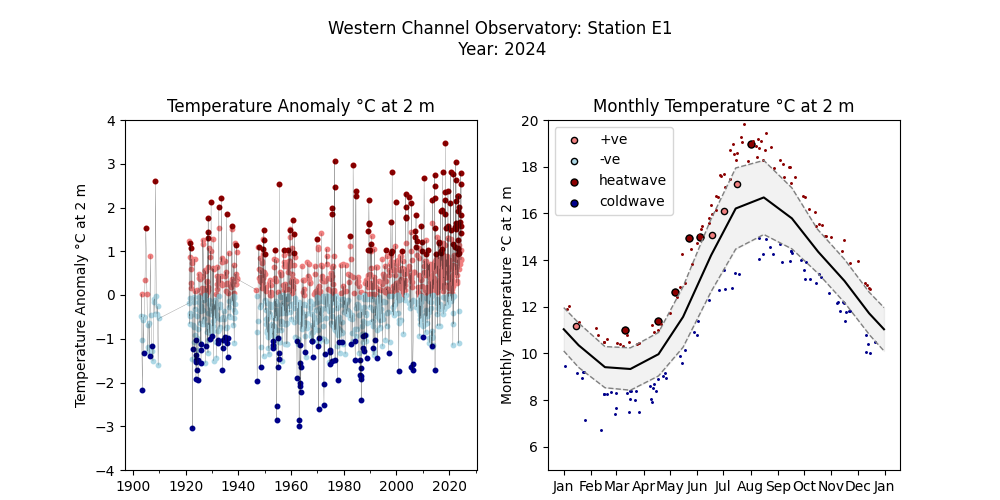
The record covers over 100 years with gaps for the two WWs, shows a distinctly warmer period than the 30s or 50s.
I hear they build very nice gardens.
They can come in handy during hostage negotiations.
I have never been able to understand how the octopus sees what colour pattern it has to match and what it has now, how it’s pattern recognition and matching works. Its eyes cannot see all of itself and presumably cannot see what the surface is like under it. Dr Google is not clear in my sporadic and quick searches, so I am asking for recommended links from readers here. Ta. Geoff S
The as of yet undiscovered monitoring micro-drone that hovers over every octopus?
My guess is their “skin” is photo sensitive.
BTW, I like the critters, I won’t eat them. Same for lobsters and crabs. And gastropods. Tuna, haddock, salmon I eat when I can get.
As a sea angler on the South Coast of Britain , we have always had octopus in the sea , things have changed a little and we saw a sunfish out on the boat last year. Since the 70s Trigger fish have been turning up and these have increased , likewise Smoothounds ( a type of Shark ) have greatly increased in numbers and we catch these all summer . Reports from Devon Cornwall and Dorset coast show Bluefin Tuna now showing up , back in the 1920s and 1930s the used to turn up but got over fished and disappeared, but now they have returned.
I used to sea fish mostly in the North Sea during the 70s, one thing that was noted was the movement of the cod and haddock further south during a cold spell but my understanding is that they have shifted further north since then. I had heard that the bluefin tuna had returned to the southwest too, also dolphins are seen around the Welsh coast which I don’t remember happening in the 60s and 70s.