Considering that High Fructose Corn Syrup (HFCS) is just sugar water, with a similar composition to table sugar, why is it vilified?
# # # # #
Villainizing HFCS is an outgrowth of the more general War on Sugar. Acting under the pretense (or misunderstanding) that HFCS is “high” in fructose, a great deal of research has been carried out to study the results of feeding 100% fructose to animals and people.
“Although the HFCS-obesity hypothesis may have been initially developed, as Popkin recently claimed, to simply “spur science” (link), it quickly took on a life of its own. This once mundane ingredient became vilified in scientific circles and then in the public arena when the hypothesis was translated as fact through leading nutrition journals, weekly and specialty magazines, national and local newspapers, and an endless number of television news programs.” [ source ]
Barry Popkin, a co-author of the study mentioned above, rapidly back-pedaled on the hypothesis:
“Even the two scientists who first propagated the idea of a unique link between high-fructose corn syrup and America’s soaring obesity rates have gently backed off from their initial theories. Barry M. Popkin, a nutrition professor at the University of North Carolina at Chapel Hill, says that a widely read paper on the subject that he wrote in 2004 with George A. Bray, a professor of medicine at the Pennington Biomedical Research Center in Baton Rouge, La., was just meant to be a “suggestion” that would inspire further study.” ….. “It was a theory meant to spur science, but it’s quite possible that it may be found out not to be true,” Professor Popkin said. “I don’t think there should be a perception that high-fructose corn syrup has caused obesity until we know more.” “[ source ]
Robert F. Kennedy Jr. is the current U.S. Federal government’s Secretary of Health and Human Services, with control over the Centers for Disease Control and Prevention (CDC), the National Institutes of Health (NIH), the Food and Drug Administration (FDA), and the Centers for Medicare & Medicaid Services (CMS).
Robert F. Kennedy Jr. said, in 2024: High-fructose corn syrup ‘is just a formula for making you obese and diabetic.’” [ source ]
This opinion depends on the large body of research that has studied the metabolic differences between diets contain exclusively fructose compared to diets containing exclusively glucose.
“If the HFCS-obesity hypothesis is correct, there should be something quantifiably unique about HFCS that is absent from sucrose. The data presented thus far in support of the hypothesis rely heavily on the metabolic comparison of glucose and fructose. It has been known for many years that fructose fed to experimental animals or human subjects in high concentration (up to 35% of calories) and in the absence of any dietary glucose will produce metabolic anomalies (7,8). The 1994 Fructose Nutrition Review commissioned by the International Life Sciences Institute was highly critical of this line of experimentation (29 – Hollenbeck (1993)).” [source]
In fact, the 1994 review mentioned concluded, among other things:
“These conclusions should not be interpreted as an admonishment to restrict all dietary fructose. Indeed, fructose is an important natural component in our diet, and an abundant source of carbohydrate in fruits and vegetables. Although the term “reasonable quantities” would be difficult to define quantitatively, it would seem unlikely, based on available data, that dietary fructose at quantities obtainable from natural sources provided in a well-balanced diet would result in any deleterious metabolic effects.” [ source ]
A diet high in fructose, in the absence of glucose, “will produce metabolic anomalies”. But neither a diet containing sucrose or HFCS lacks the necessary glucose to produce those metabolic anomalies….both sucrose and HFCS are approximately the same: 50% glucose and 50% fructose.
In Part 1 of this essay, I showed this image from Bray et al (2004):

And I asked readers if they could see what had been omitted from the graph. The following graph answers that question:

The data is from differing sources but close enough for our comparison. Bray et al. gives estimated intakes of “total fructose” and “free fructose”, against U.S. overweight and obesity rates. Total fructose means all the fructose from sucrose (which is one half fructose) plus all the fructose from fruits plus all the fructose from HFCS (which is shown as “free fructose”, which is about one half the total sugar in HFCS).
What is omitted from that graph is any change in the intake of Total Sugars. The first graph (Bray) seems to imply that total sugar intake has risen, but as given in the second graph as “percentage of caloric intake”, which, at least in that view, doesn’t really change much.

In this graph, we see that total sugar intake (not total fructose) increased by about 17% from 1970 to 2005, which is not quite in agreement with previous graph, which shows a 1% increase in calories from added sugars over the same time period. Again, the difference may be entirely due to the difference in method of calculation (What Exactly Are they Counting, and here). But the point of this is that the decrease in the amount of cane and beet sugar in U.S. diets were almost one-for-one replaced by the increase in HFCS between 1970 and 2005, and since then are about even. Over the same time period, grains (flour and cereals) and fats increased.
Further, U.S. domestic use of HFCS hit a high point in 2001 and has been declining since, while U.S. obesity rates have continued to climb:

Is the increase in the use of HFCS causing Overweight and Obesity?
Let’s see:
One thing to know is that the goal posts were moved for overweight and obesity in 1998:
The BMI classifications for overweight were changed in 1998 by the National Institutes of Health (NIH). The NIH adopted the World Health Organization’s (WHO) classification, lowering the threshold for overweight from a BMI of 27.8 (men) / 27.3 (women) to a BMI of 25. This change effectively reclassified millions of Americans as overweight or obese. Thus, any historical calculation of Overweight/Obesity must include if the older data (in the pre-1998 time frame ) was determined by the then current standard or the new post-1998 standard.
Taking an international viewpoint, we can see with this graph that HFCS consumption on a national basis is not predictive of overweight and obesity:

Examples of pure fructose causing metabolic upset at high concentrations are common, especially when fed as the sole carbohydrate source, however there is no evidence that the common fructose-glucose sweeteners – sucrose, HFCS42, HFCS 55, honey – do the same.
Again, this does not mean that large increases in intake of sweeteners and other high caloric foods do not affect overweight and obesity – but it does mean that increased HFCS use in foods and drinks does not equate to increasing overweight and obesity rates.
Another common claim is that because HFCS is a liquid and used in drinks (sodas, sports drinks, etc) it causes more weight gain than solid sugars. This oft repeated view is based mostly on a single small human study, DiMeglio and Mattes (2000) [ pdf ]:
“The study investigated the difference between two forms of carbohydrate delivery:
- Liquid form: The carbohydrate load was delivered as calorically sweetened soda for a duration of four weeks.
- Solid form: The same carbohydrate load was delivered as jelly beans for a separate four-week period.
The researchers observed that when the carbohydrate load was consumed as soda, the participants experienced significantly greater weight gain compared to when the same amount of carbohydrate was consumed as jelly beans.”
When I say “small study”, I mean really small: only 15 people. Participants were offered sweet sodas for four weeks then jelly beans for 4 weeks, in addition to their otherwise normal daily diets. It certainly tested something, but not whether liquid or solid sweeteners caused more weight gain. Here is the graphical data summary claiming to show “significantly greater weight gain” for liquid (soda) sugar (with my notations):

All the other studies on this topic are mice and rat studies. Why this matters is discussed here and here (and many, many more).
Important Note: The innocence of HFCS as a unique or special cause of overweight and obesity does not mean that excessive over-consumption of high caloric foods (sugars, starches, fats) does not contribute to those conditions. It is simply that HFCS does not do so in any special way.
IN SUMMARY:
For HFCS to be somehow especially obesogenic (causing obesity), it would have to differ from sucrose in an important way. However, HFCS is essentially the same as sucrose.
If HFCS was uniquely obesogenic, HFCS usage and obesity would be coincident nationally and internationally. They are not. In the U.S., HFCS use has declined almost 20% over the last two decades while obesity rates continue to rise.
Diabetes is related to obesity, with obesity being particularly considered a contributing cause of Diabetes Type II. As HFCS itself is not a particular cause of obesity, any more than any other sugar, it is probably not a cause of diabetes. There is no evidence that HFCS ingestion causes diabetes of either type.
Despite the popular health press and notwithstanding Robert F. Kennedy Jr.’s opinion, the U.S. Food and Drug Administration still says:
“We are not aware of any evidence, including the studies mentioned above, that there is a difference in safety between foods containing HFCS 42 or HFCS 55 and foods containing similar amounts of other nutritive sweeteners with approximately equal glucose and fructose content, such as sucrose, honey, or other traditional sweeteners.” [ source ]
# # # # #
Author’s Comment:
I am not aware of any real evidence that HFCS is in any way more or less harmful or beneficial than any other glucose/fructose caloric sweetener. Nor is the FDA.
There are a lot of arguments based on half-understood science, but no real evidence.
HFCS is, in my opinion, simply being scapegoated based on the long-term War on Sugar, and maybe just based on the misunderstanding of its name: High-fructose corn syrup. (see Propter nomen)
Please, this essay is not about The Obesity Epidemic. It is about HFCS.
Thanks for reading.
# # # # #
Ode to sweetheart (pardon the pun) –
Roses are red
Violets are blue
Sugar is sweet
And so are you!
Good to know. Scapegoating something with an ulterior motive sounds familiar somehow…
The War on Fat: Go.
Regarding that jelly bean vs liquid fructose study– there’s no placebo control group, an important point given that the average adult gains 40-110 gm/month, depending on age, sex & race, and some individuals considerably more. https://pmc.ncbi.nlm.nih.gov/articles/PMC9106499/
Be that as it may, I’m gunna stop feeding my rats HFCS.
guido ==> Thanks for that link to the weight gain study. It is in line with most earlier studies that show as people age after high school, they tend to eventualy pack on an extra 10-15 pounds — which are fairly easily lost again with moderate effort. These are “adult pounds” and generally credited to eating more and exercising less.
Obesity is another matter altogether.
The Jelly bean study was overall poor designed and poorly done and not very usefill.
Overloading on sugar, no matter what type, isn’t what I’d recommend for a healthy life. I’d also include carbohydrates in this as well. Overweight people just eat too many calories and calories coming from the wrong foods. And if you want to lose weight, exercising more isn’t the real answer either. One small chocolate chip cookie will give me enough calories to ride my bike two miles.
The other overlooked “food” is white wine. One bottle is 650 calories and every time the girls get together they drink one bottle each over a couple of hours. To me, and I’m 75 and very healthy, to live a high quality life into old age is eat the right foods in moderation, get a good night’s sleep and keep moving.
As another 75 year old- I agree completely.
I suspect this is partly wrong:
Overloading on sugar, no matter what type, isn’t what I’d recommend for a healthy life. I’d also include carbohydrates in this as well.
but that this is mainly right:
Overweight people just eat too many calories and calories coming from the wrong foods.
And that the reason is not so much where the calories come from, as what foods are eaten in what combinations.
I think there is a lot of evidence that populations which eat a diet consisting of carbohydrate staples, such as wheat, rice, corn, buckwheat, oats – even potatoes – accompanied by small amounts of meat, fish, eggs, dairy, and lots of vegetables, are fairly long-lived and healthy.
If you look at the cooking of such places the glycemic load of meals is low. Pasta is usually eaten with sauces which lowers the glycemic load. Pulses are often eaten with high carb foods. As in, for instance, pasta e ceci, pasta or rice with beans, pasta with meat sauce, corn and beans, chicken with kasha, oats with milk. The effect of such cooking is to lower total calories because its quite filling and does not lead to the hunger rebound that you get from a hamburger and a coke.
The other thing is that I suspect the effect of exercise is misunderstood. People count the calories consumed in exercise as if that were the only variable. Don’t think it is. I notice that adding brisk daily walking of some 5000+ steps to a regime centered on resistance training has a curious effect: it eliminates the sweet tooth. Brisk in the sense that its too fast to carry on a conversation, and resistance that is heavy, meaning a substantial fraction of bodyweight on the basic compound exercises such as rowing, deadlift, squat, bench press, overhead press, pullover..
In addition, heavy resistance does not simply consume calories while one is doing it, the calorie consumption carries on after the exercise period because both of repair of muscles and the fact that muscles consume more calories than fat in maintenance.
There also seems to be recent evidence that starting a weight reduction program with fasting and then very low calorie diets can reset the body’s equilibrium point so that weight gain isn’t inevitable after returning to a less restricted eating pattern.
So should we be blaming sugar? Yes and no. We should be blaming the diet of which high sugar consumption is a key element. And we should also be blaming lack of exercise, but not because of the calories content of the exercise itself, but because of its other effects.
Well, that’s my not very well documented opinions at the moment.
michel ==> Always good to heat from you. Diet and nutrition are very controversial fields, with experts all over the place on every point of contention.
Weight loss is a multi-billion dollar business as are supplements and vitamins.
The exercise industry (gyms, books, YouTube influencers) are big business too.
The point of this two-part series is to explain the topic of sugars, from the viewpoint that HFCS is really just sugar water and not a demon-food ingredient.
rbabcock ==> Quite right. Eating a wide variety of foods from all food groups, each in moderation, is the best general recommendation for everyone. 20 to 30 minutes of moderate exercise most days goes along with that. I have been saying this here at WUWT in all my essays touching on nutrition.
My advice to everyone is: Eat right. Stay fit. Die anyway.
I’ll let my self out.
Yes, avoid booze. 😉
Obesity- not enough physical activity and too much food, especially unhealthy food.
OK. I had a lot of problems with Part 1 of this pair of essays because there were *scientific* statements made in Part 1 that were patently incorrect. And I commented as such there. I also stated at the time I hoped for evidence of real science to back up the claim, “sugar is sugar is sugar,” here, and it’s fully lacking.
Now, to be absolutely fair, there is a lot of *opinion* here, but opinion from both sides, and the final comment here is totally fair: “I am not aware of any real evidence that HFCS is in any way more or less harmful or beneficial than any other glucose/fructose caloric sweetener. Nor is the FDA. There are a lot of arguments based on half-understood science, but no real evidence.”
I very much agree with that statement. As I said in response to Part 1, I was led to believe real scientific evidence that, “sugar is sugar is sugar,” was coming here is Part 2. There’s a lot of sourced opinion but no hard science. I am thoroughly convinced there’s no evidence (here, and probably anywhere) that fructose is causing many of the health problems we face as a society (overconsumption set aside) but that still doesn’t come within a thousand miles of supporting a statement like, “sugar is sugar is sugar.”
I think I provided, in a few sentence response in Part 1, proof that the statement, “sugar is sugar is sugar,” is absolutely NOT supported by science, and I see absolutely nothing here to refute what I said. I wasn’t the intended audience, so oh well, but I think everyone needs to keep that reality in mind here.
A final thought – I fully agree with the statement I quoted above. I had hoped to learn something more here, but even if I didn’t I do agree with that statement. I just wish Part 2 here had been posted without Part 1 at all – Part 1 contributes nothing to the points made here and is incorrect in several assertions.
Merrick ==> Opinions about sugar are often very strong, even extreme, but opinions do not change biochemistry and biology. You have every right to object to the title.
For most people, it makes no difference which of the common caloric sweeteners (sugars) that they eat — they all get converted to glucose (mostly) in the end.
Glucose is absorbed in the gut via specific receptors and is an energy requiring process, while fructose is absorbed via a different receptor, not requiring energy…but– almost all fructose is converted to glucose once in those gut cells so that the portal vein carries hexose to the liver as 99% glucose and 1% fructose.
https://pmc.ncbi.nlm.nih.gov/articles/PMC6457363/
https://pmc.ncbi.nlm.nih.gov/articles/PMC7019254/
Thanks – this is important information that adds to the conversation. But I’ll also add that we have hugely distorted view of historical sugar consumption. Sure, there’s plenty of fructose in fruit and some vegetables, and we get a lot from HFCS now, but we used to eat more fruit once upon a time, so we were always getting lots of fructose…
But did we really? Actually, relatively wealthy people got a decent amount of berries in the Spring, a little more in the Summer, and again with some different fruit sources in the Fall. Nothing in the Winter (perhaps some tired apples). And you only really got those fruits in a couple of week windows through most of the rest. What we ate otherwise was grain, vegetables that could be kept when out of season (especially if canned – which then includes some canned fruit as well), and meat. But a lot of access to otherwise raw vegetables and even meat in off seasons relied on wealth. We’re 5 or 6 generations (here in the West) from that kind of existence, but that’s reality for much of human existence. So having fructose (or for that matter sucrose) available 24/7 all year long? That’s still REALLY new to the human experience. And the societal affluence to make that the norm rather than the just for the wealthy? Even more recent.
So the biggest problem is that we have too many confounding variables to just point and say, “HFCS went up 50 years ago, and look where we are now!” But we also have too many confounding variables to conclude that wasn’t one of many sources of many problems. That’s why I get frustrated by claims that go too far in either direction. I want to see real science.
Merrick ==> Certainly sugar was a treat, historically, and refined sugar (even partially refined sugar) was for the rich. Once sugar became more available, early 19th century, more and more people preserved fruits with sugar (jams and jellies and preserves) and pies and pastries sweetened with sugar became the norm.
It is important to remember that though we commonly call table sugar (white, brown, or whatever) SUCROSE, it is still 50/50 fructose and glucose.
The rise of obesity time coincident with hundreds of features of modern society: diet, lack of exercise, environmental factors, and genetics. The HFCS/Obesity graph could be Global Surface Temperature/Obesity, Availability of sneakers/Obesity, on an on.
We don’t really know.
Although, chemically bound in sucrose, but not in HFCS.
Well, amount of fruit eaten depended on availability – climate notably, and preservation. Poor folk out in the country had to ‘can’ much fruit – in the north mostly berries including Saskatoon (June) berries, purchased apples (they only grow to the south). Often made into jam (oh! sugar).
‘Can’ usually in jars with good seal top.
Today perhaps just raw into a large freezer as electricity more widely available (kept outside in case electricity fails in winter ;-).
guido: Here’s a paper that seems to say otherwise: https://pmc.ncbi.nlm.nih.gov/articles/PMC6032988/
It’s lengthy and information dense, so I may be misreading it, But… It agrees with you that Fructose is primarily metabolized in small intestine with only 14% making it to the bloodstream where it is presumably transported to the liver and/or kidney. But only 42% of the Fructose converted by the small intestine is Glucose. The rest ends up as Lactic Acid, Alanine(an amino acid) and other assorted other byproducts. Whatever Fructose makes it to the liver would presumably be broken down there by another pathway whose name I don’t recall. That one’s not especially efficient either. Fructose that gets to the Kidney is presumably simply excreted,
So, yes a lot of Fructose is converted to Glucose, But a lot is converted to other stuff. And some may simply be dumped into the waste stream.
donK ==> While the metabolism of fructose is somewhat different than sucrose, the metabolism of HFCS and Sucrose are mostly the same. The byproducts of fructose metabolism in the liver are “intentional” (meaning that that’s the way our metabolism is) and are not some “bug” or malfunction. The exact same thing happens to Fructose from Sucrose.
donK ==> The study linked (and thanks for it) is yet another mouse study that may or may not apply to human metabolism of glucose/fructose sugars which included table sugar/HFCS42, HFCS55, honey, etc.
And again, they are feeding pure fructose or pure glucose — not combined fructose/glucose sweeteners as found in the human diet.
kip; you’re right of course. It is a mouse study and mice aren’t people. But it does support Fructose being processed in the gut which many other studies ignore. And it seems clear how the numbers were derived which often seems pretty hazy in nutritional studies.
But some people are rats! 🙂
That reference (and mine) say that fructose makes it thru the portal system to the liver only when overloaded to the tune of >1g/kg (the “standard man” is considered to be 70kg) ie- @4c/g, a meal of 70cal of fructose….With “sugar” being roughly half fructose and a can of soda 150 cal, that’s only one can of pop….BUT (and we’re talking about really big butts here), …
…so what?….
Once in the liver, the second step in the anaerobic glycolysis sequence is to turn phosphorylated glucose into it’s isomer, phosphorylated FRUCTOSE….so it’s pretty difficult to see a mechanism by which fructose itself is harmful and should be villified.
An interesting aside– fructose does not stimulate insulin secretion as does glucose…and insulin is the main regulator of the balance between lipogenesis & lipolysis. Go figure.
I think you raise an important point about the energy requirements. We don’t suddenly wake up one morning weighing 20 or 30 pounds more than when we went to bed. It is something that creeps up on us. After 20 years, when we start making plans to go to our 20-year high school re-union, is when we might first notice that we are 20 pounds heavier than when we graduated. This suggests that it is a small imbalance between intake calories and calories burned by exercise, an imbalance of slightly more than 1 ounce per month of retained fat, on average.
That is important because to break the chemical bond between glucose and fructose in sucrose probably takes energy, meaning that there is less available from sucrose than from an equal weight of un-bonded glucose and fructose. So, it may not be a simple matter of just ingesting more calories, but all other things being equal, we may be getting more calories from even an equal weight of HFCS. The fact that sodas typically contain an extra 5% of fructose as the sweetener probably exacerbates the problem because, as you point out, no energy is required to convert fructose to glucose.
Clyde ==> Breaking the fructose glucose bond in sucrose is chemistry in the acid environment of the stomach.
Good article. What is missing from charts and not part if this article are people exercising less and not doing partial fasting. It is better to consume sugar in its natural form e.g. apples and other fruit with some fiber as well as foods with allulose such as figs and raisins. Allulose can be made for HFCS as well. Maple syrup is another source of allulose.
Drink water instead of soda pop.
As always, too much of anything may not be good for your health.
My weakness is dark chocolate.
George ==> I have family members for whom dark chocolate is a weakness – the darker the better.
Allulose, as a general replacement for sucrose or HFCS, may not be a good choice, as it interferes with the overall metabolism of other carbohydrates. More research is needed.
I can remember trying Hawaiian sugar….it was a little more expensive. It is not readily available any more – too expensive to produce. Examine food labels – almost always sugar and salt added……it’s about taste. I know a man in his 90s who says a person needs about 3000 calories a day and he doesn’t seem to be too particular about the source of the calories…..he likes sweets…..could a human exist on a dessert diet?
antigriff ==> Sugar production in Hawaii ceased around 2016 — just couldn’t compete. There is still some sugar production in the Dominican Republic — but the countryside is littered with orphaned towns around now closed sugar mills.
The history of the sugar trade is quite interesting (and has some parallels to the salt trade). Slavery, monopolies, revolutions, war, and other shameful activities all played a role. We are fortunate that this dietary substance, so craved, is now common and cheap. When it was rare and dear much evil resulted.
During a carrier cruise to the Indian Ocean I used to take a PB&J with me on late night flights. I would give it to the pilot about an hour before landing to hopefully get the sugar energy into his system. It seemed to work well got numerous 3 wires. (3wires are considered great landings on carriers.)
Eskimos were the control group years ago about the use of sugar in regard tooth decay. I wonder if that bled over.
I’ll repeat what I said in part I .The vast majority of sugars in your diet come from foods like pasta, potatoes, bread, rice, fruit and other digestible carbohydrates. These are broken down in your gut to their component sugars. The majority of which is glucose. Glucose is the main fuel of the human cell. Fructose is the plant sugar. Its found commonly in fruits. Your liver absorbs it and turns it into glucose. Plants are sugar factories they take water out of the ground and CO2 out of the air and combine them to make these sugars. Plants are mostly made of sugar.
A medical doctor says that sweeteners cause the taste detectors in your mouth to send a signal to your brain which sends a signal to your stomach – prepare – here comes a load of sugar. But of course there is no sugar.
Medical doctors are not scientists
It’s even worse than that. They’re not even critical thinkers anymore since the advent of governmental “best practices” guidelines…Not to change the subject, but the real reason behind the all electronic records mandate of BO-Care is so Big Brother can spy on the docs to make sure you they’re following the narrative
Woody Allen did a skit about that starring some Hollywood A-listers, including Burt Reynolds.
I recently developed Gout. Since then I’ve reduced red meat intake. But a doctor also told me HFCS could exacerbate gout symptoms, but no mention of other sugars.
Jeff ==> Ouch! Gout is not good — but to limit the uric acid which is produced in the liver as part of the metabolism of fructose, you need to sharply limit all fructose-glucose sweeteners — including table sugar, foods with HFCS42 and HFCS55, honey, maple syrup, etc. — all of which are essentially 50% fructose.
You can replace these with simple Corn Syrup, which is nearly 100% glucose.
Although obesity correlates well with type II diabetes in western societies 60-80% of the time I’ve read that its only 30% east Asia.
Apparently it is genetic. Most Asians have fewer fat cells and don’t show the obesity when they are diabetic as much as other groups. I had a Chinese friend with advanced diabetes who was not obviously obese. Her fat was there but thinner and even.
Mike ==> Diabetes Type II is a tricky problem — related to but not caused by….still not medically/scientifically clear.
Every time I point out that that “We don’t really know the cause of [whatever]” readers react badly, in general. People want solid certain answers, which we (scinece/medicine/science journalists) just don;t have at the present time. Frustrating, I know.
I agree no one knows why cells become insulin resistant. Till you know the answer to that I don’t see how you can make attribution
“Diabetes” is actually a class of disease, like, say, “infection” is a class. …There are many genotypes that result in a final common pathway of elevated blood sugar and accelerated arteriosclerosis….The diabetic genotype(s) persist in the genome because in older days when calories were difficult to come by, those individuals who could maintain body weight on lower cal counts (horsemen would call them “easy feeders”) had a better chance of survival.
High blood sugars and diabetic complications don’t appear when cal counts remain below a certain level.Exercise helps because myocytes don’t require insulin for glucose absorption….. Today, with easy, inexpensive access to calories and much less physical activity, we see more diabetes manifesting itself, but the gene frequency isn’t actually changing.
It has been my experience that doctors are better at providing the name of a pathology than they are at knowing the cause or cure.
The graph above is highly misleading.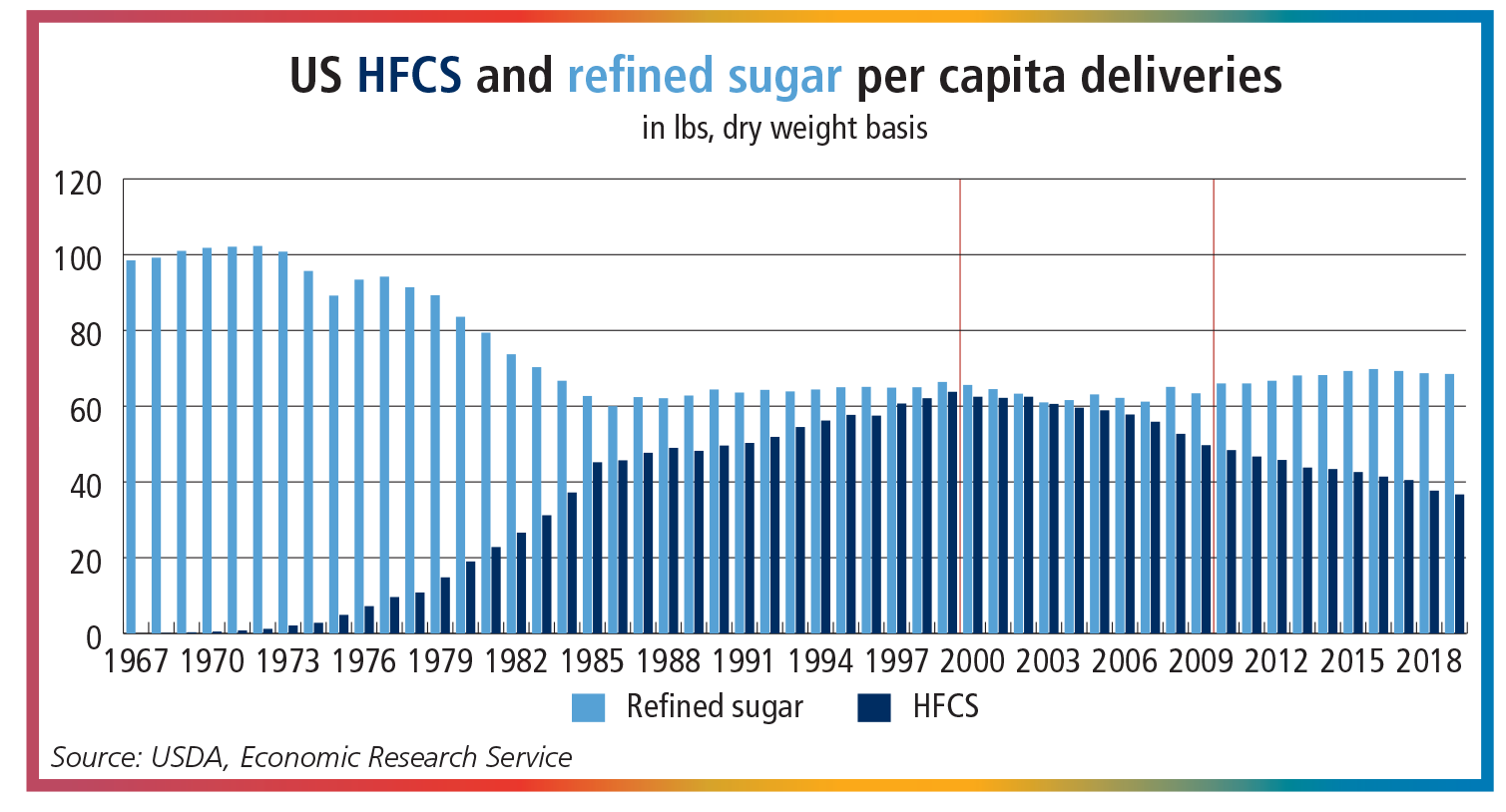
Among other things, it does not capture the massive jump in HFCS usage starting around 1970: in 1967, HFCS usage was essentially zero:
Note that while refined sugar was delivered in higher quantities, per capita, in 1967 than any time later – the sum total of HFCS and refined sugar jumped enormously after the introduction of HFCS. In 1967 – total HFCS plus refined sugars delivered was plus/minus 100 pounds per capita but has jumped to well over 120 pounds per capita by the year 2000. The total HFCS plus refined sugars delivered per capita is still well over 1967 levels as of the most recent year in that graph.
This is another indication that your pet peeve about HFCS being “just” sucrose and fructose is off base.
The problem is clearly the total amount of sugars delivered – not the sugars themselves but the reason why HFCS have driven up the total sugars delivered is because of its economics.
If you argue that the magical removal of HFCS might not change the total amounts of sugar delivered – that is more real argument but trying to paint HFCS as “simply just another sugar form” is clearly untrue given the clear increase in overall sugar consumption due precisely to the introduction of HFCS.
Lastly, I would note that this is not a “Net Zero” situation where the problem and its solution are both unclear plus the demonized commodity is critical to modern society.
In this case, the problem is clear: obesity.
The solution is also clear: less sugars.
And the demonized commodity is in no way critical to modern society.
I would also note that HFCS are probably also different in use cases than refined sugar.
A simple example: bread. You don’t need a ton of sugar for each loaf of bread eaten, but people eat a lot of bread. Depending on the bread, the sugar content can be 5% or 10% but probably averages in the 2.5% to 6% range. A significant amount of this sugar never goes to the end human consumer – it is consumed by the yeast.
However, as far as I know, HFCS are exclusively used for directly sweetening food consumed by end humans.
The USDA says the same: https://www.fda.gov/food/food-additives-petitions/high-fructose-corn-syrup-questions-and-answers
So there is a qualitative end use difference between refined sugar, overall and HFCS.
c1ue ==> The use of HFCS42 in baked goods etc is primarily that is a little less expensive than HFCS55. Both are basically 50/50 fructose and glucose. With white bread, which is mostly other carbohydrates, the starches are turned to glucose in you mouth . The minor differences between the sugars is just that: minor.
Correlation is not causation. But you bring up an important point: demonization is the current SOP of science. All sciences from nutrition to climatology to biology to geology etc are ADDICTED to hysterical dire reportage, apocalyptic doom casting, and extortionist money grubbing. If it bleeds it leads. And if some brave soul attempts to calm the waters, he is often drowned in them. Kudos to Kip. KUTGW.
c1ue ==> Look at the graphs again — The graph you link is nice — it clearly shows HFCS sharply declining since about 2000/2001 and refined sugar rising a just little, but not adding up to the decline of HFCS. Thus TOTAL sugar has declined in that graph since 2000, to about the level seen in 1973: In this version of your graph, I have stacked HFCS on top of Refined Sugar for the same year.
I specifically noted that total sugar deliveries (i.e. consumption) fell from 2000 to the last year of the graph – but yet again the total is still far higher (10 lbs +-) than 1967. This is per capita so is fully comparable.
And note again: you are railing against HFCS demonization but did not address my point that there is a pretty compelling link between the increase of HFCS use and the increase in total sugar+HFCS consumption.
That it has fallen since 2000 is not that helpful given that the present total is still very significantly higher than pre-HFCS years, and furthermore I have to wonder if the decrease is a function of the same anti-sugar movement you decry as opposed to “market forces”.
This graph shows the more recent years: overall sugar deliveries/consumption has leveled off and is still at very high levels compared to pre-HFCS:
https://www.ers.usda.gov/data-products/charts-of-note/chart-detail?chartId=105825
Graph by itself: note the “drop” from FY1999/FY2000 peaks is pretty small:
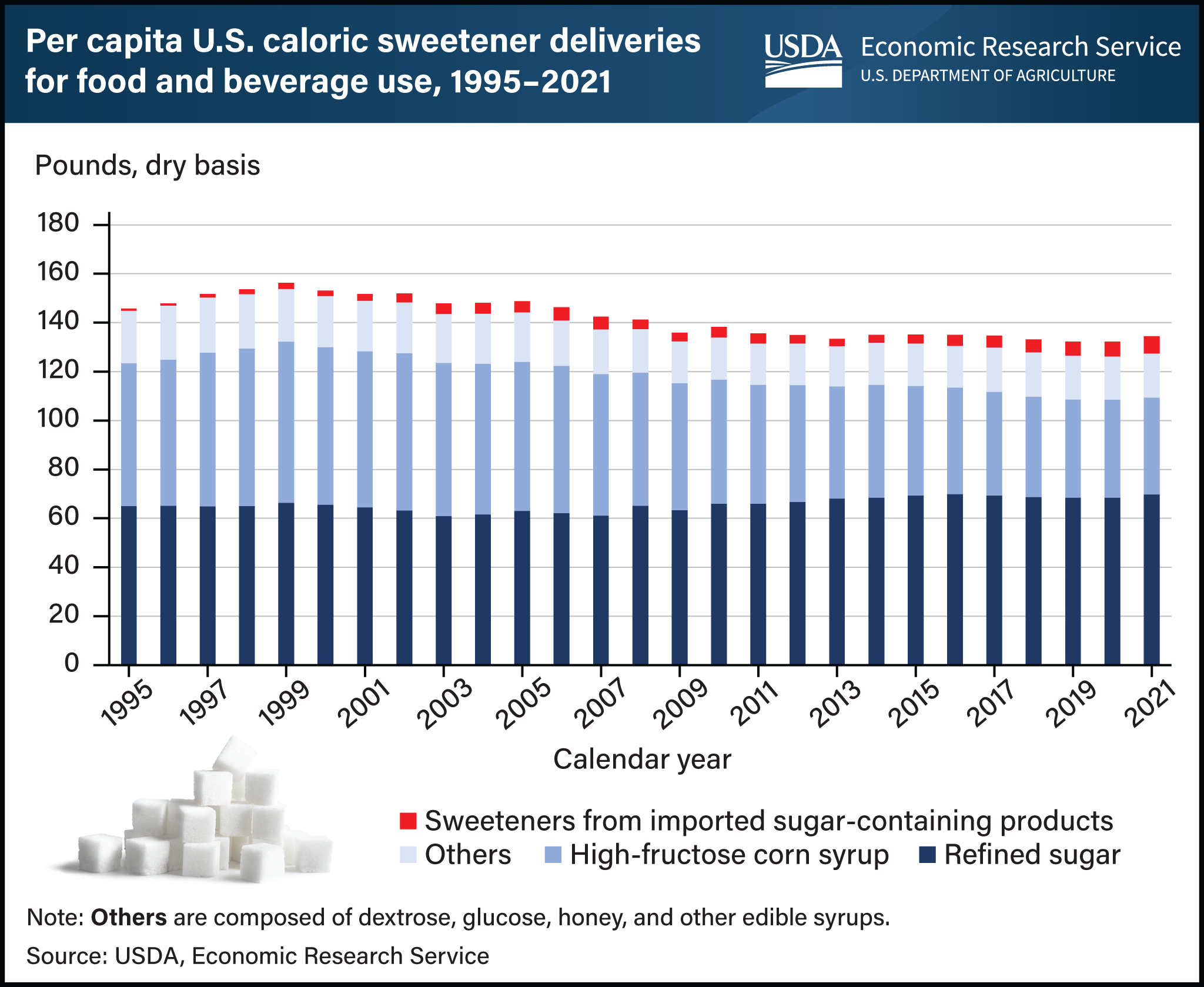
c1ue ==> It looks like the drop per capita is about 20lbs per person. That is a drop in total sugars – about around 15%. Delivers are not necessarily consumption.
The drop from peak still is to levels way above from the pre-HFCS era.
Nor is your argument about “delivers is not necessarily consumption” a valid one – you would need to prove that deliveries have somehow shifted from pre-HFCS era to now.
Given the predominant use of HFCS as end product sweeteners, is probably opposite to your intent.
It is a multi variable problem that cannot studied in a controlled manner. My opinion is that sugars and grains are famine food. Associative evidence indicates that they cause no health problems when nutrition is deficient. As in the Asian populations in the distant past.
The Randle Cycle theory indicates that high intake of of carbohydrates along with fats causes high blood glucose and insulin. Called insulin resistance and leading to diabetes 2. Clinical observation indicates that pre diabetes and diabetes 2 what is going on here with obesity and chronic disease.
It may take decades to manifest in healthy, active people.
Petey ==> As discussed with many readers, we don’t really know the cause(s) of Diabetes type II — we have clues and “contributors”….
It is certainly a “multi-variable problem”….which is not something I claim to have explained here — only that the introduction of HFCS in he diet is not “the” or “a special” cause.
It is a matter of demonizing sugar and HFCS as distinct from a high carb diet in general.
Ancel Keys and his followers had a saturated fat causes heart disease model that conflated trans fats and saturated fats, and was supported with rather cherry picked
data.
The matter is simple. It is the half-gallon ice cream in our freezer. Ready to grab, ready overeat and one-sided in nutriton. I had my eatery epiphany at age sixteen, when I stopped at the harbor in Marseille. It was a workday, on a sunny early afternoon. Here were a handful of elderly fishermen having a two-hour lunch with many courses. Lots of animated talk and lubed with wine. Wow – what a life! So, the secret is joyous friends, delicious food – a bit at a time – and all rounded with good alcohol, and having an active life. Now, at age 83 I try to be sustained the same way, but I could not bypass my bypass operation and valve maintenance. Still, I treasure my daily walk in the woods, try to not analyze nutrition much, and I heed the alcohol warning by my cardiologist. Life is good!
potsniron ==> Life IS good!
Kip: A few comments
(1) I agree with the premise that HCFS is probably no worse for one than Sucrose.
(2) I think the apparent discrepancy between charts 2 and 3 might be due to the fact that chart 2 is percent of (kilo)calories per day whereas chart 3 is (kilo)calories per day. The average caloric input of Americans seems to have increased significantly between 1970 and 2000. Maybe because the baby boom population bulge moved thru their adult years in that time frame. Or maybe because we’re a bunch of gluttons. Correcting for changes in daily calories over time might reduce the apparent discrepancy,
(3) I’m not sure how meaningful chart 4 is. I’d suggest that one reason that Japanese other than Sumo wrestlers rarely are obese is that the traditional Japanese diet doesn’t include much in the way of sweets. The fact that the few sweets that are consumed by the Nihonjin are high in HFCS may well be irrelevant. The other data may also need to be checked against cultural factors.
(4) I notice that nobody has said much about non-caloric sweeteners. Personally, I think they are a pretty good idea. I would answer anyone who objects that they aren’t “Natural” by directing them to the impressively long list of natural products that can do harm to one at https://en.wikipedia.org/wiki/List_of_poisonous_plants “Natural” is NOT necessarily synonymous with “Good For You”.
(5) While I agree that HFCS is pretty much equivalent to Sucrose, I still have my doubts that Fructose in any form is all that good for one. However I don’t think that question can be resolved very easily if at all from existing knowledge. Very likely the question won’t be resolved until we have a much more complete knowledge of the mechanics of the human body. Progress is being made on that front. But I’m pretty sure It’s not going to happen in my lifetime and quite possibly not in the lifetime of anyone now alive.
donk ==> On (2) The charts of of different measures of suagr usage — the idea is whether or not, or how much, sugar and fructose use are increasing/decreasing. All three of these charts are differing related subjects.
On chart (4) — the charts show “percentage of nutritive sweeteners” (nationally) is fructose against national obesity rates. They are clearly not correlated.
On (5), certainly the fructose in your morning orange juice or in your kids 100% pure apple jiucey box — or in their whole apple for that matter — is good for humans. Pure Fructose is NOT an element of human diets anywhere.
I read that prior to artificial sweeteners doctors would recommend diabetics use pure fructose
Mike ==> There are some advocates of Agave Syrup. “The carbohydrate composition in agave syrup depends on the species from which the syrup was made. In A. tequilana (blue agave), the syrup contains some 56% to 60% fructose, 20% glucose, and trace amounts of sucrose,[1][6] whereas in A. salmiana, sucrose is the main sugar.” [ wiki ]
Kip: I think I didn’t make myself clear on the charts. My objection isn’t to the points you are trying to make. I’m actually fine with the points. The problem is that the charts aren’t comparable for technical reasons and therefore don’t really support your argument very well. Chart 2 is percent nutrient categories without regard for changes in total caloric input. Chart 3 is caloric input. If you believe the CDC, US per Capita caloric intake increased by 11% between 1970 and 2001. To make Chart 3 comparable to Chart 2, you’d need to adjust the end point for total sugar (about 480) downward by 11% =about 427. Still noticably greater than the starting point of 400 kcal but not so much so.
Chart 4 seems odd. The HFCS line seems to be the percent of Sugar (“nutritive sweetener”) calories from HFCS. I think that would only make sense if all the nations consumed the same percent of their daily calories from sugars or if what was plotted was the percentage of daily caloric input from HFCS. Imagine a country whose diet consists entirely of 2500 calories of sugar free starches, a multivitamin pill, and 3 grams of HFCS (about 12 calories). Low obesity (probably) but 100% HFCS in their nutritive sweeteners. I think it’s no wonder results are all over the place.
BTW: While checking things on the Internet, I came across these charts:
https://ourworldindata.org/grapher/daily-per-capita-caloric-supply
https://ourworldindata.org/grapher/food-supply-vs-life-espectancy
https://ourworldindata.org/grapher/share-of-adult-men-overweight-or-obese-vs-daily-supply-of-calories
Doesn’t say anything about HFCS, but suggests a lot about the importance of diet.
don ==> I understood that — the charts of of different things measured differently (and may have little to do with diets of individuals). Chart 4 is WHO and is just what it says “HFCS as a % of total nutritive sweetner use”…the remained of the 100% is sucrose, table sugar. The meaning to derive is that increasing HFCS over other sweeteners doesn’t mean increasing obestity
Science all you want. I know that my digestive system reacts differently between a soda with sugar and a soda with HFCS. I’m not saying one makes you fatter. I’m not saying one is worse for you. But my gut feels different between the two.
LIsten to your gut!
What seems to be completely missing in this report, and the related discussions, are the consequences of a lack of fibre in one’s diet.
Sugar, whether sucrose or HFCS, is not bad in itself. The problem is the addition of sugars to processed foods which are lacking in fibre.
Foods which are high in sugar but low in fibre, tend to be digested quickly, leading to rapid spikes and subsequent drops in blood sugar levels. These fluctuations can trigger hunger and increase cravings, making one feel hungry sooner and potentially leading to overeating.
In contrast, fiber-rich foods help stabilize blood sugar levels, promote feelings of fullness, and can help manage appetite and cravings.
Many studies report that most people around the world do not consume enough dietary fibre. In the US, for example, I’ve seen estimates that less than 5% of the population meet the recommended intake of fibre.
A diet high in processed foods, refined grains, and low in fruits, vegetables, and whole grains, contributes to the fiber gap.
A low-fiber diet is also associated with several health problems, including constipation, irritable bowel syndrome (IBS), diverticulitis, heart disease, and some cancers, especially bowel cancer.
Vincent ==> If this were an essay about human diets in general, and what is good, better, best, bad, worse, worst — then fiber content of diets might have come up.
The whole sugar spike thing is mostly just a anti-sugar talking point. That is a feature not a bug. When one needs an energy boost, one eats something with readily available carbohydrates — sugar, starch.
Every nutrition talking point can be turned into a book and then is accepted as fact by many people — this is the basis of the whole supplements/vitamins/nutrition guru business. Sounds reasonable, and can be exhibited in some study, but the often the rationale is not really there.
Mankind has been seeking sweet foods intentionally for millennia.
Way to much sugar/starch/fats is bad.
50-50 surprises me.
As for fructose, some fruits are high in fructose – are they bad for you?
Corn syrup contains some glucose, which I expect to be absorbed more quickly by your body as other forms of sugar have to be converted by your body into glucose. (Glucose sugar is used in some foods to get gelling – pecan pies notably, some ice cream, hard candies, ….. Sometimes called ‘dextrose’.)
And there’s maltose.
RK ==> Pure corn syrup is very high is glucose, low in fructose and other sugars. Pure Fructose diets can be be harmful — you won’t find any….fruits are good for you. They contain fructose and glucose (some sucrose).
Xylitol is a 5 carbon sugar. All the others are 6 carbon. AFAIK.
Fructose and HFCS are significantly sweeter than sucrose and far far sweeter than glucose. This may play a role in altering consumption profiles.
Alfred ==> That is a common misconception. Fructose is sweeter than sucrose, but HFCS-55 is comparable (a tiny bit less sweet maybe).
See that chart in this paper:
https://ajcn.nutrition.org/article/S0002-9165(23)23394-8/fulltext
Here’s that chart: (click on the image for a better view)
Sweet.