The Week That Was: 2025 05 17 (May 17, 2025)
Brought to You by SEPP (www.SEPP.org)
The Science and Environmental Policy Project
Quote of the Week: “As in Mathematicks, so in Natural Philosophy [now called science], the Investigation of difficult Things by the Method of Analysis, ought ever to precede the Method of Composition. This Analysis consists in making Experiments and Observations, and in drawing general Conclusions from them by Induction, and admitting of no Objections against the Conclusions, but such as are taken from Experiments, or other certain Truths. For Hypotheses are not to be regarded in experimental Philosophy.”— Sir Isaac Newton (1643-1727)
Number of the Week: 90ºC (degrees Centergrade (162ºF (degrees Fahrenheit)) v. 10ºC (18ºF).
THIS WEEK
By Ken Haapala, President, Science and Environmental Policy Project (SEPP)
Scope: TWTW begins with and essay by David Legates on responses to those who question his assertions that an increase in carbon dioxide will result in a modest, beneficial increase in global temperatures. TWTW continues with a discussion by Roy Spencer on the publication of the latest paper by Spencer, Christy, and Braswell, and the 2023 verification of the methods used by UAH to calculate atmospheric temperature trends. TWTW discusses a strange claim by James Hansen, et al. and Russ Schussler discussing the importance of Fat Tails in estimating electricity costs. It concludes with a discussion of an error frequently made in calculating the inertia of industrial wind turbines.
*********************
The Greenhouse Effect: On Master Resource there is an essay that sums up the position of TWTW on the Greenhouse Effect by David Legates, who is a retired Professor of Geography and Director of the Center for Climatic Research at the University of Delaware, Delaware state climatologist, and the co-editor of Climate and Energy: The Case for Realism (Regnery, 2024). Currently he is the Director of Research and Education for the Cornwall Alliance for the Stewardship of Creation and on the Board of Directors of SEPP. According to Wikipedia:
“While detailed to the White House Office of Science and Technology Policy Legates commissioned a set of nine briefs known as the “Climate Change Fliers,” released in January 2021. The briefs attacked the consensus on climate change, many were written by prominent climate change deniers. The briefs were not vetted and not issued by OSTP. Nevertheless, they were published with an Executive Office of the President seal and bore a White House OSTP copyright. The head of the agency ordered the documents withdrawn and terminated Legates from his OSTP position.”
After a novel start Legates writes:
“Over the years, even before I joined the Cornwall Alliance, I received numerous complaints from people sending me emails—who, I believe, are well-meaning—that take issue with my position on carbon dioxide as a greenhouse gas, as a pollutant, and as the single most existential threat to the planet as a whole.
First, let me state for the record, that I do not believe that carbon dioxide, methane, and nitrous oxide are existential threats to the planet. Nor are they reasonable threats of any kind.
Second, let me also state for the record that I do not believe carbon dioxide is a pollutant. In fact, if all life on Earth ceased to exist, our atmosphere would lose all its oxygen content, and the proportion of carbon dioxide in our atmosphere would increase above ninety-five percent.
So what?
Well, according to most reputable scientists, there is no life on Mars or Venus, and the atmospheres of our two closest planets are largely carbon dioxide—that of Mars, about 96 percent carbon dioxide, 2 percent argon, and 2 percent nitrogen, and that of Venus about 96.5 percent carbon dioxide and only 3.5 percent nitrogen. Thus, technically speaking, oxygen in our atmosphere is a pollutant created by life on Earth, most notably by plant life. (No, I don’t seriously think oxygen is a pollutant. You’ve heard of irony, right?)
An Apparent Controversy
Here is something I recently wrote for—well, I won’t tell you where it comes from, to protect the organization. The question was posed to me, ‘Is carbon dioxide a greenhouse gas?’ My response was (trigger alert for some): Yes, certainly. And this is a good thing, because without gases like carbon dioxide creating a greenhouse effect, life on planet Earth wouldn’t exist. Earth’s surface is warmer than it would be in the absence of an atmosphere—by about 54 degrees Fahrenheit, or 30 degrees Celsius. Without it, most of us would freeze to death!
I received a response, and let me say that I have received numerous comments like this over the years, so I am not singling out this one person, but this response was, in essence:
‘Thanks for your efforts at <Name of Organization Redacted>, but CO2 does nothing to cause warming of the atmosphere. The climate alarmist ‘greenhouse effect’ does not exist and the whole anthropogenic greenhouse gas warming story is a lie from the beginning.’
Now, I don’t disagree with everything said here. I believe the concept of anthropogenic warming as an existential threat to the planet was a lie from the moment the first person attached the phrase ‘existential threat’ to anthropogenic warming. But I take issue with the argument that carbon dioxide does not warm the atmosphere and that the so-called ‘greenhouse effect’ does not exist.
Yes, I acknowledge that the greenhouse effect is a misnomer. A greenhouse warms primarily because of the lack of a transfer of latent and sensible heat. In particular, the glass in the greenhouse prevents convection and transport of water vapor—processes that are very important in the surface energy balance—from moving energy away from the greenhouse.
However, the people who have written to me about this issue do not refer to the greenhouse effect as a misnomer; rather, they mean that no gas, including carbon dioxide, can ever warm the atmosphere.
These critics provide reasons why they feel I am placating climate alarmists by admitting the greenhouse effect exists. So, let me briefly discuss some of their reasons and indicate why I think they are misinformed about physics or about what I believe.
Many of the complaints note that ‘carbon dioxide is a colorless, tasteless and harmless gas that facilitates photosynthesis so we can live on this planet.’ Well, I wholeheartedly agree.
Others complain that I should realize hurricanes, tornadoes, heat waves, wildfires, and other weather-related events are not increasing as a result of increasing carbon dioxide. Yes, I have said that many times as well.
So, what IS their argument against the greenhouse effect?
Four Groups
I tend put people into four camps, and I am sure you can name adherents to each group.
There are the climate alarmists, for whom carbon dioxide is an evil gas that will adversely affect our climate and whose production must be stopped at all costs. For them, no solution is too draconian, and both geoengineering and carbon sequestration are requisite actions.
Then there are the climate apologists, for whom carbon dioxide is an evil gas, but who feel there is little we can do about it because moving off fossil fuels will gut our economy and destroy our current way of life. They see geoengineering and carbon sequestration as necessary, but adaptation to the calamities brought by an overabundance of carbon dioxide is their primary course of action.
Then there are the climate realists, for whom carbon dioxide is a minor player in climate change and a warmer world will, in fact, be a better world. I put myself in that category.
For all three of those views, the greenhouse effect is real. The only difference is the last group—climate realists, my group—argue that carbon dioxide is not likely to create a runaway effect that destroys the planet.
Then, finally, there are those (searching for a name) for whom carbon dioxide plays no role whatsoever in Earth’s radiation balance. Eradicate carbon dioxide or flood the atmosphere with it—Earth’s temperature will remain unaffected.
These are the ones who usually take umbrage with my mere mention of the existence of a ‘greenhouse effect.’ They believe we are the victims of a conspiracy to elevate carbon dioxide to evil gas status when, in fact, it has no effect whatsoever on Earth’s climate.
GHG Hoax?
According to them, the hoax apparently began back in 1845 when physicist James Prescott Joule, for whom the unit of energy is named, produced a false definition of energy that has since corrupted the field of physics. Other big-name physicists have been in on this hoax, most notably Niels Bohr, Max Planck, Gottfried Leibniz, Johann Bernoulli, Gaspard-Gustave Coriolis, Lord Kelvin, and William Rankine, just to name a few.
Even Einstein was in on the conspiracy. Somehow, they all knew climate change would become a major scientific issue some 150 years later, so they made sure carbon dioxide’s being an evil gas was cooked into the immutable laws of physics. Humm….
Some of the arguments made to me have focused on specific aspects of physics. One person noted that when a photon of energy is absorbed by an object (or a gas), it has five femtoseconds, which is five times ten to the minus fifteenth power, to emit that energy. I have no idea from where that magic number arises. The argument is that no object, including a gas, can store energy (Reassure yourself of that next time you pick up a blazing-hot cast-iron skillet and forget the hot pad!), and thus the idea of carbon dioxide heating the atmosphere is a fraud. I am not sure how that person defines the temperature of an object, however.
Another person noted to me that the Ideal Gas Law proves that so-called greenhouse gases cannot warm the atmosphere. The Ideal Gas Law states that pressure times volume equals the number of molecules in the gas, times the ideal gas constant, times the temperature. Therefore, temperature is related only to a change in pressure and/or volume of the gas and thus, according to the argument, as long as the pressure and volume of the gas remain constant, no gas can change its temperature in any other way. The concentration of carbon dioxide is not needed in this equation, and therefore carbon dioxide has no influence. And we don’t need to know the concentration of carbon dioxide to calculate the adiabatic lapse rate, either.
Another person reasoned that if I believe the greenhouse effect keeps Earth warmer by about 30 degrees Celsius and carbon dioxide concentrations have doubled since the Industrial Revolution, then air temperatures should have risen by 30 degrees Celsius since then, too—and they haven’t. So, see, the greenhouse effect MUST be a fraud! They miss two important facts: first, that water vapor is the most important greenhouse gas, and it doesn’t increase in lock step with carbon dioxide; and second, the impact of each added molecule of carbon dioxide has a diminishing effect with increasing concentrations.
Someone else argued that it is inappropriate to use math to represent the complexities of physics because too much is left out of mathematical equations. Besides, they argue, math is not science. I don’t know what to say about that except—good luck doing any scientific calculations.
Conclusion
As I said earlier, I believe most of these people are well-meaning. That is, they recognize that the Earth is not becoming a planet of horrors and that carbon dioxide is indeed the life-affirming gas that it is. But we have to be rooted in truth and hold fast to what is good. Science does show us that more carbon dioxide leads to a little bit of warming and that both that little warming and the fertilizing effect of the carbon dioxide are likely to be beneficial. Carbon dioxide will not, however, become an existential threat to the planet.
Of course, I have been called a ‘science denier’ and labelled as someone who ‘denies the basics of climate’ so many times it is becoming trite. At least it is refreshing to see that I am also being criticized for adhering to the physics.
Maybe someday I will be labelled derisively as a science lover. I can’t wait!”
See link under Challenging the Orthodoxy and https://en.wikipedia.org/wiki/David_Legates.
*********************
Urban Heat Island: Unfortunately, surface-air temperatures used in global climate models are increased by human activities such as urbanization, which are not related to carbon dioxide. Thus, these temperatures mislead researchers in calculating the influence of carbon dioxide. The Journal of Applied Meteorology and Climatology published a paper discussed in last week’s TWTW by Roy Spencer, John Christy, and William Braswell estimating based on data from 1895 to 2023 that Urban Heat Island (UHI) effects increase summer surface temperatures by about 65% in urban and suburban locations. Thus, the data is misleading when used for estimating the influence of carbon dioxide. In his post announcing the publication, Spencer stated:
“We used PD [Population Density] data because there are now global datasets, and at least one of them extends centuries into the past. But, since we use population density in our study, we cannot account for additional UHI effects due to increased prosperity even when population has stabilized.”
Thus, if a city has a stable population or even a decreasing one, the summer surface temperature may be increasing from increased energy use, such as air conditioning. See links under Challenging the Orthodoxy.
*********************
Verification of UAH Estimates. Since January 1979, the Earth System Science Center at the University of Alabama in Huntsville has published the monthly Global Temperature Report giving atmospheric temperatures trends for the lower atmosphere (troposphere from one km to 10 kms (0.6 to 6 mi.). These data cover 97 to 98% of the Earth’s surface, far more than surface-air temperature instruments and Argo Buoy instruments cover.
In 2023, JGR Atmospheres published a paper by scientists at NOAA verifying the methods used by UAH to calculate atmospheric temperature trends. Given this independent verification, the superior extent of coverage by satellite instruments compared with surface instruments, and the bias introduced by the Urban Heat Island Effect; there simply is not excuse for the global climate modelers to continue to use surface-air data that is inferior and biased.
See links under Challenging the Orthodoxy.
*********************
Strange Claim: In February, the journal Environment: Science and Policy for Sustainable Development published a paper by James Hansen, et al., with the first paragraph of abstract stating:
“Global temperature leaped more than 0.4°C (0.7°F) during the past two years, the 12-month average peaking in August 2024 at +1.6°C relative to the temperature at the beginning of last century (the 1880-1920 average). This temperature jump was spurred by one of the periodic tropical El Niño warming events, but many Earth scientists were baffled by the magnitude of the global warming, which was twice as large as expected for the weak 2023-2024 El Niño. We find that most of the other half of the warming was caused by a restriction on aerosol emissions by ships, which was imposed in 2020 by the International Maritime Organization to combat the effect of aerosol pollutants on human health. Aerosols are small particles that serve as cloud formation nuclei. Their most important effect is to increase the extent and brightness of clouds, which reflect sunlight and have a cooling effect on Earth. When aerosols – and thus clouds – are reduced, Earth is darker and absorbs more sunlight, thus enhancing global warming. Ships are the main aerosol source in the North Pacific and North Atlantic Oceans. We quantify the aerosol effect from the geographical distribution of sunlight reflected by Earth as measured by satellites, with the largest expected and observed effects in the North Pacific and North Atlantic Oceans. We find that aerosol cooling, and thus climate sensitivity, are understated in the best estimate of the United Nations Intergovernmental Panel on Climate Change (IPCC). [Boldface added]
TWTW finds this paragraph plausible. However, the second paragraph of the abstract states that global temperatures will not fall after the El Niño, and that the global will experience in increase in the frequency and severity of extreme weather events to include flooding. TWTW finds no physical evidence that the claim is valid. The third paragraph claims that increasing melting of the Arctic ice cap will result a shutdown of the Atlantic Meridional Overturning Circulation (AMOC) in 20 to 30 years resulting in a sea level rise of several meters. The physical evidence shows that in recent years the Arctic ice cap (mainly Greenland) is increasing, not decreasing.
On May 13, James Hansen and Pushker Kharecha (a co-author of the earlier paper) issued a paper titled “Large Cloud Feedback Confirms High Climate Sensitivity.” The abstract states:
“Earth’s albedo (reflectivity) declined over the 25 years of precise satellite data, with the decline so large that this change must be mainly reduced reflection of sunlight by clouds. Part of the cloud change is caused by reduction of human-made atmospheric aerosols, which act as condensation nuclei for cloud formation, but most of the cloud change is cloud feedback that occurs with global warming. The observed albedo change proves that clouds provide a large, amplifying, climate feedback. This large cloud feedback confirms high climate sensitivity, consistent with paleoclimate data and with the rate of global warming in the past century.” [Boldface added]
“The summary begins: Earth’s darkening, by itself, provides strong proof that climate sensitivity is much higher than IPCC’s best estimate of 3°C for doubled CO2. In our ‘Pipeline’7 and ‘Acceleration’5 papers, we include two other, independent, assessments of climate sensitivity, one based on paleoclimate evidence, and one based on global warming from preindustrial time to the present. Each of the three assessments concludes that the data are inconsistent with a sensitivity of 3°C. As summarized in our recent (Acceleration) paper, we conclude that climate sensitivity for doubled CO2 is 4.5°C ± 0.5°C (1σ) [one standard deviation]. In future communications, we will describe each of the other two analyses. Climate sensitivity as low as 3°C for doubled CO2 is excluded with greater than 99 percent confidence.”
The cloud feedback presented above is a reduction in cloudiness. This claim appears inconsistent with the prior claim that increased carbon dioxide caused global warming will cause increased flooding and with the global climate models which assume that increased warming will increase water vapor. How does an increase in water vapor cause a decrease in cloudiness? Further, the entire paleoclimate datasets show that carbon dioxide does not have a significant influence on temperatures, the studies claiming it does are the result of cherry picking, selecting specific data points. Further the 99% confidence that the IPCC estimate of “3°C for doubled CO2” is too low is statistically highly unlikely. See links under Defending the Orthodoxy.
*********************
Fat Tails: Writing in Climate, Etc., Planning Engineer Russ Schussler, has begun a series explaining that the claim the wind and solar will reduce electricity costs is a myth. He begins his cautionary series with:
“Wind and solar power are often touted as the cheapest sources of electricity in many regions, capable of delivering low-cost energy for the vast majority of the time. At first glance, this might suggest that an energy mix heavily weighted toward renewables would be the most economical choice. However, this assumption overlooks a critical issue: the fat tail problem. Just because a resource is cheaper most of the time does not mean it reduces overall system costs. This post, the first in a series, explores why prioritizing wind and solar can lead to higher costs, starting with an analogy from the financial world.
The Fat Tail in Finance: A Cautionary Tale
To understand the fat tail problem, let’s consider a financial scam once common in late-night infomercials: ‘Make money on over 90% of your trades—guaranteed!’ These ads promised that with their trading strategy, you’d win on 90% of your trades and lose on less than 10%. Sounds like a surefire path to wealth, right?
Not so fast, this is too easy. The flaw lies in the magnitude of the wins and losses. Investments often rise gradually but can plummet dramatically. If you make small gains 90% of the time but suffer massive losses the other 10%, the overall result can be catastrophic. The percentage of winning trades is a poor metric for profitability when the losses are disproportionately large. This is the fat tail problem: rare but extreme events drive the economics.
The Fat Tail in Power Systems
Just as rare but massive losses in trading can wipe out gains, peak demand periods in power systems drive costs that overshadow renewables’ savings during easy times. Electricity demand fluctuates, and supplying power is far more challenging—and expensive—during certain periods. At the end of this post, I have provided a more detailed and quantitative discussion as to how and why the fat tail becomes a major factor impacting energy costs. So as not to lose many readers, I will proceed with a more generalized description here.
Typically, the most difficult times are peak demand periods in winter and summer, which account for less than 5% of the year. During a single hour of peak demand, electricity costs can spike orders of magnitude higher than the typical average cost, forcing utilities to rely on expensive backup plants that sit idle most of the year. For example, during the January 2014 Polar Vortex, a massive cold snap gripped the eastern U.S., driving electricity demand for heating across the PJM Interconnection to record levels. With no spare power to share among states, wholesale prices soared to $2,000 per megawatt-hour, over 60 times the typical $30/MWH average. Smaller localized events are more common with less drastic price fluctuations, but they contribute as well to the fat tail problem.”
In the lengthy essay, Schussler gives specific examples and emphasizes that for an electrical system such as an electrical grid, the total costs including the costs of failure must be considered, not just the average cost when the system is operating properly. For a grid, a decrease in reliability from 99.9% to 99.4% can be devastatingly expensive. See link under Challenging the Orthodoxy.
*********************
An Error in Calculations: In American Thinker, Guy Mitchell has an essay explaining the importance of inertia particularly for solar power. Unfortunately, Mitchell makes an error in the calculations of inertia for wind turbines. Howard “Cork” Hayden, who writes the monthly newsletter The Energy Advocate, provided a correction to TWTW. The issue is angular momentum, which depends on the distance of the mass from the axis. For example, electrical flywheels (used for energy storage) often have spokes distributing the mass from the center towards the edge. The longer the spokes the greater the angular momentum (inertia).
Using the same assumptions as Mitchell, Hayden calculates that the angular momentum of industrial wind with turbines roughly 26 meters long would about 15 times the angular momentum as steam turbines. Mitchael calculates that steam turbines would have about 17.5 times the kinetic energy based on the rotational speed. He does not consider the angular momentum of wind turbines. The issue is not important for maintaining grid stability during minor disruptions because once set wind turbines cannot be quickly adjusted for maintaining frequency stability should the frequency drop, as it apparently did in the Iberian blackout. See link under Questioning the Orthodoxy.
*********************
SEPP’S APRIL FOOLS AWARD – THE JACKSON
It is time for voting on the Annual SEPP’s April Fools Award – the Jackson. The grand prize is a large lump of coal. Last year, the deserving winner of the lump of coal was the US National Science Teaching Association. In 2023, the Association banned the CO2 Coalition from its meeting which the Coalition members paid for and were approved because the CO2 Coalition exhibit pointed out that CO2 is essential for photosynthesis which is the food source of all complex life on Earth.
There are many strong candidates for this dubious honor including leaders of US scientific agencies who signed off on questionable reports on climate change. Get your votes in by June 29 with the reason why you recommend that person for the award. Send your vote to Ken@Sepp.org. If you wish, you will be anonymous. The award will be announced at the 43rd annual meeting of the Doctors for Defensive Preparedness on July 5-6. The decision of the judges is final.
***************
Number of the Week: 90ºC (degrees Centergrade (162ºF (degrees Fahrenheit)) v. 10ºC (18ºF). Mars has approximately the same rotation as Earth (24 hours 37 minutes). During the day, the summertime temperature at the equator on Mars can reach about plus 20ºC (degrees Centergrade) (68ºF (degrees Fahrenheit)). At night it can drop to around minus 70ºC (minus 94ºF), yielding a range of 90ºC (162ºF).
About 80 km (50 mi) north of the equator, Kisangani (formerly Stanleyville) Democratic Republic of the Congo is more than 1000 miles from both the Atlantic and the Indian Oceans. According to Wikipedia, its hottest monthly temperatures occur from January to May with a mean daily maximum of 31ºC (88ºF). During those months, the mean daily minimum is 21ºC (70ºF), yielding a daily range of about 10ºC (18ºF).
To add evidence to the arguments of David Legates (above) regarding those claiming there is no greenhouse effect on Earth, how does one explain the great disparity between the temperature range on Mars and the range on Earth at their respective equators without a greenhouse effect?
NEWS YOU CAN USE:
Challenging the Orthodoxy — NIPCC
Climate Change Reconsidered II: Physical Science
Idso, Carter, and Singer, Lead Authors/Editors, Nongovernmental International Panel on Climate Change (NIPCC), 2013
Summary: https://www.heartland.org/_template-assets/documents/CCR/CCR-II/Summary-for-Policymakers.pdf
Climate Change Reconsidered II: Biological Impacts
Idso, Idso, Carter, and Singer, Lead Authors/Editors, Nongovernmental International Panel on Climate Change (NIPCC), 2014
http://climatechangereconsidered.org/climate-change-reconsidered-ii-biological-impacts/
Climate Change Reconsidered II: Fossil Fuels
By Multiple Authors, Bezdek, Idso, Legates, and Singer eds., Nongovernmental International Panel on Climate Change, April 2019
http://climatechangereconsidered.org/climate-change-reconsidered-ii-fossil-fuels/
Why Scientists Disagree About Global Warming
The NIPCC Report on the Scientific Consensus
By Craig D. Idso, Robert M. Carter, and S. Fred Singer, Nongovernmental International Panel on Climate Change (NIPCC), Nov 23, 2015
http://climatechangereconsidered.org/why-scientists-disagree-about-global-warming/
Nature, Not Human Activity, Rules the Climate
S. Fred Singer, Editor, NIPCC, 2008
http://www.sepp.org/publications/nipcc_final.pdf
Challenging the Orthodoxy – Radiation Transfer
The Role of Greenhouse Gases in Energy Transfer in the Earth’s Atmosphere
By W.A. van Wijngaarden and W. Happer, Preprint, Mar 3, 2023
Dependence of Earth’s Thermal Radiation on Five Most Abundant Greenhouse Gases
By W.A. van Wijngaarden and W. Happer, Preprint, December 22, 2020
Radiation Transport in Clouds
By W.A. van Wijngaarden and W. Happer, Klimarealistene, Science of Climate Change, January 2025
Challenging the Orthodoxy
Am I a Stooge of the Climate Alarmist Left?
By David R. Legates, Master Resource, May 14, 2025
Climate debate fuelled by hearsay and rumour
By David Whitehouse, Net Zero Watch, May 12, 2025
Link to paper: The role of science in the climate change discussions on Reddit
By Paolo Cornale, et al., PLOS Climate, May 7, 2025
Why “cheaper” wind and solar raise costs. Part I: The fat tail problem
By Planning Engineer (Russ Schussler), Climate Etc., May 13, 2025
Just because a resource is cheaper most of the time does not mean it reduces overall system costs. This post, the first in a series, explores why prioritizing wind and solar can lead to higher costs, starting with an analogy from the financial world.
Our Urban Heat Island Paper Has Been Published
By Roy Spencer, His Blog, Mary 15, 0225
Link to paper: Urban Heat Island Effects in U.S. Summer Surface Temperature Data, 1895–2023
By Roy W. Spencer, John R. Christy, and William D. Braswell, Journal of Applied Meteorology and Climatology, Apr 29, 2025
Ross McKitrick: The important climate study you won’t hear about Challenges trends in climate simulations.
By Ross McKitrick, Special to Financial Post, Apr 12, 2023
Link to paper: Mid-Tropospheric Layer Temperature Record Derived From Satellite Microwave Sounder Observations With Backward Merging Approach
By Cheng-Zhi Zou, Hui Xu, Xianjun Hao, and Qian Liu, JGR Atmospheres, Mar 3, 2023
New Texas Law To Force Renewables To Be Dispatchable
By Paul Homewood, Not a Lot of People Know That, May 13, 2025
Defending the Orthodoxy
Large Cloud Feedback Confirms High Climate Sensitivity
By James Hansen and Pushker Kharecha, Columbia University, May 13, 2025 [H/t Roger Pielke Jr.]
Link to paper: Global Warming Has Accelerated: Are the United Nations and the Public Well-Informed?
By James E. Hansen, et al., Environment: Science and Policy for Sustainable Development, Feb 3, 2025
Defending the Orthodoxy – Bandwagon Science
Nature Paper Claims to Pin Liability for ‘Climate Damages’ on Oil Companies
By Talak Doshi, The Daily Sceptic, May 9, 2025
Link to paper: Carbon majors and the scientific case for climate liability
By Christopher W. Callahan & Justin S. Mankin, Nature, Apr 23, 2025
From the abstract: Using scope 1 and 3 emissions data from major fossil fuel companies, peer-reviewed attribution methods and advances in empirical climate economics, we illustrate the trillions in economic losses attributable to the extreme heat caused by emissions from individual companies. [Boldface added]
From Doshi: By ignoring CO2’s greening benefits and fossil fuels’ foundational role in modern civilization and by presenting a one-sided case against oil and gas companies for trillion-dollar damages, the paper skews any reasonable assessment of trade-offs facing society.
Using scope 1 and 3 emissions data from major fossil fuel companies, peer-reviewed attribution methods and advances in empirical climate economics, we illustrate the trillions in economic losses attributable to the extreme heat caused by emissions from individual companies.
[SEPP Comment: Peer-reviewed attribution methods are not physical evidence. A lot of shoddy science is peer-reviewed.]
A Response to “Carbon Majors and the Scientific Case for Climate Liability”
By Bruce Everett, CO2 Coalition, May 14, 2025
The recently published Nature article “Carbon Majors and the Scientific Case for Climate Liability” by Christopher W. Callahan and Justin S. Mankin, both at Dartmouth College at the time this article was prepared, makes no effort to demonstrate the validity of the catastrophic climate hypothesis but offers instead a blueprint for plaintiffs to sue oil companies over climate damage. Their proposal is essentially a rehash of all the major climate fallacies.
Today, articles on climate are reviewed only by other climate activists who screen for ideological purity. The term “peer-reviewed” appears eight times in the article. Neither “consensus” nor “peer review” establishes scientific rigor.
See link immediately above.
The Self-Serving, Tyrannical War on Food
‘Climate Change’: Grift of the Century, Part II
By Robert Williams, Gatestone Institute, May 13, 2025 [H/t Bernie Kepshire]
Link to: Food and Climate Change: Healthy diets for a healthier planet
By Staff, UN, Climate Action, Accessed May 13, 2025
Questioning the Orthodoxy
The Achilles Heel of Wind and Solar
By Guy K. Mitchell, Jr., American Thinker, May 15, 2025
Everything Looks Like A Nail
By Tony Heller, His Blog, May 15, 2025
The only thing which could have caused recent high sea surface temperatures is a reduction in clouds. There is no physical mechanism for carbon dioxide to rapidly warm water.
[See link to article by Hansen under Defending the Orthodoxy.]
#LookItUp: Canadian weather data
By John Robson, Climate Discussion Nexus, May 14, 2025
The sheep look at dots
By John Robson, Climate Discussion Nexus, May 14, 2025
As G.K. Chesterton prophetically warned nearly a century ago:
“We have seen the end of the age of Reason; and that we live in the age of Suggestion. Perhaps for the first time, the degradation of Man has been openly declared; in a theory that he can be persuaded without being convinced.”
Without energy abundance, America loses the AI race
By David Holt, CFACT, May 6, 2025
[SEPP Comment: Energy abundance is a vague concept. Reliable, affordable electricity is the main concern.]
Apparently People Like Warm Weather
By Tony Heller, His Blog, May 10, 2025
Nine of the ten fastest shrinking counties in the US are in cold northern locations. The ten fastest growing counties are all in warm locations.
Energy & Environmental Review: May 12, 2025
By John Droz, Jr., Master Resource, May 12, 2025
Social Benefits of Carbon Dioxide
Biomass increase for increases in the air’s CO2 concentration for Stipa baicalensis, a C3 grass
By John Robson, Climate Discussion Nexus, May 14, 2025
From the CO2Science archive:
Problems in the Orthodoxy
NOAA seeks to reassign employees to fill ‘critically understaffed’ weather service offices
By Rachel Frazin, The Hill, May 14, 2025
Attack of the climate sanity?
By John Robson, Climate Discussion Nexus, May 14, 2025
It’s all fun and games claiming expensive alternative energy isn’t expensive and people aren’t suffering until you suffer at the ballot box, isn’t it?
As The Federal Government Abandons The Climate Fantasy, New York Doubles Down
By Francis Menton, Manhattan Contrarian, May 13, 2025
Seeking a Common Ground
The Dumbest Genius Librarian
By Willis Eschenbach, WUWT, May 15, 2025
Models v. Observations
Antarctic Ice Is Increasing…Climate Models “No Longer Reflect Reality”
By Fritz Vahrenholt, Via P Gosselin, No Tricks Zone, May 13, 2025
Changing Weather
Met Office Failed To Predict Dry Spring
By Paul Homewood, Not a Lot of People Know That, May 14, 2025
I have asked the Met Office to supply the March to May outlook, which does not pop up on Wayback, unlike the above one. When we get the actual numbers for May, I will update.
But these 3-Month Outlooks are clearly not worth the paper they are printed on if they cannot even predict weather events like this spring’s rainfall.
The Atmosphere is Now in Neutral
By Cliff Mass, Weather Blog, May 16, 2025
UK Gets The Sun, Greenland Gets The Snow
By Paul Homewood, Not a Lot of People Know That, May 16, 2025
Changing Cryosphere – Land / Sea Ice
Unsurprising Arctic ice surprise
By John Robson, Climate Discussion Nexus, May 14, 2025
Link to paper: Surprising, but not unexpected, multi-decadal pause in Arctic sea ice loss
By Mark England, et al., ESS Open Archive, preprint, May 20, 2025
Antarctic Elephant Seal Breeding Site Affirms There Was Far Less Sea Ice During Medieval, Roman Periods
By Kenneth Richard, No Tricks Zone, May 13, 2025
Link to paper: Sedimentary DNA insights into Holocene Adélie penguin (Pygoscelis adeliae) populations and ecology in the Ross Sea, Antarctica
By Jamie Wood, et al., Nature Communications, Mar 5, 2025
Link to earlier paper: Mummified and skeletal southern elephant seals (Mirounga leonina) from the Victoria Land Coast, Ross Sea, Antarctica
Paul L. Koch, et al., Marine Mammal Science, Jan 15, 2019
Changing Earth
Nashville among U.S. cities sinking due to this invisible threat, study says
By Allison Kiehl, Nashville Tennessean, May 12, 2025 [H/t Bernie Kepshire]
Link to paper: Land subsidence risk to infrastructure in US metropolises.
By Leonard O. Ohenhen, et al., Nature, Cities, May 8, 2025
From abstract: Here we use space geodetic measurements from 2015 to 2021 to create high-resolution maps of subsidence rates for the 28 most populous US cities. We estimate that at least 20% of the urban area is sinking in all cities, mainly due to groundwater extraction, affecting ~34 million people.
Agriculture Issues & Fear of Famine
Brazil’s Crops and Antarctic Ice Expose Climate Corruption
By Vijay Jayaraj, WUWT, May 12, 2025
The Brazilian Institute of Geography and Statistics projects cereals, legumes, and oilseeds to reach more than 325 million metric tons of production this year, an 11% increase over 2024.
Production of soybeans, another cornerstone crop of global food security, is expected to hit 161 million metric tons in Brazil, a 6% jump from the previous year, according to the U.S. Department of Agriculture’s Foreign Agricultural Service. Brazil’s National Supply Corporation forecasts total grain production to be more than 322 million metric tons, up over 8% from the prior harvest, as rice leads with an increase of nearly 10% in planted area.
Lowering Standards
The Met Office is Unable to Name the Sites Providing ‘Estimated’ Temperature Data For its 103 Non-Existent Stations
By Chris Morrison, The Daily Sceptic, May 12, 2025
Citizen super sleuth Ray Sanders issued a number of Freedom of Information (FOI) requests to learn the identity of these correlating sites but has been told that the information is not held by the Met Office.
And Ray Sanders’s take? “We are regularly told in the mainstream media, particularly the BBC, that we are entering an existential ‘climate emergency’, so how is it nobody wants to discuss the obviously fictional data that is being manipulated to support this ‘argument’?”
Communicating Better to the Public – Use Yellow (Green) Journalism?
BBC Think They Know More About Hurricanes Than NOAA
By Paul Homewood, Not a Lot of People Know That, May 10, 2025
Record-early heat wave hits Texas as lawmakers target renewables
By Saul Elbein, The Hill, May 14, 2025
The sudden heat spike, which was made more likely by the decades-long failure to stop burning fossil fuels, creates an acute danger for a populace not yet acclimatized to summer heat.
Climate Change Is Not Spreading Dog Heartworm
By Kip Hansen, WUWT, May 13, 2025
Communicating Better to the Public – Make things up.
LSE junk study says if men didn’t eat so much red meat we’d have nicer weather
By Jo Nova, Her Blog May 15, 2025
Link to working paper: The gender gap in carbon footprints: determinants and implications
By Ondine Berland and Marion Lerouter, London School of Economics and Political Science, May 14, 2025
From paper: Annual carbon footprints associated with men’s food and transport consumption were found to be 5.3 tonnes of carbon dioxide-equivalent (tCO2e) on average, while women’s average food and transport consumption produced 3.9 tCO2e, 26% less.
The data show that red meat consumption and car use – which are both high-emission goods often associated with male identity – account for most of the residual difference in carbon footprints once variations in food quantity, distances travelled and employment status are considered.
Communicating Better to the Public – Use Propaganda
The New Scientist Is Flat Wrong – We Live in a Golden Age Thanks to a Warmer Climate
By Anthony Watts and H. Sterling Burnett, Climate Realism, May 14, 2025
Communicating Better to the Public – Use Propaganda on Children
Children of 2020 face unprecedented exposure to Extreme Climate Nonsense…
By Jo Nova, Her Blog, May 10, 2025
Link to paper: Global emergence of unprecedented lifetime exposure to climate extremes.
By Luke Grant, et al., Nature, May 7, 2025
Nova: It’s like expert scientists in Nature have never heard of an air-conditioner?
[SEPP Comment: Or heating or dressing for the weather?]
Questioning European Green
Admit it: Net Zero is fantasy
By Andrew Montford, Net Zero Watch, May 15, 2025
And therein lies the problem. The energy system, a triumph of the enlightenment, and perhaps the greatest product of rational minds, has been captured by the benighted and superstitious, people for whom belief matters more than fact, and whose faith matters more than the wellbeing of the people around them. The result so far has been soaring energy prices, wholesale deindustrialization and economic stagnation. And if the same people stay in charge, it will become much, much worse.
Britain Faces Months-Long Blackouts Because of Net Zero
By Richard Eldred, The Daily Sceptic, May 11, 2025
[SEPP Comment: Links are to articles rather than reports.]
Net zero will not bring electricity prices down, says Centrica boss
By Paul Homewood, Not a Lot of People Know That, May 14, 2025
Centrica is a major UK integrated energy company
National Grid Boss Admits Electricity Prices Will Rise To Pay For Net Zero
By Paul Homewood, Not a Lot of People Know That, May 15, 2025
National suicide – a rejection or just a reprieve for the USA?
Will the Left succeed in convincing Europe to commit suicide? Will America follow?
By Paul Driessen, WUWT, May 12, 2025
Questioning Green Elsewhere
Green Energy Gridlock Threatens to Clot Vital Lifelines
By Larry Bell, Newsmax, May 12, 2025
Claim: “Throw Away” Conventional Economics to Become a Renewable Superpower
By Eric Worrall, WUWT, May 5, 2025
Green Jobs
Chinese Turbines For Floating Wind Farm?
By Paul Homewood, Not a Lot of People Know That, May 12, 2025
So much for all those green jobs!
Offshore Wind Tech Company Goes Bust
By Paul Homewood, Not a Lot of People Know That, May 12, 2025
Meanwhile 162 green jobs have disappeared. Beam, a Bristol-headquartered subsea and offshore wind tech company has fallen into administration.
Funding Issues
Biden Team Pumped $100 Billion Into NGOs, Green Energy Scams After Trump Win
Energy Secretary Chris Wright: “They basically tried to set bombs to make it hard for us to unwind the mess they’d created. “
By Leslie Eastman, Legal Insurrection, May 12, 2025
Litigation Issues
Objection, your honour, not a climate scientist
By John Robson, Climate Discussion Nexus, May 14, 2025
Link to article: Supreme Screw-up: How Canada’s Highest Court Got Climate Change Wrong
By Jack Wright, C2C Journal, Canada, Jan 6, 2025
Worse, from a judicial if not scientific perspective, Wright explains that:
“the high court’s two critical premises around which the whole reference case hinged were not proven material facts because there was no evidence before the Court. They were merely the untested assumptions of the seven justices.”
He then demolishes the majority decision authored by Chief Justice Richard Wagner with regard to “the physics and chemistry of climate change” for admitting that “climate change has no boundaries” before contradicting itself with an assertion that emissions in one province have “grievous” impacts on adjacent ones.
3M to pay New Jersey up to $450M in landmark ‘forever chemical’ settlement
By Sharon Udasin, The Hill, May 13, 2025
PFAS is an acronym for per- and polyfluoroalkyl substances, an umbrella group of about 15,000 synthetic compounds known for their ability to persist nearly “forever” in the environment, and for years in the human body. These cancer-linked compounds are present in a wide array of household items, such as nonstick pans, waterproof apparel, cosmetics and stain-resistant fabric, as well as in certain firefighting foams.
[SEPP Comment: “Forever chemicals” do not decay in the environment because they do not react chemically. How can they be toxic? Where is the physical evidence of toxicity.]
Trump Administration Targets State Climate Laws
By Steve Goreham, WUWT, May 16, 2025
A version of this article was originally published in The Wall Street Journal.
Liability for Climate Change: An Inequitable Economic Disaster
By Jason Scott Johnston, Real Clear Energy, May 13, 2025
Let’s Stop the Environmental Trial Lawyers in Louisiana
By Jordan McGillis, Real Clear Energy, May 13, 2025
Subsidies and Mandates Forever
Miliband plots surge in wind farm subsidies to rescue net zero
By Paul Homewood, Not a Lot of People Know That, May 11, 2025
To do that, he is going to have to offer much higher strike prices. Remember that Orsted are taking a half billion hit for pulling out of Hornsea 4, so their strike price, currently £85/MWh, is plainly far too low to make any money.
Also bear in mind that no other projects other than East Anglia Two bid as low as Orsted. My guess is that the new prices will come in around £100/MWh. As the top bid is paid to all successful bidders, strike prices will inevitable rise higher.
This presents Miliband with another problem, because the current system has a budget pot of subsidy money for each Allocation Round. The higher the prices offered, the less capacity he gets
EPA and other Regulators on the March
Energy Department proposes to cut 47 rules in ‘largest deregulatory effort in history’
By Rachel Frazin, The Hill, May 12, 2025
The department plans to ax a long list of efficiency regulations, including those pertaining to stoves, ovens, showerheads, clothes washers, dishwashers and microwaves.
“If this attack on consumers succeeds, President Trump would be raising costs dramatically for families as manufacturers dump energy- and water-wasting products into the market. Fortunately, it’s patently illegal, so hold your horses,” said Andrew deLaski, executive director of the Appliance Standards Awareness Project, in a written statement.
[SEPP Comment: Why is removing regulations restricting consumer choice an attack on the consumers? Many of the regulations make appliances more costly and require more maintenance.]
GAO to Trump Administration: Take the Bloody Shot
By Staff, Government Accountability & Oversight (GAO), May 12, 2025
In response to OMB’s solicitation of ideas for deregulation, specifically rules to be rescinded and detailed reasons for their rescission, Government Accountability & Oversight submits the following:
EPA plans to weaken ‘forever chemical’ drinking water limits
By Rachel Frazin, The Hill, May 14, 2025
“Forever chemicals” are toxic substances that are found in the tap water of nearly half of the U.S. population. There are thousands of these substances and they can last for hundreds or even thousands of years in the environment.
[SEPP Comment: “Forever chemicals” do not decay in the environment because they do not react chemically. How can they be toxic? Where is the physical evidence of toxicity.]
Energy Issues – Non-US
I’m a power engineer. The Iberian grid collapse makes me very afraid for Britain
By Paul Homewood, Not a Lot of People Know That, May 10, 2025
“One last piece of doom: the recovery of Spain’s grid in just one day is impressive. This speed is certainly due to the assistance of a large, stable grid reconnecting into the Iberian system thus allowing recovery in a series of stable steps as each grid area is recovered. We will not have that facility in the UK with our asynchronous interconnectors.” [Emphasis in original]
‘The Bottomless Well’ at 20: Is Energy on Earth Still ‘Infinite’?
By Ross Pomeroy , Mark Mills, Real Clear Energy, April 09, 2025
The truth about power bill increases
Press Release, Net Zero Watch, May 13, 2025
Link to: Why Have Electricity Bills Risen?
Fact Sheet by Net Zero Watch
Comparing April 2025 retail costs to equivalent ones in 2015
“Ed Miliband Tries To Drive The Country Off A Cliff!”
By Paul Homewood, Not a Lot of People Know That, May 14, 2025
Video
Heat Pumps Will Need Massive Hydrogen Storage
By Paul Homewood, Not a Lot of People Know That, May 14, 2025
Link to paper: Heat pumps’ impact on the requirement for grid-scale energy storage in the UK
By Bruno Cárdenas, et al., Renewable Energy, July 2025
From Homewood: The paper is specifically about how much storage we would need if heat pumps are rolled out in scale. What it does not mention is the amount of hydrogen burning power stations that would be needed, to produce the energy needed for those heat pumps.
Expert Assessment Warns Expansion Of Wind And Solar Energy Jeopardizing French Power Grid Stability
By P Gosselin, No Tricks Zone, May 11, 2025
Now what?
By John Robson, Climate Discussion Nexus, May 14, 2025
[Energy issues, Canada]
Energy Issues – Iberia
Iberian Blackout’s Renewable Energy Dependency Warning
By J.T. Young, Real Clear Energy, May 14, 2025
A far better and more realistic strategy is one aimed at mitigating climate change’s effects. As Steve Koonin, former Undersecretary for Science in the Department of Energy in the Obama administration, writes in Unsettled: What Climate Science Tells Us, What It Doesn’t, and Why It Matters: “barriers, combined with the uncertainty and vague nature of future climate impacts, mean that the most likely societal response will be to adapt to a changing climate, and that adaptation will very likely be effective.”
El oscuridad
By John Robson, Climate Discussion Nexus, May 14, 2025
Another Euronews item quoted Beatriz Corredor, the president of Red Eléctrica, the Spanish national grid, that it wasn’t her company’s fault and “won’t happen again”.
European Blackout Update (yes, it was solar)
By Robert Bradley Jr., Master Resource, May 13, 2025
Energy Issues — US
STEVE MILLOY: ‘All Of The Above’ Is DEI For Energy
By Stev Milloy, Daily Caller, May 11, 2025
Contradicting view: HILLARY BRIGHT AND HEATHER REAMS: Trump Should Embrace Offshore Wind
By Hillary Bright and Heather Reams, Daily Caller, May 11, 2025
Nuclear Energy and Fears
Will Nuclear Fusion Soon Be the “Norm?”
By Duggan Flanakin, Real Clear Energy, May 14, 2025
Link to press release: Scientists Crack 70-Year Fusion Puzzle, Paving Way for Clean Energy
By Marc Airhart, University of Texas at Austin, May 10, 2025
Microsoft: We Need AI Save the World with Nuclear Fusion
By Eric Worrall, WUWT, May 11, 2025
I have to say, I like this new green big tech activist plan to defer serious emissions reduction efforts until affordable nuclear fusion is available. If this is the latest green position, I can get on board with that plan, so long as they develop nuclear fusion on their own dime.
Alternative, Green (“Clean”) Solar and Wind
Chinese ‘kill switches’ found hidden in US solar farms
Hidden cellular radios could be activated remotely to cripple power grids in the event of a confrontation between China and the West
By Hugh Tomlinson, The Times, May 16, 2025
Chinese ‘kill switches’ found in US solar farms
By Paul Homewood, Not a Lot of People Know That, May 16, 2025
Secret comms devices, radios, hidden in solar inverters from China. Would you like a Blackout with that?
By Jo Nova, Her Blog, May 16, 2025
In Australian Senator James Paterson was warning this was possible in August 2023, saying 58% of solar panel inverters in Australia were made by companies headquartered in China. And what have we done? We installed another half a million solar PV units on homes in Australia.
What Happens When There Is Too Much Solar Power
By Paul Homewood, Not a Lot of People Know That, May 12, 2025
Now call me dim – but demand of 28 GW and solar power of 33 GW might cause a few problems for the grid! On top of that 33 GW, you also have nuclear, which cannot be simply turned on and off, and wind power, much of which is also embedded and out of reach of the NESO to control.
It is one thing paying a couple of large wind farms to switch off. But you cannot do the same with embedded generation, because they come under the control of regional distribution networks.
Few solar farms have battery storage, and in any event you could not rely on individual solar farms from sending their power to storage rather then the grid.
The idiots in charge of energy policy doubtless think we can export surplus power, but Europe won’t want it either, because their grids will also be overloaded in summer with solar power.
Solar panel blaze rips through £1.5m mansion
By Paul Homewood, Not a Lot of People Know That, May13, 2025
Alternative, Green (“Clean”) Energy — Other
Green Hydrogen in California
By Edward Ring, What’s Current, Accessed May 14, 2025
In brief, how hydrogen is produced is categorized using colors which include green, pink, purple, red, yellow, grey, brown, black, turquoise, gold, orange, clear, and white. Believe it or not, with only slight overlap, there is general agreement as to what each of these terms means, and each refers to a distinct process.
Alternative, Green (“Clean”) Vehicles
How PG&E Is Supporting EV Growth Without Expensive Grid and Home Upgrades
By Aaron Larson, Power Mag, May 1, 2025
While modern homes are often built with 200-amp service panels, houses built before 1990 often have just 100 amps or less—creating an unexpected barrier to convenient home charging.
[SEPP Comment: As electricity costs in California soar?]
Carbon Schemes
Carbon Capture Scam Does Not Even Offset Its Own Emissions
By Paul Homewood, Not a Lot of People Know That, May 16, 2025
California Dreaming
Thank Democrats for California Gasoline Prices
By David Middleton, WUWT, May 15, 2025
Health, Energy, and Climate
Benefits of boiling water with dirty fuels outweigh the risk in areas with unclean resources: Study
By Sharon Udasin, The Hill, May 13, 2025
Link to paper: Health Trade-offs of Boiling Drinking Water with Solid Fuels: A Modeling Study
By Emily Floess, et al., Environmental Health Perspectives, May 9, 2025
From paper: Methods: We calculated the total change in disability-adjusted life years (DALYs) from household air pollution (HAP) and diarrhea from fecal contamination of drinking water for scenarios of different source water quality, boiling effectiveness, and stove type. We used Uganda and Vietnam, two countries with a high prevalence of water boiling and solid fuel use, as case studies.
Environmental Industry
Saving Greenery From the Greens
By Sean Walsh, The Daily Sceptic, May 14, 2025
The current climate activism is unattractive because for its high priests it is the activism, not the climate, that is the main point.
BELOW THE BOTTOM LINE
Blackouts are Good (?)
By Robert Bradley Jr., Master Resource, May 16, 2025
UK Officially Sucks
By Tony Heller, His Blog, May 12, 2025
“Project to suck carbon out of sea begins in UK”
From the BBC article: “The small pilot scheme, known as SeaCure, is funded by the UK government as part of its search for technologies to fight climate change.”
ARTICLES
1. Trump Can End the World Bank’s Climate Hypocrisy
Countries like Germany make a show of their virtue and insist that Africa remain impoverished.
By Bjorn Lomborg, WSJ, May 16, 2025
TWTW Summary: The president of the Copenhagen Consensus begins with:
“Rich Western nations and their development banks love to parade their climate virtue and wag their fingers at Africa. They insist that the continent leapfrog from no energy to trendy renewables like solar and wind, even as wealthy nations run mostly on fossil fuels. With the biggest voting share in the World Bank, the U.S. has effective veto power over major decisions at the globe’s largest multilateral organization—and the moral duty to put its foot down.
Africa deserves the same shot at development that the West had. Sub-Saharan Africa—excluding relatively well-off South Africa—is home to 1.2 billion people, who together consume less electricity annually than Florida’s 23 million. An average person in these nations is getting by with direct or indirect access to only half a kilowatt-hour of energy a day. The average person in a rich country—those in the Organization for Economic Cooperation and Development—has access to nearly 40 times as much power.
Multilateral banks whose supposed purpose is ending poverty have widened this chasm by choking off funding to the fossil-fuel projects Africa needs to establish reliable, affordable energy. Solar power is great when the sun shines, but it can’t power cities at night or steel mills on cloudy days. Using more solar and wind substantially raises electricity prices to cover subsidies, lengthy transmission lines, and extensive backup generation.
Yet the West insists that Africa embrace solar and wind. The World Bank now diverts 45% of its financing to climate spending.
Treasury Secretary Scott Bessent aired a dissent in a speech in Washington last month. He said the World Bank must return to the basics of ‘poverty reduction and economic growth’ and solve energy poverty using all types of generation.”
Lomberg discusses that Besset’s speech has been largely ignored then concludes with:
“Tired of development institutions’ climate lecturing, African leaders plan to open the Africa Energy Bank with an initial capitalization of $5 billion. The bank will finance a mix of projects, from offshore oil exploration to gas-fired power plants, although it is also open to renewables. This is a far more pragmatic approach to African energy.
But there is still a moral onus on Western institutions that claim to care about poverty to act like it—and Mr. Bessent can help. The Trump administration is conducting a 180-day review of United Nations organizations to see if these institutions have drifted from the U.N.’s original mission or out of alignment with U.S. interests. Before the review concludes, Mr. Bessent should make clear that the World Bank must end its climate funding targets if it wants to keep U.S. backing. The bank should focus all its development efforts first on investments that alleviate poverty. Anything less is wasteful virtue signaling.
Activists will wail about climate doom. But their math doesn’t hold up. Africa is responsible for only 3.8% of global emissions. The Group of 20 nations churn out over 80%, and last year China built two coal plants a week. If Western governments are serious about climate change, they need to invest far more in low-carbon energy research and development to drive innovation and eventually make green energy cheaper—not force expensive, unreliable options on others.
Right now, ending energy poverty across the world is the only moral action to take. The Trump administration should make doing so nonnegotiable.”
Mr. Lomborg is president of the Copenhagen Consensus, a visiting fellow at Stanford University’s Hoover Institution and author of “Best Things First.”
********
2. China Is Building Megaports in South America to Feed Its Need for Crops
State grain trader Cofco plans world’s biggest export terminal in Brazil to substitute U.S. soybeans and other foodstuffs
By Samantha Pearson, WSJ, May 12, 2025
TWTW Summary: The key part of this essay is the expansion of agriculture in South American, discrediting claims that global warming will destroy agriculture:
“Brazil’s temperate climate allows for three harvests a year, compared with the one most countries manage. But this drains the land of nutrients, and Brazil’s clay-based soils struggle to retain minerals during heavy rains. So, fertilizer is critical. [Boldface added]
Brazil, which imports 85% of its fertilizers, mainly from Russia, was already struggling to secure what it needed after Russia invaded Ukraine. Trade tensions between the U.S. and Canada, a top fertilizer supplier to its neighbor, have further pushed up global prices.
‘Brazil has so much potential, yes, but that doesn’t mean it can wave a magic wand and, overnight, expand production and meet China’s demands,’ said Plinio Nastari, head of agricultural consulting firm Datagro. ‘It has its own problems and all of this is part of the equation.’”
climate alarmists, for whom carbon dioxide is an evil gas that will adversely affect our climate and whose production must be stopped at all costs.
A clear cut case of the Emperor’s New Clothes. It makes no sense at all on any level.
“adversely affect our climate”
We know full well that the Earth’s climate[s], there isn’t a single climate, are in a state of constant flux. The aim is, it seems to me, to be one of arresting any such changes and creating a [utopian] world with a static and unchanging climate. It might make for good SF, but in the real world… not a chance.
““How is it possible for you to be so easily tricked by something so simple as a story, because you are tricked? Well, it all comes down to one core thing and that is emotional investment. The more emotionally invested you are in anything in your life, the less critical and the less objectively observant you become.” — David JP Phillips, We Don’t Have Time board of directors, “The Magical Science of Storytelling”
But it only works for so long. I think we’re beginning to see that.
“carbon dioxide is an evil gas “
Or Carbon pollution as they prefer to call it. Got to make it sound like it shouldn’t be there at all.
“UK’s two biggest offshore oil and gas projects—Rosebank and Jackdaw. The boss of energy giant Equinor has already warned Miliband that blocking these developments would wreck the UK’s reputation with investors. “ – Guido Fawkes
“two of the UK’s largest new oil and gas projects are in the hands of energy secretary Ed Miliband, after a judge in Scotland’s Court of Session backed Greenpeace and fellow environmental advocate Uplift’s argument that the permits granted to the oil and gas fields were unlawful.”
https://www.investorschronicle.co.uk/content/88dc337e-3aec-5ed5-9405-cb7590143cec
To my knowledge the oil companies haven’t bothered to reapply. Why would they?
Those kill switches in Chinese solar systems may be a beneficial feature.
And boil to death, likewise. A fact rarely mentioned by GHE promoters, who fail to mention “it” is the atmosphere – all of it.
This helps to explain why nobody at all can provide a consistent and unambiguous description of the supposed “Greenhouse Effect”.
Quite easily – not that any GHE believers are likely to accept the explanation. Before providing an explanation, the Greenhouse Effect needs to be described unambiguously. Otherwise, GHE cultists will just claim that the explanation does not satisfy some aspect of the indescribable GHE.
In any case, “arguments” are completely worthless, without experimental support. As Sir Isaac Newton said “This Analysis consists in making Experiments and Observations, . . . “.
Newton himself believed his speculations about gravity were wrong at one time, as the observed motions of the Moon did not accord with his calculations. It turned out that the observations on which he relied were in error. More accurate observations confirmed Newton’s thoughts.
Story tip: Climate crisis fueled by major water catastrophe:
“Science does show us that more carbon dioxide leads to a little bit of warming…”
The issue here is what to accept about CO2 and the global temperature increase.
Can nature and man-made measurements overrule CO2 lab experiments and absorption curves?
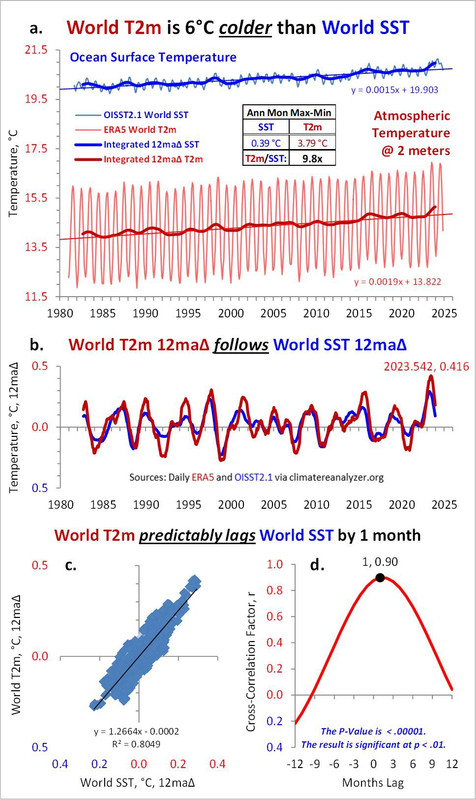
While it is popular to claim ‘human CO2 emissions trapped heat’ gets sequestered in the ocean, the warmth of the upper ocean is actually from the sunshine it absorbs, modulated by clouds, not CO2.
So while CO2 doesn’t warm the ocean, it might warm the atmosphere a little bit. Let’s see.
Assuming reliable trends in the first image below for SST and T2m, the excess warming by 2024 since 1980 in the atmosphere (T2m) over the SST is only 0.2112°C.
(0.0019-0.0015°C/mo)*(2024-1980yr)*12mo/yr = 0.2112°C
This 0.2112°C [also =1.0032°C – 0.792°C)] might be from the GHG effect, if not from fewer clouds.
Since water vapor is about 3x more powerful a GHG than CO2, the CO2 increase since 1980 of 85.85ppm might have induced 0.0528°C of the total excess from the T2m-SST trends in 44 years, ie
0.2112°C/4 = 0.0528°C and 0.0528°C/44yr = 0.0012°C/yr
CO2 =0.0012°C/yr, or 0.012°C/decade; also =0.0006°C/ppm – well below noise & uncertainty.
At this rate, the expected warming for CO2 doubling from 300ppm to 600ppm is 0.18°C.
Sure, that is a “little bit” of warming, but only if we can rule out any T2m warming from fewer clouds.
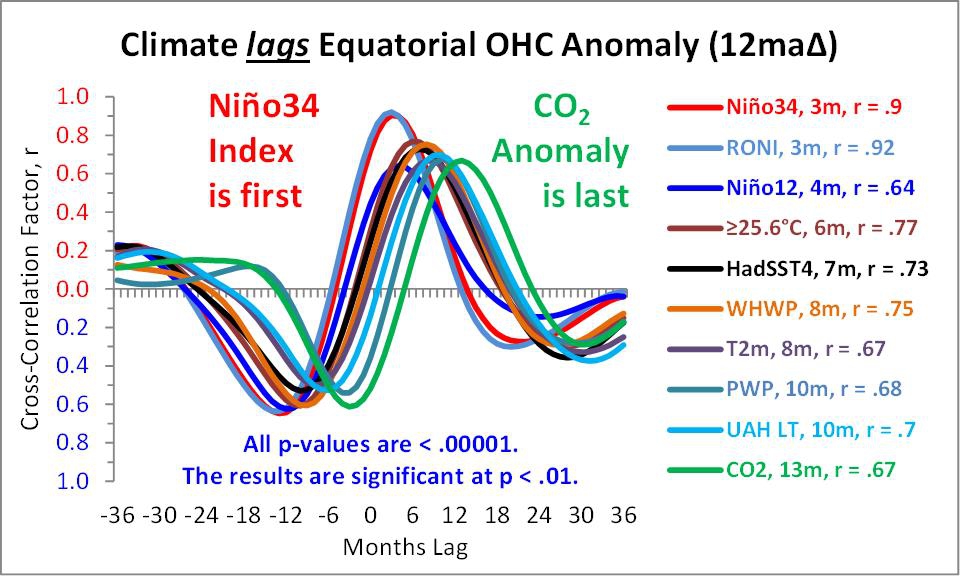
And then there’s the issue of CO2 anomalies lagging the climate, ie, not leading climate changes:
There is certainly room to say CO2 warming is so minor it can be neglected in real climate models.
Even more room to say that adding CO2 to air doesn’t make it hotter. There, I just said it!
I’m not aware of any reproducible experiment that shows otherwise.
Number of the Week: 90ºC (degrees Centergrade (162ºF …) v. 10ºC (18ºF).
Oh No! Looks like the proofreader took last week off!
90ºC <=> 194ºF (not 162ºF)
10ºC <=> 50ºF (not 18ºF, brrr!)
Unless “Centergrade” [sic] refers to a new version of Fahrenheit in which the 0ºF’ is the freezing point (triple point) of pure H2O (at atmospheric pressure, ~ 1 x 10^5 Pa).
To his main point:
Let’s start with this factoid: “The atmospheric pressure on Mars is significantly lower than on Earth. Earth’s surface pressure at sea level is about 1,013 millibars, while Mars’s surface pressure averages 6 to 7 millibars…”
Then add water vapor, a condensing ‘gas’ with other notable properties (too varied to mention here): “The water vapor pressure on Mars is significantly lower than on Earth due to Mars’ thin atmosphere…”**
Finally add life, yes Life,* the biological transformation of the so-called ‘Biosphere‘, including the Atmosphere (along with upper Hydro- and Litho-Spheres).
*Vernadsky, who was a thoroughly-modern (1920s-era) scientist on a par with Planck et al., made the persuasive case that, since time-immemorial, life has been in charge of Planet-Earth’s relation to its ‘Heliosphere’ (Photosphere).
So then, what is left to that notorious vapour of carbonic-acid (‘CO2’)? Where is it on this List? So far down as to be in the noise (of the noise)? Anyone can take the trouble to learn that its Biological Role so far exceeds its Radiative Role (and no-one cares to deny that it absorbs & emits infrared radiation in those bands — just look at the ‘CO2 (Infrared) Lasers‘, since the ’70s, used everyday in industry / welding machines).
Please, Doctors, we can do better than this!
‘What A Wonderful World’. — Q.E.D.
————————————————
https://en.wikipedia.org/wiki/Kisangani
1. Water Vapor as a Trace Gas:
Water vapor is a minor component of the Martian atmosphere, but it’s essential for understanding the planet’s climate. It’s a highly volatile trace gas, meaning it’s easily lost to space. The total mass of water vapor in the atmosphere is estimated to be equivalent to about 1 to 2 cubic kilometers of ice.[ Which, divided by the surface-area of Planet Mars gives:] The globally annually-averaged column abundance of water vapor is about 10–20 precipitable microns (pr. μm), according to a recent study.
Folks on the blogs have never figured out that the way temperature is written about should differentiate between an actual temperature and a range of temperature. I pointed this out in 2008, several times, and then gave up.
Likewise, many people think a day of 80 degrees is twice as warm as a day of 40 degrees.
Forgot the 32F offset, close enough for government work. /s
Yes*
Experience shows that it’s very hard to teach someone that a quantity of steam (as vs. hot water) will burn him much worse than liquid water, even when they are at the exact same temperature. Only the pain of blisters can make them grasp the reality of that (or the limitations of thermometry alone). Or that ice (at 0 C) can save a heat-stroke victim whereas the same quantity of liquid-H2O (at the same 0 C) will do very little. [Yes, carry ice in hot weather, not cold water]
[ In another field, it’s like trying to tell them that it’s not the voltage (electric potential) that kills, it’s the current (i.e. total electric charge passed). For the same reason, it seems. Hence the occasional deaths reported from performing stunts with big 18-V batteries. ]
In the upper-level courses on Thermodynamics, it’s best to warn the students in advance:
By the end of this course, Entropy will become second-nature to your thinking, whereas Temperature will become more mysterious.
[ Summarized, in the mathematical shorthand,
(1/T) <= ( dS / dE )
… the absolute temperature being derived from the ratio of a system’s entropy-change to an increment of energy-change … as it has been, ever since Clausius was impelled to introduce it ]
*Let’s convert your example into Celsius: ~ 27 C vs. ~ 5 C, wow that 5X ‘warmer’!
Lots of typos, missing punctuation, missing words.
“Now, I don’t disagree with everything said here.”
>The sky is blue, fish swim in water and people have three arms.
> People have two arms.
> You dumb stump, you don’t even know that the sky is blue! You deny that fish swim in water! Even a child knows these things!
>Yes. People have two arms!
> How can you stand there denying that the sky is blue!!
Severe weather dangers spread eastward into midweek, flood risk to increaseOn Tuesday, the severe weather threat will move eastward into the lower Ohio Valley and Tennessee Valley, putting regions that were impacted by powerful storms as recently as last Friday once again at risk.
Severe thunderstorms in Georgia.