by Douglas Sheil
Last week an article in Science, by Seo and colleagues, provided compelling evidence that the world’s land surface is getting drier. This global drying averaged a loss across all land surfaces of over two centimeters of water in two decades.
The trends suggest these losses continue. The authors highlighted the role of climate warming in this desiccation and claimed the changes are “permanent”. https://lnkd.in/eUV82jjV
This claim of permanence was repeated uncritically in a shorter commentary piece in the same issue of the journal. https://lnkd.in/e5r2_4mp
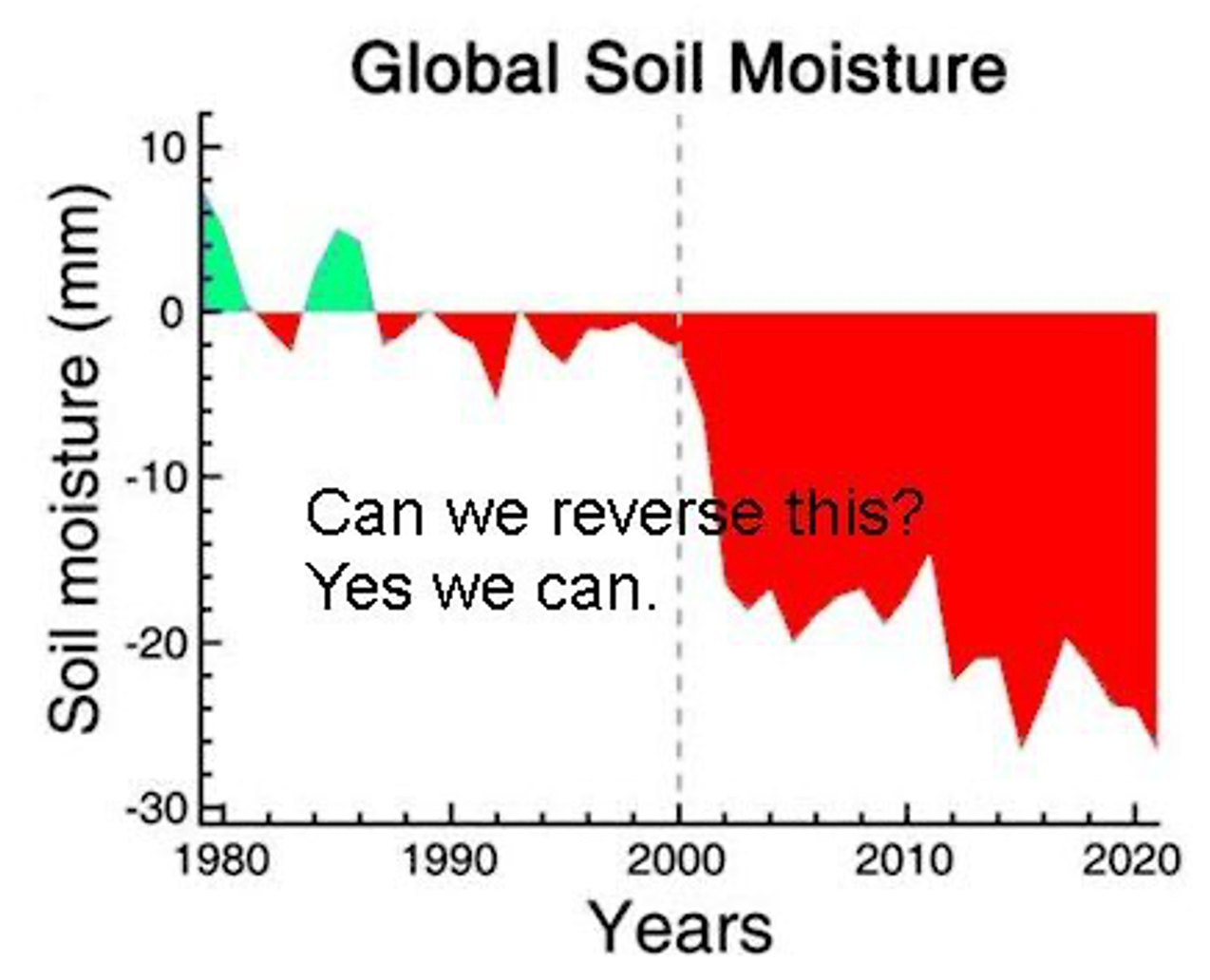
Pierre L. Ibisch and I see these trends differently. The changes may indeed be permanent but they needn’t be. It’s up to us. The role of land cover has been overlooked and is key. It wont be easy but with sufficient effort we should be able to fix this.
We submitted our comments to Science and the text is now appended below the online version of the original article (an “eLetter”). It is open access if you click through here: https://lnkd.in/eUV82jjV
The Earth is drying. Seo et al. (1) highlight an alarming shift: while for most of the planet’s history, a warming climate brought a wetter, greener world (2, 3), it now brings desiccation (1, 4). Our biosphere’s water-regulating functions are broken.
“While climate science and policy focus on greenhouse gases, they often neglect vegetation’s role in keeping the planet cool and hydrated. Forests, wetlands, and other ecosystems regulate temperatures and drive the water cycle (5) — but degradation has impaired these services. Feedbacks from droughts, heatwaves, and declining vegetation now amplify local and regional warming (6, 7). Nonlinear responses risk abrupt shifts and catastrophic tipping points (8, 9).
Solutions become clear when we recognise water and vegetation as partners in climate regulation. Protecting and restoring forests and wetlands does more than sequester carbon — it rebuilds the processes that keep landscapes cool, moist, and productive. Managing land to increase infiltration, reduce runoff, and restore soil water storage helps sustain transpiration and cool the land (5, 9-11). We need to revive a “sponge planet” (12) and support place-based innovations like “sponge cities” that enhance water retention where it’s most needed (13).
Policymakers must act boldly to safeguard “green water” (5, 14). Land-use decisions must prioritise ecosystems that regulate moisture and climate. Strong incentives are essential: those who degrade should pay; those who protect and restore must be rewarded. The message is simple and urgent: a cool, moist, green planet is our best defence against a drier, warmer world. It remains possible. The time to act is now.
References
- K.-W. Seo et al., Science 387, 1408-1413 (2025).
- U. Salzmann et al., Palaeogeography, Palaeoclimatology, Palaeoecology 309, 1-8 (2011).
- M. T. Clementz, J. O. Sewall, Science 332, 455-458 (2011).
- P. De Luca, M. G. Donat, Geophysical Research Letters 50, e2022GL102493 (2023).
- D. Ellison et al., Global Environmental Change 43, 51-61 (2017).
- C. Smith, J. C. A. Baker, D. V. Spracklen, Nature, (2023).
- D. L. Schumacher, J. Keune, P. Dirmeyer, D. G. Miralles, Nature Geoscience 15, 262-268 (2022).
- T. M. Lenton et al., Proceedings of the national Academy of Sciences 105, 1786-1793 (2008).
- A. M. Makarieva et al., Global Change Biology 29, 2536–2556 (2023).
- D. Ellison, J. Pokorný, M. Wild, Global Change Biology 30, e17195 (2024).
- D. Sheil, Forest Ecosystems 5, 1-22 (2018).
- K. Yu, E. Gies, W. W. Wood, Nature Water, 1-3 (2025).
- Z. Zheng, X. Zhang, W. Qiao, R. Zhao, Water Resources Management, 1-15 (2025).
- L. Wang-Erlandsson et al., Nature Reviews Earth & Environment 3, 380-392 (2022).
There is counter evidence to the claim in the article: “Since the early 2000s, researchers have observed a 1.5 percent decrease in the amount of atmospheric dust detected by MODIS sensors in this region each year.”
https://scitechdaily.com/the-dust-awakens-nasa-captures-spring-storm-surge-over-chinas-harshest-desert/
Might it be that the issue is more complex than suggested, and there are regional variations?
Simple minds require singular and simplistic answers.
Lack of critical thinking is pervasive.
Sadly.
The ipcc says that in a warmer world there will be more evaporation, more water vapor, and more precipitation. Hardly a recipe for what’s claimed above.
But if the rain falls in the wrong place…
/s
Funny how deserts are shrinking.
This is counter to what we already know about de-desertification of the planet for the last several decades as confirmed by actual satellite based sensing and areal measurements of greening.
But then I am told that increasing CO2 leads to less water consumption by plants.
“Strong incentives are essential: those who degrade should pay; those who protect and restore must be rewarded.”
The world doesn’t work that way.
Nonlinear responses risk abrupt shifts and catastrophic tipping points
Again with the catastrophic tipping points but this time coupled with unproven nonlinearities.
And here we thought the planet was greening, at least NASA says so.
NOAA does too.
Deserts are shrinking, agricultural production is through the roof, and there is no discernable trend in droughts according to those masters of alarm, the IPCC.
Whenever a paper ends in a conclusions as to what governments should do, you’re not reading science, you’re reading political advocacy dressed up as science.
This one smells from multiple viewpoints.
It is hard for me to wrap my head around this article. These guys are concerned about all land surface becoming drier. An average 2 centimeter loss over all land surfaces in the last two decades. They blame land desiccation and highlight the role a warming climate for it. How can they possibly know the soil moisture of all the land well enough to state we have a 2 centimeter deficit? I don’t think they can know that. I can understand a soil moisture deficit due to urban sprawl. The soil under buildings, parking lots and roads are surely suffering a lot more than a 2 centimeter deficit. We would have to take runoff into consideration both in urban areas and places that have burned such as bush and forest fires. None of this seems new and I fail to see a connection with climate change, global warming, CO2, or CAGW. This looks like old news and serves as a distraction more than anything.
Don’t overthink it Bob, just entertain the possibility that they just might make shit up.
At the moment the surface moisture around where I live is very much on high side !!
And the forecast is saying more rain later in the week.
The precipitation is white in Colorado today.
Editor’s summary–
“During the interval from 2000 to 2002, terrestrial water storage decreased by nearly twice as much as Greenland ice mass loss over the same period. —Jesse Smith”
Reminds me of the people downhill from us in a Louisiana floodplain with a sunken living room flood complaining about living there a few years and “this never happened.”
Texas west of approximately 97 degrees W longitude has more evaporation than precipitation the same time whining about the minor current drought while bragging about increasing population and industry. I just unearthed a paper on the Texas Water Plan predicting half century conditions, not pleasant. This was after the severe 7+ year 50s drought and 60s not all that wet. Probably a worse one in the 19th century.
Chapman, C. R. 1971. The Texas water plan and its effect on estuaries. pp. 40-57, In, A Symposium on the Biological Significance of Estuaries. Sports Fishing Inst.
Why would anyone want to “sequester” carbon? It’s vital for plants, and therefore humanity. The only reason atmospheric levels are rising is the “de-equestering” of carbon – burning fossil fuels! And a jolly good thing too!
Food plants are good! Trees are nice, grape vines don’t look as nice, but are valuable to many people. In vino veritas sometimes goes along with nullius in verba.
Burn, baby, burn. Reasonably easy? to ensure that the only de-sequestered products to get into the atmosphere are CO2 and H2O. Costs a little more, but I’ll gladly pay my share for clear skies, and no soot on my clothes.
“Global” soil moisture? Yeah, right. About as useful as global temperature. Mapped, the data likely show the greatest changes in regions of rapid land use change, with tropical forests ravaged for biofuel farms and subsistence farming. Asian, Asia-Pacific, South America, Africa and other regions continue to strip the land of vegetation, while western nations long ago stabilized and reversed this trend, SLOWLY over a century. Rapid reversal of this land use change in these regions could substantially offset the net growth of CO2 in the atmosphere (as if we really care).
Wreckage of the lands in these regions is at least partially due to hysterical climate policies.
However, the author is blind to the political realities. He advocates “bold” policies … Yes, like COP 25, 26 ,27, … and “Net Zero.” Just look how well those have worked.out —- create an imagined apocalyptic terror, then rush foolish, costly and hopelessly deficient policies into place. Accomplishing what? Destruction of western economies and societies and fluorishing communist tyrannies.
“Can we reverse this? Yes we can” says yhe graph.
Ehm this sounds suspiciously like: “Funding please and goverment intervention”
Sincerely pass.
I blame the greening of the earth if you got those water and carbon sucking plants pulling moisture out of the soil and providing Evaporation surfaces, its obvious where the water is going.
Plants are 80-95% water so that would be the first place to look.
How really contradictory the deployment of science has become. When the science pointed to proof of cataclysmic outcomes everyone was reading-up on Mann and only scepticism had awkward questions. Now that the fallacy has been exposed no one in positions of power, it seems, is reading the messages of hope and uncovering contradictions. I see how gloom and its Messianic bedfellows hold us in thrall to the worst sort of governance, the one that seeks to capture you in reliance and thankfulness. Yes, no one could be defamed for proclaiming their thoughtfulness for others, until you find how unscrupulous and conniving states can become in corralling their own constituencies, sewing confusion, planting fear and stitching-up society making it subservient, malleable.
I thought “Climate Change” was supposed to cause more flooding.
I wish they’d make up their minds.
My wife and I have been looking into getting a prepaid funeral plan to make it easier on our kids.
I’d like to know if my coffin should have a humidifier or a dehumidifier. /dh
PS “/dh” = “dark humor”
Does anyone have a link to the actual paper? I’m interested to know exactly how/what they’re measuring to come to that finding… I know its MODIS but little more.