
SUBSCRIBE to Climate Change Weekly
IN THIS ISSUE:
- Are Net Zero’s Days Numbered?—Heartland Comes to Europe
- Climate Change Hasn’t Affected Antarctic Calving
- Coal Use Sets New Record Despite Paris Climate Commitments

Are Net Zero’s Days Numbered?—Heartland Comes to Europe
The Heartland Institute’s influence on climate and environmental policy around the globe is spreading, nowhere more so than in Europe.
Heartland has long had a presence in Europe in the sense that we have worked with allies there over the years to encourage the European public, business community, and politicians to embrace sound climate science and avoid costly climate and energy policies that take Europe and the globe down the road to climate serfdom.
Heartland worked with the Polish labor union Solidarity to shore up its government’s rightful defense of the continued use of coal to generate power, in the face of EU pressure to end coal use and rely on imported power derived from unreliable renewables. Heartland also cohosted multiple international climate conferences with Germany’s premier climate realist organization, EIKE, to promote sound science and counter efforts of the U.N. Intergovernmental Panel on Climate Change to impose ever-stricter greenhouse gas restrictions on EU citizens and companies.
Our joint efforts haven’t always succeeded in preventing sharper restrictions, but in our role as gadfly we have helped foment dissent and encouraged and publicized protests against higher energy taxes, climate restrictions, and wind and solar subsidies. Based on the fact that a number of energy taxes in different EU countries have been delayed, reduced, or scuttled altogether and climate policies have been modified to reduce their economic impact, there is at least some evidence our efforts have borne positive policy fruit.
In the past year, what was previously a trickle has quickly grown to a torrent.
After visiting Heartland’s website and reading an online version of Heartland’s Climate at a Glance for Teachers and Students (CAAG), Harald Vilimsky and Roman Haider, two members of the European Parliament representing Austria, visited Heartland’s offices in June 2023 to meet with Heartland President James Taylor and Heartland Vice President Jim Lakely. They requested Heartland’s help to counter climate alarmism. Heartland accepted the challenge.
Following up, Vilimsky and Haider invited Taylor to present information on March 13, 2024, at a special EU Parliament session on climate change, ESG, and proposed legislation that would require net zero EU carbon dioxide emissions by 2050.
Prior to the meeting, Vilimsky and Haider had informed Taylor that the net zero legislation had sufficient support to be approved, based on Hungary’s representatives indicating that country would support it.
Taylor had met some of Hungary’s representatives at a previous event in Vienna, and he renewed acquaintances just before the March 13 special session. During the session, Taylor explained why there is no climate crisis according to the best available data, and he warned of the economic, political, and geopolitical suicide that net zero would bring. After the session, Taylor met informally with many of the Hungarian MEPs, continuing the conversation over dinner.
Less than two weeks later, the media reported stunning news. On March 25, in a striking defeat of the global climate establishment in the European Union, MEPs sponsoring the net zero legislation pulled it from consideration, after Hungarian MEPs announced they had changed their position and would vote against it. This left the net zero proposal with insufficient support to pass. Vilimsky and Haider credited Taylor’s efforts as providing cover to reject the bill. The bill was considered a slam dunk to be approved by the EU Parliament—until The Heartland Institute got involved.
In mid-October, the leaders of Solidarity brought Taylor back to Krakow and Katowice. Their plan was to educate Taylor on the specific issues and opportunities surrounding energy and climate knowledge in Poland. Taylor dined with Beata Szydlo, who was Prime Minister of Poland in 2017-2019, along with Polish representatives to the European Parliament, several of whom who flew in just to meet and talk with Taylor. Solidarity also introduced Taylor to leaders of heavy industry and agriculture and to scientists at one of the country’s top research universities. Solidarity brought Taylor in, in particular, to shape a plan to fight the so-called “Green Transition” that is destroying jobs throughout Poland.
In a presentation, Taylor gave an overview of The Heartland Institute and explained how climate activists are defying sound science and imposing devastating impacts on affordable energy, agriculture, the environment, and individual freedom in Poland and throughout the world. Heartland’s Jim Lakely and Keely Drukala set up a livestream with Obama administration Undersecretary of Science in the Department of Energy Steve Koonin to address the meeting.
The policymakers emphasized that there is no entity in Poland or anywhere else in Europe that they can rely on to help them fight for freedom, especially in the realm of climate change policy. They asked Heartland to plant a flag in Poland and create and lead a trans-European or transatlantic alliance of public-policy and grassroots entities to fight the climate activist agenda and promote freedom-focused policy in all issue areas.
At the conclusion of the meetings and tours, the leadership of Solidarity’s division of mining and energy and Taylor signed a joint declaration on climate change and energy policy and a statement of intent for Heartland and Solidarity’s mining and energy branch to work closely together in promoting climate realism.
As part of that commitment at the request of Solidarity’s leaders, Heartland updated 10 Climate at a Glance fact sheets and translated them into Polish to be published there. Taylor also developed two documents detailing a transatlantic alliance, one laying out principles and steps to advance freedom in general, and one to advance energy development and reduce climate restrictions. These documents will serve as the core of Heartland’s wider international efforts, open to allies in all EU countries and the U.K. to join, to cement and guide ongoing cooperation on issues and policies.
Heartland’s biggest move in Europe to date was still to come.
Nigel Farage, a former representative of the U.K. in the European Parliament and current member of the British Parliament and leader of Reform UK, spoke with Taylor at Heartland’s 40th anniversary dinner, at which Farage was the keynote speaker. Farage encouraged Heartland to form a beachhead in Europe, in particular in the U.K., pledging to support the effort.
Heartland had previously worked with CAR 26, a leading U.K. group promoting sound climate science and policy, headed by Lois Perry. In conversations with Perry, she emphasized that their efforts would be more effective with a stronger, permanent Heartland presence.
Thus it was that on December 17, 2024, Heartland officially launched what may be the first of several satellite affiliate offices in the U.K., Heartland UK/Europe, with former Prime Minister Liz Truss, Farage, and other prominent luminaries from the political and business communities in attendance.
Perry was hired as executive director of Heartland UK/Europe.
“The Heartland Institute has a proud history of providing research and resources that shape conservative and freedom-oriented policymaking in the United States,” said Taylor at the meeting announcing the launch. “During recent years, a growing number of policymakers in the UK and continental Europe have requested Heartland establish a satellite office to provide resources to conservative policymakers throughout Europe. With our UK and European launch, we aim to fulfill this requested impact throughout Europe, championing the principles of liberty and economic prosperity in an era of increasing regulation and anti-growth policies.”
“The Launch of Heartland UK/Europe is a signal of our commitment to bringing bold, evidence-based solutions to the forefront of European policy discussions,” said Perry. “By uniting key leaders and thinkers from both sides of the Atlantic, we are fostering a vital dialogue to counter ideologically driven overregulation and advance policies that empower individuals and communities.”
The writer of an article covering the formation of Heartland UK/Europe asked hopefully, “Are Net Zero’s Days Numbered?” Among the other points made in his article, author Harrison Pitt wrote:
The resources that Heartland UK/Europe can provide, both intellectual and financial, are bound to be invaluable. In truth, this kind of American presence in Britain could neither be better timed nor more sorely needed. Evidence suggests that the UK is currently engaged in a mortifying contest with Justin Trudeau’s Canada to see who can claim the ultimate nagging rights as the most poorly governed, declining nation in the Anglosphere.
Nowhere is our bid for this title stronger than in the British state’s quixotic, utopian obsession with ‘achieving’ net zero emissions. Cheap, efficient, dependable energy is the lifeblood of an advanced industrial economy. Without it, capital is harder to come by, homes are more expensive to heat, and people’s overall quality of life goes down. . . .
The Heartland Institute is a long-standing opponent of [the] weaponization of science. They view the scientific enterprise as a process and a method, not a moment or a catechism. This is because all true scientists proceed, as the philosopher Karl Popper urged, by “conjecture and refutation”—the idea being that any scientific knowledge we believe ourselves to have grasped, while it may have proved itself against attempts at falsification, should be treated as provisional.
Managerial politics is what happens when claims to scientific knowledge are instead treated as unquestionable certainties and enlisted to justify large-scale social engineering projects. And, in textbook managerialist style, the central planners conscripting the rest of us into whatever mission they happen to prize will for the most part be insulated from the unglamorous consequences of their grand designs.
In the case of the net zero agenda, it is ordinary working people—those for whom the Labour Party claims to speak—who are suffering, and will continue to suffer, most of all. One saving grace is that this means their political loyalties will be up for grabs over the next five years. With the intellectual heft and scientific firepower of the Heartland Institute now behind him, Farage stands an even greater chance—not just of winning people over, but keeping them on-side with practical results if he ever makes it to No. 10.
It’s onward and upward for climate realism around the world, with The Heartland Institute leading the charge.
Sources: European Conservative; The Heartland Institute; Heartland UK/Europe
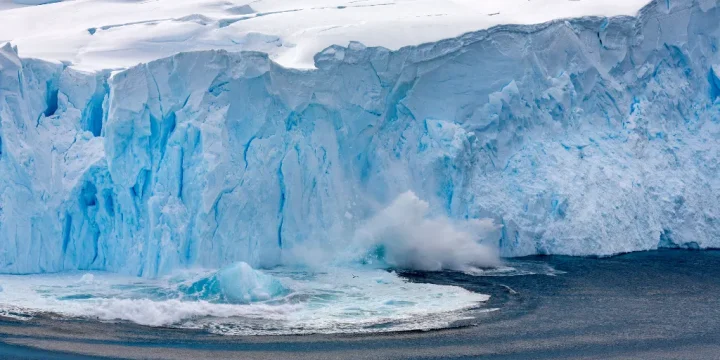
Climate Change Hasn’t Affected Antarctic Calving
A recent study, possibly the first of its kind, published in the peer-reviewed journal Geophysical Research Letters, analyzed extreme calving events, the breaking off of huge glaciers, in Antarctica to determine what impact climate change has had on their occurrence and frequency. The study found no changes in the frequency or magnitude of such calving events over the past 47 years. In other words, there was not only no suggestion that climate change was causing or contributing to such events, there was not even any correlation.
The authors of the study note:
Massive calving events, such as the one that formed the Delaware-sized (5,800 square kilometers, or 2,239 square miles) A-68 iceberg in 2017, can destabilize ice shelves and capture the public’s attention. But the infrequency of extreme calving events makes it difficult for scientists to predict them and understand whether they are connected to climate change.
Large calving occurrences are rare and unevenly distributed across Antarctica. The researchers used statistical methods, based in extreme value theory, when examining large iceberg calving in Antarctica to ascertain whether the frequency or magnitude of such events has changed as the Earth has modestly warmed. Their research focused on the single largest iceberg to calve in each year between 1976 and 2023, inclusive.
The geologists, geographers, and geophysicists who produced the study determined that the size or surface area of the largest annual iceberg decreased slightly over time and the risk of an extreme calving event did not increase. Contrary to media speculation and assertions, they write:
Our analysis reveals no upward trend in the surface area of the largest annual iceberg over this time frame. This finding suggests that extreme calving events such as the recent 2017 Larsen C iceberg, A68, are statistically unexceptional and that extreme calving events are not necessarily a consequence of climate change.
Sources: Geophysical Research Letters; Eos

Coal Use Sets New Record Despite Paris Climate Commitments
Deadlines to cut emissions, deliver funding, and set stricter emission reduction goals established under the 2015 Paris climate agreement have come and gone with none of the commitments being met. Indeed, ten years after the Paris agreement was inked, despite it being generally agreed by all the signatories to the agreement that the quickest, most meaningful way to cut emissions would be the cessation of coal use for electric power production (along with cuts in the use of oil and natural gas), the use of coal set new records in 2024, and oil and gas use has grown as well.
The International Energy Agency’s (IEA) Coal 2024 report details the fact that demand for coal has set new record highs for three years running, after the brief pandemic dip.
For at least the past half-decade, the IEA’s coal demand outlook projections have been consistently wrong. During the pandemic, the IEA forecast an 8 percent decline in coal use, but the decline was just half that. In 2022, the IEA forecast coal use would peak by 2025, yet it has set records three straight years since that prediction. In 2023, the IEA forecast the decline of global coal demand even sooner, saying coal use would peak in 2023—a year when it set a new record for use, followed by 2024’s new record for production and use.
In its “Coal 2024” report, the IEP now predicts the world will hit peak coal use in 2027. This despite continued strong growth in Asia and a modest resurgence of coal use in Europe and in the United States.
China remains the biggest driver of coal use, as detailed by the IEC for almost 30 years now, consuming 30 percent more than the rest of the globe combined, driven by electricity demand. The IEA reports that India, Indonesia, and other emerging economies are also behind the increase in demand for coal.
Using coal means mining coal. The IEA reports coal mining topped new production records in 2024, with each of the top three producers—China, India, and Indonesia—setting new production records.
It seems that King Coal’s demise has been greatly exaggerated. So have the steep emission cuts and funding increases called for under the Paris climate agreement. King Coal is dead; long live the king!
Sources: Newsbreak; The Mirror; International Energy Agency
Recommended Sites

H. Sterling Burnett, Ph.D., is the Director of the Arthur B. Robinson Center on Climate and Environmental Policy and the managing editor of Environment & Climate News.
The Real Cost of Net Zero: The shocking truth of the renewable energy push
Glad you teed that up. Idiots are in charge everywhere.
Especially in the UK parliament. It doesn’t matter whether you’re Liebour, Tory, Libdem or Green. They’re all idiots.
One face of the Parliamentary dictatorship.
Not necessarily idiots. Other factors can influence their decisions – religion (CAGW, astrology), financial incentives, pervasive propaganda, etc. They may not be able to differentiate between reality and fantasy. Most of the people I know are subject to one or more of these mental weaknesses.
All this carp simply because Manabe had no clue how Earth’s energy balance is maintained.
It is a huge indictment on the government funded research carried out in Australia. These lunatics place the incompetent fools at GISS on a pedestal, following their lead into the weird world of climate fisiics..
More power to Trump. Trump would do better to task Musk/Space X to evaluate the NASA GISS climate research then produce useful climate models that are based on physics rather than Manabe’s carp. Killing the silly notion that CO2 alters Earth’s energy balance would have an enduring effect long after the 4 year term.
And yet, no mention of the stupudity and pointlessness of trying to reduce CO2, in the first place. Nor any mention of how all this is enriching the very wealthy.
Too many socialists in EU to want the masses to be happy or self reliant.
In LA, there are numerous examples of the self reliant taking charge when government fails. It’s good to hear success stories of those who fought for things they deemed worth the risks.
The difference with the LA fires compared to wild fires in Australia is that most of the fuel load in Australia is woody biomass on the forrest floor. In LA the fuel was in the houses and cars on the street.
A man with a plan clearly worked in LA.
Australia has houses nestled amongst towing eucalyptus trees. The only plan that has any chance there is a fire bunker with enough air to outlast the fire crowning overhead:
https://www.wildfiresafetybunkers.com.au/bunkers.html
Anyone planning to saver assets must have a survival plan with suitable bunker.
It will be interesting to see how many trees survived.
The folks in the UK seem unwilling to save their young girls from grooming gangs. Sweden may be the same. I fear the EU is going to give nuclear weapons to the jihadists before Iran gets them.
Are Net Zero’s Days Numbered?
I think that largely depends upon where you happen to reside. In the case of the UK one must blank out the eye watering hikes in taxes on North Sea operations and the subsequent exodus.
North Sea oil and gas must be brought under greater public control to avoid a cliff-edge collapse of the industry and secure a sustainable future for workers and communities, according to a report.
Under the current private ownership model the inevitable end of North Sea oil and gas production – whether through government action or the lack of viable oilfields – will lead to private companies abruptly abandoning the basin, leaving frontline communities and the state to deal with the social and economic consequences, the authors predict.
https://www.theguardian.com/environment/2025/jan/11/bring-north-sea-oil-and-gas-under-greater-public-control-report-urges
A cliff edge of their own making.
It is interesting to notice the relation between the UK and the Netherlands. The latter halted all onshore production of natural gas that was state owned. Offshore is still ongoing but the state sold the rights to russian oligarchs.
The question should be: does state control means it is halting or promoting production? And what does ‘public control’ actually mean? To me it makes sense that a country owns it’s own energy source. It may chose to conduct and regulate its own production (as the NAM in Holland did) or outsource it to private companies and take a cut of the profit.
To take control of it and halting production is as idiotic as it sounds..
During a debate between the leaders of Norway’s two biggest political parties tonight, it is clear that Norway will be producing oil and gas for at least the next 100 years—or as long as it is economically viable. We have never produced more gas than in 2024. The UK is one of our biggest customers. The rest goes to the EU. Norway has been 100% “renewable” in electricity production the last 100 (or since the start of el production), from Hydro. A sizable part of the electricity goes to the continent via sea cables. As a nation, Norway earns a lot of money on stupid energy policies in Germany and UK — if the Net Zero nonsense is not stopped this will soon lead to national economic suicide!
Net Zero is (now) a proven nonsense.
Major kudos to Heartland! Their efforts in Europe are bearing fruit. Now is the time for Climate Realism globally but particularly in Europe where civilization appears to hang in the balance.
How fitting it is that Poland and Hungary are leading the Euro Climate Realism revolution. Their experience with deadly political oppression in the 20th Century has taught them lessons the hard way, lessons that other EU nations have forgotten.
Blessings to Heartland for spurring this revival, and prayers to all of Europe that they may see the light soon and have the strength to throw off their current wicked overlords.
Very nice Sterling. Heartland is doing what we should all be doing and that is reaching the public. The progress I see that Heartland has achieved wasn’t at the ballot box but rather educating the people most affected by ill considered and wrong headed government policies.
Story tip:
https://youtu.be/V16LTPe6a_o?si=hT4cYu16C7jfbCU9
A solid general presentation about media manipulation and the hierarchy of demand and control in which any topic is put into a narrow band narrative ( of which Climate is but one).
Presented by Academic Agent (Neema Parvini).
Clouds and Upward and Downward IR Radiation
The below article indicates CO2 has a very minor role regarding the greenhouse effect
.
Increasing CO2 by 100% Reduces Radiative Cooling to Space by an Imperceptible 1%
https://www.windtaskforce.org/profiles/blogs/increasing-co2-by-100-reduces-radiative-cooling-to-space-by-an
By Drs. van Wijngaarden and Happer
.
“An increase in low cloud cover of only about 1% could largely compensate for the doubling of CO2.” – van Wijngaarden & Happer, 2025
The physicists detail just how insignificant CO2 is as a factor in climate change, revealing that doubling the CO2 concentration from 400 ppm to 800 ppm – a 100% increase – hypothetically reduces radiative heat loss to space by just 1%.
It would take many decades to achieve such a ppm increase, plus there are not enough fossil fuels left over to make it happen.
Because CO2 has increased by only 50% since 1750 (280 ppm to 420 ppm), the CO2 total greenhouse effect regarding reducing upward IR radiation has thus far been in the range of tenths of a percentage point.
Such a small change in upward IR radiation, over hundreds of years, is not even detectable amid the noise of outgoing radiation measurement.
For example, the measured upward IR radiation has an error of about 33 W/m²
This negligible CO2 greenhouse effect is a calculated value for an atmosphere that is perpetually cloud-free.
As clouds are present 60-70% of the time, this clear-sky-only condition only occurs in an imaginary world – an atmosphere that doesn’t exist.
Compared to the CO2 role, the greenhouse effect of clouds is tens of times more influential.
As Drs. van Wijngaarden and Happer point out in their conclusion, all that is needed to offset the impact of doubling CO2 is a mere 1% change in cloud cover.
Because cloud cover changes of much more than 1% occur routinely, both from year-to-year and
decade-by-decade, the role of CO2 within the greenhouse effect is insignificant, if not irrelevant.
During cloudy skies, downward IR radiation from cloud bottoms is about 340 W/m^2,
During clear skies, downward IR radiation is about 260 W/m^2, about 30% less
“During cloudy skies, downward IR radiation from cloud bottoms is about 340 W/m^2,
During clear skies, downward IR radiation is about 260 W/m^2, about 30% less.”
Since the radiative heating on the surface from the Sun is approximately 160-170 W/m2, one might wonder where they get this much larger back-radiation heating. Also, it breaks the second law of thermodynamics that a colder body (the atmosphere) heats a warmer body (the Earth’s surface).
There is no greenhouse effect!