By James R. Riordon – NASA Goddard Space Flight Center
Healing continues in the atmosphere over the Antarctic: a hole that opens annually in the ozone layer over Earth’s southern pole was relatively small in 2024 compared to other years. Scientists with NASA and the National Oceanic and Atmospheric Administration (NOAA) project the ozone layer could fully recover by 2066.

NASA Earth Observatory/Lauren Dauphin
During the peak of ozone depletion season from Sept. 7 through Oct. 13, the 2024 area of the ozone hole ranked the seventh smallest since recovery began in 1992, when the Montreal Protocol, a landmark international agreement to phase out ozone-depleting chemicals, began to take effect.
At almost 8 million square miles (20 million square kilometers), the monthly average ozone-depleted region in the Antarctic this year was nearly three times the size of the contiguous U.S. The hole reached its greatest one-day extent for the year on Sept. 28 at 8.5 million square miles (22.4 million square kilometers).
The improvement is due to a combination of continuing declines in harmful chlorofluorocarbon (CFC) chemicals, along with an unexpected infusion of ozone carried by air currents from north of the Antarctic, scientists said.
The ozone hole over Antarctica averaged nearly 8 million square miles (20 million square kilometers) between Sept. 7 and Oct. 13, 2024, the 20th smallest extent in 45 years.
Credit: NASA’s Goddard Space Flight Center/ Kathleen Gaeta
In previous years, NASA and NOAA have reported the ozone hole ranking using a time frame dating back to 1979, when scientists began tracking Antarctic ozone levels with satellite data. Using that longer record, this year’s hole ranked 20th smallest in area across the 45 years of observations.
“The 2024 Antarctic hole is smaller than ozone holes seen in the early 2000s,” said Paul Newman, leader of NASA’s ozone research team and chief scientist for Earth sciences at NASA’s Goddard Space Flight Center in Greenbelt, Maryland. “The gradual improvement we’ve seen in the past two decades shows that international efforts that curbed ozone-destroying chemicals are working.”
The ozone-rich layer high in the atmosphere acts as a planetary sunscreen that helps shield us from harmful ultraviolet (UV) radiation from the Sun. Areas with depleted ozone allow more UV radiation, resulting in increased cases of skin cancer and cataracts. Excessive exposure to UV light can also reduce agricultural yields as well as damage aquatic plants and animals in vital ecosystems.
Scientists were alarmed in the 1970s at the prospect that CFCs could eat away at atmospheric ozone. By the mid-1980s, the ozone layer had been depleted so much that a broad swath of the Antarctic stratosphere was essentially devoid of ozone by early October each year. Sources of damaging CFCs included coolants in refrigerators and air conditioners, as well as aerosols in hairspray, antiperspirant, and spray paint. Harmful chemicals were also released in the manufacture of insulating foams and as components of industrial fire suppression systems.
The Montreal Protocol was signed in 1987 to phase out CFC-based products and processes. Countries worldwide agreed to replace the chemicals with more environmentally friendly alternatives by 2010. The release of CFC compounds has dramatically decreased following the Montreal Protocol. But CFCs already in the air will take many decades to break down. As existing CFC levels gradually decline, ozone in the upper atmosphere will rebound globally, and ozone holes will shrink.
Ozone 101 is the first in a series of explainer videos outlining the fundamentals of popular Earth science topics. Let’s back up to the basics and understand what caused the Ozone Hole, its effects on the planet, and what scientists predict will happen in future decades.
Credit: NASA’s Goddard Space Flight Center/ Kathleen Gaeta
“For 2024, we can see that the ozone hole’s severity is below average compared to other years in the past three decades, but the ozone layer is still far from being fully healed,” said Stephen Montzka, senior scientist of the NOAA Global Monitoring Laboratory.
Researchers rely on a combination of systems to monitor the ozone layer. They include instruments on NASA’s Aura satellite, the NOAA-20 and NOAA-21 satellites, and the Suomi National Polar-orbiting Partnership satellite, jointly operated by NASA and NOAA.
NOAA scientists also release instrumented weather balloons from the South Pole Baseline Atmospheric Observatory to observe ozone concentrations directly overhead in a measurement called Dobson Units. The 2024 concentration reached its lowest value of 109 Dobson Units on October 5. The lowest value ever recorded over the South Pole was 92 Dobson Units in October 2006.
NASA and NOAA satellite observations of ozone concentrations cover the entire ozone hole, which can produce a slightly smaller value for the lowest Dobson Unit measurement.
“That is well below the 225 Dobson Units that was typical of the ozone cover above the Antarctic in 1979,” said NOAA research chemist Bryan Johnson. “So, there’s still a long way to go before atmospheric ozone is back to the levels before the advent of widespread CFC pollution.”
View the latest status of the ozone layer over the Antarctic with NASA’s ozone watch.
______________________________________________________________________________
Was there an ozone hole in 1966 or 1866? Just wondering.
Sure. It is natural. Nothing to do with us. But the success of that scare launched the global warming scare. Hopefully the biggest and last.
Not to mention Rachel Carson’s “Silent Spring”
or Acid Rain or it never happened Global Cooling.
All in all, it’s quite the metamorphosis arriving
at The Climate Crisis
South Pole total column ozone data only goes back to 1963. At the time of the Montreal Protocol, it was claimed that there had not been an ozone hole before 1979, but by their own definition of “ozone hole” there had been ozone holes in 1964, 1966, 1969, 1974 and 1977.
The air conditioner we had installed in 1985 was replaced a few years back, and the condenser coil & fan was twice a big as the 1985 unit. I assume that’s because of the CFC regulations. Really not a big deal, but death by a thousand cuts comes to mind.
The reason the condenser and evaporator in your new unit are two to three times larger, is the “new” refrigerants are that much less efficient than the ones they replaced. And it gets worse: automotive refrigerants, specifically the new Y1234 is essentially modified propane, and extremely flammable and highly toxic. Whereas the old standard 134a is non flammable and non toxic.
Green nutbars want to phase out even the household/commercial refrigerants like 410a now in use to migrate to the flammable and toxic ones like the Y1234. It’s a freakin nightmare and will be comparable to the clot shot fiasco in terms of harm to humans with leaks and accidents.
The ozone hole was and is always naturally produced…. Duh O3 is produced by O2 interacting with UV light from the sun. And duh, the Antarctic hole appears after it’s been in the dark for 6 months – duh and the upper winds do not mix much with the rest of the globe down there. (which also means the CFC’s don’t get to the Antarctic upper atmosphere – duh)
And do you know what they replaced the CFC’s that comprised the propellants in spray cans with from the Montreal Protocol? They use propane and butane now, so they release unburned hydrocarbons and are now flammable instead of inert! Brilliant idiocy by the green blob!
“They use propane and butane now, so they release unburned hydrocarbons and are now flammable instead of inert! Brilliant idiocy by the green blob!“
______________________________________________________________
Grenfell tower fire
It was first noticed in 1956. It’s natural and occurs every year, and nothing we do will change that.
Charles Dobson himself observed ozone depletion over the Antarctic as early as 1936. It is à perfectly natural phenomenon.
It is driven by the Circumpolar Vortex. The Vortex prevents tropical stratospheric ozone from being delivered by the Brewer-Dobson Circulation and replacing the decomposed ozone. In the warm years where the Vortex doesn’t fully develop, or terminates early, the ‘Ozone Hole’ drops to about half of typical values for 1990-2024. When the vortex breaks up in the Spring, stratospheric air enriched in ozone, outside the Vortex, moves in and brings the concentration back up to where it needs to be when the sun is above the horizon.
If we looked, we’d find there’s an ozone hole on Uranus.
Yes, by international agreement we have greatly reduced CFC emission, and the hole continues to diminish.
I thought it was pretty big a few years ago. Not that there is a hole, that isthe usual nonsensical scary metaphor. Dobson readings are few and can fluctuate at any given location. I once looked at the actual data and it was ridiculous, worse than area averaged global temperatures which are pure junk.
How big should the ozone hole be?
Well it depends.
What are the standardized measurements for what constitutes a “hole”?
Surely “science” has these defined in both metric and imperial measurements?
Nick must know.
Nick?
Well, it was getting uncomfortably close to me. That’s too big.
We don’t need one at all.
Oh dearie me… You poor little thing !
You probably need to make the sun shine on Antarctica in winter then. Unfortunately, that’ll get greenies wound up because ice would start to melt. Oh dear…
You only need to worry if the sun gets directly overhead because when it is outside the ‘Hole,’ it has considerable scattering and absorption with the long path length, and sunlight goes through the abnormally high ozone outside of the Circumpolar Vortex.
As long as there is a Circumpolar Vortex, there will be declines in the ozone concentration because ozone has a short-half life, and in the absence of sunlight, it cannot be regenerated locally. Replenishment depends on Brewer-Dobson Circulation which is prevented by the Vortex.
I think we should understand it better before attempting to change it.
But other planets have a polar ozone hole too. Why shouldn’t Earth have one?
You’re “uncomfortable”? That sounds like a “you” problem. How much are you willing to pay us to make you “comfortable”?
The British Standard hole was defined in Blackburn Lancashire, and is 1/4,000th of an Albert Hall.
This comment left intentionally blank
Mr. Layman here.
As I understand it, The “Ozone Hole” was an invention of the MSM. The ozone layer thins over the poles seasonally when that pole is tilted away from the Sun. (Sunlight hitting the atmosphere is what forms ozone to begin with.)
The ozone hole is designed to be big enough to scare people. It is worth noting that the “hole” was defined at 220 Dobson Units purely so that it began in 1979 (provided people didn’t look at the earlier non-satellite data). From my paper:
1. Introduction
Depletion of ozone (O3) over Antarctica was first observed in the late 1970s, and discovery of the Antarctic ozone hole was announced in the 1980s as having started in 1979 [1]. The ozone hole was defined as the area with total column ozone of less than 220 Dobson units (DU). As NASA said: “The value of 220 Dobson Units is chosen since total ozone values of less than 220 Dobson Units were not found in the historic observations over Antarctica prior to 1979.”. In other words, the ozone hole was defined so that it started in 1979. If a different number had been used then the ozone hole could have started at a different date.”. [my bold]
The hole cannot yet be claimed to be diminishing. The article quotes NOAA’s Stephen Montzka: “For 2024, we can see that the ozone hole’s severity is below average compared to other years in the past three decades, but the ozone layer is still far from being fully healed”. Only the one year 2024 is below average, the last couple of years were not, that’s not a trend. And the average was only of the post-Montreal period. See my other comments on this thread.
Some countries still use CFCs and are careless with other chlorinated solvents. For example, people drive to Mexico from Texas to buy R-12 and R-22 because Mexico still uses them. China still produces and uses CFCs. By the way, I don’t use an apostrophe to pluralize an abbreviated word like CFC. It seems silly to make the abbreviation possessive when we would just add an s if we spelled out chlorofluorocarbon. So we really haven’t greatly reduced CFC emissions, and the hole has grown and shrank since Montreal. A good scientist would deduce that natural variables are important.
Ozone depletion was observed years before the introduction of CFC’s..
Yes, compliance isn’t perfect, and neither is the result. But it is a lot better than no action at all:
A totally irrelevant comment. !
Your emissions graph is anticorrelated with with the observed decline in the size of the ozone hole between 2005 and 2019.
Overlay the ozone hole on this graph and then we can see if there is even a correlation, let alone causation. A graph showing only one variable does not prove a cause and effect relationship.
How do you account for Dobson’s observations in 1936, years before the introduction of CFC”s?
We do know that there are “natural” emissions of organic halogen compounds, CFCs, etc.
Ah! The old correlation equals causation fallacy! I’ll bet that you believe CO2 controls the climate, too.
There was a general decline from about 2005 to 2019, and then a big jump back to about the 1990s level for the next 4 years; 2024 only declined about 15% from 2023, which seems well within typical variability. 2024 hole was about twice what 2019 was. https://ozonewatch.gsfc.nasa.gov/
Considering the demonstrated sensitivity of the ‘Ozone Hole’ area to warming, one should at least acknowledge the possibility that the warming trend plays a role as large as CFCs.
[OK, things are operating normally again. I was getting worried.]
Because of the low sun angle, there is no increase in UV over inhabited areas.
This is so obviously true that it physically hurts greenies
The ozone hole is of only mild scientific interest and is not a problem for the rest of the World.
Thanks to the Montreal protocol, it would be a lot different now if not for that!
2066 is 42 years away. Let’s review this issue in 42 years. You can look it up.
The answer to the “Great Question” of “Life, the Universe and Everything” is “forty-two.”
But does “42” reflect discounted net present value?
YES, excellent.
Looking for a graph of year by year ozone hole size/density since 1979.
Anyone know where to find one?
Look at where the sun doesn’t shine.
Which is where most “data” for climate crank “science” is pulled from.
The trend in ozone hole size reduction is so small that is not statistically different from zero. And the problem is that, according to models, by now we should have the ozone levels of the mid- to late 80s, and we don’t.
Thanks.. as I expected. ! 🙂
The reason for the slow change in the hole size is the long atmospheric lifetime of the major CFCs in the atmosphere. Consequently the concentration of the CFCs hasn’t declined very far yet:

Here’s a plot of the O3 concentration in Dobson units:

Here’s the data of hole size:
https://ozonewatch.gsfc.nasa.gov/statistics/annual_data.txt
So basically nothing happening this century…. ok dummy !
You asked where the data could be found and I provided links for you, why does that make me the dummy?
How do you know the higher values for the 20 years from 1960 to 1980 are representative? You don’t, of course.
They’re representative of what was happening then, also O3 was at the minimum in winter and grew in the spring with the return of sunlight, suddenly after 1980 it started declining in the spring instead, certainly something different was happening!
Where are these CFC measurements recorded?
Froze my post, above, before I fixed it. OOPS. continuing…
This is inferred, not measured, for high altitudes. Measurement is at the surface, but
and
The NOAA Ozone Depleting Gas Index: Guiding Recovery of the Ozone Layerhttps://gml.noaa.gov/odgi/
But the original “problem” was CFCs at high altitudes. Ground level CFCs were somehow rising, despite their relative high density, to the ozone layer, where they were thought to be persistent for decades or even centuries.
Cessation of production was supposed to be problematic, because CFCs were to continue to be emitted from exempted industries, non-signatories to Montreal, scrapyards, and permitted “grandfathered” devices and services. Final phase out of dispersants isn’t supposed to take place until 2030.
I seem to remember a smuggling conviction, just this year, of an individual bringing auto A/C refrigerant to the U.S. from Mexico. (https://www.justice.gov/usao-sdca/pr/san-diego-man-first-nation-be-charged-smuggling-potent-greenhouse-gases-united-states)
Can’t do that for fentanyl, that would be racist.
Yet “recovery” supposedly started within seven years of Montreal, long before the limited “ban” was to take effect for most applications.
And climate change is supposed to make ozone pollution worse:
https://www.sciencedaily.com/releases/2024/06/240605162446.htm
But some CFCs won’t be phased out until the end of this decade, and some CFC levels are increasing, year-to-year, or not decreasing at all.
(NOAA IDGI link, above)
It seems that there is more “evidence” from climate activist-scientists that the upper stratospheric ozone depletion was stopped by increases in ground level ozone emissions due to climate change than by reduced levels of CFC production.
“Yet “recovery” supposedly started within seven years of Montreal, long before the limited “ban” was to take effect for most applications.”
At that time production of the most long lived CFCs was increasing by ~9%/year so there was a significant change in the growth curve, followed by a slow decline. CFC-11 started declining around 1990 but CFC-112 peaked around 2000.
This article is a bit off the mark. The ozone hole is still there, and it is still a lot larger than it was before the early 1980s. The powers that be want to portray the ozone hole as getting repaired thanks to the Montreal Protocol, but here we are decades later and there is no sign of that happening. As quoted in the article, “For 2024, we can see that the ozone hole’s severity is below average compared to other years in the past three decades, but the ozone layer is still far from being fully healed.“. The last three decades that they refer to are all after the initial discovery of the ozone hole and even though the 1987 Montreal Protocol has been in place for all of those three decades there is no sign of any decline in the “severity” of the ozone hole.
It is much more relevant to look at the whole South Pole ozone history, not just the post-Montreal data. That shows a step function decline in ozone in the early 1980s, and no overall recovery since. See my paper The ozone hole and a phase change in lower stratospheric temperature. From the paper: “Depletion of ozone (O3) over Antarctica was first observed in the late 1970s, and discovery of the Antarctic ozone hole was announced in the 1980s as having started in 1979. [] South Pole station data shows that there actually were ozone holes before 1979. They may have been less pronounced than in more recent years, but they occurred in 1964, 1966, 1969, 1974 and 1977.”
The 2024 data is very much in line with the data as shown in my paper, with 2024 minimum total column ozone around 125 DU (see figure 1 or 3 in my paper).
There really isn’t any sign in the South Pole data of any CFC influence on ozone. It seems premature to say, as this WUWT article does, that the Montreal Protocol has resulted in any “improvement” in South Pole ozone at all.
Maybe I should submit another paper, or maybe I should wait for more than just one new annual minimum data point.
Agreed.
There also seems to be little data supporting any measured change in upper atmosphere CFCs. Stratospheric CFCs are inferred from ground measurements in “remote” locations.
And there seems to be little indication that the predicted ozone hole driven disasters have even begun to take place in the Southern Hemisphere, regardless of hole size.
Stratospheric CFCs have been measured, I provided a graph above showing the decline in the levels since the Montreal protocol. If the protocol had not taken place we would have about 5 times higher CFC concentrations by now.
Your claim in conflict with the information supplied by NOAA, at the ODGI web site quotes above. The NOAA Ozone Depleting Gas Index: Guiding Recovery of the Ozone Layer https://gml.noaa.gov/odgi/ . The information in your graph is from the same site, and no information supporting your claim is provided by NOAA or with the graph.
The upper atmosphere CFCs concentrations are calculated by the quoted means at the link now supplied twice. This is inferrence.
I am unaware of upper atmosphere sensor missions by NASA to provide direct observations, and there are no measurement records that I’ve found in support of your graph.
Most likely it was solar induced and never anything to do with us.
When the sun was more active ozone in the stratosphere declined and since the sun has been less active it has recovered.
The former period involved a smaller faster tropospheric polar vortex with less incursions of ozone rich air whereas the latter period saw a wavier jet stream track around the poles with more incursions of ozone rich air. Some of that ozone filtered up into the stratosphere.
Just add the ozone hole nonsense to the long list of unnecessary panics about human effects on our atmosphere.
The ozone layer is created by the sun (UV radiation) effect on oxygen. More sun equals more ozone. Not a lot of sun in the Antarctic area in their winter. Also the Antarctic polar vortex weather phenomenon which arises every winter tends to keep ozone from moving into the area from more northern regions until it dissipates in the spring. Thus the “hole” forms every winter and disappears when sunlight returns.
That is the basic background scenario but the balance of ozone creation / destruction varies over the years due to changes in the wavelengths and particles from the sun and the extent of ingress of ozone from more northern areas.
The size of the ‘hole’ therefore varies naturally across decades and perhaps centuries.
Brewer-Dobson Circulation interaction with the Circumpolar Vortex.
No, the hole forms in the spring when the sunlight returns and disappears in the summer when the stratosphere warms up and the PSCs are gone.
Thanks for confirming it is completely natural.
Speaking of Antarctica you’ll be pleased to know the whales have been saved by Big Oil-
Southern right whale numbers increase in Great Australian Bight Marine Park but new threats emerge
Those big suckers vacuum up around 2 tonnes of krill a day down in Antarctica for the trip but they have some competition for food cosmetics and fertiliser-
Factory fishing in Antarctica for krill targets the cornerstone of a fragile ecosystem
PS: Naturally any changes in krill population will all be down to the dooming as usual and send more grants-
Antarctic krill genes could reveal how they’re responding to climate change
After COVID and the present junk data coming out of US government and most governments, does anyone trust these numbers? Just remember Pournelle’s iron law of bureaucracy, these numbers are more than likely put out to protect the bureaucrats and not the environment. My best guess is in a hundred years from now the “Ozone Hole” will look very much like what it is today. My best guess it also looked like this 500 years ago. I am so tired of Let’s Blame Humans First Crowd.
Recovery from what? It’s a natural event, its cause has been well understood since the 1950s.
No it has not, it didn’t exist in the 50s! In the 50s there was a slight decline in the winter followed by a rise of about 200DU in the spring when the sunlight returned. In the 80s instead of a rise when the sunlight returned there was a strong decline of about 200DU. It was this new phenomenon that was explained by the presence of CFCs.
NOAA and NASA: “We” are “healing” the Ozone hole.”
I think that qualifies as an unsubstantiated assertion.
Climate Alarmists are bad about making unsubstantiated assertions. They do it all the time. It’s what passes for science in the Climate Alarmist community.
If the Antarctic ozone hole is so harmful, why do penguins live there?
Maybe a big question here is why there isn’t also an Arctic ozone hole. If it’s human-caused (use of CFCs) then given more land in the NH we’d expect more CFCs to be used there and a higher concentration in the North (not that much mixing between N and S hemisphere atmosphere) and thus a bigger hole over the Arctic than the Antarctic.
Thus what we should see would be holes above both Arctic and Antarctic in local Winters, maybe with the Arctic hole a bit bigger, maybe not.
The difference between the poles is that the North pole is mainly sea and sea ice, whereas the South pole is ice on land and can get a few km higher than sea level. I can’t see why that would make a difference apart from reflection of UV from the ice or sea.
Thus looks like that hole is probably from natural causes anyway. We just don’t know the causes. Applying the wrong fix won’t cure a problem, but may cause another one.
The reactions necessary for the hole to form require a low stratospheric temperature (below -78ºC). This is due to the formation of polar stratospheric clouds below that temperature which enhances the destruction of ozone, this is currently a regular occurrence in the Antarctic but not in the Arctic.
Thanks, Phil. Does this involve CFCs as catalysts still, or is it another process altogether? For the clouds, it sounds as if the mechanism might be deflection/reflection of the UV that normally forms Ozone, rather than actively destroying it.
The PSCs provide a surface on which heterogeneous reactions can take place forming ClO radicals which in the presence of sunlight break down the ozone. Also provides a mechanism by which beneficial Nitrogen compounds are removed by gravitational precipitation of PSC particles.
As I recall, the whole connection of CFCs and ozone “holes” was based on a very small number of measurements which detected the presence, not the reactions, of CFC molecules (or reaction products) in the ozone layer. The ozone layer is a difficult altitude to study, too low for satellites and too high for aircraft.
I always remember what a GE refrigeration engineer told me at a conference many years ago: The ban on freon came when DuPonts patent expired and who held the patent on the replacement? DuPont. Just coincidence maybe. At any rate the new stuff is quite inferior as a refrigerant. The engineer I spoke with was quite furious about how GE management rolled over and gave in to the politicians forcing them to make inferior refrigerators.
The other irony in all this is that the major (or only) harm of the “hole” in the ozone layer was more UV getting through. But the “hole” is in Antarctica in the winter – when the sun doesn’t shine at all so not much danger of too much UV. I remember reading about how the general ozone depletion (as opposed to the “hole”) could generally be mitigated by moving 10 miles north.
“But the “hole” is in Antarctica in the winter – when the sun doesn’t shine at all so not much danger of too much UV.”
The hole actually forms in the spring.
So basically NO-ONE is affected or in danger from it. .. Ok dummy !
Your usual non sequitur response!
So along with the correct global temperature, correct sea level, correct climate condition, correct CO2 concentration, there is a correct size for the ozone hole?
Yes, it’s zero.
Easily achieved. All we have to do is change the minimum Dobson unit thickness to qualify as a “hole” from 220 to about 100. Then the size of the hole is 0. Happy now?
Explain the observations of ozone depletion in the 1930’s.
The ozone depletion in the 30s through the 60s was due to the polar vortex isolating the polar stratosphere and the extremely low temperatures. In the winter the O3 concentration dropped slightly due to the absence of UV to create new O3 and reaction of the O3 leading to a slight decrease to about 300DU. In the spring the UV caused regeneration of the O3 to levels as high as 500DU, in contrast the O3 hole that developed in the 80s occurred in the spring caused by the ClO reactions etc. So instead of regeneration in the spring we now have depletion!
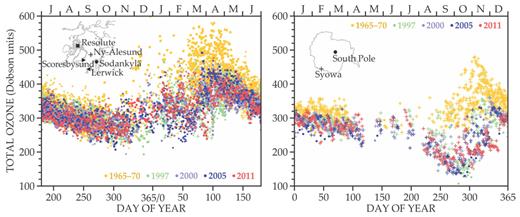 ?
?
Article says:”…declines in harmful chlorofluorocarbon…”
Harmful? Great fire suppression gas. Great air conditioning gas. What harm was it causing?
China made billions by manufacturing the stuff then getting paid to get rid of it.
Chlorine is blamed as the culprit but we can’t account for all the chlorine coming from the oceans via wind action or volcanoes. At least not when I wrote my chem term paper on this.
This caused Americans to spend millions getting rid of old refrigerators etc cause you had to get the Freon captured.
A scare scam that was unnecessary.
Ozone is diamagnetic. It moves away from the pole until it reaches the circumpolar winds that overwhelm the small magnetic impulse.
The speed of movement away affects the concentration of ozone at the pole. That depends on the magnetic field.
It would be very interesting to test this hypothesis by graphing the strength of the magnetic field at the S Pole vs Ozone concentration.
We are still arguing about ozone levels instead of looking at the big picture and citing what is happening with surface UV flux. If the surface UV flux was high enough to actually be a concern, I’d expect someone like Stokes to be telling us about it in TELETYPE CAPS.
I have been suspicious of the whole ozone thing from the beginning. Is there any proper science to support the CFC/ozone hole claim?
No.
Yes there is ample evidence for the formation of reactive Chlorine species which destroy the O3 in a regenerative chemical reaction.
What about the implied increase in surface UV? The concern is damage such as cataracts and melanomas. Ozone is not directly responsible for the pathologies of concern. Rather, ozone is a proxy of unknown value in predicting surface UV. A model I wrote with my then new Amiga computer in 1984, suggested a slight increase in surficial UV during the Winter months, when the UV was so weak as to be negligible. However, by Summer, when Antarctic animals might need protection, the ozone was back to ‘normal,’ and the UV was less than what one might encounter in the tropics, for which most animals (and even plants) have adapted.
But if not for the Montreal protocol the CFC levels will have continued to have increased substantially and by now would be about 5 times what the are now. Ozone depletion would be extending over the globe and not just limited to the polar regions. The major CFCs being released have half lives of 50-100 years which would mean if the protocol hadn’t been adopted then we would have had a much longer duration of low O3.
There are a lot of unsupported assumptions in your assertions. The model I built didn’t even suggest what you are claiming. The main problem with your claims is that Antarctic ‘Ozone Hole’ is allowed to develop because the Circumpolar Vortex blocks the Brewer-Dobson Circulation during the Winter and prevents replenishment of the decomposed ozone. The Arctic Circumpolar Vortex is weak and intermittent, which is why we don’t see the same thing happening in the Arctic. The global conditions do not allow a simple spread like a pandemic. It can only happen under the special conditions found in Antarctica, within the Circumpolar Vortex. The ‘Hole’ becomes negligible during warm years when the vortex is weak or breaks up early.
You might want to take a look at this study:
https://www.sciencedirect.com/science/article/pii/S1352231015304246
Well perhaps your model is wrong? In the winter the slight decline is due to the lack of replenishment of O3 in the absence of sunlight. Prior to the 80s the return of sunlight caused a strong growth in O3. However from the 80s onward the return of sunlight caused a strong decline in O3 rather than growth. It is that new phenomenon which is explained by the breakdown of CFCs forming active chlorine containing species.
How does your model explain the springtime decline in O3?
Don’t expect to see this information in NASA press releases:
https://www.sciencedirect.com/science/article/pii/S1352231015304246