Overview
Galileo turned his primitive telescope towards Jupiter in the early 1600’s and saw tiny specks of light with no discernable features. What a difference 400+ years can make as today’s backyard telescopes can resolve Europa’s disk surprisingly well. Europa is now considered one of the most complex and fascinating worlds in the solar system. Cracks, ridges, and chaotic terrain on the moon’s icy crust may offer access to one of the largest oceans in the solar system–and a possible abode for aquatic life. NASA’s Europa Clipper spacecraft, due to launch one week from now on October 10th, will conduct a detailed reconnaissance of the moon’s surface to help plan future missions including a lander and perhaps even a submarine. Europa Clipper’s main science goal is to determine whether there are places below the surface of Europa that could support life.
Discussion on Europa and the mission
Europa is a world that shows strong evidence for an ocean of liquid water beneath its icy crust which could very well host conditions favorable for life. NASA will place a highly capable, radiation-tolerant spacecraft named “Clipper” into a long, looping orbit around Jupiter to perform repeated flybys of the icy moon. In fact, the plan is to have 49 flybys of Europa at closest approach altitudes as low as 16 miles, soaring over a different location during each to scan nearly the entire moon. With its massive solar arrays and radar antennas, Europa Clipper will be the largest spacecraft NASA has ever developed for a planetary mission. The spacecraft needs large solar arrays to collect enough light for its power needs as it operates in the Jupiter system, which is more than five times as far from the Sun as Earth. The spacecraft will be about 16 feet (5 meters) in height. With its arrays deployed, the spacecraft spans more than 100 feet and has a dry mass (no propellant in the tanks) of 7,145 pounds. The launch date for this spacecraft is currently set for Thursday, October 10th with arrival at Jupiter in April 2030.

Credit: NASA/JPL-Caltech
Because Europa is bathed in radiation trapped in Jupiter’s magnetic field, Europa Clipper’s payload and other electronics will be enclosed in a thick-walled vault. This strategy of armoring up to go to Jupiter with a radiation vault was developed and successfully used for the first time by NASA’s Juno spacecraft. The vault walls – made of titanium and aluminum – will act as a radiation shield against most of the high-energy atomic particles, dramatically slowing down degradation of the spacecraft’s electronics.
For Europa to be habitable, it needs the essential building blocks for life including carbon, hydrogen, oxygen, and sulfur. Liquid water is essential for the complex chemistry that makes life on Earth possible. Many scientists predict a salty ocean lies beneath the surface of Europa which has more water than all of Earth’s oceans combined. While the icy moon of Jupiter is far from the sun, Europa gets the energy to sustain life from Jupiter’s strong gravity which creates tides that stretch and tug the moon producing heat. One of the most important measurements by the Galileo mission which previously explored Europa showed how Jupiter’s magnetic field was disrupted in the space around Europa. The measurement strongly implied that a special type of magnetic field is created (induced) within Europa by a deep layer of some electrically conductive fluid (like saltwater) beneath the surface, which interacts with Jupiter’s strong magnetic field.
The amazing work of Galileo
Peering through his newly-improved 20-power homemade telescope at the planet Jupiter on Jan. 7, 1610, Italian astronomer Galileo Galilei noticed three other points of light near the planet, at first believing them to be distant stars. Observing them over several nights, he noted that they appeared to move in the wrong direction with regard to the background stars and they remained in Jupiter’s proximity but changed their positions relative to one another. He later observed a fourth star near the planet with the same unusual behavior. By Jan. 15, Galileo correctly concluded that they were not stars at all but moons orbiting around Jupiter, providing strong evidence for the Copernican theory that most celestial objects did not revolve around the Earth. In March 1610, Galileo published his discoveries of Jupiter’s satellites and other celestial observations in a book titled Siderius Nuncius (The Starry Messenger).


Top: Two of Galileo’s telescopes. Bottom: Page from Galileo’s notebook about his observations of Jupiter’s satellites. Credits: National Geographic, gabrielevanin.it, University of Michigan Special Collections Library.
As their discoverer, Galileo had naming rights to Jupiter’s satellites. He proposed to name them after his patrons the Medicis and astronomers called them the Medicean Stars through much of the seventeenth century, although in his own notes Galileo referred to them by the Roman numerals I, II, III, and IV, in order of their distance from Jupiter. Astronomers still refer to the four moons as the Galilean satellites in honor of their discoverer. The German astronomer Johannes Kepler suggested naming the satellites after mythological figures associated with Jupiter, namely Io, Europa, Ganymede, and Callisto, but his idea didn’t catch on for more than 200 years. Scientists didn’t discover any more satellites around Jupiter until American astronomer E.E. Barnard found Jupiter’s fifth moon Amalthea in 1892, much smaller than the Galilean moons and orbiting closer to the planet than Io. It was the last satellite in the solar system found by visual observation – all subsequent discoveries occurred via photography or digital imaging. As of today, astronomers have identified 79 satellites orbiting Jupiter.
Meteorologist Paul Dorian
Arcfield
arcfieldweather.com
Follow us on Facebook, Twitter, YouTube
Cool!
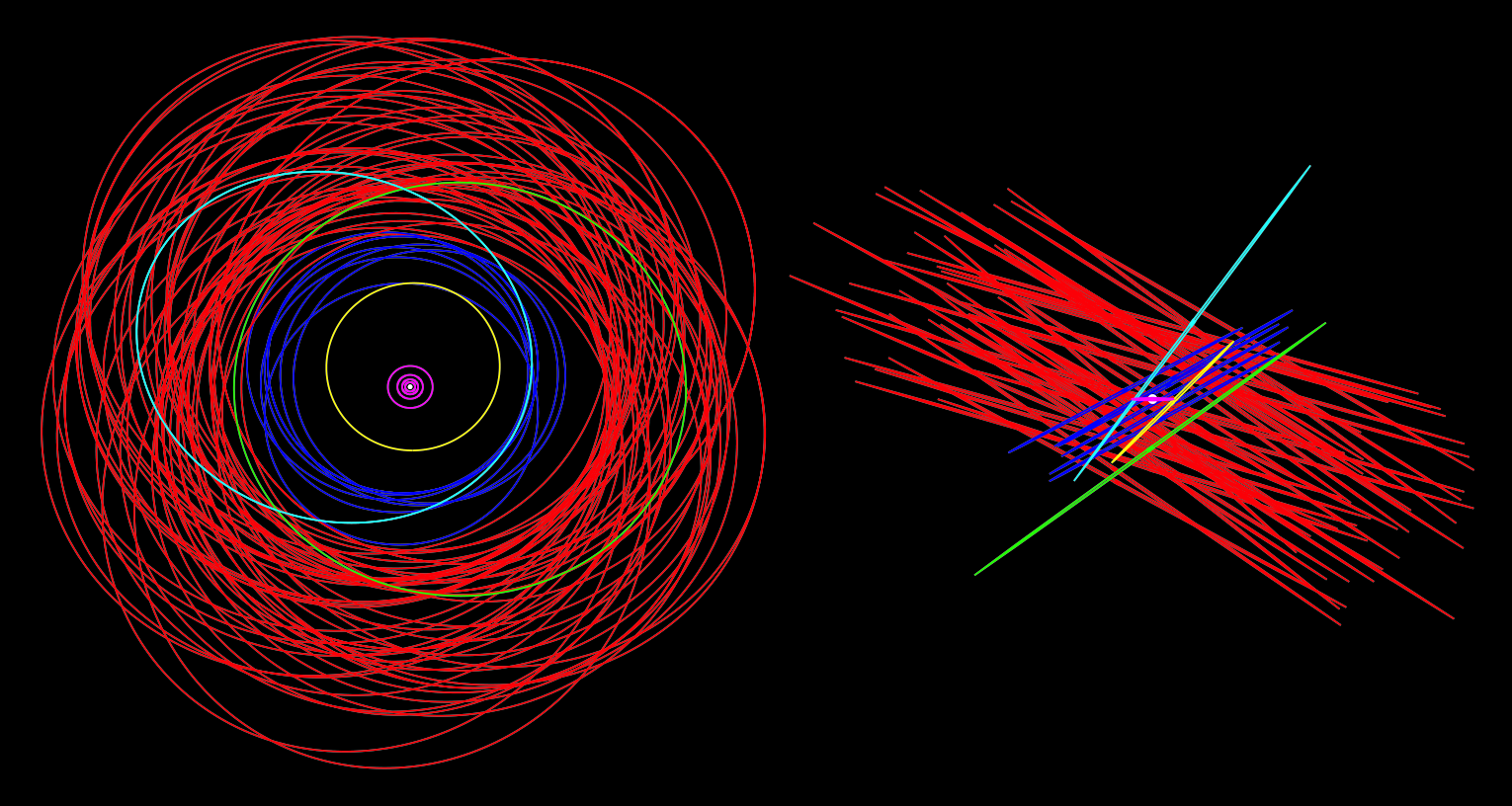
And here’s a diagram of the orbits of Jupiter’s Moons note how close the Galilean orbit (purple) relative the the other ones and the difference in orientation of orbital inclination
Sounds like a good place for sea monkeys.
The national debt is now 35 trillion dollars. I can’t add that high even using all my fingers and toes. In all likelihood this mission will conclude that bacterial life on Europa is possible but not proven and another mission is needed. (You already know that is going to be the probable final report.) I don’t want to be the nay-sayer here. I believe in scientific research. I have a science background myself. But geez, we’ve got an awfully big national debt, we are facing threats of war from Russia and China, there is nothing good on television except old reruns of Gilligan’s Island, and we’re looking for bacteria on Europa?
You mean it isn’t an “investment” that pays for itself? Seems like our spending criteria could use some refinement.
Still, I’d rank Europa study a higher priority/benefit than another $20 billion of aid to the Taliban/Afghanistan. Perhaps our support of gain of function research needed/needs more scrutiny as well.
It might pay for itself … if we can find and return the proper bacteria it could be researched at the Wuhan Lab
Yeah, Wuhan’s research went viral.
These are the kind of unnecessary programs that should be funded privately. No useful practical knowledge will come of this. Sure, it will produce pretty pictures and lots of grist for science fiction stories, but the actual temperature and depth and content of Europa’s oceans is utterly useless. This thing’s probably going to cost a billion dollars over the next 10 or 20 years. I’d pony up a few dollars, if it were voluntary. But it absolutely should not be a government function.
Finding ANY life anywhere in the universe, especially in the Solar System would be one of the most significant events in history. If found in this Solar System, would suggest life is extremely common in the universe. Worth it.
Unrelated curiosity question: How recursive can moons get? Instead of …
… why not orbit Europa directly? We’ve had plenty of satellites around our own moon, but of course they only lasted years, not eons, and Europa has much larger parent to orbit than Luna.
Would trying to orbit Europa require too much fuel?
Could Europa sustain its own moon in any kind of long-term stable orbit? Could any such moon sustain its own long-term natural satellite?
And are there web sites or “simple” programs which can simulate any of this?
We human creatures are evolved products of this planet Earth exclusively.
If we ever became invasive species of other places in the universe, we should expect the same hostile receptions that other such invasive species naturally and properly receive here.
(Unless of course such other places in the universe were being run by morons like the ones that run the USA, UN, EU, UK, Canada, Australia etc, where invasive species are not only encouraged and welcomed, but actually fed and nourished at the expense and demise of the established populations)
For a wild guess I suspect slowing down the spacecraft enough to put it into a moon orbit would require much more fuel than it could possibly carry.
How about making it battery powered like an EV? It could have its own recharging station on board with a really, really, really long cord.
Even anaerobic bacteria require an electron acceptor to drive their metabolism.
So, Europa ought to have lots of nitrate or sulfate, or the like, and a way for the metabolic chemistry to cycle from its reduced form back to the oxidized form (Earth has photosynthesis).
As an aside, one hopes NASA got the metric/English unit conversion right.
And in reply to Marty, the cost of a NASA planetary mission is a budgetary triviality, but is unrivaled in encouraging optimism and outward-looking excitement.
Our future is in space, and the sooner we move there, the better.
Government has no business determining our future. Government is not society. Society is individuals interacting of their own volition. Almost all political problems can be traced back to governments thinking they are society, that society is theirs to push around and define.
No one wants to throw the baby out with the bathwater.
Columbus was funded by Ferdinand and Isabella. Expensive explorations can be funded by the state. Upfront money. Then step aside.
Just to say, in a democratic constitutional republic, government is an instrument of society.
Government is an instrument of society in only the loosest sense, like saying meat bees are an instrument of BBQ feasts.
Citizens vote in representatives to carry out their views for the organization and goals of their society. That may include forwarding space exploration. I see no problem with that.
Government is much more than you allow. Seeing to the integrity of contracts, for example.
government of, by, and for the people- at least that’s the goal
The ORIGINAL goal, long lost.
At least it’s good to have that original goal- as something we can push to go back to. Most nations don’t have such a goal- and not even a constitution, which is also mostly ignored.
“… with arrival at Jupiter in April 2030 …” That is ~67 months from now.
Actuary calculations suggest I may be approaching “check-out time” at the time of Clipper’s arrival at Europa. The 4 year mission through 2034 is more of a stretch, and the science to follow will surely live long beyond me. Actually, I am more hopeful I will see the collapse of the climate craziness by the time of Clipper’s news.
Why? Well, the end of the war on CO2 will have immediate impact on individuals and society – Clipper’s news, not so much.
Those of us alive at the end of the Appolo missions may recall the cost arguments at the time and NASA turning its telescopes inward for a mission to planet earth. Space exploration drifted aimlessly for the next 50 years while climate science took off like a rocket. Budget deficits took off as well.
NASA’s core mission of space exploration and funding was captured by the Club of Rome cabal in the late 1960s,which then went on to infiltrate / infect the UN and their worldwide acolyte socialist political movements.
And here we are now . . .
It was all about beating the Russians- who it turned out were not in the race. Now we need to do it to beat the Chinese, a far more powerful competitor.
If the nation was graduating rocket scientists instead off climate scientists, our enemies would take us seriously. Delivering a warhead on your enemies doorstep in 15 minutes speaks louder than delivering 0.0005C of cooling in 50 years.
Which was one of the subtexts of the Apollo program. With NASA demonstrating that they could land a lunar lander within walking distance of a Surveyor from ~240,000 miles away, the message was that the US could drop a nuke to land a few hundred feet away from the target. That meant another nuke could be dropped into the crater formed by the first one…
Mind you, the whole idea of nukes is that you don’t have to drop one a few hundred feet away from the target.
Just somewhere within the ZipCode will probably suffice.
rocket scientists and engineers! China produces lots of engineers, more than any other nation, though maybe on average, not as good
Please send Ed Miliband along.
Do humanity a favour.
Very nice.
What would be the source of the salinity given there is no mineral erosion or water evaporation possible?
Chemical alteration of minerals in water is still on-going. I wonder if the “ocean” of Europa is all that placid – it’s a fairly large world and there’s a lot of water. It is tidal locked to Jupiter, but it’s also heavily tidal flexed, to the point of being heated. Might there not be currents that mechanically eroded the underlying rock?
That’s a bit overstated. From Earth Europa subtends an angle of about one arc second (4.5 urad). With a “backyard” telescope, if it large enough (>15 cm), you can tell it’s not a star.
Which goes to show just how far away things in the Solar System are – our moon is roughly the size of Europa, and it subtends 1800 arc seconds from our view.