By Andy May
In an interesting linkedin debate between Tinus Pulles and me, two subjects came up that are related to one another and too complicated for a comment. First is Tinus’ question, “Will more atmospheric CO2, all other variables being equal, lead to a higher surface temperature.”
The second question arose when I quoted the following from the IPCC AR6 report:
“As a result, non-condensing GHGs with much longer residence times serve as ‘control knobs’, regulating planetary temperature, with water vapour concentrations as a feedback effect (Lacis et al., 2010, 2013).” (IPCC, 2021, p. 179).
And this comment from AR5:
“Currently, water vapour has the largest greenhouse effect in the Earth’s atmosphere. However, other greenhouse gases, primarily CO2, are necessary to sustain the presence of water vapour in the atmosphere. … So greenhouse gases other than water vapour provide the temperature structure that sustains current levels of atmospheric water vapour. Therefore, although CO2 is the main anthropogenic control knob on climate, water vapour is a strong and fast feedback that amplifies any initial forcing by a typical factor between two and three. Water vapour is not a significant initial forcing, but is nevertheless a fundamental agent of climate change.” (IPCC, 2013, p. 667).
Oddly, Tinus doesn’t think the IPCC is serious about Lacis, et al.’s idea that CO2 is a control knob for surface temperature and he apparently disagrees with it. His excuse is that in the first quote “control knob” is in quotes and in the second is in a colored box, which identifies it as an answer to a “frequently asked question” or FAQ 8.1 (chapter 8, pp 666-667).
But both reports clearly cite Lacis, et al. (2010 & 2013) and use Lacis et al.’s language and agree with them. We can comfortably assume that the IPCC AR5 and AR6 reports agree with Lacis et al., regardless of Tinus’ objections.
The interesting thing is that these two points are intimately related to one another in an interesting way. Tinus’ first question is a leading question with the underlying assumption that CO2 controls the climate. He knows, as everyone does, that if infrared radiation is shined on pure CO2 in a laboratory, it will absorb some of it and warm up. The laboratory experiment is the “all things equal” he is talking about.
Outside the laboratory and in the real world there are a number of other factors that need to be dealt with that can change the result, this is why the question Tinus is asking is leading, the question is framed to get at a particular answer. Often, the way a question is framed can result in an answer that is incorrect, so we need to avoid answering leading questions.
Now we come to the second issue, calling CO2 the climate “control knob.” Lacis et al. explains this idea, which the IPCC clearly supports:
“Ample physical evidence shows that carbon dioxide (CO2) is the single most important climate-relevant greenhouse gas in Earth’s atmosphere. This is because CO2, like ozone, N2O, CH4, and chlorofluorocarbons, does not condense and precipitate from the atmosphere at current climate temperatures, whereas water vapor can and does. Noncondensing greenhouse gases, which account for 25% of the total terrestrial greenhouse effect, thus serve to provide the stable temperature structure that sustains the current levels of atmospheric water vapor and clouds via feedback processes that account for the remaining 75% of the greenhouse effect. Without the radiative forcing supplied by CO2 and the other noncondensing greenhouse gases, the terrestrial greenhouse would collapse, plunging the global climate into an icebound Earth state.” (Lacis, Schmidt, Rind, & Ruedy, 2010)
Lacis et al. estimate that water vapor supplies about 75% of the overall greenhouse effect, which is in the ballpark of other estimates, but no one knows for sure because the effect of clouds is unknown. Clouds have a large positive (warming) greenhouse effect at night, keeping heat in and a large negative (cooling) albedo effect during the day because they are bright white and reflect a lot of incoming sunlight. Further, clouds vary over time and with location (more on clouds here and here).
This means that the greenhouse effect changes both temporally and areally. In the tropics where it is humid all the time the greenhouse effect is very large and in deserts and in the polar regions in the winter it is very small, even negative at the poles over much of the winter. In the polar regions in winter and in deserts the skies are usually cloud free.
As Lacis, et al. say, water vapor condenses, and is unevenly distributed over Earth’s surface. That is the crux of their argument that CO2 and other non-condensing GHGs are the “control knob” for climate and water vapor is a significant, but relatively unimportant, “feedback” that does what the superior GHGs tell it to do.
Does that argument hold water? The pun is fully intended. As Wim Röst has said (in a very good June, 2023 presentation in Hillegom, The Netherlands) water, snow, and water vapor dominate the greenhouse effect, cool the surface through evaporation, release much of their latent heat to space, and determine all weather. The various water-driven processes in the troposphere control the amount of incoming and outgoing radiation by varying both the location and movement of clouds and latent heat.
Wyatt and Curry [ (Wyatt & Curry, 2014), (Wyatt M. G., 2012c), (Wyatt M., 2014)] have shown that numerous ocean and atmospheric oscillations move across Earth’s surface in a coordinated manner, that they call the “stadium wave,” that forms a roughly 65-70-year climate cycle or oscillation. This oscillation can be seen in global average temperature as shown in (May & Crok, 2024) in figure 1 below.

As figure 1 shows the detrended global average surface temperature (HadCRUT4) conforms very well to the detrended AMO index. This correspondence is better, at least visually, than the correspondence between CO2 and temperature. The AMO is not the leading oscillation in the stadium wave, but it is an important component of it. The correspondence of the AMO to the global average surface temperature opens the possibility that water and water vapor are not a “feedback,” but a driver of climate change. CO2 and other noncondensing greenhouse gases probably have some effect on climate change, but by all accounts, it is small, and it is doubtful that they are in the driver’s seat.
Download the bibliography here.
Discover more from Watts Up With That?
Subscribe to get the latest posts sent to your email.
Your paper is paywalled so I can’t view the details. What is the non-detrended AMO? My understanding is the AMO index is nothing more than detrended North Atlantic SSTs – wouldn’t that make your top plot simply North Atlantic SSTs?
And isn’t the bottom panel simply comparing detrended global surface temperature to detrended SSTs? What is the proposed significance of them being similar? The global surface temp index includes the SST.
Lots going on here at home so not much time. Yes, the AMO is based on North Atlantic SSTs and detrending those make the AMO index.
Yes, the bottom panel compares the AMO index to global surface temp (GMST), which contains the AMO.
Not sure I see your point, the AMO shows an oscillation that goes back at least to 1567 (Gray, 2004), well before the industrial period. It is natural. I am showing a natural oscillation compared to GMST, which is supposed to be all CO2 according to AR6. Yet we see the natural oscillation. The point is, the GMST has a natural component.
I don’t think the AR6 says anywhere that CO2 drives unforced internal variation within the climate system (short term variability in GMST), it is only said to be driving the long term trend in GMST.
But my point was that saying that detrended global surface temperature looks more like detrended sea surface temperature than CO2 looks like detrended surface temperature doesn’t seem to be saying much.
To reframe my query: what would it look like if you removed North Atlantic SSTs from HadCRUT and replotted your bottom panel?
As HadCrud is contaminated by URBAN warming and mal-adjustments…
… that is a pointless question.
Pointless to do so. The point is that the AMO, by itself reproduces the oscillation in global temperatures, it isn’t some magical aerosol.
What I’m getting at is that I think you’re showing that the AMO explains the AMO. It’s not clear to me what the significance of this finding would be.
AR6 says several places that CO2 drives warming, 100% since 1750. See attached.
AR6 knows their models cannot reproduce the ocean cycles, like the AMO, NAO, etc. (Eade, et al., 2021). To obscure this vital point, they rename the AMO the AMV and deny it is a natural oscillation and even try to claim it is random. Michael Mann says the AMO doesn’t exist.
see: https://www.realclimate.org/index.php/archives/2021/03/the-rise-and-fall-of-the-atlantic-multidecadal-oscillation/
The fact that the oscillation continues in a regular pattern since 1567 is important and yet it and all natural ocean oscillations are not reproduced by the models and not used as input to the models. This makes them less accurate and allows them to claim CO2 did it all.
I think this point is very valid and relevant.
Right, IPCC says CO2 is driving the warming trend, not that it is driving internal (unforced) variability within the climate system. Mann’s research article presents compelling evidence that the purported AMO (which he proposed in the first place, we should note) is actually a quasi-cycle driven by volcanic forcing, but regardless, no one ever said it was driven by CO2 to begin with. When you detrended the GMST, you removed the signal that is supposed to be driven by CO2, so it isn’t a novel finding that the remainder of the series doesn’t look like it’s related to CO2.
Download the submitted version of the paper here:
https://www.researchgate.net/profile/Andy-May
Thanks, I appreciate you making the paper available.
If you are not a member of researchgate, download the paper here:
or
here:
https://andymaypetrophysicist.com/wp-content/uploads/2024/05/Carbon-Dioxide-and-a-Warming-Climate-are-not-problems_Final_Submission_no_logo.pdf
Are you too poor to pay for your education? Perhaps we can start a gofundme account to help with that.
“Currently, water vapour has the largest greenhouse effect in the Earth’s atmosphere. However, other greenhouse gases, primarily CO2, are necessary to sustain the presence of water vapour in the atmosphere. … So greenhouse gases other than water vapour provide the temperature structure that sustains current levels of atmospheric water vapour.”
This is pure BS. There is no need for other GHE gases to sustain the presence of water in the atmosphere. More CO2, less CO2 or no CO2, the Sun would evaporate water just fine, and the same radiative equilibrium would be reached.
It’s not obvious to me that climate science understands feedback. I keep hearing from the CAGW advocates that positive feedback can be stable. Nothing I’ve ever encountered verifies that. If it is truly positive feedback then one of two things happen; 1. the system grows to destruction, or 2. the system grows until the power source limit is reached. Anything else, such as stability, requires the system feedback to change either to zero or to go negative.
How is this applicable to the Earth? When CO2 was higher we should have seen one of two things happen, either the Earth’s temperature grow to destruction and since that didn’t happen something stopped it. Or the CO2 feedback caused the biosphere to reach an equilibrium where the feedback gain went to zero, i.e. CO2 saturated.
The climate models don’t show the second scenario, they assume no saturation. The models imply that the biosphere will destroy itself.
[the transfer function for positive feedback is T = G/(1-GH). Climate science assumes GH will grow without limit as more and more CO2 is put in the air – meaning at some point GH=1 and the system goes kabooey!]
“It’s not obvious to me that climate science understands feedback.”
I’ll go a bit further. It’s obvious to me that they don’t.
That they think they understand the whole climate before they understand the water cycle goes beyond the usual bravadaggio.
Coupled with intellectual conceit such as is not seen in other disciplines, it’s the sign of people who are a bit too comfortable and paid too much.
100%
It’s an undisciplined discipline.
In other words, an “undiscipline.” 🙂
Thank you. Someone who actually understands systems engineering and positive/negative feedback in control theory.
What you will usually get from climate scientists is “H” only. They say that “H” can be positive and the system will be stable. The issue is that the transfer function is “G” * “H”, not just “H”.
If H = .5 (a positive factor) and G = 2 then the system becomes unstable because GH = 1.
I agree with you. CO2 or not, with water there would still be clouds and a GHE
Lacis et al. also clearly that that without CO2 there would be clouds and a GHE but just that it would be dramatically reduced. This is what they state would be the result after removing all of the CO2 from the atmosphere:
“After 50 years, the global temperature stands at –21°C, a decrease of 34.8°C. Atmospheric water vapor is at ~10% of the control climate value (22.6 to 2.2 mm). Global cloud cover
increases from its 58% control value to more than 75%, and the global sea ice fraction goes from 4.6% to 46.7%, causing the planetary albedo of Earth to also increase from ~29% to 41.8%. This has the effect of reducing the absorbed solar energy to further exacerbate the global cooling.”
So without CO2 there would be an increase in clouds but with only 10% of the current amount of water vapour the green house effect would be reduced lowering the temperature by 34 degrees.
So do you have any reason to think that they are wrong? And where is your evidence to back it up?
Isn’t it the duty of Lacis et. al. to prove it? Not for others to disprove it.
Lacis et al. have submitted their work and their evidence for their claim. Now they might be wrong (as are most published papers) but simply claiming the opposite doesn’t hold any weight in a scientific discussion.
And again the question is how much water vapour would remain in the atmosphere after removing all the CO2. Both Lacis and May agree that there would be some water vapour so the question is how much and how do you estimate it? Lacis et al. have used a model to answer that question whereas May has not answered it at all so for all we know May might be agreeing with Lacis or think that their estimate is too high.
The tropics would be warm and sunny with a much lower global average temperature and that being the destination of the vast proportion of the global solar incoming radiation the storms that would ensue from the massive temperature difference between the tropics and the roaring 40’s and 50’s would be a sight to behold.
WE has talked about the emergent phenomena and this would be the expression of it.
Does that model reproduce the early 20th c. warming period ? NO !!! It has ZERO value in evaluating anything in the real world.
Next question.
Lacis et al use the Goddard Institute for Space Studies (GISS) ModelE and don’t have any actual data (evidence) to back up their claims.
Pescator: Lacis et al use climate models that assume CO2 controls climate, to prove that CO2 controls climate. This is circular argument of the most transparent kind. If you accept that, I can’t help you.
But their conclusion that CO2 is the control knob is based on a model that assumes that CO2 is the control knob. They have proved nothing…. their supposed results of removing CO2 from the atmosphere just go to show how bad their model is.
Their model assumes that CO2 is a greenhouse gas which radiates according to the usual laws of physics.
Just what do you think would happen if the CO2 was removed from the atmosphere? And where is the evidence to back it up?
Their model produces temperture results that are much higher than reality so the model is invalidated.
I think more insolation would be absorbed by the earth. This no doubt would increase conduction and convection and raise the temperature by some amount. Does the model you are using to base your assertion on show this when no CO2 is used as an input? If not, then the model is imperfect.
“Imperfect.” Understatement of the year. 😄
Comment says:”Their model assumes that CO2 is a greenhouse gas which radiates according to the usual laws of physics.”
Hotel said that CO2 has almost zero emissivity at normal atmospheric temperature and pressure. How can something that is almost zero cause any warming? Does their model use zero?
We already know what happens when CO2 is reduced – absolutely nothing, apart from plants developing more stomata. The Earth warmed dramatically T the end of the last Glacial Maximum, despite the fact that CO2 was only 180 ppm.
“despite the fact that CO2 was only 180 ppm.”
As is repeatedly said on here by people that know the science.
There are other things that drive climate apart from CO2.
On geological timescales it is Earth’s orbital eccentricities.
See Milankovitch cycles.
As a more favourable orbit warmed Earth then the warming released CO2 from the oceans AND as CO2 is a GHG it produced a feedback of more warming.
CO2 both lags and leads warming depending on which comes first.
Prior to the industrial period CO2 was encapsulated within the natural carbon cycle (unless expelled volcanically).
Now it’s not.
Their model assumes that CO2 is a greenhouse gas which radiates according to the usual laws of physics.
No. They do not. They totally ignore valence bands and more importantly ignore scattering.
The models do not include electro-magnetic fields and waves calculations.
I have my doubts they’ve ever heard of the inverse-square law.
They omitted to say no plant, insect or animal life would be left on earth.
Hurrah for CO2!
In defense: no Co2= no plants= higher albedo=colder.
Plus lower aerosol levels and lower water vapor.
Hard to say that if clouds were less, would there be as much cooling?
“So without CO2 there would be an increase in clouds but with only 10% of the current amount of water vapour the green house effect would be reduced lowering the temperature by 34 degrees.”
Why would water vapor be reduced if CO2 is removed from the atmosphere?
I was always taught that the main source of water vapor in the atmosphere was from evaporation/sublimation. Does CO2 somehow control evaporation of water from the water surface?
CO2 does have an effect on evaporation. More CO2 causes more evaporation via downwelling IR. It is a direct forcing, not a feedback.
This added energy is most important in the tropics where the water temperature is warmer. The increased water vapor drives enhanced convection. This produces thicker clouds and a reduction in high altitude water vapor. This is the source of high altitude water vapor for the rest of the planet.
The overall effect of water vapor’s response is cooling
“CO2 does have an effect on evaporation. More CO2 causes more evaporation via downwelling IR. It is a direct forcing, not a feedback.”
This is at best an unproven conjecture.
Even if hypothetical GHE from CO2 could raise the air temperature by tens of a degree (big IF), all it would do would be to change the air relative humidity by a minuscule amount, and note, not in the boundary layer, where water is evaporated, but higher up.
Water does not need any CO2 to be evaporated. The Sun does it.
Evaporation happens because of absorption of sunlight, not because of minute air temperatures of the air. In fact, it is the air temperature that is controlled by the ocean which has incomparably larger thermal mass.
Water by itself provides nearly all of the GHE effect. So, if any GHE from CO2 could cause more water evaporation, more GHE from water itself would have done it just as well, no CO2 needed in the discussion.
How can CO2, which at 14.9 um interacts with at most 5-6 w/m^2 cause a downwelling that is more than total irradiance from the ground?
It can’t. If you look at a single particle of energy, x, radiated from the ground only a certain percentage gets returned, call it R. So Rx gets returned.
Climate science pretends that Rx gets reabsorbed and never gets re-radiated. In fact, it gets sent back out as Rx and of that amount R*Rx gets returned, i.e. R^2x. The next time its R^3x, and on and on. It’s a decaying function.
The ocean may be a sink but it doesn’t sink heat re-radiated by CO2 forever. It’s impact goes down as a decaying exponential. Every parcel of heat the earth receives follows an exponential decay over time and becomes asymptotic to zero.
Your assertion does not mention at all what conduction and convection adds to the temperature of the atmosphere. Your assertion doesn’t deal with the fact that less water vapor allows more sunlight to be absorbed which will also warm the atmosphere. It is the bane of climate science that “radiation” is the only concept dealt with.
How much of the 34 degrees you are asserting is only CO2 and how much is from conduction and convection along with more insolation?
You didn’t actually expect an answer, did you?
Haven’t you heard Biden has suspended the laws of thermodynamics
He was waiting on Congress to pass bi-partisan legislation to suspend the laws, but got tired of waiting and decided to issue an Executive Order just to give the people what he knew they want, even if they haven’t been clamoring for it. That is the role of a benevolent ‘president.’ Give the people what they want, whether they realize it or not.
LOL
Another Executive Order?
Next he will mandate that PI be 3.0.
Agree absolutely. They seem to be saying that if you had an atmosphere composed only of nitrogen, oxygen and a bit of argon (but no CO2), no water would ever evaporate from oceans, lakes, swamps and moist soils and the air would be anhydrous. Phrased like that, it’s clearly a nonsensical statement that ignores everything we know about physical chemistry.
No they are not saying that. They say very clearly that 50 years after removing the CO2 from the atmosphere that: “Atmospheric water vapor is at ~10% of the control climate value (22.6 to 2.2 mm). Global cloud cover increases from its 58% control value to more than 75%, and the global sea ice fraction goes from 4.6% to 46.7%, causing the planetary albedo of Earth to also increase from ~29% to 41.8%. This has the effect of reducing the absorbed solar energy to further exacerbate the global cooling.”
They then go on to say that at the tropics the oceans remain liquid and which is why there is still a green house effect and water still evaporates.
All your numbers are gibberish. !
They are using dumb idiotic models based on dumb idiotic conjectures.
Totally divorced from any sort of reality.
No wonder you fell for it. !!
And do you have any other numbers? What do you think would happen if all of the CO2 was removed from the atmosphere? And what evidence do you have to support your claim? Insults really do not add much weight to an argument.
The most notable thing to happen if all CO2 was removed would be the end of all life on earth.
Not quite all, the one that matters to humans, yes.
Why should anybody have any numbers for a purely imaginary and farcical hypothesis. !!
To you also want me say how many people the disappearance of the Easter Bunny would kill ??
There is no weight whatever to your post… it is totally meaningless gibberish.
I haven’t read the paper and probably won’t. But you are failing to give any argument against it.
His post is not ‘meaningless gibberish’. It may well be wrong, and Lacis may well be wrong also, but you have given no arguments to that effect. Have you even read Lacis?
There seems to be an argument which is at bottom just physics. One side says, remove CO2 and nothing much happens, the greenhouse effect from water vapour continues at very similar levels. The other side says, not sure exactly on what grounds, remove CO2 and water vapor falls dramatically.
I don’t see why it should, but then… I haven’t read Lacis…
The arguement is fairly simple. If you remove CO2 then the temperature drops since you are removing a greenhouse gas. The drop in temperature causes a reduction in water vapour in the atmosphere which further reduces the green house effect thus reducing the temperature still further. So the whole process continues until a new equilibrium is reached which is dramatically lower than the current one.
On top of that as the earth cools there is more snow which increases the amount of sunlight reflected which leads to more cooling. The physics of which is similar to the start of an ice age.
“The physics of which is similar to the start of an ice age.”
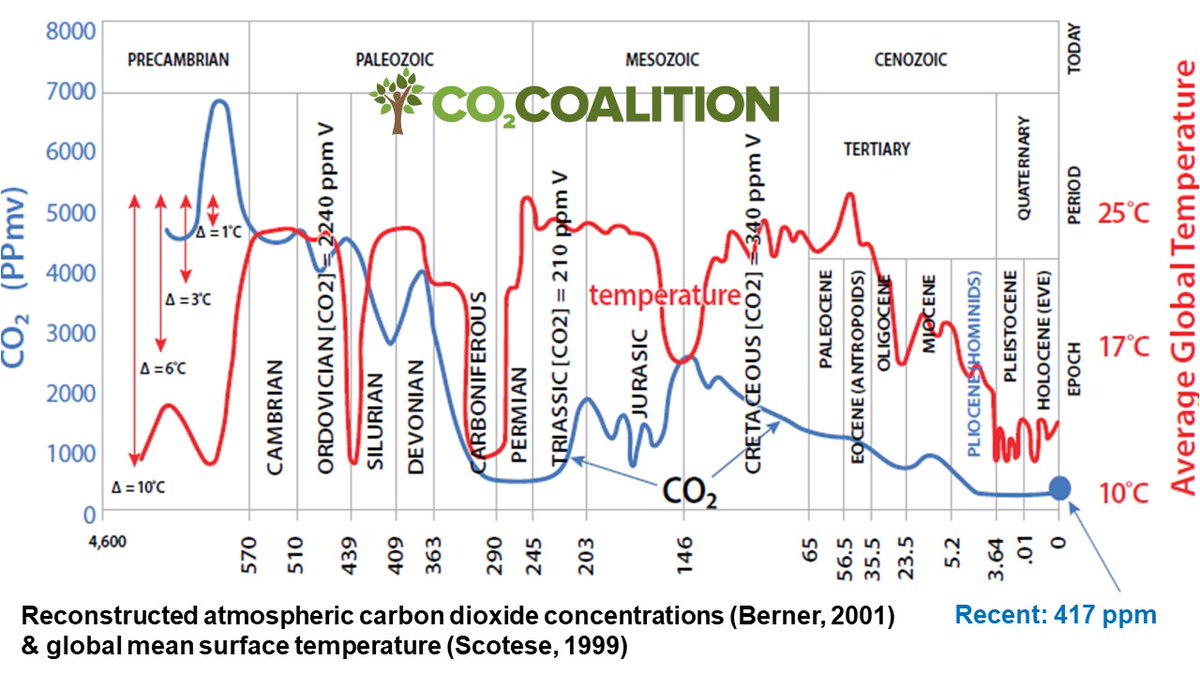
Sorry according to accepted history you are wrong.
Have you not looked at the geographic history of the Earth.
Ice ages starting when CO2 is at 4500ppm.
Ice ages starting when CO2 is at 4000ppm.
And how did we get the highest temeperatures ever see when CO2 was below 2000ppm.
A reminder
“If you remove CO2 then the temperature drops since you are removing a greenhouse gas.”
How much would it drop? To come up with that number implies the ECS is well established. All this is way over my head- just enjoying the discussion.
You left out the most important part of your argument. Show support for the assertion that water vapor would only be 10% of the “control” yet cloud cover would increase by 30% over the “control”.
Where does the additional cloud cover originate? With less water vapor how would there be more snow? How would cloud cover increase 30%? None of this makes any sense other that from a suspect model output.
You do not mention increased insolation being absorbed. You do not mention what conduction and convection will change to.
Gibberish!
Comment says:”If you remove CO2 then the temperature drops since you are removing a greenhouse gas.”
The mass times Cp combination of nitrogen or oxygen is lower than mass times Cp of CO2 so the temperature would be higher given the same energy input.
Q = Cp * m * dT
WV and CO2 help cool the atmosphere.
Yes, specific heat is part of it and the miniscule amounts of CO2 in the atmosphere have a minor effect of joules to degrees C in the atmosphere.
Also, the thermal resistance of CO2, which is what Tyndall actually tested, means thermal conductance/convection in the atmosphere are minutely affected. Yes, Tyndall and Foote also experienced specific heat effects in their experiments.
Electromagnetics also play into this along with valence bands of CO2. There will less IR scattering with no CO2, so the 14.9 um wavelength will pass easier. A modest effect.
Electro magnetic fields and waves can also calculate the momentum transfer from a wave front to individual molecules (the so-called photonic pressure). That, along with gravity creates the ground level atmospheric pressure that in turns affects the adiabatic temperature (specific heat) calculations. Eliminating CO2 does not significantly alter the mass of the atmosphere, so any temperature affects of eliminating CO2 are near zero.
There are no absolutes. Well, absolute zero (Kelvin), by definition is absolute. So there are no absolute absolutes… 🙂
Absolutely: Water and water vapor define our weather, temperature, etc.
Climate is merely a definition of 30 years of weather averaging in specific localities or regions. Before being repurposed, this was called micro climate.
“If you remove CO2 then the temperature drops since you are removing a greenhouse gas. “
False.
Earth radiative equilibrium established due to output of the Sun and Earth albedo (snow, glaciers and clouds are the major players).
When there is a mixture of GHE gases with unlimited supply of water, GHE effect of any of them cannot be assessed in isolation. When the GHE effect is already saturated by a mixture of GHE gases, addition of some of them will reduce GHE potential of the rest, but any reduction will also increase GHE potential of the rest, negating the changes.
I don’t deal in idiotic fantasies. I deal in what is actual and real.
If you want to go and believe pretend nonsense from conjecture-driven models… that is up to you.
I don’t have an opinion on it, haven’t read the paper. Don’t think it much matters.
The important thing is, even if they are all right, which I don’t think is so, their remedies are completely idiotic. I mean the idiocy of wind and solar & EVs and heat pumps. It cannot work, and it will cause more misery than any plausible amount of problems from any plausible global warming.
That’s the real thing to focus on.
“One side says, remove CO2 and nothing much happens, the greenhouse effect from water vapour continues at very similar levels.”
That’s the side I’m on.
I haven’t seen any evidence to cause me to change my mind.
Yup, as long as CO2 absorption is saturated, not much happens. Since saturation is currently 4 orders of magnitude, that means it needs to be reduced by a factor of 10,000. That’s less than 1 ppm.
This entire discussion shows another major problem with climate science. Since more water vapor drives cooling (as it does in the real world), then reducing CO2 have little to no effect.
Yes it is. He needs to show support for the assertion that water vapor would only be 10% of the “control” yet cloud cover would increase by 30% over the “control”. This is gibberish!
Well, I would say its not gibberish because its clear. May well be completely wrong, but its clear enough to know what he is saying and to rebut it. Gibberish would be nonsense, a sort of word salad that was not even wrong. He is perfectly clear.
What would you know about “gibberish”, Jim? For example, here’s some that you wrote:
1) Work does not require the expenditure of energy
2) Your lie that you never claimed that work does require the expenditure of energy
3) Photons cannot exert mechanical force
(I agree that Izaak is writing gibberish too, there is a lot of that going around it seems)
Show support for your assertion that water vapor would only be 10% of the “control” yet cloud cover would increase by 30% over the “control”.
As repeatedly said, Lacis’ work is based on invalidated models that do not reproduce the natural ocean oscillations. It is a meaningless paper and can be ignored. And no, I do not have an alternative hypothesis of what would happen with no CO2, no one would be left on Earth to care.
Well, observe in any event.
Hmmm! Less water vapor, but more cloud cover?
You need to reevaluate what you are asserting or lose your belief in the models!
Less water vapour and more clouds makes sense. Currently over 99% of the water in the atmosphere is water vapour meaning clouds make up less than 1% of the available water. As the temperature drops water will condense quicker leading to more clouds and less water vapour. Even with only 10% of the current amount of water vapour in the atmosphere there is still plenty of water available for an increase in clouds.
Your math is iffy.
I agree. Something is missing in the argument that CO2 is necessary to sustain the presence of water vapor in the atmosphere. CO2 radiation only affects the very thin top layer of H20. It causes cooling when the H2O evaporates. Water vapor contains latent heat which does not add to temperature. So, when CO2 radiates, it cools, when water evaporates it causes cooling, and as an end point, the heat of CO2 is converted to latent heat. Therefore, cooling is observed at the end point and not further heating.
Does CO2 cause additional water vapor. Probably. Does this increase temperature of the atmosphere? Not hardly.
True and accepted by many scientists for decades. Then along came climate models which ignore the physics you just mentioned.
Maybe this is an aside.
The (C)AGW proponents tend to ignore Nature’s CO2 emissions. “Everything is Man’s fault!”
It seems they also ignore Nature’s ability to compensate for more CO2. The planet is greening (in a good way).
A bit higher temps. A bit more rain overall. More food.
How is that bad?
Actually, all of mankind’s Co2 emission is about 5% of the total of earth’s own output. Earth’s variation yearly is +/- 15 percent, depending on climate, volcanoes, etc.
Guess what? If every single mankind-emitted Co2 molecule was eliminated, the climate would not even notice. And, climate would not change as a result.
There is absolutely ZERO proof that the current level of Co2 in the atmosphere is anything other than natural variability. (Yes, I know about the isotopes that ‘identify’ human sources, but so what?)
The studies of Co2 vs temperature invariably show that temperature changes first, not the other way around. It can’t be both. Either the studies are wrong, or the current ‘hypothesis’ is wrong. Co2 has been 6 times what it is now. Somehow, earth not only survived, but flourished.
“Concentrations of CO 2 in the atmosphere were as high as 4,000 ppm during the Cambrian period about 500 million years ago, and as low as 180 ppm during the Quaternary glaciation of the last two million years.”
So, is 400 ppm scary to you?
As far as I can tell from my reading, the issue of isotopic fractionation during out-gassing has not been studied thoroughly and there are a lot of unsupported assumptions that go into the claim the an increase of 12C in the atmosphere comes only from fossil fuels.
Re the human sourced isotopes:
Net Isotopic Signature of
Atmospheric CO2 Sources and
Sinks: No Change since the Little
Ice Age
by
Demetris Koutsoyiannis
https://www.mdpi.com/2413-4155/6/1/17
Taking CO2 to 10,000 ppm would have an average effect of ~ 0.5 C in the atmosphere.
“The planet is greening (in a good way).” This certainly is NOT appreciated in the MSM. It is sometimes mentioned but not nearly as often as they grossly exaggerate “severe weather” which is not historically rare.
I don’t like the control knob analogy. It makes people think that all past climate changes were caused by someone twiddling that control knob. The CO2 control knob is exercised by putting CO2 in the air, and until the last couple of centuries, no-one was doing that. Medium term changes happened via various oscillations, which came and went with no long term effect. But now we are turning that previously untouched control knob, and that will have long term effect.
You are implying that CO2 has always been constant (within boundaries) throughout the Earth’s history and only man is causing it to increase outside those boundaries. Nothing could be further from the truth! CO2 has been *much* higher in the remote past than it is today. The biosphere didn’t go kablooey then so why should it now?
No, I’m not. Varying volcanism puts more CO2 into the air, but not on the timescale of human history.
Human releases of CO2 are tiny compared to natural sources. (around 4%)
A warmer climate enhances those natural sources…
… and it doesn’t take much change to swamp any effect that human CO2 might mythically have.
Dormant volcanos, even those declared long extinct can still emit CO2 (search “Lake Nyos disaster” for one example). Geothermal vents, an unknown number of sea mounts, tectonic plate boundaries. So many invisible sources, but only those visibly active are included in calculations.
“No, I’m not. Varying volcanism puts more CO2 into the air, but not on the timescale of human history.”
Really? No volcano outgassing since humans have been around? No volcano outgassing since the start of the industrial age? And you expect us to believe that?
The truth is that neither you or climate science has a good grasp of how much CO2 is being generated naturally. It’s just one more parameterization that is being guessed at by dragging something out of the nether regions!
Mauna Loa is atop a volcano.
While their measurements are exceptionally well done, does anyone actually believe those readings reflect CO2 levels throughout the globe?
The published Mauna Loa CO2 data is based on dry mole fractions. With water vapor, the ppm levels are 10-15 ppm lower. The speculation that the seasonal variations are due to flora growth and decay. But, there are no measurements of the surrounding ocean temperatures included in that data. Also the measurements are at 11,000 feet with no corresponding sea level measurements. While it is good, high quality data, one has to wonder if it paints a complete picture.
We already know CO2 levels are higher in urban than in rural areas.
NASA has determined CO2 is not constant and there are pools and eddies and currents of CO2.
People point out other CO2 measurements sites. Of the 5 mentioned, I’ve determined 3 are in geothermally active or volcanic areas. I have not tracked down the other 2.
People also point out the CO2 readings are confirmed by balloons. Hundreds or thousands of balloons can not simultaneously measure the entire atmosphere, so extrapolations and filling in the blank spaces is done. How accurate is that?
“and that will have long term effect.’
Voice in your head Nick. Please try harder to get it under control.
NS, it is generally provable that the recent Mauna Loa measured increase in atmospheric CO2 is anthropogenic from fossil fuels—since long sequestered carbon photosynthesis favored ‘lighter’ C12, increasing atmospheric C13 until recently. It is generally NOT provable that this has any concerning effect. IPCC expressly bigger natural cycles. And the planet is greening in arid areas thru the well known C3 stomatic water conservation effect. Green house C3 plant optimum is about 1000ppm. We have a long ways to go.
Actually , wasn’t there recent paper that showed there is zero isotopic evidence of human CO2 in the atmosphere?
I’d like to see that. Can you provide a link or citation?
The Conclusion Humans Drive Atmospheric CO2 Increases Is Undermined By Carbon Isotope Data (notrickszone.com)
Late. As much as I respect Kotsoyannis, his new paper is flawed by a very short isotope sampling period from too few locations.
WRONG, there is no evidence that CO2 has any effect on the climate.
CO2 warming has never been observed or measured anywhere on the planet.
Not zero. No absolutes. A minor, trivial, inconsequential effect only.
If that were true there would be a good correlation between the effect (e.g., temperature and sea level) but that is not the case. The evidence is that CO2 is a response not the cause of an effect.
Except that photosynthetic plankton was pulling carbon dioxide out of water at an increasing rate as the oceans warmed, which was then returned at a similar increased rate as the plankton died. That is, warm water supports chemical reactions at faster rates than cold water. Similarly, the greening of terrestrial plants, which can extract carbon dioxide from limestone by supplying hydronium ions at roots to dissolve rocks, can generate more CO2. Additionally, warming in the Winter releases more CO2 from Boreal trees respiring from their roots, and soil bacteria can more efficiently decompose organic material sequestered in the permafrost.
“Except that photosynthetic plankton was pulling carbon dioxide out of water at an increasing rate as the oceans warmed, which was then returned at a similar increased rate as the plankton died.”
Exactly so. It is a cycle that doesn’t go anywhere. So are you other examples.
Really Nick, pretending the natural carbon cycle doesn’t expand as it gets warmer.
That is dumb, even for you. !
Wait. How did plants already evolve to use 4X the current amount of atmospheric CO2 then? And why do they retain this ability today? Evolution takes natural selection which requires eons of time to present itself..
Are you suggesting it was divine intervention instead? Because that’s the only explanation left.
Most of oceanic life ends up at the bottom of the oceans removing carbon from circulation. Bones and shells form CaCO3 chalk/limestone/marble deposits. Very little of it ever gets back into circulation.
Well, over eons, that matter is subducted, ultimately forming more oil and gas.
When plankton die, some of the decay is CO2, but the mass sinks and over eons subducts to form new oil and natural gas.
Also, while the plankton live ocean fauna eat the plankton and poop, which sinks, and grow, using the gained food, and then feed other fauna or float, wash up on the beach, or sink.
Just a nit. That more plankton returns more CO2 is a fair point, but not all the plankton CO2 is returned to the ocean or atmosphere.
You do not like the control knob analogy. As do most of us.
I am reading your last sentence as a challenge to or questioning of the so-called consensus. If my read is correct, I agree.
If my read is not correct, you are ignoring the dynamic shifts in CO2 levels through the past 5 billion years.
Andy, excellent post. Let me add three ‘random’ strong supports from previous posts and comments over the years.
Rud, have any climate scientist(s) ever directly addressed your various assessments and mathematical proofs?
Rud is a lawyer, not a physicist, so he doesn’t know what words like “radiation” mean. Therefore the numbers he is pushing around are basically fantasy, like those of the rest of the “climate scientists”.
Why do you never, ever provide any of your own numbers. Your only argument is nothing but a fallacy. Ipse Dixit – because I said so! That just doesn’t cut it.
Hi Jim! Oh look, it’s the undereducated lying Electrical Engineer with his room-temperature IQ and a whole 9 hours of thermodynamics lectures, at least half of which he completely misunderstood, here to “enlighten” us.
Tell us, Jim, what do you think “work” means? Does it require the expenditure of energy, or not? And why did you lie that you never said it did? (Take careful note of those question marks, which indicate that these are questions. The question marks are the squiggly lines with a dot underneath, like this: “?”)
While we are here, can you explain how you think a photon can possess momentum despite having no rest mass, and yet somehow be unable to exert a mechanical force? Where is your MATH, Jim? And your REFERENCES?
Maybe you should stay in your lane, Jim, which obviously isn’t physics, and I’m not convinced it’s electrical engineering either, since I wouldn’t hire you to design a light switch myself, and leave the physics to those of us who have studied it for more than, oh, one day?
5 paragraphs of repeated ad hominems in replying and not a single attributable number provided to support any position.
Why is that blather non distinguishable from any other internet troll?
I don’t know, doonman, why don’t you try teaching Jim some physics for me? I’ve been trying for months, and I have gotten nowhere. He has thus far displayed all the brainpower of an epileptic monkey. And he’s been lying and insulting me the whole time, which is not a good look for an Engineer, who is of course supposed to adhere to well-established principles of Engineering Ethics. Good luck! I’ll just sit over here politely and watch.
E=mc^2
E = hf
mc^2 = hf
m = hf/c^2
So a photon has mass related to its frequency or wavelength.
Relativistic mass
Of course it does, mkelly. But I’m not the one who needs to know that. Jim is the one who claimed that photons cannot apply mechanical force (just one of his many erroneous notions, and not the one I was initially trying to correct for him, either, when he went off into these particular weeds for some reason). I think he went from F=ma, plus the mostly correct notion that photons have zero rest mass, to the conclusion that they should not be able to apply force, or something. Can you teach him this for me, please?
I have to remember to never feed the trolls.
How would you tell the difference between a troll and a physics teacher, Sparta Nova 4?
You and IPCC also do not know what radiation means.
I agree with you that the IPCC doesn’t know, they are climate “scientists”, but why do you say that I don’t know? I am one of the teachers who is trying to teach this concept to Willis, Jim, Rud, and the rest of the non-physicist clowns around here. They’re very difficult to teach, though.
Not to my knowledge.
OTOH, in early 2014 I supplied a rigorous written proof that Marcott’s 2013 Science ‘hockey stick’ was proven academic misconduct. Even included a ‘Smoking Gun’ comparison. The then Science chief editor Marsha McNutt’s assistant acknowledged receipt in writing—then nothing. So my expectations in general for engagement are not high.
Good points Rud
Late reply due to sad personal circumstances. I thoight your points deserved irrefutable support. The above adhominems (Rud is only a lawyer) are flak support that I was over your target. Am also a PhD level econometrician and an HBS MBA—cannot graduate without doing logical arithmetic on lots of stuff.
It’s not an “ad hominem”, Rud, it’s a description of your background – i.e. not a physicist. Law, econometrics, and business are no substitute for a decent physics background, although it seems this can be a difficult concept for non-physicists to grasp. So you should probably stay away from anything related to physics, especially thermodynamics, just like your intellectual hero Willis the
fishermanliar (who “never does [make a mistake]”, you said, which was itself a giant mistake on your part, and could only have been fantasized by a non-physicist). Because neither of you has a clue. Note that I didn’t say there was anything wrong with your arithmetic, though.To this particular point, ECS is nonsense. No one has ever demonstrated “sensitivity” to atmospheric CO2 levels, nor any “radiant greenhouse effect” that ECS is supposed to be based on. It’s all guesswork based on phony physics.
Sorry to hear about the sad personal circumstances, hope everything is better now…
CO2 concentration is not the ultimate “control knob” on the climate that the IPCC pretends it is. If the net increase in absorption of infrared radiation by increasing the CO2 concentration from 300 ppm to 424 ppm is calculated, the resultant increase in surface temperature would be about 0.27 C (averaged over the globe), while the GISS surface temperatures have increased by about 1.09 C from 1900 to the present.
This means that the direct absorption of infrared radiation by CO2 (most of which occurs less than 5 meters above the ground) is only responsible for about 23% of the observed warming since 1900, so that human CO2 emissions are a relatively weak “control knob” on the climate.
A more detailed analysis shows that the warming effect of CO2 is highest in colder and drier climates, and less in warmer or more humid climates, since more of the infrared is absorbed by water vapor, and less is available to be absorbed by CO2. In middle latitudes, the warming effect is more pronounced in winter than in summer.
The remainder of the warming (about 0.82 C) is due to factors outside of human control, and would have occurred anyway even if mankind did not burn any fossil fuels.
In response to “Gunga Din” below, there are natural emissions of CO2 to the atmosphere, and one or more natural sinks whose overall removal rate is proportional to the concentration in the atmosphere.
Using a mass balance over the atmosphere, and the fact that 1 ppm of CO2 in the entire atmosphere corresponds to 8.0 Gigatonnes (Gt) of CO2, using estimates of global human CO2 emissions and measurements at Mauna Loa from 1959 to 2023, it can be shown that the change in mass of CO2 in the atmosphere is given by
dm/dt = E + 39.92 – 0.140 C
where E = human CO2 emissions in Gt/yr, and C = CO2 concentration in ppm. This equation was regressed with an R^2 value of 0.83. The 39.92 Gt/yr term represents natural emissions to the atmosphere, and the -0.14*C term represents the natural removal rate, which seems to be a first-order reaction in CO2 concentration.
In terms of concentration,
dC/dt = E / 8.0 + 4.99 – 0.0175 C
Human CO2 emissions were estimated as 37.2 Gt/yr in 2022. If these emission rates remained constant, the CO2 concentration would level off when dC/dt = 0, which would occur for a concentration of 551 ppm, which is less than double the assumed “pre-industrial” concentration of 280 ppm.
Even if there was no reduction in fossil fuel use in the foreseeable future, there would not be a “runaway” increase in CO2 concentration, but the natural removal rate would catch up to the emission rate and reach equilibrium. At 551 ppm, plant growth rates and crop yields would be higher than they are now, which would be a net benefit to human and animal life.
This means that the direct absorption of infrared radiation by CO2 (most of which occurs less than 5 meters above the ground) is only responsible for about 23% of the observed warming since 1900, so that human CO2 emissions are a relatively weak “control knob” on the climate.
I would genuinely enjoy reading physics updates that demonstrate CO2 absorption of IR results in kinetic, not valence electron energy excitations.
Hi Andy. Nice Post.
A few comments:
Good points. On 3, I think the driver of the overall ocean oscillation (stadium wave) is due to solar variability. But I don’t know how this works. Exactly how solar signals work their way through the climate system is still very much unknown.
I agree with you that the driver of the ocean oscillation is solar variability. However I believe that the frequency of the oscillation is internal to the oceans themselves.
This is analogous to the violinist. The driver may be the violinist’s bow, however the frequency is related to the properties of the violin string.
Add to it the variation on the Earth’s tilt, and minor fluctuations in the rotational velocity.
I do not know how much a change of 25 usec has on the oscillations, but it is not absolute zero.
“Without the radiative forcing supplied by CO2 and the other noncondensing greenhouse gases, the terrestrial greenhouse would collapse, plunging the global climate into an icebound Earth state.”
Wow. I have learned that if CO2 drops below a certain level, plants will die- but the idea that the Earth will freeze is a new one. Doesn’t make much sense to me- but most of “climate science” is over my head. I read this web forum to learn but I hadn’t heard this before.
The idea is total nonsensical gibberish !
On the other hand, Earth going into an icebound state, would certainly lower atmospheric CO2 content… dangerously.
Markus Ott explains and debunks the -18ºC nonsense in these two short videos:
https://www.youtube.com/watch?v=Bj6ORbRBZ2s
Well, i would not call it ‘debunk’. It simply tries to explain the SB equation on an surface without an atmosphere. The stated comparison between the Earth and moon does not fly. It is not just Earth’s atmosphere but its components that muddies the..mmm..water (sorry). Whenever physicists try to calculate the GHE it always ends up in a set of relational elements based on a premise that is itself based on a guess. There simply is no steady state, ground zero to start building your hypothesis, let alone a theory. Climate as a system cannot move from hypothesis to theory. Anyway, people try as they should. To me i accept the diversity of opinions including Ott’s. I don’t think it is very relevant. It remains unsettled, that’s all you need to know..
I forget where I read it, but I recall the surface temperature of the moon in direct sunlight is substantially hotter than the surface of the earth at the equator at noon.
Makes on wonder if the misnamed greenhouse effect warms the planet or cools it to a level where life can flourish.
Nor should it make sense to you. The first question you should always ask is “what radiative forcing”?
The one thing this old forester is sure of is that, the science ain’t settled. Which is why I like very much “Unsettled” by Koonin. I refer it everyone I know here in Wokeachusetts- but here, almost everyone thinks it’s settled and soon the planet will be burning up and the oceans boiling. So nobody reads it- at least not those I mention it to.
Still trying to figure out how CO2 can create energy out of nothing.
Still trying to figure out whether you are anything but a troll.
Maybe you could ask Jim your question. He says work does not require the expenditure of energy. (He also says it does, then he lied that he never said that)
Temperature places an upper-bound on how much water vapor the atmosphere can hold (Clausius-Clapeyron relationship); however, the atmosphere can, and often does, hold much less than the amount at saturation. While evaporation is increased if the temperature of the air and/or water is high, wind can also cause an increase in atmospheric concentration through evaporation and sublimation as long as the air doesn’t become saturated. Furthermore, transpiration from vegetation contributes water vapor, again limited by saturation. While water vapor does precipitate out, it is continuously replenished from the sources mentioned above. Therefore, I would submit that the above quote from AR5 is an overstatement and brings into question the IPCC’s claim about the role of non-condensing ‘GH’ gases.
Very nice Andy.
Andy, you say “He knows, as everyone does, that if infrared radiation is shined on pure CO2 in a laboratory, it will absorb some of it and warm up”.
Any material can (will?) heat up if you shine light energy on it, within certain known physical principles like Laws of Thermodynamics and some quantum theory.
I have long found it hard to find the (or a) definitive paper used to support the CO2 gas/IR incident light deduction. This is despite years spent on spectrometry, mainly atomic back then because molecular was still developing in important aspects.
So, do you, or does any reader, have the link to 1 or 3 key papers on the energetics of this CO2 process? I mean more than just a set of Modtran calculations, I seek actual CO2 use, actual thermometery, etc. Ta Geoff S
Use Google to obtain the essay “Climate Change Reexamined” by Joel M. Kauffman. The essay is 26 pages and can be downloaded for free. You only need to print out page 735.
Shown in Fig. 7 is the IR absorption spectrum of Philadelphia city air from 400 to 4,000 wavenumbers. Integration of the spectrum determined that water absorbed 92% of the IR light and CO2 only 8%. Since the air sample was city air, it is likely that the concentration of CO2 was somewhat larger than that of a remote or rural location. Unfortunately, Kauffman did not measure the concentration of CO2.
In 1999 the concentration of CO2 at the MLO in Hawaii was 367 ppm by volume. This about 0.721 grams of CO2 per cubic meter of air. At 28 deg. C and 76% RH the concentration of water 29,549 ppm by volume. This is about 23.7 grams of water per cubic meter of air.
Thus, water is the main greenhouse gas by far and CO2 a minor greenhouse gas. The IPCC claim that CO2 is the greenhouse gas that is the cause of the recent global warming is a lie.
Thank you Harold,
I will obtain and study.
Geoff S
Geoff, there was a report recently on an experiment that showed it was the density of the gas in the jar that causes the increase in temperature from LWIR and not the fact that CO2 is not a monotomic molecule. In fact the other monotomic gas ended up at a higher temperature than the CO2.
But I cannot now find the report, which is very frustrating.
google doesn’t help at all, just showing all the standard CO2 glass jar experiments
Try this 1861 paper by John Tyndall
I. The Bakerian Lecture.—On the absorption and radiation of heat by gases and vapours, and on the physical connexion of radiation, absorption, and conduction | Philosophical Transactions of the Royal Society of London (royalsocietypublishing.org)
Andy,
Read Tyndall long ago and a few times since. Too primitive. With modern gear we can do much better. I have more interest in measurements than theory on this matter just now. Geoff S
Try to read that in the context of what technology was available at the time. Also note, further reading of the remarkable John Tyndall reveals that the sensor used in his experiment was a thermo-electric pile. He was measuring heat, not IR.
Andy,
re “greenhouse gases, primarily CO2, are necessary to sustain the presence of water vapour in the atmosphere”.
Maybe they mean that CO2 in air raises the overall temperature and prevents water vapour from converting to solid unable to perform previous functions. If they do mean that, they are simply changing the goalposts from a field of study of what has happened in the past, to guesses about what could happen in the future.
The words are a deflection from reality to imagination, as I see it, and of no practical importance.
Geoff S
Water covers 70% of the earth’s surface and does not need any help from CO2. On land a lot of greenhouse gas water is released by plants.
I agree. I also do not believe that air temperature is the primary control on water vapor content in the atmosphere, as I discuss here:
Atmospheric water vapor (TPW) and climate change – Andy May Petrophysicist
Ideal gas law proves you correct.
The magic properties of Co2. It must be truely magic when the physical properties of a molecule with smaller vibrational modes ( Co2) is able to move/force a much more abundant molecule with more vibrational modes(WV). And then even stating that without the wee one the Big one wouldnt exist. But hey, just dump everything in the ‘kinetic’ hat.
If we start at base level near the surface where most of the (inter)action is, Co2 is the heaviest molecule and water vapour the lightest. They do mix and affect one another but it is silly to say that without the mouse the elephant wouldnt exist.
But i guess these articles are written w the purpose of exposing the public to the Truth of Co2 being the control knob. It doesnt actually have to be true or prove anything. It is just a numbers game. Nobody checks but if they do they get to be put on the noughty step or in an isolation cell. It is arming the public to look away and be suspicious of critical thinking. A few days ago, in conversation w a very intelligent friend, he used the ‘must be in the pocket of the oil industry’ line and ‘misinformation’ to tackle any presented doubts qualified scientists have made about either Co2 or the climate. The door stays firmly shut. Just standard blocking tactics, exactly what the standard narrative wants.
In fairness, the article doesnt state wv wouldnt exist. What it does is overstating the influence of Co2 on wv, as usual. Somehow proportionality is often ignored.
See my comment above has a IR absorption spectrum of moist air. Water has many vibrational modes, but CO2 has only 2.
Co2 has only 1 i believe (bending). Water vapour 3. Co2 antis ignore that and go ‘kinetic’ straight away.
“Clouds have a large positive (warming) greenhouse effect at night, keeping heat in and a large negative (cooling) albedo effect during the day…”
The above describes a correlation, but not a causation. It is equally likely that the presence of (relatively) warm, moist air at night causes clouds; and that the presence of (relatively) cool, dry air at night causes clear skies. Both phenomena can be caused by advection.
How much CO2 is released into the atmosphere from the global use of carbonated drinks? If all of that CO2 is initially extracted from the atmosphere to begin with shouldn’t it be counted as a sink?
I did some calculations a while back on a humorous challenge. It is pretty insignificant.
No, it would not be a sink. It would be a cycle. CO2 is infused in the beverage (if it was not due to fermentation, aka adult drinks), the released when the top was popped. In effect, the cycle defines an equilibrium.
Article says:”He knows, as everyone does, that if infrared radiation is shined on pure CO2 in a laboratory, it will absorb some of it and warm up.”
This does say which of the three IR radiation frequencies that CO2 absorbs they are talking about but the 15 micro is the one mostly talked about.
But what this sentence does is totally destroy standard thermodynamic specific heat tables. (See attached). There is only one value shown for each energy/temperature not two. If that sentence is correct this table should have two columns one for with IR and one for without. The table for air also would require two.
Interesting concept that does seem to invite further investigations.
Lacis says “This is because CO2, like ozone, N2O, CH4, and chlorofluorocarbons, does not condense and precipitate from the atmosphere at current climate temperatures,”
CO2 flows through the atmosphere and lasts about 4 years. It may not condense but it leaves the atmosphere through many processes.If anthropogenic CO2 is 5% of CO2 emissions it will not build p to a larger percentage over time.
“CO2 flows through the atmosphere and lasts about 4 years”
A single CO2 molecule does, yes.
But not a “pulse”.
This is because in the natural carbon cycle each molecular absorption has a molecular emission.
(Obviously for atmospheric content to remain stable).
Consider a shopping mall where at peak times there is a pulse of, say 50% more shoppers than usual.
Now each shopper may only stay a short time but others replace them and so the 50% greater number remains.
It is only when more shoppers leave than arrive will the excess 50% reduce.
So it is with atmos anthro CO2.
It is in excess of the Earth’s ability to drawn down and so a pulse builds up.
Like for like exchange within 4 years is not going to do anything to the size of the “pulse”.
The greening of the planet increases the draw down.
Likewise any cooling of the ocean increases the draw down.
The point being all of this is dynamics attempting to achieve equilibrium, but given the complexities, equilibrium is never achieved.
Technically, CO2 does precipitate when absorbed by water (aka rain).
The AMO is always warmer during centennial solar minima, so it’s a negative feedback, with overshoot. The warm phase reduces low cloud cover, increases lower-mid troposphere water vapour, and increases CO2 levels by reduced CO2 uptake in the North Atlantic.
Imagine if all the CO2 was removed from the atmosphere, would the sunshine still generate just as much water vapour and clouds in the tropics?
Hmmm. “Water vapour is a strong and fast feedback that amplifies any initial forcing by a typical factor between two and three”. The total effect, then, is not qualitatively different than the original forcing, and so never converges; instead a quickly “runs away”. If it were, for example, a feedback of an additional 25%, the total effect (1/1-n) would be 1.33333 of the original. When it reaches 100%, it goes undefined. Either we all boiled to death long ago, or the IPCC is full of it….take your pick.
“it quickly”, not “a quickly”. Typo.
Hmmm… Is that why my legs turned a little pink while wearing my shorts outside for the first time this summer? Did I get partially boiled?
This is ridiculous. Climate scientists suck at thermodynamics as well as heat and mass transfer.
There is conductive heating, and there’s these gases called nitrogen and oxygen. And conductive transfer is going to be a whole lot more prevalent than radiative cooling at atmospheric temperatures.
So if the atmosphere “cools” because of lack of CO2, than the N2 and O2 will absorb more heat from thermals as the driving force increases. And N2 and O2 are horrible radiators.
Finding the new equilibrium would be interesting, but the green house effect from water vapor wouldn’t “collapse”.