From Dr. Roy Spencer’s Global Warming Blog
by Roy W. Spencer, Ph. D.
The Version 6 global average lower tropospheric temperature (LT) anomaly for January 2023 was -0.04 deg. C departure from the 1991-2020 mean. This is down from the December 2022 anomaly of +0.05 deg. C.

The linear warming trend since January, 1979 now stands at +0.13 C/decade (+0.11 C/decade over the global-averaged oceans, and +0.18 C/decade over global-averaged land).
Various regional LT departures from the 30-year (1991-2020) average for the last 13 months are:
| YEAR | MO | GLOBE | NHEM. | SHEM. | TROPIC | USA48 | ARCTIC | AUST |
| 2022 | Jan | +0.03 | +0.06 | -0.00 | -0.23 | -0.13 | +0.68 | +0.10 |
| 2022 | Feb | -0.00 | +0.01 | -0.01 | -0.24 | -0.04 | -0.30 | -0.50 |
| 2022 | Mar | +0.15 | +0.27 | +0.03 | -0.07 | +0.22 | +0.74 | +0.02 |
| 2022 | Apr | +0.26 | +0.35 | +0.18 | -0.04 | -0.26 | +0.45 | +0.61 |
| 2022 | May | +0.17 | +0.25 | +0.10 | +0.01 | +0.59 | +0.23 | +0.20 |
| 2022 | Jun | +0.06 | +0.08 | +0.05 | -0.36 | +0.46 | +0.33 | +0.11 |
| 2022 | Jul | +0.36 | +0.37 | +0.35 | +0.13 | +0.84 | +0.55 | +0.65 |
| 2022 | Aug | +0.28 | +0.31 | +0.24 | -0.03 | +0.60 | +0.50 | -0.00 |
| 2022 | Sep | +0.24 | +0.43 | +0.06 | +0.03 | +0.88 | +0.69 | -0.28 |
| 2022 | Oct | +0.32 | +0.43 | +0.21 | +0.04 | +0.16 | +0.93 | +0.04 |
| 2022 | Nov | +0.17 | +0.21 | +0.13 | -0.16 | -0.51 | +0.51 | -0.56 |
| 2022 | Dec | +0.05 | +0.13 | -0.03 | -0.35 | -0.21 | +0.80 | -0.38 |
| 2023 | Jan | -0.04 | +0.05 | -0.14 | -0.38 | +0.12 | -0.12 | -0.50 |
The full UAH Global Temperature Report, along with the LT global gridpoint anomaly image for January, 2023 should be available within the next several days here.
The global and regional monthly anomalies for the various atmospheric layers we monitor should be available in the next few days at the following locations:
Lower Troposphere:
http://vortex.nsstc.uah.edu/data/msu/v6.0/tlt/uahncdc_lt_6.0.txt
Mid-Troposphere:
http://vortex.nsstc.uah.edu/data/msu/v6.0/tmt/uahncdc_mt_6.0.txt
Tropopause:
http://vortex.nsstc.uah.edu/data/msu/v6.0/ttp/uahncdc_tp_6.0.txt
Lower Stratosphere:
http://vortex.nsstc.uah.edu/data/msu/v6.0/tls/uahncdc_ls_6.0.txt
As transmission of LW through the atmosphere is reduced, net emission from the atmosphere is spontaneously increased.
This is because the system is in thermodynamic equilibrium with ample opportunity for fluid adjustments. The total adjustment period can take up to 20 years.
Increasing solar available into the ocean will result in periods of earth energy imbalance, as the absorbed solar to some depth is not immediately made available to surface energy budgets. Surface energy drives convective process.
The atmosphere is always in radiative equilibrium, extending to the surface. Total thermodynamic equilibrium, on the other hand, deviates based on surface available energy.
Earth energy imbalance is lowest during el nino, despite higher atmospheric water vapor content. This speaks to the power of fluid dynamics, which responds to surface available energy. Atmospheric emitted energy to OLR is not impacted by the higher water vapor content during el nino, as latent flux to height is increased. Reduced LW transmission from the surface is compensated by mass flux. Atmospheric upward net emission increases.
Human influence can impart influence on surface properties and cloud condensation process. Surface properties impact surface energy partitioning between latent and tangible heat.
Cloud condensation is largely mediated by hygroscopic microflora or giant cloud condensation nuclei. Precipitation efficiency and cloud albedo can be directly impacted by human alteration to the system. Namely, desiccating 5 billion hectares of the bio-geo-hydrological system.
Reduced cloud albedo, and increasing solar penetration into ocean, describes adequately earth system energy imbalance.
LW radiative transmission reduction cannot account any temperature change nor earth energy imbalance. This is because the atmosphere in isolation will not deviate from radiative equilibrium. OLR is a fixed proportion to surface available flux.
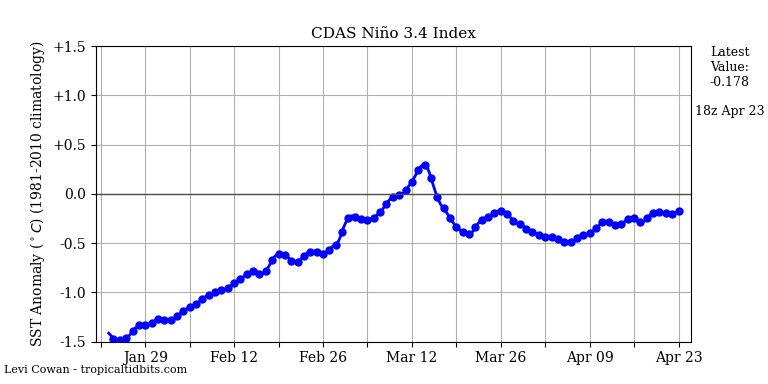
If La Nina lasts until April, it could be extended if solar activity continues to jump like this.

The forecast that says La Niña will end in February is wrong.
http://www.bom.gov.au/archive/oceanography/ocean_anals/IDYOC007/IDYOC007.202302.gif
Ireneusz From your various comments think we are in complete agreement on how climate works in both the long and short term. Let me know if you agree. The following is a brief summary from
http://climatesense-norpag.blogspot.com/
Re La Nina – I use the SOI and see a peak in April/May.
“The IPCC and UNFCCC post modern science establishment’s “consensus” is that a modelled future increase in CO2 levels is the main threat to human civilization. This is an egregious error of scientific judgement. A Millennial Solar ” Activity” Peak in 1991 correlates with the Millennial Temperature Peak at 2003/4 with a 12/13 year delay because of the thermal inertia of the oceans. Earth has now entered a general cooling trend which will last for the next 700+/- years.
Because of the areal distribution and variability in the energy density of energy resources and the varying per capita use of energy in different countries, international power relationships have been transformed. The global free trade system and global supply chains have been disrupted.
Additionally, the worlds richest and most easily accessible key mineral deposits were mined first and the lower quality resources which remain in the 21st century are distributed without regard to national boundaries and demand. As population grows,inflation inevitably skyrockets. War between states and violent conflicts between tribes and religious groups within states are multiplying.
2 The Millennial Temperature Cycle Peak.
Latest Data (1) https://www.nsstc.uah.edu/data/msu/v6.0/tlt/uahncdc_lt_6.0.txt
Global Temp Data 2003/12 Anomaly +0.26 : 2023/01 Anomaly -0.04 Net cooling for 19 years
NH Temp Data 2004/01 Anomaly +0.37 : 2023/01 Anomaly +0.05 Net cooling for 19 years
SH Temp Data 2003/11 Anomaly +0.21: 2023/01 Anomaly -0.14 Net cooling for 19 years
Tropics Temp Data 2004/01 Anomaly +0.22 : 2023/01 Anomaly – 0.38 Net cooling for 19 years.
USA 48 Temp Data 2004/03 Anomaly +1.32 : 2023/01 Anomaly + 0.12 Net cooling for 19 years.
Arctic Temp Data 2003/10 Anomaly +0.93 : 2023/01 Anomaly – 0.72 Net cooling for 19 years
Australia Temp Data 2004/02 Anomaly +0.80 : 2023/01 Anomaly – 0.50 Net cooling for 19 years
Earth’s climate is the result of resonances and beats between the phases of natural cyclic processes of varying wavelengths and amplitudes. At all scales, including the scale of the solar planetary system, sub-sets of oscillating systems develop synchronous behaviors which then produce changing patterns of periodicities in time and space in the emergent temperature data. The periodicities pertinent to current estimates of future global temperature change fall into two main categories:
a) The orbital long wave Milankovitch eccentricity, obliquity and precession cycles. These control the glacial and interglacial periodicities and the amplitudes of the corresponding global temperature cycles.
b) Solar activity cycles with multi-millennial, millennial, centennial and decadal time scales.
The most prominent solar activity and temperature cycles are : Schwab-11+/-years ; Hale-22 +/-years ; 3 x the Jupiter/Saturn lap cycle 60 years +/- :; Gleissberg 88+/- ; de Vries – 210 years+/-; Millennial- 960-1020 +/-. (2)
The Oulu Galactic Ray Count is used in this paper as the “solar activity ” proxy which integrates changes in Solar Magnetic field strength, Total Solar Insolation , Extreme Ultra Violet radiation, Interplanetary Magnetic Field strength, Solar Wind density and velocity, Coronal Mass Ejections, proton events, ozone levels and the geomagnetic Bz sign. Changes in the GCR neutron count proxy source causes concomitant modulations in cloud cover and thus albedo. (Iris effect)
Eschenbach 2010 (3) introduced “The Thunderstorm Thermostat Hypothesis – how Clouds and Thunderstorms Control the Earth’s Temperature”.
Eschenbach 2020(4) in https://whatsupwiththat.com/2020/01/07/drying-the-sky uses empirical data from the inter- tropical buoy system to provide a description of this system of self-organized criticality. Energy flow from the sun into and then out of the ocean- water interface in the Intertropical Convergence Zone results in a convective water vapor buoyancy effect and a large increase in OLR This begins when ocean temperatures surpass the locally critical sea surface temperature to produce Rayleigh – Bernard convective heat transfer.
Short term deviations from the solar activity and temperature cycles are driven by ENSO events and volcanic activity.

Fig 1 Correlation of the last 5 Oulu neutron cycles and trends with the Hadsst3 temperature trends and the 300 mb Specific Humidity. ( 5,6 )
The Oulu Cosmic Ray count in Fig.1C shows the decrease in solar activity since the 1991/92 Millennial Solar Activity Turning Point and peak There is a significant secular drop to a lower solar activity base level post 2007+/- and a new solar activity minimum late in 2009. In Figure 1 short term temperature spikes are colored oranorange and are closely correlated to El Ninos. The hadsst3gl temperature anomaly at 2037 is forecast to be + 0.05……………”
correlated to El Ninos. The hadsst3gl temperature anomaly at 2037 is forecast to be + 0.05.
https://blogger.googleusercontent.com/img/a/AVvXsEjEbcj5Rk2czupOsD4PnxjTI-dNoIAxcMG7yKIGiTboHkXgmlF-HR1m87NYfqMPtiJwwLrIvGpQBvedJLU9dgcqsm-EV63Xuz7VyuiLjy7aqL2p6NaMD9mt9TOO-iDEeT_GIcBDpyAFUkX5-gJwoywFuphiM6-20iV3lXEUvLpz1Ln0mdmiRqpfyAR_3w=w631-h410
Fig.2 Northern Hemisphere 2000 year temperature reconstruction and a Millennial Temperature Turning Point. (MTTP). (7)
Because of the data quality, record length and methods used, the NH Christiansen et al 2012 series was selected as the “type reconstruction” to represent the NH trends. The de Vries, Maunder, Sporer and Wolf minima are noted. Important volcanic cooling events are marked with a V. An MTTP occurs at about 990. The Millennial cycles are asymmetric with a 700+/- year down-leg and a 300 +/- year up-leg.
https://blogger.googleusercontent.com/img/a/AVvXsEi_Nb8FScfi4vU39WRnt85Ua6CSHHmuRkp9lCLYNQqXLsAyLu5iOnnIgr2Jj32od9RAOhpiG6MHcdUVBUb-3_ATOd7Wue73fogFWBHPBRMEu2gsmZ7wn5ZEuLlxxCCjK2T47UdKng6Wbt36Igdf659FOWPLsuAlR19WeFoGaXjbVZn6qctZd6RnLFj1gQ=w446-h516
Fig 3 The NRLTSI2 Solar Activity – CET Relationship 1600- Present (8,9,10)
In Fig.3 the Roth & Joos Cosmogenic Index (CI) is used as the emergent proxy for the solar activity driver of the resulting emergent global and NH temperature data.
The effect on observed emergent behaviors i.e. global temperature trends, of the combined effect of these solar and GCR drivers will vary non-linearly depending on the particular phases of the eccentricity, obliquity and precession orbital cycles at any particular time.
Figure 3 shows an increase in CI of about 2 W/m 2 from the Maunder minimum to the 1991 activity peak. This increase, together with the other solar “activity” variations modulate the earth’s temperature and albedo via the GR flux and varying cloud cover.
The emergent temperature time series trends of the combined orbital, solar and GCR drivers also reflect turning points, changes of state and important threshold effects created by the interactions of the underlying physical processes. These exogenous forcings are also simultaneously modulated by changes in the earth’s magnetic field and length of day.
The temperature increase since the 1680s is due to the up- leg in the natural solar ” activity” Millennial cycle as shown by Lean 2018 “Estimating Solar Irradiance Since 850 AD” (ibid) Figure 3 also shows the correlation between the CI driver and the Central England Seasonal Temperatures. (ibid). The 1650 – 1700 (Maunder), 1810 – 20 (de Vries/Dalton), and the 1890-1900 (Gleissberg) minima are obvious.
These temperature changes correlate very well with the changes in energy flow from the sun shown in Figure 1 C without any measurable effect of C02.There is NO CO2 Caused Climate Crisis”
By April, low temperatures will persist in California’s mountains and there will be more snowfall.
The amount of heat accumulated in the Pacific during La Niña is currently low.

Look at where the elevated SSTs are:
The temperature of the troposphere rises during El Niño when evaporation in the Pacific increases. Several temperature zones need to be distinguished:

temperature near the Earth’s surface, troposphere temperature and temperature near the tropopause. They can vary depending on solar insolation, the ENSO cycle and changes in the amount of ozone in the tropopause (depending on UV radiation).
After a strong SSW, the polar vortex will strengthen again. It promises to be a long winter in the northern hemisphere.

This latest blast was proceeded by strong stratospheric warming as is usually the case it seems.
Is there a current or imminent SSW?
All you weather deniers need to go back to your office.