Earth’s energy balance sheet is in the red, leading to higher temperatures, rising sea levels, floods, droughts, more powerful blizzards and hurricanes, and deadlier extreme events.
PRINCETON UNIVERSITY
Sunlight in, reflected and emitted energy out. That’s the fundamental energy balance sheet for our planet. If Earth’s clouds, oceans, ice caps and land surfaces send as much energy back up to space as the sun shines down on us, then our planet maintains equilibrium.
But for decades, that system has been out of balance. Sunlight continues to pour in, and Earth isn’t releasing enough, either as reflected solar radiation or as emitted infrared radiation. The extra heat trapped around our globe — some 90% of which is stored in the ocean — adds energy to worldwide climate systems and manifests in many ways: higher temperatures, rising sea levels, floods, droughts, more powerful blizzards and hurricanes, and deadlier extreme events.
While climate scientists have warned for a half-century that this was the inevitable result of adding too much carbon dioxide to the atmosphere, so-called climate deniers have continued to suggest that the observed changes might be a fluke — just natural variation.
“Until now, scientists have believed that because of the short observational record, we can’t deduce if the increase in the imbalance is due to humans or climatic ‘noise,’” said Shiv Priyam Raghuraman, a graduate student in atmospheric and oceanic sciences (AOS) at Princeton. “Our study shows that even with the given observational record, it is almost impossible to have such a large increase in the imbalance just by Earth doing its own oscillations and variations.”
He and his co-authors used satellite observations from 2001 to 2020 and found that Earth’s “energy imbalance” is growing. Raghuraman worked with David Paynter of the Geophysical Fluid Dynamics Laboratory (GFDL), a NOAA-funded national laboratory located on Princeton’s Forrestal Campus, and V. “Ram” Ramaswamy, director of GFDL and a lecturer with the rank of professor in geosciences and AOS at Princeton University. Their paper appears today in Nature Communications.
“It is exceptionally unlikely — less than 1% probability — that this trend can be explained by natural variations in the climate system,” said Raghuraman.
So what has caused the growing energy imbalance?
“We always think, ‘Increasing greenhouse gases means trapping more infrared heat’ — the classic greenhouse effect becomes larger,” said Raghuraman. “This is correct, but the flip side is that the resulting warmer planet now also radiates more infrared heat away to space, so the greenhouse gas heating impact is cancelled. Instead, much of the imbalance increase comes from the fact that we are receiving the same amount of sunlight but reflecting back less, because increased greenhouse gases cause cloud cover changes, less aerosols in the air to reflect sunlight — that is, cleaner air over the U.S. and Europe — and sea-ice decreases.” (Bright white sea ice reflects much more sunlight than sea water, so as sea ice melts, Earth is becoming less reflective.)
In addition, the Princeton and GFDL researchers noted that oceans store 90% of this excess heat. Because of this close relationship between the growing energy imbalance and ocean heating, the Earth’s energy imbalance has important connections to marine health, sea-level rise and the warming of the global climate system. The researchers hope that tracking the historical trends in this energy imbalance and understanding its components will improve the models of future climate change that drive policymaking and mitigation efforts.
“The satellite record provides clear evidence of a human-influenced climate system,” they said. “Knowing that human activity is responsible for the acceleration of planetary heat uptake implies the need for significant policy and societal action to reduce anthropogenic greenhouse gas emissions to curb further increases in Earth’s energy imbalance.”
###
“Anthropogenic forcing and response yield observed positive trend in Earth’s energy imbalance,” by Shiv Priyam Raghuraman, David Paynter and V. Ramaswamy, appears in the current issue of Nature Communications (DOI: 10.1038/s41467-021-24544-4). The research was supported by the National Oceanic and Atmospheric Administration, the Future Investigators in NASA Earth and Space Science and Technology (award 80NSSC19K1372), the High Meadows Environmental Institute at Princeton University, and the Mary and Randall Hack ’69 Research Fund.
JOURNAL
Nature Communications
DOI
10.1038/s41467-021-24544-4
METHOD OF RESEARCH
Computational simulation/modeling
Discover more from Watts Up With That?
Subscribe to get the latest posts sent to your email.

1% probability is not exactly what I’d call “extremely unlikely”, or is it?
The exact quote is
They are claiming that there is a 99% probability that it is caused by man.
Of course the reasoning they use to come up with that 1%/99% calculation is a bit shakey.
Nor have they demonstrated that the tiny bit of warming that they have detected is bad, much less catastrophic.
Exactly . He says …”Earth’s energy balance sheet is in the red “…
No. it’s in the green !
Ask the plants.
But 97% of scientists agree
Only if you get self-selected scientists that agree with you already.
But look at his earlier claim:
Note the “just by”. That means they found it had to be a mix of anthro and natural change. But then the BIG BOLD LETTERS claim is:
“It is exceptionally unlikely — less than 1% probability — that this trend can be explained by natural variations in the climate system,” said Raghuraman.
Here he manages to miss out the word ALONE: less than 1% probability — that this trend can be explained by natural variations ALONE
That is called lying by omission.
I would guess that there is less than a 1% chance that this grad student got off his butt and walked a few hundred yards to talk to Will Happer over at the Physics Building. Princeton U. and AOS are big on their claims of diversity, diversity in science, not so much.
But, Happer is not his advisor. He has to please his advisor and committee.
This is pathetic. I would like to know who the peers are that reviewed this tripe.
What energy imbalance? Any measured ‘imbalance’ is 99% more likely to be a measurement error or some biased adjustment. Considering that each hemisphere exhibits over 100 W/m^2 of difference between maximum positive imbalance in its winter (emits more than it receives) and maximum negative imbalance in the summer. The size of any claimed ‘imbalance’ is significantly smaller than the uncertainty in the data used to approximate it.
Exactly.
It is all lies, all the time.
All the way down.
from the paper:”Using climate model simulations, we show that it is exceptionally unlikely (<1% probability) that this trend can be explained by internal variability
The 95% CI consists of uncertainty due to observational error, as well as uncertainty due to internal variability (latter quantified by standard error associated with linear fit.”
All the calculations are were done using the same models that have been used to produce the “projected temperatures” by the IPCCC.
The main problem is that what the climate models calculate on such large grid patterns it is difficult to evaluate the effects in real terms. The models are designed to prevent any runaway calculations.
AS a result, it is not surprising that they are in good agreement with each other and can produce a very small radiation imbalance. The question is: is this 1% real, or just a response to the inherent error in the climate models? With no measures of observational error and internal error that the actual equations generate in the models despite the damping used- it is quite likely internal errors are more than enough to give a <1% error.
Is it real?
Let’s have a look at models vs reality in a picture, attached below.
As we can see, this question was settled years ago.
Since then, the lies have only continued to increase in ridiculousness, audacity, divergence from reality, and shrilly unhinged exaggeration.
Need to update the graph.
I’ll get right on it.
‘Less than 1% probability’
These aren’t scientists. They’re carnival barkers.
I have an entirely defensible claim:
There is way less than a 1% probability that the numbers they give are as accurate as they claim.
Even if they don’t supply an accuracy figure, they imply it by the number of significant digits they use to display a number. For instance, if they give a number as 147 that means it is between 146.5 and 147.5, elsewise they would give the number as 146 or 148. So, by giving a number as 147, they are claiming better than 0.7% accuracy.
Can you provide a concrete example of what you are talking about?
Here’s one “Bright white sea ice reflects much more sunlight than sea water, so as sea ice melts, Earth is becoming less reflective.”
They couldn’t even be bothered with the two clicks that show Antarctic sea ice isn’t melting. Three clicks if you want to verify that yesterday was above the same day in 1979, the start of the satellite era of measurement. (Yes, I know it was earlier but let’s just play along with their fraudulent cherrypicking).
Here’s yer first click:
https://nsidc.org/arcticseaicenews/charctic-interactive-sea-ice-graph/
Antarctic sea ice has far greater effect on albedo than does Arctic, as so much more of it spreads to higher latitudes.
Lower latitudes?
But more of it melts during the summer, only about 15% of it remains from one year to the next.
Lately it has snowed frequently in Greenland, very large island to the south of the artic.
Yesterday’s Antarctic ice extent was about tied with 2015 for third highest on that date since dedicated satellite observations began in 1979. The two higher years were 2013 and the monster ice year of 2014.
Clearly, CO2 doesn’t melt sea ice.
I don’t think that has any relevance to the uncertainty on energy budgets. I will say that the NSIDC lists the uncertainty on sea ice anomalies as +/- 0.3 km^2.
Okay, I’ll bite. If it isn’t relevant then why do the authors of the study mention it as one of their main concerns? Somewhat confusing.
My point was mainly with the interpretation of uncertainty given the figures in energy budget diagrams like the one from NASA used as a thumbnail for this blog post. My comment was not in reference to the Raghuraman et al. 2021 publication.
Ah right. In that case, since satellite observation routinely undervalues sea ice coverage by about 30-50%, isn’t your uncertainty somewhat on the low side?
They also completely ignore the fact that at low angles of incidence, the difference between the reflectivity of snow vs sea water is very small.
For half the year at the poles the incidental solar energy is so vanishingly low as to be almost nonexistent 😉😁
That is high angles of incidence, equal to low solar elevation angles.
On the illustration showing the Earth’s energy balance, they show the total reflected solar radiation as 99.9 W/m2. That’s claiming an accuracy of 0.1%. At any moment that’s not the amount of energy reflected from the planet. In any event, there’s no instrument you can point at the Earth which will give the total reflected energy.
The reflected energy goes in all directions. To measure it all at once, you’d have to have a sensor that would surround the Earth. That would, of course, block the Sun’s radiation.
So, we have to sample and calculate. That entails making assumptions. Oh yes, and let’s not forget that the reflected energy exists at bandwidths ranging from microwaves to x-rays and beyond. How the heck do you separate reflected IR from emitted IR? You have to make more assumptions.
It’s not too rude to say that their claim of <0.1% error for reflected energy is total and utter B.S.
I believe you are referring to the Loeb et al. 2009 and Trenberth 2009 et al. 2009 blended energy budget. That 99.9 W/m2 is not the uncertainty nor does it contain any vestiges of it. Loeb et al. 2009 contains an entire section on the uncertainty here and lists the SW reflection uncertainty as +/- 2 W/m2. So their claim is for a 2% uncertainty.
Note that the ~100 w/m2 of reflected SW radiation is only that which is directed to space and is not absorbed by the planet. Terrestrial radiation is distinguished from solar radiation by the frequency. The former primarily being in the SW bands and the later in the LW bands. IR arriving from the Sun does not get reflected. It is absorbed.
I do agree that any claim of uncertainty < 0.1% for reflected SW radiation is utter B.S. But…no one is claiming that as far as I know.
As I stated, I am referring to the illustration on the WUWT main page for this article. That illustration is similar to others commonly presented except maybe more egregious. Giving a number with three significant digits is a claim of accuracy.
You can claim that the significant digits in the illustration are the result of the illustrator, not scientists, but I guarantee that a graphic artist did not dream up those numbers. They came from some scientist somewhere, so yes, someone is making an unfounded claim of accuracy.
Anyway, back to the article on which we are commenting … If you apply proper error bars, Raghuraman et al’s claims of certainty fall apart.
Yeah, that illustration has Loeb et al. 2009 and Trenberth et al. 2009 listed as references. I realize there are established rules for the display of digits based on quantified uncertainty, but you should not assume the display of digits always implies the uncertainty. The illustrator definitely should have included the lower and upper bounds for all figures.
I did read Raghuraman et al. 2021. They’re methodology quite clearly considers error bars so I’m not sure what the concern is here.
You are mixing ‘metaphors.’ At least units! Try using “wavelength” since you use implied wavelength in the names you use in the next sentence, i.e. “SW bands and the later [sic] in the LW bands.”
That depends on the material and its refractive index in the IR. Most materials are more absorbent in the IR than in visible wavelengths, although there are frequently abrupt changes at specific wavelengths. However, for specular reflectors, particularly water, IR is totally reflected at glancing angles. Your claim is only correct for certain materials and then it is dependent on the angle of incidence and the variation of the extinction coefficient at specific IR wavelengths.
You definitely got me there. I should be more careful about usage of frequency and wavelength and make sure I’m consistent with it. I’ll definitely be more careful about that in the future.
Thank you for the acknowledgement. However, how about your blanket statement that IR arriving from the sun does not get reflected?
Near-IR is strongly reflected by chlorophyll!
I did a rough calculation and estimated that 0.2 W/m2 of solar IR is reflected back to space. That is small relative terrestrial radiation, but not insignificant. I concede that point. I should be more careful about blanket statements like that. They are almost never right.
How much solar IR do you think makes it to the surface?
🙂
You need to be more specific. The solar IR that makes it to the surface varies with time of day, latitude, season, cloudiness, specific humidity, and concentration and type of aerosols. It also varies a small amount with the solar sunspot cycle. Furthermore, are you asking about all wavelengths called IR, or just thermal IR?
That’s an assumption. Reality is more complicated. example
Good point. I should be more careful about claiming that all solar IR is absorbed. It might not be. In fact, based on the paper you cited and doing some rough back-of-the-napkin calculations suggests that reflected solar IR could be as high as 1 W/m2 but more likely on the order of 0.2’ish W/m2. That’s not insignificant. Assuming I did the calculations right and no one has objection I’ll concede the point.
“IR arriving from the Sun does not get reflected” So clouds are like a two-way mirror. Only stopping O/G IR?
It is nuanced. I did a quick calculation suggesting that just under 1% of the incoming solar radiation is 4 um or above. The publication commiebob just posted suggests 15% of IR can be reflected by clouds. The biggest unknown for me is the coverage of high cirrus clouds which I estimated at 40%. That comes out at right at 0.2 W/m2 (340 * 0.01 * 0.15 * 0.4). If someone wants to throw out different figures that would be great. I’m not very confident with the result so I arbitrarily threw in a factor 5 for some wiggle room.
But to your point there is significantly more terrestrial IR than solar IR. So any increase in the return to the emission source whether it be reflected or absorbed and remitted blocks more outgoing terrestrial energy than incoming solar energy.
The modern science does not depend on numbers.
It was very similar question on the radio:
Almost as unlikely as a Trump victory in 2016 😉
I always have trouble assessing the direction an ‘odds’ that is presented suggest, especially when it is coupled with negatives and then comparing it to an analogy offered. But, thinking about your analogy here’s how I read it: Hillary stalwarts boasting a less than 1% chance of a Trump victory.
Based on that reading I’d have to give that mega +’s for the allusion of watching their reactions as the “less than 1%” changes as time goes on.
Either he does not know the basics of thermodynamics or he does not know de basics of statistics.
Or both.
Auto
My money is on almost total ignorance. Outside of his specialism in ‘how to obtain grant funding’ that is.
What energy imbalance?
Joe Biden ?????
Koyaanisqatsi, I guess.
Koyaanisqatsi:
So the study contradicts this: https://www.mdpi.com/2072-4292/11/6/663?type=check_update&version=1
The author is saying that EEI is decreasing, reflecting the OHC derivative.
Whom should we give credit to?
“We always think, ‘Increasing greenhouse gases means trapping more infrared heat’ — the classic greenhouse effect becomes larger,” said Raghuraman. “This is correct, but the flip side is that the resulting warmer planet now also radiates more infrared heat away to space, so the greenhouse gas heating impact is cancelled.”
Right.. so now CO2 causes : ” cloud cover changes ” not an enhanced “greenhouse effect”.
This is likely correct. CO2 produced IR is very weak and thus enhances evaporation especially in warmer oceans. This enhances the evapo-convective forces which will lead to more cloud cover in those warmer regions (especially summer and day time in the extratropic areas).
The net result would be some warming in colder parts of the planet and more cloud cover over warmer parts of the planet. This will tend to moderate temperatures overall. Of course, latitudinal moderation will also decrease extreme weather.
I agree. But this guy is saying.. “much of the imbalance increase comes from the fact that we are receiving the same amount of sunlight but reflecting back less, because increased greenhouse gases cause cloud cover changes,” implying less cloud cover.
Clouds hold heat in as well as reflect it, remember.
Only at night.
not “hold” they do slow the movement of the IR waves but they do NOT “hold” any of it.
I agree completely: Bad math isn’t a natural process.
Ah, the commander in Chief says he is .
As all involved [measurement] uncertainties are (far) greater than 1%, I doubt that he can falsify a hypothesis that narrowly.
Not only is he not in the neighborhood of 1% he isn’t even in the right state. What am I saying? He isn’t even on the right planet.
Please stop saying derogatory things about planet Libtardia. The Libtardians mean well.
The Libtardians mean well.
The Libtardians mean well – for themselves.
Better?
Auto
“The road to Hell is paved with good intentions.”
It is a corollary to Unintended Consequences.
So who is right?
https://rumble.com/vkd3jp-top-climate-scientist-dr.-willie-soon-predicts-global-cooling-for-next-20-3.html
It is also well known that the Earth has been MUCH warmer in the not-so-distant past!
“It is exceptionally unlikely — less than 1% probability — that this trend can be explained by natural variations in the climate system,” said Raghuraman.
I say bullsh!t.
Keep in mind that this warmist cabal has made more than 48 consecutive false predictions of climate disasters – the odds of this being mere random stupidity is 1 in ~281 trillion.
His means of making this claim was to compare to climate models. The other possibility is that climate models are worthless piles of non-validated code.
In the past, much bigger changes in planet temperature were entirely natural.
However there is only a 1% chance that the current one is natural.
UN IPCC CliSciFi GCMs can’t even correctly represent the past. To say a bunch of models that get global average temperatures 3 C apart can get energy budget calculations within 1% is delusional.
There is a 100 percent chance that is total bull shit!
His apology is plausible. but less than 1% probable. This is the state of modern science, the old/new “jurisprudence”, etc.
The article castigates the strawman they call “deniers” using an old debating trick. But there is a whole spectrum of people who expect more rationality than supposition in these extreme claims. A lot of these are very knowledgeable people who finished their engineering or other hard science degrees instead of opting for the easy grad studies courses in the environment department like Ragahuraman did.
I suppose I am a “half ***ed lukewarmer” in the sense that I agree the average temp. is up a degree since 1850 with about half of that caused by changes in land use and CO2….but a “denier” in the sense that I deny it is any real problem.
The relevance of the paper’s findings can be summarized by one statement it contains…..”we begin with 2001”. FFS, not even a 30 year climate assessment period. Just a waste of attention span to read it. Seems you can now be published in Nature Communications if you know the symbol for “sigma”….
If I’m not mistaken (and I’m not going back to check right now), even the CERES crew at NASA Langley (LaRC) only go to 2005 for their Earth’s Energy Imbalance (EEI) estimates. What makes his data back to 2001 any better?
He is a grad student in CliSciFi, that’s why. Right or wrong, on the surface his paper destroyed the CAGW theory; it is not GHGs disrupting the outward flow of LW radiation, it is CO2 destroying aerosols and clouds. Pal review has fallen apart.
Did you mean “half-fast?”
“The researchers hope that tracking the historical trends in this energy imbalance and understanding its components will improve the models of future climate change that drive policymaking and mitigation efforts.”
And I HOPE that tracking the historical trends in roulette number outcome will improve the models of future number outcome that drive my decision making.
But of course that would involve risking MY money, so maybe relying on hope is not a good thing for MY bankroll.
Thank you for the intelligent, clear and sensible comment!
But how can the models be improved? I thought the science was “settled”?
Chucking them in the bin would be a vast improvement.
“so-called climate deniers have continued to suggest that the observed changes might be a fluke — just natural variation.”
““It is exceptionally unlikely — less than 1% probability — that this trend can be explained by natural variations in the climate system,” said Raghuraman.
This system of thought is wrong, and the people pushing are simply activists.
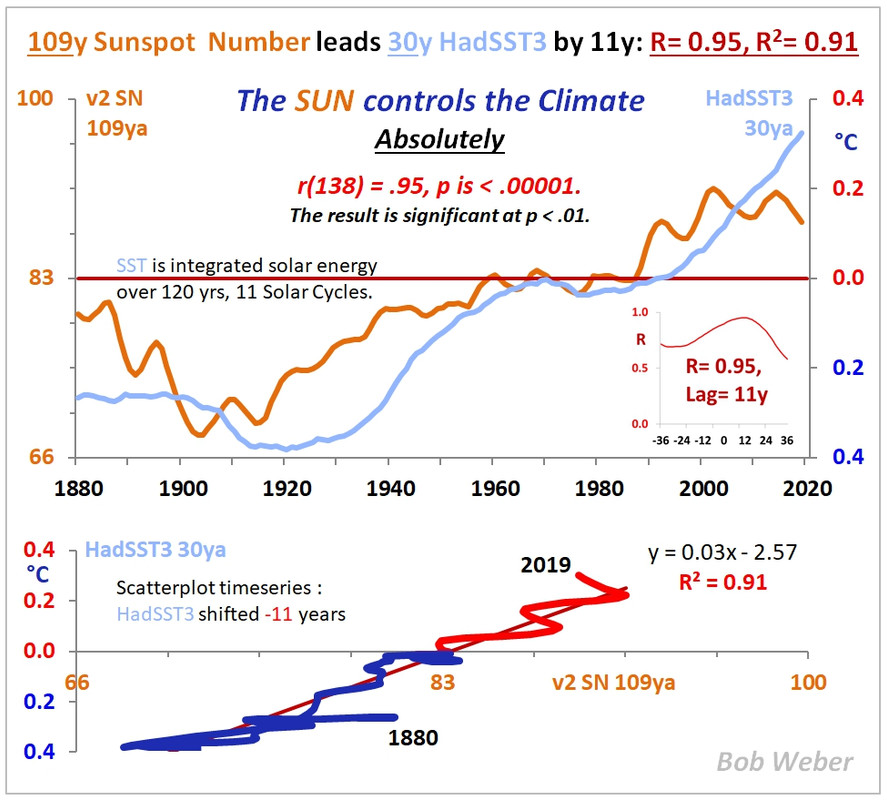
Climate change is due to natural ocean variation driven by solar variation.
The use of the pejorative ‘denier’ is a dead giveaway that this article is just more politics.
The authors shown their hand in the abstract (my bold):
What is clear and evident, as they don’t understand the drivers, is their ignorance.
“…..We conclude that the satellite record provides….”. And what does the satellite record show about the Little Ice Age, The Roman and Minoan warm period…and oh yeah, the Ice Age ? Do I need a /sarc?
Yes, and why do they exclude the 1979-2000 portion of the satellite record? Looks a lot like a big bowl of cherries to me.
Guesses about the energy imbalance wasn’t available before about 2005. I don’t know where the grad student got his 2001 to 2004 data. I’m not about to spend time digging into this steaming pile to find out.
Willis has just posted a really good take down of the nonsense used to support this paper’s predetermined conclusion.
0.38 ± 0.24??? Are they having a laugh?
Good enough for government work, I suppose.
Remember when the UN IPCC trotted out CliSciFi models showing with and without human drivers. Since the models were tuned to CO2 using aerosols to hindcast, naturally the “with” tracked observed and “without” showed cooling. This grad student is attempting the same trick. No wonder the pal reviewers liked it.
‘ reflecting back less , because of changes in cloud cover caused by greenhouse gasses ” . totally unfounded speculation . its still completely unknown whether cloud cover has increased or decreased and what effect increased co2 has had on clouds . junk science built on wild ass guesses and assumptions . since they’re always saying warming has put more water vapor into the atmosphere wouldn’t that mean more clouds ?. clouds and their effects on weather are almost totally absent in CC thinking . clouds are the weather maker .
The pretzel-twisting logic is nothing short of amazing. First, CO2 was going to be amplified by a “positive feedback loop” of increased water vapor; now, it’s apparently going to reduce cloud cover, somehow in the supposed presence of more water vapor in the atmosphere.
Yet, still without a scrap of empirical evidence, they blame CO2 as the ultimate “driver” of the Earth’s climate. They aren’t even aware of their own ignorance about what drives the Earth’s climate.
As I like to put it – We don’t have sufficient information of sufficient quality over a sufficient period of time to say anything reasonably “scientific” about what changes are occurring, what the driving forces are, and what’s going to happen when. We can hypothesize and guess all we want, we just don’t have the level of information required to divine the climate’s changes with this absurd degree of precision. I’m much closer to being completely accurate when I say that there is a 100% chance that the authors of this “study” don’t have a clue what they’re talking about.
And of course, the old “bad weather is caused by warming climate” bullshit – the same thing they told us was going to happen when climate was cooling in the 1970s (which at least was closer to a realistic claim, since colder climate increases the temperature differential between the poles and the tropics, meaning more violent weather in “extra tropical” zones). Put the various blather together and we’re supposed to be stupid enough to believe that the Earth was in some sort of “climate nirvana,” any departure from which will make the weather “more extreme.” Plus the underlying assumption that the climate would be unchanging absent human “inputs” which are minuscule.
more water vapor <> more clouds … clouds require more than water vapor to form …
So let us say it is not caused naturally, then what is the rationale it has to be CO2? Is it because that is the only possibility the authors can imagine? This is an unbased logical leap.
And I am not just pointing that out, because it is formally wrong, but rather because I know CO2 just does not have the potential to drive climate like this. Contrails are a much potent agent and they are “man made” as well.
For that reason “not natural” will not mean CO2, or prove the CO2 theory respectively.
From the article, this paragraph is stunning:
****
“We always think, ‘Increasing greenhouse gases means trapping more infrared heat’ — the classic greenhouse effect becomes larger,” said Raghuraman. “This is correct, but the flip side is that the resulting warmer planet now also radiates more infrared heat away to space, so the greenhouse gas heating impact is cancelled. Instead, much of the imbalance increase comes from the fact that we are receiving the same amount of sunlight but reflecting back less, because increased greenhouse gases cause cloud cover changes, less aerosols in the air to reflect sunlight — that is, cleaner air over the U.S. and Europe — and sea-ice decreases.” (Bright white sea ice reflects much more sunlight than sea water, so as sea ice melts, Earth is becoming less reflective.)
****
So the news is… wait for it… NEVER MIND ABOUT THAT “HEAT-TRAPPING” THING. It’s the cleaner air that did it!
Do GHG emissions drive sea-ice decreases without actually “trapping” heat? Do GHG emissions cause cloud cover changes without actually “trapping” heat? And do GHG emissions really decrease reflective aerosols somehow?
There has to be something lost or left out in the study summary. The whole aerosol/cloud discussion is nonsensical. The mention of Western reductions in aerosols as being causative ignores developing countries’ increases in aerosol production. We have gone down the rabbit hole with the grad student. Maybe he will get a ‘Mannian’ Phd where he pulls a disappearing GHG theory (Medieval Warm Period) trick.
I agree a stunning paragraph but for me the most stunning part of the paragraph is one line “so the greenhouse gas heating impact is cancelled ” hang on a minute isn’t that the very thing the warmists and ecoloons have used for decades to scare the crap out of everyone? So false alarm, no need to keep crucifying the countryside with windmills and solar panels, I can keep my house with central heating, I don’t have to go back to the dark ages and live in a mud hut. I don’t have to replace my little suv with a donkey. Oh no I forgot the bit about changing cloud cover which is all our fault and has never happened before. I shall call my donkey Donald.
Just 19 years of data, really? Once again one of those amazing computational models, that has been carefully tuned to give the wanted answer.
This paper is destined to become yet another prediction failure.
Head meet Wall.
It is at least a couple years short of a full solar-magnetic sunspot cycle.
Mark Twain — ‘There is something fascinating about science. One gets such wholesale returns of conjecture out of such a trifling investment of fact.’
Man, I don’t trust full professors nowadays, with years of experience, why should I trust a grad slave that published on the easiest journal to publish, from the same editorial group that published the arsenic DNA?
I stopped reading at: ‘stored in the ocean’.
I stopped at: “…manifests in many ways: higher temperatures, rising sea levels, floods, droughts, more powerful blizzards and hurricanes, and deadlier extreme events.”
Ha ha. They can’t even be bothered to check the empirical data, which completely contradict the coherent parts of the quote.
Ditto here.
The IPCC’s AR4 Report Chapter 5 page 387 says:
“The oceans are warming. Over the period 1961 to 2003, global ocean temperature has risen by 0.10°C from the surface to a depth of 700 m.”
Really they can measure that to three places? Besides, an increase of a tenth of a degree isn’t going to warm anything more than a tenth of a degree, and isn’t likely to cause draughts, floods, hurricanes, blizzards and even deadlier extreme events.
The oceans have been warming a bit, but not enough to significantly alter the Earth’s climate. The atmosphere has only been warming at about 0.14 C/decade (UAH over land and ocean combined). I know of no physics that would have the approximately 1 C warming over 150 years drive an increase in global bad weather.
If there were a real imbalance then the earth would crash and burn (figuratively?). Over the past seven decades I have through empirical observation not seen this happening.
And this is supposed to be a “peer reviewed” paper in “Nature Communications”.
That journal has completely lost all credibility …
I think they jumped that shark a while back.
Now don’t be nasty – they reviewed the spelling and grammar and it passed!
There is also a 99% probability that he will get more grant money to expand this wonderful theory.
And, he will get his PhD by pleasing his dissertation committee.
Will his overturning the GHG blanket theory have any impact on how the committee looks at the paper?
Possibly, if they are bright enough to understand the implications. That is not a given, since they are in the discipline of climatology.
Wild. The paper clearly states that CO2’s effect on aerosols and clouds is driving CAGW, not its LW radiative retention properties. One would have to be blind to miss that one. Was it his buddy grad students pal reviewing his paper?
Anyone using the term “denier” is confessing that they are an advocate, not a scientist.
Pure, raw, unfiltered climate pr0n.
Groan! There are two parts to this:
PART ONE:
“But for decades, that system has been out of balance. Sunlight continues to pour in, and Earth isn’t releasing enough, either as reflected solar radiation or as emitted infrared radiation. The extra heat trapped around our globe — some 90% of which is stored in the ocean — adds energy to worldwide climate systems…”
PART TWO:
“…and manifests in many ways: higher temperatures, rising sea levels, floods, droughts, more powerful blizzards and hurricanes, and deadlier extreme events.”
Part 1 is reasonable. The planet has warmed about a degree since the 19th century, and it is reasonable to say that increased CO2 has played a role in that warming.
It’s also reasonable to report that the sun will rise in the east tomorrow.
Part 2 is not reasonable and is not supported by anything other than good old fashioned fear mongering & bullshit.
It should be noted that the claims in Part 2 are from the eurekalert.org/news-release and not the cited Princeton peer reviewed publication.
This so called balance has resulted in only a few tenths of a degree of warming over the last 70 years. Over the last decade it has actually resulted in cooling.
Tell me again why I’m supposed to be panicking?
What does that say about Eureka Alert?
Again, UN IPCC CliSciFi GCMs are tuned to reflect only AGW, not natural influences. One or more of the UN IPCC Assessment Reports used this trick to “prove” only Man’s influences had any impact on observed temperatures by comparing GCM runs with and without anthropogenic influence, both compared to observed temperatures. Son of a gun, they “proved” that the world would be cooling rapidly without Man’s influence.