
Ebru Kirezci, University of Melbourne and Ian Young, University of Melbourne
Over the past two weeks, storms pummelling the New South Wales coast have left beachfront homes at Wamberal on the verge of collapse. It’s stark proof of the risks climate change and sea level rise pose to coastal areas.
Our new research published today puts a potential price on the future destruction. Coastal land affected by flooding – including high tides and extreme seas – could increase by 48% by 2100. Exposed human population and assets are also estimated to increase by about half in that time.
Under a scenario of high greenhouse gas emissions and no flood defences, the cost of asset damage could equate up to 20% of the global economy in 2100.
Without a dramatic reduction in greenhouse gas emissions, or a huge investment in sea walls and other structures, it’s clear coastal erosion will devastate the global economy and much of the world’s population.
In Australia, we predict the areas to be worst-affected by flooding are concentrated in the north and northeast of the continent, including around Darwin and Townsville.

Our exposed coasts
Sea levels are rising at an increasing rate for two main reasons. As global temperatures increase, glaciers and ice sheets melt. At the same time, the oceans absorb heat from the atmosphere, causing the water to expand. Seas are rising by about 3-4 millimetres a year and the rate is expected to accelerate.
These higher sea levels, combined with potentially more extreme weather under climate change, will bring damaging flooding to coasts. Our study set out to determine the extent of flooding, how many people this would affect and the economic damage caused.
Read more: The world may lose half its sandy beaches by 2100. It’s not too late to save most of them
We combined data on global sea levels during extreme storms with projections of sea level rises under moderate and high-end greenhouse gas emission scenarios. We used the data to model extreme sea levels that may occur by 2100.
We combined this model with topographic data (showing the shape and features of the land surface) to identify areas at risk of coastal flooding. We then estimated the population and assets at risk from flooding, using data on global population distribution and gross domestic product in affected areas.

Alarming findings
So what did we find? One outstanding result is that due to sea level rise, what is now considered a once-a-century extreme sea level event could occur as frequently as every ten years or less for most coastal locations.
Under a scenario of high greenhouse gas emissions and assuming no flood defences, such as sea walls, we estimate that the land area affected by coastal flooding could increase by 48% by 2100.
Read more: Water may soon lap at the door, but still some homeowners don’t want to rock the boat
This could mean by 2100, the global population exposed to coastal flooding could be up to 287 million (4.1% of the world’s population).
Under the same scenario, coastal assets such as buildings, roads and other infrastructure worth up to US$14.2 trillion (A$19.82 trillion) could be threatened by flooding.
This equates to 20% of global gross domestic product (GDP) in 2100. However this worst-case scenario assumes no flood defences are in place globally. This is unlikely, as sea walls and other structures have already been built in some coastal locations.
In Australia, areas where coastal flooding might be extensive include the Northern Territory, and the northern coasts of Queensland and Western Australia.
Elsewhere, extensive coastal flooding is also projected in: – southeast China – Bangladesh, and India’s states of West Bengal and Gujurat – US states of North Carolina, Virginia and Maryland – northwest Europe including the UK, northern France and northern Germany.

Keeping the sea at bay
Our large-scale global analysis has some limitations, and our results at specific locations might differ from local findings. But we believe our analysis provides a basis for more detailed investigations of climate change impacts at the most vulnerable coastal locations.
It’s clear the world must ramp up measures to adapt to coastal flooding and offset associated social and economic impacts.
This adaptation will include building and enhancing coastal protection structures such as dykes or sea walls. It will also include coastal retreat – allowing low-lying coastal areas to flood, and moving human development inland to safer ground. It will also require deploying coastal warning systems and increasing flooding preparedness of coastal communities. This will require careful long-term planning.
All this might seem challenging – and it is. But done correctly, coastal adaptation can protect hundreds of millions of people and save the global economy billions of dollars this century.
Ebru Kirezci, PhD candidate, University of Melbourne and Ian Young, Kernot Professor of Engineering, University of Melbourne
This article is republished from The Conversation under a Creative Commons license. Read the original article.
Discover more from Watts Up With That?
Subscribe to get the latest posts sent to your email.
Even if climate warms these studies vastly underestimate the flexibility of the economy. Business and people adjust to change in efficient ways.
They assume that everyone else is as dumb as the climate scientists, and would keep rebuilding in the same spots over and over again.
Over the last 10,000 years, sea levels have increased something like 6 feet, and somehow, civilization kept trucking.
A few years ago, a storm washed a couple of feet of sand off “our” beach. The cries of lost tourist revenues, the cost to dredge and replace the sand were considered but too immense so not done….last year another storm brought the sand back….no word of monetary effects….apparently weather-caused waterfront changes are only expected to COST taxpayers bigly.
Meanwhile, in the real world, 61 consecutive years of heavy CO2 emissions and monotonically rising CO2 levels have resulted in no significant, detectable acceleration in sea-level trends. In fact, in the great majority if long, high-quality measurement records there’s been no acceleration in rate of sea-level rise since the 1920s, or even earlier.
That includes Australia. This is Australia’s longest, highest-quality sea-level measurement record:
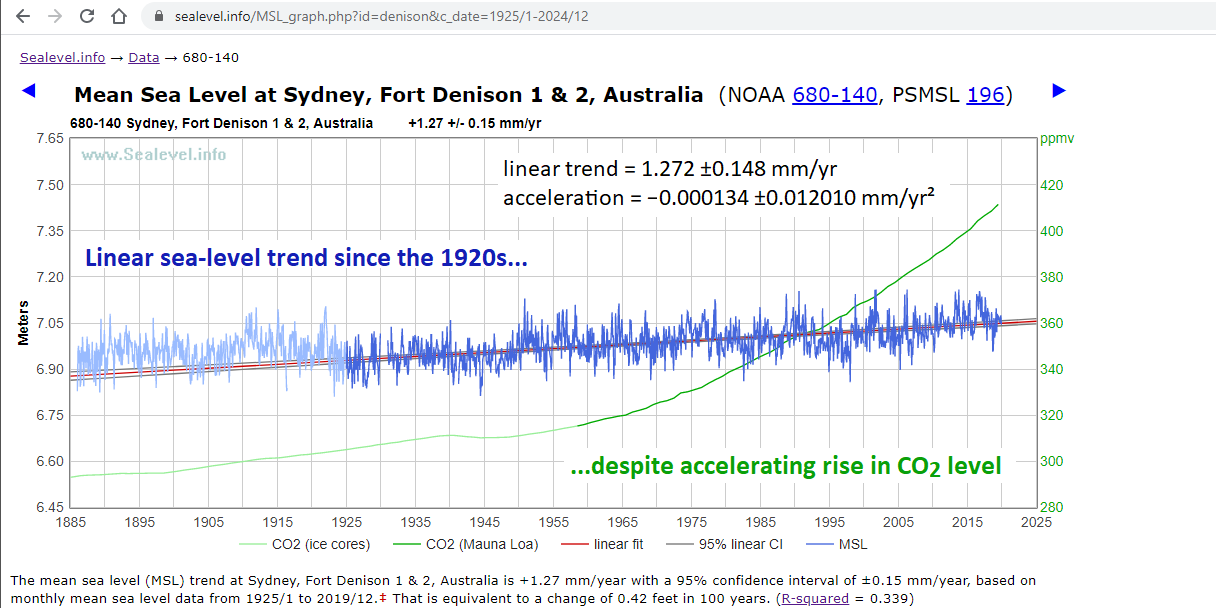
https://sealevel.info/MSL_graph.php?id=denison&c_date=1925/1-2024/12&lin_ci=0
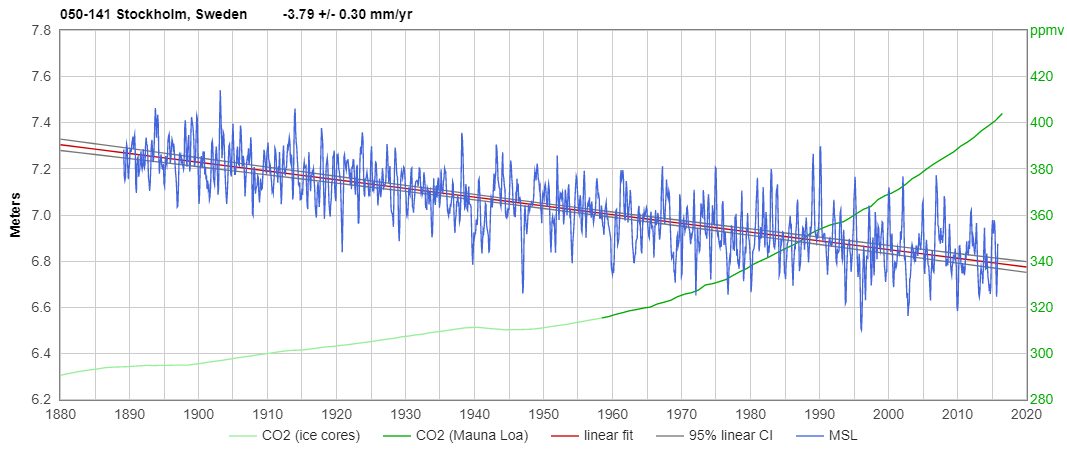
In fact, the global average sea-level trend is so minuscule that in many locations it is greatly exceeded by local factors, like sedimentation, erosion, and vertical land motion. Places with high rates of vertical land motion, like New Orleans (sinking) and Stockholm (rising), have sea-level trends which are very different from the global average. Greta Thunberg’s hometown is a example:
Some people think that global warming “simply must” cause accelerated sea-level rise because, after all, it melts ice, doesn’t it?
The answer is that, yes, it can melt ice, if the ice is already close to its melting point, but as the climate warms at high latitudes (where most warming occurs), it also increases snowfall on ice sheets and glaciers, adding to ice accumulation, reducing sea-level, and offsetting sea-level rise from other factors. Here’re some papers about it:
1. https://www.nature.com/articles/s41558-018-0356-x
2. https://www.nature.com/articles/354058a0
3. https://cp.copernicus.org/articles/13/1491/2017/cp-13-1491-2017.html
DB, the Australian Govt BoM data for the total record of sea levels at Fort Denison from May 1914 to June 2020, actually shows a fall in MSL of 63 mm [2.5 inches] for that 106 year period:
http://www.bom.gov.au/ntc/IDO70000/IDO70000_60370_SLD.shtml
And we must remember that Fort Denison is in a stilling pond [Sydney Harbour] adjacent to the broadest piece of ocean in the world.
Nothing happening. Only weather and storm surge.
Sea-level there spiked slightly (by about 10 cm) for around twenty years, between about 1902 and 1922. 1914 was within that “spike,” so average sea-level that year was slightly on the high side, which makes simply comparing graph endpoints a bit misleading.
I don’t know why the ABoM and PSMSL only report measurements at Ft. Denison back to 1914, since NOAA has data for Ft. Denison all the way back to January, 1886. NOAA has a note on their page for Ft. Denison which says:
“Under a scenario of high greenhouse gas emissions and no flood defenses, the cost of asset damage could equate up to 20% of the global economy in 2100.”
Kind of like saying if the Dutch had never built dikes the cost of asset damage could equate to . . .
Bjorn Lomborg gives a good drubbing to such inanities on pages 22-24, 30-34, and 185-188 of False Alarm. For example, one alarmist study projects sea level rise could inflict $100 trillion in damages, or 11% of global GDP, by 2100. But that’s only if we don’t adapt. The same study implies that, with reasonable projections of adaptation, the number of people flooded drops from about 3.4 million people in 2000 to about 15,000 per year in 2100. Bjorn writes: “Yes, dike costs will increase to $48 billion, and flood damages to $38 billion. But the total cost to the economy will actually decline, from 0.05 percent of GDP to 0.008 percent. And a 99.6 percent reduction in flood victims will be an undeniable victory.”
“Under a scenario of high greenhouse gas emissions and no flood defences,”
“However this worst-case scenario assumes no flood defences are in place globally. ”
Assuming that the entire population of the earth agrees to stop doing flood control, as humans have been doing for around 8000 years, if you ignore the insurance industry, which parts of the world have been practicing for 300 years (and requires continuous “investment” against future setbacks) then bad things could happen.
Suitable for scaring children. We miss you, Ed Wood.
‘the oceans absorb heat from the atmosphere‘
Really? How does that work?
Best,
Willem
Who knew that “climate justice” was out there but we did not have a clear picture from its promoters that it really means you get to pay for NYC subway upgrades, beachfront condos, and freshman-level geology lessons of land subsidence in delta regions like south Louisiana and Bangladesh. You will be told at the proper time when you are powerless to stop the wealth transfer.
The city of Townsville is in danger? Of flooding? Call the Powerpuff Girls! Or perhaps hire a few Dutch hydraulic planners.
This is kind of like when certain people figured out when and where solar eclipses would happen and then claim they had some kind of magical power to make them happen.
…..”research finds coastal flooding may cost up to 20% of global economy by 2100″
That is entirely provable right now.
No matter what the global economy is in 2100 it can be said that it will have been 20% better without coastal flooding.
See how that works in the woke world.
Make a claim that can never be disproven and you get to pretend as though it is a scientific finding.
In other news, the Sun MAY go nova tomorrow.
Not very likely, but the probability of it happening is not zero. Should I be worried . . . no.
It also did this erosion when MSL of Sydney was about 7cm lower than today, about 53 years ago (13.5mm/decade). It rose 6.4mm/decade from 1900 to 2000, the whole data to Dec 2019 has a rise of 7.6mm/decade. Some recent decades may indicate 20 to 28mm per decade but confidence interval is large (of the same order), cycles of 28 years show ups & downs. More corrections may have now been applied to the sensor data so it’s hard to keep track of reliability.
http://sealevel.info/MSL_graph.php?id=680-140
Sea level rise does not appear to be the major factor when you look at the timing and trends. It’s a sandy shoreline with a lack of natural rocky protections and open to water action at the base of the sand dune that erodes what is behind the existing coastline. Therefore what’s above falls down with nothing supporting it and then can also be washed away. If they built upon rock, it would have lasted much longer.
“Build on the rock and not upon the sand” Matthew 7:24-27 for the long quote.
How to you reply to low level drivel? Much of this work was covered before 1970. Sedimentologists like Robert Deitz had already identified beach dune migration systems that explained the deposition and erosion of beaches. He also provided the advancing paralic wedge model to explain how a body of sand migrates upwards and across the continental shelf, creates a strandline when a retreat takes place and then continue as before once sea level rises. Fairbridge in 1960 produced an excellent model of sea level changes including advances and retreats from 30,000 yrs BP. Drill proven to confirm his modeling – no computers involved just good hard geology that has stood the test of time.
If the citizens want to build close to the beach line their dwellings interfere with the shape of the wave taking it from a deposition cycle to the erosive cycle during storms and increasing the wind speed due to the venturi effect. Most beaches with only vegetation behind them can withstand the heavy storms of recent times. Beaches with dwellings near them suffer accordingly. In summary there is no good news for the owners of houses built on the dune headland at Wamberal Beach.
The only mechanism that may work is to dump the heavy basalt boulders behind the breaker line and create a wave platform for the waves to hit. That may dissipate the energy of the winter erosive wave a little, allowing for the possibility of deposition to take place rather than erosion.
To paraphrase-“The moment you see the words projections or projected reach for your wallet – you’re being had”
H/t to Congressman Hank Johnson. Everyone knows that the population of Australia has been and will continue to increase, its is this extra weight that is causing Australia to sink into the oceans.
(I think this has as much scientific weight as this ‘research’ from Melbourne University!)
Another factor involved in wall collapse is the design of agricultural drains and their misuse. This wrong design has been in newspapers about sea wall collapse in Oz in the past months. Nothing to do with climate change!
https://www.cornellengineers.com.au/how-agricultural-drains-wreck-houses/
Model fantasies and confirmation bias validations that result in new doom estimates. Simulated estimates that result in doom predictions for 2100…
Yeah, right!?
How about a prediction for next year? A result that is independently verified?
Not likely. There is no satisfaction from total failures; better to drool over their extreme opinion based estimates.
Truly pathetic