Note: Dr. Schmidt argues points he doesn’t seem to fully grasp, perhaps purposely, then again, Schmidt is no stranger to pettiness. – Anthony
Guest essay by Steve Koonin
Gavin Schmidt has posted a commentary on the video of a talk I gave recently at Purdue University. I’m grateful for his attention and comments, as I’m always trying to improve my presentations. It seems that I failed to get my points across in some crucial places, so I’ve got work to do.
As part of that work, I offer below some responses to Schmidt’s comments . I have reformatted his original text as block quotes and removed figures to improve the readability of this response. I’ve also, without changing meaning, removed some of his snark, which has no place in a serious discussion.
Steve Koonin, June 17, 2019
*******************************************************
In the seemingly endless deliberations on whether there should be a ‘red team’ exercise to review various climate science reports, Scott Waldman reported last week that the original architect of the idea, Steve Koonin, had given a talk on touching on the topic at Purdue University in Indiana last month. Since the talk is online, I thought it might be worth a viewing.
…
The red team issue came up a few times. Notably Koonin says at one point in the Q and A:
The reports are right. But obviously I would not be pushing a red team exercise unless I thought there were misleading crucial aspects of the reports.
55:55
Schmidt doesn’t get my wording quite right, and truncates an important follow-on statement. The full quotation as transcribed from the video is:
A lot of the reports are right. But obviously I would not be urging a red team exercise unless I thought that there are misleading crucial aspects of the reports. What I like to say is I believe, to be determined, that they are written more to persuade than to inform. And, you know, having thirty years’ experience in providing advice to policy makers about science, that’s not where we want to be. It’s OK to write an advocacy document, but not one bearing the mantle of science. I believe the reports have that problem.
But in over an hour of talking, he doesn’t ever really say what they are.
Instead, there are more than a few fallacious arguments, some outright errors, some secondhand misdirection, a scattering of dubious assumptions and a couple of very odd contradictions. I cannot find a single instance of him disagreeing with an actual statement in the reports.
I said up front (at 4:00) that my focus was to point out the disconnect between what the reports actually say and the public/political dialog. It would be a different talk to point out exactly how the reports promote that disconnect (such as by burying the lede or failing to provide historical or quantitative context); that would be the focus of a red team exercise. However, the economic impact discussion (at 36:40 and below), where Schmidt seems to agree that NCA4 has a problem, is an example of the kind of thing I’d expect that a red team would highlight.
First, the fallacies
Three examples:
“Until you explain variability on all the scales relevant to the alleged human warming, you haven’t really nailed it down.”
21:10
Nope. This is basically claiming that until you know everything (an impossible task), you know nothing.
Having quoted me explicitly, Schmidt then provides his own interpretation of what I “basically” said. I did not say “until you know everything”, but rather said “on all scales relevant.” Nor did I say “you know nothing”, but rather said “you haven’t really nailed it down”; there are big differences in both cases.
The basis for the thought should be obvious. Unless you understand natural variability on the relevant scales, you’re in danger of misattributing observed changes to anthropogenic influences and so, for example, misjudging sensitivity.
I try to be careful with my words (even in an unscripted talk) and am disappointed that they’re not read with comparable care. I’m also disappointed that Schmidt didn’t address the point I made, rather than just dismissing what he thinks I said.
33:00. Apparently, Koonin “doesn’t think” rapid sea level rise is going to happen in the future because it hasn’t happened over the last 100 years at the Battery in NYC.
Again, Schmidt is criticizing an “interpretive” quotation. The transcript from the video is:
I don’t think that’s going to happen [a one meter rise by 2100]. I’m not certain, but it sure looks discordant with what we’ve seen for the last 150 years.
For sea level to rise 1 meter by 2100 would require an average rate of 12 mm/yr through the end of this century. That’s about six times the rate we’ve seen for the past 150 years and four times the rate we’ve seen in recent decades (and likely also in the 1940’s). So I don’t see much reason to change my quote.
35:40. Koonin skips his slide on why Arctic sea ice trends aren’t anything to worry about, but his point was going to be that people noticed warming in the Arctic in 1923. This is of course another fallacious argument (and we’ve dealt with it before).
I’ll pass on responding to this one. Since I didn’t talk to the charts, Schmidt doesn’t know what I would have said.
Contradiction Central
There are two glaring sets of contradictions in the talk, first, involving attribution of past change and secondly, his stance on normative judgements in discussing science. Starting around 7:29 he discusses attribution of recent trends and states:
“You had better have [natural influences] under control before you can attribute what you see to human influences.”
This is fair enough (assuming he means that one should have a good handle on natural variability rather than ‘controlling’ it), and one might read this as a statement that attribution is complex and deserves careful attention – an opinion with which I fully concur. But this is illustrated with the most useless kind of pop attribution. He makes a blanket statement that any changes prior to 1950 must be purely ‘natural’ without any analysis at all (a stance completely at odds with the literature, for instance, Hegerl et al., 2018), and supports it with an uncredited graph from, of all people, Bob Tisdale, a frequent blogger at WUWT, showing running 30 year trends of the (now obsolete) HadCRUT3 data. That’s an interesting choice of metric because it is the longest trend period you can use that allows the ~1940 rise to almost match the more recent decades. With 35 year, or 40 year, or 50 year or 60 year trends, the exceptional nature of the recent change is obvious.
The data shown in the left panel at 8:00 are indeed an accurate representation of HadCRUT3. I appreciate the suggestion that I use more up-to-date data in future presentations. However, the quantitative 30-year trends shown in the right hand panel are those I determined from GISS’s own LOTI data (recently downloaded); they make the point even more powerfully.
Yes, I should not entirely dismiss the role of human influences in the first half of the 20th century, although the anthropogenic forcing used in the GISS CMIP5 simulations pre-1950 was no more than about 25% of what it is today. I do show (at 13:11) quantitatively the evolution of forcings over the past 250 years and at 20:50 do discuss the IPCC statement that includes anthropogenic forcing as one of the contributors to the early 20th century warming. The Hegerl et al. paper Schmidt cites does not appear to warrant changing that statement.
WMO defines climate as a 30 year average, which is what I used. It’s poor practice to be changing one’s definition a posteriori. The problem with longer averaging intervals is that there are then fewer independent periods upon which to base the claim of recent “unusualness” and whatever response there is to human influences in the recent decades is also diluted.
His second contradiction concerns his statements about normative values. He, of course, claims to make no normative statements, while implying others (unnamed) are perverting their science to do so. And yet, not only is his talk filled with his opinions, he has a remarkably different approach to the climate science results than to the results from economic modeling. For the former, he is hyper-critical (mostly without any valid cited reasons), while for the latter he appears naively credulous. This, at best, is incoherent, since the economic projections are rife with embedded normative values.
For instance, he uses a standard contrarian argument that future damages associated climate change will be a small fraction of the expected economic growth and therefore do not need to be mitigated. But the models that produce that result simply assume that no amount of damage from climate change can effect the exogenous growth rate. Additionally, they assume that damages themselves are simply proportional to the square of the temperature anomaly. You can judge how credible these assumptions really are. Of course, if we are to be ridiculously better off in the future without any effort, then the estimated costs of mitigation (also a few % of GDP) are also irrelevant.
Yes, the economic modeling is at least as uncertain as the climate modeling and compounding the two is even worse, as I noted in my Wall Street Journal OpEd on the subject. I’m glad Schmidt now agrees, since he seemed quite taken with the economic modeling when Volume II of NCA4 was officially released. Perhaps he now shares my opinion that this should not have appeared in NCA4? (How did it survive peer review?)
However, my point in the talk was that these economic projections did appear in NCA4 (the alleged “gold standard” of the science) and were highlighted in headlines by the media and politicians. But NCA4 failed to provide proper quantitative context, which would have shown that the impacts (as projected) are minimal. How did that get past peer review?
Koonin gives his summary around 47:00, after spending a fair bit of time correctly describing the size of the challenge involved in stabilizing climate. But then he just shrugs and assumes that it is too big to ever be dealt with. This is not a conclusion that “just comes from the numbers”. He clearly has a normative preference for adaptation (seemingly oblivious to the point that it is very hard and very costly to adapt to a continuously changing, and even accelerating situation). Whether or not mitigation will be too hard, it is undoubtedly a normative decision to give up trying.
I used the word normative in the sense of prescriptive- “the world should …”, which necessarily involves tradeoffs based upon values. That’s very different from giving an opinion on what “will” happen, which is necessarily a judgement.
In the talk, I’m careful to avoid any “should”, but have no hesitation in making judgements about “will.” Only with apologies do I reluctantly stray into normative language in my last slide (48:00).
But even there I do not advocate that we “give up trying’; perhaps my failing in Schmidt’s view is that I do not advocate for urgent mitigation. Of course, Schmidt might have a different opinion about what will happen (his judgements) or about what should happen (his values), and I’d be happy to engage on those. But that shouldn’t be confused with a science discussion.
Errors galore
Some of these are trivial, some are more consequential, but all are illustrative of someone who is not well-versed in the topic.
At 14:40, he claims that climate models take time steps of 6 hours. It would be a little hard to resolve the diurnal cycle with that. The correct value is more like 15 to 30 min for the column physics, and more like 2 or 3 minutes for the advection routines. Curiously, even the slide he is talking to says this.
Mea culpa. My point was that many timesteps are needed for a useful model run. Citing the smaller time step makes the point even more powerfully (1.8 million 30-minute steps over a century).
18:45. he says that Figure 9.8 in IPCC AR4 (2013) was ‘misleading’ because it showed anomaly temperatures alongside the range of absolute mean global values. This is odd. If the sensitivity of the model is not dependent on the base state, this is a good result.
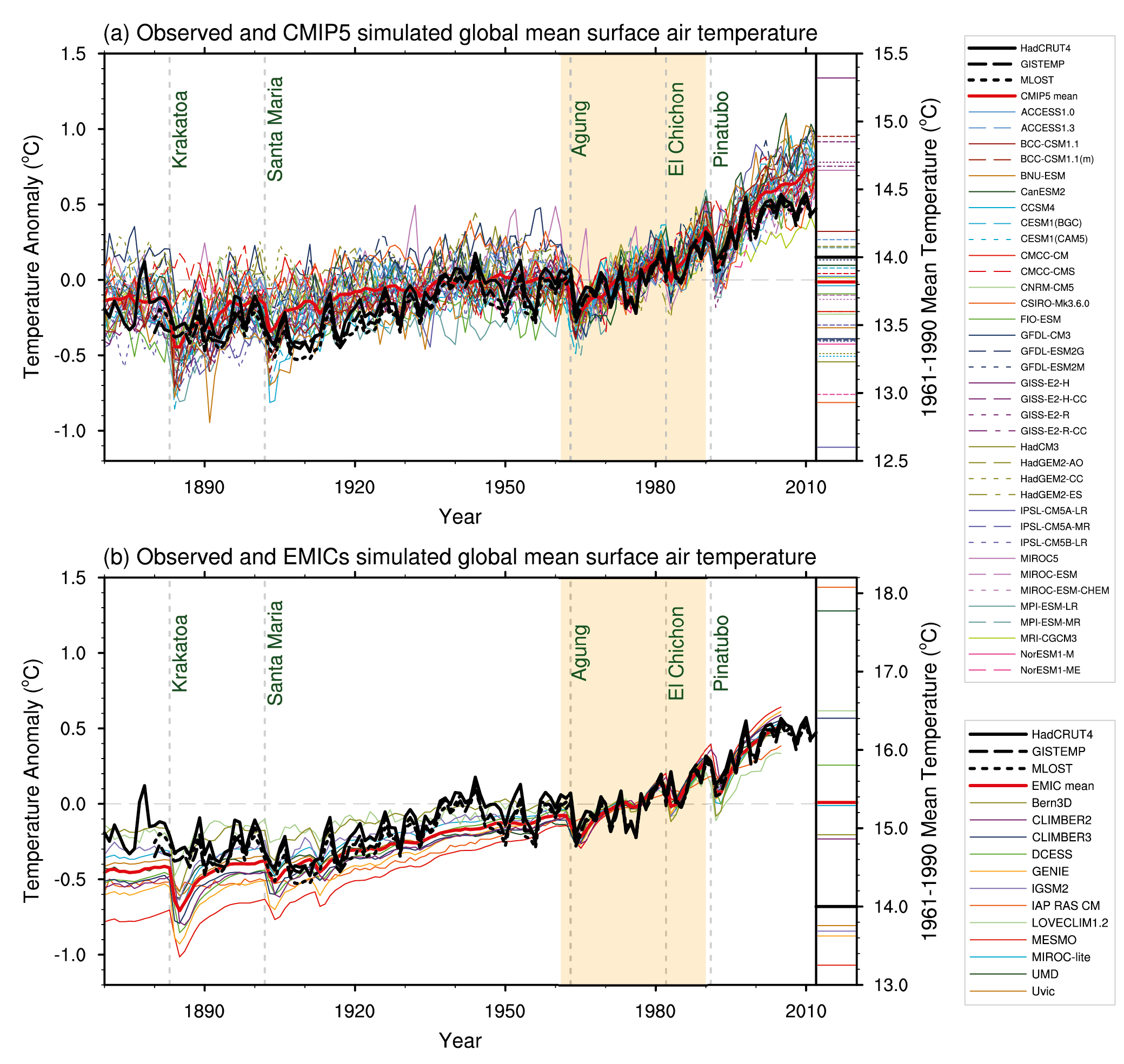
That’s a pretty big “if” in the last sentence. Schmidt explored the issue some years back, likely stimulated by a discussion he and I had had a month or two earlier. The results presented there are far from persuasive – indeed, on average the 2011-2070 trend of the CMIP5 models under RCP4.5 decreases about 20% for every degree C increase in 1951-1990 absolute GMST. Perhaps there has been further work on this subject?
20:34. he claims that the CMIP5 models were tuned to 20th Century trends, which is why without anthropogenic forcings they show no trend. This makes no sense at all. First, it is just untrue that all the models were tuned on the trends. And second, if there is no big trend in the natural forcings, you just aren’t going to get a big long term trend in the response. Nothing to do with tuning.
21:06 Another graphic borrowed from Bob Tisdale. This one makes the classic error of confusing the forced trend (as estimated from the mean of model ensemble) with the actual trend (which includes the actual forced trend and internal variability). For someone who claims to be interested in how internal variability is represented in models, that’s an odd lacuna.
It’s good to see acknowledgment that the models under-represent multidecadal variability. But it is stunning for Schmidt to say that it is “a classic error” to compare the forced ensemble-mean trend with the actual trend. Schmidt first tried to justify ignoring model absolute temperatures and paying attention only to model anomalies. And now he’s saying it’s an error to compare trends in those model anomalies to the observations. If that’s the case, what’s left if we want to compare simulations with the real world GMST?
26:00. His slide 25 is just BS from start to finish. Note there are no actual quotes from any specific case – everything is a strawman argument.
No doubt I’d be accused of cherry picking were I to cite specifics. However, I invite interested parties to reread the NCA4 or AR5 extremes sections with my refrain in mind to judge for themselves whether I’m spouting “BS from start to finish”.
28:05. He quotes me! This is not an actual error, but I find it funny that my views on how the media treats extremes (at least in 2013) are worthy of inclusion, but not, say, my views on climate modeling or attribution (you know, my job).
I’ve no problem acknowledging when Schmidt (or anyone else) is right. Note, however, I use a literal quotation, not an interpretive one, since the latter can create confusion, as some of Schmidt’s criticisms demonstrate.
31:00. Satellite records of sea level rise (since 1992) “are commensurate” with the tide gauge estimates (roughly 2mm/yr). Sure, but Koonin mysteriously neglects to mention they are 50% higher than the long term trend from those gauges. Also missing from his commentary on longer term records is that even the modern tide gauge-derived rate is more than twice the Holocene trends since 6000 BP (see for instance, Ashe et al., 2018).
My chart at 32:20 displays the tide gauge trends over the past century (from the NCA4 primary reference on this topic, although not shown in NCA4). It clearly shows recent decades (and the satellite record) rising faster than the long-term average trend, and I remark on that fact. With regard to the past 6000 years, I do cover the geological context a bit, but it’s only a 50 minute talk. And as I remark, what really matters for attribution is what’s happened over the past 150 years as human influences set it.
34:10 “If you get all your climate information from watching CNN or reading the New York Times or Washington Post [the data on hurricanes] is a surprising statement”. Apparently, these outlets report on hurricane trends so frequently and so erroneously that no reference to them actually doing so is needed. Ok then.
I’m not sure what’s the gripe here. Even a casual search of the media shows that statements like “there has been no detectable human influence on hurricanes” occur far less often, if at all, than does coverage indicting “climate change” for every hurricane misfortune.
50:02. “I would do more when the signal has come out of the noise, which it has not yet”. This is complete rubbish. The signals of temperature change, sea level, sea ice loss, intense precipitation, heat waves, phenology, permafrost loss, Greenland melt, ocean heat content etc. have all clearly ‘come out of the noise’. What is he really waiting for?
I do mention some of these other indicators of warming at 6:50. Per my discussion at 33:05, there’s only about a ½ σ indication that sea level has come out of the prior multidecadal variability. Further, the AR5 quotes at 26:50 do not inspire confidence in significant changes in the majority of weather extremes. And certainly let us not confuse detection with attribution.
Is there anything new here?
This is what I don’t really understand: There is absolutely nothing new here. Every argument, point, and even some graphics, are old, stale, and previously rebunked. These points could have been made (and undoubtedly were) in official reviews of assessment reports going back years. The people making these points have undoubtedly been told this and shown responses. In Koonin’s case, I know this for a fact (for instance). And yet, they persist. There is no development of the arguments, no counter-points, no constructive back and forth, just the same arguments that they appear to have thought up once and never examined.
Personally, I like taking on smart criticisms. They help hone the science, clarify the arguments and point to areas of needed research. But there isn’t a single thing here worth taking on.
This was a talk for non-experts meant to highlight the disconnect between the reports and the popular/political discussion of climate science. I made no claim to introduce any new science.
Schmidt’s comments correct some real nits (thanks for that!), and attempted to correct some others he imagined. But he’s not successfully challenged my larger points (for example, as expressed in the summary at 47:20). So I’m mystified as to what he thinks has been rebunked [sic]. Appropriate to the purpose of the talk, my discussions of modeling challenges and deficiencies, temperature extremes, sea level rise, hurricanes, economic impacts, and the challenge of effective mitigation were all based upon what’s in the reports themselves, the refereed literature, or widely acknowledged data (like LOTI). So I’m not surprised that he “sees absolutely nothing new here”. However, much of my audience was wide-eyed and, I hope, inspired to investigate further on their own.
The reports continue to paint a demonstrably deficient picture of the science. The scientific community needs to fix that, both to better inform the decision makers and also to bolster the integrity of the people and institutions that produce the reports. A red team exercise would go a long way toward that end.
Here is the talk being discussed.
The climate models have demonstrated no skill to forecast, let alone hindcast, and demonstrate a statistically significant bias to confirm global warming. There has been no climate change, but rather short-term and long-term weather variability within a normal range. Furthermore, there has been no statistically significant evidence of harmful outcomes caused by this natural variability on a sustained basis.
Gavin Schmidt and friends are on a dead path and he is really sure he is right, which explains why he is clueless/not interested in the new/old observations that disprove CAGW/AGW.
This recent observation that C14 is making to the deepest ocean with no delay is another observational fact that absolutely disproves the CAGW team created absurdly non-physical so-called Bern model of CO2 sinks and sources and resident times.
The Bern model assumed there is zero/nada organic sequestration of CO2 in the ocean by the sinking of organic particles. P.S. If there is a large unaccounted sink of CO2 in the ocean then there must also be a large unaccounted source of CO2 into the atmosphere besides CO2 from volcanic eruptions. A large unaccounted for source and sink of CO2 explains why atmospheric CO2 tracks planetary temperature not anthropogenic emissions.
There are now close to a dozen different independent observations that support the assertion humans caused less than 5% of the recent rise in atmospheric CO2.
The Bern model assumes that ocean circulation (with hundreds of years delay) is the only method for deep sequestration of CO2 in the ocean.
The alleged long lifetime of 500 years for carbon diffusing to the deep ocean is of no relevance to the debate on the fate of anthropogenic CO2 and the “Greenhouse Effect”, because POC (particular organic carbon; carbon pool of about 1000 giga-tonnes; some 130% of the atmospheric carbon pool) can sink to the bottom of the ocean in less than a year (Toggweiler, 1990).
https://www.livescience.com/65466-bomb-carbon-deepest-ocean-trenches.html
Bomb C14 Found in Ocean Deepest Trenches
‘Bomb Carbon’ from Cold War Nuclear Tests Found in the Ocean’s Deepest Trenches
Bottom feeders
Organic matter in the amphipods’ guts held carbon-14, but the carbon-14 levels in the amphipods’ bodies were much higher. Over time, a diet rich in carbon-14 likely flooded the amphipods’ tissues with bomb carbon, the scientists concluded.
Ocean circulation alone would take centuries to carry bomb carbon to the deep sea. But thanks to the ocean food chain, bomb carbon arrived at the seafloor far sooner than expected, lead study author Ning Wang, a geochemist at the Chinese Academy of Sciences in Guangzhou, said in a statement.
https://www.co2web.info/ESEF3VO2.pdf
At this point one should note that the ocean is composed of more than its 75 m thick top layer and its deep, and that it indeed contains organics.
The residence time of suspended POC (particular organic carbon; carbon pool of about 1000 giga-tonnes; some 130% of the atmospheric carbon pool) in the deep sea is only 5-10 years.
This alone would consume all possible man-made CO2 from the total fossil fuel reservoir (some 7200 giga-tonnes) if burned during the next 300 years, because this covers 6 to 15 turnovers of the upper-ocean pool of POC, based on radiocarbon (carbon-14) studies (Toggweiler, 1990; Druffel & Williams, 1990; see also Jaworowski et al., 1992 a).
The alleged long lifetime of 500 years for carbon diffusing to the deep ocean is of no relevance to the debate on the fate of anthropogenic CO2 and the “Greenhouse Effect”, because POC can sink to the bottom of the ocean in less than a year (Toggweiler, 1990).
Thank-you William Astley for those links. 🙂
Yes the continuous fall of detritus from the upper layers to the lower layer will always take carbon out of the upper system for many years (maybe hundred or thousands ?) The very slow end of the carbon cycle and it’s interaction with the solar cycle.
One can speculate forever about where CO2 enters and leaves the atmosphere. But at the end of the day, it’s just that: speculation. Observations necessary to nail down natural sources and sinks aren’t there. They probably never will be. But observations sufficient to falsify the IPCC’s most basic assumption, the central pillar of its thesis, are there. They are sufficient to show that human emissions are much too small to be the cause of increasing CO2 in the atmosphere. And if human emissions aren’t the cause of increasing CO2 in the atmosphere, they can’t possibly cause increasing CO2 in the oceans.
https://rclutz.wordpress.com/2019/06/15/upside-down-co2-dogma/
Carbon isotope analysis is your friend.
“That means ancient carbon, and fossil fuels are the only known source of ancient carbon in the amounts required to explain the data.”
http://www.jamespowell.org/Stuff/Ourfault/Ourfault.html
Isotope analysis is not my friend – because it’s not actual data. It’s analysis. My friend is real data – actual measurements of atmospheric behavior, free of “analysis”. Those measurements are sufficient to falsify the central assumption of the IPCC. Supra
You present no “actual data”. Your posts are pure unsubstantiated supposition.
Linking to Ron Clutz is just plain foolish. And as for Hermann Harde:
https://retractionwatch.com/2018/04/23/flawed-climate-science-paper-exposed-potential-weaknesses-in-peer-review-process/
Warmist gatekeepers have worked nonstop to silence Harde. Full story of his battle to be heard:
https://notrickszone.com/2018/08/27/agw-gatekeepers-censor-the-co2-climate-debate-by-refusing-to-publish-authors-response-to-criticism/comment-page-1/
There is a great story about the discovery of a massive, powerful, thing about the earth that changes everything.
The Geology department is sitting on a discovery of a thing about the earth. A thing is more important than a theory , as theory must be developed to explain things.
The thing is what moves the tectonic plates and is the reason why 70% of the planet is covered in water, why there is helium in natural gas, why there is uranium in heavy oil, and in coal, and fifty or so observations many of which have been known for decades however the pictures of the thousands of force tubes that go down to core of the planet is very recent, last couple of years.
The tubes in the mantel that run down to the core of the planet are ‘seen’ by computer analysis of seismic waves and their refection as the wave move through the mantel.
The ‘theory’ of tectonic plates took decades to reach acceptance as Geology was missing a force to move the massive plates.
Fast forward, 15 years. It was discovered that there is fracturing along the spreading ocean ridge that is caused by a liquid that is delivered from the core of the earth. There is no other possible physical thing to cause the fracturing observed.
This is not even a lack of imagination. The only imaginable reason rock would fracture for millions and millions of years pushing the tectonic plates around is there is some massive force that is pushing out a liquid from the core of the planet.
This observational ocean ridge fracturing evidence shows the toy diagram in Geological text books of ocean floor being pulled apart by mantel that moves for a magic reason is non-physical, completely incorrect. Oddly enough the text books do not change.
The fracturing energy to both fracture the plate in a specific region and move the plate is ten times greater than the highest possible force the dead mantel moves tectonic plate theory could generate.
The geology community has reached agreement, there is no evidence the mantel (mantel is the rock that the tectonic plates sit on, is of course a solid and solid does not move except when a force acts on them) mantel does not move except when moved by the moving tectonic plates.
Fast forward, 30 years.
The Geologists have ‘discovered’ thousands of tubes that go down to the center of the earth.
https://www.newgeology.us/presentation21.html
Plate Tectonics: too weak to build mountains
“In 2002 it could be said that: “Although the concept of plates moving on Earth’s surface is universally accepted, it is less clear which forces cause that motion. Understanding the mechanism of plate tectonics is one of the most important problems in the geosciences”8. A 2004 paper noted that “considerable debate remains about the driving forces of the tectonic plates and their relative contribution”40. “Alfred Wegener’s theory of continental drift died in 1926, primarily because no one could suggest an acceptable driving mechanism. In an ironical twist, continental drift (now generalized to plate tectonics) is almost universally accepted, but we still do not understand the driving mechanism in anything other than the most general terms”2.”
William Astley June 18, 2019 at 11:55 am
said
Looks to me like a typo in “particular”. Likely should be “particulate”. Maybe mods could fix. Not meant as a criticism.
CO2 never “accumulates” in the atmosphere.
Any biologist who understands the biogeochemical carbon cycle will say the same.
The entire field of radiocarbon dating is based on a 14-CO2 Tau of 20 years.
Former IPCC reviewer Segalstad is just one example.
https://wattsupwiththat.com/2013/07/01/the-bombtest-curve-and-its-implications-for-atmospheric-carbon-dioxide-residency-time/#comment-1352246
bwegher
+100
Exactly.
What’s up with the “Red Team” in the title?
It implies that you’re part of a certain tribe if you question AGW.
This is a science topic, not some tribal BS.
There is currently an active political debate around the creation of a Climate Red team by the US administration. By convention red teams always act as devil’s advocates to consensus blue teams in all fields.
It actually stems from the military, as a way of shoring up any holes in defensive tactics, and also bulking up offensive tactics. They would have a “red team” do the attacking, and a “blue team” defending. The analogy doesn’t really hold up with the climate debate unfortunately. In the military, they are all on the same side.
I stand corrected, but I think, (hope) I expressed the current cultural metaphor.
Steve skipped the Arctic bit, but I looked at the old paper clippings anyway. Here is what they say on RealClimate. It seems to make sense, or not ? Is the Nth pole really that bad
http://www.realclimate.org/index.php/archives/2014/04/faking-it
Some sites to check on the Arctic
http://nsidc.org/arcticseaicenews/
http://psc.apl.uw.edu/research/projects/arctic-sea-ice-volume-anomaly/
Arctic sea-ice extent and volume data are confined to the satellite era which also coincides with the AMO index positive phase:

Alekseev et al., 2015:
https://rmets.onlinelibrary.wiley.com/doi/abs/10.1002/joc.4550
Something longer term.

https://nsidc.org/cryosphere/sotc/sea_ice.html
Thanks. It’s looking pretty bad and getting steadily worse up there
Schmidt and Co. has gotta be scared shitless if someone like Koonin, who actually has the credentials and the executive branch WH privilege, comes in to examine what GISS has done to GISTEMP.
I have long believed that one reason the old school NASA Dr. James Hansen retired was he resisted further demands from OSTP John Holdren to keep making GISTEMP adjustments ad infinitum. So he retired and was replaced by someone who would do whatever the WH at the time for the AGW cause wanted.
Like Hansen before him, Gavin Schmidt’s biggest single daily concern is probably how to maintain funding, employment and status for all of the employees in the organization under him. And that is being done by aggressively trying to mainatain the catastrophic global-warming agenda. A one-trick pony.
I can understand him trying to do his best for all those people, but cannot take him at all seriously as a scientist. He is an administrator, and one that I am embarrassed to share an English accent with.
absolute non academic here.
If climate is a 30 year average is that how you see if what you call climate is changing by plotting 30 year averages, for say temperature, going back from today ?
In his talk the graph at 11:03 has a base line of +250 thus decapitating the data and deliberately exaggerating the rise in CO2. What kind of science hides the relationship with what the baseline is? The baseline should be zero with a y-axis scale of 1,000,000.
Context is everything.
Only pseudo-science charlatans would ever object to double scrutiny of their claims. Real scientists would welcome it. Always.
Considering Gavin Schmidt’s propensity for deleting any “smart criticisms” that are submitted to “Real Climate” I find his comment below to be absolutely amazing.
“Personally, I like taking on smart criticisms. They help hone the science, clarify the arguments and point to areas of needed research. But there isn’t a single thing here worth taking on.”
Great — acknowledge the good in taking on smart criticisms, and then disqualify anything you disagree with as “not worth taking on”.
Here, let me give this method a try:
Gavin’s words are gold, if you consider garbage as gold.