By Christopher Monckton of Brenchley
This will be a long posting, but it will not be found uninteresting.
Global warming on trial: Global warming goes on trial at 8.00 am this Wednesday, 21 March 2018, in Court 8 on the 19th floor of the Federal Building at 450 Golden Gate Avenue, San Francisco. Court 8 is the largest of the courtrooms in the Federal District Court of Northern California. They’re clearly expecting a crowd. The 8 am start, rather than the usual 10 am, is because the judge in the case is an early bird.
The judge: His Honor Judge William Haskell Alsup, who will preside over the coyly-titled “People of California” v. British Petroleum plc et al., is not to be underestimated. Judge Alsup, as the senior member of the Northern California Bench (he has been there for almost two decades), gets to pick the cases he likes the look of. He is no ordinary, custard-faced law graduate. Before he descended to the law (he wanted to help the civil rights movement), he earned a B.S. in engineering at Mississippi State University.

Don’t mess with me: His Honor Judge Alsup flourishing a tract by his mentor, the Supreme Court justice whom he once served as Clerk.
Six years ago, in an acrimonious hearing between Oracle and Google, the two Silicon-Valley giants were arguing about nine lines of computer code, which Oracle said Google had filched for its Android cellphone system. In preparation for the case, Oracle had tested 15 million lines of Android code, and had found that just nine lines – a subroutine known as rangeCheck – had been copied keystroke for keystroke. Oracle’s case was that these nine lines of code, though representing only 0.00006% of the Android software, were a crucial element in the system. Judge Alsup did not buy that argument.
Rumors gather about great men. In hushed tones, those who talk of Judge Alsup say he taught himself the Java programming language so that he could decide the rangeCheck case. In fact, he is not familiar with Java, but he does write computer code using qBasic, which used to be bundled free with MS-DOS. On the vast desk in his book-lined office sits a 2011-vintage Dell laptop, the only one he has that will still run qBasic. He has written programs for his ham-radio hobby, for the Mastermind board game, and for his wife’s bridge game.

The 18-year-old Bill Alsup at his ham radio console in Mississippi.
This, then, is that rarest of creatures, a tech-savvy judge. And he has taken the very rare but commendable step of ordering both parties to answer nine scientific questions about climate change in preparation for what he has called a “tutorial” on the subject next Wednesday.
Hearing of this case, and of Bill Alsup’s starring role, I wondered what line of argument might convince a scientifically literate judge that the plaintiffs, two Californian cities who want the world’s five biggest oil corporations to pay them to adapt to rising sea level, that there is no cause for alarm about manmade global warming.
Judge Alsup might well be moved to dismiss the plaintiffs’ case provided that the defendants were able to establish definitively that fears of global warming had been very greatly exaggerated.
Two propositions: If the following two propositions were demonstrated, His Honor might decide – and all but a few irredentists would be compelled to agree – that global warming was not a problem and that the scare was over.
1. It can be proven that an elementary error of physics is the sole cause of alarm about global warming – elementary because otherwise non-climatologists might not grasp it.
2. It can be proven that, owing to that elementary error, current official mid-range estimates of equilibrium sensitivity to anthropogenic activity are at least twice what they should be.
Regular readers will know that my contributions here have been infrequent in the past year. The reason is that I have had the honor to lead a team of eminent climatological researchers who have been quietly but very busily investigating how much global warming we may cause, known as the “equilibrium-sensitivity” question.
We can now prove both points itemized above, and we have gone to more than customary lengths to confirm by multiple empirical methods what we originally demonstrated by a theoretical method. The half-dozen methods all cohere in the same ballpark.
Three days before His Honor posted up his list of questions on climate science, my team had submitted a paper on our result to a leading climatological journal (by convention, I am bound not to say which until publication).
The judge’s question: When I saw His Honor’s eighth question, “What are the main sources of heat that account for the incremental rise in temperature on Earth?”, I contacted my eight co-authors, who all agreed to submit an amicus curiae or “friend-of-the-court” brief.
Our reply: Our amicus brief, lodged for us by a good friend of the ever-valuable Heartland Institute, concludes with a respectful recommendation that the court should reject the plaintiffs’ case and that it should also order the oil corporations to meet their own costs in the cause because their me-too public statements to the effect that global warming is a “problem” that requires to be addressed are based on the same elementary error as the plaintiffs’ case.
In effect, the oil corporations have invited legal actions such as this, wherefore they should pay the cost of their folly in accordance with the ancient legal principle volenti non fit injuria – if you stick your chin out and invite someone to hit it, don’t blub if someone hits it.
The judge has the right to accept or reject the brief, so we accompanied our brief with the usual short application requesting the court to accept it for filing. Since the rules of court require the brief to be lodged as an exhibit to the application, the brief stands part of the court papers in any event, has been sent to all parties, and is now publicly available on PACER, the Federal judiciary’s public-access database.
Therefore, I am at last free to reveal what we have discovered. There is indeed an elementary error of physics right at the heart of the models’ calculations of equilibrium sensitivity. After correcting that error, and on the generous assumption that official climatology has made no error other than that which we have exposed, global warming will not be 3.3 ± 1.2 K: it will be only 1.2 ± 0.15 K. We say we can prove it.
The proof: I shall now outline our proof. Let us begin with the abstract of the underlying paper. It is just 70 words long, for the error (though it has taken me a dozen years to run it to earth) really is stupendously elementary:
Abstract: In a dynamical system, even an unamplified input signal induces a response to any feedback. Hitherto, however, the large feedback response to emission temperature has been misattributed to warming from the naturally-occurring, non-condensing greenhouse gases. After correction, the theoretically-derived pre-industrial feedback fraction is demonstrated to cohere with the empirically-derived industrial-era value an order of magnitude below previous estimates, mandating reduction of projected Charney sensitivity from  to
to  .
.
Equations: To understand the argument that follows, we shall need three equations.
The zero-dimensional-model equation (1) says that equilibrium sensitivity or final warming ΔTeq is the ratio of reference sensitivity or initial warming ΔTref to (1 – f ), where f is the feedback fraction, i.e., the fraction of ΔTeq represented by the feedback response ΔT(ref) to ΔTref. The entire difference between reference and equilibrium sensitivity is accounted for by the feedback response ΔT(ref) (the bracketed subscript indicates a feedback response).
ΔTeq = ΔTref / (1 – f ). (1)
The zero-dimensional model is not explicitly used in general-circulation models. However, it is the simplest expression of the difference between reference sensitivity before accounting for feedback and equilibrium sensitivity after accounting for feedback. Eq. (1), a simplified form of the feedback-amplification equation that originated in electronic network analysis, is of general application when deriving the feedback responses in all dynamical systems upon which feedbacks bear. The models must necessarily reflect it.
Eq. (1) is used diagnostically not only to derive equilibrium sensitivity (i.e. final warming) from official inputs but also to derive the equilibrium sensitivity that the models would be expected to predict if the inputs (such as the feedback fraction f ) were varied. We conducted a careful calibration exercise to confirm that the official reference sensitivity and the official interval of the feedback fraction, when input to Eq. (1), indeed yield the official interval of equilibrium sensitivity.
The feedback-fraction equation (2): If the reference sensitivity ΔTref and the equilibrium sensitivity ΔTeq are specified, the feedback fraction f is found by rearranging (1) as (2):
f = 1 – ΔTref / ΔTeq. (2)
The reference-sensitivity equation (3): Reference sensitivity ΔTref is the product of a radiative forcing ΔQ0, in Watts per square meter, and the Planck reference-sensitivity parameter λ0, in Kelvin per Watt per square meter.
ΔTref = λ0 ΔQ0. (3)
The Planck parameter λ0 is currently estimated at about 0.3125, or 3.2–1 K W–1 m2 (Soden & Held 2006; Bony 2006, Appendix A; IPCC 2007, p. 631 fn.). The CO2 radiative forcing ΔQ0 is 3.5 W m–2 (Andrews 2012). Therefore, from Eq. (3), reference sensitivity ΔTref to doubled CO2 concentration is about 1.1 K.
The “natural greenhouse effect” is not 32 K: The difference of 32 K between natural temperature TN (= 287.6 K) in 1850 and emission temperature TE (= 255.4 K) without greenhouse gases or temperature feedbacks was hitherto imagined to comprise 8 K (25%) base warming ΔTB directly forced by the naturally-occurring, non-condensing greenhouse gases and a 24 K (75%) feedback response ΔT(B) to ΔTB, implying a pre-industrial feedback fraction f ≈ 24 / 32 = 0.75 (Lacis et al., 2010).
Similarly, the CMIP3/5 models’ mid-range reference sensitivity ΔTS (= 3.5 x 0.3125 = 1.1 K) and Charney sensitivity ΔT (= 3.3 K) (Charney sensitivity is equilibrium sensitivity to doubled CO2), imply a feedback fraction f = 1 – 1.1 / 3.3 = 0.67 (Eq. 2) in the industrial era.
The error: However, climatologists had made the grave error of not realizing that emission temperature TE (= 255 K) itself induces a substantial feedback. To correct that long-standing error, we illustratively assumed that the feedback fractions f in response to TE and to ΔTB were identical. Then we derived f simply by replacing the delta values ΔTref, ΔTeq in (2) with the underlying entire quantities Tref, Teq, setting Tref = TE + ΔTB, and Teq = TN (Eq. 4),
f = 1 –Tref / Teq = 1 – (TE + ΔTB) / TN
= 1 – (255.4 + 8) / 287.6 = 0.08. (4)
Contrast this true pre-industrial value f = 0.08 with the CMIP5 models’ current mid-range estimate f = 1 – 1.1 / 3.3 = 0.67 (Eq. 2), and with the f = 0.75 applied by Lacis et al. (2010) not only to the 32 K “entire natural greenhouse effect” but also to “current climate”.
Verification: We took no small trouble to verify by multiple empirical methods the result derived by the theoretical method in Eq. (4).
Test 1: IPCC’s best estimate (IPCC, 2013, fig. SPM.5) is that some 2.29 W m–2 of net anthropogenic forcing arose in the industrial era to 2011. The product of that value and the Planck parameter is the 0.72 K reference warming (Eq. 3).
However, 0.76 K warming was observed (taken as the linear trend on the HadCRUT4 monthly global mean surface temperature anomalies, 1850-2011).
Therefore, the industrial-era feedback fraction f is equal to 1 – 0.72 / 0.76. or 0.05 (Eq. 2). That is close to the pre-industrial value f = 0.08: but it is an order of magnitude (i.e., approximately tenfold) below the models’ 0.67 or Lacis’ 0.75.
There is little change that some feedbacks had not fully acted. The feedbacks listed in IPCC (2013, p. 818, table 9.5) as being relevant to the derivation of equilibrium sensitivity are described by IPCC (2013, p. 128, Fig. 1.2) as having the following durations: Water vapor and lapse-rate feedback hours; Cloud feedback days; Surface albedo feedback years.
The new headline Charney sensitivity: Thus, Charney sensitivity is not 1.1 / (1 – 0.67) = 3.3 K (Eq. 1), the CMIP5 models’ imagined mid-range estimate (Andrews 2012). Instead, whether f = 0.05 or 0.08, Charney sensitivity ΔTeq = 1.1 / (1 – f ) is 1.2 K (Eq. 1). That new headline value is far too small to worry about.
Test 2: We sourced mainstream estimates of net anthropogenic forcing over ten different periods in the industrial era, converting each to reference sensitivity using Eq. (3) and then finding the feedback fraction f for each period using Eq. (2).
The mean of the ten values of f was 0.12, somewhat higher than the value 0.05 based on IPCC’s mid-range estimate of 2.29 W m–2 net anthropogenic forcing in the industrial era. The difference was driven by three high-end outliers in our table of ten results. Be that as it may, Charney sensitivity for f = 0.12 is only 1.25 K.
Test 3: We checked how much global warming had occurred since 1950, when IPCC says our influence on climate became detectable. The CMIP5 mid-range prediction of Charney sensitivity, at 3.3 K, is about equal to the original mid-range prediction of 21st-century global warming derivable from IPCC (1990, p. xiv), where 1.8 K warming compared with the pre-industrial era [equivalent to 1.35 K warming compared with 1990] is predicted for the 40-year period 1991-2030, giving a centennial warming rate of 1.35 / (40 / 100) = 3.3 K.
This coincidence of values allowed us to compare the 1.2 K Charney sensitivity derived from f on [0.05, 0.12] in Eq. (4) with the least-squares linear-regression trend on the HadCRUT4 monthly global mean surface temperature anomalies over the 68 years 1950-2017. Sure enough, the centennial-equivalent warming was 1.2 K/century:

The centennial-equivalent warming rate from 1950-2017 was 1.2 K/century
Test 4: We verified that the centennial-equivalent warming rate in the first 17 years (one-sixth) of the 21st century was not significantly greater than the rate since 1950. We averaged the monthly global mean surface and lower-troposphere temperature anomalies from the HadCRUT4 terrestrial and UAH satellite datasets and derived the least-squares linear-regression trend (the bright blue line on the graph below).
The satellite data were included because they cover a five-mile-high slab of the atmosphere immediately above the surface, and have a coverage greater than the terrestrial measurements. The trend was found to be  , equivalent to
  /century:

Test 5: To confirm that we had understood feedback theory correctly, one of my distinguished co-authors, a hands-on electronics engineer, heard of our result and built a test rig in which we were able to specify the input signal (i.e., emission temperature TE) as a voltage, and also the direct-gain factor μ to allow for direct natural or anthropogenic forcings, and the feedback fraction β (we were using the more precise form of Eq. 1 that is usual in electronic network analysis). Then it was a simple matter directly to measure the output signal (i.e. equilibrium sensitivity ΔTeq).
The most crucial of the many experiments we ran on this rig was to set μ to unity, implying no greenhouse forcing at all. We set the feedback fraction β to a non-zero value and then verified that the output signal exceeded the input signal by the expected margin. Not at all to our surprise, it did. This experiment proved that emission temperature, on its own, induced a feedback response that climatology had hitherto overlooked.
This is where the elementary error made by climatologists for half a century has had its devastating effect. Look again at Eq. (1). The input signal is altogether absent. Although it is acceptable to use Eq. (1) to derive equilibrium sensitivities from reference sensitivities, the mistake made by the modelers was to assume, as Lacis et al. (2010) and many others had assumed, that the entire difference of 32 K between the natural temperature TN in 1850 and the emission temperature TE was accounted for by the natural greenhouse effect, comprising a direct greenhouse warming ΔTB = 8 K and a very large feedback reponse ΔT(B) = 24 K to ΔTB.
However, in truth – this is the crucial point – the emission temperature TE (= 255 K), even in the absence of any greenhouse gases, induces a large feedback response ΔTE. This feedback response to the input signal is entirely uncontroversial in electronic network analysis and in control theory generally, but we have not been able to find any acknowledgement in climatology that it exists.
Just as Lacis (2010) did, the modelers assumed that the industrial-era feedback fraction must be every bit as large as the pre-industrial feedback fraction that they had erroneously inflated by adding the large feedback response induced by emission temperature to the small feedback response induced by the presence of the naturally-occurring greenhouse gases.
It was that assumption that led the modelers to assume that there must be some very strongly positive feedbacks, chief among which was the water-vapor feedback. However, although the Clausius-Clapeyron relation indicates that the space occupied by the atmosphere can carry near-exponentially more water vapor as it warms, there is nothing to say that it must.
Suppose there were a water-vapor feedback anything like as large as that which the models have assumed (and they have assumed a very large feedback only because they are trying to explain the large but fictitious feedback fraction consequent upon their erroneous assumption that emission temperature of 255 K somehow induces no feedback response at all, while the next 8 K of warming magically induces a 24 K feedback response). In that event, atmospheric dynamics requires that there must be a tropical mid-troposphere “hot spot” [I had the honor to name it], where the warming rate should be twice or thrice that at the tropical surface. However, the “hot spot” is not observed in reality (see below), except in one suspect dataset that Dr Fred Singer scrutinized some years ago and determined to be defective.


Models predict the tropical mid-troposphere “hot spot” (top, IPCC 2007, citing Santer 2003; above left, Lee et al. 2008; above right, Karl et al., 2006).
However, the “hot spot” is not observed in reality (see below). Our result shows why not. The “hot spot” is an artefact of the modelers’ error in misallocating the substantial feedback response induced by emission temperature by adding it to the very small feedback response induced by the naturally-occurring greenhouse gases.

The model-predicted “hot spot” is not observed in reality (Karl et al. 2006).
Test 6: Even after we had built and operated our own test rig – as far as we know, this is the first time anyone has tried to test climatological feedback theory empirically rather than simply modeling it – we were not satisfied that anything other than tests performed under rigorous conditions at a government laboratory would be found widely acceptable.
Accordingly, based on the results of our in-house test rig, we drew up a more sophisticated specification for a new rig, together with four test groups comprising 23 sets of three quantities – the input signal, the direct-gain factor and the feedback fraction. Armed with the specification, I commissioned a government laboratory to carry out the experiments.
However, a problem at once arose – indeed, it was a problem with which our own engineer had wrestled. So very small were the feedback responses predicted by long-established control theory that even the presence of the operator in the same room as the test rig tended to bias the results.
Accordingly, I worked for months with a patient and amiable scientist at the government laboratory. Eventually, by somewhat altering the initial-state values specified for the 23 tests, I was able to give the scientist values that would yield results to the required precision but without loss of experimental integrity.
In due course the laboratory reported, and the results of all 23 tests – to within one-tenth of a Kelvin – were exactly as we had been able to predict theoretically. Again, the most important results were for the group of tests in which the direct-gain factor was set to unity, so that we could reassure ourselves that control theory was correct in predicting that, in the presence of a non-zero feedback fraction, even an unamplified input signal would induce a feedback response that would either amplify or attenuate it.
Another snag arose. When I had originally approached the laboratory, I had not mentioned that the research had anything to do with climate change, because all I wanted to do was to establish that we had understood the relevant control theory correctly.
When the laboratory reported, I sent it a copy of our draft paper, in which the lab results were mentioned. The laboratory panicked and said we were not allowed to use its report.
However, I had written into the contract a term to the effect that we intended to include the laboratory’s results, and a discussion of them, in an academic paper. A compromise was reached, by which we are free to include the laboratory’s results in our paper, as long as we do not mention either the name of the laboratory or the name of the scientist there who built and ran the high-specification rig for us.
The laboratory also kindly confirmed that we had represented its results fairly in our paper and had drawn justifiable conclusions from them. Furthermore, much to our pleasure, it promoted the scientist who had assisted us. He wrote us a charming letter to say that he had not allowed, and would not allow, politics to intrude into the work he had carried out for us.
With these results from a national laboratory (we cannot even mention which country it was in) we were at last content that we had established our conclusion with sufficient rigor.
The true picture: How should the 32 K difference between emission temperature and natural temperature be apportioned? Approximately 23.4 K of the 32 K is the feedback response to emission temperature; 8 K is the directly-forced warming from the presence of the natural greenhouse gases; and just 0.7 K is feedback response to that 8 K warming (panel b):

(a) Erroneous apportionment of the 32 K difference between natural temperature in 1850 and emission temperature in the absence of any greenhouse gases, given in Lacis et al. (2010).
(b) Corrected apportionment of the 32 K, allowing for the feedback response (blue) to emission temperature; the directly-forced warming from the naturally-occurring, non-condensing greenhouse gases (yellow); and the feedback response to that greenhouse warming (red).
Looking at it the other way about, if the feedback fraction were really as large as the 0.75 imagined by Lacis et al. (2010), then the Earth’s emission temperature of 255.4 K would induce a feedback response of 766.2 K, and the 8 K greenhouse warming would induce a feedback response of 24 K, so that the pre-industrial or natural temperature in 1850 would be 255.4 + 766.2 + 8 + 24 ≈ 1054 K, about three and a half times the true value of 287.6 K.
We also considered whether non-linearities in individual feedbacks might vitiate our result. However, to obtain even the 1.5 K minimum Charney sensitivity predicted by IPCC one would need to multiply at least fivefold the empirically-derived industrial-era feefdback fraction f = 0.05.
The reason why even a very large nonlinearity in the feedback sum and consequently in the feedback fraction makes little difference to equilibrium sensitivities is that the curve of equilibrium sensitivities in the presence of various feedback factors is a rectangular hyperbola (see below). Our result shows that the sensitivity calculation is not done, as now, rather close to the singularity at f = 1 (note in passing that for f > 1 Eq. (1) predicts cooling); instead, it is done at the left-hand end of the curve, where the sensitivity increases very slowly with f:

The rectangular-hyperbolic curve of Charney sensitivities in response to feedback fractions f, showing current predictions compared with the corrected result.
The outcome of the case: What will His Honor make of all this? My guess is that he will allow our amicus brief to be filed. With his engineering background, he will have no difficulty in understanding why we say that the notion of catastrophic rather than moderate global warming is rooted in the elementary physical error we have discovered.
Therefore, we hope His Honor will ask all parties to provide formal responses to our brief. On any view, it plainly raises a serious question about whether global warming matters at all – a question that strikes right to the heart not only of the case before him but of numerous other such cases now arising in several jurisdictions – and showing some evidence of careful co-ordination.
The parties will not be able to dismiss our result lightly. To refute it, they would have to show that our pre-industrial feedback fraction f = 0.08, obtained by theoretical means rooted in mainstream control theory, is incorrect; that our industrial-era value f = 0.05, obtained empirically from IPCC’s estimate of the net anthropogenic forcing to date and from the HadCRUT4 temperature record, is also incorrect; that our campaign of ten empirical calculations giving a mean feedback fraction f = 0.12, is incorrect; that the rate of observed warming over the past 68 years is either incorrect or irrelevant; that the rate of observed warming this century to date is also either incorrect or irrelevant; that the results from our test rig are inapplicable; that the results from a government laboratory are likewise inapplicable; and, above all, that it is justifiable to assume that control theory is wrong and that, per impossibile. 255.4 K of emission temperature generates no feedback at all, while the next 8 K of warming suddenly causes 24 K of feedback, as if by magic.
We do not believe in magic.
Conclusion: The anthropogenic global warming we can now expect will be small, slow, harmless, and even net-beneficial. It is only going to be about 1.2 K this century, or 1.2 K per CO2 doubling. If the parties are not able to demonstrate that we are wrong, and if His Honor accepts that we have proven the result set out publicly and in detail here for the first time, then the global warming scare was indeed based on a strikingly elementary error of physics.
The avowedly alarmist position too hastily adopted by governments and international bureaucratic entities has caused the most egregious misallocation of resources in history.
Ladies and gentlemen, we call time on a 50-year-old scam, in which a small number of corrupt and politicized scientists, paid for by scientifically-illiterate governments panicked by questionable lobby-groups funded by dubious billionaires and foreign governments intent on doing down the West, and egged on by the inept and increasingly totalitarian news media, have conspired to perpetrate a single falsehood: that the science was settled.
Well, it wasn’t.
Discover more from Watts Up With That?
Subscribe to get the latest posts sent to your email.
There is little change that some feedback
=======
typo? change/chance?
For “change” read “chance”. My apologies.
I still say that the easiest way to check the IPCC ‘feedback’ hypothesis is to examine the climates transient response to any major event whose driving force can be estimated reasonably accurately.
Pinatubo would be ideal. The albedo increase should be multiplied by the same feedback that the IPCC models allege.
If that results in a snowball earth that never happened, then case proved.
We have all the data to examine the earth’s response to a non CO2 driver right there.
Remembering that the feedback hypothesis applies to ALL drivers that modulate temperature, not just CO2…
The amount of stuff lifted into the atmosphere by Pinatubo is just an estimate.
The distribution of particle sizes and compositions is also a guess.
The impact of dust on aerosols on clouds and cloud formations is still being studied and argued over.
This isn’t the simple experiment that you think it is.
Leo, good points. It seems after a significant volcanic event the temperature depresses and when the air is clear again, the temperature recovers, overshoots a bit and then falls back to trend. Possibly a short term rapid heating or cooling event gives an over-surge of feedback a la Hookes Law.
In response to Mr Smith, there are various ways of attempting to derive the correct feedback fraction. However, our method has the merit of great simplicity and it depends not upon contentious volcanic outputs but upon premises that are all, or very nearly all, agreed by the “mainstream” scientists whom we are attempting to persuade that the game is up.
There is also considerable merit in exposing a sufficiently serious error in the official calculations. In the end, if we are right that the error is an error and is as large as we say, official climatology will not be able to adhere to anything like its current estimates of equilibrium sensitivity without committing fraud.
You have in previous posts said that the rate of warming had slowed down doesnt this simple statement contradict your statement in this post that co2 causes warming so get over it. And doesnt this post disregard the prevarication of bert bolin maurice strong who hijacked the presumption that Co2 caused global for purely ideological reasons to enforce what Christiana Figueres said was a new economic structure for the planet? And how does this post co relate to historical proxy data that indicates temperature has been higher with co2 lower and vice versa. It seems to me that more or less you are validating what `scientists say’ want us to believe that Co2 does cause warming just not so much?
I picked up on that as well David
In response to Mr Wells, the fact that the rate of warming had slowed down until the recent el Nino does not in any way vitiate our result, which concerns itself with what the feedback fraction should be.
If our result is correct, the plans by the likes of Edenhofer and Figueres to enforce the end of capitalism will be thwarted.
One can appreciate the interest in a model of climate, since that is the basis for the hysteria over Global Warming/Climate Change. But is it a mistake to presume that the prediction, whether it be 1.5K or 4 K, has any relation to reality. I find Pat Frank’s critique more compelling in that it shows the demonstrable error in the annual prediction of water vapor/cloud cover grows to such a point that nothing can be discerned in the noise after even a decade, let alone a century. But again, it does not address the fundamental error, which is the presumption that CO2 is the driving force. The absorption and scattering of radiation in our atmosphere is dominated by H20. And the variability of H2O is enormous, and cannot be modeled. CO2 affects only a small fraction of the spectrum, and it has already pretty much maxed out in the absorption of radiation in its niche. Further, the environment uses CO2 to sustain life, and these processes serve as dynamic sinks that consume and store the substance. Water, on the other hand, is what characterizes the earth, and it is available to atmosphere in vast quantity, given only a little heat from the morning sun.
Good comment.
Mr Stewart thinks it is a mistake to presume that any prediction, whether it be climatology’s 4 K global warming per doubling of CO2 or our 1.2 K, has any relation to reality. He may care to read the head posting. What we say is that, on the generous assumption that official climatology has made no error but that which we have identified, exposed and quantified, there will be about 1.2 K global warming per century, or per doubling of CO2. Since 1950, warming has been occurring at 1.2 K per century equivalent (HadCRUT4); since 1979 warming has been occurring at 1.3 K/century (UAH) and since 2001 warming has been occurring at 1.3 K/century (mean of HadCRUT4 and UAH). Our estimate of Charney sensitivity thus seems consistent with observation, while the official mid-range estimate is manifestly inconsistent with observation.
And we submit that we have proven that an error exists. If we are right, then that is the end of the global warming scare.
Yeah, but Christopher, 1.2C is still a modest warming. And again, you’re using the 1.1C as your baseline starting point. That assumes the 3.6 W/m^2 is equal to Pi (post albedo solar power in) in intrinsic surface warming ability.
In response to RW, 1.2 K per CO2 doubling is indeed a modest warming, and indeed we start with the CMIP5 models’ estimate that the reference sensitivity is 1.1 K before accounting for feedback. But we accept such values ad argumentum. We do not warrant that they are correct. We say that, if official climatology has made no other error but that which we have identified, Charney sensitivity is 1.2 K or thereby.
Christopher you have to have a doubling equation. Doubling from 1ppm to 2ppm isnt the same as from 280 to 560. Also notice that it will take a lot longer than a century to double the CO2 on present rates of addition to atmosphere. Even doubling from the 330 level in 1950 will take another 58 years.
Mr Tomalty says doubling CO2 from 1 to 2 ppmv is not the same as 380 to 560 ppmv. In fact, the interval over which the approximately logarithmic CO2 forcing obtains is [100, 950] ppmv. Therefore, without error we may safely assume the logarithmic forcing is correct, for little error will arise.
Bob, the biological sink for CO2 is also an endothermic process so it is a heat sink too. The 15+% expansion of planetary forest cover coincided mainly with the Pause – hmm … maybe at least a small contributor?
Bob Stewart wrote
“and it has already pretty much maxed out in the absorption of radiation in its niche.”
I have seen this quote many times by dozens of people and not one explained exactly why this is so.
Also the alarmists need a large forcing by CO2 of water vapour for their theory to work. For that to be true H2O levels have to increase over time. James Hansen then director of the Goddard Institute in 2009 shut down the section that measures water vapour after they couldnt prove any increases after measuring it for 20 years. To this day any further measurements of the global atmospheric H2O content are unavailable.
Christy’s 29 March 2017 congressional testimony proved that the CMIP5 models run hot. The missing modeled tropical troposphere hotspot is but one disagnostic. The reason was simply explained in guest post here last summer Why Models Run Hot. A more mathematically grounded explanation was given in earlier, longer guest post here The Trouble with Models. So modeled ECS 3.3 must be rejected.
The question becomes, what is the ‘true’ ECS. The energy budget approach produces ~1.65 using iPCC AR5 WG1 values (e.g. Lewis and Curry 2014). Or ~1.5 using Steven’s updated aerosol forcing estimates (Lewis 2015). Both results are posted at Judith Curry’s Climate Etc.
A separate set of observational considerations previously commented on here (in discussion the irreducable equatiin Monkton posts) suggests the AR5 net f (here 0.67, my previous comments used 0.65–close enough given uncertainties) is high by at least half. First, Desslers 2010 paper actually showed net cloud feedback is ~0, not the inferable 0.17 (or 0.15 in my previous comments). Second the water vapor feedback must be less than half of the 0.5 remainder (0.67 – 0.17). There are two lines of reasoning: (a) modelled precipitation is about half observed, so rainout leaves less water vapor than modeled, (b) the observationally missing modeled tropical troposphere hotspot is a water vapor feedback issue. So this leaved an inferrable f of something less than 0.25, therefore an ECS something less than 1.6.
This post offers a third way to approach the estimate using a combination of theory and observation. More top down than bottom up. Whether the ‘true estimate is 1.65, 1.6, 1.5, or 1.2 as here the result is the same—cancel the alarm. Game over.
There are, re this lawsuit, two further difficulties for the warmunist California cities. 1. Their bond offerings identity no risks such as they are suing big oil for. 2. There are no present damages to monetize, and since sea level rise is not accelerating since before 1950 (natural) there can be no future AGW SLR damages either.
This lawsuit and the mandated ‘tutorial’ will backfire on the warmunists.
The ever-thoughtful Mr Istvan is quite right that our approach to the derivation of the feedback fraction is top-down and theoretical rather than bottom-up. There is a good reason for this. For a start, in the climate, no individual feedback can be directly quantified by any measurement, or distinguished by any measurement from any other feedback, or even from the forcing that induced the feedback response. What is more, not only is any empirical derivation of individual feedbacks impossible, but there is no theoretical method of deriving a respectable estimate of any individual feedback. Various attempts have been made, but without convincing both sides of the argument.
We submit that our approach, which demonstrates that both theoretical and empirical methods of deriving the overall feedback fraction (which is the product of the feedback sum and the Planck sensitivity parameter) are available, and that the results of these methods cohere.
You clearly are fully aware of the great value your appraoch and undisputable (except on the edges of data details as you admit) has. Very well done. Highest Kudos.
I don’t believe there is such a thing as a “true” ECS.
That is your problem, not mine, Do read up more on CAGW theory.in my primer was provided as last long probative chapter in 2012 ebook The Arts of Truth. I would rewrite more negatively in light od Blowing Smoke, and aubsequent posts.
ristvan:
Do you have a counter argument? If so, what is it?
TO, yes. The long version is explained in detail with illustrations in essay Sensitive Sensitivity in ebook Blowing Smoke. Here is a short over simplified version. Adding GHG (e.g CO2) to the armosphere causes a radiative imbalance (more SW in than LW out). This property was first measured in the lab by Tyndall in 1859 IIRC. That radiative imballance will cause Earths surface to warm until radiative balance is restored by the resulting increased LW IR radiation from higher T. This new higher temperature balance is called the ECS, equilibrium climate sensativity, by definitional convention to a doubling of atmospheric CO2. It must be some number expressed as some delta T, and it must be positive else Earths surface woild be 255K rather than observed 283K (see some elses longer comment upthread for logic details). What it is above the ‘lab measured’, computable from first principles (see an early 2010 Climate Etc Curry post, or from fundamental observed parameters as in this post depends on net feedbacks. The ECS value without feedbacks is always between 1.1 (this post) and 1.2, (Lindzen). My own calculations of no feedback ECS produces a value of 1.16. Posted tye calcs in a comment here long ago to a different Monckton post. So ECS must physically exist. It must be some value greater than 1.1. The fight is over how much greater. We know the IPCC 3.3 from climate models is wrong. See my long comment upthread for why.
But to think some positive ECS >1.1 does not exist indicates a very weak grasp of the basic physics. Please do not tar knowledgable skeptics withnsuch a ‘dummy’ brush.
ristvan (March 20 at 2:31 PM)
Thanks for taking the time to respond. My understanding is based upon the definition
of ECS. It is the ratio of the change in the global surface air temperature at equilibrium
to the change in the logarithm of the atmospheric CO2 concentration. The equilibrium temperature (called
the “steady state temperature” in the engineering literature) is not observable. Thus, if by the
“true” value of ECS one means the “observable value,” there isn’t one.
ECS is a theoretical concept dreamt up by alarmists to show that CO2 causes warming. What somebody needs to do is to pump in CO2 at 400ppm into one container that is at the same temperature as the average troposphere at 5 Km high and then pump in H2O vapour in another container each with a black body and have the temperature measurements to see which gas absorbs and then reflects the heat to the black body. and then have a 3rd container with a mixture of the 2 gases with the same measuring tools. I believe that this experiment has never been done.
I forgot to add that there should be a 4th container where you pump in double the CO2 along with H2O vapour.
Alan Tomalty:
The seeds of the ECS concept seem to have been planted by Arrhenius with his “radiative forcing” concept. Radiative forcing is a Platonic rather than a scientific way of organizing a study that has the shortcoming of generating models whose claims are not falsifiable. In IPCC AR4, report of Working Group I, the IPCC admits they are not falsifiable but claims that in the modern era falsifiability has been supplanted by peer review. Actually, falsifiability is the so-called “line of demarcation” between settling an issue by observation and by the unsubstantiated claim of an authority. There was a conflict between the Vatican and Galileo because the Galileo favored observation and the Vatican favored authority. The Roman law of heresy sided with the Vatican.
Terry Oldberg March 21, 2018 at 9:02 am
We keep hearing about the alleged radiative imbalances inducing an alleged temperature change. Back to Nahle’s experiment: if you believe in this alleged mechanism, then repeat the experiment to prove that this warming caused by back radiation exists.
I know what the theory says. We all know what the theory says. We all know what the calculations say. What we don’t know is if any of this has been demonstrated experimentally. Nahle seems to have done a simple and elegant experiment– after Wood and Pratt– to test it. Tyndall did NOT prove the alleged mechanism of absorption/emission leading to temperature change. No one has!
Just because a paradigm is self-consistent and assumed to be true by everyone doesn’t mean it’s true. We need an experiment, please. Basic science, or asking for the impossible?
Here is Nahle’s experiment: http://www.biocab.org/Experiment_on_Greenhouses__Effect.pdf
Don132 (March 21 at 9:28 am):
Thanks for the citation.
The lesson to be learned from Woods’ experiment is that it is possible for convective heat transfer to
counterbalance radiative heat transfer such that the temperature at Earth’s surface does not rise. That
this is the case is predicted thermodynamically. I’m not aware of any modern day global warming
climatologist who takes issue with this conclusion.
On the other hand, there are few if any modern day global warming climatologists who do not incorporate
the idea of “radiative forcing” into the advice that they offer to politicians on climate change. The role of
radiative forcing is not to deny the results of Woods’ experiment but rather is to express a theory
of the climate system that is Platonic rather than being scientific. Like a modern day climatologist, Plato felt
that abstract objects were real and concrete objects were imperfect copies of them.
Now, to return to the issue of whether ECS has a numerical value that is “true,” there are solid grounds for stating that ECS is a property of an abstract Earth. For a scientist an abstract object is not real. For a Platonist, on the other hand, an abstract object is real. With nearly perfect consistency, journalists and left-leaning politicians confuse Platonists with scientists. Right-leaning politicans make the same mistake but argue that the left-leaning politicians exaggerate the magnitude of ECS. In the lawsuit between the oil companies and the cities that are suing them for damages, both sides seem prepared to confuse Platonism with science. Scientifically, the cities have no case but this not because combustion of oil has no effect on Earth’s surface air temperature. It is only because the research on climate change has thus far been conducted by Platonists rather than scientists.
Wow! I love the empirical test rig. I will stay tuned.
It seems churlish to point out the use of ‘small change’ where I think you mean ‘small chance’.
Lastly, do you think this error you have found has been masked by the assumption of steady state and ignoring of day/night temp variations in all theoretical considerations of greenhouse behaviour?
In response to Mr Dixon, again, apologies for “change” where the context requires “chance”.
We think that the reason for the error we have discovered is the importation by climate science of equations from control theory without having understood them sufficiently.
As the term “empirical test rig” could be misleading it would be better to call the rig an “analog computer.” Rather than test Lord Monckton’s theory, this computer computes the response of Monckton’s theory to its inputs.
Bode’s LINEAR feedback analysis for quantifying POWERED (active) gain does not apply to the climate system. Feedback analysis requires a strictly linear system in order to be useful. When an audio amplifier starts to clip and goes non linear, Bode’s analysis no longer works. Climate feedback specified as W/m^2 in and degrees K out is not even approximately linear over the relevant ranges of temperature found on the planet. The second missing precondition for applying Bode’s feedback equations is the implicit power supply that can not also be the forcing input. The significant difference is that an active amplifier measures the input forcing and feedback to determine how much output to deliver from an implicit source, while the climate system consumes the forcing and feedback to comprise its output. The COE constraint this imposes is not taken into consideration in any AR.
I wanted to say the same, but you did it better.
co2 –
Whereas I understand the basics of what you’re saying, not being an electrical engineer makes it difficult to fully digest your point…
Thus, are you taking issue with the IPCC’s approach or Monckton’s? Or both?
rip
ripshin,
I’m objecting to the general approach of applying Bode’s feedback analysis to quantify the climate, especially given the massive amount of feedback claimed by the IPCC.
Christopher is correct that the consensus analysis has been horribly botched and while his analysis shows this, even in the context of an improper application, my point is that there’s a more fundamental reason for why the ‘consensus’ is so wrong.
Joules are joules and each Joule from the 240 W/m^2 of NET energy arriving from the Sun does the same amount of work to increase the surface temperature, that is, Joules are interchangeable. That being said, each W/m^2 of the 240 W/m^2 arriving from the Sun results in a NET if 1.6 W/m^2 emitted by the Surface, or about 600 mw of ‘feedback’ per W/m^2 of input where the ‘feedback’ is prior surface emissions that were delayed and bounced back to the surface after being absorbed by the atmosphere.
The confusion arises because the IPCC considers the absolute gain to be far smaller than the incremental gain in violation of the precondition for applying Bodes’s analysis and dramatically inflates the incremental gain from 1.6 W/m^2 per W/m^s of forcing input measured for the average all the way up to 4.3 W/m^2 per W/m^2 of forcing input for the nominal sensitivity claimed by the IPCC. The linearity restriction requires the incremental and absolute gains to be the same.
BTW, the climate is very linear in the energy domain, as COE requires, which means that the next W/m^2 of forcing will only contribute another 600 mw/m^2 of ‘feedback’ which is consistent with the 0.2-0.3 C per W/m^2 sensitivity generally considered as the sensitivity by Lindzen and others.
In response to “co2isnotevil”, the head posting went to some lengths to point out, first, that the linear Bode feedback equation, even in the simplified form used in climatology, precisely reproduces the official interval of Charney sensitivities if the official inputs are deployed therein; and secondly, that even quite strong nonlinearities don’t matter where the feedback fraction is sufficiently small, because the response curve of equilibrium sensitivities in the presence of various values of the feedback fraction is a rectangular hyperbola, and our result shows that the calculation should be performed not, as now, at the right-hand end of the curve close to the singularity at a feedback fraction of unity but at the left-hand end, at a feedback fraction an order of magnitude smaller, where even quite large variations in the value of the feedback fraction have very little impact on equilibrium sensitivity.
Therefore, pleading that the Bode equation is linear is not only insufficient to overthrow our result but also incorrect, for even where the inputs to the equation are all linear the output signal is not.
This from an old engineer. Feedback was generally used to overcome nonlinearities of components like like paper capacitors, carbon resistors, and even active components in order to achieve stable gain over a large portion of the operating range. If nonlinearities would upset the circuit, back to the drawing board. So the fact that those in our climate don’t change things much doesn’t’ bother me at all. They shouldn’t bother anyone who has dealt this before.
Christopher,
I agree that your analysis show how wrong they are when conforming to the incorrect assumptions the consensus makes. My point is that there are more fundamental reasons for the many errors made by the consensus related to ‘feedback’.
Jim,
Feedback is not to eliminate non linearities, but to make the resulting gain independent of the variability in the open loop gain, or the variability in mu per Bode. The closed loop gain is significantly smaller than the open loop gain and if negative feedback sets the closed loop gain to 1000, with only 0.1% negative feedback, the open loop gain can vary between 1 million and 10 million and have little effect on the closed loop gain., The general equation is,
1/Go = 1/Gc + f
where Go is the open loop gain (Bode mu), Gc is the closed loop gain and f is the fraction of the output returned to the input and can only be between -1 and 1. Note that this requires that the dimensionality of the output must be the same as the dimensionality of the input. In general, Bode requires the dimensions of the input and output to be linearly related to each other, for example, volts in and amps out, which are linear through Ohms law.
Bravo! Make these court cases scientific inquisitions! Get the serious scientific objections written into evidence that “scientific” journalists must finally read, and the television mouthpieces must finally report to their audiences.
The general public is naturally skeptical based on practical experience, but is generally unaware that serious scientific objections to the proposed catastrophe exist.
your analysis appears correct. feedback is a response to temperature. not a response to GHG. thus you must account for the feedback (water vapor) that results from 255k temp in the absence of GHG.
thus the 32k of observed warming is due to 255k feedback + GHG + GHG feedback. which reduces GHG + GHG feedback. and this reduction explains why the tropospheric hotspot was predicted and not observed.
brilliant!! the missing hotspot was strong evidence of an error in GHG theory. it appears you have located the error!!
well done!
Ferd Berple has rightly highlighted one of the main points of the head posting. Our result explains why the missing hot spot is missing.
i assume that is why lord monckton did not respond to the comment up the page from germinio. i am also slightly perturbed that i can grasp the basic premise here, though hopefully that is a good sign for when it comes before the court.
one thing for sure, lord monckton is certainly back with a vengeance ! nice work lord monckton, i hope it stands the test of time and examination by your peers.
My take on it is the 32.2 K difference between non atmosphere temp and present temp is 31.4 (clouds and H2O) contrasting with CO2,methane etc accounting for 0.8 K The chaotic feedbacks of evap and precipitation make it impossible to separate out the clouds and the water vapour. But with the CO2 and H2O we can measure them. You can make the 1/Go = 1/Gc + f equation try to fit the present situation with the atmosphere but in the end it boils down to ppm of each gas in the atmosphere absorbing and reflecting in all directions the IR. So because H2O is anywhere from 50 to a 100 times more ppm than CO2 that is why I give the CO2 such a small total effect. i think that giving CO2 = the importance of 8K by both the alarmists and Monckton is false. However Monckton’s choice was simply taking the alarmist number and turning it against them. I would like to see the true number for CO2 from Mr. Monckton.
OOOPs I meant 0.8K instead of 8K in 3rd to last sentence
Here’s my theory,
based on 20 years
of study — and also
three strong martinis:
.
The tropical hotspot is hiding
at the bottom of the oceans!
.
.
Why not?
.
Anything goes in modern climate “science”:
.
you just have to say the same thing
year after year, with with great confidence,
.
mention a 97% consensus,
.
state that the “science is settled”,
.
maybe even claim 95% confidence,
or even better — 105% confidence !
.
and repeat all this over many years
— decades actually,
.
wearing a nice suit,
or better yet,
a white lab coat
with 35 pens and pencils
in the pocket protestors,
.
thick lens eyeglasses would help too,
with the broken frame taped,
.
and claim you double-checked
the models with your trusty slide rule
(show slide rule to camera)
or show an abacus
if you are of the
Chinese persuasion
.
and make sure you’re a government
bureaucrat, with a science degree,
.
because no one in the government
would ever lie … or could be wrong.
And that is how modern climate “science” works !
Models’ Missing Hot Spot, a travesty or a falsification ?
Not going to work.
A court of law decides issues of law. A mathematical proof may be 100% true, but that’s not an issue of law.
The judge’s problem is that both sides can produce sound mathematical arguments to show any temperature variation you like. All they have to do is to leave out important external influences. So it’s not enough to show that a set of sums works – you have to show that the set of sums uniquely applies to the subject in question, and that there is NOTHING which over-rides it.
It is this last – proving a negative – which will be the problem. Courts of law do not usually accept freestanding mathematical proofs – instead they require an ‘expert witness’ to make a statement. The expert may use maths, but it is the expert qualification that the court recognises – not the maths he employs.
In this case Michael Mann and Hansen can get up and wave their ‘expert’ status – which the court is required to recognise…
Yes, but they will be cross examined under oath.
Also, their credibility as an expert witness is fair game.
“Dodgy geezer” is another who would rather not do anything. But we prefer not to allow 1.2 billion people to struggle along without electricity in the name of averting catastrophic global warming when we can prove that the global warming won’t be catastrophic.
If “Dodgy Geezer” had read the head posting, he would have seen that the judge had raised nine questions about global warming in his brief in preparation for Wednesday’s tutorial. Not one of those questions is about the law. It is about the science of global warming.
If no one can even be bothered to reply when a senior judge with a scientific backgroud asks scientific questions about the science of global warming, we have only ourselves to blame if the oil corporations lose.
As it is, we have taken the initiative to brief the judge on a strikingly elementary error of climate science. Without that error, there is no case for the oil companies to answer. Whether “dodgy geezer” likes it or not, the courts decide not only points of law but also points of fact. We have addressed a relevant point of fact.
DG, true at the federal appellate level, BUT NOT at the federal district court level. At that level, judges use the Law (e.g. rules of admissible evidence —hearsy generally is not) to best ascertain the facts. Discovery (part of this unusual ‘tutorial’ process) is used to putnthe fact submitted by both parties into two buckets: undisputed and disputed. The undisputed bucket is stipulated true by both aides. The disputed bicket is then litigated.
The value of Monckton’s amicus bried is that it will take the ECS value out of the disputed bucket (models vs. observations (see my long post above) and move it into the undisputable bucket. That is the value of the proof. It matters not whether refinement moves ECS from the simplest 1.2to something a bit more. Its still game over for any damages. See LMs thoughtful response to mynlong comment. He has it exactly legally right.
24/255=0.09; 0.7/8=0.088
Yes, elementary Dr. Watson. An excellent piece of work milord. However, the bulwarks of the edifice of CAGW are not the science of it. Global governance by elites and the support and employment of wranglers for useful idiots to clamor for it is the issue. The main puppeteers have already admitted the real purpose of this putsch.
Mr Pearse, though his sentiments are kind, is again arguing that we should not bother to do anything to demonstrate that the science behind the global warming scam is hollow.
He and others like him have, with respect, underestimated the power of our formal demonstration that climatology has been in error on the question of the feedback fraction and hence of climate sensitivity for half a century, if not longer. Whatever the purpose of the totalitarians in peddling the global warming scam, the truth is now available, and, if it is indeed the truth, the scam can endure no longer, for the pretext for it has been proven false.
What science?
Hardy any outside a laboratory experiments!
It’s not real science just because
it comes out of the mouth (or computer game)
of a government bureaucrat with a science degree.
I have a science degree — so what?
If I claimed adding CO2 to the air
will eventually mean the end of all life on Earth,
what does a science degree have to do with
a wild guess of the future climate?
After reading about climate change for 20 years,
I don’t trust “scientists” any more — that may be
the worst side effect of the CO2 scaremongering.
If scientists ever see a REAL environmental problem,
will we believe them ?
Modern climate “science”
Is just one assumption and wild guess after another,
all backed by haphazard, mainly wild guess “infilled”,
surface temperature data, that does not correlate
with weather satellite and radiosonde data !
Modern climate “science” is mainly politics,
not science — an attempt to “sell”
big government socialism as
“Save the Earth Socialism”,
where the usual slow economic growth
that accompanies socialism (bad news)
can be redefined as good news
(slow economic growth = less CO2 = save the Earth ! )
Nonsense, of course, but many people
fall for emotional leftists nonsense.
Since every model predicts a Tropospheric hot spot but it’s not seen in the data, all the models are wrong. End of story. At least that’s how it’s been done in the Physics Department since the time of Galileo. There’s absolutely no need for all this sound and fury.
Mr Linsay has not understood the head posting, which, for the first time, explains why there is no tropical mid-troposphere hot spot. The fact of its non-existence is evident in nearly all datasets, but the reason for its non-existence had not hitherto been sufficiently explained.
Yes. The missing hot-spot pointed to a “fundamental error”. And what is a fundamental error? An error that is so obvious when you find it, that one is temped to immediately ask: “why it was not found earlier?”
Indeed, this I expect will be the attack made on this analysis. That this discover is so fundamental and obvious that it cannot be real. Otherwise someone would have found it earlier.
However, when one considers the history of science, this is very much how fundamental discoveries are made. The sit there staring everyone in the face, and are so blindingly obvious that no one sees them for what they are. In effect they hide in plain site for years, decades and centuries waiting for discovery.
for example, Newton’s cannonball or Einsteins elevator.
I would have thought that global warming caused by petroleum products has to be proven – ie that they are responsible for the present rise in sea level and future rises in sea level. If it cannot be proven that would very much be a win for BP. Because we have always been saying that the science is not settled and that there is insufficient retrospective, accurate data to prove a non cyclical trend
We can now go one better than Mr Hansford’s approach. We can prove that, after correction of the large error of physics we have identified, and on the assumption that climatology has made no other error, global warming will be of order 1.2 K per CO2 doubling, or 1.2 K in the 21st century, and that is not fast enough or severe enough to be dangerous, let alone catastrophic.
Implicit in any damages claim is the presence of (a) damages that occurred – not that damages might occur sometime in the future, and (b) damages are caused by the actions of all the defendants in the case. It is irrelevant even if the defendants thought that their actions might cause damages, a right protected by the first amendment.
In this case (a) no damages occurred and (b) any damages that claimants demand to be compensated for are not caused by defendants actions since all emitters of CO2, this includes the all the animal kingdom and every and each of the industry that used energy should be included as a party to the case.
The claimants have no case to be decided by any court in the land of law.
Carry the one, divide by… Oh no, God really does not exist.
“God is dead.” – Marx
“Marx is dead.” – God
This reminds me of Brexit which was likened to a divorce, but all the ‘other’ side (the EU) wanted was alimony money, without looking at the benefits they had received during the marriage. In other words, in any situation such as this there are profit and loss accounts to consider and in this case only the supposed loss (the cost of the wall) has been considered.
Surely it could fairly be asked what financial and practical benefits-such as heating, transport, quality of life, health etc etc have the California cities enjoyed through using fossil fuels for over a century?
Do they outweigh the claimed costs for protection against that element of sea level rise allegedly caused by burning fossil fuels (provided by BP) Bearing in mind that sea level rise commenced around 1750 after the glaciers began to recede as the little ice age started to lose its grip?
tonyb
Absolutely. The overall benefits of fossil fuels over the last 100 years must be absolutely vast. We owe much of our prosperity to fossil fuels. Even if the judge finally agreed that fossil fuels had caused some amount of climate damage – which it clearly hasn’t – then surely he should demand a proper accounting of the benefits. Almost certainly the benefits would hugely outweigh the costs.
If I were putting the defence case for BP, I would show this evidence:
1. Deaths from extreme weather have been falling and are at historic lows.
2. Overall intensity of hurricanes has been falling.
3. No increase in tornadoes or wildfires.
4. The graph of sea level rise. Since 1850 it is an almost perfect straight line with no acceleration. The graph would show that sea level rise is about the same as it was during the Boer war!
5. Failed predictions of AGW theory: the amount of warming (models running too hot), the tropical hot spot, and a basic but fatal flaw in the maths as per Monckton.
6. The global data from organisations such as the UN and World Food Organisation: food per head of population higher than ever before, rising agricultural productivity, rising lifetime expectancy etc
7. Data showing that the planet is becoming greener at a dramatic rate, almost certainly caused by increased CO2 and probably also by global warming.
8. Oh, yes, and the poor polar bears. Their numbers are close to 30,000 (if I remember correctly) and the number has dramatically increased over recent decades.
With such a huge weight of evidence showing the benefits of CO2, the judge would have no option but to award a huge payment to BP for all the good their oil has done!
Chris
Also a list of the bad things that have never happened in the last 68 years which was the start of heavy fossil fuel burning
!) No one has froze to death because of global warming even though some have froze to death because fighting global warming has upped the heating costs so much that some people have died
2) No one has died of heat exhaustion caused by global warming
3) There has not been an increase of extreme weather events
4) The sea level has not risen because of global warming thus noone has drowned because of global warming
5) No species has become extinct because of global warming and no species has been even harmed in any way because of global warming
6) The Greenland and Antarctica icecaps have not melted
7) Not one scare story about global warming has come to pass
8) The total penguin population of Antarctica has not diminished (1.5 million more penguins have been found that we didnt know existed
9) Global warming has not caused any plant species to wither away and indeed the extra CO2 has caused a greening of the earth by 18% in the last 30 years.
10) Insect populations have not brought tropic diseases to nothern climates (It is because of air travellers).
In short not one bad thing has happened because of global warming. WHY because this whole thing is a hoax of the highest caliber.
Mr Tomalty’s list is excellent. And now, if our result is correct, we know why none of the luridly-predicted disasters has come to pass.
“Accordingly, based on the results of our in-house test rig, we drew up a more sophisticated specification for a new rig, together with four test groups comprising 23 sets of three quantities – the input signal, the direct-gain factor and the feedback fraction. Armed with the specification, I commissioned a government laboratory to carry out the experiments.”
I do not trust “Government Laboratories” to be unbiased in this regard and would question their ability to conduct such an experiment honestly. Perhaps there has been to much corruption of all researchers to trust their results without 3rd party verification by independent researchers.
“Dr Bob” does not trust government laboratories. But we wanted to see whether a government laboratory, with its sophisticated temperature-controlled chambers, would replicate or falsify the results from our own test rig. The government laboratory, in every one of the 23 instances, measured results that were within one-tenth of a Kelvin of the results that theory as well as our empirical tests on our own rig had led us to predict.
I was impressed with the dispassionate and professional approach of the government scientist who carried out the work for us, and still more impressed when he subsequently wrote to me to say that he had not allowed, and would not allow, any political consideration to intrude.
Our impression was the that the government laboratory had done a good and careful job of work, though the management, once they saw our draft paper and realized that their results had helped to disprove the global warming in which the government of the day passionately but misguidedly believed, were reluctant to upset their climate-obsessed paymasters by allowing their name to be used on their report. We know just how vicious the true-believers can be, so we sympathized with the government laboratory in that regard.
Unfortunately, or fortunately, people will be people.
Christopher, if the oil companies lose this, it’s because they’ve missed the obvious.
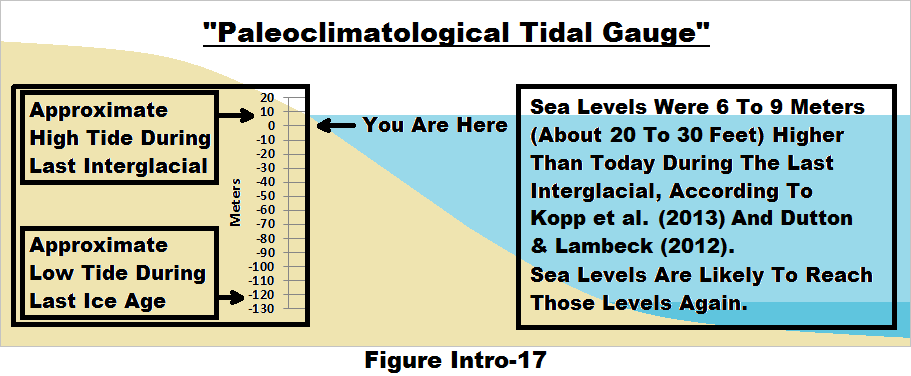
Sea levels have risen 300 to 400 feet since the end of the last ice age, because global surface temperatures have been above the temperature at which ice sheets and glaciers melt for about 11,000 years. What part of that 300 to 400 feet are the oil companies responsible for, a couple of inches? Prorate it!
Cheers
Bob
Image from free ebook here:
https://bobtisdale.files.wordpress.com/2015/11/tisdale-on-global-warming-and-the-illusion-of-control-part-1.pdf
PS: That obvious part of sea level rise was also discussed early on in my recent short story DAD, WHY ARE YOU A GLOBAL WARING DENIER?
https://www.amazon.com/Dad-Why-Global-Warming-Denier-ebook/dp/B078VBBPHD/ref=sr_1_1?ie=UTF8&qid=1515370466&sr=8-1&keywords=dad+why+are+you+a+global+warming+denier%3F
Can someone please explain how testing a physical analog to an equation set can yield any information that could be obtained directly from the equations?
In response to Mr Mills, just about every climatologist to whom we have explained that the input signal in a feedback loop induces a feedback response even in the absence of any direct gain factor has simply not believed us. The reason is that the zero-dimensional model equation used by climatology makes no provision for the input signal – in this case the very large input signal of 255 K that is the emission temperature that would prevail at the Earth’s surface in the absence of any forcing or feedback.
Therefore, although we were of course able to rewrite the equation by replacing the delta input and output signals with the entire values and then by recalculating, some very eminent climatologists had become so used to doing things wrong that we could not persuade them that our theoretical approach was correct.
Accordingly, an engineer who had heard of our result built a test rig and I gave him some values to put into it. Then we confirmed the position with the government laboratory.
Equations can be mathematically right but physically wrong. That is the whole point of discovering the error. Building physical simulators to prove the error experimentally is the clincher for those blinded to the physically wrong part.
In theory there is no difference between theory and practice. In practice there is.
“in this case the very large input signal of 255 K that is the emission temperature”
This makes no sense. A signal is a change which can be variably amplified, responding to feedback. The 255K is not a change, and cannot be amplified (think what if it were!). It’s like saying that your sound amplifier isn’t doing much because it only produces a few volts output from a signal that is a few millivolts+240V input.
Nick, I can’t believe you just said this. Have you ever heard of DC coupled amplifiers. You’ve obviously never worked with analog computers either.
jim, i think nicks response is an example of the first sentence in lord moncktons reply to anthony mills above.
“Have you ever heard of DC coupled amplifiers.”
I have. I have never heard of an amplifier where you could the supply voltage as part of the signal for calculating gain.
With respect, Mr Stokes is not correct in stating that emission temperature is not a “signal”. That is the term of art in electronic circuitry. If, on the other hand, your dynamical system is the climate, then the input signal is not a voltage but a temperature.
Consider a real signal light within range of an instrument for detecting light (e.g. the Mk 1 eyeball). If the signal light is off, there is no signal. If it is on, there is. If there were no Sun, there would be no signal to speak of. But the Sun is on, so there is an emission temperature, which, in the climate system, is the input signal.
One quite understands that Mr Stokes has not heard of a feedback amplifier in which the mu gain block is set to unity and yet the feedback fraction is non-zero. But the climate in the absence of the greenhouse gases is precisely that. One can certainly build a feedback amplifier in which the mu gain block is set to unity and yet the feedback fraction is set to be non-zero. We did it at the government laboratory, and the resulting output signal was modified by the feedback block to the precise extent predicted by feedback theory.
If the feedback fraction is positive, even in the absence of any amplification (i.e., with mu = 1) there will be a gain. We measured it.
It isn’t surprising when you consider that Dr. Pat Frank has never met a climatologist that knew the difference between precision and accuracy.
I’m wondering if the scope of this trial is to be very narrow and turn on the just the subject addressed by the findings in Brenchley’s amicus>/i> brief, or if it will be broader where such things, as the 8,000+ adjustments NASA’s GISS made to the pre-1900 data in their Global Land Ocean Temperature Index, will be allowed
Steve, that was the very thought I had when reading this. I’m still unsure of the degree of accuracy with regards our historical temperature data sets.
They have been significantly adjusted, the land data sets are wildly inconsistent, the ocean temp data sets were conveniently left out, infilling, etc. Most of this information I would never have discovered we’re it not for Mr. Watts hard work and fellow scholars such as Mr. Monckton, Mark Steyn, Judith Curry, etc…
I’m sincerely grateful for all of your hard work and dedication.
My question regarding the accuracy is “are we absolutely certain the Earth GMT actually risen as they claim? I could be wrong but I thought the error value was +/- .5°C?
If that is so it could be well under 1°C, and even if it was the opposite I’m still unsure why the panic.
My perception is that those who want to control us, by their utterances and actions, display a severe selfish misanthropy. “Carbon” is there delivery system for global unavoidable tax. Carbon is essential to life. We are carbon, so I interpret this as a direct attack on the beauty of life and humanity.
We need more work like this. Those of us who understand the game need to organize and push back the agenda, shills we want our grandchildren to thrive. After all, isn’t that there argument? Let’s counter them with that too!
Hip, Hip Horray, I say.
This case has the potential to establish a judicial ruling against the endangerment finding (indirectly)
His requested tutorials amount to a red team vs blue team debate that will be in the judicial record.
My opinion, this case can become a turning point in the effort to bring sanity
to the debate.
Mr Smith is right: we should take a positive approach to the news that a scientifically literate judge is curious enough to ask scientific questions. Now he has in front of him a proof that global warming is not a problem.
Mr Smith is also right that our result makes a nonsense of the endangerment finding. Our friends in the United States are going to arrange for Administrator Pruitt at the EPA to be told of our result.
Actually, as I have been studying how to legally undo the endangerment finding without being tied up in court forever, this post nicely cuts through that legal gordian knot. Old way, argue the previous fact finding did not follow the Clean Air Act’s rules (over-reliance on IPCC, blah blah blah, red/blue team), and then an ad nauseum he said she said where most ‘experts’ think there is endangerment because that is where their bread is buttered. Pruitt come down on the revised no endangement side, and the greens file dozens of lawsuits and nothing useful happens for years.
Only solution I previously saw was win enough control in congress to rewrite CCA definition of pollutant, presently a circular ‘that which pollutes’ where pollutes means harms using 8 different tests. No way even if Trump gains rather than loses seats in the midterm is that going to be easy.
This result simply shows why and how the experts were wrong, period. And all the supposed endangements that followed from wrong warming extrapolations automatically fall away. Simple, neat, incontrovertible, with clean grounds for reopening the finding. Cannot get tied up for years in court arguing disputed facts, because none are left in dispute.
I’m delighted that Mr Istvan sees some merit in using our result to influence the outcome of legal processes, such as the reversal of the endangerment finding. If we’re right, expect a lot of the climate cases to be quietly withdrawn.
Where is Nick Stokes? Nick, where are you?
I think you need to come on here and either find a cast iron means of refuting Christopher Monktons paper or go away and burn in an only moderately warm place.
While I don’t see the merit in choosing to dip to personal attacks, although it was clever, I’m no fan of Mr. Stokes either. I only see him comment when he can obfuscate topics not as clear cut as this. I’m interested to see what he has to say, if anything to Mr. Monckton.
Mr. Stokes, would you care to weigh in?
” Nick, where are you?”
In a place where it is currently 6.30 am. I invite your explanation of what Lord M is saying that you would like me to refute.
Nick, it seems clear to me and likely many others here, that when you comment, it is rarely in agreement because you believe in the man-made CO2 climate driven hypothesis and all the un-falsifiable claims surrounding it. Almost every post or comment from you is in the realm of defending the now firmly entrenched establishment theory.
So, I would say, review his work and if you have criticisms, levy them so Mr. Monckton may reply.
“So, I would say, review his work”
As usual, I seem to be almost the only one doing so. But not quite. Scottish sceptic has noted the glaring error below, and I have appended my comment there.
Nick, between my crap phone and delays to getting on my personal computer, I can’t always see the updates to the comment section. I’m reading your response and Mr. Monckton’s rebuttal. It quickly escalates beyond my comprehension, so I can’t say who appears to be more correct, but I notice that the responses were quite exhaustive, as to his methods. Again, I enjoy reading the comments most because, even though I disagree with you quite significantly, I’m sure there is merit to some things you say. I do notice from time to time that you get the last word, and I don’t see others concede or rebut (and that has bothered me), but I’ve also seen it go the other way. It could also be mental fatigue and we all just get tired of going back and forth. So I can only digest to the best of my cognitive abilities.
I do get the impression that you are the unstoppable force going against immovable objects. I’m waiting to see how this all plays out.
Mr Monckton: thank you and your team for clear, concise analysis. I do not consider your work skeptical science. There is no such thing: there is only science which involves detailed analysis, basic math and physics that need to be scrutinized, and verified via actual data. Its sad that its gotten to the point that doing actual science is career threatening…..
I agree very much with Mr Davis that doing actual science ought not to be career-threatening, though not one but two of my co-authors have had their careers threatened, and one has had it actually damaged, but their participation in this project.
And, as al-Haytham used to say, it is the duty of the “seeker after truth” to be skeptical.
This is no less intersectional than the Scopes trial… a once per century clash of science vs political ideology with the resulting decision couldn’t be more transformative. Either science prevails or we witness the birth of a State Religion.
Wharfplank is right. If we are right, the judge may well rule that he is, on the whole, persuaded by our argument. That would be the beginning of the end for the global warming scam.
Can’t WUWT find a climate scientist to write its articles? Christopher Monckton is an engaging personality, and given that he is a classicist, I would value his opinions on genitive absolutes and second aorists — but his article exposing the “fundamental error” on which 50 years of climate science alarmism is nothing but dust in the eyes of the beholders.
Mr Fell’s lamentable comment is a tired instance of argumentum ad hominem – a petty attack on the man rather than on his argument. My co-authors include three Professors – one emeritus in statistics, one tenured in climatology, one adjunct in control theory – as well as a doctor of astrophysics, a brace of electronic engineers with practical knowledge of feedback theory, an expert in the electricity supply industry and an undergraduate in environmental sciences. The pre-submission reviewers included the most eminent professors currently practising in optical physics and in the application of feedback theory to climate, respectively.
Regardless of this distinguished authorship and their undoubted qualifications, the argument in the head posting stands or falls on its own merits. Mr Fell appears unable to find any legitimate criticism of the argument itself, so he resorts to the usual technique of ad-hom attack. He has not realized how deadly the argument in the head posting is to the cause in which he passionately but misguidedly believes.
” My co-authors include three Professors”
The amicus is now posted. Why so coy about the names?
My distinguished co-authors were Dr Willie Soon (award-winning astrophysicist); Professor David Legates (tenured professor of climatology); Emeritus Professor William M. Briggs; Dipl.-Ing. Michael Limburg; Adjuncth Professor Dietrich Jeschke (professor of applied control theory); Mr Alex Henney (expert in electricity supply, who has testified in many jurisdictions including California); Mr John Whitfield (the electronics engineer who built our test rig); and Mr James Morrison (University of East Anglia).
I am still hoping to hear a good explanation of why natural variations in temperature do not trigger the feedback mechanisms used to cause most of the warming in “global warming.”
Mr Graney is quite correct. Temperature feedbacks arise in response to temperatures, regardless of the cause of the temperatures (there are some exceptions, but that is the general rule). However, in our paper we have assumed for the purposes of argument that all warming before 1850 was natural and all warming after 1850 was anthropogenic. To the extent that warming after 1850 was natural, our estimate of final sensitivity should be reduced. This point is explained in the underlying paper and in the amicus brief.
“all warming before 1850 was natural
and all warming after 1850 was anthropogenic.” ? ? ?
That’s worse than the IPCC claims.
There’s no reason to believe
much man made CO2 influence
before 1940 — the measured warming
is mainly in the 1975 – 2000 period.
I think it would have been more neutral
to assume no effect of man made CO2
before 1940, and all warming after 1940
attributed to CO2.
That’s still a worst case
theory but the IPCC
does not even claim
that much warming before 1975
can be attributed to CO2,
so why would you?
Sometimes natural variations do trigger feedback mechanisms. In fact, feedback mechanisms were first discovered when scientists asked how the very small variations in the amount of solar energy reaching the high northern latitudes, owing to the natural variations in the Milankovic cycle, could trigger the coming and going of the ice ages, as is apparently the case.
Feedback acts on a forcing to produce an observed temperature different to what the forcing would have achieved without feedback. With natural variation you do not know the forcing. You only have the observed temperature. It may well, include feedback effects.
there is no “may well” about it nick.