And the answer is, Yes. In fact, they’ve already survived millions of years of climate change.
Age of corals since they first appeared on Earth:
Corals are 500 million years old, and date back to the late Cambrian period, during the Paleozoic era – Source: the Global Reef Project
Climate change since then:

What is really hilarious is that right next to the ‘ARC Centre for Excellence’ release, is this one in the Eurekalert feed:

PUBLIC RELEASE: 1-SEP-2017
Can corals survive climate change?
Coral reef experts deliver urgent recommendations for future research
A group of international scientists, including scientists from Australia, have issued advice that more research is urgently required to determine whether corals can acclimatise* and adapt to the rapid pace of climate change.
The team of coral experts, led by Dr. Gergely Torda from the ARC Centre of Excellence for Coral Reef Studies (Coral CoE) at James Cook University and the Australian Institute of Marine Science (AIMS), have delivered recommendations for future research.
As the Great Barrier Reef faces unprecedented coral mortality from back-to-back mass bleaching in 2016 & 2017, rising carbon dioxide and other natural and human-induced pressures, scientists advise more research is urgently needed into the poorly-understood mechanisms that corals might use to survive in a rapidly warming world.
“There is still a lot to understand about corals,” says Dr. Torda. “While our only real chance for their survival is to reverse climate change, a nugget of hope exists – that the corals may be able to adapt to their changing environment,” he says.
“However, there are major knowledge gaps around how fast corals can adapt or acclimatise to changes in their environment, and by what mechanisms they might use to achieve this,” adds co-author Professor Philip Munday of Coral CoE.
“For example,” explains Dr Jenni Donelson, co-author at Coral CoE,”recent studies show that fish can acclimatise to higher water temperatures when several generations are exposed to the same increased temperature, but whether corals can do the same, and how they might achieve this, is largely unknown.”
Eight research recommendations are published today in the prestigious journal Nature Climate Change and arise from a workshop with a team of experts composed of 22 biologists from 11 institutions in five different countries.
The team agrees that further research identifying how corals respond to climate change is critical, as the Earth undergoes an unprecedented rate of environmental change.
AIMS Climate Change Scientist, Dr. Line Bay says, “There is sufficient inertia in the climate system that we will not be able to prevent further climate-related disturbances affecting the reef in the immediate future.”
“Solutions are required to help corals adapt and acclimate to near-term future climate pressures while we figure out how to reduce emissions and halt and reverse longer-term climate change.”
Co-authors Prof. Timothy Ravasi and Dr. Manuel Aranda from King Abdullah University of Science and Technology (KAUST) warn that the clock is ticking. “The Great Barrier Reef has suffered substantial losses of coral over the past two years. Understanding the mechanisms that could enable corals to cope with ocean warming is becoming increasingly important if we want to help these ecosystems,” they say.
The paper is focused on stony, reef-building corals, which are the ‘ecosystem engineers’ of tropical coral reefs. These corals build the frameworks that provide shelter, food and habitat for an entire ecosystem. When corals are lost, the diversity and abundance of other reef organisms declines, until ultimately the ecosystem collapses.
“Predicting the fate of coral reefs under climate change is subject to our understanding of the ability of corals to mount adaptive responses to environmental change,” says Dr. Torda. “Our paper sets out key research objectives and approaches to address this goal.”
“The time to act is now, as the window of opportunity to save coral reefs is rapidly closing,” he concludes.
###
The paper titled: “Rapid adaptive responses to climate change in corals” is published today in Nature Climate Change: http://dx.doi.org/10.1038/nclimate3374
* “Acclimatisation” is the response of organisms to environmental change through non-genetic processes. It is different to adaptation, which involves inheritance of a genetic change.
Can corals survive climate change? No. They never did, they never will 🙂
The coral reefs became extinct when first faced with climate change, ca. 499 million years ago. They were replaced by fake corals put there by benign aliens, who culd foresee the man-made climate disaster and controls the bleaching of the fake reefs in order to make us mend our ways, and stop flying. Except for Leonardo di Caprio and Ridley Scott, who have a special deal with the aliens.
Henning Nielsen
It’s Polar Bear science……..Dying, Dying, Dead………Whaaaaaat! A Polar bear ate me!
Anyone who has the arrogance and hubris to call themselves a “CENTRE OF EXCELLENCE ” pretty surely is not.
Were they a CENTRE OF EXCELLENCE before they even started ? Or did they operate for a few years before deciding that if they did not call themselves a CENTRE OF EXCELLENCE , no one would notice how EXCELLENT they were?
Those who are really excellent have the modesty to remain silent and let others judge them and EARN a reputation for excellence.
Oddly this self proclaimed “excellence” seems to be the hallmark of left-wing climate groups engaging in activism dressed as science.
Greg
Look up your local builder. They all claim to be the best builder in the area.
In other words, given half the chance they’ll rip you off.
Actually it is a lefty protesteth too much example. Other lefty examples include Deutsche Demokratische Republik, Social Sciences, Political Science, the New Democratic Party, Democratic Peoples Republic of Korea.
ARC Centre also gave us the Ship of Fools expedition of Chris Turney, who wound up with nick name Christmas Turkey for his expedition into the freezing up sea ice that required an international rescue efforts costing millions. Oh they gave him a medal for it for God knows why – also typically lefty.
In Australia , A COE is created to try to get funding.. Some groups may actually do some good work.
But of course, ANYTHING to do with climate is immediately and irrevocably tainted with the socialist totalitarian AGW agenda.
When Mickey Mann introduced himself to congress for his testimony back in March (I think), it was with the words “distinguished Professor”.
I don’t know what the norm might be in the US but is this usual?
Is there some formally recognised academic rank or status attached to “distinguished”?
In Oz or any other place I can think of, the use of the word “distinguished’ is only added when one is, say, introduced by another person at a speaking engagement or some such. It’s a politeness.
Adding the word yourself smacks of the heigh of conceit.
Maybe it’s all part of the pathology and the reason he passed himself off as a Nobel laureate?
Maybe they’re funded by Montgomery Burns.
“I don’t know what the norm might be in the US but is this usual?”
Yes, some U.S. college award “Distinguished” to full professors who are standaouts from the other full profs, AFAIK.
Thanks, Roger,
I must say, I still don’t like it. I might be a somewhat too conservative.
I had the term ‘distinguished’ down with the likes of ‘my learned colleague’ or ‘the honourable member’ . . that sort of thing.
Ya live and learn.
Cheers.
As there are corals in the Red Sea and the Persian Gulf, Corals have rather more heat tolerance than supposed.
Do all biologists believe in intelligent design?
Not the intelligent ones.
or maybe the designer is more intelligent than they are.
Since the blind watchmaker was debunked, biologists are left being unable to answer many questions about human ‘purposiveness’ and purposiveness in many life forms. Doesn’t mean there is a God or designer, but it does mean there is a large amount of ‘biology’ we don’t understand.
And where exactly is the research showing how a slight increase in temperature causes coral bleaching? All I can find is blanket statements like “the algae become stressed” or “algae leave the tissue”. Well maybe they just start to sweat too much and pack up their bags and take a holiday to the spa because they get “stressed”. This is sounding somewhat like the erroneous conventional wisdom that stress causes peptic ulcers.
It’s merely coincidental that slightly warmer sea surface temperatures typically coincide with decreased water circulation and mixing that the corals rely on to feed, right?
A good bit of the bleached coral is due to dropping sea levels (or rising see floor) exposing reefs. But this contradicts the AGW theory of rising seal levels, so its omitted.
Well that’s exactly one of the things fueling my skepticism in the coral bleaching meme — when large patches of the GBR are subaerial exposed and a clear mechanism for coral mortality is presented, the alarmists still preach the meme. It’s clear to me that marine biologists have never seriously studied all the variables because the dogma of global warming.
I’ve only come across one paper that mentions the decrease in primary productivity in the water column coinciding with coral bleaching events, and even in that paper there really wasn’t any attention paid to nutrient levels, but rather UV levels. I would think that it’s a compounding effect; decreased nutrients (iron) decreases the primary production and limits the feeding ability of the polyp, the decrease in plankton makes the water column clearer during a time when the sky is inherently more cloud free (high pressure/high temp) and UV increases on the reef which damages the zooxanthellae, so then you have a situation where both feeding mechanisms of the coral is hindered at once, hence, the coral’s health suffers. It’s simply a convenient truth (for the alarmists) that these conditions coincide with relatively warmer temperatures, and if you follow the citation trail it looks like blinders were put on to focus primarily on warmer water from the beginning.
Indeed, and the Red Sea is very warm.
You would expect the starting polnt to be the measurement of sea temperatures around all the major corals since this would immediately indicate the range of temperatures that one knows tha corals can survive and indeed in which they flourish.
A couple of years ago WUWT had a thread on a survey that found that corals around uninhabited islands, about half the total surveyed showed no signs of stress, implying that heat and acidity were not what was stressing the others.
I’ve definitely heard claims that only the coral reefs that are frequented by divers are bleaching.
What about those at Bikini Atoll?
They have come back to life, surprising everyone.
Its also the best place in the world for shipwreck diving.
I dpn’t know about the coral, but those researchers surely will with all those plans for research projects.
No, Al. Terrestrial ecology is not “delicate”.
There is something strange in all these reports an effect that has actually been noticed and reported that the reef could actually just move south.
http://theconversation.com/on-the-move-corals-migrate-south-into-nsws-warming-waters-8238
So make a big leap of faith and CAGW warming comes up by 2.5 degrees the NSW waters are then within the range for the corals. The corals themselves don’t actually have to adapt at all and one could argue that would be the most likely thing to happen is the just move south. What is strange is that the research funding on that is tiny compared to the doom and gloom story and that seems to be the criteria for dishing out the funding.
That would be a good thing, LDB, it would shorten the trip to visit the reef for we southerners. But I don’t like the fact that it would also bring the crocodiles to our coasts & rivers.
That idea could be substantiated already if there were any actual evidence that corals were expanding into higher latitudes. Anyone know if this might be true?
Just so I’m clear on the concept…
You can farm them in lagoons that get hotter, throw them in a plastic bag and ship them all over the world…
..they can sit out bone dry in full hot tropical sun..and rain…and do just fine
But 1 man made degree is going to kill them all….
http://www.danintranet.org/storymedia/13641.jpg
You got it. Human wickedness is a different kind of wickedness and life is instantly doomed by humans.
That’s a VERY INCONVENIENT TRUTH, Lat ! We grow them in little glass boxes in horrendous conditions, break of 1″ pieces a ship them wrapped in damp tissue anywhere you want, and we grow them again, and again. Activist academics struggle with this concept.
The Mesozoic Era atmospheric CO2 was pretty well always 2 to 4 times the level at which the World Bank cartoon indicates that coral reefs will dissolve, yet the Mesozoic Era was full of coral reefs.
Coral reefs of the Mesozoic Era seemed to like CO2.
For that matter, the modern Great Barrier Reef also seems to like a CO2-enriched diet…
The average calcification rate of the Great Barrier Reef seems to be increasing along with atmospheric CO2. Data from De’ath, G., et al. 2009 ftp://ftp.ncdc.noaa.gov/pub/data/paleo/coral/west_pacific/great_barrier/readme_greatbarrier.txt
A recent paper in Geology (Ries et al., 2009) found an unexpected relationship between CO2 and marine calcifers. 18 benthic species were selected to represent a wide variety of taxa: “crustacea, cnidaria, echinoidea, rhodophyta, chlorophyta, gastropoda, bivalvia, annelida.” They were tested under four CO2/Ωaragonite scenarios:
The effects on calcification rates for all 18 species were either negligible or positive up to 606 ppm CO2. Corals, in particular seemed to like more CO2 in their diets…
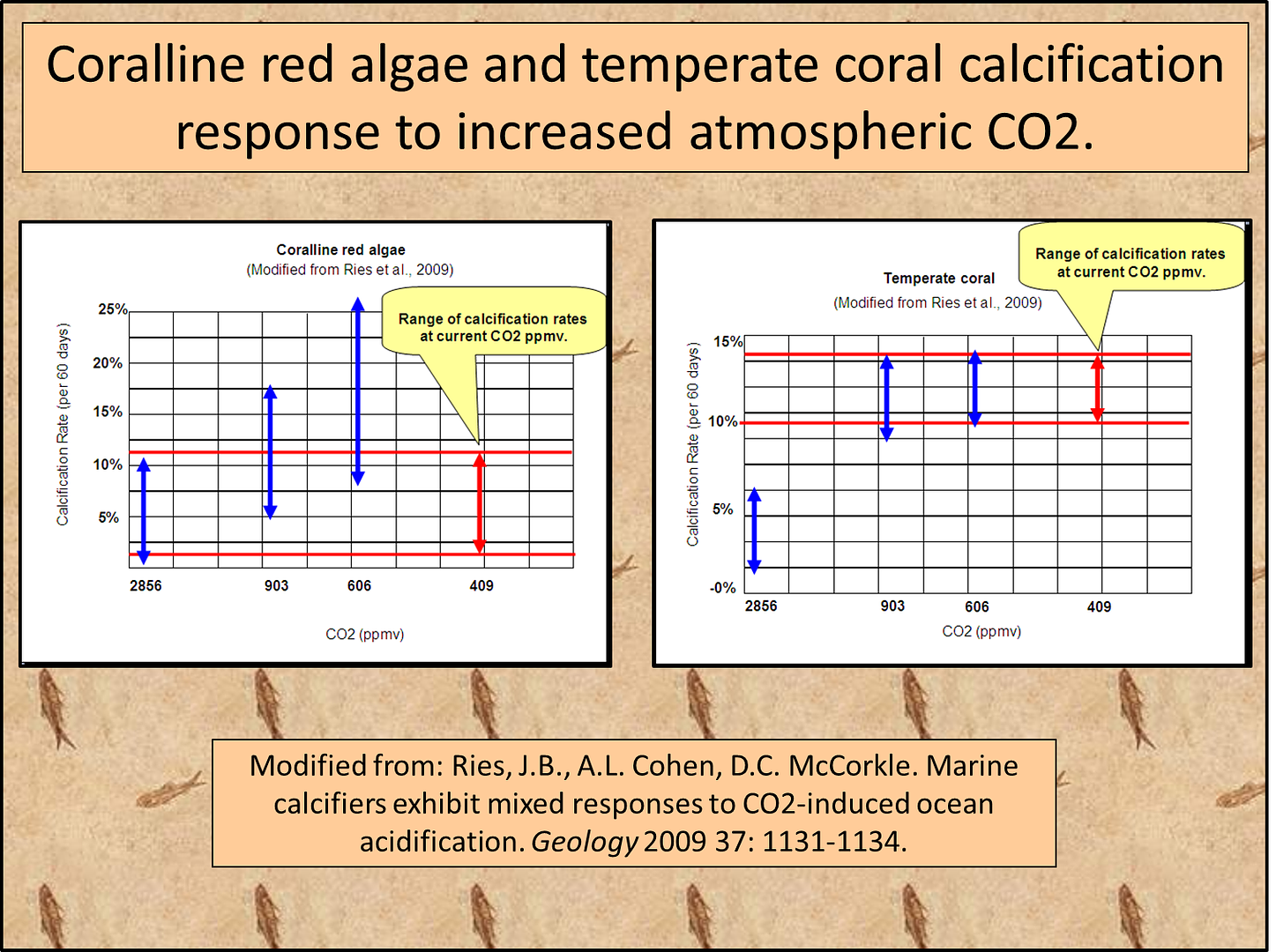
Coral seems to be A-OK with CO2 levels of 1,000 ppmv. This might explain how they thrived in the Mesozoic Era.
It’s not really “coral”, coral is the host……zooxanthellae (zoox) is the symbiote, a dinoflagellate (not algae)..
..is CO2 limiting to dinos?……absolutely
IMO what matters is the amount of CO2 in seawater for the photosynthesizing symbionts of corals. Warmer water holds less CO2, but more CO2 in the air also gets mixed in water in the wind-driven mixing layer.
The cold depths are a huge reservoir of CO2. Oceans were astonishingly hot during the Cretaceous Period, yet the ancestors of today’s scleractinian corals thrived.
along with calcium, the major building block of coral is CO2. Like trees on land, coral reefs are made from billions and billions of tons of CO2.
chem 101. add more CO2, you will get more trees and more coral reefs.
Just before the Northern Hemisphere ice-sheet started melting some 17,000 years ago, world ocean levels were around 400 ft (~120 metres) lower than they are at the moment. So 17,000 years ago, Australia’s Great Barrier Reef did not exist.
There are huge areas of the NE Outback of Australia where old fossilised coral reefs lie exposed. http://www.abc.net.au/science/articles/2008/09/22/2370844.htm
Oops, delete “NE” left over from editing.
“For that matter, the modern Great Barrier Reef also seems to like a CO2-enriched diet…”
Of course it does! There is not enough dissolved CO2 to supply all of the photosynthetic needs of the symbiotic zooxanthellae that live in coral tissue. In fact, there is an enzyme called carbonic anhydrase that can allow corals to utilize dissolved carbonates as an inorganic source of carbon for photosynthesis.
And, the more atmospheric CO2 that is present, the more is dissolved in water and converted to carbonates. So, yes, I totally can see how the GBR has enhanced calcification with higher atmospheric CO2 concentrations. Not to mention that corals evolved with the atmospheric CO2 concentration was many times higher than current levels, and probably still have the ability to utilize increases levels of dissolved CO2 even without conversion to carbonate.
I suspect bleaching events reduce the amount of available alkalinity, rapidly increase salinity, or rapidly change PAR levels (or all three simultaneously) that lead to corals expelling their zooxanthellae. El Nino is known to warm waters in the southeastern Pacific as well as suppress cloud cover, so it is not a stretch to think that bleaching is primarily an effect of ENSO.
Worst bleaching event I have ever witnessed…was because of cold
Rapid temperature rise will induce it as well, but cold is a bigger problem.
Are corals bleaching, or evolving?
Like everything else on the planet that’s evolving.
Yet every minute evolutionary event is put under the human microscope, over analysed with the limited knowledge we have, and declared a disaster.
We have no idea how quickly anything can evolve if pushed.
The straw-man headers misrepresent the article. The article asks: ‘Can corals survive THE RAPID PACE OF climate change’? The part in capitals being omitted changes the sense of the article.
There was no change in the article headline quoted. It is exactly as published in their press release:
https://www.eurekalert.org/pub_releases/2017-09/acoe-ccs083117.php
They often throw in “rapid change” as a fallback when it’s pointed that “the this” has happened before and “the threatened” is doing just fine.
(Of course, the “rapid” part is due to Man.)
Who says it is “RAPID” (implying human cause) ? Evidence more likely points to cyclical nature of changing climate.
> “There is still a lot to understand about corals,” says Dr. Torda. “While our only real chance for their survival is to reverse climate change, a nugget of hope exists – that the corals may be able to adapt to their changing environment,” he says.
• We don’t understand corals.
• Their survival requires reversing climate change.
Dr. Torda should be ashamed.
Corals survived the Great Dying mass extinction event at the end of the Permian. Rugose or horny corals were indeed wiped out then, along with most other sea life, but scleractinian corals rapidly radiated to fill the niches left empty by their previously dominant kin.
Corals have survived everything that an abusive Mother Earth has thrown at them for about 500 million years. An extra molecule of CO2 in 10,000 dry air molecules, ie four instead of only three a century ago, is as nothing.
A little elementary science –
Coral reefs are built by coral organisms. They are made primarily of calcium carbonate. The corals take the calcium (Ca) and carbonate (CO3) from the sea water.
The calcification process involves a chemical reaction: Ca + 2 HCO3 (bicarbonate) –> CaCO3 + CO2 + H2O. The rate of this reaction is controlled by the availability of the scarcest component.
There are about 400 parts-per-million (ppm) of calcium in sea water. There are about 140 ppm of bicarbonate in sea water. The scarcest component is the bicarbonate. Adding more carbonate (by adding more CO2) to the ocean would make the calcification reaction faster.
Probably not, Tad. The reaction is reversible with CO2 being a product as written. Adding more CO2 will drive the reaction in the reverse direction.
More JCU nonsense from the Center headed by Prof. Terry Hughes, who Jim Steele exposed as a deliberately misleading coral alarmist here a few days ago. The opposite of excellence.
The fact they endorse AGW is proof they’re frauds. Their church can’t even calculate the temperature of the atmosphere properly, attaining a temperature in line with the International Standard Atmosphere.
It is merely a cry for additional funding to study corals. Had they simply requested more funding it probably would have been ignored. They are just trying to advance their cause by becoming squeaky wheels.
We are lambasting it because it disingenuously uses language that presumes the latest boogeyman is to blame.
A little OT but I got this message today from the Cornwall Alliance:
For as long as supplies last, Cornwall Alliance will send you a FREE copy of An Inconvenient Deception [by Roy Spencer] as our way of saying “Thank you!” for a gift of any size between now and the end of September! To take me up on this offer, just mention Promo Code 1709 and ask for An Inconvenient Deception when you make your gift of ANY size by credit card through our secure online donor site or by calling 703-569-4653, or when you mail your check to Cornwall Alliance, 9302-C Old Keene Mill Rd., Burke, VA 22015.
God Bless You,
Megan Toombs
Director of Communications
The Cornwall Alliance for the Stewardship of Creation
Donor site:
https://www.egsnetwork.com/gift2/?giftid=D1F98866-F290-4AFD-8E16-E73C3D306807&utm_source=Cornwall+Alliance+Newsletter&utm_campaign=0909c84ff3-EMAIL_CAMPAIGN_2017_08_28&utm_medium=email&utm_term=0_b80dc8f2de-0909c84ff3-131700753
URHHGHGHGHGG
Corals adapt every single generation
Evolution is a mix of generational adaption and random mutation.
Seems with some warmer waters which were more temperate may be more hospitable to corals that were not before. Perhaps we’ll see stag horn corals in North Carolina some day. Would be nice. Experimental ‘plantings’ in Florida may help damaged reefs as well. Plant a coral next “Earth Day”.,..
reefs are still today being hacked up for the aquatic trade
Corals reproduce and will keep on reproducing long after mankind is gone. Enormous swaths of coral have been found at the bottoms of previously dried-up seas. They’ve been around millions, and millions of years, and the current static atmospheric conditions, oscillating on either side of the nominal global atmospheric average temperature by about a half degree, isn’t really changing much at all.
If it were, there couldn’t be an international legal and regulatory physics standard called the International Standard Atmosphere. People aren’t being taught about the basics of atmospheric matter-energy relationships.
That international standard couldn’t exist, if climate were currently in a state of flux. That’s all there is to it.
While somewhat true, there are lots of efforts around sustainable aquaculturing, mariculturing, and education for responsible harvesting of specimens. Pollution and tourism are far more damaging to wild coral reefs.
– Corals evolve in the Cambrian-Ordovician under 10-30,000 ppm atmospheric CO2.
– 20th century CO2 increases from 300-400ppm.
– “Scientists” assert that 400ppm is dangerously high CO2 for corals.
– This tells you all you need to know about these “scientists”.
(And don’t jump on the speed of change cop-out, we don’t know the speed of change in the past, paleo records smooth this out massively.)
Any citation for the Phanerozoic climate change plot?
The WUWT palaeo climate page points this to wikipedia: geologic time:

Here’s the wiki page with references:
(try again) Here’s the wiki page:
<>
Thanks! Still not seeing the wiki page w refs but will try to google it down.
Yes, links to Wikipedia commons images seem to mysteriously disappear – but are actually there as a small icon. Learn something every day.
You are referencing the Wiki page not the image, here is the image from the page —
aka [https:]//upload.wikimedia.org/]wikipedia/commons/9/9c/Phanerozoic_Climate_Change.png
Square brackets added to prevent the page loading.
tom0mason
Thanks
Today’s ecologists suffer en masse from conditioned reflexive dystopia.
However healthy and vibrant life may look, the expert always knows that it’s doomed.
Actually the first link worked–thanks again.
Wrong question, should be how do we protect coral from land pollution”
Where man does not go ( Bikini Atoll) where coral is protected ( 2% ) and where pesticides and fertilizers are not used ( Cuba) the coral is in pristine condition and growing like a forest.
Exactly. What we need is research into the condition of reefs and their proximity to human conurbations, marine transportation, and associated pollution.
Center of Excellence? More like Center for Mediocrity.
The Great Barrier Reef is the world’s largest coral reef system composed of over 2,900 individual reefs and 900 islands stretching for over 2,300 kilometres (1,400 mi) over an area of approximately 344,400 square kilometres (133,000 sq mi). It stretches from 10 degrees south latitude to 20 degrees south. No water temperature variations north to south, and summer to winter?
“….900 islands stretching for over….” Are those islands made of Coral? If so it would seem that the Great Barrier Reef is a natural island making process.