By EMILY HOLDEN
08/11/2017 05:32 PM EDT
Updated 08/12/2017 01:01 PM EDT
Environmental Protection Agency chief Scott Pruitt said his staff will gauge the “accuracy” of a major federal science report that blames human activity for climate change — just days after researchers voiced their fears to The New York Times that the Trump administration would alter or suppress its findings.
“Frankly this report ought to be subjected to peer-reviewed, objective-reviewed methodology and evaluation,” Pruitt told a Texas radio show Thursday. “Science should not be politicized. Science is not something that should be just thrown about to try to dictate policy in Washington, D.C.”
Pruitt, who has expressed doubts about carbon dioxide’s role as a major driver of climate change, also dismissed the discussions in Washington about manmade carbon emissions, calling them “political.”
Scientists called his remarks troubling, especially because the report — part of a broader, congressionally mandated National Climate Assessment — has already undergone “rigorous” peer-review by a 14-person committee at the National Academies. The reviewing scientists backed the report’s conclusion from researchers at 13 federal agencies that humans are causing climate change by putting more greenhouse gases in the atmosphere, leading to a clear increase in global temperatures.
Morning Energy newsletter
The source for energy and environment news — weekday mornings, in your inbox.
By signing up you agree to receive email newsletters or alerts from POLITICO. You can unsubscribe at any time.
The report’s authors implemented the 132 pages of suggestions from the reviewers, and now the Trump administration has one last opportunity to review the document before publication. Agencies are supposed to sign off by Aug. 18 and send their comments to the authors.
“It’s a much more extensive process than a usual peer review, which does not typically come out as a paperback book,” said Bob Kopp, a lead report author and climate scientist at Rutgers University.
Kopp said he has “no idea” what to expect after hearing Pruitt’s comments. Staffers at EPA had already signed off on an earlier draft.
Eric Davidson, president of the American Geophysical Union, said the report has undergone “a very rigorous peer-review” and is “built on 50-some years of published research, and each of those papers went through its own peer review.”
He added that while fears of Pruitt suppressing the climate report might be more imagined than real right now, he didn’t rule it out.
“Certainly it’s a possibility, and if the administration doesn’t understand that it’s already peer-reviewed, that really is a sign of concern that he may not understand the process,” Davidson said. “If he’s continuing to question why CO2 is a big deal, that’s also very concerning, because CO2 is a big deal. … To see those quotes continue to come out is definitely disconcerting.”
Several climate experts said they welcomed scrutiny of the report, but they also expressed concerns that political biases could color the process.
“The question is will it be reviewed by people who are scientific experts or will it be reviewed by people who have a political agenda?” said Kathy Jacobs, who oversaw the broader National Climate Assessment under the Obama administration and now heads the Center for Climate Adaptation Science and Solutions at the University of Arizona.
“The implication of [Pruitt’s statement] is that it hasn’t been linked to the data,” she said of the report. “That certainly is not true. This is built on a mountain of evidence.”
Even as Pruitt said EPA would review the report for objectivity, he criticized the Times for saying scientists worry that the administration might interfere with its publication.
“The New York Times out there saying they had to release this report because it’s going to be suppressed is just simply legendary,” he said. “It’s just made-up news trying to create a distraction from the real work that’s being done in Washington, D.C.”
His comments Thursday came the same day that the National Oceanic and Atmospheric Administration issued a separate report confirming that 2016 was the warmest year on record, surpassing the records set in each of the two previous years.
This week’s dust-up over the 13-agency climate report is far from the first climate science dispute for Pruitt, who as Oklahoma’s attorney general sued to block a series of major EPA regulations. He drew criticism after announcing in June that he wanted to conduct a “red team, blue team” debate of climate science, a move that his detractors said would put fringe views on the same plane as established, peer-reviewed research.
The EPA chief defended his “red team-blue team” strategy in the radio interview, saying that “this debate, this discussion, I think it’s good and healthy for the country.”
Pruitt told the Texas radio show that his agency would review the 13-agency report “like all other 12 agencies and evaluate the merits and demerits and the methodology and accuracy of the report.”
HT/The GWPF
Apparently many scientists have lost their way regarding average global climate.
It is pretty well accepted that greenhouse gases (ghg) absorb infrared (IR) radiant energy being emitted from the liquid and solid surfaces of the planet. It should be apparent that there must be some elapsed time between when a molecule absorbs a photon and when it emits one because if the elapsed time was zero, there would be no way to tell that the photon had been absorbed. This elapsed time is called the relaxation time for the molecule. Relaxation time for CO2 molecules has been measured and is about 6 microseconds.
Conduction of heat in a gas, sometimes called thermal diffusion, results as molecules bump into each other. This jostling of molecules is observed as temperature and pressure and is accurately described by the well-known Kinetic Theory of Gases. Calculation of the time between collisions has determined that contact between atmospheric molecules at sea level conditions occurs, on average, at about 0.0002 microseconds. Thus it is about 6/0.0002 = 30,000 times more likely that the energy and momentum in a photon will be converted into heat energy and shared with the molecules which surround the molecule that absorbed the photon. The process of photon absorption producing temperature increase is called thermalization. Water vapor (WV) is a ghg. A common observation of thermalization is that humid nights cool slower than desert nights. Thermalized energy carries no identity of the molecule which absorbed it.
Emission of IR from the planet surface is in accordance with the Stephan-Boltzmann (T⁴) law. Emission of radiation from gas molecules is quite different and depends on the energy level of individual molecules. The energy level of individual molecules is determined probabilistically and complies with the Maxwell-Boltzmann distribution of molecule energy which favors lower energy molecules.
Emission of photons by molecules occurs only at discreet wavelengths which are characteristic for each molecule species. Every discreet emission wavelength is accompanied by the capability to absorb at the same exact wavelength. At sea level conditions, the discreet absorb/emit wavelengths are slightly broadened into bands. WV has 170+ emission bands at lower energy than the one emission band for CO2 and there are about 35 times as many WV molecules as CO2 molecules. As a consequence, energy absorbed by CO2 is effectively thermalized and rerouted to WV with the end result that CO2 has no significant effect on climate.
The only thing countering the temperature decline that would otherwise be occurring is the increasing trend in water vapor. (WV is a ghg. ‘Otherwise’ results from the net effect of ocean surface temperature cycles which have been in decline since about 2005 and declining solar activity (a proxy for earth warming/cooling) which has been declining since 2014 and dropped below ‘breakeven’ in early 2016.) Average global atmospheric water vapor has been measured and reported by NASA/RSS since 1988 and shows an uptrend of 1.5% per decade. WV has increased about 8% since the more rapid increase began in about 1960.
Links to source data and graphs showing this are at http://globalclimatedrivers2.blogspot.com
Fingers crossed that the “settled science” is beginning to sink.
(The consensus was that the Titanic was unsinkable.)
And mother nature stuck two fingers up at our hubris. It might well do the same with cAGW within the course of the next 5 years or so.
Someone check if there’s a new definition for ‘rigorous’. It’s probably in the appendix in really small print, color #fafafa.
Nah, the color would be #ffffff.
#fafafa is still to visible. Remember, hide the decline — it takes white print on a white background to do this most effectively.
Enjoy Pruitt while you can. The next Democrat EPA administration will undo any progress Pruitt makes so fast it will make your head spin, and redouble the effort to destroy modern society, to make up for lost time.
The federal agencies wouldn’t know what a global temperature was even if it came up and slapped them in the face with a wet fish. There are HUGE areas without measurement coverage, and in the US land station network, less than 10% of stations can read with an accuracy of 1/2 degree or better. The concept of a global average temp is just ridiculous, so to say it’s risen (or fallen) by 0.1deg or so is impossible. Those who do are lying.
globally you only need a few hundred stations.
The reason is this.
90+% of the variance in temperature is explained by latitude and altitude.
Tell me the latitude, tell me the altitude and I can tell you the monthly average.
You can test this.
Simple prediction.
A few hundred? That would be about, what, 1 station to cover about 50,000 square miles!
Yea, right.
You’re computer program may spit out a number with such limited input but your computer screen is not reality.
PS How many of them will be sited at airports?
One of the few ideas of yours Moshe that I agree with. When I look at raw data for the US, Canada, Greenland, Iceland, Siberia, South Africa, Paraguay… and see they all give 1930s-40s the hottest period in a thousand years, these are unquestioningly corroborative. A hundred modern, reasonably well located stations (left unadjusted) would serve as an adequate early warning system. Like sea level, if we are worried about several meters of rise, why do we rush down to the sea with micrometers? We could use a yardstick. Or if the more hysterical rates are believed, we could even measure it in ax handles.
There must be a typo in the ‘peer review’ claim. It should read “Pal Review”. Here’s what Tony Heller has to say:
https://youtu.be/MMC55rdOX_8
I love the way he uses selected data.
worse than NOAA
I think Tony Heller’s work is honest.
Regards, Allan MacRae, P.Eng.
Isn’t NOAA building another Ark for 2100.
“worse than NOAA”
But ten thousand times more honest and scientifically literate than you.
Tony Heller posted this sequence – all “global” temperatures – see the cooling of ~1940-1975 disappear?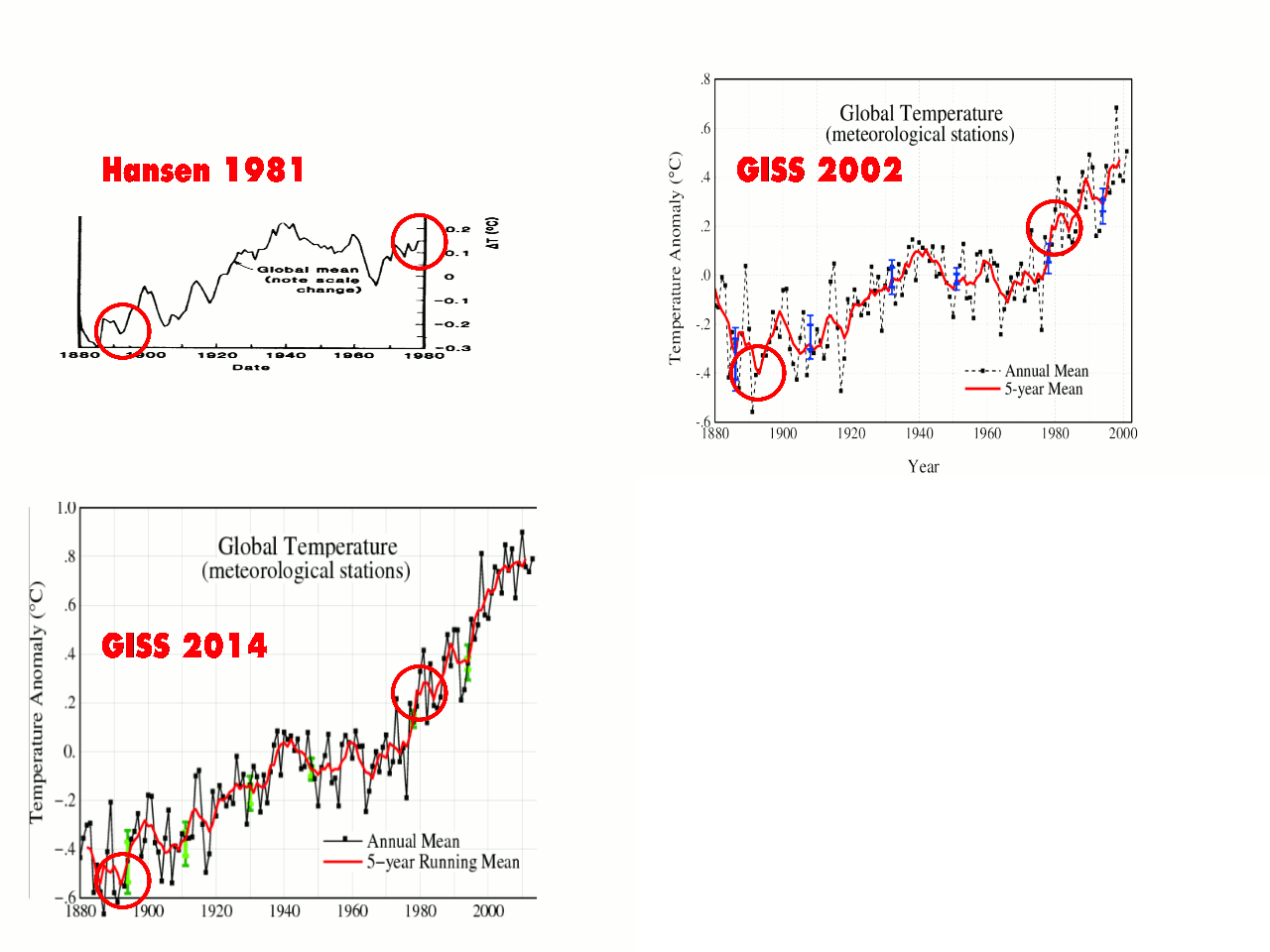
Mr. Pruitt, convene the Red Team to review and edit the National Climate Assessment report.
Atmospheric Group
Richard Lindzen
John Christy
Roy Spencer
Sallie Baliunas
Oceanographic Group
Judith Curry
Roger Pielke Sr.
Don Easterbrook
Ecological Group
Freeman Dyson
William Happer
Craig Idso
Patrick Moore
Economic Group
Ross McKitrick
Bjorn Lomborg
Roger Pielke Jr.
Is there a reason why Christopher Essex is not in your list of superstars, Dr. SL ?
What?
Where is Tony Heller, Anthony? Mcintyre? WIllis? All the skeptics that really do the day in day out work
Where is RUD!!!
Rud wrote an EBOOK fer chrissakes
Where is Javier???
Statistical Group
Christopher Essex
Steve McIntyre
Anthony Watts
All others can provide information and analyses to the group
After reviewing the previous National Climate Assessment I wrote to the editors to report the existence of errors that disqualified this work from publication. The editors ignored my remarks in favor of a version of reality that supported the Democratic Party line,logically flawed though this line was.