Subtitle: A Bit of Gathering Into Groups Gives Good Results
by: Roger Sowell (1)

Background: Much discussion, and much misinformation, is had over the price of electricity in the US, and many other areas of the world. The discussions sometimes end up as diatribes against renewable energy sources such as wind and solar. The article below is an attempt to begin to bring some facts into the discussion, using actual data from the US Energy Information Agency, the EIA. This is from an article from about a year ago on my main blog, SowellsLawBlog. The take-away points are: 1) there is an almost perfect inverse relationship between price and consumption, and 2) the fact that California prices are below the trend line. That is true even though California has substantial renewable energy statewide, a figure that passed 25 percent in 2015.
Discussion
It is not often that one creates a graph using actual data and discovers an almost perfect linear relationship. It is even more rare to have a software package calculate the least-squares trend line and obtain a correlation coefficient, R-squared, of 0.99 or higher. Yet, that is exactly what occurred for data from calendar year 2014 for US residential annual electricity consumption per customer, and average price per kWh. The graph and simple statistics are shown below, then a discussion. Note the R-squared value of 0.9997, indicating an almost perfect correlation.
 |
| Figure 1. Data from US Energy Information Agency, by state
Shows 39 states, excludes 10 states with lowest prices and Hawaii |
This article follows another SLB article that ascribes the relatively higher price for residential electricity in California compared to the US average to mild climate and large population. (see link to “Why California Electricity Costs More than US Average; Mild Climate and Large Population Contribute to Prices”) Conventional wisdom is very wrong in blaming solar power and wind power for the higher California prices.
With the data ready at hand from US Energy Information Agency files from their website, it was a simple matter to sort the data for each state by annual average residential price in cents/kWh. Being previously aware that low residential prices tend to correspond to high electricity consumption, and vice-versa, inspection of the data for 2014 confirmed that relationship. However, when the data is grouped into quintiles, a convenient grouping as there are 50 US states with ten members in each quintile, an almost perfect straight line resulted, as shown in Figure 1 above. However, there are only four data points in Figure 1. This is discussed below.
The R-squared of 0.9997 resulted when only the four quintiles with highest prices are graphed, that is, the quintile with lowest prices was excluded. Also, Hawaii is excluded as a high-priced outlier. More on that in a moment.
The data for each quintile is shown in table form below.
Quint kWh/y Cents/kWh
1 13,528 9.67
2 12,178 10.78
3 11,445 11.89
4 10,550 13.15
5 7,311 17.58
Next is shown in Figure 2 the graph of all five quintiles for 49 states – Hawaii is excluded as being a-typical and an outlier. This graph has only a slightly lower correlation coefficient, R-squared of 0.9931.
 |
| Figure 2. Showing 49 states (excludes Hawaii) |
The conclusion that can be drawn is that there is indeed a correlation, and a very good correlation, between average price for residential electricity and the quantity of electricity consumed on an annual basis by each utility customer. California is in the fifth quintile for high price but low consumption (16.2 cents/kWh and 6,741 kWh/yr/customer). Other states with California in the fifth quintile are almost all in the North East sector, Massachusetts, Vermont, Rhode Island, New York, Maine, New Jersey, and Connecticut. Example states at the other extreme, in the first quintile are Louisiana, Arkansas, and Oklahoma – all hot, humid, and consuming 14,000 kWh/yr/customer on average, more than double that of California.
In fairness, it should be noted that the high correlation coefficient only results when the quintiles are graphed. For all 49 states individually, again excluding Hawaii as an outlier, a much lower correlation coefficient results, of R-squared 0.546.
The graph shown below as Figure 3 is a repeat of Figure 2 above, with the highest (in red) and lowest (in green) states shown, as their average price’s deviation from the national trend line. California, the green circle at top left, is 2 cents below the trend. Other states substantially below the trend include Maine, Colorado, Illinois, Utah and Montana. Those states with the highest deviation above the trend are Alabama, South Carolina, Tennessee, Mississippi, Connecticut, Louisiana, Maryland, and Texas.
 |
| Figure 3 – Showing individual states
with greatest deviation from trend as colored circles |
Footnotes
(1) Roger Sowell is an attorney in Science and Technology Law. Since earning a BS in Chemical Engineering in 1977, he has performed a great many engineering consulting assignments worldwide for independent and major energy companies, chemical companies, and governments. Cumulative benefits to clients from his consulting advice exceeds US$1.3 billion. Increased revenues to clients are at least five times that amount. He regularly makes public speeches to professional engineering groups and lay audiences. He is a regular speaker on a variety of topics to engineering students at University of California campuses – UCLA and UC-Irvine. He is a founding member of Chemical Engineers for Climate Realism, a “red-team” style think-tank for experienced chemical engineers in Southern California. He is also a Council Member with the Gerson Lehrman Group that provides advice to entities on Wall Street. He publishes SowellsLawBlog; which at present has more than 450 articles on technical and legal topics. His widely-heralded Truth About Nuclear Power series of 30 articles has garnered more than 25,000 views to date. Recently (2016), he was requested to defend climate-change skeptics against an action under the United States RICO statutes.
“Agreed, in a free market, as demand reduces, companies would go out of business restoring the balance of too much overhead. As many utilities are government regulated/owned, with “jobs for life” and full pensions, the only way to cover all these costs is to raise rates and artificially keep the lights on.”
So Duncan let me ask you a few questions before I label you pond scum.
If you make a mistake at work could it kill you or a co-worker? How many 24 shifts have you pulled to provide a vital services for your family and neighbors? How many prejobs briefs have you been part of because of high temperature, pressures, voltage, noise, or radiation?
There are no jobs for life at utilities. When you job is gone so are you. It is not too hard to find a new job because whims like Duncan need to buy coffee at Starbucks and there are not too many of those next to power plants.
Of course the new job means selling your house and moving the family, or working a temp job away from the family. As an adult, I have lived more than 30 places. Which is why I know about a lot of places.
Governments do not run power companies in the US. Some are investor owned and some are public power. All answer to a board of directors who worry about costs. The two times I had to leave a power plant because the job went away was public power mismanagement.
I suspect Duncan is one of those folks who think maintaining equipment and right of ways is ‘too much’ overhead. Then he wonders why power is not restored at his convenience. One of the root causes of the last two major is state regulators lot allowing cost of trimming trees.
Finally, what rates are you paying and how much electricity are you using? It is amazing how whiners do not know what they are about.
Clearly some states do a better job than others. California and New York come to mind. Power cost hare higher because large amounts are imported. Of course these states are generally screwed up with bloated public employee payrolls.
Kitty, you need to chill-out, you’re being a d*ck. I’m a technologist, a mechanical designer and previously engineered equipment (like Caterpillar excavators), now a Project Manager. My equipment currently is provided to utilities through the likes of Siemens and Mitsubishi. Yes, I have/do make life or death decisions so operators/people on the ground don’t get killed and I have to meet all ASME (piping and pressure vessel), ESA, UL, OHSA, CSA, etc codes. Equipment I engineer/design is critical service for mining and power generation. If it does not work the lights go out and potential of ten’s of thousands of dollars in back charges per hour. I have been to a many power plant and mining operation (USA, Canada & South America). I’ve seen both great operations and the Pig’s Trough’s.
BTW – I don’t like Starbucks’s, in Canada we drink Tim Horton’s. Starbucks is over priced and I don’t like saying “Venti” when I want a small coffee. I usually drink instant coffee in a reusable thermos, it’s cheap and I don’t have to sit in line to get it.
So get off your egotistical ‘better then everyone else trip’, your not impressing anyone.
So Duncan you are Canadian. You have no operational experience in the power industry US or otherwise. However, you have visited a few places.
Apparently your visits did not help you understand the difference between sitting in an office and standing beside operating equipment.
When you slander a whole industry, maybe you not tell some in that industry to chill out. Maybe you should go back and look at what you wrote.
Kitty, like I said, you are being a d*ick. You think, just because you are ‘turning wrenches’ you somehow are better then everyone else. As a PM, it is about the team, nothing gets done without YOU, ME and everyone else involved in the solution. Your mode of thinking is to divide, short sighted, either on this side of the fence or the other. Until you accept everyone is not you, you might take that Chip off your shoulder. For example, who makes sure your pay (before you retired) is deposited into your account? Some dude sitting in an office, this is what makes the world go around (you and me). “And standing beside operating equipment”, build it and tested all the time. Nothing like a 40ft Grinding Mill rotating just feet from your head, makes a person feel small.
“When you slander a whole industry,” – that’s a Strawman Argument, never said that. You just ‘feel’ that way because I pointed out the truth and it hurts. The power generation industry in general is not governed by supply and demand principals and tends to have a disproportionate amount of ‘capital security’ that most (if not all) industries could only wish they had. Suck it up buttercup, enjoy that pension, better than most.
For DHR, re August 12, 2017 at 8:50 am
The EIA residential electricity prices are based on the following: (basically says everything: capital charges, energy charges, taxes (but not income taxes) ) It’s pretty much what the customer pays in the monthly bill.
“Average price of electricity to ultimate consumers represents the cost per unit of electricity sold and is calculated by dividing electric revenue from ultimate consumers by the corresponding sales of electricity. The average price of electricity to ultimate consumers is calculated for all consumers and for each end-use sector.
The electric revenue used to calculate the average price of electricity to ultimate consumers is the operating revenue reported by the electric utility. Operating revenue includes energy charges, demand charges, consumer service charges, environmental surcharges, fuel adjustments, and other miscellaneous charges. Electric utility operating revenues also include State and Federal income taxes and taxes other than income taxes paid by the utility.”
source: https://www.eia.gov/electricity/monthly/pdf/technotes.pdf
“in the first quintile are Louisiana, Arkansas, and Oklahoma – all hot, humid, and consuming 14,000 kWh/yr/customer on average, more than double that of California.”
Roger do you think there is a causation to that correlation? We live part year in Louisiana. All the households of our families, even the young ones, have moderately large houses by California standards.
So people can afford houses and use power from AEP (American Electric Power). Since housing is affordable, there are no long commutes from cities thus saving on gasoline.
I think there are a lot of young families in California who would love to get into a single family dwellings.
What is wrong with California is people like Roger.
My dad used to tell me “If it sounds too good to be true … it is.” On my planet, having looked at heaps of data, this includes Roger’s claim of an “R-squared value of 0.9997, indicating an almost perfect correlation”. When I get a correlation like that, huge red flags go up.

So I went and got the Excel spreadsheet from the EIA, and plotted it up. I left out Hawaii because they have to ship in all their fuel by sea, making it a very expensive outlier.
So as usual, Roger Sowell doesn’t have a clue what he’s talking about.
Oh, yeah … the R^2 is not 0.9997. It’s 0.53.
I’ll do the quantiles thing next, but his underlying claim is simply not true.
w.
PS—I’ve provided the link to the spreadsheet above, so anyone can check my work.
Thanks Willis, that is exactly what I wanted to do but Roger did not have idea to put a link to his source, and I did not fance wasting time searching for something fitting his vague description.
Thanks, Greg. Yeah, I looked for a link to the data in Roger’s post but of course, he didn’t put one in … another red flag.
However, Google is indeed my friend, so I searched on “US EIA energy consumption price” which quickly got me to the EIA site.
Lots of good info there …
w.
Still without Hawaii which is off the page.
Greg August 12, 2017 at 12:27 pm
Thanks, Greg. Hawaii’s an outlier because they have to ship in all their fuel, so it’s not apples to apples comparison.
w.
“they have to ship in all their fuel”
…
Except for the 17% they don’t have to ship in: https://en.wikipedia.org/wiki/File:Hawaii_Electricity_Generation_Sources_Pie_Chart.svg
So about 50% of the variation can be described as people using more power when it is cheap.
So when CA gets big into expensive renewables and carbon taxes, they get to sit in the top left corner, in accordance with the national behaviour patterns. The warmists get to feel warm and fuzzy and Roger Sewel’s conclusion goes up in a cloud of PM2.5
WE, given the pronounced “L shape” to the distribution, R is a really bad measure of the relationship. My math skills suck, so I do not know what statistic is appropriate, but Pearson’s R is not it.
R is a measure of the degree of correspondence between the suggested linear relationship and the data. It is a good and valid, indicating this is poor model, NOT a “perfect fit”.
Pearson’s R is a measure of the linear relationship between two variables. A good, predictable relationship that described a very narrow curve would not be well described by R
The R statistic has nothing to do with what fn you chose to fit. It is a measure of similarity. The linear model was Roger’s choice , nothing to do with R.
Thanks, Willis. Exposes Roger’s deceptions.
Willis, if you multiply Rogers ‘gathered’ bins average prices by corresponding average consumption, you find that the average American in each bin is paying about $1300 a year for power, probably indicating that something below that is all poor people can pay for electricity at the limit.
As you’ve noted from time to time it’s the poor that are suffering the saving of the planet the most. Why such a graph would be so cheery put forward is beyond me.
But you left in states with refineries and very low cost fuel transportation?
Hawaii ships in their wind and sun? Either wind and sun is too expensive to use even in Hawaii or they use a significant amount and still have a prohibitive price?
More wind puffery.

California annual total generation:
California imports:
Is “unspecified power” environmentally friendly?
Further thoughts. I’m doing the quantile analysis, but it gives a curious result in that he’s using quantiles of averages with radically different populations. This gives curious results. Usage, for example, is sales divided by customers.
But if you do usage quintiles, things get wonky. I’ll come back to this, but I gotta go to work now.
w.
So very interesting to read all the negative comments. Sheesh, people!
And it is truly hilarious for one commenter to provide a chart with different data from a different year to “prove” me wrong. For the record, when I did this article back in 2016, the most current data on the EIA website was for 2014, the data shown in this article,
It is also quite amusing for all those bent out of shape over dependent and independent variables, as related to electricity price and electrical consumption. Which is dependent, they ask? Which is independent?
The independent variable, by definition (and no, you don’t get to pick your own definition!) is the variable that one can adjust, can manipulate, or over which one has direct control. The dependent variable, by definition, is the variable that moves in response to a change in the independent variable. We who are chemical engineers use these definitions to ensure the design and operation of thousands of chemical plants, and oil refineries, and the internal power plants that are in most of them, actually run safely and reliably 24/7.
We are not about to change those definitions on the whims of others. Not a chance.
So, in electricity discussions, which is the independent variable? One can only change how much electricity one uses, by running the A/C, the electric appliances, and any other electrical loads in the home. One cannot run down to the local utility and change the electric power rates. That, then, settles the matter with consumption as the independent variable.
For those who argue the graphs in this article have the axes reversed: No, they don’t. Convention places the independent variable on the x-axis (that’s the one that runs from side to side, for F. Gardener and his ilk).
The point, to but it quite bluntly, is that electricity prices are, on average, an inverse function of usage. That statement has significance to those who know statistics, and process control. The very high correlation shows that there is almost zero room for anything else to have an impact on the dependent variable, average price per kWh.
If one wanted to decrease the average price of electricity in the state where one is a consumer, one way would be for the majority of people to use more and more and more electricity. The utility must then reduce its rates, the billing rate of $/kWh, else it takes in too much money and has too great a return on the assets. Note that almost nobody does this. In the short term, the electrical bill would go up. In the long term, it might go up or down, depending on the rate changes.
Instead, utilities, and states themselves, encourage conservation. By having consumers using less and less electricity, the utilities must then increase the rates to maintain their return on assets.
Next, for those who apparently cannot read, I quote from the above article on the correlation coefficient for all 49 states individually:
“For all 49 states individually, again excluding Hawaii as an outlier, a much lower correlation coefficient results, of R-squared 0.546.” Again, this is for the data from EIA for the full year, 2014.
Next, for those who whine about not me knowing that electricity has tiered pricing in California. Of course I am aware, having lived here for decades. Also have written articles on this. What (apparently, many) people do not know or understand is the reason in California for the tiered pricing structure. To quote my SLB article from June, 2016:
“The state (California) has a multiple tier system for power pricing based on the kWh used each month. The rate structures have changed over the years. The complex, and a bit un-fair system has caused a new and improved system to be developed by the California Public Utility Commission. The CPUC website for the improved system, and the process to develop that system, is at “California Residential Electric Rate Redesign”
Below is a portion of the Rate Redesign website statement:
“In 2001 during the energy crisis, California passed legislation that froze volumetric electricity rates for a large portion of residential electricity usage (i.e., usage less than 130% of the baseline energy allowance or customer tiers 1 and 2). As utilities’ costs increased over the years, because tiers 1 and 2 were frozen by law, increases could only be borne by those customers consuming above 130% of baseline levels (or customers in tiers 3 and 4). As a result, the difference between the lowest and highest tiers has become very large, and rates for tiers 3 and 4 to more than double those for tiers 1 and 2.
In June 2012, the CPUC opened a Rulemaking to examine existing residential electric rate design, with the intention of ensuring that rates are both equitable and affordable for the foreseeable future, including for low-income customers.”
Note that the state freezing the lowest tier rates was a move toward helping those with the lowest incomes. I fully support such a move. Politicians do, too, as the poor have a disproportionate impact on votes. Not only do the poor vote, but measures to help the poor garner wide voting support from those who are a bit more affluent.
And, it must be noted that, by increasing the rates for high consumers (Tier 3 and 4) the state is penalizing those who choose to purchase a large home with high energy requirements. Or, those who simply run up large electrical loads so they can complain.
And last, for the commenter that placed a graph of electricity rates over the years, complaining that California went up while Texas went down: totally beside the point of this article. This article is about the price difference within one year span over all the states, not change over time.
To repeat: electricity rates are an inverse function of average usage. If one had either of the opposite outcomes, high rates with high usage, the utility would be making an outrageous return on investment. If one had low rates with low usage, the utility could not afford to stay in business.
Non-dispatchable sources with “must take” rules drive up prices.
Since you do not show the true correlation of the data or even plot it that statement is a knowing misrepresentation.
I guess that is the difference between a scientist and a lawyer. A lawyer’s job it to prove his case by any means possible in an adversarial way. It’s all about winning one’s case, not getting to the truth. That is someone else’s job.
The argument about independent variable is a false one. You do not have a controlled experiment or a control process where on variable can be freely set, independently. He you have two mutually dependent variables which are also affected by host of other uncontrolled and unexamined factors.
You are simply insisting on your definition of which variable is driving to other in order to come to the conclusion you wish to support.
You start with that assumption and then claim to have proved when the same thing comes out the other end. Pretty much the way climatology has been functioning for the last 3 decades.
That’s not really true. Consumers can and do control electric power rates – by not electing tax-and-spend politicians that impose high regulatory burdens and taxes that cause rates to rise. All of the states in the higher costs portion of your graph are those kinds of states. They also all have some form of renewables mandates that also raise rates.
Roger: You are following the traditional practice of putting price on the vertical axis and demand on the horizontal axis. However, economists do not do this because price is a dependent variable controlled by demand.
In some areas of science we have the privilege of being able to do well controlled experiments were only one variable is changed and the results of that change can be measured. Economics is not science and economists to not determine cause and effects from such graphs. Economists use multiple linear regressions that include all important variables and attempt to measure the elasticity of the demand for electricity: How much will a 1% increase in price reduce demand? There is a large literature on this subject, which disagrees with your deceptive graph which predicts about 1% drop in consumption for a 1% increase price.
Roger wrote: “electricity rates are an inverse function of average usage. If one had either of the opposite outcomes, high rates with high usage, the utility would be making an outrageous return on investment. If one had low rates with low usage, the utility could not afford to stay in business.”
More idiocy. Generators of electricity have fixed costs (mostly a return on invested capital) and variable costs that are paid by customers through a distributor (who adds the cost of the distribution network and collecting money from customers). In a sensible world, peak demand is met by plants with low invested capital, which has to be paid for in a month or two of operations. These cheap plants use fuel less efficiently, but these fuel costs only need to be paid for a month or two a year. Base load demand is met by plants with the lowest fuel cost (which is being charged 100% of the time) and therefore the highest capital cost (which can be spread over the whole year). You idiots in California demanded that peak demand be met by high efficiency CC-gas plants, which more than double the cost of meeting peak demand. And you insist on adding renewables with high capital cost and low fixed costs. Those characteristics make them most suitable for meeting base load demand, but they aren’t dispatchable. They need to be backed up by f a dispatchable generator, which capital costs must be paid whether or not renewables are meeting demand. Some day you will reach the point – if you haven’t already, that no one will want to buy solar power around noon on sunny days and no one will want to buy wind power on windy days – because of the law of supply and demand. Germany has reached that point with wind; Honolulu with solar. That is why your prices will really get out of control.
Roger wrote: “Note that the state freezing the lowest tier rates was a move toward helping those with the lowest incomes. I fully support such a move. Politicians do, too, as the poor have a disproportionate impact on votes. Not only do the poor vote, but measures to help the poor garner wide voting support from those who are a bit more affluent.”
What BS! Do you voluntarily patronized businesses that charge you a higher price for a product than another customer because you are an affluent attorney? You would be outraged and shop somewhere else. However, electricity is a publicly controlled monopoly in California, and the socialists in charge FORCE you pay a higher rate. Someday the initiative process will let CA voters decide this issue for themselves. Then we will see how much public support really exists for tiered pricing.
Messy thinking of elitists (my definition: those “betters” who know what’s best for the rest of us and at the same time have little touch with their would be ‘subjects’ ), your bias favoring what the greens have done with the power system to save the planet at great cost to the poorest, and the unattractive superior, condescending attitude of the elite that you display is the ‘tell’ . The danger to you isn’t that the great unwashed won’t like you, but worse – that it makes your thinking simply wrong. Here is why:
You did not notice that annual power bills for the average American across your entire data set is some $1300 for EACH ONE of your bins that’s why you have a straight line. This shows that there isn’t a lot of independence in the hands of poorer Americans (66% make 41000 or less; half make 29,000 or less.) to choose how much power they would like to use. Power used to be cheap but it has been made much more expensive deliberately with the stated objectives of the neoмагх¡sтs/UN/ EU/Davos grp. Remember Pres O telling us our energy prices will “necessarily” skyrocket. I won’t go into quotes from Maurice Strong, MS Figures, and others who conceived and foist this ugly stuff on us, you must know them and approve. It has become a luxury good for the poorest, who in your bins are earning a lot less than the princely sum of 30k/yr.
Now, it’s true that the more filet magnon you buy, the cheaper it is (within tight limits) . Or if you buy Mumms Cordon Bleu Brut by the case… these fit your idea of quantity choices effect on price and the independence factor is a discount but not a big one. You remain a price taker – the tiers and other shmeers are the lesser factor. Ask the people in South Australia how this works in their favor. I have much more but suffice it to say that you don’t know that you are a let them eat cake type, an elites. To help you have an insight into your wrong thinking, how does it sound to you when we say that Al Gore with his multi mansions can choose to use as much electricity as he wants and the good thing is he gets it cheaper than the poor folks.
And it is truly hilarious for you to reply that people are not getting exactly same data yet you STILL have not provided a link or proper reference to the data you DID use. Neither here in comments, as an update to your article or on your own web site.
Like Willis said , another red flag.
A little late in reading this entry, but if R.S’s conclusion is right, it would make no difference whatsoever what year’s data is used, unless he wants to argue that consumers have changed how they decide to use electricity. Why would the graph be different depending on the year if usage/cost were so perfectly correlated?
Exactly, which is why Willis did not make an issue about using 2016 which is what is currently presented instead of 2014 which the author chose not to provide a source for.
The objection is disingenuous.
Roger: Looking at Willis’s plot, isn’t the correct question: Why have CT. MA, AK, RI, NH. NY, VT, CA, NJ, ME, MI and WI failed to provide their citizens with electricity at a cost below 14 cents a kWh?
Alaska is an expensive place to do business. We can excuse them and Hawaii. What about the other 11?
Once you get away from these outliers, there is almost no correlation between price and consumption.
Some of the poorest states in the nation (MI, AL, LA) have the highest consumption, demonstrating that demand from electricity isn’t very elastic. People with less money to spend are not purchasing less electricity.
High distribution costs associated with low population density isn’t a critical factor: WY, MN, NE and other low density states aren’t outliers.
What excuse do these states have for charging their poorest citizens ridiculously high prices for electricity? Are the prices paid by the poorest citizens is these states are subsided by ordinary citizens?
The states with the most expensive electricity have one thing in common. They are run by Democrats for the last few decades. WA and OR are big exceptions, but they have lots of cheap hydroelectric. IL is the only big democratic state with moderate electricity prices and little hydro.
Illinois – The democrats have not found a way to ruin our electricity production, despite wasting millions on bird blenders. We are blessed with nuclear power production, much like WA and OR have hydro.
From EIA:
Frank there are programs to help the poor out with energy costs kind of like food stamps or Medicaid.
When my mother was dying of cancer, the city picked up her heating and electric bills. Not at first because she was a registered Republican and therefore must be rich. Able body union workers on strike were also getting bills paid by the city.
I must say I became unglued when I found out my mom had no heat. I let it be know I was coming home on emergency leave. This nuclear trained officer knew how to disable heating systems and make houses glow ion the dark. I would start with the mayor and work my way down.
Roger: Any excuse for the gross deception exposed by Willis’s plot and your Figure 1?
Roger, you said:
“And it is truly hilarious for one commenter to provide a chart with different data from a different year to “prove” me wrong. For the record, when I did this article back in 2016, the most current data on the EIA website was for 2014, the data shown in this article,”
If the data from the next year is completely different, something is wrong, and it is nearly certain your assertions are inaccurate.
I have found you informative over the years, but often by learning from your mistakes.
The “too good to be true” flag was unmissable. Interestingly, I had to reread before I noticed Roger pointed out that he had to manipulate the data to get what he was claiming. All data considered (except Hawaii), he admitted, made things unimpressive.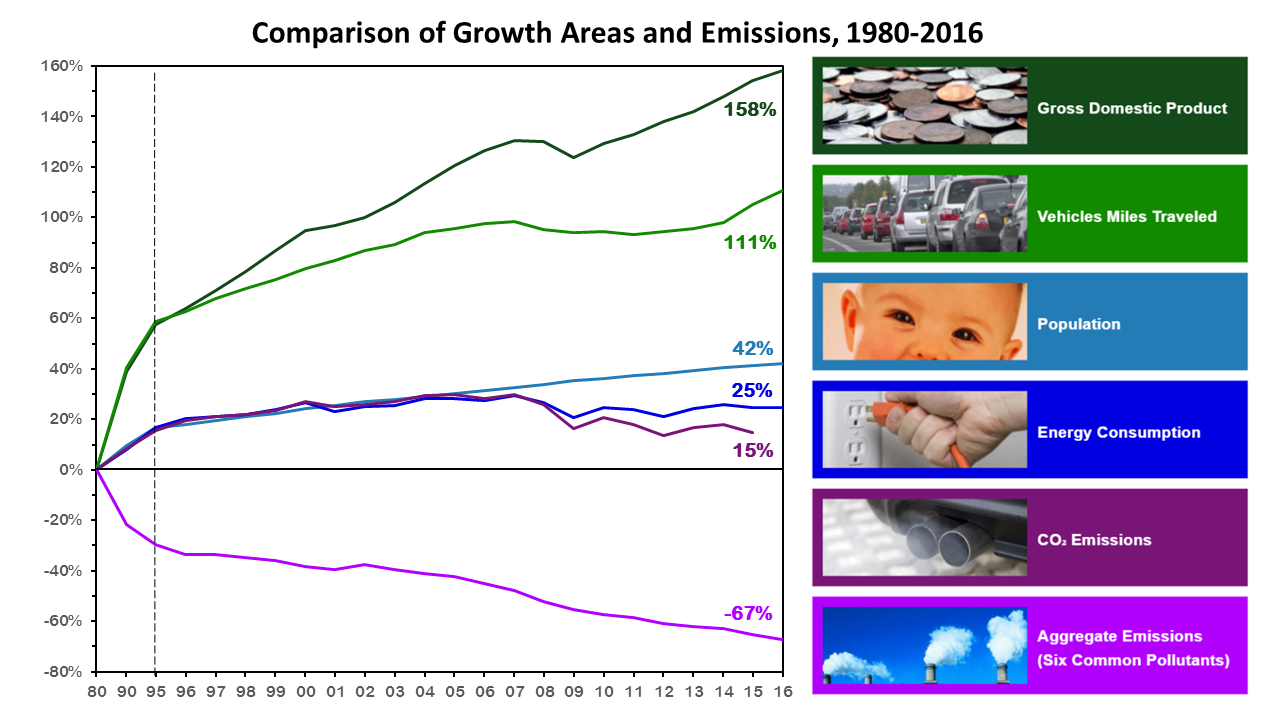
As the EPA’s graph has shown since I first noticed it decades ago, consumption follows GDP. Miles driven tracked GDP closely until government interference somewhat decoupled the two. Gasoline prices hardly affected driving, ever. Overall economy did, though.
The situation for energy is not a lot different. The government meddling and regulating matter more than expectable factors.
Oh, and don’t miss the fact that the air has gotten cleaner practically every year since 1970. Air pollution is an imaginary problem at the national level. Our air, as a nation, is cleaner than it was a century ago. Coal has not been a problem in that regard for a very long time.
Re: “Conventional wisdom is very wrong in blaming solar power and wind power for the higher California prices.” and (in his linked blog article) “The reason for the higher price is low electricity consumption in a mild climate, by a very large number of customers…”
No. Electricity prices are set by regulators, on a cost-plus basis. So higher costs result in higher prices. Solar and wind have high costs, so they cause high prices.
Neither mild climate nor large State population cause California’s high electricity prices.
Louisiana has a mild climate, but very low electricity prices. North Dakota has a harsh, cold climate, and also has low electricity prices. What they have in common certainly is not climate! What they have in common is fossil fuel production.
Re: “The conclusion that can be drawn is that there is indeed… a very good correlation, between average price for residential electricity and the quantity of electricity consumed on an annual basis by each utility customer.”
Right, but the (inverse) causation runs mostly in the opposite direction from what you seem to think, Roger.
Reduced consumption can sometimes cause slightly higher average prices, because with low consumption the fixed costs of the distribution grid must be spread across smaller number of kW-hrs. However, that may be offset by the reduced necessity to use expensive, inefficient, last-resort power sources during periods of peak demand.
The observed inverse correlation is mainly because higher electricity prices cause reduced consumption, particularly in the long term.
There are two fatal flaws in this argument. The first is the assumption that correlation proves causation. It doesn’t and other evidence is required to confirm such a claim. The second is the use of a small sample. Believe it or not, the USA is not the whole world. I suspect that if this study had included all of the developed world, this apparent correlation would disappear in a puff of smoke. Here in the UK we have just had a 15% hike in electricity prices and it is directly attributable to the subsidies paid to offshore wind farms and the cost of their connection infrastructure, which are coming on line at a rapid pace.
“If I was paying 17.58¢/kWh, I would use a helluva lot less electricity than I actually use at 11¢/kWh.”
So Allen you think this is a worthwhile comment and think David M is being truthful?
If David had said I used to pay 5c/kwh and now I am paying 11c/kwh. This how much I reduced my usage and these are the things I did …..
Well then I might I might think David is credible.
Allen if you were a skeptical thinker, you might be wondering why David M needs price incentives to do the right thing. Why would a reasonable person use more energy than they need just because it is cheap?
I have always had relatively low energy bills by doing all the cheap practical things. While my personal ethics about using energy are not something I demand of other people, I am really skeptical of claims of lifestyle changes based on price incentives.
“Kit has made unsubstantiated and aggressive accusations.”
Allen the lies are obvious. I call people liars because the lies are told so often the people like you believe them. It is not an accusation, it is pointing a fact.
In my line of work, you did not get fired for making a mistake. You get fired for lying about it. I have told people they were lying. Very aggressively but behind closed doors.
There are a few here who write convincingly about all kinds of subjects. It would be nice if those people would stick subjects where they at least have some experience. If you lie about making electricity, wait for it…..
The fact that someone retired doesn’t understand supply and demand curves just goes to show that the lack of even basic economics instruction in high school is not a recent problem.
After 40 years in the power including working in the control room of nuke plants cold winters nights and hot days, I understand the difference between theory and reality.
Power demand is insensitive to price signals.
In a free market things cost approximately the same in all states. Any differences should be in transportation costs and state taxes. It would be interesting to see e.g. automobile cost vs state.
To be a little more explicit, the reason electricity costs are so high in California is because of the requirement that x amount of energy must come from renewable sources which are much more expensive than coal or natural gas. Plotting energy cost versus energy consumption has almost no significance — people use the amount of energy they need almost independent of cost.
Jim Butts wrote, “people use the amount of energy they need almost independent of cost.”
Only in the short term, Jim.
Short term elasticity of demand for energy is low, but long term elasticity of demand is pretty high. When gasoline becomes expensive you still have to commute to work, and you won’t scrap your SUV because of sticker shock at the pump, but when you replace your vehicle in a few years you’ll shop for something that gets better mileage. When electricity becomes expensive you won’t stop taking hot showers or tear down your poorly-insulated house, but when you replace your water heater you’ll get a more efficient one, and when you remodel your house you’ll spring for the extra insulation.
I double that Dave, you get A+ for ECON101 on price elasticity (and normally only 40% of my college students understand this short versus long run aspect of elasticity on exams), see my comments above, also lots of empirical papers have price elasticity estimates, one I yanked and linked to has some short and long run estimates.
Yep, I think Dave pins it there, and it is the long term relationship which shows in the annual data, not what we do in a heat wave or a cold snap in winter.
“To be a little more explicit, the reason electricity costs are so high in California is because of the requirement that x amount of energy must come from renewable sources which are much more expensive than coal or natural gas. Plotting energy cost versus energy consumption has almost no significance — people use the amount of energy they need almost independent of cost.”
Jim, 90% of californias solar capacity was installed after 2010. This fact applies equally to the overall renewable capacity in california. If renewables is pushing up the cost of electricity in the state the per capita cost of electricity should graph out as a flat line from 1990 to 2010 and rise rapidly after 2010.
I have lived in california during that entire time period. My utility bill has stayed almost flat the entire time. My electricity bill did go up in 2015 mainly due to new chevy volt. but Overall I am pay a lot less for gas (I have only fill ed up the gas tank about 4 times this year). I have not yet seen any graph showing the cost of electricity increasing with renewable installed capacity and I certainly don’t see that in my own utility bill.
Also if we look at Texas they have also installed a lot of wind capacity since 2010. So if renewables rase utility costs to the customer you should also see a dramatic price increase starting in 2010. Again I have never see a graph showing that. In fact many people still compare texas to california and claim renewables cause electricity prices to increase. There is no correlation between electricity cost and the installed capacity of renewables in either state.
Its not just renewables, its also related actions. If the States govt is full of the faithfull (Ca and South Australia) they overcommitt and also start demolishing fossil and nuclear plants, and start relying on imported power when renewables inevitably tail off.
Jim you are wrong. Power prices where high in California before renewable energy. I was there.
There was a time when power prices were low in California. Los Angles Water and Power got 75% from out of state coal plants with no pollution controls. S, David Freeman took care of that just after he closed the nuke plant in Sacramento where I worked.
Price influencing consumers in Australia
https://cleantechnica.com/2017/08/13/tesla-powerwall-high-electricity-prices-driving-australians-energy-storage/
Again Griff please refrain from commenting on things you know nothing about reading some article from some political sales pitch article. What is the driver for the uptake is SA is going to have massive shortage problems for the next 2 years and so is offering massive incentives.
https://www.solarchoice.net.au/blog/news/how-south-australian-government-supporting-renewables-energy-storage-290316
If you have the initial money to invest it’s a pretty good deal … if you don’t well bad luck chump.
Like all your stupid articles, you cherry pick positives.
I will make a prediction the sales figures will continue an upward trend so long as the power grid remains as fragile as it has been dragged and the tax payers can afford to keep paying the incentives. When those two things change the sales will drop to a very small number where they started historically.
Roger,
Many of us in Australia cannot construct graphs like shown in your feature piece. This is because the price paid for electricity is affected by voluntary rebates and multi-tier price schemes for peak versus non-peak and different transition points in different geographies. The result is a rubbery price probably incapable of correlation coefficients like you quote because price is a combination of many variables, some not related to consumption.
Do you have this complication in your data?
Correlation coefficients between two nominated variables have no meaning if there is no causal relation between them. You need to state the absolute errors involved in your figures rot consumption and price. You need to quantify factors such as the quality of electricity from time to time such as whether there are voltage drops in commercial supplies as loads peak, and whether electricity from various sources has the same relation to price that you postulate overall, with a dubious use of r squared for publicity more than for rigour.
Lawyer views can be more arm waving than scientists like. Cheers. Geoff
Cherry 🍒 picking of correlations by greens
In the field of ionizing radiation biology and epidemiology, related to nuclear safety, there is a strong negative correlation between rates of cancer incidence and background levels of radiation dose received by the public, in the USA. Yes – negative. States and regions with higher background radiation have lower cancer mortality. This has been shown for decades by epidemiologists such as Cohen and Jaworowski.
However the radiation epidemiology community have rejected the conclusion from this that low levels of radiation are protective against cancer. Instead they argue that there are many other factors such as socioeconomic ones which confound a causal conclusion about radiation and carcinogenesis. To the extent that what they call “ecological studies” which just correlate parameters A and B between regions, are practically outlawed in epidemiology. They favour much more tightly controlled cohort studies.
And they’re probably right – by far the biggest determinant of health and lifespan is socioeconomic. More money and more social connections add decades to your life. By contrast radiation is an exceptionally weak carcinogen and is among a host of rusk factors that might shorten or lengthen one’s life bu hours, days or weeks.
Now contrast this rejection of correlative ecological studies in the radiation field, with the wonderland of climate “science”. Here correlation is ALWAYS causation. Every possible bad thing that has happened, or has been computer modeled to virtually happen, has been attributed a climate warming causation simply because the naturally chaotically oscillating climate happens by chance to have been warming over the last century following the LIA. No-one in the climate community has any hesitation in ascribing climate causation to anything and everything.
So the same progressive green community advances its pseudoscientific agenda by diametrically opposite arguments in different fields, taking advantage of the fact that scientists and decisions-makers in one field are usually sterile of knowledge in any other field.
In radiation biology, to help kill nuclear power, correlation is NEVER causation.
In climate science, to kill right wing capitalism, correlation is ALWAYS causation.
(And it’s all done in the best POSSIBLE taste!)
Low level radiation external to the body, or even internal to the body for brief periods, is not a problem (or even the issue). The problem is when highly radioactive hot particles of certain man-made isotopes enter the body for extended periods, either through immediate contact (eg, plutonium in lungs, iodine-131 in thyroid) or by incorporation into cellular tissue (eg, strontium-90 in bone, cesium-137 in muscle). Try inhaling or ingesting a 1 quadrillion becquerels per kilogram hot particle (insanely radioactive), like some found in dirt and dust samples taken in Japan, and see how that enhances your health.
Low ionizing radiation dose is is like low levels of smoke (second hand smoke). They both have a weak or negative correlation with mortality. And the reason may be that we have evolved in the presence of both– radioactive decay of unstable isotopes, cosmic rays, campfires, —–.
ICISIL, Jim
Low level radiation below a few tens of mSv is indeed either harmless or slightly beneficial, although the “hot particle” scenario outlined by ICISIL is a valid one. I collaborated with radiation scientists in Kiev, Ukraine in the 90’s, on behalf of a UK university, to develop SSNTD (solid state nuclear track detector) based methods for detecting and characterising such Pu, Am hot particles. This method is in use to this day in Chernobyl remediation.
The LNT (linear no threshold) hypothesis behind “conservative” (and nuclear energy bankrupting) radiation protection practices is patently false, a few seconds search of the radiobiological literature with Google scholar or pubmed will reveal dozens of highly repeatable studies in which low level (low LET) radiation decreases cancer incidence and increases lifespan in mice and rats. There is a threshold below which there is no radiation harm. This reduces the number of virtual deaths from radioactivity contamination events (e.g. Chernobyl, Fukushima) from tens/hundreds of thousands to nearly zero. LNT creates these “deaths” statistically out of thin air and is a powerful political weapon against nuclear and it has almost succeeded in killing off the industry.
However the negative correlation between cancer deaths and background radiation levels such as Cohen reported in the USA, is mainly because areas of natural beauty in the mountains etc. tend to (a) have higher levels of background radiation and (b) be inhabited by richer (thus healthier) people.
The best epidemiological study of radiation carcinogenesis was the US shipyards study. Here two shipyards were compared in which the socioeconomic characteristics of the workforces were very similar, the only difference being that one was a nuclear shipyard and the other not. Almost the perfect, textbook epidemiological controlled cohort study. Its only “failing” was it’s politically incorrect result. There was a very clear threshold of a few tens of mSv, above which there was elevated cancer incidence (only in the single, highest dose group), below which there was not. For this reason the study and its results were suppressed by the scientific community where antinuclear activism holds sway. Have you heard of this study? Thought not (but you’re not to blame).
I have heard of the study and was also the radiation safety officer a nuclear ship during shipyard availability.
The best way to reduce paper work is avoid exposure.
Roger is an anti-nuke. His only experience in the power industry is being a self proclaimed critic. There is a lot of that in California.
Anti-nukes are often advocates of other things but never accomplish anything.
The same companies that are good at building and operating nukes are good with coal too. Also wind and solar too.
I am one of those all of the above people. Do it right, the first time.
I am anti-clown. The engineer that sat next me at the nuke plant near Detroit was famous for going to the meeting dresses as Bozo. He looked at upper management and told them he wanted the rest of the clowns to feel more comfortable.
The problem with the wind and solar clowns is that they put stuff where it will not work. Making power is about good engineering not bad politics.