By Irene Klotz, Space.com Contributor, Original Story on Space.com Here

An artist’s impression of a nuclear power system, consisting of four separate fission reactors, for Mars habitats.
Credit: NASA/Kilopower
As NASA makes plans to one day send humans to Mars, one of the key technical gaps the agency is working to fill is how to provide enough power on the Red Planet’s surface for fuel production, habitats and other equipment. One option: small nuclear fission reactors, which work by splitting uranium atoms to generate heat, which is then converted into electric power.
NASA’s technology development branch has been funding a project called Kilopower for three years, with the aim of demonstrating the system at the Nevada National Security Site near Las Vegas. Testing is due to start in September and end in January 2018.
The last time NASA tested a fission reactor was during the 1960s’ Systems for Nuclear Auxiliary Power, or SNAP, program, which developed two types of nuclear power systems. The first system — radioisotope thermoelectric generators, or RTGs — taps heat released from the natural decay of a radioactive element, such as plutonium. RTGs have powered dozens of space probes over the years, including the Curiosity rover currently exploring Mars. [Nuclear Generators Power NASA Deep Space Probes (Infographic)]
The second technology developed under SNAP was an atom-splitting fission reactor. SNAP-10A was the first — and so far, only — U.S. nuclear power plant to operate in space. Launched on April 3, 1965, SNAP-10A operated for 43 days, producing 500 watts of electrical power, before an unrelated equipment failure ended the demonstration. The spacecraft remains in Earth orbit.
Russia has been far more active developing and flying spacecraft powered by small fission reactors, including 30 Radar Ocean Reconnaissance Satellites, or RORSAT, which flew between 1967 and 1988, and higher-powered TOPAZ systems. TOPAZ is an acronym for Thermionic Experiment with Conversion in Active Zone.

A photograph of the SNAP-8 generator from the Lewis Research Center, part of NASA’s Systems for Nuclear Auxiliary Power (SNAP) program. Here, engineers exposed the system to shocks and vibrations expected to occur during a launch into space and subsequent maneuvering.
Credit: NASA
Nuclear power revival
Read the complete article here
Irene Klotz can be reached on Twitter at @free_space. Follow us @Spacedotcom, Facebook and Google+. Original article on Space.com.
There is no water on the moon and no water at Mars. Without water, no colonies. End of story.
One large comet would provide all the water needed in the short term, however I am sure that water can be manufactured if required.
We don’t do it Earth because we don’t need to.
Manufactured out of what? You need hydrogen to make water, and where are you going to get that from?
One large comet would provide all the water needed in the short term
How are you going to stop, manouevre and then lower a comet onto Mars? At 10 miles per second, they don’t just brake you know.
People lose all sense of the possible when it comes to space.
There’s probably more water on Mars than you think https://www.nasa.gov/press-release/nasa-confirms-evidence-that-liquid-water-flows-on-today-s-mars. Would be a bit of an Arrakis experience but probably doable.
Water has been found on both Mars and the moon.
There is water ice on the Moon in craters permanently sheltered from sunlight. There is also water ice on Mercury.
The main reason NASA should establish a base on the Moon is to harvest the water ice that is there and use that ice to lower the costs of space exploration and development.
does anyone have a number? the real number of how much tax payer money NASA pizzles through with 0 return?
The real number is far greater than one we are given for space programs
NASA has been scamming billions for junk science for decades
What is a nuclear physicists favourite meal? Fission chips. ………
I’ll get my coat…..
“…small nuclear fission reactors, which work by splitting uranium atoms to generate heat, which is then converted into electric power.”
Are they going to carry water with them to make steam with? Or are there other ways of making electricity with heat?
Cowboy,
It’s called an RTG. Look it up.
Thank you, never heard of it.
Mars also does have an abundance of water ice about just below the surface.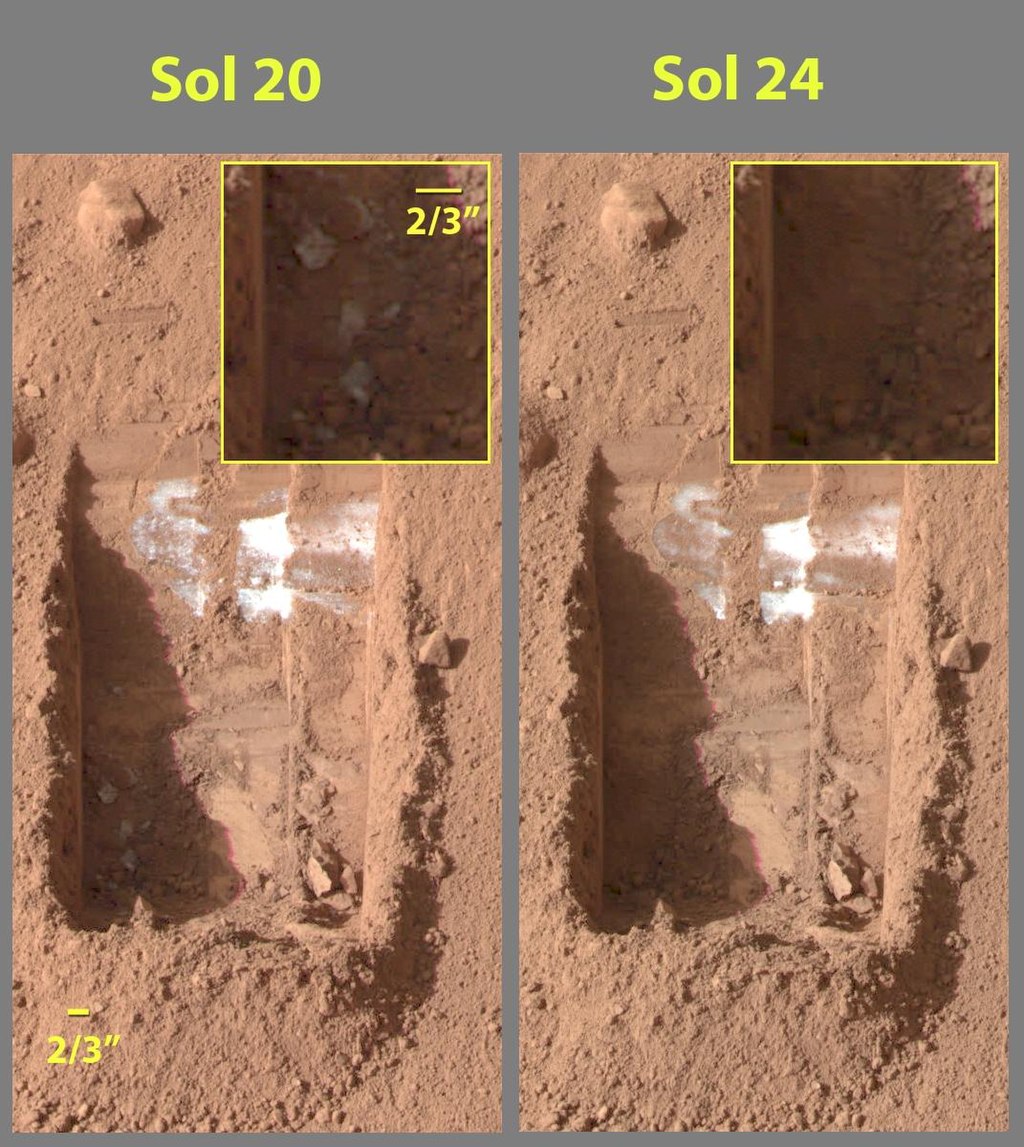
Clearly visible in these images from the Phoenix Lander
Hmmmm…let’s see…maybe try searching for something called a thermo-electric generator?
Money is on they will attempt to have a base on the moon first. Interestingly it has a two week day and night so nuke power is required.
Why the powers that be disregard thorium for mere low power TMG’s running off a dangerously fast decaying isotope is withering.
That unit on the back of Mars Curiosity rover could only muster 125 watts when first assembled.
Still no hard proof of water available at the moon or mars. Without water, no condo on the moon. http://canadafreepress.com/print_friendly/your-condo-on-the-moon
Bryan A
July 10, 2017 at 10:18 am
Mars also does have an abundance of water ice about just below the surface.
Clearly visible in these images from the Phoenix Lander
That is dry ice not frozen water.