From the University of Wisconsin
From rocks in Colorado, evidence of a ‘chaotic solar system’
Plumbing a 90 million-year-old layer cake of sedimentary rock in Colorado, a team of scientists from the University of Wisconsin–Madison and Northwestern University has found evidence confirming a critical theory of how the planets in our solar system behave in their orbits around the sun.

The finding, published Feb. 23, 2017 in the journal Nature, is important because it provides the first hard proof for what scientists call the “chaotic solar system,” a theory proposed in 1989 to account for small variations in the present conditions of the solar system. The variations, playing out over many millions of years, produce big changes in our planet’s climate — changes that can be reflected in the rocks that record Earth’s history.

Geoscience Professor Stephen Meyers. © GIGI COHEN
The discovery promises not only a better understanding of the mechanics of the solar system, but also a more precise measuring stick for geologic time. Moreover, it offers a better understanding of the link between orbital variations and climate change over geologic time scales.
Using evidence from alternating layers of limestone and shale laid down over millions of years in a shallow North American seaway at the time dinosaurs held sway on Earth, the team led by UW–Madison Professor of Geoscience Stephen Meyers and Northwestern University Professor of Earth and Planetary Sciences Brad Sageman discovered the 87 million-year-old signature of a “resonance transition” between Mars and Earth. A resonance transition is the consequence of the “butterfly effect” in chaos theory. It plays on the idea that small changes in the initial conditions of a nonlinear system can have large effects over time.
In the context of the solar system, the phenomenon occurs when two orbiting bodies periodically tug at one another, as occurs when a planet in its track around the sun passes in relative proximity to another planet in its own orbit. These small but regular ticks in a planet’s orbit can exert big changes on the location and orientation of a planet on its axis relative to the sun and, accordingly, change the amount of solar radiation a planet receives over a given area. Where and how much solar radiation a planet gets is a key driver of climate.
This animation shows a chaotic solar system and changing planetary orbits playing out over billions of years, illustrating the slight chance in the distant future of planetary collisions. Geologic evidence was recently found to confirm the idea that the planets in our solar system do not orbit the sun like clockwork in a quasiperiodic manner, as has been believed since the 18th century. Credit: Jacques Laskar
“The impact of astronomical cycles on climate can be quite large,” explains Meyers, noting as an example the pacing of the Earth’s ice ages, which have been reliably matched to periodic changes in the shape of Earth’s orbit, and the tilt of our planet on its axis. “Astronomical theory permits a very detailed evaluation of past climate events that may provide an analog for future climate.”
To find the signature of a resonance transition, Meyers, Sageman and UW–Madison graduate student Chao Ma, whose dissertation work this comprises, looked to the geologic record in what is known as the Niobrara Formation in Colorado. The formation was laid down layer by layer over tens of millions of years as sediment was deposited on the bottom of a vast seaway known as the Cretaceous Western Interior Seaway. The shallow ocean stretched from what is now the Arctic Ocean to the Gulf of Mexico, separating the eastern and western portions of North America.
“The Niobrara Formation exhibits pronounced rhythmic rock layering due to changes in the relative abundance of clay and calcium carbonate,” notes Meyers, an authority on astrochronology, which utilizes astronomical cycles to measure geologic time. “The source of the clay (laid down as shale) is from weathering of the land surface and the influx of clay to the seaway via rivers. The source of the calcium carbonate (limestone) is the shells of organisms, mostly microscopic, that lived in the water column.”
The finding is important because it provides the first hard proof for the “chaotic solar system,” a theory proposed in 1989 to account for small variations in the present conditions of the solar system.
Meyers explains that while the link between climate change and sedimentation can be complex, the basic idea is simple: “Climate change influences the relative delivery of clay versus calcium carbonate, recording the astronomical signal in the process. For example, imagine a very warm and wet climate state that pumps clay into the seaway via rivers, producing a clay-rich rock or shale, alternating with a drier and cooler climate state which pumps less clay into the seaway and produces a calcium carbonate-rich rock or limestone.”
The new study was supported by grants from the National Science Foundation. It builds on a meticulous stratigraphic record and important astrochronologic studies of the Niobrara Formation, the latter conducted in the dissertation work of Robert Locklair, a former student of Sageman’s at Northwestern.
Dating of the Mars-Earth resonance transition found by Ma, Meyers and Sageman was confirmed by radioisotopic dating, a method for dating the absolute ages of rocks using known rates of radioactive decay of elements in the rocks. In recent years, major advances in the accuracy and precision of radioisotopic dating, devised by UW–Madison geoscience Professor Bradley Singer and others, have been introduced and contribute to the dating of the resonance transition.
“Other studies have suggested the presence of chaos based on geologic data. But this is the first unambiguous evidence …”
Stephen Meyers
The motions of the planets around the sun has been a subject of deep scientific interest since the advent of the heliocentric theory — the idea that the Earth and planets revolve around the sun — in the 16th century. From the 18th century, the dominant view of the solar system was that the planets orbited the sun like clockwork, having quasiperiodic and highly predictable orbits. In 1988, however, numerical calculations of the outer planets showed Pluto’s orbit to be “chaotic” and the idea of a chaotic solar system was proposed in 1989 by astronomer Jacques Laskar, now at the Paris Observatory.
Following Laskar’s proposal of a chaotic solar system, scientists have been looking in earnest for definitive evidence that would support the idea, says Meyers.
“Other studies have suggested the presence of chaos based on geologic data,” says Meyers. “But this is the first unambiguous evidence, made possible by the availability of high-quality, radioisotopic dates and the strong astronomical signal preserved in the rocks.”
– See more at: http://news.wisc.edu/from-rocks-in-colorado-evidence-of-a-chaotic-solar-system/#sthash.vtKvXCKY.dpuf
h/t to Joe D’Aleo
Likewise, The precession of the lunar line-of-apse and the lunar line-of-nodes – which are the lunar equivalents of the precession of the Perihelion of the Earth’s and Mars’ orbit and the precession of the nodes of the orbit of the Earth and Mars, are also affected by the relative orbital positions of the Jovian planets, when integrated over tens of millions of years. Note that the position of the centre-of-mass (or Barycentre) of the solar system compared to the centre of the Sun is a proxy for the relative positions of the Jovian planets.
http://astroclimateconnection.blogspot.com.au/2010/03/synchronization-between-solar-inertial.html
http://1.bp.blogspot.com/_tG8JCC_Tnp0/S549wMcQ3rI/AAAAAAAAACY/Su5no2LPfeg/s1600-h/Solar_Lunar.JPG
Replacement image for post at 7:14 a.m. February 27th. Hopefully this image will post.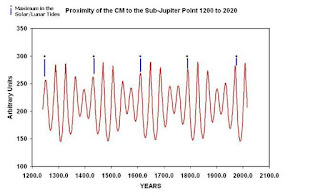
It is a bit contradicting that they point to chaos, and anyway think they can calculate what happened or would happen. The most they can say is that it might change somehow.
It’s come to this. We’re actually looking under rocks to come up with plausible explanations for changing climate! Surprised Cat is surprised.
Niobara Fm. hosts significant oil shales. Maybe an exploration tool this theory.
I think considering only Mars too narrow an idea. The entire solar system travels relatively to the galactic arm it is contained in. We encounter other gravitational tugs on this journey and attract bolides as well. Maybe Meyers et al have too clockworky a view even in their theory.
As a geologist I indeed do not have extensive knowledge of ‘multivariate non-linear systems or a comprehensive understanding of celestial mechanics’ as mentioned above. But I can’t help but wonder if, for those who do have those skills, if this might not be a highly evolved version of ‘if your tool is a hammer every problem looks like a nail.’ The reason I say that is because geologists have been looking at the extensive rhythmic and repetitive sedimentary deposits around the world, comparing them to the ongoing sedimentation processes they see happening around them in real time, and finding them entirely consistent. Because of their economic significance sediments and sedimentary processes are extensively studied. If the processes we observe were inadequate to explain these deposits that inadequacy certainly should have been exposed long before now. With many years of geology and oil and gas industry experience (now retired) I’ve never heard of the need to go outside the earth to explain these deposits. I’m not closed-minded to a new idea, but I’d like to see something more than two things that both happen to be cyclical.
true
In this link is a photograph from a place called Smokovac in Montenegro (north Mediterranean) , not far from the place I was born. It shows newest top rock formation from the sea floor, now rotated by 90 degrees in vertical position; it clearly shows layering of different strata that might have taken millions of years to form. However, the bottom older rocks are inclined at about 30 degrees.
I’m assuming that the top part belonged to a different tectonic plate, riding over subducting plate in the bottom section.
What might be your interpretation of this strange arrangement?
A simple explanation is that the newest rocks (A) and oldest rocks(B) were subject to different tectonic events. B was deposited , at some point the formation was tilted/rotated to 60deg. An unconformity would have created a planar surface for newer sediments A (whenever sedimentation resumed). After X time the entire package of rocks, A&B, were rotated to the vertical position. Of course it is more complicated than that. The point is that one area could be subject to vastly different tectonic events.
Well of course what is your definition of ‘outside the earth’ ???
Since all of geology is affected by the sun, in terms of it being the driving engine of the water erosion and deposition cycles, how can you say that you dont need to go ‘outside the earth’??
Surely you are not asserting that climate change has not affected what types of rock are deposited?
If climate change itself has a ’cause’ outside of the earth, then that too is a statement that refutes the ‘no need’ to go outside the earth’?
Or did you misunderstand the (rather muddled) point of the article: Namely that geological climate change obviously exists, and may well have been (partly) driven by climate change, and the cycles seen in it – the geology or the climate change – are not inconsistent with quasi-periodic changes in celestial orbits.
Look at the surface of the moon. No erosion to obscure history.
The earth has weathered many more impactors yet climate is stable enough for evolution? Impactors alter atmosphere and orbit. Impactors expose fresh mineral faces which increases erosion.
Planetary geology is where you need to look.
Poor old Milankovitch must be rolling in his grave. It’s one thing to explain recent geology through astronomy–which Milankovitch did quite nicely. Quite another to do it backwards and infer planetary behavior from ancient geology. And whenever I hear someone say total insolation varies only slightly, or that they have to “tune” the data to get a fit, I can’t even roll my eyes.
For the thousandth time, insolation at 50 degrees north latitude varies by a max of 100W per meter squared, while all you need is an average of 3W per meter to melt a km of ice in 10ky. And “tuning” is what enables the eyeball to easily recognize the continents on an ancient map when they are deformed to the extent that R is near zero.
And these crackpots “discovered the 87 million-year-old signature of a ‘resonance transition’ between Mars and Earth”? Goes to show how bad it can get when the arbitration is loaded with climate quacks. –AGF
+1
The Solar System is still a chaotic system, just over a longer time scale.
Light is beginning to dawn. The word “chaos” is starting to creep into more areas of the climate discussion despite the innate predjudice against it in many scientific disciplines.
Even planetary orbits chaotic? Fortress linear never looked less secure.
Linear is a special and localised and limited form of the chaotic. As the size of your universe tends to zero, all rules governing in tend to linear.
Small islands of quasi stability adrift in a storm tossed sea of chaos.
The Milankovich forced glacial-interglacial oscillation is an example of a periodically forced nonlinear oscillator. Such systems were first identified and studied by Mary Cartwright of Oxford University in the 1940s in the context of wartime research into radar and electronic noise. Her work on this was largely forgotten then later re-“discovered” by others.
External periodic forcing of a nonlinear oscillator – such as the classic Belousov-Zhabotinsky chemical oscillator – can be either strong or weak. If glacial Milankovich forcing was strong, then the cycle would be a simple monotonic reflection of the dominant forcer e.g. obliquity or precession. But weak forcing means that the system’s internal oscillations are as strong or stronger than the external forcing. Here it gets much more messy. The emergent oscillation can be complex such that the periodicity of the weak forcer is hard to recognise. Such is the nature of the Milankovich glacial phenomenon – it’s a weakly periodically forced nonlinear oscillator.
Interesting analysis. In my comments further above I have considered possibility of the Milankovic cycles not being direct cause but acting as synchronising trigger inputs into a self sustaining oscillating system. Further complication I see here is that the Milankovic cycles are strictly periodic, while the interglacial oscillations internal time ‘constant’, is not a constant at all but a variable driven by the geological evolution in the area I considered.
vukcevic: I find your viewpoint very interesting, but -0 and heres the rub, just as limiting as those who say ‘its all due to X, Y or even Z’
The reality is that I suspect its extremely likely that everything affects climate, and more than one thing affect it hugely.
Now this is an area I cant seem to pin any mathematicians down on, and that is just how many variables of a chaotic equation are needed to drive a system the way climate historically seems to have been driven.
But I strongly suspect its more than just one.
Hi Mr. Smith
Not being any kind of expert, or particularly knowledgeable on the subject, just an exercise in rational thinking, as far as I see it, climate is a regional thing. Every region has one or two major and masses of the minor factors . The major factors persist while the lesser ones, even if temporarily could dominate, they eventually taper off. Any attempt to define a global trend most likely is a task doomed to failure.
Vukcevich, Leo Smith
Thanks for your comments. Indeed “triggering” or “pacing” are other ways of describing a weak periodic forcing.
Leo – of course very many things will affect climate and the oceanic circulation modes that drive major climate change. However a chaotic outcome does not I believe require multiple inputs; just one or two will do it if they are weak relative to the system’s internal resonance-enhanced oscillations. One published example is the chaotic tidal oscillations that can arise when the lunar tidal forcing is funelled through a narrow inlet to a bay – the resonances and bay topography combine to change the tidal pattern to either a more complex form of the forcing frequency or a chaotic oscillation:
http://s3.amazonaws.com/academia.edu.documents/41591594
Of course the analogy to ice age oscillation is very distant, but the point here is how an external periodic forcing which is completely regular but is attenuated can give rise to chaotic dynamics in the forced system to the extent that the forcing (lunar tidal) time signature may become unrecognisable.
Or you could try this link:
http://s3.amazonaws.com/academia.edu.documents/41591594/On_the_nonlinear_Helmholtz_response_of_a20160126-15196-61uhfq.pdf?AWSAccessKeyId=AKIAIWOWYYGZ2Y53UL3A&Expires=1488149256&Signature=oxlZfoO5e7mmT61jl4cztk0BEtw%3D&response-content-disposition=inline%3B%20filename%3DOn_the_nonlinear_Helmholtz_response_of_a.pdf
let us just put up the variables we know of [feel free to add variables that could affect the weather.]
1) We have varying input due to energy coming from the sun, i.e. various solar cycles, mainly 11, 22 and 87 years.
2) It is not only total E coming in varying here, allegedly only by about 0.1%, there is also a variation in the wavelengths of E: The lower the magnetic field strength, the more energetic particles can leave the sun, the more ozone, N-O and peroxides are produced TOA, the less UV is allowed through the atmosphere. So we must look at measuring UV coming in at a daily basis as this affects the amount of heat going into the oceans.
3) the strengths of the solar cycles are pre-determined by the position of the barycenter of the whole solar system….which includes the position and movement of the planets.
4) earth inner core is moving, and as it happened, it moved a lot more north, going by the shift in the magnetic north pole. Hence we see the ice on the north pole decreasing; the rise in the T over the past 40 years according to my measurement was 0.02K/annum in Nh and 0.00K/annum in the Sh….this is a local affect wrongfully blamed on CO2 warming.
5) we have the lunar tides which affect the amount of mixing of the much deeper and much cooler waters with the top layers, and this affects the evaporation rate in general: the more mixing of the top with the bottom layers the less water vapor is produced? I am asking.
6) we have varying amounts of volcanic activity, and again, just like the Lunar tides, this could affect the T of the sea waters where this activity happens.
7) human activities, especially nuclear, which are warming the waters and rivers, could also affect the total evaporation rate of water on earth.
[but I think not so much]
8) burning of fossil fuel / H2/ could also warm the atmosphere to some extent, [but I think not so much]
Meyer’s thesis is not a new discovery but its good to see the idea reinvigorated. Geologists before him called the cyclicality or cyclic nature of sedimentary rocks, cycles, cyclothems. This has been documented in geology textbooks on sedimentation since I attended in the 1960s.Peter Vail of Exxon, doing work in Indonesia noted a worldwide cyclic nature of sedimentation again and documents this in publication, in the American Association of Petroleum Geologists Bulletin in the 1980s-1990s.
And I might add from my own experience witnessed during investigations of the rock strata from geological prospecting in the US Rocky Mountains: 1. rock strata in the Ordovician Red River Formation of North and South Dakota record nearly identical repeating sequences of dolomite-limestone-anhydrite-black shale “rhythms” with total thickness of 30 to 40 feet that record “shallowing” and then “deepening” of oceans from deposits of near-shore deposits; 2. rock strata of the Mississippian Mission Canyon Formation of North Dakota and the Permo-Pennsylvanian Minnelusa Formation of Wyoming to South Dakota record the same repeatable sequences, 30 to 40 feet in thickness that record sequences of black shale, anhydrite, limestone and dolomite that first exhibit “shallowing” and then reverse to record “deepening” of the near-shore deposits as the rocks reveal conditions that we can relate to these for repeating environments today as supratidal (above sea level) to peritidal, to open marine to restricted marine . The rock sequences are so predictable that geologists, including myself, use these as “models” to predict, find and discover and then produce previously unknown, and undiscovered deposits of oil and natural gas.
“Seaway” does not mean “shallow ocean.” When a paper starts off with such a clinker I am immediately dubious. Having passed DiffEQ, when insults to geologists immediately follow I am even more dubious. This article is a crock.
This thread is bizarre, some people have too much time on their hands, clearly…
Yet the WIS was a shallow ocean, ie an epicontinental sea, like the East and South China Seas or North Sea today.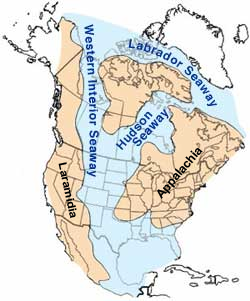
Life and death in the dangerous WIS: mosasaur v. young pliosaur, from the great Oceans of Kansas site. Mosasaurs evolved from land lizards remarkably rapidly, perhaps aided by demise of the ichthyosaurs.
http://oceansofkansas.com/Varner/varner.jpg
Sharks circle dead hadrosaur washed out to sea:
Michael
thanks so much for that comment. I am over the moon with it [as it contributes to what exactly?].
Perhaps you just could give us your pass rate as well for the DiffEQ
that would help us evaluating your IQ
The presence of our moon is proving to be essential to maintaining a magnetic field and essential to holding a sustainable atmosphere for life to exist or ever begin through natural causes. A person has to question the idea of chaotic.
You have some proof for that?
Bailin,
You’ve got the magnetotail wagging the dog, so to speak. Once a month, earth’s magnetic tail raises dust storms and causes electrostatic discharges on the moon, but the weak magnetic field of our satellite has little to no effect on our planet, unless I’m mistaken.
Nor does the moon account for our air. Venus has an atmosphere on the order of 100 times denser than ours, without benefit of a big satellite.
Our unique moon has plenty of effects on earth but those you suggest aren’t among them.
This underscores the pitfalls of making assumptions. For centuries, it has been simply assumed, on the basis of no particular hard evidence, that variations in insolation resulting from Milankovitch rhythms were responsible for climate changes on Earth (“What else could it be?”) This despite N/S hemispheric differences in insolation that required compensatory “ancillary forcings” to explain them away. What if insolation has nothing to do with it? What if the actual effect is really gravitational? Okay, How can gravitation possibly affect climate? Easily, in fact, by affecting Earth’s delicately balanced plate tectonic system, setting it into increased or decreased motion. Why would that affect climate? Through increased or decreased volcanism, of course. Andesitic volcanism tends to cool Earth through aerosol production, but basaltic volcanism releases HCl and HBr, which, if elevated above sea level, as in Iceland, can enter the atmosphere and become a source of stratospheric ozone depletion, which allows more of Sun’s “hottest” UV-B radiation to reach Earth’s surface, where it is absorbed by water and water vapor, causing global warming. This is admittedly an unproven hypothesis, but there is a lot of circumstantial evidence with which it is fully consistent, and it should therefore at least have equal status with the likewise unproven insolation hypothesis.
David
if you come with a theory you have to produce at least some figures to support it.
Looking again at my own figures, it does not seem to support your theory.
over the past 40 years,
on means
on a truly representative global sample of 54 weather stations, [balanced to zero latitude]
I have 0.02K/annum warming in the NH and it is 0.00K/annum in the SH
average is 0.012K/annum, global
on maxima it is 0.026K/annum in the NH and 0.042K/annum in the SH.
average is 0.034K/annum globally.
Go figure how that fits in with your theory?
It’s consistent with some observed facts. First, obviously, there’s a gravitational component to Milankovitch rhythms. Should this simply be ignored, or should its possible ramifications be explored? Second, it’s been observed that volcanic eruptions tend to be more frequent during full Moons, an obvious gravitational effect. Third, tectonic plates are already in motion; it shouldn’t take much to nudge them into greater activity. Fourth, sedimentary rhythmites through the Phanerozoic aren’t glacially related, but they are related to Milankovitch rhythms. Insolation variation makes no sense with regard to sediment production, but increased tectonism does. Fifth, although both insolation and gravitation can only be assessed through correlations and theoretical calculations, neither of these constitutes hard data, and so definite proof of causation can’t ever be obtained for either possibility. Nonetheless, I think that weight of evidence and the fact that rhythmites can’t be ascribed to insolation place a stronger likelihood on gravitation as the actual cause of Milankovitch-related changes.
David
You did not help explain my results.
My results say insolation is happening and varying – various solar cycles.
Also that earth’s inner core moved a bit north east
… as evident by the shift in the magnetic north pole over the past 50 years.
Fine. No doubt they are, but that alone doesn’t invalidate my concept. The DJIA has been rising over the last hundred years or so, and so has atmospheric carbon dioxide. That doesn’t necessarily mean that the DJIA causes global warming. Both your mechanism and mine can explain observed facts, and to that extent both should be considered unless it can be shown that one of them is inconsistent with observed facts. When two or more such mechanisms can explain the same phenomenon, and neither or none of them can be shown to be invalid, then Occam’s razor comes into play, i.e., which mechanism has the fewest problems, requires the least arm-waving to make it work, is simplest and most straightforward, and is most consistent with observed facts. Considering these criteria, I submit that gravitation comes out ahead of insolation.
David
my own findings show that maximum T is falling on earth, globally, in line with the solar polar magnetic field strengths. Must be that as the magnetic field is falling, more of the most energetic particles are able to escape from the sun, forming more ozone, peroxides and N-oxides, TOA. More of these substances, as you can imagine, divert more of the normal UV back to space. Hence, less energy [UV] actually goes into the oceans.
Most data sets [except my own] have not even picked on the fact that globally cooling has already started, or are being manipulated to show otherwise.
you can draw a binomial from 1971 -2014 to represent the average polar field strengths?
[the ‘double’ sc around 1971 and 2014 indicate dead end stops]
henryp, your observations are probably correct. This mechanism, along with mine, should both be further investigated as probable causes of temperature change on Earth. In any case, the system is a whole lot more complex than the warmists and the carbon demonizers would have us believe.
Thanks for that comment
A serious and informative thread, but there is something missing that cannot be found (yet) from any of the above. That obliquity changes around a mean of 23,26′, where the mean is fixed for eternity, is false. It can change, and has done so and repeatedly, and abruptly, during the Holocene max. Those changes have been recorded in man-made calendars, along with the seismic events that resulted. Those events left their mark in various proxies. Thanks to several papers the dates of the events have been identified with a decent level of confidence. Perhaps someone would be interested to go back to the basics of obliquity and prove (or disprove) why the empirical part of obliquity (the as-is factor) is or should be unchanging.
Take a look at this structure, one of several. It is post 5200bce, latitude 35.8N. An 18deg equinox to solstice sunrise on horizon movement means an obliquity of around 14deg (rough calc). One of more than 16 different sites with same dimension, (but long story). Here: https://www.facebook.com/melitamegalithic/photos/a.433731873468290.1073741829.430211163820361/471094826398661/?type=3&theater Dating as per here: https://www.facebook.com/melitamegalithic/photos/a.729796877195120.1073741865.430211163820361/749567168551424/?type=3&theater
meltamegalithic’s argument is circumstantial, and therefore not proof of significant deviation from an obliquity of 23.4 degrees. The mechanism responsible for constancy of obliquity is Moon’s gravitational force on Earth’s equatorial bulge. This doesn’t vary over time.
David, I am presenting technical, -with a mathematical base-, evidence/proof (since no way it could happen by chance). The mechanism you describe accounts for the secular variation of obliquity, but not where the mean ought to reside. That evidence indicates that transient changes/shifts are possible.
That is not enough in itself. However three thousand years of technical development from one stage to another, once its been unraveled and understood, leaves little doubt. The latter half of that forced+developmental changes are dated. That those dates show up unmistakably as corresponding disturbances in various proxies, matter.
Now I have used one latter design to forecast the summer solstice (they are that versatile). The model was accurate to within 3hrs of UTC time. The original would be more accurate. Now that unit was designed to a lower obliquity, as several previous ones, and modified to higher as per today’s. That evidence I find hard to deny.
Gloateus Maximus March 4, 2017 at 11:50 am
Upon the imposition of direct Roman rule of Judea in AD 6, Publius Sulpicius Quirinius, Roman governor of Syria, did take a census. The Jewish historian Josephus portrays the annexation and census as the cause of an uprising which later became identified with the Zealot movement. The author of the Gospel of Luke (whom I’m willing to believe was the Luke of Acts) uses it as the narrative means by which Jesus gets born in Bethlehem, placing the census within the reign of Herod the Great, who actually died ten years earlier in 4 BC.
No satisfactory explanation has been put forward so far to resolve this contradiction.
———————————————————————————————————————
GM, many have been satisfied that the supposed contradiction has been resolved when they learn that the census in 6 AD was the 2nd taken while Quirinius was a Governor of Syria.That there were 2 is the reason Luke needed to specify:
Luke 2:2 (This was the first census that took place while Quirinius was governor of Syria.) (NIV)
The 1st census was indeed taken 10 years earlier while Herod still lived, as anyone who has looked into the matter as much as you have surely knows.
==============================================
Gloateus Maximus March 4, 2017 at 2:54 pm
…It is clear to the most casual observer, not blinded by faith, that the Bible was not written by Moses nor inspired by God. The writers in the Babylonian Captivity or before who reworked ancient Mesopotamian myths starring Yahweh rather than Marduk or Sumerian deities were at least creative.
————————————————————————————————————–
Genesis 6:15 This is how you are to build it: The ark is to be three hundred cubits long, fifty cubits wide and thirty cubits high. NIV
The Gilgamesh epic specifies the ship to be 10 ninda long, 10 ninda wide, and ten ninda high
GM, it is clear to the most casual observer, not blinded by bias, that the shape of the ship in Gen. 6:15 makes a sea-worthy craft, while a cube does not. This same casual observer would realize that the account that gets the details right is not a reworking of an account that gets them wrong.
SR
thanks Stevan for that comment.
I did not know about the two census es {?} but it makes good sense….
OOPS! my preceding post was meant to go further down…SR
The moon is currently receding at ~3.8 cm per year. This rate of course has not been constant. Four billion years ago, tidal calculations show it to have been only 16,000 km away from the Hadean Eon earth then spinning in a six-hour day.
Eventually the barycenter of the earth-moon system will lie outside the earth.
Gloateus
[does that mean the same as glorious?]
earth then spinning in a six hour day
henry says
must say
I have always been wondering about what Jesus says in Matthew 24
namely that during the great persecution [distress], those days with be shorter [shortened]
If I take that literally it would imply a large object from the solar system coming very nearby earth and changing its rotation speed…..obviously eventually causing disaster and the subsequent end of earth.
Could that be the dark planet that has been identified from its force but not from its position.
Henry,
It’s a play on gluteus maximus, the muscles of the human posterior, and on the verb to gloat.
IMO the actual history of the solar system has nothing to do with random New Testament passages. Or OT.
There is no science in the Bible, which is an assemblage of pre-scientific documents, surprisingly even the NT, written after pagan Greek science had already made major advances. The Bible itself doesn’t even claim naturalistic reality, as obviously it couldn’t, being so riddled with internal contradictions and plain physical impossibilities and observational falsehoods.
As 2 Tim 3:16 notes, “inspired scripture is useful for teaching, rebuking, correcting and training in righteousness”, by which of course the author (who wasn’t Paul) referred to the OT as it then was, quite different from later Christian versions. The (forged, yet canonical) passage says nothing about accurately reporting the natural world or even history, although after about 800 BC the Bible becomes less myth and legend and more historically reliable.
In any case, the “days” in Matthew 24 refer to the time the elect will suffer compared to the rest of humanity. It doesn’t mean that physical days will get shorter or longer.
That said, the temple was in fact destroyed only a few decades after Jesus, by the Romans in AD 70.
Argued like that, you could also dismiss all the prophecies written long before Jesus’ life on earth, but we know they are true because it all happened during Jesus’ life on earth and particularly, on his way to the cross.
I think the reference could be meant literally – i.e. that the days will become shorter just before the world comes to an end. It ties in with the star called wormwood in rev.
I don’t really think that the solar system is fully understood and how much our weather depends upon it.\
e.g
http://oi64.tinypic.com/5yxjyu.jpg
Henry,
The NT was concocted to try to make it look as if Jesus fulfilled OT prophecies, starting with Luke and “Matthew’s” obviously bogus Bethlehem taxation story. Jews are right not to buy into the returned Messiah thing.
OTOH I see no compelling reason to doubt that an itinerant Essene rural preacher did live in 1st century Galilee, possibly even named Joshua, son of Joseph. However, despite an alleged discovery in 2009 of 1st century materials in Nazareth, there still is no evidence that the village existed then, so those who question the reality of the biblical Jesus have some basis for their doubts.
G
You might want to think this over a bit.
First post of my new blog. First chapter of my book.
Best wishes.
H
And this Joshua (Jesus) might well even have been John the Baptist’s cousin. There is some evidence supporting the actual existence of John the Baptist.
But Jesus’ birth in the city of David due to a census and flight into Egypt stories are plainly made up. Nevertheless, I like having been born on Holy Innocents’ Day.
Upon the imposition of direct Roman rule of Judea in AD 6, Publius Sulpicius Quirinius, Roman governor of Syria, did take a census. The Jewish historian Josephus portrays the annexation and census as the cause of an uprising which later became identified with the Zealot movement. The author of the Gospel of Luke (whom I’m willing to believe was the Luke of Acts) uses it as the narrative means by which Jesus gets born in Bethlehem, placing the census within the reign of Herod the Great, who actually died ten years earlier in 4 BC.
No satisfactory explanation has been put forward so far to resolve this contradiction. Some scholars think that Luke simply made a mistake, but others are less charitable. To them the “mistake” was intentional, a shameless attempt to connect the Galilean preacher with the House of David.
henryp
March 4, 2017 at 12:48 pm
I’ve thought about and studied the Bible for well over 50 years, to include the NT and Septuagint OT (as known to the Apostles) in Greek. Also the Hebrew OT with attention to the original meanings of its words, as elucidated by modern scholarship, to include the Ugaritic texts and Dead Sea Scrolls.
It is clear to the most casual observer, not blinded by faith, that the Bible was not written by Moses nor inspired by God. The writers in the Babylonian Captivity or before who reworked ancient Mesopotamian myths starring Yahweh rather than Marduk or Sumerian deities were at least creative.
I meant the number of prophecies written down hundreds of years before Christ that all came true during Jesus’ life on earth and on His way to the cross are staggering. If it were only one or two correct prophecies one might still be able to call it a
coincidence. But with 30 or 40? And it is not like He Himself could have a hand in
the fulfilling of these prophecies. Take for instance Psalm 22, written in about
960 BC. Hanging on the cross Jesus quotes from this particular psalm (See Matt 27:
46), which means of course that these scriptures were in existence during His life on earth. But there was no way that He personally could have exerted any influence on what they were doing with his clothes! (Ps 22:17–19, compare with Luke 23:33 or John 19:23-24). It is almost like a signature! Jesus is saying: It
is I, your God, who hangs on this cross; it is about Me that all the Scriptures are speaking. I thought it good to start my book with some of those prophecies.
As to the problem of planetary involvement on earth’s weather – we digress.
GM, the Moon could never have been closer to the Earth than 18,400 km, as that is the Roche limit. A Moon sized object would be broken up within that distance. In your scenario the material of the Moon would initially have been a ring of rubble that could not coalesce. Tidal forces would not cause individual pieces to recede. If your ideas are right, we would not see the Moon in the sky. Maybe I shouldn’t believe my lying eyes…
Actually, the rate of the Moon’s recession is gradually slowing with increasing distance. The recession rate, if run back in time as a mathematical exercise, would have placed the Moon in contact with the Earth only 1.5 billion years ago.
Either there is no Moon, or the Earth isn’t as old as many think.
SR