From the POTSDAM INSTITUTE FOR CLIMATE IMPACT RESEARCH (PIK)
How the darkness and the cold killed the dinosaurs
66 million years ago, the sudden extinction of the dinosaurs started the ascent of the mammals, ultimately resulting in humankind’s reign on Earth. Climate scientists now reconstructed how tiny droplets of sulfuric acid formed high up in the air after the well-known impact of a large asteroid and blocking the sunlight for several years, had a profound influence on life on Earth. Plants died, and death spread through the food web. Previous theories focused on the shorter-lived dust ejected by the impact. The new computer simulations show that the droplets resulted in long-lasting cooling, a likely contributor to the death of land-living dinosaurs. An additional kill mechanism might have been a vigorous mixing of the oceans, caused by the surface cooling, severely disturbing marine ecosystems.
“The big chill following the impact of the asteroid that formed the
crater in Mexico is a turning point in Earth history,” says Julia Brugger from the Potsdam Institute for Climate Impact Research (PIK), lead author of the study to be published today in the Geophysical Research Letters. “We can now contribute new insights for understanding the much debated ultimate cause for the demise of the dinosaurs at the end of the Cretaceous era.” To investigate the phenomenon, the scientists for the first time used a specific kind of computer simulation normally applied in different contexts, a climate model coupling atmosphere, ocean and sea ice. They build on research showing that sulfur- bearing gases that evaporated from the violent asteroid impact on our planet’s surface were the main factor for blocking the sunlight and cooling down Earth.In the tropics, annual mean temperature fell from 27 to 5 degrees Celsius
“It became cold, I mean, really cold,” says Brugger. Global annual mean surface air temperature dropped by at least 26 degrees Celsius. The dinosaurs were used to living in a lush climate. After the asteroid’s impact, the annual average temperature was below freezing point for about 3 years. Evidently, the ice caps expanded. Even in the tropics, annual mean temperatures went from 27 degrees to mere 5 degrees. “The long-term cooling caused by the sulfate aerosols was much more important for the mass extinction than the dust that stays in the atmosphere for only a relatively short time. It was also more important than local events like the extreme heat close to the impact, wildfires or tsunamis,” says co-author Georg Feulner who leads the research team at PIK. It took the climate about 30 years to recover, the scientists found.
In addition to this, ocean circulation became disturbed. Surface waters cooled down, thereby becoming denser and hence heavier. While these cooler water masses sank into the depths, warmer water from deeper ocean layers rose to the surface, carrying nutrients that likely led to massive blooms of algae, the scientists argue. It is conceivable that these algal blooms produced toxic substances, further affecting life at the coasts. Yet in any case, marine ecosystems were severely shaken up, and this likely contributed to the extinction of species in the oceans, like the ammonites.
“It illustrates how important the climate is for all lifeforms on our planet”
The dinosaurs, until then the masters of the Earth, made space for the rise of the mammals, and eventually humankind. The study of Earth’s past also shows that efforts to study future threats by asteroids have more than just academic interest. “It is fascinating to see how evolution is partly driven by an accident like an asteroid’s impact – mass extinctions show that life on Earth is vulnerable,” says Feulner. “It also illustrates how important the climate is for all lifeforms on our planet. Ironically today, the most immediate threat is not from natural cooling but from human-made global warming.”
###
Article: Brugger, J., Feulner, G., Petri, S. (2017): Baby, it’s cold outside: Climate model simulations of the effects of the asteroid impact at the end of the Cretaceous. Geophysical Research Letters [DOI:10.1002/2016GL072241]
Weblink to the article: http://onlinelibrary.wiley.com/doi/10.1002/2016GL072241/abstract
Discover more from Watts Up With That?
Subscribe to get the latest posts sent to your email.
These guys put Arthur C Clarke to shame.
Please do NOT denigrate Arthur C. Clark in such an egregious fashion! There is no valid comparison possible here.
tty
Thanks for your great biological insights such as the ammonites / nautiloids (small / big eggs) observation which strongly and elegantly points to a catastrophe of a few weeks duration only (plus lake and river survivors, etc.)
Dammit, a model cannot, as they claim, prove anything. Let alone the KT extinction!
Maybe God just didn’t like big dinosaurs. /sarc
“Ironically today, the most immediate threat is not from natural cooling but from human-made global warming.”
First I thought, what’s ironic here?
Verbal Irony-where someone says the opposite of what they really mean or intend; sarcasm is a particularly biting form of verbal irony
What’s going on? The most immediat threat is another asteroid strike.
“The dinosaurs were used to living in a lush climate”
Errrrh…..maybe not all of them.
There were plenty of southern, at least sub-polar dinosaurs, living in areas where the climate was quite cool, even then. And while summer days were long, winter nights were long as well.
https://en.wikipedia.org/wiki/South_Polar_dinosaur
It’s speculated that some of theses dinosaurs may have made it through the KT boundary but there is no evidence for it.
But some other dinosaurs did make it.
KFC is the evidence.
http://www.dailymail.co.uk/sciencetech/article-448283/Proof-fearsome-T-Rex-evolved-chicken.html
Just noting that the dinosaur cove location was most definitely not in the Antarctic circle. If you look at the mid-oceanic ridge that designates the separation point between Australia and Antarctica (starting about 100 mya but didn’t really get going until 40 Mya), the dinosaur cove area had to be at around 58S at the time of the south polar dinosaurs. For some reason, they always misplace Australia and Antarctica too far south at this time.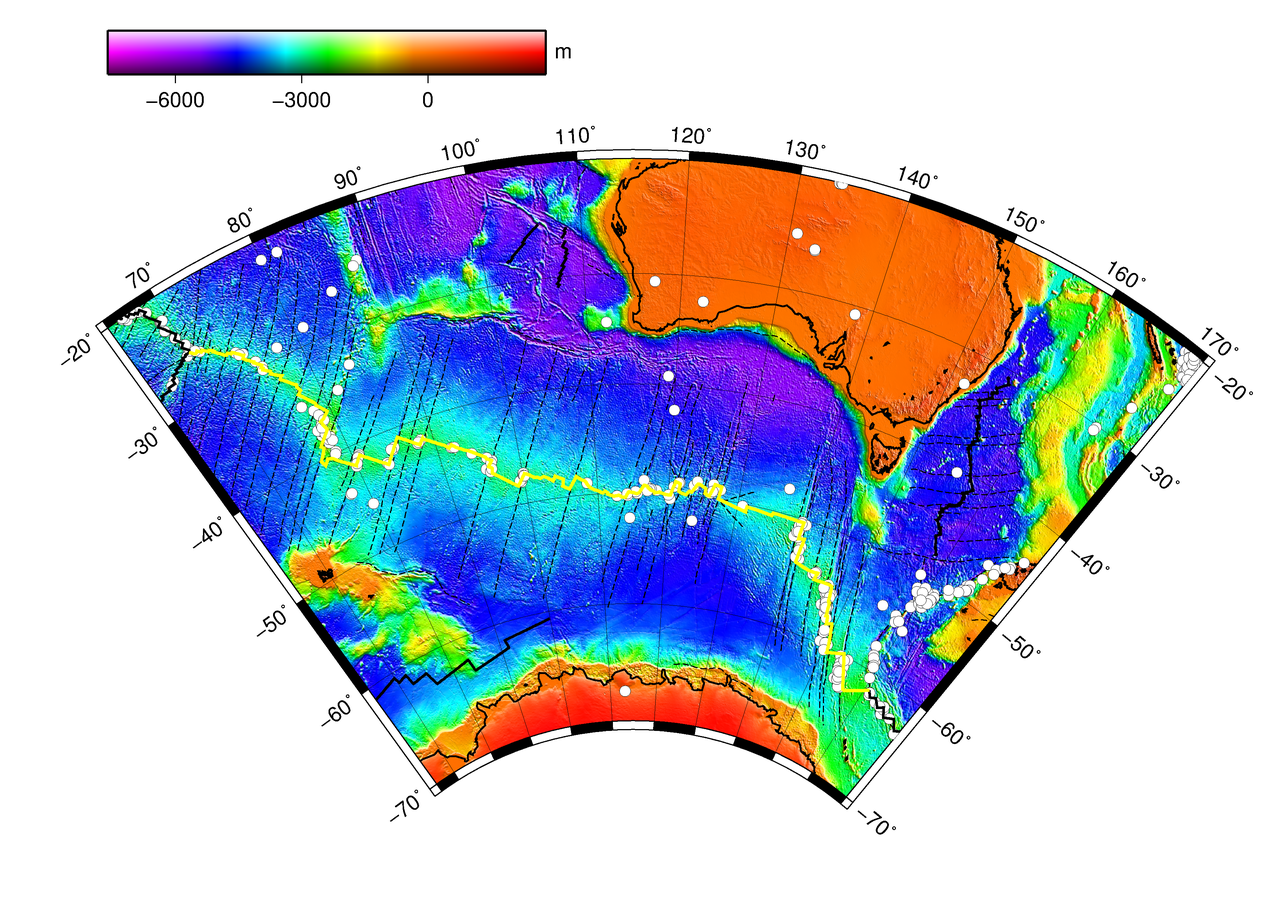
Actually Dinosaur Cove was at about 75 degrees latitude 100 mya as shown by paleomagnetism:
https://academic.oup.com/gji/article/163/2/727/2058539/Apparent-polar-wander-paths-for-the-major
Spreading ridges are no more stationary than continents.
Umm…no. T rex did not evolve into chickens. But it is true that tyrannosaurids are close to the line of dinosaurs that evolved into birds. At least early small tyrannosaurids like Dilong and Yutyrannus actually had primitive feathers.
TTY,
Yup. Tyrannosaurs are close to the maniraptoran dinos. Most if not all coelurosaurs were feathered, at least at some time in their lives. Even T. rex might have had simple plumage when young.
https://fr.wikipedia.org/wiki/Tyrannoraptora
Besides their evolving large size, tyrannosaurs are distinct from other coelurosaurs in losing their third fingers, which were but a stub in T. rex and those tyrannosaurids most closely related to it. In the bird-like alvarezsaurs, the three standard fingers got down to just one, possibly as an adaptation to eating insects.
They had “but one claw!”
Dean,
That animals died while eating and were then fossilized is no reason to imagine a global flood covering the highest mountains, which is a physical impossibility. Such an inundation would require more than three times the surface water on earth today. Where did it come from and where did it go?
There is no global flood in the geologic record. Of course local floods occurred, and over four billion years, sea level has changed markedly repeatedly. But fossils sort by age, not by size, as would happen if they were deposited all at once, with Precambrian, Paleozoic, Mesozoic and Cenozoic plants, animals, fungi and microbes all intermixed. How did Australian and oceanic island land animals get to Noah’s area of operation? How could the millions to tens of millions of animal species alive now, let alone the hundreds of millions to billions of extinct species fit on the arc? How could a few humans care for so many animals? To mention but a few problems with taking the biblical flood myth as reality.
Soft tissue fossilization is rare, found very irregularly, but it does confirm that birds are dinosaurs, a fact already known from every other sort of evidence.
Evolution is the only possible scientific explanation for the genetic information found in cells. In fact, comparing the genomes of organisms helps work out evolutionary relationships, along with fossils, embryology, comparative anatomy, biogeography, physiology and every other line of evidence.
Global flood — how did the plants survive?
Maybe the plants regres from seeds, but in the meantime, what did the herbivores eat once off the arc? All vegetation would have been dead a year or however long it took for the flood waters to recede.
Folks, Dean seems to be referring Noah allegorically, since the Biblical Noah lived a mere 6000 years ago or so, but Dean is referring to events that by his own words were “tens and hundreds of millions of years ago”. Don’t get so excited by the mere possibility that someone is using a biblical reference. To do so only shows your overweening prejudice against mention of a Biblical reference. Like the folks who go bonkers at the mere mention of models. Models are very useful, but as is clear in AGW, they can also be (ab)used to prove any damn thing.
Kook,
It’s obvious that Dean actually believes that the flood myth in the Bible really happened.
His comment isn’t just a biblical reference, but a scientific impossibility.
As a geologist with a long standing interest in the trace element behaviour of exhalative volcanics I would suggest that a few simple scans of the material enclosing the dinosaur remains would yield a strong volcanic affiliation. Having seen the foot prints in the sand (actually pumice) on Green Mountain In Denver, CO then my first suspicion would be to look more closely at this phenomenon. And what to analyse for – common rock forming oxides and trace elements including Ba, Sr, Rb, V etc. Using the common elemental ratios then it is very easy to lot the genesis of the host material surrounding the dinosaur remains.
To think all species of dinosaurs (including flying/aquatic reptiles) died out 66 million years ago is absurd, there must have been some, small size/lucky species that survived, maybe up until recent times. Birds and big cold blooded retiles survived.
Simon,
Some small dinosaurs did survive, ie birds. The marine reptiles were large and their prey died out. At the end of the Cretaceous only the biggest flying reptiles still lived.
PS: The larger crocs and turtles which survived did so because they could hibernate or estivate or could survive on carcasses, fish or plant food which didn’t die out. But mostly only small vertebrates survived.
Crocs might also have raided egg mounds and eaten the young of their own and other species, along with the little creatures which survived.
I will say it again.. The Dinosaurs are an elaborate hoax. Its a religion that was created just like evolution and Global Warming.. Pseudo science….http://www.atlanteanconspiracy.com/2015/09/dinosaur-hoax-dinosaurs-never-existed.html
Your link is a pack of ludicrous lies.
Dinosauria is a superorder, not a class. It was defined by Owen in 1842, far from the height of evolutionary fact, but 16 years before Darwin’s Origin.
You’ve taken too many college courses that never taught you to think for your self. You just regurgitate what was regugitated before, etc. etc.
Be like a forensic scientist. Examine the so called evidence.. I am positive that no Museum today will allow you to search out all their fossils.. I mean plaster castings.
P/T survivals are most easily explained as underground–as eggs or as fossorial creatures. A few eggs buried at maximum typical depth survived because the ground did not get too cold at that depth. This entails a short cold period, as would be caused by dust. Even a few bird species survived, possibly as cave dwellers like the oil bird. –AGF
K/T!