Guest post by David Middleton
From Bloomberg…

The number of U.S. jobs in solar energy overtook those in oil and natural gas extraction for the first time last year, helping drive a global surge in employment in the clean-energy business as fossil-fuel companies faltered.
Employment in the U.S. solar business grew 12 times faster than overall job creation, the International Renewable Energy Agency said in a report on Wednesday. About 8.1 million people worldwide had jobs in the clean energy in 2015, up from 7.7 million in 2014, according to the industry group based in Abu Dhabi.
[…]

Why is this newsworthy? Energy production is not a jobs program. The fact it takes more people to provide for 1% of our energy consumption than it takes to provide for 52% (67% if imported oil is included) is not a positive aspect of solar power.
The following charts are calibrated in “millions of tonnes of oil equivalent” (MTOE). The data are from the Bloomberg article, BP Statistical Review of World Energy June 2015 and the U.S. Bureau of Labor Statistics.

What’s that? You can’t see the Oil & Gas bar on the chart? I can fix that.


I am using 2014 because that is the most recent year for which I had comprehensive data. It was also the peak employment year for the oil and gas industry (~200,000 employees vs ~165,000 solar employees). Since 2014, U.S. oil & gas employment has declined; however our total oil & gas production continued to climb…

The fact that the United States leads the world in oil & gas production is a bit more significant than the fact that the typical solar industry worker is less than 1% as productive as the typical oil & gas employee.
Data Sources
BP Statistical Review of World Energy June 2015
U.S. Bureau of Labor Statistics
Discover more from Watts Up With That?
Subscribe to get the latest posts sent to your email.

Pretty sad, when the green jobs are not “sustainable” without subsidies from ratepayers and taxpayers. The ultimate make-work program.
More “make-work” is adding bureaucrats to taxpayers’ payroll to administrate the collapse.
200,000 more US citizens essentially working for The State. We’re inching ever closer to the socialist utopian dream.
CAGW = the “Broken Window Fallacy” writ large.
http://www.speroforum.com/a/18796/Spain-Every-green-job-destroys-22-jobs#.V0dze9QmKrU
“Spain: Every ‘green’ job destroys 2.2 jobs
While some U.S. politicians point to Spain as a model for how government subsidies can create “green jobs,” a new study documents that every renewable job created by the Spanish government destroyed an average of 2.2 other jobs. Also, each “green” megawatt installed in Spain destroyed 5.39 jobs in non-energy sectors, the study found.”
That was then (2009). Where is Spain’s economy now? Is that where the US is heading if it keeps on destroying jobs by rushing headlong into expensive unreliable energy?
Sustainable energy IS THE job-creation scheme of all times!
I’m only interested in three metrics of free clean green renewable energy business versus old tired obsolete oil drilling business; i.e. the ratio of new to old.
Those metrics are :
1/ business percent of US GNP
2/ Business tax payments to US Treasury.
3/ Industry employee tax payments to US treasury.
So tell us HOW MUCH MORE is free clean green renewable energy business contributing to US economy, that old tired oil drilling industries.
G
Higher efficiency and productivity creates MORE wealth and FEWER jobs, than does lower efficiency and productivity.
We need less people working to provide energy, rather than more.
G
Higher efficiciency, that is, enabling workers to create more stuff in an 8 hour shift is what has created the middle class and was the source for all of the wage increases over the last few hundred years.
It had nothing to do with government.
It had nothing to do with unions.
It was private companies investing in the latest in tools for their workers.
Mark W
Yes. Spot on.
Tools – and Training, etc.
But – absolutely – private companies investing.
Auto
MarkW, won’t disagree when you say “private companies.” Government may have affected things, unions may have as well, but what has killed the golden goose and middle class is private corporations, where the only thing that matters is the profit return to stock holders. Private companies viewed their workers as assets that produced wealth, thus they took care of them. Private corporations view their workers as cogs in a machine, and can easily be replaced or removed until the machine breaks. Then you declare bankruptcy and either stick the people that supplied you or got support from the government, but one thing was certain, the big stock holders got out without losing much of anything.
Never mind that. The fact is we need to employ more people per unit output of “green energy” than we do for conventional energy. How the hell is that progress?
Put 50,000 people on bicycle treadmills to generate electricity if you want to spike the numbers that much. Just don’t expect the people to be able to afford the price per kilowatt hour once all the costs come in…
John Christy : If it’s not economically sustainable , it’s not sustainable .
Doesn’t have much of anything to do with economics. Government can fix economics with the stroke of a pen.
It’s a technological (science & engineering) problem. You have to consume LESS already available energy, in a process that makes MORE additional energy available. (Using nothing but the raw material resources in their current natural state).
G
Absolutely correct. Besides being sustainable the oil and gas industry provides several orders of magnitude more energy per worker than the “green mafia” does.
..Obviously it takes more people (at a higher cost), to produce “Green Energy” !! ….I wonder what the energy created per person is ?
Good question Marcus, I also wonder what the renewable taxes paid after subsides is for each unit of useful energy generated, minus the additional cost to conventional energy (appropriately charged to renewables) to ramp up and down at the whim of nature and sporadic renewables politically designated guarantee of first right to sell ALL that they produce. (despite far higher costs)
” ….I wonder what the energy created per person is ? “.
Yep. Someone needs to calculate how much energy all those solar workers would generate if we simply strapped each of them to a bicycle/generator set 8 hours a day.
If we hired the solar workers to run all day in human sized hamster wheels powering generators, would they produce more energy?
humans that are in shape (which if they aren’t now, would be soon) can produce ~100W continuous for 8 hours at a time. So 200,000 humans / 3 * 100 watts/human = 6.7MW continuous output. Even solar has some advantage…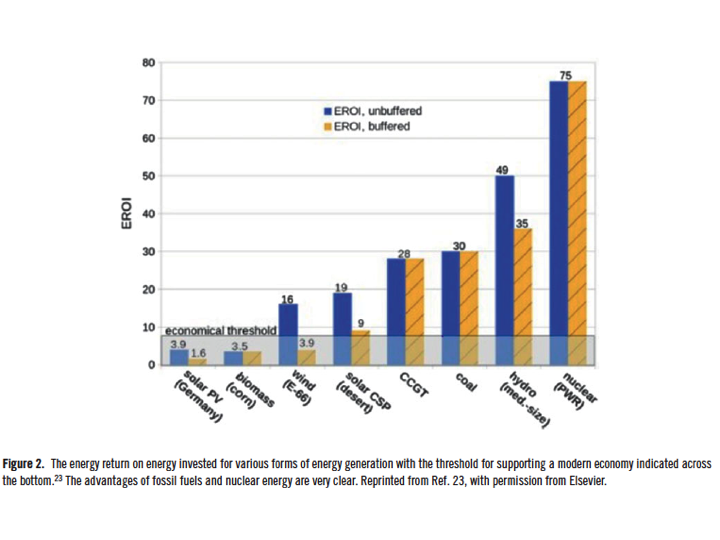
What you really want is Energy Returned on Energy Invested. Really good writeup on this at JC’s blog: https://judithcurry.com/2016/05/23/is-much-of-our-effort-to-combat-global-warming-actually-making-things-worse/
In particular this picture:
If I haven’t goofed in my calculations …
TOE => 4.20E+010 J
MTOE => 4.20E+016 J
Employee / MTOE => 39402
Energy/employee => 1065935739302.57
hours work / year => 2000
seconds work / year => 7200000
Power / employee => 148046.63 W/worker
So a couple orders of magnitude more power than running a hamster wheel, but still WAY short of oil.
It’s the inverse of the number of employees per MTOE.
It seems to me the ultimate form of recycling, which lacks wealth creation.
Yet another welfare/subsidy mining operation. Having to go to a diferrent scale on the productivity graph is revealing.
kilowatts per job, or jobs per megawatt tells the story. If the consistent energy income is not there to support the jobs, then profit is down and as mrmethane said, the ‘jobs are not sustainable’.
No mention of the wages involved. No surprise. The “green jobs” pay half what oil and gas did, but, hey, a job’s a job, right? And what’s wrong with earning $14 an hour instead of $30? You can still pay your mortgage and maybe even buy food.
Yeah, as long as your solar company doesn’t go bankrupt.
The fossil fuel “industry” is not faltering, in the sense that free markets are dictating natural, economic outcomes. It is being attacked by unnecessary regulation and disadvantaged by subsidies going to far less efficient forms of energy. This is costing millions of jobs in any job sector that depends of fuel, electricity, heating oil. Economic illiteracy is the headline here.
Let’s remove subsidized jobs from both sides then compare.
Define “subsidized jobs”. If you mean “tax breaks”, you can just shut the door on virtually every US industry. Farming is one of the heaviest subsidized industries out there. Shall we shut down farming? Actually, I’m fine with removing subsidized jobs from both sides as it will immediately destroy the economy, push the US into chaos and then things will sort out. Since people are so totally math illiterate and don’t care about economic reality, I figure just toss the whole thing in the blender and let Nature or whatever sort it out. This slow, agonizing death from illiteracy and emotional appeals is depressing and shows no sign of reversing. So toss them all out. Get it over with fast.
Reality Check: Tax breaks are deferred taxes; subsidies are lost (wasted) taxes.
Subsidies are money that comes OUT of the federal treasury. They are not money that doesn’t go into the federal treasury.
The largest “shareholder” in the oil and gas petrochemicals industry is the US federal treasury.
G
Since oil and gas pay large NET taxes after “subsides” (tax and business deductions common to many industries and industry specific to allow equitable US competition in foreign markets) and green energy true subsidies likely exceed any taxes, then, as you know, doing this will show a very large benefit of fossil fuel production. Do not forget to include the taxes paid to the Fed and state for every gallon of gas sold.
” … oil and gas pay large NET taxes after “subsides” …
Indeed, yet this is rarely/never mentioned when the Oil/Gas subsides are referenced. I found it quite revealing when President Obama said that he wanted to remove the Oil/Gas subsidy because that money could be better spent elsewhere. Why wouldn’t the first thing be to apply that subsidy amount as an offset to gas taxes at the pump?
The only “subsidy” that has ever been identified is the depletion allowance. Which is similar in affect to the depreciation allowance that every other business uses.
That is, as they land/leases that they bought become less valuable as the oil/gas/whatever is taken from it, they can deduct this drop from their income.
In reality though, neither depreciation nor depletion are subsidies, they actually increase the total taxes that a company has to pay.
Absent these allowances, a company would be able to expense 100% of the cost of attaining building/equipment/leases etc. in the year in which they were purchased. Instead they are only permitted to subtract a fixed percentage per year over a set number of years.
Since, as everyone knows, money now is more valuable than money sometime in the future, the companies are losing money when they are forced to deduct these costs over time.
Yes, I am quite aware that there are sound actuarial reasons for doing it this way and I don’t feel like debating those at this time. I’m just pointing out that these “deductions” actually cost the companies money. They are NOT subsidies.
There are no subsidies on the oil and gas side. Unless you are one of those people who consider any tax rate less than 100% a subsidy.
They count standard tax deductions as “subsidies.”
The “big” one is the percentage depletion allowance. The cost of developing an oil field can’t be recovered as an expense for the year in which it was incurred. It has to be recovered against the production over the life of the field. If they did away with percentage depletion and forced all companies to use cost depletion, it would generally take longer to recover their costs.
What if one side doesn’t have any subsidized jobs; then what are you going to do ??
G
Watching the clouds of obfuscation surrounding the explanations offered here for “subsides” (what the hell are sibsides); indicates the problem in dealing with the low information people.
It’s very simple: Every morning, I shave with my 50 cent twin blade Schick razor. And every morning I toss a penny into a jar in the bathroom. In about seven weeks time, I take that jar and I go and buy a new twin blade Schick razor that is sharp.
If the government steals my jar of pennies, then I can’t shave, so I get fired from my job.
So then I can’t pay any taxes, because I have no source of revenue. I’m quite happy to pay taxes (If I had the money) so that the government can buy bullets, and bombs, and feed the soldiers, so they can stop some other Cretan from stealing my pennies.
That’s about all there is to it. My penny jar is NOT a subsidy.
Think about what a hell of a pickle I would be in if my Schick twin blade shaver evolved like happens in the semi-conductor computer chip industry.
If I save up my 50 pennies over seven weeks and then go to Target, to buy a new sharp one; what I discover, is that the engineers have been busy, and my twin blade 50 cent razor has now blossomed into a new whizz bang five blade razor that will cost me five dollars instead of 50 cents.
So unless I put away more than a penny a day for my new razors, I would have to go to my boss or some other rich guy, and ask him if he wants to invest $4.50 in my new five blade razor, so I can continue to go on shaving; now even closer than before, and keep my job, so I can design all kinds of wonderful useful things for my boss to sell.
The semi-conductor industry is an example of an industry, where depreciation is totally inadequate to the task of maintaining the business. You need to have very large profitability, and you need to lure even further investment from moneyed investors seeking a piece of your profitability, or else you go out of business due to obsolescence.
The motto of Silicon Valley is:
” If it works; it’s obsolete ! ”
G
Generally speaking, one doesn’t want an energy system that requires large numbers of employees. Elon
Musk’s bright idea for the most efficient battery factory will employ practically no one. Factory efficiency is almost entirely due to lack of any need for employee payroll. Anyone who thinks that , with the new advanced nuclear coming online in the early2020’s, that solar and wind will still be viable, is just plain dumb.
I read a report yesterday that even the Chinese are replacing 10’s of thousands of employees with robots.
Looks like another hockey stick forming in solar employment. Perfect example regulatory burden combined with a tax/subsidy effect. Tax/regulate and you get less. Subsidize and you get more. Central planning at it’s finest – National control of industry, social issues and speech.
So what, all of those solar energy jobs produced nothing of a “net value increase” in/for the US economy.
On the contrary, all of those solar energy jobs are directly responsible for a dastardly “net value decrease” in/for the US economy.
Increases in solar energy jobs are directly akin to increases in government employment jobs.
They are an extreme cost burden on the taxpaying public and they produce nothing of value.
When the cost of labor exceeds the retail value of the product produced …… then automation will reduce the amount of labor needed to produce the goods, …… like so in the US, to wit:
From 885,000 miners before automation …… to 76,000 miners after automation with production quantities increasing all the while.
Have these numbers been replicated by anyone, like science requires ?
Is this a scientific theory? I thought we were talking economics here.
which numbers?
It is amazing that efficiency in the use of human energy and intelligence is ignored in this “forced” transition to solar. This on top of solar being a poor substitute.
Solar and wind are now competitive with fossil fuels when producing energy. The bottom line is the cost to the consumer. If renewables produce more jobs than fossil fuels and they are still competitive, I say it is a win-win situation.
Looks like a huge waste of time, manpower and resources with little benefit in terms of “product” produced and one must include tax dollars wasted in the “cost to consumers”.
By competitive I mean the cost of producing a megawatt of electricity from renewables is similar to fossil fuels.
From Fortune
The Bloomberg report says that the average cost of electricity generated by wind farms (on land, not offshore) throughout the world dropped to $83 per megawatt hour in the second half of this year. At the same time, electricity generated by solar panel farms fell to $122 per megawatt hour.
In comparison, the cost of electricity from coal and natural gas actually rose in the second half of this year. Coal-based electricity cost $75 per megawatt hour (up from $66 per megawatt hour) in North and South America, while natural gas-based electricity cost $82 in North and South America (up from $76 per megawatt hour).
http://fortune.com/2015/10/06/wind-cheap-coal-gas/
If renewable produce the product at the same cost and produce more jobs, I say that is a win-win. Where is all the money associated with producing electricity with fossil fuels going if it isn’t going into jobs? The alternatives I can see are: 1. the CEO is walking off with obscene amounts of money, 2. the money is being stashed in offshore accounts, 3. it is being invested into other industries. Only the latter may benefit society.
Luke, where indeed? You are omitting two additional options, which are both true and change the question around entirely.
4: Wind and solar are economical due to a number of unfair structural advantages. Wind and solar have extreme subsidies and favorable regulations, while oil, gas, and coal experience punitive taxes and restrictions.
5: The wind and solar cost omits the increased transmission costs due to their distributed production and increased costs due to storage and lost grid efficiency due to rapid cycling.
So the answer is that the data is incomplete. It is half-accounting. The claim that they somehow hire so many more people while providing the same service at the same price should have clued you in on the fact that they were omitting other important facts.
Jumping to the conclusion “they are evil people funneling away money” says more about you than them.
Luke,
Did you read that article which you linked?
It puts a lie to the renewable price competitiveness meme with one sentence.
“Carbon policies in the U.K. and Germany make the cost of electricity from wind significantly cheaper than electricity from fossil fuels.”
Why do you always promote the fashionable ideas put forth by the likes of Bloomberg and Soros?
You are wrong with every post you make here, either logically, or factually.
You definitely fit the profile of a paid spokesman. There is no other way that you could be so wrong, so consistently.
Luke quoted Forbes:
“Coal-based electricity cost $75 per megawatt hour (up from $66 per megawatt hour) in North and South America, while natural gas-based electricity cost $82 in North and South America (up from $76 per megawatt hour).”
Luke, you and Forbes are suffering from poor accounting skills. The reason that the cost to generate from coal and gas has increased in the face of diminishing fuel costs is that they have been forced to intermittently fill in for irregular wind and solar power delivery. With proper accounting these costs should be placed where they belong: into the wind and solar accounts not the coal and gas accounts. But if those cost were properly charged then the cost of wind and solar would “necessarily skyrocket”. Certain regulators will not allow utilities to properly treat the cost consequences of intermittent supply, which also includes a more expensive and fragile grid. It’s a scam.
Hi Luke, how you doing?
Lets see,, to answer you question on the difference in where the money goes between renewables and “fossil fuels” you have to first establish the “cost of goods sold” (COGS) for each type . Also factor in all the Taxes Federal State and local. Also factor in taxes of equipment owned. do both pay equally? This determines the profit margin. Next how do they fund their enterprises. For renewables it tends to be grants, Government backed loans and cost transfers to costumers For fossil fuels it is stock sales and profits. Note, all fossil fuel companies make dividend payments.This were the profits tend to go. You know 401Ks, Public and Private Pension plans. Renewables miss loan payments and file bankruptcies.
Pick your business model and invest in it.
michael
Luke, if you actually believe your drivel, please do what others say and put your money where your mouth is. Have fun with those “competitive” investments.
RWturner I do put my money where my mouth is. I own an electric car and I have installed solar panels that cover all of my electricity usage.
[All? .mod]
Luke, the money from hydrocarbon based energy goes to taxation and regulatory costs, which wind and solar get a free pass on.
Luke,
it appears to me that you have averted your eyes and your mind to the FACT that …..renewable electrical generators REQUIRE constantly operating fossil fuel electrical generators as “back-up” ……… whereas fossil fuel electrical generators do not REQUIRE constantly operating (HA, HA) renewable electrical generators as “back-up”.
So, best you add the co$t$ for operating those “back-up” fossil fuel electrical generators to the co$t of renewable generated electricity.
Cam: You may be (though I doubt it) be covering all of your electric usage from solar panels, however you only paid about 10% the cost of buying and installing those panels.
PS: If you drive more than a couple of miles a day, it is physically impossible for a roof mounted system to both power your house and recharge your car.
Luke, please define what you mean by “competitive”.
He means after the “green” energy subsidies, and after punishing fossil fuels (especially coal).
GreenEconomics™ 101.
Green Math:
1 + 1 = Shut up and stop questioning me you denier.
Green Math:
1 + 1 = Shut up and stop questioning me you d#nier.
No. The bottom line is not cost to the consumer.
The bottom line is reliability.
If wind and solar are really so cheap, why are Denmark and Germany’s electricity cost about 3 times as much as oours
pssst sciguy54
Fortune, not Forbes… and they were reporting on a Bloomberg “study”, which instantly trigger working BS detectors.
Wind and solar are far from competitive.
http://i90.photobucket.com/albums/k247/dhm1353/dhm1353156/LCOE1_zpszvqakb1c.png
https://www.eia.gov/forecasts/aeo/electricity_generation.cfm
While wind’s LCOE is competitive, its capacity factor will never be competitive. Furthermore, the LCOE doesn’t include the cost of storage or dispatchable back-up generation capacity. These Department of Energy estimates are for plants entering into service in 2020.
In order to replace 1 MW of natural gas you would have to deploy 2.4 MW of wind or 3.5 MW of solar and you would have to have a cost-effective storage system. Or you would have to back up every MW of solar/wind with a MW of gas or coal.
Well, at least we agree that the LCOE is competitive. That is a very major step for a skeptic 😉
Also, why is the capacity factor so relevant? You’d indeed need more nameplate generation capacity, but so what? If wind turbines are so cheap you can afford to build 3 MW worth for every MW of coal, what do you care? Also, it should be pointed out that capacity factor is partially a design feature. If you would just stick a 1MW turbine on a massive wind turbine that would normally do 7MW, the capacity factor would be very high (80%?), but you’d still have less energy overall and the LCOE would be higher.
Finally, storage. Yes, you are totally correct. But lets at least advance the discussion to the point that we agree that for a marginal addition, the LCOE of wind is competitive and we can discuss storage for true large scale deployment.
@benben
The size of the turbine doesn’t affect the capacity factor.
Wind can be competitive under certain conditions. The reason it works well in Texas is due to physical geography. The Llano Estacado is the ideal place for wind farms. The capacity factor can exceed 50%.
Capacity factor is the difference between “dispatchable” and “non-dispatchable” generation. A typical natural gas plant will operate at a capacity factor of 87%. It is capable of delivering its full capacity 87% of the time. The down time is generally related to maintenance. Solar and wind only have capacity factors of 25 to 35% in most places. Their down times are generally due to the Sun not shining and wind not blowing.
Gas, coal and nuclear are dispatchable. They deliver electricity based on demand. Wind and solar are non-dispatchable. They deliver electricity based on availability. This means that comparable LCOE’s are not terribly relevant. Making solar and wind cost-competitive with fossil fuels isn’t even half the battle. Two things can have the same unit price; yet have vastly differing values.
benben:
May you end up living in a field full of wind turbines. Southern Alberta used to be beautiful to ride a horse across the prairie and listen to the wind. Now all you hear is “thump, thump thump”. The rolling hills look like porcupines that would make Quixote excited and provide a lifetime of tilting. I get sad as I watch the urban environmentalists destroy a Rural Alberta that they don’t even see as they roar by in their mini-vans with their kids playing X-Box in the back while they rush to their next stop without any idea of what they have done to the countryside while staring straight ahead on the ribbon of asphalt guided by cars with lane control so they don’t even have to turn their brains on. In reality, the urbanites by and large, don’t care about the countryside as long as they get their power, water, sewer and roads so they can put money in the bank while giving lip service to the environment. Most of them live in an urban bubble and have no idea of what the green machine is doing in the country side. But it has been like that for centuries so nothing new here. Well a little bit new – subsidy farming is carried out both in the urban and rural environment. Farmers and ranchers do get decent income from having their land despoiled with turbines, roads, power lines, substations and transmission lines from the badlands to the cities.
But who benefits the most?
Not the public.
Who has seen the wind?
Ah well. Some of us will soon just be dust blowing across the prairie. You, beben, can live with what you have built. A Mad Max future.
For evening reading:
http://www.amazon.com/Who-Has-Seen-Wind-Mitchell/dp/0771061110
Levelized Costs are fairy tale numbers, just like Tesla’s Non-GAAP income numbers.
And the Fortune article compares world green numbers with coal/gas prices in North and South America. Talk about “cherry picking”! What do coal and gas prices in Chile have to do with the same in the US?
Wayne Delbeke, you have a point of course. But according to your own arguement you should then also take an honest look at the environmental destruction caused by drilling, oil spills, oil sands etc etc. And they are massive (and incredibly well documented). But then the real point here is probably: you don’t live in any of these third world countries that are absolutely being destroyed by fossil fuels. And what you don’t see, you don’t care about?
Obviously the vast majority of the population on this planet has decided that they rather have wind turbines than oil sands. Or, perhaps its a vast and massive conspiracy by a small group of evil overlords. Your choice!
David, I understand that. Contrary to what many believe here I have a degree in chemical engineering and took plenty of courses on energy systems, renewable energy etc etc. at the electrical engineering and aeronautical engineering depts. I know my stuff. Either I did not explain properly how capacity factor and nameplate capacity interact, or you just don’t want to know… Anyway, no time to write a massive wall of text. My apologies!
benben is as clueless as any other eco-alarmist:
…take an honest look at the environmental destruction caused by drilling, oil spills, oil sands etc etc.
Like the Deepwater Horizon oil spill, where you can’t find any evidence now of that ‘disaster’? Or any of the other ‘disasters’ that left no trace a few years later?
benben refuses to ever consider any cost/benefit analysis. Because he would have to conclude that fossil fuesl are worth the occasional accident. But benben demands that everything must be perfect, to fit his fantasy of a perfect green world.
These hypocrites get so tedious. They all use their share of fossil fuels, while demanding that poor countries must do without what they have. That’s benben and his eco-contingent. Always pontificating; always telling others how they should live their lives — but with no skin in the game themselves. Hypocrites all.
Can the kids still go out and blast gophers?
benben posted…
This proves that you are clueless about capacity factor…
A 1 MW wind turbine with a 30% capacity factor would generate:
0.3 × 1MW × 24 hr/d × 365 d/yr
= 2,628 MhW/yr
A 7 MW wind turbine with a 30% capacity factor would generate:
0.3 × 7MW × 24 hr/d × 365 d/yr
= 18,396 MWh/yr
If you “would just stick a 1MW turbine on a massive wind turbine that would normally do 7MW,” the capacity factor would still be 30%.
The capacity factor of a wind turbine is dictated by the wind resource. Capacity factor is totally independent of installed capacity.
No… that way to simplistic, and wrong: imagine a 7MW, 400 feet high wind turbine with massive rotors. They usually have a somewhat higher capacity factor than the average because they are higher and the wind up there is more consistent. So lets say 35% capacity factor. Sometimes it will produce at 100% of capacity, but not very often because it takes A LOT OF WIND to drive a 7MW turbine. Usually it will run at 50%, or 20% or whatever. Averaging to 35% of what could be achieved if there was maximum wind all the time.
Now imagine the same wind turbine, just with a 1 MW generator on it. All those times the 7MW generator would be anywhere between 15-100% capacity, this 1MW generator would be steady at 100%. Obviously it would be not utilizing a lot of energy, because it will max out at 1MW while the other design would max out at 7MW, but purely in terms of capacity factor, it would reach 100% much, much more often. hence a much higher capacity factor.
This by the way is an actual design consideration which is one of the factors why average capacity factors in the US are different than in Europe. Related to how the energy content of wind increases non-linearly with linearly increasing wind speeds.
Cheers,
Ben
David Middleton replies to benben:
This proves that you are clueless about capacity factor…
Benben couldn’t even define the troposphere. But he’s going to lecture a professional petroleum geologist on energy??
Get a clue, benben. You’re way out of your league.
“benben May 26, 2016 at 7:32 pm”
That has to qualify as one of the dumbest posts of the week.
how exactly is that dumb? It’s just an exaggerated example of one of the trade-offs in turbine design. Just to show that David’s statement that capacity factor and turbine design are not related, which is patently not true.
I find it pretty weird how everyone here is so full of their own math/engineering/etc skills, but is completely incapable of stepping outside their own prejudices and just think about a technical aspect (namely, the effect of turbine design choices on capacity factor, LCOE, etc).
Has nothing to do with political preferences, AGW skepticism or whatever else floats your boat.
Benben babbled,
If’s the freaking definition of capacity factor. I don’t know if you are totally ignorant of basic math and science or if you are intentionally being obtuse. Either way, your comments are a waste of space.
did you even read what I wrote?
Definition: “The ratio of the net electricity generated, for the time considered, to the energy that could have been generated at continuous full-power operation during the same period.”
Clearly, if there is a day with X amount of wind that would cause the 1MW generator running at max capacity while the 7MW generator would produce, say 2MW of actual power, the capacity factor of that 1MW design would be higher, even though it would produce less energy overall for a given amount of time.
This is such a bizarre discussion. What exactly do you not understand? Perhaps you are missing out on the fact that larger turbine blades will produce more power at the with the same amount of wind (the point being here that you would run the 1MW design with the larger turbine blades that are normally matched with larger generators), or you are not aware of the fact small wind turbines max out at higher wind speeds?
Anyway, clearly you guys are not interested in wind turbines so I can’t expect you to know the finer points of turbine design. My apologies for overestimating your interest in the subject matter!
Cheers,
Ben
benben says:
I find it pretty weird how everyone here is so full of their own math/engineering/etc skills, but is completely incapable of stepping outside their own prejudices…
That’s pure projection from ‘benben’ (and you use a very fitting and juvenile name there, kid).
Instead of learning something from Dave Middleton — an engineer specializing in energy production, and with decades of real world experience — benben (heh) argues from ignorance and inexperience. Sorry benben (ha-ha!), you’re still a young, wet behind the ears know-nothing, with no real world experience. You should just read the comments here, instead of commenting and displaying your lack of knowledge.
Speaking of “definitions”, benben (*snort*) displayed his ignorance of the of the troposphere’s definition. He tried to wing it, and got smacked down by about a half dozen other commenters.
See, benben? In your case it’s better to just read the comments without trying to post your own misinformation. That way you’re not publicly embarrassed.
heh, thanks DB for that running commentary. It’s quite entertaining. You should try your hand at narrating a basketball match 😉
And ^that^ is the extent of benben’s argument. Could it be more lame?
Yes I did. You keep babbling nonsense.
Capacity factor has a simple definition and is expressed by a simple equation. Instead of babbling nonsense, simply show the math.
Capacity factor is a function of output. Show the math supporting this abject nonsense…
Math illiteracy runs rampant.
It has to, if you want to sell folks like Luke their propaganda.
Luke says, “Solar and wind are now competitive with fossil fuels when producing energy.”
============================
Not on earth Luke. Solar and wind are many times the cost of conventional, and significantly raise the cost of ALL energy production, are incredibly labor intensive per unit of energy produced, as this post demonstrates, do almost nothing to stop any global mean Temperature rise, provide zero of the massive benefits of increased CO2, and hundreds of billions of tax payers dollars have already been tossed into the trash after alternative energy bankruptcies which were heavily subsidized by tax payers.
Couldn’t have said it better myself. Unfortunately, there is way too much of this type of misinformation out there being drummed into the minds of the masses who aren’t paying attention to the scam and are therefore doing nothing to put a stop to it.
Wind and solar are competitive without subsidies.
http://fortune.com/2015/10/06/wind-cheap-coal-gas/
Luke:
Bwahaha…and, because humour is subsidised: hahahahaha!
Luke’s link above is nonsense. It never mentions the immense taxpayer subsidies funneled into windmill energy.
Clean coal energy costs about 6¢ to 9¢ per kWh in many places. Wind energy always costs more — plus, there is currently more than a 25¢ taxpayer subsidy added on, and those subsidies will increase year over year in many places, to more than 50¢ per kWh.
All Luke is doing is parroting the misinformation that the eco-crowd emits. The fact is that windmill energy is always far more expensive than any fossil fuel energy. But it takes intelligence and skepticism to understand that. Luke lacks both.
Luke also pretends that the mandates to buy “renewable” electricity at preferential prices don’t exist.
Ah – good point Luke. I wondered where all the squeegee kids at intersections went. Gainfully employed now wiping dust off solar panels. Which reminds me, gotta go clean my solar fencers. Thanks.
That’s only true because someone else pays for 90% of the cost of solar/wind.
Not to mention the fact that the government has to require utilities to buy solar/wind.
If what you say were actually true (for once), there would be no need of subsidies and mandated purchases.
And they don’t pay squat either in comparison.
“Under my plan of a cap-and-trade system, electricity rates would necessarily skyrocket.”
“So, if somebody wants to build a coal-powered plant, it’ll bankrupt them.” http://www.thegatewaypundit.com/2015/08/obama-to-crush-middle-class-new-program-will-force-energy-prices-to-necessarily-skyrocket-video/
Halfway there.
Solar will become much more competitive after we eliminate >95% of solar labor/MWe.
All jobs are not created equal, and the stats are number of employees, not total payrolls. Someone working in an assembly plant for solar panels is making about $15 an hour. A rig hand on a well site, or a welder on a pipeline, is making $35-40 an hour. Heavy equipment operators at open pit mines make 80K a year.
Even if your estimates are correct, that still does not account for the huge disparity in the number of jobs. Where is the rest of the money going” Offshore accounts? CEO bonuses? How many people does that help?
Luke, arguing with you is really pointless, since you don’t seem to comprehend anything that’s being said in these comments.
If you don’t like it, buy shares. Then all that extra money you claim is being skimmed goes to you.
Stop your whining… You are the source of your own misery.
Even if the numbers were real, which they aren’t (see prior post), why couldn’t it be equipment costs? Taxes? Overhead? Everything else? It’s not like they are public companies with routinely audited books … Oh wait, they are. Why don’t you look for yourself if you are so curious as to what they are spending money on? Insinuating that they could charge much less but don’t for sinister reasons just doesn’t make sense.
Then I object to your premise that it would be a bad thing, even if you were right. How about I posit this: IF the numbers were right and they were able to make such huge volumes of cash on their production, that would be nothing but benefit. It’s the Luddite fallacy. Doing more with less work is bad for people whose jobs are no longer necessary. However, in the long run, it benefits society that we spend less on energy. As for those people who made all those billions? The money won’t sit in a McDuck style money bin, but will go into investments, making more money and supporting more businesses with more jobs. So, with your way you get energy, but with big oil, you have energy + more stuff. Everyone wins.
Furthermore, even it was somehow happening and we decided we should do something, then the best idea would be to get better competition out there to reduce the amount they could charge for electricity. Keeping an inefficient competitor around would only SUPPORT the price, as the oil companies could charge one penny less per kWh than wind no matter how cheap their production costs.
I have work to do, so I can’t afford to spend any more time on this, but you really need to rethink how you are approaching these problems.
Other ben, I think the perils of having a society with a mega-rich oil funded elite is pretty clear to anyone who has looked at… well, basically any oil-producing country outside of Norway.
As I wrote below, the main message of this news is that renewables are not a job-killing thing, but rather that moving from fossil to renewables will be a net + for number of jobs. You agree that unemployment is bad, right?
You can still be skeptical about all the other things and have long and entertaining discussions on how you want your society and economy to look like. It’s just that the ‘green policies kill jobs’ thing has been falsified and should no longer be used.
Luke asks, “Where is the rest of the money going”
======================================
You mean the real profits made by oil and gas.
Much is reinvested in additional production and a surprising amount goes to the retirement portfolio of millions.
BTW Luke you should be asking what the Government does with their fossil fuel profits. (The government makes more off of gasoline at the pump then the oil industry makes from oil)
Luke , you do not appear to have allowed for the fact that perhaps a significant amount of the money made by conventional power generators flows to the US treasury in the form of company taxation – which helps to pay for a lot of food stamps . In the case of some green ventures the flow is in the opposite direction judging from some comments above .
The CEO of bancrupt German Solarworld lives in a castle and drives Ferraris. Just to answer your question where the money goes.
The purpose of a business is to make money for its owners… Not to help people.
The huge disparity in employment is a function of power density and the nature of the two businesses. Oil and gas exploration, drilling and production is a capital-intensive business. It costs a lot of money to find and produce oil and gas. However, it is not a labor-intensive business. It doesn’t take a lot of people to find and produce oil and gas. Solar is both capital-intensive and labor-intensive… because almost all of the cost is in the construction of solar modules and facilities. It is also land use-intensive because solar has a very low power density.
A marginal gas well “has a power density of about 28 W/m^2.” The largest solar PV plant in the US has a power density of 45 W/m^2. However, with its 33% capacity factor, it only delivers the equivalent of 15 W/m^2. The most powerful solar PV plant in the US is half as powerful as a marginal gas well.
The best oil field (so far) in the Gulf of Mexico is Shell’s Mars Field (Mississippi Canyon 807). It has produced at an average rate of 135,000 barrels of oil per day since 1996. Its power density has been 45,626 W/m2 per day. And that’s just from the oil production. If I add in the natural gas production, Mars Field’s power 55,537 W/m2 per day.
A typical Marcellus Shale gas well in Lycoming County, PA comes on at 6,000 mfc/d… That’s 28,000 W/m2. Even when you account for the power loss during generation, the power density remains very high relative to solar.
The maximum solar insolation at the Earth’s surface is only about 280 W/m^2.
Fossil fuels are millions of years of concentrated solar energy. Nuclear fuels are billions of years of concentrated solar energy. Wind and solar are not even in the same power density ballpark as fossil fuels and nuclear power. N2N (natural gas to nuclear) is the only real alternative to oil and coal.
There goes benben with the patented socialist drivel about the evils of rich people.
“Even if your estimates are correct, that still does not account for the huge disparity in the number of jobs. Where is the rest of the money going” Offshore accounts? CEO bonuses? How many people does that help?”
Translation:
I’m so much smarter than those clowns, but those evil and greedy CEO’s somehow got really good paying jobs. They can’t possibly be worth so much more than me so we need to take their money until they are equal, no, below my income level.
Then there is the idea that the money goes into a hole, never to be seen again. Or that a bunch of power hungry politicians can better determine where it should go than the person that was smart enough to earn it in the first place.
Other Ben. Yes. More employment for the same job is bad. Spending more for the same product is bad. Jobs created in this way harm everyone else in the system.
You can argue other benefits or negatives, but this isn’t even economics. This is the definition of efficiency. Sorry, but I know you know better. Don’t lecture me on being closed minded on something like this when you are supporting a nonsensical position.
If you’re truly interested, the money you seem to think of as ill-gotten gains goes to buying capital equipment. For example: building a deep water facility in the Gulf of Mexico, drilling the wells, laying the pipeline across the ocean floor will require a planning team of about 50 people and a few hundred construction staff. The cost of steel, transport, and material will be $2-4 Billion. It will provide energy for about 30 years.
If you want a real answer to your questions the answers can easily be found if you actually *read* a few annual reports or 10-Ks. It will become clear to you that these businesses have optimized technology and work processes and safety to a really amazing extent.
You should thank them for bringing a product that touches every single thing you do every day. Otherwise good luck with your world view, I hope it works out…
Do a NPV (Net Present Value) calculation adding in all cost attributable to solar and wind, then, juxtapose that with conventional fuels. Wind and solar are massively more expensive —- 4x as costly. And, that is before you consider any battery backup which would make it 8x more expensive without subsidy. Additionally, subsidies always contract the economy. But, that is another point. And, don’t forget to add the externalities to the marketplace of battery recycling. There is a reason every solar/wind projection uses IRR (Internal Rate of Return) in lieu of NPV even after omitting parts of true cost calculation. There are 5 situations where IRR gives false estimates of real cost. It is what is used in every software presentation package for Solar and Wind, that, I have ever seen.
Luke: Energy density 101: Energy density of solar is 0.0000015 Joules per cubic meter. Energy density of oil is 45,000,000,000 Joules per cubic meter. In other words, oil is 3 X 10^16 more energy dense than solar. In physics, energy is the ability to do work. I wouldn’t try running a modern economy on solar. You won’t get a whole lot of work done. Just do a thought experiment. Imagine you want to fly to London, and you have the choice of going solar (Solar Impulse 2) at 40 mph with you as the only pilot/passenger because that’s all solar can do) or flying a 747 at 550 mph with 400 other travellers and a crew of 8. Your choice.
Your argument applies to using fuels for transportation, not producing electricity for a grid. I agree that fossil fuels have higher energy density but that is irrelevant to my argument.
Unfortunately, factoring density out of your argument renders it incoherent with reality.
This is so strange. What luke says is exactly true. For transportation density is extremely important. For wind, you need enough surface area. And there are plenty of studies that show that there is plenty of surface area with good wind resources.
And lets not forget that there are plenty of countries in europe with very high levels of wind energy and no problems with grid stability, and a very high level of public approval for renewables (~90%). All important facts, no?
I love the way the trolls try to pretend that reality and physics 101 are no longer relevant.
A small country has a high renewables factor, yet is tied into a larger country with a very low renewable factor.
If benben ever told the whole truth, his brain would explode.
benben says:
What luke says is exactly true.
That’s another indication that benben has no more understanding of the real world than Luke does.
The whole argument is about energy density. Fossil fuels have it; windmills don’t. Case closed.
When instruments of solar and wind power can produce enough power in their usable lifetime to reproduce themselves, they will be one step closer to being competitive. That is the reason that low density harvesting of energy is not a self-sustaining industry.
Yes, solar powers my horse fences adequately, but cattle ignore the solar-charged fence and push right through. One replacement battery costs me as much as 5 years of electricity on a plug-in charger (my battery lasted 5 years).
The best usage I’ve seen so far are small scale devices powered by wind and solar, such as road signs and bridge lane-closure traffic lights, although I noticed that spare units must be kept on-site and switched out as needed. These extra equipment and labor costs are only offsetting hiring an electrical contractor to connect conventional signals to the roadside power lines, but I’ll bet they qualify as “green”.
If we get rid of farm tractors, back hoes, graders, etc., just think how many more people we could employ on farms and construction projects — just like the 1880s.
Don’t forget how many hoses and oxen that takes, and how small those populations have become. The value of these animals would be greater than humans to the oligarchy.
Sorry, should be “horses”.
Bob Cherba – And therein lies the ultimate utopia for the current mindset – the elimination of the continuing benefits of the Industrial Revolution (machines doing the work previously accomplished by animals and humans). Somehow, a large section of the younger generations in America and Europe have concluded going back to this world is the best thing for humanity. I’ll leave it to the rest of y’all to give input as to how we have arrived at this strange worldview!
MCR
Socialist brainwashing in our school.
A green job may be sorting trash at a recycling center or driving a bus. As usual, it’s an invalid headline written to obfuscate reality. It’s also not comparing energy generating employment.
Why shouldn’t a bus driver be counted as an oil job? Buses run on petroleum products. That trash being sorted at a recycling center was all made and marketed and collected and transported on petroleum products also. Without oil there wouldn’t be any bus passengers, buses, recycling centers, etc.
Think of the solar energy employees as welfare mothers. That is what they are.
Success.
The parasites now outnumber their hosts.
The subsidy suckers, outnumber the taxpayers who labor to supply them.
Another genuine government investment .
Quick math: So for solar to replace Oil and Gas, ‘they’ would only need 47 million more employees (1188MTOE x 39402 employees/MTEO). That is more than the entire population of Canada.
This all makes Obama’s plan for a ‘new green economy’ now seem so sinister. His green economy translates into subsidized, taxpayer funded, jobs.
I keep hearing Margaret Thatcher’s quote in my head – “The problem with socialism is that sooner or later you run out of other people’s money.”
Other People’s Money or OPM. Pronounced opium.
Leave it to liberals to think that having high costs for energy (lots of jobs) is a good thing.
Bwahahahahahhahaha!