Guest Post by Willis Eschenbach
The satellite-based atmospheric temperature dataset is one of the better datasets in climate science. Drs. Roy Spencer and John Christy have long been scientific heroes of mine because of the quality of their work in the creation, analysis, corrections, and curation of the dataset. It is kept at the University of Alabama Huntsville (UAH), and it is based on measurements taken by a series of satellite-based instruments called “microwave sounding units” (MSU). One part of it has to do with the temperature of the lower troposphere, called “TLT”.
So of course, it is called the UAH MSU TLT dataset
I noticed that the new 6.0 beta version of the UAH MSU dataset was now available, to replace the current version 5.6 of the dataset. And of course, after doing my own analysis below, I found out that Dr. Roy has been there already with a most excellent and detailed discussion of the new dataset here.
To get the UAH MSU data, I went to the marvelous KNMI climate data access portal. One of the less obvious beauties of the KNMI portal is that after you’ve chosen whatever dataset you are interested in (e.g. the UAH MSU v5.6), on the very bottom of the page that comes up it says:
If you really want to get it here, UAH MSU v5.6 Tlt anomaly is available as a netcdf file (size 17.2871 MB).
For me that’s great, I’m quite fond of netcdf files because they contain all of the metadata (e.g. dimensions, units, starting times, coverage) and they store the data typically as a three-D array (rows are latitude, columns are longitude, layers are months or years or days). But unfortunately, near as I can tell the UAH doesn’t offer a gridded dataset as a netcdf file … but that doesn’t matter when KNMI does it.
So at KNMI I snagged both the older version 5.6 of the UAH MSU dataset for the temperature of the lower troposphere (TLT), the layer down near the ground, and the newer UAH MSU 6.0 beta 2 TLT version as well (also about 17 MBytes or so).
In order to highlight the differences between the two UAH MSU datasets, I made a map of the decadal temperature trends on a gridcell by gridcell basis. Figures 1 and 2 show the versions 5.6 and 6.0 beta2 of the UAH MSU data:
 Figure 1. Decadal temperature trends, January 1979 to May 2015 (36+ years). Version 5.6 of the UAH MSU TLT is shown.
 Figure 2. Decadal temperature trends, January 1979 to May 2015 (36+ years). Version 6.0 beta 2 of the UAH MSU.

Figure 2a. Several commenters asked for a graph showing the 6.0 beta 2 information using the same color range as was used in Figure 1. This is that graph.
It was most interesting to see both the commonalities and the differences of the two datasets. One of the first things that I noticed in both maps was that despite warming in most areas of the planet over the 36 years, there are large areas of the Pacific, the Southern Ocean, the North Atlantic, and Antarctica that have actually cooled over the period. If ever there were a graph to emphasize the complexity of the climate, Figure 2 is a candidate.
Next, if I had to choose between the two versions based solely on what I see above, it would be version 6.0 all the way. To explain why, look at say India in both maps. It is well understood and verified that when there is a change in conditions the land generally warms or cools both faster and more than the ocean. We see this on a daily, monthly, and annual basis.
As a result, it is unlikely that India would warm or cool at the same rate as the ocean around it, as is shown by v5.6. In the v6.0 results, on the other hand, India is shown as warming at a different rate than the ocean. The same can be seen in western Australia, central Africa, and all over South America.
(In passing, let me note that the above graphs were made from the UAH MSU data. This data comes from KNMI at a 5° by 5° gridcell size. I resampled them to a 1° x 1° gridcell size, using the R function “resample” in the package “raster”. I was concerned about the accuracy of such a radical change in resolution … but when I look at say Australia, I gotta say that their “bilinear interpolation” method handled the resampling much better than I expected. The colors line up very well with the black lines everywhere on the map … and the colors are from the resample while the black lines are from the mapping program.)
There are a couple other differences between the two datasets. The overall global decadal trend has decreased by ~ three hundreds of a degree per decade. Also, the range of the trends has decreased by about 60%, from a range of 1.3°C (-0.5 to +0.8 degrees) per decade in the earlier version to a range of 0.8°C (-0.3 to +0.5 degrees) per decade in the later version.
Finally, I note that much of the central tropical Pacific has either cooled or stayed about the same for 36 years. Here’s how I read that situation. I’ve described elsewhere how the Nino/Nina pumping action is a major part of the global temperature regulation system. When the Pacific starts overheating we get an El Nino, and warm water piles up in the eastern Pacific as shown in the left half of Figure 3. Then during the subsequent La Nina, increasing trade winds pump the warm surface waters westward across the Pacific and from there they flow polewards.
 Figure 3. 3D section of the Pacific Ocean looking westward alone the equator. Each 3D section covers the area eight degrees north and south of the equator, from 137° East (far end) to 95° West (near end), and down to 500 metres depth. Click on image for larger size. SOURCE http://www.pmel.noaa.gov/tao/jsdisplay/
Notice in the right half of Figure 3 how the strong La Nina trade winds have hollowed out the surface by pumping away the warm surface water. In addition to moving the warmth polewards where it can radiate away more easily, there is another important effect of the Nino/Nina Pump—it exposes the cool underlying waters to the atmosphere.
Now, bear in mind that for all practical purposes there is an unending reservoir of cold water underlying the tropical Pacific. As I discussed in the post Things in General, the simplified circulation of the Pacific looks like this:
 Figure 4. Simplified overall circulation pattern, Pacific Ocean. The north and south poles are at the right and left ends of the diagram, and the equator is in the middle.
Because the cold bottom water is constantly being replaced from the poles, and because the overturning time is half a millennium or more, the supply of ascending cool water in the tropical mid-Pacific can be thought of as infinite.
So IF we assume for the sake of discussion that the Nino/Nina pump is a part of the temperature regulatory system, then let’s look at what might happen during the time of a general temperature rise. Due to the need to move increasing amounts of energy polewards, I’d expect to see increased Nino/Nina pumping, with a consequent greater exposure of the cool underlying Pacific waters.
So I can certainly see how the central tropical Pacific might be cooling or staying about the same while the rest of the world is warming, as shown in Figure 2. As long as the wind is removing the warm water from that part of the ocean surface, the amount of upwelling cool water will determine the surface temperature.
And what is the explanation for the other area of cooling shown in Figure 2, in the Southern Ocean and Antarctica?
How do you say in your language, “I don’t have no stinkin’ clue”?
Regards to everyone, thanks again to Drs. Christy and Spencer,
w.
The Perennial Request: If you disagree with someone, please quote their exact words that you object to, so that we can all understand the exact nature of your disagreement.
Data and Code: It’s in a 14 Mbyte zipped folder here. It contains R code, the functions, and the two MSU datasets (5.6 and 6.0).
Discover more from Watts Up With That?
Subscribe to get the latest posts sent to your email.
Possibly, your greatest Tour De Force in Climate evaluations.
Thank you,
Jack
Might be helpful to have the same color scales on the comparison figures 1 and 2. Thanks
I concur with both.
See above: Also, the range of the trends has decreased by about 60%, from a range of 1.3°C (-0.5 to +0.8 degrees) per decade in the earlier version to a range of 0.8°C (-0.3 to +0.5 degrees) per decade in the later version.
The range changed, so the scale was changed.
Can you please add a map with GISS trends for comparision; per S. Geiger in the same colour scheme?
An interesting analysis, though the fact that historical satellite datasets keep being changed suggests to me that the UAH guys don’t really know what the figures are, at least not with any certainty. I can understand that surface data needs to be ‘adjusted’ for environmental effects on weather stations, by why should adjustments (of an uncertain extent) have to be performed on the output of a satellite instrument?
Or more importantly, if the magnitude of the adjustments needed is uncertain, then can the error range be predicted with any confidence?
Roy Spencer explains some of the reasons for adjusting satellite data here (which is the same link as given in Willis’s article)
http://www.drroyspencer.com/2015/04/version-6-0-of-the-uah-temperature-dataset-released-new-lt-trend-0-11-cdecade/
extract:
“One might ask, Why do the satellite data have to be adjusted at all? If we had satellite instruments that (1) had rock-stable calibration, (2) lasted for many decades without any channel failures, and (3) were carried on satellites whose orbits did not change over time, then the satellite data could be processed without adjustment.”
He also has another relevant post
Why Do Different Satellite Datasets Produce Different Global Temperature Trends?
http://www.drroyspencer.com/2015/01/why-do-different-satellite-datasets-produce-different-global-temperature-trends/
But, I agree with you, the error estimate on any dataset , surface based or satellite, must be at least as large as the difference made by revisions and adjustments.
The adjustments made to the satellite data have been minor and significant only because they arise from the desire of competent scientists to be precise. The adjustments to the surface data, by contrast, are gargantuan and arise from the desire of corrupt “scientists in name only” to support a lucrative political agenda. This constantly manipulated surface data has become useless for any serious purpose.
Hardly minor
http://s28.postimg.org/ye6hlporh/UAH_v5_6_vs_V6.png
Pochas,
“The adjustments to the surface data, by contrast, are gargantuan and arise from the desire of corrupt “scientists in name only” to support a lucrative political agenda. ”
You have no evidence to support your outrageous claims, only your own political agenda.
Honest adjustments wouldn’t change the trend, but these do. So how come?
============
Exactly, the satellite data has been by far the superior data.
Not true that historical satellite data sets keep being changed. The RSS data set has had very little change and the UAH data set is now almost identical to the RSS data set. This is what should give one pause, when one data set is adjusted (UAH) and ends up being almost identical to the only other data set (RSS). It’s like doing you school homework and looking at the answers in the back of the book.
One apparent change is that the new TLT dataset is weighted at a higher altitude than the old.
While the old version weighting was max around 6000 ft, where the Cessnas and Pipers fly, the new one has raised it to around 12,000 ft, above where unpressurized aircraft fly, and farther away from the surface temperature readings.
TLT isn’t directly comparable to GISS and HadCRUT, but it sure serves as a reality check to their fiddlin’ around.
Mike McMillan: I have worked on the ground, and flown my Maule at 12,000 feet. I believe the requirement for supplemental oxygen for the pilot, only kicks in, when you are at altitude, beyond a certain amount of time. The service ceiling on my Maule is 18,000 feet MSL.
CLARIFICATION TO MR. McMILLAN: Upon further reflection, I believe the FAR states, that at either 12,000 or 12,500 the pilot is required to use supplemental oxygen after 30 minutes at altitude and above, and oxygen for the passengers is required at 14,500? and above. My Maule is not pressurized, and it is normally aspirated. Unfortunately, I haven’t been able to fly it for years, so I may be a little rusty on the FAR’s.
Correct Scott, the UAH has had multiple adjustments, in fact the existence of the RSS product is due to researchers finding errors in the UAH product and the unwillingness of S & C to make changes. One of their largest early corrections was in fact wrongly applied (subtracted instead of added and wasn’t corrected for ~10 years).
Much has been made of the ‘fact’ that UAH 6.0 now matched RSS TLT, in fact it does not. Although UAH now uses a much smaller contribution from surface temperature in their new product (similar to that which RSS have always used), its weighting function now most closely matches the RSS product TTT. UAH will in future have no TLT product if they adopt the present beta version of version 6.0. Sorry Willis for adding even more acronyms to your list.
How do people hike at 14K feet in the Rockies if people with no more exertion than sitting need O2?
As part of autoregulation, after a strong El Niño occurs strong La Nina. Now it’s different.
http://www.climate4you.com/images/NOAA%20CPC%20OceanicNinoIndexMonthly1979%20With37monthRunningAverage.gif
El Niño appears to be closely linked to solar activity. Otherwise the PDO and AMO that result from ocean circulation.
Yes ren, my look at periods of continuous -ve monthly SOI associated with “El Ninos” shows that it is close to 11 years which is turn is close to the sunspot cycle and also to the orbit period of Jupiter (note the moon causes tides on earth, so it is possible Jupiter and other aligned planets can cause “tides” on the sun). Of course the AGW alarmist will not agree that the sun has any influence. They believe in a religion which characterises “man” are having a large evil influence.
Temperature in India depends on the strength trade wind. The stronger the wind, the lower the temperature (greater amount of clouds).
http://www.sat24.com/homepage.aspx?page=io
How do you say in your language, “I don’t have no stinkin’ clue”?
At least I can answer that one. “Ik zou het begot niet weten” (Flemish, for those who might wonder).
Interesting theory, but don’t have the competence to give useful comments, so looking forward to reading what the experts have to say .
Willis in Oz at least it’s : “I don’t have a friggin clue” But you probably knew that it avoids the other f word.
The sea bordering the Antarctic Peninsula seems to show cooling. How does that jive with the claim that the ice on the Peninsula is melting alarmingly?
Or is the melting coming from below (Circumpolar Deep Current) and is the cooling of the surface water caused by an increase of meltwater?
wonder if volcanic action plays a role in that equation
http://www.livescience.com/46194-volcanoes-melt-antarctic-glaciers.html
My question is, given that the arctic appears generally to be warming, and the antarctic to be cooling, does this match up with where we are in the precessional cycle? Since the earth wobbles, and sometimes the arctic is wobbling closer to the sun and sometimes the antarctic?
Does my question even make sense?
Indeed that is one of the possible causes for the melting. But my questions was where does the cooling surface waters come from.
Assuming that the cooling lower tropospheric trend in figure 2a is coincident with cooling trend in the surface waters.
A clue?
The Antarctic circumpolar wind velocity increase with the extra heat input.(tornado effect around a two km high pile of ice?). The Arctic is at sea level, so it simply warms?
Figures 1& 2 are good presentation. But here including localized factors like El Nino or La Nina [southern oscillation or PDO] is irrelevant. We appreciate if you could present the trend [year to year] in different latitude belts and then southern and northern hemisheres and finally global picture. This is important in light of the controversies on global temperature rise and global warming component with ground based data with around 80% extra-polated or inter-polated and even in the remaining data sets there are several problems like unit of measurement change, equipment change, measurement site change, topographical conditions change, etc, etc.
Finally, why the two versions present different patterns?
Dr. S. Jeevananda Reddy
India — you tried to say version 6.0 is better than version 5.6 but it is not so basically because, India varies between dry desert to humid rain forests; on three sides seas [Arabian sea on the west, bay of bengal on the east and indian ocean on the south. On the north Himalayan mountains and south to north western ghats — these control rains. With the population growth, built reservoirs and increased the area under irrigated agriculture — changed from in 1960-61, irrigated area was 24.66 million hectares and in 1999-00 it was 48.02 million hectares — and at the same time destruction of forests and increased urban areas, mining, roads, etc. So, the map should reflect these variations and not come under uniform one colour regime.
Dr. S. Jeevananda Reddy
Where we hid EL Niño?
http://vortex.accuweather.com/adc2004/pub/includes/columns/newsstory/2015/650x366_06191447_hd34.jpg
Is it possible to get reliable data gridded at 1 degree of lat and lon from a dataset gridded at 5 degrees of lat and lon?
Using bilinear interpolation, the resolution of the data does not change, you just get more data-points.
what a great site wuwt is running here. i think it would be even better if they could invite climate scientists from the other side of the divide to also contribute – in plain language (as in this article).
They have been invited, many times. They refuse to engage, as such engagement would legitimize the “skeptics”. Clearly, the other side is hiding, and it profits them to do so($$$$).
That’s really funny!
But entirely accurate. Schmidt v Spencer?
i think a lot don’t even dare to debate here it would be nice to have both sides here with a theory and a “debunk theory” but from what i see in the links at the right side WUWT is one of the very few “sceptical” or lukewarming sites that does link to pro AGW sites and “other then their view”- sites.
i certainly didn’t find a pro AGW site that does this.
it just keeps me revisiting here
Gavin Schmidt would not even appear on the screen with Roy on the Jon Stossel show, it was embaraasing (for Gavin)
Sorry, it would be a waste of time. The majority of AGW believers do not understand the basics, of thermodynamics and heat&mas transfer. On another blog Gavin Schmidt admitted that he did not know about the Schmidt number. If one of the so-called gurus of climate does not understand the basics think about the incompetence of the rest.
You mean like Potholer Vs Monckton?
In the past we have contributed. But it is hard to get any where when the premise of everyone writing here and reading here is that
1. We are guilty of fraud.
2. We are somehow in it for the gold.
I mean seriously, if the writers and readers of this blog would categorically state that they
1. Don’t believe we are guilty of fraud
2. Are not doing science just to enrich ourselves ( crap I worked for free for 3 years)
Then we might show up to have extended conversations. Until that happens, folks like me may drive by and have some fun. otherwise, there is no point in talking to folks who think the science is settled.
1. Folks who think the science is settled and that satellites are the gold standard, for example.
2. Folks who think the science is settled and its the sun stupid
3. Floks who think the science is settled and c02 has no effect
you know the settled science according to skeptics.
I would sign a list or whatever saying I don’t think BEST is guilty of fraud when it comes to how they handle their data. I can’t categorically state I don’t believe BEST is guilty of fraud at all though. In fact, I’d argue under some definitions of “fraud,” BEST is clearly guilty. I explained why I feel that way here.
Basically, when your group goes around telling everybody you’ve released data it hasn’t released, it deserves criticism. When your group then willfully refuses to correct that falsity when its brought to its attention, there’s an argument for fraud. That’s especially true if the same group has papered over previous mistakes rather than disclose them.
I might not say BEST is guilty of scientific fraud, but I’m hard pressed to see why a person would be wrong in saying BEST has committed plain old fashioned fraud.
Translation:
Folk who think the science is settled and its not the sun stupid see no point in talking to sceptics.
Ok Mosh,
1. I do not think you, or most people involved in climate science are guilty of fraud. There are some notable exceptions, but discussing climate science in terms of ‘fraud’ is a waste of time and unhelpful.
2. I do not think most scientists are motivated by money (“gold”). I think they are motivated by other riches, such as career advancement, reputation, and common human weaknesses such as social acceptance.
I think hubris is the main problem. And I also think that many of the problems in climate science as a social enterprise (a bunch of people trying to figure things out) are common in other disciplines as well. I agree – calling it a big hoax or fraud is inaccurate and unhelpful. It is a social movement with the hallmarks of religion (at times).
1b. I don’t think the science is settled and I know there are problems with all the data sets – satellites included. Of them, I think the satellites are probably the best of them. I have not heard an argument to persuade me otherwise, but I’d listen to it.
2b. I don’t think the science is settled and I think solar indirect effects are likely to throw up some surprises. I certainly don’t think they have been adequately ruled out, and until they are, strong confidence in the traditional orthodox view of CO2 as climate ‘control knob’ is unjustified.
3b. I can only speak personally, but I don’t see many skeptics – even the more shrill and politically motivated – actually say that CO2 has “no effect”. Skeptics views range from it being significant but unalarming, down to “trivial” (and therefore unalarming).
I put it to you, if someone that was alarmed about manmade climate change were to denigrate anyone skepitcal of it because they didn’t “believe” in greenhouse gases or that CO2 was a greenhouse gas, would you let such a mischaracterisation stand?
There are plenty of people on this blog who hold informed, balanced and reasonable views, even if there are plenty who say any old thing. In my view you would be better served responding to individual arguments rather than a preconception of what a particular “team” thinks, which is what you have done here.
Mosher,
Put this shoe on the other foot. How many of consensus sites:
1. label everyone not in lockstep a “denier”
2. disappear reasonable comments
3. accuse skeptics of being in the pay of big oil
Seriously, you want it both ways. Pull the log out of your own eye if you’re complaining about the log in the skeptic eye (which there certainly is in some cases). Do unto others, brother… then we might have more Watts/McKibben moments and actually detoxify the conversation.
So, categorically, I don’t think there’s widespread fraud on either side. There IS political motivation on the warmer side and economic reaction/motivation on the skeptic side, but neither of these is science.
Mosher, I believe the request was for a scientist, not an English Major. Much less one so often confused with mathematics, or so prone to pontifications and exaggerations of his accomplishments, and degrees etc. Your use of red herrings and strawmen aside, very few agree with any points you outline. You just bring them up to make yourself feel better. I for one would enjoy most climate sites more with people like Schmidt, Spencer, Tol, Lindzen, even Hansen commenting, and less Moshers and Cookes.
Steven – All I ever heard from AGW is that the science is settled. CO2 is the driver of man made global warming, we must reduce CO2 levels at all cost. 97% of world scientist agree. So forgive me if I have the hypothesis wrong in my post lower in the thread. I have quoted your response.
[quote]“The AGW hypothesis is CO2 drives temperature. Increasing CO2 levels will result in increased temperatures”
wrong.
The AGW hypothesis is this:
temperature is a function of FORCINGS
there are two kinds of forcings: Internal and external.
1. Internal forcings, natural cycles, sum to zero over time because you cannot create excess energy out of nothing. Every natural UP will be balanced by a natural down. there is no net gain.
2. External forcings Include the following
a) Solar
b) Aerosol
c) GHGs
c1. H20
c2. C02
c3. Ch4
c4.. black carbon
and a few more
temperature is a function of all this, Not just c02.
the hypothesis is this: IF you hold everything else constant and increase c02 then the temperature will increase.
problem: you cant do this experiment. take a given period of time: IF c02 goes up, But other forcings go down then you cant evaluate the hypothesis. If c02 goes up and internal forcing goes down, you cant evaluate the hypothesis. The only way to evaluate the hypothesis is
1. Run a model where you hold everything else constant
2. Wait for enough data to accumulate so you can rule out other explanations ( like wait over a period of a few natural cycles ). [/quote]
I appreciate your response and from it I take it that the science is not settled, which is what I have always believed.
It would be nice to hear other scientist from government agencies echo your statement above. Perhaps then we could have a reasonable discussion. The economic policies that industrial nations are being asked to commit via the IPCC have very real negative effects. To take such action when the science is not settled is premature and will have a devastating impact on the world economy.
Mosher has contributed very little to anything ever outside of publishing a book of received e-mails.
“The premise of everyone writing here and reading here is that
1. We are guilty of fraud
2. We are somehow in it for the gold”
It heartens us to know the venerable english guy Mosher has read every single post here and knows every single person’s point of view. Perhaps he should revisit English and realize using absolutes in such arguments portray him as the fool. Especially since a large number of people here do not agree with either of point one or two, though may agree with parts in a different way. Mosher is good at throwing up strawmen so he can easily tear em down.
“I mean seriously, if the writers and readers of this blog would categorically state that they
1. Don’t believe we are guilty of fraud
2. Are not doing science just to enrich ourselves ( crap I worked for free for 3 years)”
Moot point as I doubt many of the informed readers here want conversation with you. As I said earlier, everyone does not believe these things, and you insert the beliefs and raise the strawmen up yourself.
“1. Folks who think the science is settled and that satellites are the gold standard, for example.
2. Folks who think the science is settled and its the sun stupid
3. Floks who think the science is settled and c02 has no effect”
1. I know of virtually no skeptics who think the science is settled, that is more the alarmist position with the caveat of ecs estimates needing to be adjusted. There are many skeptics and non-skeptics who do believe the satellites are perhaps the best record of temperatures, due to many factors, but I don’t know of hardly any who believe they are perfect, or need no adjustment.
2.) Many people believe the sun is the main driver of climate, but that does not mean it is settled or they believe that. Many of such persons believe the sun controls the climate more than most other forcings and factors. This is once again just ridiculousness by Mosher. Most skeptics are very firm on it not being settled, and forcings not being taken into account enough, the sun, volcanic activity, albedo, PMO, AMO, etc etc. Although, its not like I expect Mosher to be honest in much of anything.
3.) EXTREMELY few people believe CO2 has no effect, (and no floks). Most of them are over at principia scientifica, and even then it is not correct to say they believe CO2 has no effect, they debate the existence of the GHE in general. Which can mean they believe it has no effect, but it is a non-sequitur to assume so.
“you know the settled science according to skeptics.”
Another Mosherman or strawman, I’ve yet to find a skeptic that thinks the science is settled. People want more people posting from other perspectives, great, I’d enjoy it. Just be great if one of those wasn’t Mosher.
Everyone seems to be welcomed here as long as they aren’t guilty of unsportmanshiplike conduct. I can’t say the same for those “other” sites…where Al Gore gets praised for his movie but I get edited or blocked for posting inconvenient data… like forecast v observed.
A Trenberth or Schmidt commenting here would probably cost them their yob. The Climate Gestapo does not take kindly to to dissent (or even a small appearance of partiality) within their ranks.
Hello Willis,
In order to properly compare, could you put the two maps with colors meaning exactly the same thing? I see in the first map, yellow means +0.3 and orange +0.5, but in the second, yellow is +0.2 and orange +0.3. This makes the comparison more difficult.
Willis will answer, but perhaps he shows V6.0 that way to accentuate the sea-land differences, which would not be as apparent with the coarser temp increments of the V5.6 figure.
Thanks, I understand why it was done this way, I just think that showing the other way could allow a better comparison.
It is just the range of the data. Perhaps it is hard in R to force a range to where the data do not go in one of the datasets?…
I think we could surmise here that in fact the deniers were correct all along and that the lukewarmers are edging their bets LOL (especially if any cooling at all occurs within the next 2-4 years. LOL
hardly.. personally my estimate of sensitivity doesnt change even if the pause goes out 25 years.
with TSI headed down for 5 or 6 years.. real skeptics would predict cooling
Mosher writes “real skeptics would predict cooling”
Ouch. Real skeptics dont believe that just because the AGW theory resulting in a high sensitivity is shaky means that it must be 180 degrees out.
Once again it’s your Mosher strawmen heading rampant out here. Nic Lewis does a good job with ECS estimates from a skeptical point of view. Mosher does ok at publishing e-mails.
How high is the ‘Lower Troposhere’? The discussion here treats the data as surface data. Is that sensible? I’m confused.
It’s just below the upper troposphere. Make sense?
As seen in Fig. 7, the new multi-channel LT weighting function is located somewhat higher in altitude than the old LT weighting function. But if global radiosonde trend profile shapes (dashed line in Fig. 7) are to be believed, the net difference between old and new LT trends should be small, less than 0.01 C/decade. This is because slightly greater sensitivity of the new LT to stratospheric cooling is cancelled by even greater sensitivity to enhanced upper tropospheric warming.
http://www.drroyspencer.com/wp-content/uploads/MSU2-vs-LT23-vs-LT.gif
http://www.drroyspencer.com/2015/04/version-6-0-of-the-uah-temperature-dataset-released-new-lt-trend-0-11-cdecade/
Try wearing to answer.
http://www.cpc.ncep.noaa.gov/products/stratosphere/strat-trop/gif_files/time_pres_TEMP_MEAN_ALL_EQ_2014.gif
“Try wearing to answer.” One of your gibberish comments. You make many.
How high is the ‘Lower Troposphere’?
Up to 12 km.
The lower troposphere temperature data include the altitudes of zero to about 12,500 meters, but are most heavily weighted to the altitudes of less than 3000 meters….The lower troposphere temperature data are calculated from a series of satellites with overlapping operation periods, not from a single satellite.
UAH lower troposphere temperature data are for the latitudes of 85S to 85N (which does not include the poles).
http://wattsupwiththat.com/2015/04/29/new-uah-lower-troposphere-temperature-data-show-no-global-warming-for-more-than-18-years/
MIKEB thanks very much for the useful info.
If the data collection cuts off at 85 degrees, why do the top graphs have colored poles with trends?
According to RSS not only should the data not be used from the poles (75ºS-75ºN) but also from high altitude ice covered areas such as the himalayas and even more of antarctica because of interference.
Perhaps some of the polar problems go away because the new UAH TLT goes to higher altitude but that won’t diminish the inference from ice. It’s interesting that the UAH product now matches the RSS product despite now having a different altitude profile
A nice retainable lesson on what the satellite data set is all about. Thanks. One thing: I used to remark on concerning the TLT v5.6, is how it shows the low degree of change in the tropics. Having been in Lagos, Nigeria in 1965-67 (went by sea) and in 1998 and seen essentially the same temperatures there as today, I would have expected there to be less change than that shown by v6. I see that offshore this is the case and I realize that the interior of country (and the continent) being land masses are different but I would have expected the tropical southerly strip of this region to show less (if any) warming, ditto equatorial south America looks a little too bright.
In terms of global warming, the depiction from both makes a big statement: the warming is taking place in cold places, and where most people live, there is no support for all the daily harangue about what we and non human life will suffer with CAGW. Probably sea level rise measurement would be a sufficient metric to warn us of trouble. It doesn’t seem that thermometers are scaring us much.
Once again, a very clear readable article.
Nobody lives at the altitude of TLT
[and that’s exactly the pint! no possibility of human influence on the atmospheric temperature -Anthony]
No possible influence?
is that settled science?
How do you prove that? go ahead.
while you try to prove that I will say:
You can remove all urban sites and still get the same trend
you can look at MAT ( marine air temp ) and STILL get the same trend
You can look at reanalysis based on pressure data ALONE ( no temperature) and STILL get the same trend.
UHI is not settled science.
[Mosher will fall hard on this one soon -Anthony]
“You can remove all urban sites and still get the same trend”
How about posting a list of all urban sites.
But they do live in Lagos, Nigeria and that was my point – the satellite data put Nigeria into too warm a trend. Now that Willis has changed v6 to have the same legend values, I see a ‘greening’ of Nigeria (and equatorial South America that I mentioned) that I now agree is what it should be. It also gives me some confidence in my own personal semiquantitative observations over a long time period.
Record ocean surface temperatures driving 2014’s heat demonstrate the ocean’s role as an important heat sink and are linked to unusual atmospheric patterns. http://climatenexus.org/2014-putting-hottest-year-ever-perspective
How may are living on the ocean surfaces?
Mosher says: “You can remove all urban sites and still get the same trend.”
Inasmuch as urban sites include many megacities whose UHI exceeds 1.5K/century–a trend virtually unseen in century-long non-urban records–his claim is patently ridiculous.
I hate these stupid ‘trends’ that start in 1979……
India only shows warming in fast growing areas.
India’s average…but includes Bombay and Calcutta … rapid urban growth
http://appinsys.com/globalwarming/RS_India_files/image006.jpg
http://appinsys.com/globalwarming/RS_India.htm
Latitude: The temperature trends start in 1979 because that’s when the first satellites were launched. Wilis is only talking about satellite data.
I hate these stupid ‘trends’ that start in 1979……
Greymouser,
Latitude wants trends from when there is no data. Well, so do I. But I accept that it is impossible, so see no reason to complain about the lack of satellite data and trends starting in 1500 A.D. YMMV….
Dr. Roy Spencer announced the UAH TLT dataset in http://www.drroyspencer.com/2015/04/version-6-0-of-the-uah-temperature-dataset-released-new-lt-trend-0-11-cdecade/#comments
Notably there, in Figure 7, he shows among other things a plot of warming rate with altitude according to radiosonde datasets. The surface-adjacent troposphere is shown to have warmed since 1/1/1979 about .02-.03 degree/decade faster than the main part of the lower troposphere.
Willis Eschenbach says: “The satellite-based atmospheric temperature dataset is one of the better datasets in climate science.”
..
Carl Mears says: ” A similar, but stronger case can be made using surface temperature datasets, which I consider to be more reliable than satellite datasets ” Reference: http://www.remss.com/blog/recent-slowing-rise-global-temperatures
..
Mears is the chief scientists and vice president of RSS which provides satellite data just like UAH.
..
Why does the person most responsible for the RSS data think surface temperature datasets are more reliable than his own product?
Because he is a warmunist and does not like the pause his RSS now shows.
What pause?
..
http://www.woodfortrees.org/plot/rss/plot/rss/trend
Thanks for the picture of the pause, JDJ. Did you think it started in 1979?
Mears article is remarkably muddled rationalizations, stirred with a stick held by a man who’ll use ‘denialist’ with aplomb. Subducted heat in the ocean, my oh my.
=====================
Kim, you “see” a pause by only looking at a subset of the entire RSS dataset. You’ll learn in Satistics 101 that the larger your sample size, the more accurate your estimator is. When you look at the entire RSS dataset, the trend is obvious. When you ignore a big chunk of the data, you see what you want to see.
well then that’s great news……there’s no global warming at all
http://www.foresight.org/nanodot/wp-content/uploads/2009/12/histo4.png
Joel D. Jackson
http://www.woodfortrees.org/graph/rss/from:1997/trend/plot/rss/from:1997
Nice picture Lattitude.
…
No labels. no source reference, besides, I don’t think that shows either RSS or UAH data. Is that data from NCC 1701 ?
What pause?
http://www.woodfortrees.org/graph/rss/from:2000/trend/plot/rss/from:2000
“What pause?” The trend line one would calculate using this data from 1998 to present, as opposed a single trend on the full data from 1979.
“you “see” a pause by only looking at a subset of the entire RSS dataset” That’s great, Joel. Using your logic, the stock market didn’t experience a massive decline in 2008/2009, and no one lost any value.
Heh, that shows rebound off the coldest depths of the Holocene. Now would you rather that rebound be natural or just because of man. Choose carefully, my friend.
And please, JDJ, no one claims the pause started in 1979. You have a peculiar justification for refusing to see the pause in your own graph.
=============
JDJ – The claim by AGW supporters is that the world is warming at an alarming rate do to man burning fossil fuels and increasing CO2 levels. If we don’t do something drastic the world will face certain doom. However despite man not taking the action that the IPCC indicated was required to stop this certain global disaster, CO2 levels have continued to rise.
The AGW hypothesis is CO2 drives temperature. Increasing CO2 levels will result in increased temperatures.
Real world observation – Over the last 20 years CO2 levels have increased from 360 ppm to 400 ppm yet RSS temperature data shows a very very slight increase in temperature. http://www.woodfortrees.org/plot/rss/from:1995/plot/rss/from:1995/trend
Last time I checked if the data don’t back up the hypothesis then there might be something else going on here.
Paul Gaertner, the stock market and global climate are two different things. Apples and oranges. Physics is behind the climate, psychology is behind the stock market. One is an exact science, the other is not so exact.
Dean, look at a longer time span than 20 years.
jdj,
Got yer pause right here:
http://realclimatescience.com/wp-content/uploads/2015/06/ScreenHunter_9549-Jun.-17-21.12.gif
Kim: “Heh, that shows rebound off the coldest depths”
..
It does?….gee, I thought it showed the MPG of a Toyota versus feet above sea level. Let me guess, it’s ice core data from one geographical location?
The pause is less than 20 years so JDJ expects us to look longer than 20 years. No wonder he can’t see the pause, but I wonder at his ability to wonder.
====================
Poor JDJ, do you doubt a declining trend through the Holocene?
=========
It is not a pause – we are now on the cooing side of the quasi-millennial solar driven temperature peak at about 2003.I have no doubt that Mears is under pressure to re-analyze, normalize and otherwise change his data to fit the IPCC CAGW meme. He deserves great credit for standing firm so far.
http://2.bp.blogspot.com/-JVvSFvACeJY/VYS8i51Cs1I/AAAAAAAAAWw/g-B0x8ouSJg/s1600/may2015trendrss.png
Kim: ” do you doubt a declining trend through the Holocene?”
…
I don’t think you can tell that from either UAH or RSS data. That is the subject of this thread, isn’t it?
JDJ, you are not answering valid points and you’ve descended to stupid snark. Go back to SKS where strawmen can be set afire without danger to the onlookers.
=================
Dr. Page, I’ve long considered Josh Willis of the ARGO project to be one of the most conflicted men on earth, but he too seems to be holding to the scientific line. Now, if we could only get NOAA to be so scientific.
=================
JDJ – “When you look at the entire RSS dataset, the trend is obvious.”
Why are trends always linear with alarmists?
“The AGW hypothesis is CO2 drives temperature. Increasing CO2 levels will result in increased temperatures”
wrong.
The AGW hypothesis is this:
temperature is a function of FORCINGS
there are two kinds of forcings: Internal and external.
1. Internal forcings, natural cycles, sum to zero over time because you cannot create excess energy out of nothing. Every natural UP will be balanced by a natural down. there is no net gain.
2. External forcings Include the following
a) Solar
b) Aerosol
c) GHGs
c1. H20
c2. C02
c3. Ch4
c4.. black carbon
and a few more
temperature is a function of all this, Not just c02.
the hypothesis is this: IF you hold everything else constant and increase c02 then the temperature will increase.
problem: you cant do this experiment. take a given period of time: IF c02 goes up, But other forcings go down then you cant evaluate the hypothesis. If c02 goes up and internal forcing goes down, you cant evaluate the hypothesis. The only way to evaluate the hypothesis is
1. Run a model where you hold everything else constant
2. Wait for enough data to accumulate so you can rule out other explanations ( like wait over a period of a few natural cycles ).
it goes back thousands of years … what do you think it is?
…look at the entire data set moron, not your littel subset
Joel. Are you aware that the graph you link to shows that over a 35 year period that temperature increased by about 0.35 degrees C? Over a century that is about 1 degree. Even the IPCC says anything less than 2 degrees C a century is not a problem.
Try doing a sine wave match instead of linear sometime.
“What pause?”
I’m kinda new to all this and get sides confused. Which side are the “deniers”?
JDJ,
Your point on Sats 101 is correct only if you are sampling the same population. With a time series you are not sampling the same population. Each time interval is in effect a new population. But I think you know that. But why let “little things” like facts cloud your confirmation bias?
Latitude June 21, 2015 at 8:06 am
well then that’s great news……there’s no global warming at all
Well Latitude you’re not using the full record either, you’ve left off the last 150 years!
Joel,
Going forward in time we will peg your earnings change to the past changes in T. Perhaps we offset it by -ve 12 years; Might make you a bit more realistic on T changes.
Stealey, your graph left out data from 1979 thru 1997.
…
Didn’t you know that the longer the time interval you examine, the better your estimation of a trend is? They teach you that sort of thing in statistics when you learn about sample size.
Gad, JDJ, several have pointed to the error of your thought, here. Can you not learn?
==============
Well, that would be true if you knew the underlying trend was in fact linear. In the case of temperature data, however, there is no reason to think it increases linearly with time, otherwise it would be very hot by now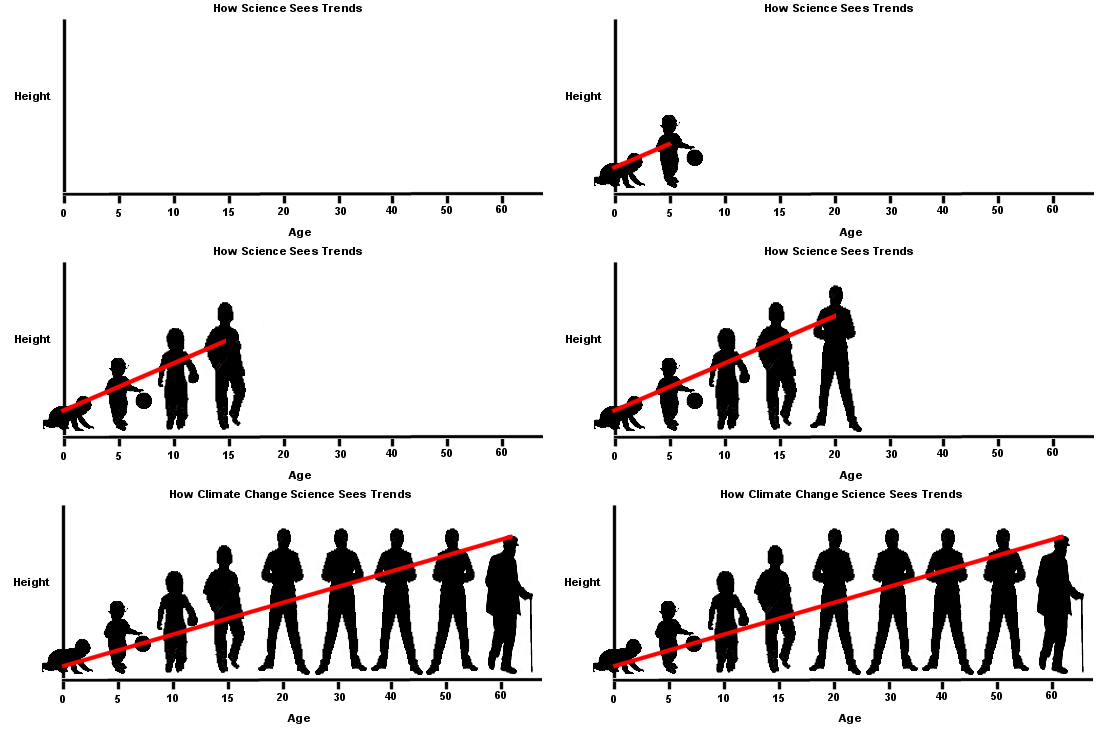
If you suspect a change in the trend, for example a ‘pause’ following a period of warming, then it is valid to show separate trends for the different stages.
On the other hand, applying least square trends to this type of data is a very dubious practice in the first place.
kim,
JDJ still cannot accept that the ‘pause’ begins currently, and extends back 18 ½ years. Today is time zero. There have been entire articles posted here explaining that, and showing how and why the ‘pause’ must be measured that way.
Therefore, 1979 is irrelevant. It is an arbitrary year, based on the start of a data set.
But jdj must include 1979 – 1997. Otherwise, he would be forced to admit that we have been in a ‘pause’ for many years, and that every ‘man-made global warming’ prediction has been flat wrong.
If we are going to arbitrarily go back in time, let’s look at the Holocene:
http://i.snag.gy/BztF1.jpg
I wonder how many ‘hockey stick’ warmings jdj can count there? I count at least twenty.
Stealey says: “There have been entire articles posted here explaining that”
..
Yes there have. However, they all depend on the RSS dataset. (see my post above re: Mears). Analysis of other datasets give different results.
..
Once you look at the other datasets (see my post re: sample size) you come to a different conclusion.
..
Why ignore the other datasets such as HADCRUT or GISS?
..
Now posting a graph of the temperatures of top of the Greenland ice sheet does not provide us with global temperatures. Also posting a graph that ends in 1850 does no justice to recent warming measured at the same spot that core was taken.
It’s weird to see arguments between people when both sides are wrong. Joel D. Jackson says:
But that’s just silly because the issue of whether or not there has been a pause is in reference to a particular period. Statistics does not teach you a larger sample size gives you a better estimate if by increasing your sample size, you go outside the range of interest.
On the other hand, dbstealey says:
Now, I haven’t seen the posts he refers to. I do, however, understand that’s an absurd requirement when looking for a “pause.” It is tied to the exact same problem found in Ross McKitrick’s paper which claimed to study the length of the pause. I wrote a post about it, but the most important part of it is:
Which is a trivial truth. If you assume one endpoint of the “pause” is the most recent time, then by definition, you assume we are currently in a pause. That means you are defining your “pause” as existing then seeking to use that definition to prove there is a pause. That’s called begging the question. It’s a tautology. It’s completely wrong.
It’s also nothing more than cherry-picking. As I show in my post, if you applied the same approach at the start of 1997 (assuming the temperature values for the past were the same as we have right now), you’d have found a ~13 year “pause” from 1983-1996. But if you repeated the analysis at the start of 1999, you’d have found there was no pause at all.
The same could happen in current times. All it would take is a strong warming spike in the next couple years. If that happened, using the most recent times as an endpoint would result in there not being a pause at all. That would “erase” the pause everybody is talking about. Which is wrong. If there is a pause right now, then there is a pause. No future temperatures can change that.
But by the definition Ross McKitrick used, and the one dbstealey says we must use, it can happen. The “pause” they insist we look at could vanish in as little as a couple years because their definition is foolish.
I actually like the second technique, Brandon. In effect, any continued pause or cooling nearly doubles the length of the pause. But I recognize its fragility. It has an artifact in the way of understanding that is not too difficult to peer around.
===============
jdj sez:
Why ignore the other datasets such as HADCRUT or GISS?
Because they are not as accurate as satellite measurements. The others are hopelessly corrupted by the UHI effect. And NASA constantly “adjusts” past temperatures. Those ‘adjustments‘ always seem to show scarier warming. But then, what should we expect from a has-been organization whose new priority is “Muslim Outreach”?
Brandon Shollenberger says:
If there is a pause right now, then there is a pause. No future temperatures can change that….
No one but you has discussed future temperatures. You misunderstand the rest of it, too.
Everyone on both sides of the debate looks at the new global temperatures as soon as they are posted every month. If global T breaks out to the upside, then the “pause” will be over. Everyone else (almost) seems to get that concept.
But that has not happened. Global warming has stopped. Argue all you want, but that is what the real world is telling us. Either accept empirical evidence, or reject it. That’s your call.
Also, I suggest you read the articles that you haven’t read; most of them are by Lord Monckton. They are very easy to find. Prof McKittrick is extemely knowledgeable, too. Maybe you know more than both of them, but I doubt it. Otherwise, you would have been the one to debunk Mann’s Hokey Stick. But McIntyre and McKitrick did that.
Brandon, all you are doing is making assertions. Is there any reason to believe your information is superior to Prof. Ross McKittrick’s? Or are you just giving in to your confirmation bias? Instead of that, try being skeptical of the MMGW narrative for a change. Every honest scientist is a skeptic, first and foremost. Being a skeptic will put you on the right track. For starters, try being skeptical of what the government is doing to the temperature record:
http://stevengoddard.files.wordpress.com/2012/07/ushcn26.gif
And Joel, don’t start until you establish your bona fides. What is your professional qualification? All you ever do is trot on back to your alarmist blogs, and then post their misinformation here. That is tedious, because you’ve been flat wrong from the get-go and your narrative never changes.
For close to twenty years the alarmist cult has preached the ‘dangerous man-made global warming’ scare. But for almost 20 years they have been complettely wrong. That’s what Planet Earth is demonstrating to everyone. Even the usually alarmist Washington Post now admits that global warming has stopped:
http://www.washingtonpost.com/blogs/capital-weather-gang/files/2014/06/newchart.jpg
For neutral readers who would like a little perspective, watch this:
http://www.greenworldtrust.org.uk/Science/Images/ice-HS/noaa_gisp2_icecore_anim_adj.gif
Well, that was inelegantly if not incorrectly phrased. I meant that any additional pause or cooling nearly doubles its effect in lengthening the pause.
================
kim:
I still think it’s hilarious people want to use a methodology which can “erase” any pause they may find at almost any point. Think about it. People are using a methodology which says there is a “pause” for something like 1998-2015, but in 2017, the same methodology could say the “pause” only lasts from 2008-2017. Call me crazy, but I’d like to think whether or not warming had paused over 2003 is not dependent upon whether or not temperatures go up in 2016.
If I were more clever, or at least less exhausted, I could probably come up with a witty remark about how it’s wrong to adjust the past 😛
dbstealey says:
I don’t know what I’m supposed to have misunderstood. Of course nobody but me “has discussed future temperatures.” I discussed future temperatures to show how this methodology produces absurd results if its adopted. If anyone else had bothered to look at what would happen with the methodology in the future, they’d reach the same conclusions I reached.
I haven’t misunderstood anything. I’ve just done what nobody else has done – examined the effects of the methodology people are using.
This may be the dumbest thing anyone has said all week on this site. Whether or not one person knows more than other people has nothing to do with whether or not he would have obtained their accomplishments. And whether or not I know more than Ross McKitrick has nothing to do with whether or not my analysis of his proposed methodology is right. You don’t have to know more than someone, especially not in general, to be able to find mistakes they’ve made.
Plus, there’s a degree of humor in this. Of all the people in the world aside from Ross McKitrick, Steve McIntyre and maybe a couple other people, I’ve probably done the most to spread knowledge about the problems of Michael Mann’s hockey stick. I’d wager there are, at most, half a dozen people who know the details and problems of temperature reconstructions better than I do.
So this is like saying, “How dare the fourth place person criticize the second place person!?”
You know, rather than chasing stupid red herrings, I think I’ll stick to doing what I’ve done – perform analyses testing the validity of methodologies. You ask if there’s “any reason to believe [my] information is superior” to McKitrick’s, but that doesn’t even make sense. The information I’ve provided in no way contradicts any of McKitrick’s. All it does is provide context to McKitrick’s which shows his methodology produces absurd results. I don’t dispute that his methodology gets the results he gets; I just point out the meaning of those results. As for why you should believe it, I provided documentation of what I did. You should believe what I say because I’ve provided the work showing it is true.
As for you telling me to be “try being skeptical of the MMGW narrative for a change,” what in the world is wrong with you? The only thing I’ve ever done to promote “the MMGW narrative” is say the greenhouse effect is real and humans are contributing to it. That’s it. Put that up against all the things I’ve done to challenge mainstream positions on things. They won’t begin to compare.
Seriously, what is wrong with you? Why is it the moment anyone disagrees with a position you hold, they must be warmists without a shred of skepticism in them? Why should a person have to meet challenges like this:
To point out skeptics people make? More importantly, why is when I provided detailed and documented criticisms of a methodology, your response was to not address anything I said or show, but to instead resort to ad hominem remarks?
You’re a moderator for what is supposed to be the leading skeptical website. Try acting like a skeptic. For a change.
dbstealey says:
I don’t know what I’m supposed to have misunderstood. Of course nobody but me “has discussed future temperatures.” I discussed future temperatures to show how this methodology produces absurd results if its adopted. If anyone else had bothered to look at what would happen with the methodology in the future, they’d reach the same conclusions I reached.
I haven’t misunderstood anything. I’ve just done what nobody else has done – examined the effects of the methodology people are using.
This may be the dumbest thing anyone has said all week on this site. Whether or not one person knows more than other people has nothing to do with whether or not he would have obtained their accomplishments. And whether or not I know more than Ross McKitrick has nothing to do with whether or not my analysis of his proposed methodology is right. You don’t have to know more than someone, especially not in general, to be able to find mistakes they’ve made.
Plus, there’s a degree of humor in this. Of all the people in the world aside from Ross McKitrick, Steve McIntyre and maybe a couple other people, I’ve probably done the most to spread knowledge about the problems of Michael Mann’s hockey stick. I’d wager there are, at most, half a dozen people who know the details and problems of temperature reconstructions better than I do.
So this is like saying, “How dare the fourth place person criticize the second place person!?”
You know, rather than chasing stupid red herrings, I think I’ll stick to doing what I’ve done – perform analyses testing the validity of methodologies. You ask if there’s “any reason to believe [my] information is superior” to McKitrick’s, but that doesn’t even make sense. The information I’ve provided in no way contradicts any of McKitrick’s. All it does is provide context to McKitrick’s which shows his methodology produces absurd results. I don’t dispute that his methodology gets the results he gets; I just point out the meaning of those results. As for why you should believe it, I provided documentation of what I did. You should believe what I say because I’ve provided the work showing it is true.
As for you telling me to be “try being skeptical of the MMGW narrative for a change,” what in the world is wrong with you? The only thing I’ve ever done to promote “the MMGW narrative” is say the greenhouse effect is real and humans are contributing to it. That’s it. Put that up against all the things I’ve done to challenge mainstream positions on things. They won’t begin to compare.
Seriously, what is wrong with you? Why is it the moment anyone disagrees with a position you hold, they must be warmists without a shred of skepticism in them? Why should a person have to meet challenges like this:
To point out mistakes skeptics make? More importantly, why is when I provided detailed and documented criticisms of a methodology, your response was to not address anything I said or show, but to instead resort to ad hominem remarks?
You’re a mod for what is supposed to be the leading skeptical website. Try acting like a skeptic.
@jdj: GISS is not a data set. It is a processed data food product filled mostly with computer fantasies. From about 1200 current global data collection locations, if finds 16, 000 temperature anomalies in grid cells. Calling it data is way over generous. https://chiefio.wordpress.com/gistemp/ has more detail than you can handle in links to the whole body of code and my analysis of what it does.
Also the willful ignorance of the Holocene Climate Optimum being clearly warmer than now is an astounding admission. It is found in everything from ice cores, to sediments to isotopes to pollens to species to…long list…
Joel D.Jackson says “Why does the person most responsible for the RSS data think surface temperature datasets are more reliable than his own product?”
Mears gives one reason in his post: “they certainly agree with each other better than the various satellite datasets do”. A related reason is that the revisions in the surface T data are smaller than the revision Willis discusses. Another reason might be that the satellite data is not quite what it seems to be in that the “lower troposphere” data is partly dependent on what is happening in the stratosphere (I base this on what Roy Spencer has posted on his web page).
The two data sets are certainly measurements of different things. It is not at all obvious which one is preferable.
Correlations of monthly change 1979-2015 in four main data sets.
http://postimg.org/image/6hecbysep/
The individual data series vary from the consensus by an average of 0.063 deg K per month.
If they all were perfect, there would be no deviation from the consensus.
Therefore, IMO, it is unlikely that we can measure monthly temperature changes within 0.06 deg.
I believe Dr. Spencer has claimed an error of less than 0.01 but that seems crazy after the recent revision from ver 5.6 to ver 6.0
ARGO proponents claim the error is < 0.0000000000000000001 deg (~sarc). but we know that is insane.
Bottom line… we are arguing about "catastrophic " warming that is so small that the signal is often much smaller than the noise. The fact that this thread discussion exists is essentially proof that the warming has been insignificant in this century.
“Another reason might be that the satellite data is not quite what it seems to be in that the “lower troposphere” data is partly dependent on what is happening in the stratosphere (I base this on what Roy Spencer has posted on his web page).”
As the troposphere has stopped warming, the stratosphere has stopped cooling: http://data.remss.com/msu/graphics/TLS/plots/RSS_TS_channel_TLS_Global_Land_And_Sea_v03_3.png
If Spencer’s new TLT were contaminated by stratospheric sampling, the alleged contamination would not have any effect during the period of the pause.
“Why does the person most responsible for the RSS data think surface temperature datasets are more reliable than his own product?”
1. Because satellite products do not measure TEMPERTURE. Sensor’s measure BRIGHTNESS.
2. Because over a short period of time the instruments have changed in significant ways.
3. Because to get from brightness to temperature you have to
A) make a variety of assumptions.
B) use idealized atomospheric profiles.
C) use physics models to predict temperature at altitude X, given brightness recieved at the sensor
in space.
4. Because in the vast majority of satellite products you validate against surface data.
5. Because for a very long time you had two satillite series that used the SAME data and different methods
that produced different answers… WHILE the surface teams used different data and different
methods to produce the same answer.
“WHILE the surface teams used different data and different methods to produce the same answer.”
HadCrut and GISS have a monthly correlation of 0.66.
All the data set and methodologies make a lot of assumptions. If you use the Wood For Trees Index (WTI), you get a consensus product.
I look forward to a few years from now when the satellites spike warmer and the surface data drops and everybody argues the exact opposite based on their side…LOL I’ll still use WTI.
Of course, there is also the weather model initialization data set.
http://models.weatherbell.com/climate/cfsr_t2m_2005.png
http://models.weatherbell.com/climate/cfsr_t2m_1988.png
http://models.weatherbell.com/climate/cfsr_t2m_1979.png
This is interesting because the weather models are initialized very carefully several times a day. This initialization of the 2m Temp field is plotted in the links above. The data is objective, detailed, global, and the people who created it had no interest in climate. They were just getting the best data into the model for each run.
Thoughts?
IPCC might have some close approximation of the amount of C/CO2 mankind’s activities added to atmospheric CO2 between 1750 and 2011, but as to the natural amounts from oceans, plants, etc. to borrow a phrase, they “…don’t have no stinkin’ clue”!
According to IPCC AR5 industrialized mankind’s share of the increase in atmospheric CO2 between 1750 and 2011 is somewhere between 10% and 200%, i.e. IPCC hasn’t got a clue. IPCC “adjusted” the assumptions, estimates and wags until they got the desired result.
At 2 W/m^2 CO2’s contribution to the global heat balance is insignificant compared to the heat handling power of the oceans and clouds. CO2’s nothing but a bee fart in a hurricane.
The hiatus/pause/lull (IPPC acknowledges as fact) makes it pretty clear that IPCC’s GCM’s are useless trash.
nickreality65 says: “According to IPCC AR5 industrialized mankind’s share of the increase in atmospheric CO2 between 1750 and 2011 is somewhere between 10% and 200%”.
Wow, that is quite a claim. Where in AR5 I can find that? Or did you just make it up?
IPCC AR5 Chap 6 pg 486
Table 6.1……………………….all PgC
……………………….minus….mean…..plus………..Uncertainty +/-
Anthro output………..470…….555……..640………….15.3%
Fossil Fuel………..…345……..375……..405…………..8.0%
Net land use………..100……..180……..260…..……..44.4%
Ocean atmos flux….-185…….-155…….-125…….…..19.4%
Residual land sink…-250…….-160………-70……..…56.3%
Anthro Residual…….230………240……..250………….4.2%
Percent Retained…….48.9%…….43.2%…..39.1%
Maximum Range…….10……….240……..470…………95.8%
Min to max……………….4%…..mean……196%
Square root sum of squares, +/-………..76%
How can one possible get +/- 4.2% in the final answer w/ +/- 56.3% on residual land sink, +/- 44.4% net land use. +/- 56.3% & +/- 44.4% are rather large “haven’t got a clue” WAGs.
10% to 200% was a rounding error. How about 4% to 196%.
Try SPM TS.6 for a whole lot of interesting and really important stuff IPCC admits to having no clue.
Need to do the assigned reading to effectively participate in class discussion.
nickreality65,
“Total anthropogenic emissions” is the sum of “Fossil fuel combustion and cement production” and “Net land use change” so:
Total anthropogenic emissions: 555 +/- 85
Accumulation in atmosphere: 240 +/-10
fraction in atmosphere: 0.43 +/- 0.07
I have no idea what you are trying to do in your calculation (where does the range from 10 to 470 come from?), but it appears you are the one who “…don’t have no stinkin’ clue”.
nickreality65 June 21, 2015 at 11:43 am
OK, nick, thanks for an interesting question. I’ve hacked through the math and found the difficulty you are having.
Your list of values and errors is all correct, but only up to the “Percent Retained” calculation. You can’t calculate the error in the “Percent Retained” by dividing max values or min values. Doesn’t work that way.
The rules for the propagation of errors is different for division/multiplication than they are for addition/subtraction. With addition/subtraction, the absolute errors add quadratically (square root of sum of squared errors). You’ve done that properly in calculating the errors of the “Anthro output” above.
However, with multiplication/division, instead of using absolute values, it is the percentage errors which add quadratically. Per your figures above, which agree with mine, this gives us a percentage error of
sqrt( 1.153^2 + 1.042^2) = 1.55
You are calculating anthro residual/anthro output. The uncertainty of this division is the square root of (1 + the anthro percent error)^2 plus (1 + the anthro resid percent error)^2 ).
A result of 1.55 means that there is± 55% uncertainty in the final answer of 43.2% … which in turn means that the absolute error of the “Percent Retained” is ± 24%, and not the ± 4.2% you’ve calculated.
I hope this helps, if you have questions askem …
w.
Willis,
You wrote: “However, with multiplication/division, instead of using absolute values, it is the percentage errors which add quadratically. Per your figures above, which agree with mine, this gives us a percentage error of
sqrt( 1.153^2 + 1.042^2) = 1.55”
If I follow you, you have a fractional error in “anthro output” of 0.153 and a fractional error in “anthro residual” of 0.042 which gives a fractional error of
sqrt( 0.153^2 + 0.042^2) = 0.159
or 15.9%. Which is what I said earlier.
Mike M. June 21, 2015 at 5:47 pm
Ah, yes, many thanks, Mike. I was moving too fast again, you are 100% correct and I was wrong.
An error of 15.9% on a value of 43.2% is an absolute error of 6.9%. This leads to a somewhat wider range than nickreality calculated, of 50.1%, 43.2%, and 36.3%
However, nick says:
First, the percentage uncertainty (as you point out above) is 15.9%, not 4.3%.
More to the point, when the net land use is included in the calculation, it is an addition calculation the percentage error doesn’t matter. All that counts is the absolute error, no matter what percentage that might be.
The percentage error doesn’t matter for addition/subtraction, only for multiplication/division.
w.
does figure 3 show water temperature only or does it also show air temeprature to some altitude? I am having trouble understanding what the variation in the “top” surface of figure 3 is showing. is it a variation in sea level between el nino and la nina condition? thanks for any help.
January 1979 and May 2015 had weather phenomena that lasted a few months up to about a year: patterns associated with the state of ENSO, unusually warm water recently off the Washington state, etc. These transient local anomalies may be large enough to bias yourmap of trends. A map of the difference between the means of the last and first 36 months might tell us more about climate change with less influence from “weather”.
“I don’t have no stinkin’ clue”? In German: “Ich hab’ keine (verdammte) Ahnung.”
Great work and very interesting, Willis. Thank You.
How about in English?
Translating “stinking clue” out of American:
“I have no idea or even a lousy guess where to begin”
🙂