Peak Oil Alarm, Energy Crisis, Renewable Hype: A 100 Year Old Scare
Most people today know Arrhenius as the ‘father of global warming’ due to his 1896 publication of On the Influence of Carbonic Acid in the Air upon the Temperature of the Ground which became the cornerstone work for global warming theory today. Robert Rhode, who setup the Global Warming Art website (and also BEST), made the paper available online wrote of it:
Arrhenius’s paper is the first to quantify the contribution of carbon dioxide to the greenhouse effect (Sections I-IV) and to speculate about whether variations in the atmospheric concentration of carbon dioxide have contributed to long-term variations in climate (Section V). Throughout this paper, Arrhenius refers to carbon dioxide as “carbonic acid” in accordance with the convention at the time he was writing.Contrary to some misunderstandings, Arrhenius does not explicitly suggest in this paper that the burning of fossil fuels will cause global warming, though it is clear that he is aware that fossil fuels are a potentially significant source of carbon dioxide (page 270), and he does explicitly suggest this outcome in later work.
It was surprising to encounter a book by Svante Arrhenius published in 1919 which contains many very current-sounding ideas on energy topics. Although Svante Arrhenius showed great foresight in many of his comments on energy, he was wrong in some of his most important predictions: America will run out of oil by 1953 at the latest. Coal reserves will be depleted in England within 50 years and in America within 150 years. –Charles G. Moseley, Journal of Chemical Education 55(3) 1978
That so great a scientist as Svante Arrhenius could badly overestimate the energy problems of his time suggests that we should perhaps place more emphasis on using technology to solve our energy problems and less emphasis on bemoaning the difficulty of the problem. –Charles G. Moseley, Journal of Chemical Education 55(3) 1978

Although Svante Arrhenius showed great foresight in many of his comments on energy in 1919, he was wrong in some of his most important predictions: America will run out of oil by 1953 at the latest. Coal reserves will be depleted in England within 50 years and in America within 150 years.
For most of us the concept of an energy crisis dates primarily from the oil embargo established by the Arab nations against many of the western nations in 1973. Who can forget the long lines at service stations and the increases in gasoline and chemical prices which soon resulted? Thus, it was surprising to the author to encounter a book by Svante Arrhenius (famous for his theory of ionization of acids, bases, and salts in water) published in 1919 (and in 1925 in English translation[1]) which contains many very current-sounding ideas on energy topics. He mentions the following energy-related problems:
* Some oil fields are already depleted, and known petroleum reserves will last only a short time.
* Known coal reserves will last longer but are certainly finite.
* Burning large amounts of fossil fuels will increase the carbon dioxide concentration in the atmosphere and possibly cause adverse climate changes.
* No really adequate battery exists for use in electric vehicles or for storing energy derived from the sun, wind , or water.
The book also contains the following proposals to help solve the predicted energy crisis:
* Institute stringent conservation programs to reduce consumption of coal and oil.
* Replace all lights which utilize petroleum products with electric lights.
* Push development of water, wind, and solar energy sources.
* Develop more efficient fossil fuel powered engines.
* Utilize alcohol derived from plant sources as a fuel to replace oil and coal.
* Develop more efficient methods to transport coal and utilize its energy content.
* Study atomic energy for possible future use.
Although Arrhenius obviously showed great foresight in many of his comments on energy, he was far from correct in some of his most important predictions. Examples are: America will run out of oil by 1953 at the latest. Coal reserves will be depleted in England within 50 years and in America within 150 years.
There are at least two lessons which can be derived from this very interesting book. One is that our energy problems are not really new (although they may, of course, be more acute at some times than at others). Providing sufficient reasonably priced energy for our needs has always been a challenge and will likely continue to be so. Another lesson is that it is very easy to underestimate our ability to solve or at least alleviate our energy problems. That so great a scientist as Svante Arrhenius could badly overestimate the energy problems of his time suggests that we should perhaps place more emphasis on using technology to solve our energy problems and less emphasis on bemoaning the difficulty of the problem.
Footnote 1: Arrhenius, Svante A., and Leonard, Clifford S. (Translator), Chemistry in Modern Life, D. Van Nostrand Company, New York, 1925.
From: Charles G. Moseley, Journal of Chemical Education, 55(3) 1978
– See more at: http://www.thegwpf.com/svante-arrhenius-an-early-prophet-of-the-energy-crisis/#sthash.KAB4gnBe.dpuf
In addition to being wrong about energy predictions, it should also be noted that there is this entry in Wikipedia that highlights another great failing of Arrhenius:
Svante Arrhenius was one of several leading Swedish scientists actively engaged in the process leading to the creation in 1922 of The State Institute for Racial Biology in Uppsala, Sweden, which had originally been proposed as a Nobel Institute. Arrhenius was a member of the institute’s board, as he had been in The Swedish Society for Racial Hygiene (Eugenics), founded in 1909.
Ouch – global warming, energy crisis, AND Eugenics?
Although Svante Arrhenius showed great foresight in many of his comments on energy in 1919, he was wrong in some of his most important predictions: America will run out of oil by 1953 at the latest. Coal reserves will be depleted in England within 50 years and in America within 150 years.
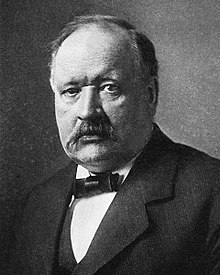
Svante Arrhenius (1859-1927) was the first peak oil alarmist and the first scientist to calculate how changes in the levels of atmospheric CO2 could alter the surface temperature due to the greenhouse effect. Photo Wikipedia
For most of us the concept of an energy crisis dates primarily from the oil embargo established by the Arab nations against many of the western nations in 1973. Who can forget the long lines at service stations and the increases in gasoline and chemical prices which soon resulted? Thus, it was surprising to the author to encounter a book by Svante Arrhenius (famous for his theory of ionization of acids, bases, and salts in water) published in 1919 (and in 1925 in English translation[1]) which contains many very current-sounding ideas on energy topics. He mentions the following energy-related problems:
* Some oil fields are already depleted, and known petroleum reserves will last only a short time.
* Known coal reserves will last longer but are certainly finite.
* Burning large amounts of fossil fuels will increase the carbon dioxide concentration in the atmosphere and possibly cause adverse climate changes.
* No really adequate battery exists for use in electric vehicles or for storing energy derived from the sun, wind , or water.
The book also contains the following proposals to help solve the predicted energy crisis:
* Institute stringent conservation programs to reduce consumption of coal and oil.
* Replace all lights which utilize petroleum products with electric lights.
* Push development of water, wind, and solar energy sources.
* Develop more efficient fossil fuel powered engines.
* Utilize alcohol derived from plant sources as a fuel to replace oil and coal.
* Develop more efficient methods to transport coal and utilize its energy content.
* Study atomic energy for possible future use.
Although Arrhenius obviously showed great foresight in many of his comments on energy, he was far from correct in some of his most important predictions. Examples are: America will run out of oil by 1953 at the latest. Coal reserves will be depleted in England within 50 years and in America within 150 years.
There are at least two lessons which can be derived from this very interesting book. One is that our energy problems are not really new (although they may, of course, be more acute at some times than at others). Providing sufficient reasonably priced energy for our needs has always been a challenge and will likely continue to be so. Another lesson is that it is very easy to underestimate our ability to solve or at least alleviate our energy problems. That so great a scientist as Svante Arrhenius could badly overestimate the energy problems of his time suggests that we should perhaps place more emphasis on using technology to solve our energy problems and less emphasis on bemoaning the difficulty of the problem.
Footnote 1: Arrhenius, Svante A., and Leonard, Clifford S. (Translator), Chemistry in Modern Life, D. Van Nostrand Company, New York, 1925.
From: Charles G. Moseley, Journal of Chemical Education, 55(3) 1978
– See more at: http://www.thegwpf.com/svante-arrhenius-an-early-prophet-of-the-energy-crisis/#sthash.KAB4gnBe.dpuf
Discover more from Watts Up With That?
Subscribe to get the latest posts sent to your email.
Jeez, he looks a dour as Malthus.
As a physical chemist, Arrhenius was a genius. As a prognosticator, he was far less. He incidentally suggested the inherent failing of all soothsayers when he mentioned “known petroleum reserves” and “known coal reserves”.
Humans are constantly learning new things, and what may seems obvious today may become ridiculous tomorrow, as we learn then what we don’t know now.
Dante’s “Divine Comedy” had little respect for soothsayers.
Arrhenius was a superb physical chemist, but as a prognosticator – well, not so much. He hinted at the problem when he used the phrases “known petroleum reserves” and “known coal reserves”.
Human beings are constantly learning. What is thought to be certain knowledge today may become ridiculous tomorrow as we learn something new.
Dante’s Divine Comedy (about 700 years ago) had little respect for those who presumed to foretell the future.
I’m curious why some of these comments are out of chronological order? Makes following the conversation thread a bit confusing.
Bill makes a point with his post, Ted makes the next post, but didn’t respond to Bill. Alice comes along 3 hrs later and responds to Bill, using the reply to Bill button, putting her comment ahead of Ted, who is off on his next excellent adventure.
Alan Robinson,
Perfect explanation. Thanks.
Their out of order, your out of order, this whole damn place is out of order!!!!
Ouch – global warming, energy crisis, AND Eugenics?
Ouch — Hitler AND the Autobahn?