
Remember this alarmist whining from Joe Romm’s Climate Progress last year?
Great Lakes Michigan and Huron set a new record low water level for the month of December, and in the coming weeks they could experience their lowest water levels ever. It’s becoming certain that, like the rest of the country, the Great Lakes are feeling the effects of climate change.
Last year was officially the warmest year on record for the lower-48 states. The hot summer air has been causing the surface water of the Great Lakes to increase in temperature. One might think this causes more precipitation around the lakes, but the warmer winter air is causing a shorter duration of ice cover. In fact, the amount of ice covering the lakes has declined about 71 percent over the past 40 years. Last year, only 5 percent of the lakes froze over –- compared to 1979 when ice coverage was as much as 94 percent.
What a difference a year makes.
Current data from the U.S. Army Corps of Engineers shows that for the first time in 14 years, all five Great Lakes are at or above average water levels. Lake Michigan/Huron is up 18″ in the last year.
 Source: http://w3.lre.usace.army.mil/hh/GreatLakesWaterLevels/GLWL-CurrentMonth-Feet.pdf
Here is the last twenty years worth of data. The red line is the “normal” line in each lake level plot. The red dashed lines are forecasts.
 Source: http://www.glerl.noaa.gov/data/dashboard/GLWLD.html
From a July 07, 2014 Chicago Tribune article:
In January 2013, the average water levels in Lakes Michigan and Huron dipped to 576 feet, the lowest point since modern record-keeping began in 1918.
The all-time high of 582.3 feet was set in October 1986, representing a sizable range of about 6 feet.
The lakes tend to follow yearly cycles, swelling in the spring and summer and shrinking in the fall and winter, but they have never in 95 years of recordings remained below average for so long.
The last two years of relatively heavy winter and spring precipitation, however, have led to this year’s stronger-than-usual seasonal rise, according to Keith Kompoltowicz, chief of watershed hydrology for the Army Corps of Engineers Detroit District.
“We saw a tremendous amount of snow,” Kompoltowicz said of this winter. “We haven’t seen snow like that in a long time.”
In fact, the snowpack around the Michigan basin this year was 30 percent higher than at any time in the past decade. The past two months have also supplied above-average amounts of rain, quenching parched harbors and popular fishing holes like the Lincoln Park Lagoon.
So much for climate change effects, water is back to normal levels for now.
[duplicated Tribune quote removed. .mod]
h/t to WUWT reader cjames
Steve R says: September 9, 2014 at 4:44 am
http://polarbearscience.com/2014/07/10/breakup-date-average-for-w-hudson-bay-is-july-1-this-year-its-late-again/
There is a seaport at Churchill and the first grain ship departed for Mexico on August 5th, which is normal. It usually stays open into November. They have records going back to 1600.
http://polarbearalley.com/blog/2014/08/07/polar-bear-blog-churchill-bears-and-belugas/
If it’s above normal it must be caused by global warming.
Yes but if it’s below normal it must be caused by global warming too.
Yes, I know it’s not obvious. You have to go through 7 years of daily indoctriation to just begin to grasp how climate really works.
During the “Chippewa Phase” of ancestral Lake Michigan 10,000 years ago the lake level was 100 feet lower that it is today. During a cooling period (6-10,000 years ago) known as the Hypsithermal the lake levels reached 20 feet higher than today about 5500 years ago In between glacial periods there does seem to be a cycle of about 60 years where lake levels hit a low, then surge to highs 30 years later then back down again.
See more at http://igs.indiana.edu/FossilsAndTime/LakeMichigan.cfm
“Hypsithermal” means “warmer (than today)” and is a name for the climatic optimum during the early-mid Holocene. And, yes, it was also wetter than at present. Warm intervals ar normally wet and cold intervals are dry.
However, apparently rare real life catastrophic events such as major earth quakes, stock market crashes, heavy rainfall events , etc., occur more frequently than indicated by the normal curve, i.e., they exhibit a
probability distribution with a fat tail
. Fat tails indicate a power law pattern and interdependence. The “tails” of a power-law curve — the regions to either side that correspond to large fluctuations — fall off very slowly in comparison with those of the bell curve (Buchanan, 2004). The normal distribution is therefore an inadequate mode l for extreme departures from the mean.
http://arxiv.org/ftp/arxiv/papers/0805/0805.3426.pdf
This water levels look similar Artic ice coverage. I’ll have to plot the together: notable decline since 1997, low in 2007, 2012; climbing last two years.
Are you sure we’re not moving into global cooling?
The Detroit News also had a good report on rising lake levels, and I can tell you that it is much easier to get in and out of my boat this year than last. I have tried to convince the editor of the Detroit News to interview all the shaman who were proclaiming that the lake levels were in permanent decline due to climate change. Unfortunately, I have not had much success, but I will keep trying.
If these are heights above sea level have they accounted for sea level rise???
That would give the false impression of 3mm/yr drop in lake levels even if they had the same water in them.
Isn’t 6ft about the amount global mean sea level has risen since 1986 😉
I’m sure the reference is to some well-surveyed benchmark that is traceable to some sea-level benchmark from a long time ago.
Anthony, unless there some subtle difference I’m missing, it seems you posted the Tribune quotation twice.
There be “ice” on the Glacier Park, “Goat Haunt” web cam lens.
Just weather, but cold weather.
I once read a report from NOAA that natural rising of the land under the great lakes would cause them to lose depth and virtually become dry lake beds in the distant future. Therefore, climate change matters not base on that assumption.
Not exactly become dry lake beds, since the land around the lakes is also rising at approximately the same rate. What will happen is that the lakes will be “tipped over” towards the south since the land is rising faster towards the north (where the ice was thicker and melted later), so the northern shores will rise and the southern sink. Tough luck for Chicago.
This phenomenon is quite noticeable for large lakes in Scandinavia where the postglacial rebound is still quite large. Believe it or not, there is even a special word for it in Swedish “sjööverstjälpning”.
It is even conceivable that the lakes will start draining into the Mississippi system again, if the interglacial lasts long enough.
Global Warming means never having to say you’re wrong.
Its like someone cleaned the lens at Goat Haunt, now no ice at all.
Thanks National Park Service Rangers I guess.
I can’t fathom how much water it would take to raise the great lakes a foot and a half…..
If one rain in Australia can be blamed for sea levels falling…..
….then this much water had to have been measured in sea levels falling
With the late ice this year, are the lakes also the coldest in many years?
See the map provided by Bob Tisdale – Figure 6, right side, in green.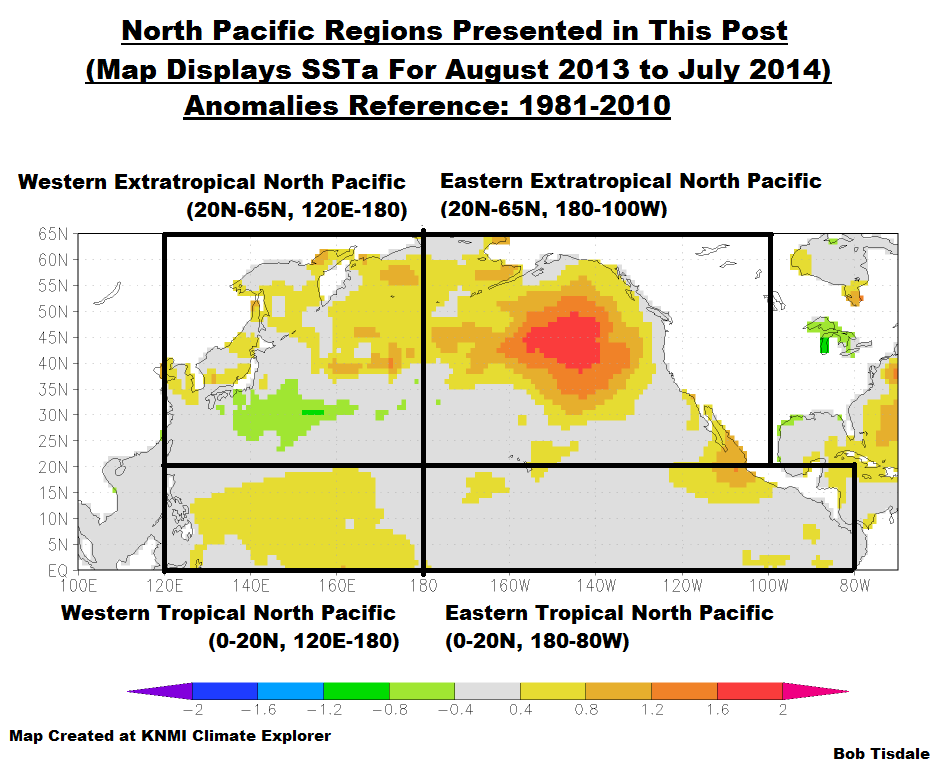
http://bobtisdale.wordpress.com/2014/08/16/on-the-recent-record-high-global-sea-surface-temperatures-the-wheres-and-whys/
map only:
Thank you! So they are about a degree cooler than normal. It does not sound like much, but for all that water, it is an awful lot of joules.
[snip – if you want to ask a question, don’t phrase it with “deniers” pejorative – any and all such comments will be snipped. Feel free to be as upset as you wish – Anthony]
Sorry, I thought the /s tag would have made it obvious that I was being sarcastic. I’ll avoid using the word deniers even in a sarcastic sense.
Next headline?
Great Lakes rising, soon to submerge Toronto, Buffalo.. Chicago is doomed..
At what point do we stop laughing and make ready with the tar and feathers?
The costs of this mass hysteria have been brutal.
My humour toward these shamen is becoming the same.
Enough already.
“…water is back to normal levels for now.”
Oh no, it’s worse than we thought. We’re doomed!
I’m a bit surprised someone has not blamed catastrophic Republican-caused climate change for diverting California’s rain to the Great Lakes. Sometimes these climate nutters are a bitter disappointment.
My models show that the water level rise in the Great Lakes is caused by catastrophic thermal expansion of the water therein. I think we’re found the missing heat! And we’re all going to die if we don’t build more windmills.
Breaking News: Franklin expedition found.
http://news.nationalpost.com/2014/09/09/franklin-expedition-ship-found-pmo-says/
Michigan inland lake levels have rebounded very nicely due to our 2013/14 mega winter and copious rains last fall. Summer rains have mostly replaced all water lost to this summer’s solar evaporation too.
So, this is magnitudes more water than they claimed in the Australia floods….
Does anyone know if they are showing it as saw levels falling again?….or is it crickets?
saw???…….sea!
We were told in 2013 that the Great Lakes were at a historic low water level condition. One short year later, their water levels have all recovered to ‘normal’ levels, thanks to plentiful precipitation and an extended seasonal ice coverage.
This illustrates dramatically how wide the natural variability of the Great Lakes water levels really is…. and the utter folly of trying to link changes in their seasonal/annual water levels to minor changes in atmospheric trace gases.
Family members and friends that reside in Wisconsin were far more concerned about the scarcity and high costs of propane for heating in the record setting cold of last winter (54 days below 0F) and the increasingly unreliable electrical grid than any laughable ‘warming’ effects from 0.04% by volume atmospheric CO2.
I would like to point out that there is no “normal” level for the Great Lakes it is actually the average this seems to be a small mistake with the topic that should be corrected.
With the almost absolute ice cover and the long, slow thaw, the lake was VERY cold this summer. Water sports on the lake were rather unpleasant, and probably dangerous (hypothermia risk). The temperature stayed so mild that we barely got into the 80’s much less the 90’s, and “cooler near the lake.” The beach was kind of chilly in a swimsuit, and you really couldn’t stay in the water at all safely. Only 2 days above 90 degrees all summer. Unusual but pleasant. Lake levels have been up or down 4-6 feet at various times over the last 20 years, and I tend to ignore it, as it is always changing. I am more concerned about invasive species and the health of the fish population. Let’s spend some environmental money on those problems.