 From the University of California – Irvine and the “Environmentalists are never happy” department comes this amusing quandary.
The cause? Increased high-elevation plant growth fueled by climate warming
Irvine, Calif. — Freshwater runoff from the Sierra Nevada may decrease by as much as one-quarter by 2100 due to climate warming on the high slopes, according to scientists at UC Irvine and UC Merced.
Accelerated plant growth at higher elevations caused by increasing temperatures would trigger more water absorption and evaporation, accounting for the projected runoff declines, the researchers add.
A diminished river flow will only add to the burden of providing resources to the thirsty farms and homes that rely on it. The state is currently experiencing a severe drought, and some reservoirs and groundwater levels are at all-time lows.
The study findings appear this week in the early online edition of Proceedings of the National Academy of Sciences.
“Scientists have recognized for a while that something like this was possible, but no one had been able to quantify whether it could be a big effect,” said UCI professor of Earth system science Michael L. Goulden of the decreased runoff. “It’s clear that this could be a big effect of climate warming and that water managers need to recognize and plan for the possibility of increased water losses from forest evaporation.”
According to the researchers, runoff from mountain ranges is vulnerable to temperature hikes that lengthen growing seasons and result in more vegetation growth at high elevations. Snow-dominated mountain forests that are currently dormant in winter with cold temperatures have lower vegetative density and less evapotranspiration than downslope forests in the snow-rain transition zone, which have year-round growing seasons. Evapotranspiration is the combination of water evaporation from land and the loss of water through plant-leaf transpiration.
Goulden and UC Merced’s Roger C. Bales investigated the potential influence of a warming climate on evapotranspiration in the Kings River Basin in California’s Sierra Nevada and found resulting changes in the amount of freshwater mountain runoff available to serve surrounding communities.
They gauged water vapor emission rates and combined those measurements with remote sensing imagery to determine relationships among elevation, climate and evapotranspiration. According to the data, freshwater mountain runoff is highly sensitive to expanded vegetation growth.
The authors found that greater vegetation density at higher elevations in the Kings basin with the 4.1 degrees Celsius warming projected by climate models for 2100 could boost basin evapotranspiration by as much as 28 percent, with a corresponding 26 percent decrease in river flow.
Further, the relationships among evapotranspiration, temperature and vegetation density were similar across a broader area of the Sierra Nevada, suggesting that the impact of climate change on evapotranspiration and freshwater availability could be widespread.
“Most people have heard about the giant forests around Yosemite and Sequoia national parks, but these areas have not been a focus of this type of research. Understanding of Sierran hydrology has improved recently with the National Science Foundation’s Critical Zone Observatory, and data collected there allowed us to look at the problem from several perspectives,” Goulden said. “All of our analyses pointed in the same direction: An upslope expansion of forest with warming would cause a large increase in evaporative water loss and lead to reduced water availability.”
Bales is a professor of engineering and director of the Sierra Nevada Research Institute at UC Merced. The research was supported by the NSF, through the Southern Sierra Critical Zone Observatory (EAR-0725097) and a major research instrumentation grant (EAR-0619947), and by the U.S. Department of Energy’s Terrestrial Ecosystem Science program.
They should be happy about more trees. After all the coal plants are shuttered, they will need the wood to stay warm.
Doesn’t increased run off have a lot to do with flooding in California?
what a load of hogwash. Water is too serious a matter to let fools like that play with failed computer models. Anyone who extrapolates out that far is not a scientist of any repute or regard. We have to use what water we have in much better ways and technology is rapidly advancing in this area.
That advance must not be blocked by these dopes trying to grab so me more climate funding.
The loss of ground water to trees is no model. One of the worst consequences of “only you can prevent forest fires” was the drastic increase in the numbers of trees per acre in most of the lower 48 since the end of the 19th C. I have heard from good authorities that there are more trees within the US borders now than there were 200 years ago. Fire suppression also encouraged development of dense undergrowth and understory formation which fire fighters of my acquaintance refer to as “fire ladders.” The reason given is that a small fire in the duff can burn merrily along until it encounters brush, climb into the brush, thence into understory trees and from there into the overstory crown. It was preventing forest fires that made them worse. One cause of lowered incidence of major fires in the west may be due to the hands-off, defensive approach now employed by many forests in fire suppression.
One of the consequences of dense tree stands is increased depth to ground water, and as the water elevation drops the trees compete with each other. A forester working with the Willamette N.F. in Oregon pointed out square miles of dead trees that had essentially “fought to the death” for declining water. Seriously thinning forests is a means of increasing surface water supply and I have seen it convert seasonal streams to perennial streams, and intermittent streams to seasonal streams on ranches in the Sierra Nevada foothills and in the Coast Ranges in California. Not everything about climate is temperature, and not everything about climate change is NOT anthropogenic. We do have an influence, just not usually what “the Team” talks about.
The problem is really one of unbounded funding.
Why governments have been suckered into approving this enormous waste of taxpayers money is beyond me
With so many real problems facing every country, this climate overstudy nonsense is both reprehensible and just plain STUPID!
Get a job you useless bludgers!
So,,,, we have a new feedback to absorb more C02? Go figure, a cycle perhaps?
“but thanks for acknowledging the need for CO2 sequestration”
That’s’not what ossqss meant.
Global warming causes earthquakes — we have heard that bit of loony nonsense before.
ossqss was being cynical about CO2.
Your “there is good science that says this [drought] may cause stress to the San Andreas Fault” is not supported by the article you linked. It says that extensive groundwater pumping “makes it a bit easier for the plates to slide, which might set off subtle shudders“. Sounds to me like groundwater loss eases the stress slightly.
Peter you should actually read the articles you link before you (incorrectly) comment on them.
It is not the draught per se, that causes tectonic strain, according to the article but rather the seasonal changes of alternate of snow and rain load followed by summertime relief from the precipitation load. According to their hypothesis a prolonged drought would reduce stress on the SA fault.
Oh, BTW increased tree/vegetation growth from increased atmospheric CO2 concentration may lead to greater snow deposition accumulation in the Sierra Nevada causing a net increase in springtime water runoff. The increased CO2 concentration will improve vegetation drought resistance improving produce yields in the central valley as well .
Yea increased CO2!
It is the slight rise of atmospheric CO2 that has increased tree growth.
Droughts suck but have little to do with CO2. Building in a desert is the real problem… The irony is the panic of increased CO2 will run uncontrolled. But when alarmists acknowledge flora is a negative feedback, suddenly flora is the cause for alarm. I’m pretty sure not everything that happens in the world is panic worthy…
More trees will not mean more CO2 absorption? Really? Not to mention all the other non-tree foliage that will accompany the trees. You made your statement as if you already know the precise amount of vegetation that will result in a bit of warming. And what of the evaporation rate? More evaporation means more rain. More rain means more cloud coverage. More cloud coverage means a cooler surface.
Business Insider, MSNBC and ThinkProgress. What great scholarly and peer reviewed scientific sources. Why not include The Daily Kos and MediaMatters for America?
Lots of “coulds” in this article as in “it could be with warming”….. Of course the fact that the Sierras are cooling makes it irrelevant .
Moreover, the useless bastards will starve or freeze to death when the upcoming mini ice age really gets cracking!!
Those environmentalists and their negative vibes … their glass is always half empty.
Sounds more and more like there’s too many people in California – it is characteristically incapable of supporting so many people in the style and comfort they’ve raped the land to produce. Let the Owens river run free and relocate the hungry and parched climate refugees to New England, the other leftist coast.
The left coast really is the left coast. Geographically speaking the majority of Calif is conservative.
The water shortage is primarily political, despite the current and real drought. We flush a lot of water to the ocean for a little fish, the CA smelt. The greens have shut down any new reservoirs for decades.
Just a dry spell if you live here. As regards “flushing water” anywhere, a very large number of delta ranchers aren’t in favor of tunnels or, for that matter, pumping water to So. Cal., or even south into the desert called the southern San Joaquin Valley. If you know what you are looking for, evidence of the past failures of long distance water transport to make perfectly good grazing land useable as cropland are all over the Great Valley. Besides, smelt are decent eating when you can take them legally. You can’t say that about an inhabitant of L.A.
Too many stupid people.
They dumped eight hundred thousand acre-feet of fresh water into the ocean on the unproven assumption it would help a so-called endangered fish.
“Sierra Nevada freshwater runoff could drop 26 percent…”
Instead of freshwater, we should runoff the politicians in California. Dump them into the ocean!
Stunning,.. the CAGW types only see DOOM and GLOOM in every thing they study. When it comes to CO2 fertilizing food crops, they focus on the 5% reduction on possible minerals and the fact that the bugs will find them more attractive to eat. It is to the point that I think these people need to be on meds.
In addition to all the positive benefits gained from a slightly warmer Earth this “researcher” mentioned, isn’t it funny he completely failed to mention the CO2 fertilization effect, which will further increase plant growth, crop yields and forest growth by 50% once CO2 levels hit 560ppm? (Idso & Idso et al).
How will nature and humans ever adapt to a greener and more fertile planet that’s better able to feed and support more life?
Oh, the humanity….
Moreover, increased ocean evaporation from slightly warmer global temps would more than offset any incremental loss of evaporation from tree lines moving to higher altitudes/latitudes…
I forgot to mention that the, “4.1 degrees Celsius warming projected by climate models for 2100”, cited in this paper is now a completely implausible scenario.
Such an absurd CAGW warming projection would require CO2 induced warming to be 0.38C/decade every year for the next 86 straight years, starting from tomorrow, to achieve such a huge amount of CO2 induced warming….
Too bad for the CAGW grant swindlers that there hasn’t been ANY global warming trend for the past 15~18 years (depending on temp database used), despite 1/3rd of all man-made CO2 emissions since 1750 (not a typo) made over just the last 18 years..
Not even the IPCC will admit 0.38C/decade of CO2 forcing is even remotely possible for the next 86 straight years…
I guess they never leave the air-conditioned office.
Trees, foothill forests prolong river flow throughout the year.
The forest acts as a sponge for snowmelt, downpours and so on, thus preventing flooding and then their real value kicks in, come midsummer the water flow is clean, cool and steady.
Known in many farming areas where the forests were cleared ruthlessly to create farm land.
Until the foothill forests grew back, there was spring flooding and summer drought.
Back in the day, the supporters of AGW were far more amusing, speculating about global warming creating more prostitutes, and stuff like that. Now they are getting rather boring.
‘“Scientists have recognized for a while that something like this was possible, but no one had been able to quantify whether it could be a big effect,” said UCI professor of Earth system science Michael L. Goulden of the decreased runoff. ‘
‘ recognized for a while’? When the dams don’t fill because of reduced runoff, because it is not PC to maintain good runoff drains, has been known for decades.
This shall not help the historic (dare I say “unprecedented”) anthropogenic aquifer depletion, some areas will already need a thousand years of steady rain to recharge, or more. Compare maps: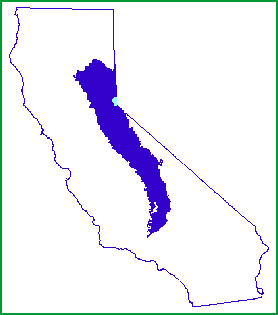
Used in Wikipedia “Sierra Nevada” entry:
From USGS on groundwater depletion:
http://water.usgs.gov/edu/gwdepletion.html
http://water.usgs.gov/edu/graphics/gwdepletion-map-2008.png
Naturally clouds from the Pacific move inland to the Sierra Nevada range, which yields precipitation. But the area of greatest depletion is in this “rain shadow” of the mountain range, incoming is far less than outgoing. With less freshwater runoff, the situation will worsen.
Question for experts: With the aquifer depletion there is subsidence, which can happen suddenly. Does the area of great aquifer depletion indicate an area with a pattern of minor earthquakes?
The water shortages and riots will happen shortly without action. If California doesn’t build desalinization plants soon, as in build and not just start another multi-decade environmental review and blocking lawsuit cycle, smart people should evacuate. As if anyone needed another reason to get away from Krazy Kalifornia.
It’s absurd that California has not spent more on desalinization plants given its population growth and its semi-desert climate.
Many desalinization plants have been proposed, but the EPA and enviro-wacko advocacy groups have prevented their development.
Another problem in California is the cyclical nature of its precipitation, which closely follows El Nino/La Nina cycles. Stupid political hacks often propose building desalinization plants during dry La Nina cycles, and then defund the projects once El Nino/high precipitation cycles restart….
The US should follow Singapore’s model of rapid desalinization plant development to address their water shortage problem.
In the future, cheap and abundant waste heat from Liquid Fluoride Thorium Reactors will eventually supply arid areas of the country with more fresh water than they’ll know what to do with…
Until LFTRs are available, reverse osmosis desalinization plants must rapidly be built in California to meet its growing water requirements.
The only CO2 problem is the Earth has already sequestered away too much as carbonate, the plants would like much more to grow better.
With the desalinization water you can have greenhouses, the “carbon emissions” from the coal-fired energy stations can be pumped through the greenhouses where they will be happily received by the plants.
Don’t forget to first use the incoming seawater as cooling water for the coal-fired energy stations before sending it to desalinization pre-warmed. Perhaps it can be engineered as part of the desalinization, convert seawater to steam to drive the turbines, then condense the freshwater. Total commercial products from burning coal: potable water, sea salt, happy fresh produce, coal ash.
You should be happy to know coal ash has many uses, including as a partial replacement of Portland cement in concrete which greatly increases its durability. Thus by displacing the cement, the carbon footprint of the concrete is reduced.
All that about desalinization plants was also said in Australia a few years back — and they built them. They now sit unused — one of the biggest government boondoggles in Australian history.
That’s because idiot politicians didn’t know about Australia’s drought and deluge aquifer cycle, but they did know jumping on the CAGW bandwagon got them votes and political support including financial.
This in the US is different, we’ve pumped down aquifers until the ground is sinking in and seawater is infiltrating. See the link, around Chicago they’re down 900 feet, and that’s next to Lake Michigan. I wouldn’t be surprised to see Chicago swallowed up in a chasm from a subsurface channel of inflowing water that eroded the bedrock.
This aquifer depletion is not sustainable. Really.
Looking for an updated report on the central valley water table. Most of the initial depletion happened prior to 1985, with some land subsiding up to 60′. By about 1985, for a time, water table decline flattened, and even rose in the northern areas of the central valley. This was partially due to extensive canals that actually acted as mini rivers, losing water into the ground water table. In the last ten years, despite some areas being denied water, many wineries were approved, and many fruit and some nut trees have been abandoned and torn out. It is a solvable problem, even in severe droughts like the current one, but not in todays political non-sense thought.
Simple solution. drill it and frack it. Then when flood rainds come, drain the excess into the aquifer rather than let it run away to sea and or flood areas.
floating nuke desal unit.
far enough off shore to survive a tsunami.
In fact, make it a floating town as well.
There is no CO2 problem other than those created by the current political stupidity.
Now get back to discussing REAL environmental problems, there are plenty, and maybe we can work together on real solutions.
I grew up arguing for paper and glass recycling when it all went into landfill. Now I’m sick of hearing all this so-called “ecological” crap. I’m not some redneck neoconservative republican but I’m sick of it.
Do you understand that?
What “CO2 problem”? http://www.woodfortrees.org/plot/rss/from:1960/from/plot/rss/from:1996.6/trend
What warming ?
How do they get away with blaming things on something that hasn’t happened .
Oh – by 2100 according to estimates based on models I presume .
We’re all gonna die !!!
Yes we are Vic, yes we are.
Horoscope:
Aries – You are gonna die.
Cancer – You are gonna die.
Leo – You are gonna die.
Scorpio – You are gonna die.
Pisces – You are gonna die.
Taurus – You are gonna die.
Gemini – You are gonna die.
Virgo – You are gonna die.
Libra – You are gonna die.
Sagittarius – You are gonna die.
Capricorn – You are gonna die.
Aquarius – You are gonna die.
“The authors found that greater vegetation density at higher elevations in the Kings basin with the 4.1 degrees Celsius warming projected by climate models for 2100 could boost basin evapotranspiration by as much as 28 percent, with a corresponding 26 percent decrease in river flow.”
Given how accurately climate models have
predictedprojected warming hitherto, I would suggest moderated terror.Research sponsored by the USFS to justify a larger timber cut. ( just kidding).
It would make a funny rebuttal to propose logging as a solution to the problem.
am i right that none of this is based on the results of analyzing actual data? they took the results of what a climate model predicts will happen to temps in 2100 and plugged them into another model that predicts runoff levels in the predicted climate of the year 2100…
No doubt contributing to Omega drought . Suspect they may be forgetting the CO2 fertilization. Imagine all those doggone plants up there sucking up our rightful water and sinful CO2 to put Oxygen in the atmosphere!
Better call the lumberjacks.
That does seem to be the answer to this problem.
If you want more water shed from the highlands get rid of the trees and brush! Kill Smoky the Bear! The stories you have been fed are lies. The Indians and old timers knew this and created the conditions that maximized water and food production from these areas. Modern practices maximize fire storm fueled conditions of high fuel accumulations and die off from soil water depletion under that growth. Trees and brush suck springs dry and deplete the shallow water tables. They use as much water as a real irrigated farm field!. pg
I take this seriously, given that water shortages already occur every few years. This paper will make a positive contribution if it persuades people to take steps to provide more water.
Peter, Peter, Peter, this is models all the way down, and models ignorant of history to boot. From your paper”…and the risk of an unprecedented 50 year megadrought is non-negligible under the most severe warming scenario (5-10%…”
————————————————————
Calif has had two 100 plus year droughts in the last 1000 years.
Interesting. David A points out two issues (over reliance on models and the ‘unprecedented’ scare word) and Peter responds with an appeal to authority. They are probably right though, 100 years is not the same as 50, so it is possible that if the drought went to 50 years, even though it has gone longer, it would be unprecedented unless you can show another went exactly 50 years. They got you there David.
If increased evaporation from more trees at higher altitudes is really an issue, the can borrow my chainsaw !!!