EPA document supports ~3% of atmospheric carbon dioxide is attributable to human sources

NOTE: this post has an error, see update below. – Anthony

From a Wry Heat reprinted with permission of Jonathan DuHamel

A new post on The Hockey Schtick reviews a new paper “that finds only about 3.75% [15 ppm] of the CO2 in the lower atmosphere is man-made from the burning of fossil fuels, and thus, the vast remainder of the 400 ppm atmospheric CO2 is from land-use changes and natural sources such as ocean outgassing and plant respiration.”

This new work supports an old table from the Energy Information Administration which shows the same thing: only about 3% of atmospheric carbon dioxide is attributable to human sources.  The numbers are from IPCC data. 

Look at the table and do the arithmetic: 23,100/793,100 = 0.029.

URL for table: http://www.eia.doe.gov/oiaf/1605/archive/gg04rpt/pdf/tbl3.pdf

EPA_Table3pct

If one wanted to make fun of the alleged consensus of “climate scientists”, one could say that 97% of carbon dioxide molecules agree that global warming results from natural causes.

===============================================================

UPDATE:

Thanks to everyone who pointed out the difference in the chart and the issues.

I was offered this post by the author in WUWT Tips and Notes, here: http://wattsupwiththat.com/tips-and-notes/#comment-1696307 and reproduced below.

The chart refers to the annual increase in CO2, not the total amount. So it is misleading.

Since the original author had worked for the Tucson Citizen I made the mistake of assuming it was properly vetted.

The fault is mine for not checking further. But as “pokerguy” notes, it won’t disappear. Mistakes are just as valuable for learning. – Anthony Watts

wryheat2 says:

July 28, 2014 at 12:28 pm

Mr. Watts,

John Droz suggested I contact you.

On my blog, I commented on the reasearch by Denica Bozhinova on CO2 content due to fossil fuel burining. She apparently scared The Hockey Schtick into taking down his post on the matter. However, there is an older table from EIA which I reproduce on my post.

Denica Bozhinova has commented extensively, and frankly, I can’t understand her position since she seems to contradict what she wrote in the abstract to “Simulating the integrated summertime Ä14CO2 signature from anthropogenic emissions over Western Europe”

See my post here (you may reprint it if you wish):

http://wryheat.wordpress.com/2014/07/19/only-about-3-of-co2-in-atmosphere-due-to-burning-fossil-fuels/

Jonathan DuHamel

Tucson, AZ

2.3 3 votes
Article Rating

Discover more from Watts Up With That?

Subscribe to get the latest posts sent to your email.

311 Comments
Inline Feedbacks
View all comments
sinewave
July 29, 2014 3:20 pm

Hockey Schtick says
“‘Regarding taking down this post: if you removed this post all the comments would go away.’
Not so, I’ve saved all the comments and will repost them as well, although none of them relate to the issues…”
Just for clarification, my real point was that the comments on posts on WUWT are enjoyable and informative. The last three hours worth of comments are a perfect example of that. I wasn’t trying to imply that anything would be disappeared or that anything shady was about to happen. I’m just a random reader of this blog who enjoys it 🙂

Latitude
July 29, 2014 3:39 pm

Hockey Schtick says:
July 29, 2014 at 11:59 am
In addition, I ask all the “know it alls” here to explain why the airborne fraction of man-made CO2 has declined 20% over the past 60 years, according to none other than James Hansen:
http://hockeyschtick.blogspot.com/2013/03/hansens-mea-culpa-says-man-made-global.html
A decreasing airborne fraction of man-made CO2 over the past 60 years as man-made emissions increased by 4 times is inconsistent with man-made CO2 as the primary source of the increase atmospheric CO2.
======
ditto……….

July 29, 2014 4:05 pm

Hockey Schtick says:
July 29, 2014 at 3:15 pm
As Bart and others have explained to you on many threads, your mass balance argument is a single equation with two unknowns, thus proves nothing. In addition, since T leads CO2 on short, intermediate, and long-term timescales, the cause does not follow the effect
HS, as explained in the above examples, the two unknowns don’t play any role at all. It is only the difference at the end of the cycle which matters. It doesn’t matter how much water circulates over a fountain, the pool will overflow if you add only 1% or 0.1% of the circulating flow. Neither does it matter that a factory doubles its throughput: that may give more gain, less gain or even a loss.
The same for the mass balance: it doesn’t matter that one year the natural cycle was 150 GtC in and 154 GtC out and the next year 300 GtC in and 302 GtC out. In all past 55 years there was more natural out than in…
Further, Bart’s arguments were based on the fact that there was a (not so) good agreement between temperature and the CO2 rate of change. That agreement is in the variability, not in the slope, as that are the results of different processes. One can match any linear slope with any other linear slope, that is only a matter of choosing the right factor but has nothing to do with cause and effect.
The only point where Bart could be right is if the natural carbon cycle increased a 3-fold together with the human emissions: then and only then the natural cycle could dwarf the human emissions. But there isn’t the slightest sign that the natural carbon cycle even increased over the past 55 years: the residence time didn’t decrease a 3-fold, instead it slightly increased. There is no sign that the seasonal vegetation cycle increased a 3-fold or that the oceans released and absorbed 3 times more CO2…
Further T leads CO2 on seasonal and (opposite!) on year by year variations. CO2 follows temperature on decades to multi-millennia, but over the past 160 years CO2 is growing much faster than the temperature dictates (8 ppmv/°C) over the past 800,000 years:
http://www.ferdinand-engelbeen.be/klimaat/klim_img/antarctic_cores_001kyr.jpg
The MWP-LIA transition is visible as a ~6 ppmv drop in the Law Dome DSS ice core:
http://www.ferdinand-engelbeen.be/klimaat/klim_img/law_dome_1000yr.jpg
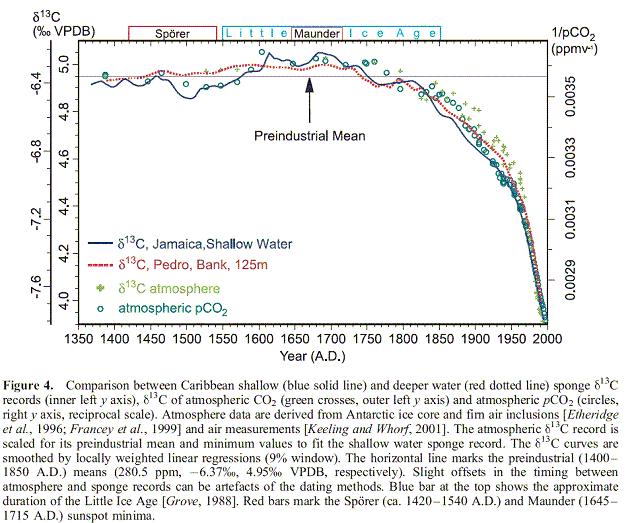
The same for the (reverse) HS in δ13C:
http://www.ferdinand-engelbeen.be/klimaat/klim_img/sponges.jpg
But nature should be the cause of the CO2 increase after 800,000 years simply following temperature with exact the same timing as humans started to emit twice the amounts of CO2 as found as increase in the atmosphere?

DesertYote
July 29, 2014 4:09 pm

Johan says:
July 29, 2014 at 3:59 am
Oh brother, yet another thread wasted on trying to explain the obvious.
Here is a 5-year old paraphrase from David J. C. MacKay, professor of natural philosophy in the Department of Physics at the University of Cambridge,
###
MacKay is a well know liar. What he claims here is ridiculous. Mans contributions to the carbon cycle are little more then a rounding error and are well within natural variability. If what liar MacKay stated was true, he would not exist to state it, and you would not be around to regurgitate it.

July 29, 2014 4:12 pm

Phil. says:
July 29, 2014 at 2:44 pm
In addition, as I explained to Richard, if you add some acid to the oceans, the total amount of carbon forms (DIC: CO2 + bi + carbonates) would decrease because of the loss of CO2, while we see an increase of DIC with decreasing pH.
That proves that CO2 is pressed into the oceans, not the other way out…
Simply add some vinegar to a solution of (baking) soda and weigh both containers before and after the mixing…

July 29, 2014 4:33 pm

Hockey Schtick says:
July 29, 2014 at 11:59 am
In addition, I ask all the “know it alls” here to explain why the airborne fraction of man-made CO2 has declined 20% over the past 60 years, according to none other than James Hansen:
As said before, the “airborne fraction” is completely irrelevant for the cause of the increase. As long as there is an airborne fraction, humans are responsible, no matter if 99% or 1% of human emissions (as mass) remain in the atmosphere. If it was 101%, then nature contributed 1%. If it was -1%, then nature was a larger sink than humans emitted.
But the fraction remained remarkably constant over time:
http://www.ferdinand-engelbeen.be/klimaat/klim_img/acc_co2_1900_cur.jpg
over the past 51 years:
http://www.ferdinand-engelbeen.be/klimaat/klim_img/acc_co2_1960_cur.jpg
for Mauna Loa and the South Pole
Main cause of being that constant: a slightly quadratic increase of yearly emissions which leads to a slightly quadratic increase of CO2 in the atmosphere and a slightly quadratic increase of sink capacity for a remarkable linear CO2 equilibrium process (as proven over 800 kyear).
The removal of the extra CO2 out of the atmosphere is a matter of extra CO2 pressure which changes the uptake/release of the oceans and the uptake by plants. If taken into account the uptake/release of CO2 as function of temperature and atmospheric CO2 pressure, the airborne fraction still is largely within the natural variability:
http://www.ferdinand-engelbeen.be/klimaat/klim_img/dco2_em4.jpg

July 29, 2014 4:38 pm

Ferdinand says “The only point where Bart could be right is if the natural carbon cycle increased a 3-fold together with the human emissions: then and only then the natural cycle could dwarf the human emissions.”
Natural sources and sinks are ~96% of the carbon cycle. Natural sinks would only have to expand by ~4% to accommodate all man-made CO2. Multiple papers show from satellite measurements that the Earth has “greened” 11-20% over the past couple decades, thus the natural sinks could have expanded ~11-19%, considerably more than the 4% man-made sources. No 300% increase in the carbon cycle required as you claim.
Single graph shows T controls CO2 on short timescales:
http://hockeyschtick.blogspot.com/2013/01/single-graph-demonstrates-man-made-co2.html

DesertYote
July 29, 2014 4:41 pm

Someone here needs to learn how to do some simple differential equations. If they did then they would stop getting on there hobby horse every time this discussion comes up!
From -20 to +40 C, the CO2 produced by eukaryote metabolism is directly related to temperature. Don’t ask me to quote a bogus study. Referencing studies is NOT science. Do the experiment for yourself. It easy grade school stuff. Use yeast.

July 29, 2014 5:06 pm

Hockey Schtick says:
July 29, 2014 at 4:38 pm
Natural sinks would only have to expand by ~4% to accommodate all man-made CO2.
Completely right, but they didn’t do that over the past 55 years:
http://www.ferdinand-engelbeen.be/klimaat/klim_img/dco2_em2.jpg
thus the natural sinks could have expanded ~11-19%, considerably more than the 4% man-made sources.
The greening of the planet is a fact, but that is only for ~1 GtC/year of the 9 GtC/year human emissions. That is the net result of the increased cycle. Again, the height of the natural cycle is not of interest, the net source/sink result after a full cycle is what is of interest:
http://www.sciencemag.org/content/287/5462/2467.short
and
http://www.bowdoin.edu/~mbattle/papers_posters_and_talks/BenderGBC2005.pdf
The 300% is only of mathematical interest: human emissions increased a threefold over the past 50 years or so. As plants and oceans don’t make any differentiation between human and natural CO2 (except a slight one in isotopes), if not humans are responsible for the increase of CO2 in the atmosphere, then the natural CO2 cycle should have increased a threefold too, to build enough resistance in the (then theoretically very fast accommodating) sinks so that they can’t remove the extra CO2 flux in short term, but still remove near all of human emissions.
But there is not the slightest indication that that happened: not in the residence time, not in the 14C/12C ratio, not in the 13C/12C ratio, not in the oxygen changes,…

July 29, 2014 5:22 pm

Wu said ”
Excuse my ignorance but I thought plants INHALE CO2 and exhale Oxygen. Was my science teacher wrong? He was a tad old to be frank.”

Plants, chlorophyll pigmented plants, absorb CO2 and when chloropyll are irradiated by light, the chemical reactions produce carbohydrates that the plants use for food and structure and expire oxygen. Plant cells like any other living aerobic cells consume the food, and using oxygen produce the energy to live with and expire CO2. Durring the day the expiration of O2 exceeeds the CO2 from metabolism, at night there is no O2 released from photosynthesis so the CO2 becomes noticable.
This is why fishkeepers worry about their prize Koi on hot July and August nights, the algea in the warm water has a high metabolism and can use up enough oxygen in the water to sufficate the fish.

July 29, 2014 5:26 pm

DesertYote says:
July 29, 2014 at 4:41 pm
From -20 to +40 C, the CO2 produced by eukaryote metabolism is directly related to temperature. Don’t ask me to quote a bogus study. Referencing studies is NOT science. Do the experiment for yourself. It easy grade school stuff. Use yeast.
Sometimes simple sums and subtractions are of more importance than fancy linear equations…
The eukaryotes only produce CO2 that was first captured out of the atmosphere by plants in the form of sugars and other stuff. Thus that is part of the natural cycle and doesn’t add any extra CO2 to the atmosphere, as long as plants capture more CO2 out of the atmosphere than the rest of the biosphere can eat/break down/oxidize again.
Which is the case, based on the net oxygen production by the biosphere.
Thus again, that humans emit only 4% of the natural emissions is of no interest at all, as nature captures 102% of the natural emissions back each year… Which means that the net natural contribution to the atmospheric increase is zero, nada, nul,…

July 29, 2014 6:05 pm

Ferdinand,
Your graph has no data cited to back up your assertion of a declining “sink rate”
Many of your graphs are based upon flimsy assumptions about mass balances, including the 2000 paper from Science you cite which also uses the mass balance argument.
“The greening of the planet is a fact, but that is only for ~1 GtC/year of the 9 GtC/year human emissions.” Where is the data to back up this assertion, and what assumptions are made?
Call me skeptical that a 11-20% greening of the planet over the past couple decades found by satellite observations would only translate according to you to a 4/9 or 0.4% increase in natural sinks.
Of course the carbon cycle hasn’t increased 300%. Natural sinks would have only had to increase a mere 4% to accommodate all man-made CO2, and the error bars on natural sources and sinks are large, as well as on land-use changes.

EricS
July 29, 2014 6:06 pm

Ferdinand said, “As long as there is an airborne fraction, humans are responsible…”
So, *nothing* else is changing in the carbon balance: no volcanoes erupting, no algae blooms blooming, etc.? Gaia is running a controlled experiment I guess? Including any sources/sinks that we have yet to characterize?
Do we even know if we’re in a regime where the D.E.s can be treated as approximately linear?
The problem is far more subtle than the crude lumped averages in the table can possibly illuminate. The conclusion that humans are *solely* responsible for the airborne fraction is unwarranted.

July 29, 2014 6:13 pm

Ferdinand,
Your declining “sink rate” makes the convenient assumption that 100% of the CO2 increase is man-made, that none of the increase is a secondary effect of temperature, ocean outgassing, etc., thus it is a circular argument that proves nothing.

July 29, 2014 10:28 pm

At the end of the day it makes little whether the incremental 120 ppm in the atmosphere is human or not.
Ferdinand is the master of this and he is probably right. However there is a significant wild card in the form of plankton. Our measurements in the ocean are simply pathetic. We have considerable geological evidence that some force has created Carbon isotopic excursions that dwarf human efforts. In deep time there are few alternatives to the oceans if we wish to presume the force is earthly.
Human CO2 is currently about 5% of the Carbon cycle. With any discount for photosynthetic increase, Beer’s saturation, H2O dominance in the incoming greenhouse spectrum, H2O being half the molecular weight of CO2 and therefore representing twice the number of molecules per given weight; to translate from 3 odd percent of concentration to three odd percent of warming is not reasonable. It is way too high.

JJ
July 29, 2014 10:47 pm

Dr. Bozhinova gave the pipe analogy:
“Now you add a much smaller pipe for the inflow from anthropogenic emissions. This pipe does not have outflow to balance it, so it’s net contribution is in fact the entire inflow of it to the pool. And the net contribution of this pipe is in fact bigger than the net contribution of the other huge pipes and is growing.”

That is not what is happening here on earth. Thus far, the net increase of the flow into the pool is NOT equal to the entire flow from the “anthropogenic emissions pipe”. Persistently and inexplicably, the net increase is but half of the supposed flow from that “pipe”. So there must be an outflow pipe, or pipes, that we don’t know about. All we know about them is that they are at least as large as half what we think the anthro pipe is flowing, and growing right along with it. In fact, they could be much larger than half the anthro pipe, perhaps several times that size. They might thus be concealing from the AGW faithful the existence of other, larger inflow pipes. We have no clue. The earths carbon budget is not balanced.

DesertYote
July 29, 2014 11:25 pm

Ferdinand Engelbeen says:
July 29, 2014 at 5:26 pm
DesertYote says:
July 29, 2014 at 4:41 pm
###
Your attempt to model the carbon cycle using naive linear equations is a big fail. The rate at which CO2 is “sequestered” is directly related to the concentration of CO2. The rate at which CO2 is released is directly related to temperature. You can not model a system like this without differential equations. The overestimated rate of anthropogenic CO2 production is well within the measurement uncertainty of vastly underestimated rate of “natural” CO2, and much smaller then the natural variability. What we have here is a naturally stabilizing system with a great deal of negative feed back that totally swamps out mans insignificant contributions. The history of the Earth demonstrates this quite well, else life would have been destroyed when the Deccan Traps were created. Get real. Do some real math for a change. What are planning on doing next, try modeling the solar system using epicycles?
Your “We don’t need no steenking diff eq” stance just makes you look foolish to those of us with real systems engineering experience.

richardscourtney
July 30, 2014 12:01 am

Phil:
I write as a courtesy to say that I have read – and laughed at – your post at July 29, 2014 at 2:44 pm. As is typical of your comments, it is good on untrue abuse from behind the coward’s shield of anonymity, but it is poor on factual content.
I will discuss any flaw in my comments from rational humans and – as always – express gratitude when I am shown to be wrong. But only my disdain is obtained for untrue and irrational twaddle from anonymous internet trolls such as you.
Richard

July 30, 2014 12:07 am

Ferdinand Engelbeen says:
July 29, 2014 at 5:26 pm
“Thus again, that humans emit only 4% of the natural emissions is of no interest at all, as nature captures 102% of the natural emissions back each year…”
Once again, a complete detachment from the way feedback systems work.
JJ says:
July 29, 2014 at 10:47 pm
“In fact, they could be much larger than half the anthro pipe, perhaps several times that size.”
Bingo! In fact, if one takes it as given that it could be anywhere from half to many multiples, the overwhelmingly greater share of possibilities obviously tends toward the latter.
DesertYote says:
July 29, 2014 at 11:25 pm
Yes. It is a fundamental misconception to try to model this dynamic system as though it were a problem in basic accounting.
It is, again, a detachment from the way feedback systems work. The inflow and outflow are not static, unchanging quantities. The outflow expands in reaction to the inflow.
This static point of view is one of a magical world, in which an equilibrium between natural inflow and outflow simply happened, and stayed that way just because one side wanted to play nice with the other.
That is not how an equilibrium is established in nature in this universe. If there is no push-back from either side, then random fluctuations create a drift, like Brownian motion of a particle suspended in a fluid. Scientifically speaking, the notion that there was a rock solid equilibrium in existence for millennia when there were no opposing forces keeping it there is farcical.
Given the powerful opposing forces necessary to produce such a tight equilibrium, it must be presumed that nature can shrug off our puny inputs with hardly any notice. It is very obvious that nature is in control of the atmospheric CO2 balance on this planet. It never ceases to amaze me how people will rationalize away something which is right before their noses like this. Someday, people will look back on this silly idea that humans control the planet’s CO2 like we now do at leechcraft, phlogiston, or phrenology.

richardscourtney
July 30, 2014 12:17 am

Ferdinand Engelbeen:
At July 29, 2014 at 2:48 am I wrote here saying

There are many possible ways it could be “sustained” because almost all the CO2 circulating in the carbon cycle is in the deep ocean, and it is not known what rate of CO2 exchange occurs between deep ocean and ocean surface layer.
For example, a minute change to ocean surface layer pH of 0.1 would alter the equilibrium of CO2 between air and ocean to induce more change to atmospheric CO2 concentration than has been observed. Such a pH change could not be induced by alterations to CO2 concentrations and fluxes because of the carbonate buffer. But it could be a result of change to the sulphur injected into the thermohaline circulation by submarine volcanoes long ago. When the dissolved sulphur reached the ocean surface layer it would change the ocean surface layer pH with resulting change to atmospheric CO2 concentration. And such a global 0.1 pH change is far too small for the limited available data to indicate it.

Aat July 29, 2014 at 4:12 pm you have replied to that by saying in total

Phil. says:
July 29, 2014 at 2:44 pm
In addition, as I explained to Richard, if you add some acid to the oceans, the total amount of carbon forms (DIC: CO2 + bi + carbonates) would decrease because of the loss of CO2, while we see an increase of DIC with decreasing pH.
That proves that CO2 is pressed into the oceans, not the other way out…
Simply add some vinegar to a solution of (baking) soda and weigh both containers before and after the mixing…

Your post I have here quoted disputes that because, you say,
“That proves that CO2 is pressed into the oceans, not the other way out…”
So what? At issue is how the equilibrium CO2 concentration between air and ocean has changed. The anthropogenic emission is to the air so the equilibrium – whether altered or not – will have a net flux of CO2 from air to oceans.
And nobody can weigh the oceans.
Richard

Pete Mack
July 30, 2014 1:46 am

This number shows emissions and absorptions. In an equilibrium model, emissions and absorption would be equal. They are not. The difference (and a bit more) is due to extra CO2 from fossil fuel and land-use change. On this, at least, I’m glad to see you on the same side as the climate-change people.

A. Scott
July 30, 2014 2:04 am

Anthony … this link:
http://www.geocraft.com/WVFossils/greenhouse_data.html
… appears to contain the data I think people are thinking about – the US Dept of Energy numbers from 2000 on anthropogenic vs. natural share of CO2. And analysis of the concentration.
Tables 1 and 2 show the “share” data and that data adjusted for GWP (global warming potential) of the GHG’s.
This anthropogenic vs. natural share of CO2 data is highly elusive – next to impossible to find a clear succinct representation such as here. This is key information – core data – on the entire CAGW claim. Yet this data is all but non-existent.
For example the reference/source link for the Table data in the Geocraft link above – to the US Dept of Energy, OakRidge – is still active:
http://cdiac.esd.ornl.gov/pns/current_ghg.html
However, that link no longer provides any data on the relative shares between natural and anthropogenic CO2 contributions to the total.
Here is an image – presenting a simple picture showing the natural vs anthropogenic shares of CO2:
http://diggingintheclay.files.wordpress.com/2011/02/ed2.png?w=640
(from this page: http://diggingintheclay.wordpress.com/2011/02/24/the-futility-of-trying-to-limit-co2-emissions/ )
‘Digging in the Clay’ provides this reference link as support for this graphic:
http://cdiac.ornl.gov/faq.html#Q2
Which goes to the same exact link as the Geocraft reference:
http://cdiac.ornl.gov/pns/current_ghg.html
Which, again, NO longer provides any data on the athropogenic vs. natural share of CO2, as it clearly did when the Geocraft table and the ‘Digging in the Clay’ graphics were created..
This perhaps is a good challenge for the WUWT crowd sourced research “team” – find recent data or graphics that show updated data on the respective natural and anthropogenic shares of total CO2, in the simple form as shown in the Dept of Energy tables in the Geocraft link above and in the ‘Digging in the Clay’ graphic.
I would suspect the warming crowd has purposely and intentionally buried this information to every extent possible … as the simple graphics and tables as shown in links above – that clearly show the natural vs anthropogenic share, in perspective – become a real problem for their narrative.
.

July 30, 2014 2:59 am

Hockey Schtick says:
July 29, 2014 at 6:05 pm
Where is the data to back up this assertion, and what assumptions are made?
The net uptake of the biosphere is based on the oxygen balance: fuel consumption is known with reasonable accuracy (if anything wrong, probably underestimated). CO2 emissions and oxygen use for the different fuels can be calculated and the oxygen decrease in the atmosphere can be measured (be it at the edge of analytical possibilities). That shows that since the 1990’s some less oxygen is used than calculated. The difference is what the biosphere as a whole (land + ocean plants, bacteria, molds, insects, animals, humans) has produced (or used) by (plant) uptake or (plant/others) decay/food/feed/burning. This makes it easy to make the distinction between simple ocean release/uptake and the biosphere release/uptake as for the oceans no oxygen is involved (except for its solubility in seawater). Another way is to look at the δ13C balance, which is far more pronounced – and opposite – than the ocean influence. Both methods gives a similar net uptake by the biosphere:
http://www.sciencemag.org/content/287/5462/2467.short and
http://www.bowdoin.edu/~mbattle/papers_posters_and_talks/BenderGBC2005.pdf
Natural sinks would have only had to increase a mere 4% to accommodate all man-made CO2, and the error bars on natural sources and sinks are large, as well as on land-use changes.
It seems quite difficult to understand the difference between an increased cycle and the net result of a cycle.
If we take the ~1.5 GtC/year extra uptake of the biosphere for granted, that gives an increase in total bio carbon mass of ~30 GtC over the past two decades. That is about 5% in total mass.
Does that increase the seasonal cycle? Maybe somewhat, but not in the tropics: the decay rate and growth rate there is near equal, except during El Niño’s (drought, heat) and Pinatubo’s. Thus the difference should be in the extra-tropic (mainly NH) forests. That should be visible in the seasonal cycle, because the NH seasonal cycle is dominated by the NH forests.
I haven’t looked at that in detail, but there are signs that the seasonal cycle increased over time.
But again, and increase in seasonal cycle doesn’t influence the net result of the cycle: more growth is accompanied by more decay, as most debris is from one-year leaves…
While the error bars of the natural cycle are huge, the net result shows a remarkably modest variation: not more than +/- 1 ppmv (2 GtC) from year to year:
http://www.ferdinand-engelbeen.be/klimaat/klim_img/dco2_em2.jpg
including huge influences from the 1992 Pinatubo and 1998 El Niño.
That is less than halve the human emissions and less than 3% of the estimated fluxes. But take into account that seasonal ocean and biosphere fluxes are opposite to each other with the temperature change.
Land use changes only add to the human emissions…

July 30, 2014 3:01 am

You really ought to pay attention to more of your mistakes. For example, in the title of this article, you say “~3% of atmospheric carbon dioxide is attributable to human sources”. And then in the first paragraph of the article it says “about 3.75% [15 ppm] of the CO2 in the lower atmosphere is man-made from the burning of fossil fuels, and thus, the vast remainder of the 400 ppm atmospheric CO2 is from land-use changes and natural sources such as ocean outgassing and plant respiration.” Last I heard, most land-use changes are sourced by humans. I haven’t seen the deer trying to farm rice in my back yard lately.
So, it’s not just that you re-post crap articles without reviewing them, you also lack the reading comprehension and writing skills to make the title of the article match up with the content of the article.

Will Nitschke
July 30, 2014 3:14 am

When I once pointed out how Nick Stokes had misrepresented an article written by Roy Spencer, rather than admit the completely black and white mistake, Stokes obfuscated and misdirected in shameless fashion. What a vast gulf exists between those of intellectual merit who admit mistakes, and the hacks.

1 4 5 6 7 8 13
Verified by MonsterInsights