 Guest Post by Willis Eschenbach
The lack of cycles in the solar wind isn’t surprising when you analyze this paper. There is very little sign of any kind of annual cycle, which makes perfect sense because the sun doesn’t run by earthly clocks … the sun doesn’t know much about “one year for earthlings”.
Over at the Hockey Schtick, I saw a post discussing a new study (paywalled here) of the solar wind as a possible amplifying mechanism for the sun’s effect on climate. It’s called “Effects on winter circulation of short and long term solar wind changes”, by Zhou, Tinsley, and Huang (hereinafter ZTH2014). To support their hypothesis that solar wind affects the North Atlantic Oscillation (NAO) and Arctic Oscillation (AO), they’ve stacked the records of times of low solar wind, aligned at the minimum in the wind speed. Well, not exactly the minimums of the wind speed, come to find out it’s the minimums of a most strange triangular filter of the wind speed. But only in the winter, not the summer. Well, not exactly the winter, but the five month period November-May. Then they sub-divided the stacks into times of “low volcanic activity” and “high-volcanic activity”. Then they further subdivided them into times when the interplanetary magnetic field (IMF) points up, and times when the IMF points down … seems like waterboarding the data to me, but I was born yesterday, what do I know? Here’s their money graph:
 Figure 1. Fig. 2 from ZTH2014. “Stacked” analysis aligned on the minima of the solar wind speed in the winter months. “SWS_MIN” means minimum solar wind speed.
Figure 1 shows the claim they are making, that on a daily level the North Atlantic Oscillation (NAO) and the Arctic Oscillation (AO) are affected by minima in the solar wind. Looking at the Hockey Schtick article, I realized I didn’t know much at all about the solar wind. I mean, I knew what most folks know, that the solar wind is the result of constantly varying high-speed ejection of a variety of charged particles from the sun. But I didn’t know how it changed over time, how fast it blew, what a solar wind gust or a gale looked like, nothing. So here’s what I found out.
As usual, I started by getting all the data. It took some digging, but I finally found the hourly data here. Of course, it’s in the form of a whole stack of individual files, one per year from 1963 to 2014 … so I had to write the code to download them all, and then extract the information I wanted. I ended up with 324,204 hourly observations of solar wind. I averaged them out day by day, to match the time intervals of the ZTH2014 study, and I ended up with the data shown in Figure 2.
 Figure 2. All daily average solar wind observations in the OMNI-2 dataset. The “winter” data, shown in blue, uses the same definition of “winter” as is used in ZTH2014, viz November through March (5 months).
This is a most interesting graph, 51 years of data from more than a dozen satellites. First off, we can see the usual ~11-year sunspot cycle in the data, with a swing of about 50-100 km/sec.
Next, the solar wind has a clear minimum speed of around 300 kilometres per second. For those interested, this is about a million kilometres per hour … and it rarely blows much slower than that, summer or winter.
Next, they say that they have no less than 887 days that were identified as SWS_MIN, or solar wind speed minimums. As there are 51 years in the dataset, this means that over a typical winter there are 17 identified solar wind speed minima … and they are stacking them up 800 deep or so.
What I think I’ll do next is to see how the solar wind speed varies over the course of the year. Hang on … OK, I just created that graph, and it turns out I didn’t learn a whole lot in the process …
 Figure 3. Solar wind speed by day of year. Portion of the year shown in blue is the “winter” (NDJFM) as defined in the study.
There is very little sign of any kind of annual cycle, which makes perfect sense because the sun doesn’t run by earthly clocks … the sun doesn’t know much about “one year for earthlings”.
So … we’ve seen the 51-year record of the solar wind, and the lack of an annual cycle. Let me move on to their physical explanation for the purported solar wind/atmospheric pressure connection. From the paper:
The responses on the day to day time scale have been shown to involve both the relativistic electron flux (REF), precipitating from the radiation belts at subauroral latitudes, and stratospheric volcanic aerosols. A strong correlation between the REF and the SWS has been examined by Li et al (2001a,b). Tinsley et al. (1994, 2012) described a link between space weather and lower atmospheric dynamics through the global electric circuit. Minima in the SWS and deep minima in the REF are associated with the HCS crossings, as shown by Tinsley et al. (1994, Fig. 5).
The REF can penetrate down to upper stratospheric levels, and the Bremsstrahlung radiation that they produce can impact the electric conductivity down to lower stratospheric levels and change the stratospheric electrical column resistance. The consequent changes in the ionosphere-earth current density (Jz) that flows as the downward return current in the global electric circuit was considered to be the physical link to the tropospheric cloud and dynamical changes, especially when there is high stratosphere aerosol loading due to volcanic eruptions, which will increase the proportion of the stratospheric column resistance to that of the whole atmosphere column. Observations of minima in tropospheric potential gradient and Jz at HCS crossings have been reported by Reiter (1977), and Fischer and Muhleisen (1980) also observed such potential gradient minima.
Now, is their explanation possible?
Sure. Lots of things are possible. I have long held that the electromagnetic aspects of weather and climate were the unknown unknowns in the climate game. For example, to many scientists’ surprise, it was discovered within the last decade or so that the cloud nuclei, the seeds that cloud droplets form around, are not mainly dust or sea salt crystals as was once thought … much of the cloud nuclei are microbes of various kinds. Which led to a new question … how did they get up so high in the sky? Turns out that the electrical forces are what make thunderstorms able to loft these tiny creatures that high up into the atmosphere …
So I don’t have a problem with the idea that electromagnetic forces are way understudied in the climate system, and thus may play a larger role in climate than is immediately apparent.
The part I’m missing in their explanation, however, is the connection of the solar wind to the variations in pressure that make up the NAO.
Finally, the most important question … does their study hold water? In regards to this question, let me list my objections to their study. Note that these are not objections to the results, these are objections before we’ve gotten to their results. Here, in no particular order, are the problems that I have with the study.
• No Archiving Of Data As Used: First and foremost, they have not archived the 887 magical dates on which they claim that there are “solar wind minima”. Without that, there’s no way to determine if they’ve made any errors. As a result, to date it’s just advertising, not science.
• High number of “minima”: Next, the “winter” portion of the dataset contains 6,684 days with data. There are 887 days they call “solar wind speed minima” during the winter. That means that a “minimum” occurs every 6,684 days / 887 minima equals 7.5 days per minimum, about once a fricken’ week …
Once a week? Give me a break. I realized this was a problem as soon as I looked at Figure 1 at the head of this post. I thought, 887 wintertime “minima” in half a century? That’s about eighteen minima every winter …
• Divide and Conquer: This study employs a much-abused technique I call “Divide and Conquer”. It works like this: you look for a theorized effect. But you can’t find it in the data. So then you divide the data into two piles, say into winter and summer data. Then you look for the effect again.
But you still can’t find the theorized effect in the data. So then you sub-divide the data again, say into “volcanic” and “non-volcanic” data. Now you have four piles of data. But you still can’t find the effect. So then you divide the data into maxima and minima, that gives you eight piles of data. You ignore the maxima, presumable because they didn’t show the effect.
So then you divide the minimum data into 887 overlapping two-month-long chunks centered on some subset of all of the minima, and you average the chunks together … at which point you find something and declare that your study is a resounding success …
I’m sure you can see the problem with this kind of analysis. If you keep dividing, eventually you will find something. No surprise.
• Bad Statistics, No Cookies: However, if you insist on using the “divide and conquer” plan as they have done, each time you subdivide the data you need to adjust the threshold for statistical significance. In climate science, the usual level for assigning statistical significance is a “p-value” of 0.05. That’s one in twenty. But if you look in more and more places, to be significant, the p-value needs to be lower. How much lower? Glad you asked. Here’s a handy chart … for mathematicians, the p-value is calculated as
p-value = 1 – 10^( log(1-p) / n )
where “n” is the number of trials, “p” is the single-trial p-value (0.05 in this case) and log is logarithm base 10.
 Figure 4. Change in the required p-value to be significant at the single-trial 0.05 level with a given number of trials.
In this case, they have the original data, and then the two halves split summer/winter. Then they have four quarters after they’ve sub-spit by volcanic/non-volcanic. Then they’ve divided off the minimum values from the maximum values … already they’ve looked in fifteen different places for the claimed effect. So if they find something, in order for it to be significant it has to have a p-value of less than 0.004 … four in a thousand …
• Length of “Winter”: Picking five months for “winter” gives every appearance of special pleading. I mean, the first thing you’d try for “winter” is December-January-February. Then maybe the six months between the equinoxes, October to March. Either of those might be OK, although you’d need to adjust the significance threshold as required … but using a five-month winter is just fine-tuning the results.
• Proportionality of Effect: One of the ways we determine if there is causal relationship between A and B is that there is some kind of proportionality, whether linear or non-linear, between the cause and the effect. In their case, they are claiming that variations in maximum solar wind speeds don’t affect the North Atlantic Oscillation, but variations in minimum solar wind speeds do affect the NAO … how is that supposed to work? It seems odd, particularly when the solar wind minima vary so much less than the solar wind maxima.
• Width of Stacked Data: To dig out the signal, they’ve “stacked” the data. This means that they have aligned a number of years of results based on the minima in the wind speed. This is shown in Figure 1. It’s a legitimate technique, but note that their stacks are 2 months in width. This means that each individual layer in the stack contains on average eight different minima (60 days divided by 7.5 days per minimum).
• Uneven Duplication of Stacked Data: Like the minimum years, on average, every day in the dataset appears in the full stacked data about 8 times. However, the number of times that a given day appears in the total 887-layer stack is quite variable. Days during periods where a number of minima are in close succession will be over-represented in the stack, and vice versa.
• Missing Data: The early years have a lot of missing data. Coverage of 365 days/year is not achieved until 1995. It’s not clear what effect this has on their calculation of “minima”.
• Calculation of Minima: The previous problems are bad enough. But here’s where they go totally off the rails. In the ZTH2014 paywalled study they say they use the method for calculating minima from a previous paywalled study. The method of determining the location and depth of the minima in that study turns out to be quite baroque, viz:
The minima and their relative depth are selected with reference to a sliding window of 13 days, with the preceding and following ‘shoulder’ values (ps) being the mean for days 1 through 3 and 11 through 13, and the deviation from the shoulders (pm) being the mean for days 6 through 8, so that the percentage deviation is: y = ((pm-ps)/ ps) 100%.
Dear heavens … do you see what they are doing? I get a thrill when I see a bizarre mathematical transformation like that, it’s like coming across some strange new primitive life form. That is an extremely crude method of fitting a sawtooth wave to the data, one that will function as a strange form of triangular filter. Since the centers of the two ends of the filter (points 1-3 and 11-13) are 11 days apart, I thought that it would emphasize any cycles in the data with a period of 11 days, although from the description the frequency response of such an odd creature could only be guessed at. When I read that, I could hardly wait to see how their “minima finder” algorithm munges some real data. Before we get to the real data, however, here’s the bandpass of their triangular “minima” filter. It shows the amplitude of sinusoidal signals after they have been savaged by their method.
 Figure 5. Bandpass of their 13-point-wide filter. Values are given as a percentage of the maximum.
That is one strange bandpass filter. As I suspected, the maximum bandpass is at a period of 11 days … and it has a curious problem in the present application. Solar wind data has a clear ~27-28 day cycle. This is the result of the ~27-28 day rotation period of the sun. Unfortunately, the amplitude this 28-day cycle is severely attenuated by their procedure, down to about a third of its original value. So their filter is minimizing a real cycle in the data, while artificially enlarging any random 11-day cycles. Most curiously, it totally wipes out all 3-day and 5-day cycles. I suspect that this has to do with the fact that they are not using some of the 13 points of the filter width—points 4-5 and 9-10 are not involved in the calculation. But that’s a guess.
Having seen all of that, without further ado, it’s time to look at real data. Here’s a typical winter from the OMNI-2 solar wind dataset. The time of the winter is 1998-1999, merely because it happens to be the first one I picked. This one has the full complement of 154 days of data, so it should have 154 days divided by 7.5 days per minimum equals about twenty minima. So I’ve included their bizarre “minima” calculations as well, scaled to the same mean and standard deviation as the solar wind data for easy comparison … hold your nose, here we go …
 Figure 6. Daily average solar wind data (blue) and calculated “minima” (red). Minima calculated using the procedure quoted just above. The one gold, two tan, one blue, and two violet shaded areas show sections of particular interest. “Minima” are scaled to the mean and standard deviation of the solar wind speed data.
Like I feared when I first read their description, this procedure does indeed do weird things to data … to start with, in the right hand tan shaded area is what was the lowest minimum speed of the entire winter (blue line), a day when the solar wind dropped below 300 kilometres per second, a relative calm spell … with the wind only blowing a mere million kilometres per hour or so …
But once their procedure gets through with it, the red line shows that what was the record minimum of the period is now about the tenth lowest minimum. And the two minima in the other tan area have suffered the same fate, reduced to insignificance.
The violet shaded areas show the opposite effect. In the right hand violet shaded area, there was no real minimum of any kind (blue line). But under the new regime (red line), it’s the fourth largest minimum in the record. And it’s the same in the left hand violet shaded area. A significant false minimum has been created out of nothingness.
Next, the gold shaded area (center) shows what was a fairly minor player in the original data (blue line). But after their triangular filter works it over (red line), it becomes the deepest, most evident minimum of the winter.
Finally, the most outré part. See the blue shaded area? Their whizbang method actually shifts the dates of the two actual minima during that time (blue line) by two days each …
Like I said, it’s a most baroque method for picking “minima”, one that manufactures minima where none exist in the data, distorts the actual sizes of the minima, turns the deepest minimum into a minor player, and shifts the dates of some of the minima but not others, all the while minimizing the natural ~27-28 day cycle that actually exists in the data.
Conclusions? Other than the fact that looking at this study for four days now makes my head ache? Well, between all of the problems, that’s enough for me to say that the study is definitely not ready for publication. To recap, those problems were:
• No Archiving Of Data As Used
• High Number of “Minima”
• Uses a “Divide and Conquer” Method
• Bad Statistics
• Strange 5-month Length of “Winter”
• No Proportionality of Effect
• About Eight Minima in Each Layer of the Stacked Sections of Data
• Uneven Duplication of Stacked Data
• Missing Data
• Mondo Bizarro Method of Minima Calculations
Best thing about their study? I understand much, much more about the solar wind than I did a week ago.
Finally, people often read more into my statements than I intend. For example, when I say I can’t find an 11-year cycle in the 10Be data used as a proxy for cosmic rays, people interpret it as if I had said there are no cycles at all in climate data. Generally, I mean what I say, and not some generalization of my statement.
So please note that in this case, I am NOT saying that solar wind has no effect on the climate. It may well have such an effect, although the lack of any 11-year signal in temperature datasets argues strongly against it.
What I am saying is that the manifold flaws and problems in the study of Zhou, Tinsley, and Huang 2014 mean that they are a long ways from demonstrating that such a purported effect actually exists
My best wishes to each of you,
w.
The Usual Request: If you disagree with something I’ve said, please quote the exact words you disagree with. That avoids lots of misunderstanding.
Data: The press release at the Hockey Schtick post is here, my thanks for the discussion of the solar wind study. I have collated the OMNI-2 data into a single CSV file containing the daily average solar wind speed data called OMNI-2 Solar Wind.csv
vuk – Thx for the magnetosphere info – but as I said, it has no significance wrt this study. The tilt of the Earth varies from month to month but it is the same each year. ie, every Nov-Mar it does exactly the same thing (and every Apr-Oct too of course) so using only Nov-Mar to look for interannual solar cycles is still nuts. Every cycle based on something Earth does is irrelevant at the sun. The sun has never heard about “Nov-Mar”, has no idea what it means, and certainly doesn’t break its wind for it.
[apologies to anyone whose first language isn’t english]
ren says:
May 17, 2014 at 10:36 pm
Of course blocking the polar vortex has an effect on climate. Everything “has an effect” on climate. The question is only “how much an effect”, not whether there is an effect.
It’s totally unclear what you mean by “solar activity”. Sunspots? Solar wind? Variations in magnetism?
As to whether the sun “has an effect on distribution of temperature”, sure—where the sun shines more, it tends to be hotter.
Again, I’m sorry, ren, but your questions don’t make any sense as stated, so I have no clue about the real answer.
w.
Thanks, ren. Actually, I do have a different opinion. Let me count the ways that stratospheric temperature is affected other than by ionization.
• Stratospheric temperature is also a function of the amount of aerosols in the stratosphere, as is demonstrated by the temperature rises in 1991 and 1982 after the volcanic eruptions.
• In addition, the tropical thunderstorms regularly punch through the tropopause, delivering both warm air and moisture to the stratosphere.
• The stratosphere is generally isolated from the troposphere, but it is not physically distinct. There is no physical barrier between stratosphere and troposphere. Not only that, but the interface between them is as big as … well, it’s as big as the surface of the planet. As a result, there is a slow exchange of both energy and molecules of all kinds between the troposphere and the stratosphere.
• While the stratosphere doesn’t contain a lot of either GHGs or airborne particles, it does have some. As a result, just like the troposphere, the stratosphere absorbs a certain amount of upwelling thermal longwave from the surface.
• Finally, consider the not un-common phenomenon of stratospheric clouds, particularly in the polar regions. Known as “nacreous clouds”, they are quite effective at absorbing upwelling LW radiation, and they form another way that the temperature of the stratosphere is affected by things other than ionization.
There are likely others, nature is endlessly ingenious.
Mmmm … I would phrase that a bit differently. GCR changes depend directly on the strength of the heliocentric magnetic field, because the field diverts them away from the solar system. But although UV varies generally in sync with the sunspot cycle (and with the magnetic field), it is not directly controlled by the interplanetary magnetic field as are the GCRs.
You are welcome.
w.
Sorry Willis.
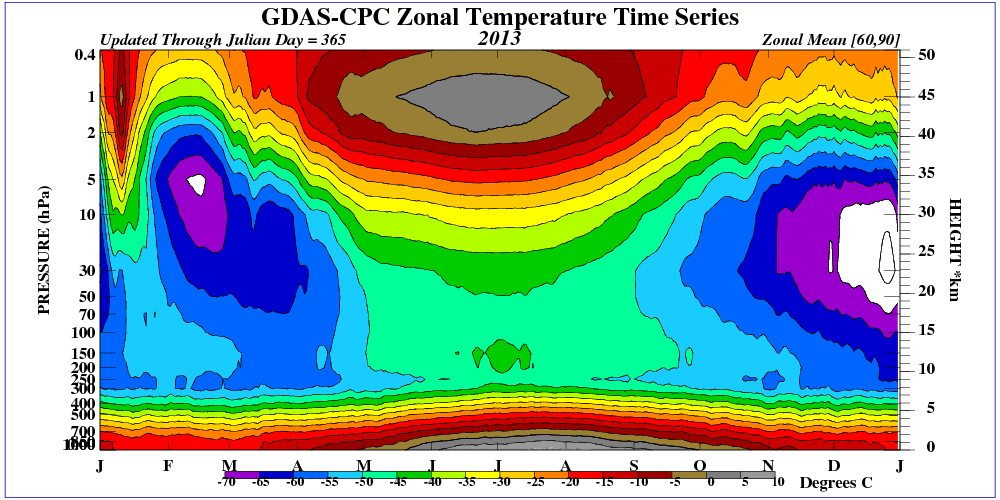
It seemed to me that the temperature of the tropopause is nearly constant at about -50 degrees C. As these charts are able to be wrong.
What temperature is no cloud in the stratosphere?
Not to mention the volcanoes.
[Thanks for that, Ren. I’ve brought the graphic inline, it’s an interesting one. -w.]
ren says:
May 21, 2014 at 12:59 pm
Good question, always more for me to learn. The “tropopause” is where the temperature of the atmosphere stops dropping with increasing altitude. If you look at your cited chart of Arctic atmospheric temperatures, in the summer the temperature of the troposphere bottoms out at around 15 km. of altitude and a temperature of -45° to -50°C, and then starts rising with altitude.
But in the winter, the temperature of the tropopause is much colder (shown as white in your graph), at times below -70°C. The tropopause is also much higher in winter, up around 25 km in December, then dropping in January, then rising again to about 30 km in February..
I don’t know if there is a lower temperature limit for nacreous polar clouds, as they are composed of ice.
Sorry, that last part doesn’t make sense.
Regards,
w.
What I mean is, like a volcano warms the stratosphere, when the temperature drops gradually in the troposphere when the pressure changes to -70 degrees C (above the equator)? Begins to rise gradually from 20 km altitude (above the equator).
http://www.cpc.ncep.noaa.gov/products/stratosphere/strat-trop/gif_files/time_pres_TEMP_MEAN_ALL_EQ_2013.gif
Regards.
Data Suggest That Solar Wind Impacts Global Temperature
Figure 2 is a plot of the solar wind (inverted) and sea surface temperature since 1963 (three-month centered averages ).
http://notrickszone.com/wp-content/uploads/2014/05/Caryl_21.gif
http://notrickszone.com/2014/05/22/data-suggest-that-solar-wind-impacts-global-temperature/