 Guest Essay by Kip Hansen
I complain a lot about poor science being done by what I assume to be professional scientists. I’d like to think that if I were in their labs, I would do better. [ *** see note ]
If we want good science, and we do, we need good scientists. If we want good adult scientists, we need to get the kids – junior high and high school kids — started off in the right direction and on the right foot.
I spent the last two days judging a science fair here in Cape Canaveral, Florida, along with 50 or more other dedicated people.
Judging these types of events is exhausting work, physically and emotionally. The fair I helped judge was set up in the center aisles of a large sprawling shopping mall and judging involved miles and miles of walking on those hard, hard floors.
The kids are great. You get all kinds. Some are so enthusiastic –– some so shy they can barely speak to the judges – some so outgoing you can’t get them to stop talking. The projects range from the truly dopey (one wonders where the science teacher was when the proposal was made or, on the other hand, one worries that the teacher thought it was a great idea too) all the way over to really important scientific ideas needing research.
One student bravely picked a rather eclectic idea out of a blog comment – that Interval Training (the kind athletes do for muscles) might be applied to attention span – and tested that idea. The results were a little “iffy” but he’ll go on to improve the testing protocols next year and see if he gets similar results.
Another student tested soils exposed to the rocket exhaust clouds from the rocket launches at the Kennedy Space Center on Cape Canaveral – important because there are plans afoot to build a new private launch site just north of the federal launch site which plans are being opposed by environmental groups – expecting to find the soils contaminated to the point of being toxic. When her extensive tests found the soils to be no more toxic in high exposure zones than in low exposure zones, a “helpful” ecological scientist from a local environmental group suggested she run various statistical regressions on her data to find some toxicity. This serious student taught herself enough R-language to run the regressions, and still couldn’t get a “small enough P-value” on anything to make a point. I was so proud that she concluded that the rocket exhaust cloud simply was not toxic in the surrounding soil after all. This young lady may someday be another Judith Curry. She does the work, and finds what she finds – no shortcuts, no hedging. I privately recommended her project as a special project to represent her county (which includes the space center) at the State Science Fair. I have no idea if such a thing is even possible – but I had to make the special effort on her behalf.
I was gratified by the number of students whom I judged (a very small percentage of the total projects at the fair) that stuck by their original hypothesis and found “negative” results. I don’t know if this is a result of more careful monitoring of the science fair project process or if there has been an improvement in teaching the scientific method – but many conclusions included the statement “My hypothesis was rejected”.
One still finds goof-ball mistakes that call into question the qualifications, not of the students, but of their teachers ==> in one project, “exposure to radio waves” was accomplished by placing the petri dishes next to an FM radio playing NPR – which could, admittedly, have deleterious effects, but not from exposure to radio waves.
A common fault found was that advisors were forcing the students to work in units, with concepts and in languages that they were not familiar with. Temperatures in centigrade, plants with Latin names, statistics that were meaningless to them except as a button to push in Excel – P-value and ANOVA. Sure, kids today should know both °F and °C. But, I gave many mini-lectures on using terms in their lab notes that they understood with a column next to it in the “required “ language – always to know what they were doing when doing it. This confusion led one student to think that he could maybe raise the temperature of a human body to 90 °C therapeutically!
What are the kids interested in? Cancer and its prevention and treatment. Pollution and its mitigation. Water and water purification. Diabetes and lowering blood sugar levels (many of these based on family situations). Engineering projects focused on energy production: geothermal, solar, wind. Biology: Hydroponic and aeroponics , aquaponics, aquaculture. This list goes on and on – they are interested in everything!
The surprise was that there were so many projects, here at our county level. They are not easy, they take a lot of student time and effort and don’t return much social reward. Only a few students get the ‘golden ring’ – a First or Second Place – and get to the State finals or get to fly to Los Angeles for the Nationals. I tried my best to give each kid I judged enough personal attention and validation for the parts they’d gotten right to make their efforts worthwhile. (Even projects with silly errors were terrific work at their own levels – and get credit due.)
So, what can you do? If you have any kind of a science degree or work in a scientific field (active or retired), do an internet search and find out where and when the Science Fair cycle is in your locality. Find the email contact. If it is still in the future, see if they need help. (I signed up as a judge only one week in advance – they were still desperate – the more judges, the faster it goes.) If this year’s Fair has gone by, see if they need mentors in your specialty to help the students on next year’s projects. Get involved.
If you know how science really should be done – you can help train the scientists of the future — Science Fairs in your area are an opportunity for you to help.
# # # # #
[ *** In my own field, which was IT, I held myself and my co-workers to a very high professional standard, to the point where I was named the “Czar” for the type of code we were writing – not a line of code could be pushed out into the real world without my approval. The actuality was I helped the team write what we hoped to be perfect code. The upside was that I knew the code would be bullet-proof – the downside was that if anything broke, it was always my fault. I didn’t mind. ]
Memories, memories, thanks for the memories…
While I’ve never judged a Science Fair, I certainly participated as an entrant in high school back in the early 1970’s. And I helped out with the logistics of some of the events as well. One of my entries had to do with recording weather events, temperature, barometric pressure, cloud types, etc. I can’t remember exactly what my goal was for the project, other to show how these factors can vary wildly from one day to the next. I applied no smoothing. 😉 Another of my science fair entries was more of an engineering/electronics project involving a laser diode that could, theoretically, send a message via light through the air or through a (then new) fibre optic cable. Unfortuantely I couldn’t get the thing to work in time for the science fair, but at least I received a good mark for explaining how the thing was supposed to work. Great fun. 🙂
I participated in three back when I was in high school… the first I did I thought was a lot more valid and interesting than the second one, and the third was pretty pointless… I think I only did it because the school was requiring it that year.
1) passive nuclear-decay powered battery… basically used the properties of alpha and beta particle emitance to strip or add electrons to two successive plates… the aluminum sheet gets hit by the alpha particles and gets electrons stripped from it. Past that was a lead block that would absorb the betas (electrons). Because of the charge differential you had voltage. Granted, my access to radioactive sources was tiny, so I could only generate milivolts, but I thought it was very cool. 🙂 Research in books and a guy at the DoE who could let me use small radioactive samples, etc. A great experience.
2) construction of electric/optical hybrid logic circuits, using a laser, photodetectors, and LCD displays with the silver backing removed. I nearly didn’t get that one to work in time as I threw it together last-minute when I changed my mind about participating. Alignment was tricky, then it suddenly worked.
3) a rather lame AI program. Ironically, got a second place in that one, where the better projects got looked over. *shake*
All told though, none of these were really Science. They’re all examples of Engineering (Applied Science), which is what I went on to do. 🙂
Hi Kip,
Thanks for this. Each year I judge a science fair out on Long Island, and you’re right, the students are so refreshing! I’m still chuckling at the following exchange:
Finished with my judging in the Engineering section, I wandered over to the Biology section, and became intrigued by a project that purported to discover whether aspartame was toxic to fruit flies. The hypothesis was of course that it was.
Me (to student): “So what did you find? Was it?”
Student: “Nah. There was a tiny correlation, but not enough to be statistically significant. The experiment didn’t uncover anything.”
Other student to student: “You shouldn’t say that, she’s a JUDGE!” (Implication being that the boy should have pretended the experiment was more meaningful).
Student: Looks at me, shrugs, and laughs.
Me: “So would YOU stop drinking aspartame? On the basis of what you know from your experiment?”
Student: “Nope.”
I laughed and told him his career in science was off to a great start.
The world of Science is changing, and we must resist that change. This post gives me hope that a younger generation is still trying to get it right.
Today’s science appears to be little different from today’s music industry: instead of doing the hard work, understanding theory, working with others, everyone wants to be the lead singer, the diva, the center of attention, the star… while not actually knowing much about details and hard work. To continue the analogy, people will do anything they think will get them on the radio, sell a cd, or get a paper published with “peer review”, even if it’s utter crap that is debunked days later.
I never did the science fair thing, my teachers were far too lazy to actually work with any of us. But I so clearly remember the optimism and excitement of computer fairs back in the late 70s, when it was all new, with so much yet to come. All of the computer industry’s movers and shakers were kids in that era too, and all just as excited for the future as I was, including young Bill Gates, Paul Allen, Steve Jobs and Wozniak.
Thanks Kip for the encouraging story!
Our youngest daughter had the opposite experience, meanwhile some 20 years ago. After here study of geology, she was invited to do a Ph.D. work for the detection of the small personal mines which were used by the hundredthousands in countries like Cambodia and several African countries in several civil wars. The study was done partly in Belgium (KUL), partly in the US and partly at King’s College in London.
That type of mines is small and without metals, thus can’t be detected with metal detectors. Radar is problematic and time consuming if a lot of stones are present in the soil. But the common main chemicals present in all explosives are nitro (-NO3) components, which can be detected via their response to ultra high frequency magnetic resonance (NMR).
After a lot of tests, several of which with negative results, at last she had a good working prototype which in combination with radar could detect all mines (without the ignitors!) in an experimental field within 15 minutes.
In her final work, she described all methods and results, negative and positive and the reasons of failure. That was not what the English professor did like (but the professor in Belgium did support here). She refused to remove the negative results (she has some of my character…) and here Ph.D. never was honored.
This experience turned her away from science and now she is an experienced helicopter pilot…
Kip
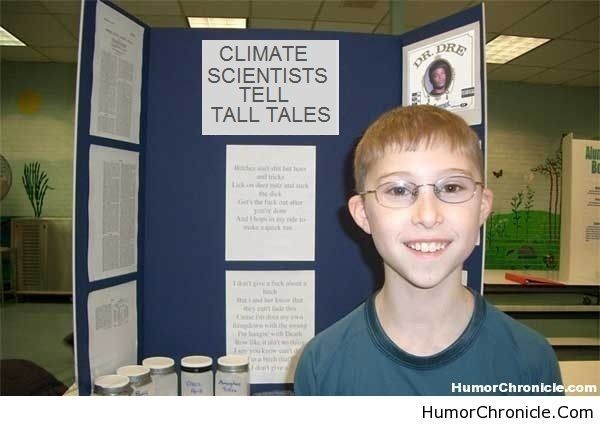
I still wanted to hear about the “tall tales” the student from the picture had identified. Was he able to correlate them with the scientific method?
Kip, this does sound encouraging. I took a first place in a science fair many years ago, but virtually every project you describe is better science than what I did, and in fact better than most of the projects on display near me. It encourages me to expect higher quality science and, dare I say it, more skepticism from the up and coming class of scientists.
Thanks Kip, good story.
I enjoy and suffer doing science outreach in South Miami; weekly star parties, an annual science fair. An astronomy website with meteorology and climate pages.
All these are sand grains to build a mountain. Much has been destroyed, more has to be rebuilt.
And yes, thanks to many good teachers along the way!
Some mines are set to explode if they vibrate or are tilted. I wonder if a sonic boom from a low-flying fighter jet could make many of them harmlessly explode.
Science fairs have been popular in my area (Manitoba, Canada) for decades. Most of the judges were volunteers from the local university, which allowed coverage of most “subject areas”. My responsibilities covered the earth sciences (geology and physical geography). As judges we worked together and met several times a year to discuss rules and provide feedback to teachers before students began their projects. This worked for years. Some things we noticed were the slow progression with student age of the concepts of testing hypotheses. Because of this we encouraged teachers to emphasize proper data collection during early years, especially since many elementary teachers were poorly trained in science, but could help students log data. Over time the poor data that plagued middle year projects decreased, and data analysis increased with better results. The only downer has been mentioned- the number of projects decreased rapidly after about grade 8. I’ve been retired for 10 years and my colleagues tell me interest in declining, which is sad indeed. If you are interested, please get involved.
Dear Kip,
One of your commenters asked where the image came from. I think when you grabbed this one, you didn’t know that it had been a humor image floated around for several years, with people substituting various slogans for the young man’s project. For example, this one from 2010:
I found the original; it was a project on a variant of Silly Putty called Thinking Putty, and was featured on the Thinking Putty company’s blog in 2007:
http://www.puttyblog.com/2007/03/science-fair.html
I actively support the science fair concept, and enjoyed your article. I just did a write-up for a school’s program called “Every Child a Scientist!” — and as a result, the school is being considered for a “Distinguished School Award.” They deserve it.
===|==============/ Keith DeHavelle
Hah. The image is trimmed out by your settings. Here was the joke link to the image:
http://www.epiclol.com/cdn/pictures/2012/02/my-lil-bro-s-school-_1329543709_epiclolcom.jpg
===|==============/ Keith DeHavelle
Interesting post, however, with respect to °C and °F it is long past the time when the USA joined the rest of the world. The Fahrenheit scale has no relationship to anything today and is simply a carry over from a time (300 years ago) when they thought 0°F was the coldest you could get.
In contrast the Celsius scale is related to the Kelvin scale and the size of the unit is the same for both. The SI units were published in 1948, some 66 years ago and have since been adopted by every other country of significance in the world except the USA.
While we are at it, why not change the date system as well – months/day/year who came up with that cranky system. The rest of the world uses progressive time intervals day/month year.
Come on US get your act together
Reply to K DH and all curious about the image at the top ==> This image was added by our WUWT editors. It should be received in the spirit in which it is offered — in jest.
MY MOST IMPORTANT POST SO FAR
A theme which I see appearing here over and over is that those who are older, 50 or 60 and up had superior high school science teachers. I also had a superb high school physics teacher who taught me what science really is. The teachers of that generation tended to have been A and B students in school themselves. Today’s teachers of all subjects tend to have been C students who barely made it into or out of college.
The reason for this shift is found at http://www.constitution.org/col/one_room_schoolhouse.htm
in a great change in educational methods. Today’s methods also produce irresponsible adults which is why we see our freedoms plummeting. Many of you have expressed concern about that.
I have a book called “Catholic Home Schooling,” which discusses the last American One-room Schoolhouse. This was 1962, Tennessee, and it produced 80% National Merit scholars. That is one in 10 000, I believe, so we are talking proven educational technology.
Most of you on this site care deeply about the consequences of these things. Go to that site, print out that article and research farther. Then find a local group (churches with a private school would be especially good) and volunteer to teach them all something, using those methods. Your aim is first to experience this for yourself, and then to expand in your area, getting this method applied in parochial schools first. The public schools will listen when they have lost enough pupils to cheaper and far better private ones. This will be how they can get the kids back.
The science being done at school science fairs is often superior to the science being done by professional scientists, and the reason is simple: The students are only being judged on their ability to do science. The professional scientist is usually judged on his ability to get more funding for his work, either by providing the money-men with the answers they want, or scaring them half to death.
Imagine the progress we could make if professional scientists were only judged on their ability to do scientific research correctly, like at a science fair. We would probably have cures for cancer, virtually unlimited clean, cheap energy and flying cars in every garage by now.
Oh…and the hockey stick temperature graph would have never existed.
Would have been nice to acknowledge the photo was manipulated, It is misleading to make it look like this was a kid at the the science fair you judged.
In regards to teaching science in “foreign” units from a U.S. perspective; At age 47, I was working on a mechanical engineering degree. I was unhappy with the very large percentage of space that modern engineering books devote to metric units.
When I took physics, it was virtually 100% metric. But, being an older man in a class room of younger students, I figured it was just me that had a problem with this. So, I took an informal survey. I asked the class if something weighs 20 grams, is it more likely to be a paper-clip, a baby, or an elephant. While a few U.S. born students had a guess, the only students who were confident of their answer were foreign born.
They were required to learn new concepts in science and engineering, using units they did not really understand in real-world units. They will need to go and get jobs at companies using U.S. standard units, which were largely ignored in their college education. All the engineering firms where I had been were nearly 100% English units. And Metric was only done for projects dealing with other countries.
I do think it is important to cover both unit systems in education. But, I wonder if this extreme academic push to be metric, is a factor in the decline of science and engineering in the U.S.
-Joe Dunfee
Reply to Peter Foster ==> On F/C , historically, according to the venerable Wiki > “On Fahrenheit’s original scale the lower defining point was the lowest temperature to which he could reproducibly cool brine (defining 0 degrees), while the highest was that of the average human core body temperature (defining 100 degrees).” The US should, of course, have switched to the centigrade system with the rest of the world post WWII, why the effort failed is anyone’s guess. Do any of you readers have any insight? I remember being required to convert back and forth willy-nilly in grade school, jr. high, and high school — and can do rough conversion mentally, but still think in Fahrenheit.
For the dates — I prefer the year-month-day, all numerals, that I use in IT — such as today being 2014_02_16, which makes the operating systems always sort the entries into numerical date order auto-magically.
Reply to Lady Life Grows ==> My older brother actually attended a one room school house for first grade in rural Wisconsin. I was six months too young to share the opportunity. In the same vein, all of my children save one received some part of their education at home — all received much of their science education extracurricular both at home and in the woods, mountains, valleys and rivers of New York State.
Reply to kindlekinser ==> See my earlier reply on the image. The image was supplied, unbeknownst to me, by the editors at WUWT, and was meant in jest. In their defense, which is totally unneeded, it is quite clearly marked HumorChronical.Com, twice, once in white type on the image, and once in black type, as a caption.
Reply to Joe Dunfee ==> The only beef I had with the metric/English problem was when the kid was forced to work with units he didn’t really understand, when he was alone with himself, in his own lab. So when he is measuring plant growth or a temperature, or planning a tubing size or a heating element, does he know how big it is going to be or how hot it is going to get? In his own little world? When decides to heat an oil to 90 °C does he know he means 194 °F (nearly boiling water temperature)? When he decides to order tubing 2.5 cm in diameter, does he know it will be 1 inch diameter tubing? Both of these instances came up in my Science Fair judging – 90 °C was way too hot and 2.5 cm was way too big. Yes, the time to learn these things is before they hit the professional world – and before they have to work with them. If we start them early enough, elementary school, it will be like being bilingual – they’ll actually think – hmm, 2.5 cm/~1 in .
Mr Hansen; While I think part of the reason for the U.S. not adopting metric, is that it didn’t need to, I think it primarily a political statement by its citizens. I can see a similar political component back at the time the metric system itself was created. There already was a world-wide standard, but the creators of the metric system wanted to create a standard that was as un-British as possible. There was no scientific reason for choosing many of the metric standards, even if that is touted as the reason.
I just don’t see the U.S. accepting the metric system for the same reason the metric system was created. I.e. to assert our independence.
I also have been a high school science judge. I have seen some very good research. Perhaps the most significant was a study of the dispersion of fresh water bacteria, much of it extremely dangerous, upon entry into beach swimming area via steam flow. The conclusion was that it was quickly rendered equal to natural background. Without going into the specifics, the findings were so important that the State Board of Health continued the study and adopted guidelines.
Rhys Jaggar says:
February 16, 2014 at 1:10 am
I think you’ll find that if you think that ‘science fairs make scientists’, then all you are doing is a Darwinian selection of those, whose scientific interest is fired by science fairs.
I’m not saying it’s not one piece of the jigsaw, what I’m saying is that it’s only one. It’s a suitable approach for one segment of the young population.
Some people will be fired up by doing things themselves for 5 years. They are feet-on-the-ground realists, not starry-eyed dreamers. They are actively turned-off by dreaming bullshit, as they see it. It’s not saying ‘aim for the moon, land on the roof’ doesn’t work for some, it’s saying that some think you can get onto the roof with a ladder rather cheaper than you can paying for a defective space rocket. A point worth mentioning in bankrupt western economies…….
I think you are confusing ‘scientist’ with ‘engineer’.
A scientist may research ideas some of which may be real lateral thinking that are not expected to work but might do.
An engineer takes an idea that looks like it might work and implements it ensuring that all the life-cycle issues are covered too.
Both capabilities are required
Ian W,
I am in rebellion against your narrow definitions of scientist and engineer. Having done both science and engineering at graduate levels and practiced both science and engineering professionally I would say that science isn’t confined to what people do. Science, I believe, is a method of studying an unknown. It is a method of proceeding through a problem. Good engineers often apply this method to assist them in achieving a solid solution to their needs.
Timoshenko comes to mind here.
Some engineers don’t use scientific reasoning, but that is true for chemists and physicists etc who ignore the scientific method. Many climate scientists for example. Science is a manner of reasoning. Some engineers are very good scientists. So in terms of set theory, there is a big overlap between the scientific method and the practice of engineering.
In my opinion.
Yet the Telegraph reports that “One in four Americans ‘do not know the Earth circles the Sun’“
I wouldn’t worry about it, the DT is rabidly anti-American anyway.
Anyway, according to this, 56% of the French “who wants to be a millionaire” audience believe the Sun circles the Earth.