 At right: Portrait of the artist first writing on sea-ice; coastal Maine, January 1977
Guest essay by Caleb Shaw
PART ONE
Nearly forty years ago, back when nobody talked of Global Warming, I lived up on the coast of Maine during a series of remarkably cold winters in the late 1970’s, residing in a shack on a dock on the Harraseeket River in South Freeport. I worked landscaping, house-and-dog-sitting, posing as a nude model for an art school, managing a local market, “creasing sails” in a sail loft, in a herring cannery, but mostly as little as possible. I was young. I was stupid. But I was learning.
One thing I learned about was sea ice, because I sauntered about on it. Some of the close calls I had can now wake me up in a cold sweat, but God must have had a pack of angels watching over me, because I never learned the hardest way, which is to die. Instead I pulled dunderheaded stunts such as walking across Casco Bay to Harpswell, or skating down to Yarmouth, so young and naive that I deemed such things everyday and ordinary, utterly unaware decades might pass before such ice was seen again.
Up there the ordinary tide rises and settles twelve feet, so the sea ice rose and fell that much. Because I slept in a shack on a dock I grew used to the sound of squealing, moaning, grinding, groaning ice. The ice was fractured along the shore, and you had to walk through a jumble to get out to the flat ice at low tide. At high tide you had to hop from berg to berg.
Out in the harbor the stout pilings, (people suddenly remembered why those pilings had been planted so firmly and stoutly,) punctured holes in the ice. As the ice rose and fell twelve feet, the deep brown pilings were like wicks dipped into wax, and white ice froze to the creosote-colored timber, layer after layer, thickest at the high-tide top, until, at low tide, they looked like so many white exclamation points. Or white upside-down teardrops. I couldn’t decide which, but had the time to think about such things, for I took my retirement when I was young and could enjoy it. (Now that I’m old I dread retirement.)
Though my family had lived within a hundred miles for nearly four hundred years, we hadn’t lived on the coast during winters for four generations, and therefore I was not a “local.” I knew a little about the summer sea, but not about sea-ice, and managed to nearly kill myself in new and interesting ways.
One time I merely opened and spread out my jacket and made a sail of it, wearing skates on sea-ice that had frozen so swiftly it was like glass, and I went sailing off downwind in a gale, faster and faster, until I may have been zooming along at forty mph without flexing a muscle. It was wonderfully exhilarating, until…I had to turn around and punch my way back upwind into that gale. By the time I staggered up the dock’s steps to my shack I was so cold I was shuddering, and didn’t even try to take off my skates until I’d crammed the pot-bellied stove with kindling and had it roaring and glowing cherry red.
Some of the locals disapproved of that skating stunt, which surprised me because I didn’t think anyone was watching. However little you do goes unnoticed, in a town that small, and my chief source of disapproval was a silent glance I got from the elderly local postmistress, when I went to pick up my usual quota of rejection slips at my post box. A taciturn woman, she knew everything about everyone, because everyone chattered at the post office. I had no secrets. She even knew I was a nude model, though I’d assumed the art classes were at a safe distance, (forty miles away.) (Unfortunately a local library trustee took art classes.) Nor did I get any leeway for being an eccentric artist, for back then everyone who lived in Maine was eccentric. It was a state of eccentrics, as far as I could tell, and I was actually rather boring compared to others. Usually the postmistress didn’t waste words on me; The Glance was enough, however when I went sailing down the harbor on skates she spoke two words, “You’re foolish.”

The artist “berging;” coastal Maine, March 1977
She was quite right, of course, but back then I was a sensitive poet, which is another way of saying you can’t stand the truth. I found any sort of disapproval crushing, and journeys to the post office, and getting both rejection slips and The Glance, were so devastating that only long, trudging walks across sea-ice could restore my high spirits and my slightly insane self-confidence.
It was during those walks I learned two things that many reporters and even some Climate Scientists seemingly still don’t know. The first was that the melting of sea ice largely comes from below, and can occur even when the air temperatures are well below the freezing point of salt water. This was apparent to me because where the tidal currents of the Harraseeket River were strongest, (out by “Pumpkin Nob” and “Pound of Tea,”) the ice only formed when it dropped to twenty below, (-29 Celsius) and the ice vanished there a couple days later, though the temperatures had never risen above ten (-12 Celsius.) I had the good sense not to walk or skate out there, however it was along a stretch of ice I had walked over many times that I nearly died.
It was late February, and I should have known the ice might be thinning despite the cold temperatures, however I was simply in the habit of pacing about on the Harraseeket River when dealing with the profound problems poets face, (such as finding rhymes for “orange” and “silver”). It happened to be a moonless night with a thick overcast, and I wasn’t watching where I was going, but some subconscious alarm woke me from my pondering, and I noticed it seemed a little more pitch black straight ahead. For some reason I flexed my knees, and all around me the ice undulated up and down with a creepy, squealing sound. I turned around and walked back the way I came. It was only when I sat down in my shack that my heart suddenly started pounding, for I knew I had been a few steps away from plunging through and being swept under the ice by the current. I would have just vanished; (there is no body to find; the lobsters make certain of that).
At least that would have been a swift death. The second death could have occurred with plenty of time for me to contemplate its approach, if a large slab of ice simply broke off and went drifting away out to sea with me upon it. This prospect never troubled me, back then, though I heard lobster-men talk of such many-acre plates of ice drifting out past “Halfway Rock.” My own close calls involved poling about shallow mudflats at high tide on smaller bergs in the spring, (“berging,”) and then briefly drifting where the pole stopped touching the bottom.
Despite the beauty of the ice, and the undeniable convenience of being able to get around the harbor without a boat, there was no getting around the fact sea ice made life much harder. The clammers couldn’t clam and the lobster-men couldn’t lobster and the fishermen couldn’t fish, unless they moved out to the most brutal and exposed anchorages. The fishermen still able to fish then faced the dangers of frozen spray, and I faced the herring they brought in, at the cannery. (Amazingly, that cannery is now a condo.)
The Royal River was frozen, so the fish were landed elsewhere and brought to the cannery in big, long tank trucks, much like the ones that deliver gasoline to gas stations. One of my jobs at the cannery was to climb inside the cramped, cold, dark tanks of such trucks to flush the herring out with a fire hose, when the temperature was well below freezing. Often a big silver hake would get stuck in the outlet, and I’d have to reach down through the cold, slimy herring to wrench it free. (It was around about that time I started to think I wasn’t a sensitive poet, after all.)
Living with people whose lives were temporarily ruined by sea-ice fed into a life-long interest I had in the Vikings of Greenland, and what led to their demise. However the connections I made would likely have been little more than a side interest in my life, had not the hullabaloo involving Global Warming appeared twenty years later. When I left Maine in 1980 I had no thoughts that anything I’d done there had any value whatsoever.
Life did not turn out as I planned it, which is something I thank God for. Now, (perhaps with a smidgen of a sour grapes attitude,) I can think of few things less appealing than writing poetry all the livelong day, (if such a thing is even possible, in a society which likely utilizes its best poets for writing Super Bowl commercials.) I’ve been kept busy in other areas, basically as an anachronism, with little time left over to stay modern and up-to-date. Rather than writing being my livelihood, it became my hobby, and my knowledge of sea-ice was merely a bit of fairly useless trivia from my past, until I finally rejoined the modern world and connected to the Internet around 2003. Then, almost immediately, I discovered that the modern world had changed greatly, and “weather” was no longer the safe topic it had been in the past, and instead had joined the ranks of religion and politics as a dangerous subject to broach.
I discovered this in a way that struck me as delightful, when I ventured my first comment on some forgotten site. I think the comment likely had to do with Vikings in Greenland, and the fact there was evidence that it was much warmer when the Vikings arrived in Greenland back around the year 1000. I was immediately belittled and scorned; yet this was delightful to me, as it was so much better than a rejection slip. (A rejection slip, in case you have never experienced one, is an amazingly artful antithesis to humane communication. It is colder than the coldest shoulder, for it doesn’t leave you any option of responding. If you curse, you are cursing to a brick wall.) After thirty years of rejection slips, being soundly rebuked on the web was sheer heaven to me. An actual human was actually responding! After getting rejection slips that made dead fishes look lively, even a response that resembled a rabid dog’s foaming seemed thrilling, and I swiftly became an addict of Internet brawling.
Back then it seemed everyone was learning, midst the fury of ferocious debate about Global Warming, and one bat people used to club each other with was “The Link.” I got hit off the side of the head on a regular basis by “links” to “authorities.” It forced me to stop typing my arguments, and instead to read, and I learned quite a lot. Sometimes I learned some actual science, but often I learned “authorities” didn’t know what they were talking about. This often involved things they stated about sea-ice. It was obvious they had never walked across the harbors of Maine.
This forced me to think about my own identity. I am not an “authority,” however my experience does have some sort of value. After much thought I decided I am simply a “witness.” I may have no degrees in science, and a poor understanding of math and computer programming, but I do have eyes. I can see, and be a witness, and a witness has great power in our courts of law.
Forgive me for being briefly serious, but I feel this distinction is an important one. Certain “authorities” involved in our national Global Warming fiasco have ignored a great many witnesses who offered honest observations. In doing so they ignored the fact that observations are the lifeblood of science. Instead they have used there own criteria, which seemingly puts things that involve short-term pleasure, (such as fame, power, popularity and money,) ahead of things which have lasting value.
That being said, I mostly have been involved in the fray because it is a lot of fun. This has been especially true over the past eighteen months, which is a bit odd, because over a year ago I decided I was tired of the fray, and was bailing out of the Global Warming debate. It seemed to me the “links,” which once had forced me to read and learn, no longer were hitting me across the side of my head. (Most of the links had been already discussed, and had been learned from, if they were good, and demolished, if they were balderdash.) Instead I was merely was being hit by infantile name-calling. Who needs that?
Although I was abandoning the debate, (which had proven Global Warming was a fraud, as far as I was concerned,) I remained very interested in sea-ice. Partly it was because it reminded me of being a twenty-one-year-old poet, and partly it was because sea-ice is a cooling thing to contemplate in sweltering July heat, but also it was because there were certain things I didn’t understand and was curious about. Therefore I tried to avoid all the political arguing and just understand sea-ice.
It began with the summer of 2012, which had the record-setting arctic ice-melt, which surprised me. Not that I am an authority who can make authorized forecasts, but the very fact I could be surprised proved some part of the back of my mind expected one result, and when a different result surprised me, it was proof I had made some sort of forecast. I then immediately wanted to know what it was that I didn’t see coming. I embarked upon an old man’s armchair adventure, across a frozen sea.
PART TWO
The first thing I noted, at the onset of the summer of 2012, was that the ice at the western approaches to the Northwest Passage melted away with surprising speed. When I wondered aloud about this at various sites, I heard an interesting theory. Apparently the winter had been milder than normal over the Mackenzie River’s headwaters, (even as it was colder over Russia,) and those warmer river waters may have warmed the surface “lens” of less-salty water in that region of the Arctic Sea.
I had no idea if this theory was well founded, and made further inquiries, which led me into discussions about the effect of the great Russian rivers, the Ob, Lena and Yenisei, on the Arctic Sea’s freshwater “lens” across the Pole. Apparently Russia was experiencing a hot summer, complete with burning peat bogs and smoky air in Moscow, and there was debate about whether the “lens” on the Siberian side of the Pole would hold heat from the warm inland summer. The ice was melting swiftly on that side as well, as summer progressed, and then the gale struck.
The arctic gale of August, 2012 made a great deal of ice swiftly vanish, and the general view was that the gale had stirred up warmer waters from deeper down in the Arctic Sea, which helped melt the ice. There was then further debate about whether the warmer waters originated from rivers, or the Gulf Stream, however I was unconvinced the ice was actually gone. I took the obtuse view that the ice might be piled up in heaps, into a much smaller area, by the storm.
This unconventional idea was born of a news item that stated a drilling operation in the Chukchi Sea (north of Bering Strait) had been suspended due to a large mass of ice approaching the area east of Wrangle Island. When I consulted the ice-maps I saw the area listed as “ice free.” It seemed curious to me that an ice-free sea could suspend a drilling operation, and I decided to have a bit of fun, by asking some questions.
I was frustrated at first, because the Royal Dutch Oil Company involved wouldn’t answer any queries. I could hardly blame them, as they were under attack from Greenpeace, and they had no way of knowing if I myself was a Greenpeace spy. (It also turned out they didn’t even own their own name, on the web; a disgruntled employee had stolen their identity, owned that “domain,” and was busily using it to say rude things about them.)
Greenpeace wasn’t much better, as they were claiming a victory for having stopped the drilling. Strutting like triumphant roosters, they insisted there was no possibility of ice in the ice-free waters, and that the oil company had made up the story about approaching ice in order to save face.
Lastly, and with little hope, I searched the fine print at the bottom of various government sea-ice sites, and sent off inquiries to faceless bureaucrats via email. I expected little from anyone connected with the government, unless it was politically inspired drivel. To my delight I received courteous, helpful and lengthy replies. Apparently, buried in the bowels of bureaucracy, there are some people who actually care about the things they are supposed to care about.
One reply contained a long, detailed, eyewitness account of how surprisingly ice-free the Arctic Ocean was that summer, describing the view the man saw from an airplane as he flew over that sea, though he confessed he had not flown near the oilrig I was curious about.
The second reply explained ice could exist in “ice-free” waters, because some large masses of ice straddled the demarcations of a “grid.” Sometimes such masses, which ordinarily would result in a single “grid” being listed as ten percent ice-covered, (if the ice lay entirely within a single “grid,”) instead lay on the “four corners” of four “grids,” and therefore did not amount to enough ice in any single “grid” for that “grid” to officially be counted as “containing 10% ice.”
To receive such detailed explanations restored my faith. After all, who am I? Just a nosy nobody, yet these people took time to write me a lengthy explanations. It proved to me that some still care more about increasing understanding than about promoting propaganda.
I should also note that my inquiries led to a discussion with the WUWT blogger “Phil,” who linked me to a small Alaskan newspaper which spoke of an iceberg containing stones, which scientists had rushed off in a boat to examine, but hadn’t been able to relocate, after fishermen reported it. Phil contended that most of the scattered ice left in that part of the Arctic Sea was not sea-ice, but ice calved from Greenland glaciers, (which was why it contained stones.) While I doubted this was true of the mass of ice that shut down the oilrig, I did concede that most of the missing ice was not piled up; it had simply melted in the gale.
As the arctic sun sank in September there was discussion about what effect the larger expanse of open water would have. Some stated it meant the Arctic Ocean would lose a lot of heat, as open water loses heat more efficiently than ice-covered water. (This view now seems likely, but back then many deemed it laughable.) Others stated it simply meant the Arctic Ocean would greet the following summer with but a thin skim of “baby ice,” which would melt away much more swiftly and lead to a nearly ice-free arctic. What seemed odd, about those who held the latter view, was how they gloated.
It was odd because, if you took them at their word, we needed to act by 2008 to prevent a world calamity. We were therefore five years past the deadline. The fate we might have avoided was now unavoidable, if they were correct. We were doomed. Therefore any sign of an ice-free Pole should have filled these people with dread, as it would have foretold the approach of death. Gloating seemed utterly inappropriate, given the circumstances.
Perhaps they were counting their chickens before they hatched, anticipating carbon taxes their fingers itched for, but looking at the archives leaves little doubt they were joyous. They were practically slapping each other on the back, high fiving, hugging themselves with glee, and just about drooling in anticipation of an ice-free arctic in the summer of 2013. At long last they had proof of Global Warming was real! The fact Russia’s hot summer was followed by a brutally cold winter couldn’t dissuade them. They simply said the lack of ice in the arctic had led to a changed weather pattern for Russia. The fact the pattern persisted even after the arctic iced over should have raised a few doubts, however their certainty grew all the greater when there was a crack-up of the sea-ice in the Beaufort Gyre in February of 2013.
The cracks that appeared were not ordinary narrow leads only a few hundred feet across, but were huge expanses of open water, in some cases scores of miles across. A glance at the DMI arctic temperature graph shows that this water was exposed when the air temperatures were at rock bottom for the winter, down near forty below, when there was no sunlight to warm the exposed waters. Some suggested this would greatly chill the waters of the Arctic Sea, however those prone to gloating gloated all the more. Even as a new layer of thin ice formed over the exposed areas they were certain this new ice would never be thick enough to withstand summer sunshine, and the fact the ice could break up in the dead of winter merely proved how frail the ice was, and made it all the more certain it would swiftly break up and vanish in the summer.
I begrudged they might have a point, especially as the Navy ice-thickness maps continued to show the cracks as long, thin lines of lesser-thickness, as the spring sun rose over the Arctic Sea. (Ordinarily leads are far too hair-thin, when viewed from outer space, to show up in maps made of satellite data. In other words, the thin lines on the Navy maps represented gigantic, frozen-over cracks.) Some of these lines rotated around quite close to the North Pole itself, and I fully expected we’d soon see pictures of large open areas of water at the North Pole, (as was the case when submarines were photographed surfacing there, decades ago.)
The prospect of a relatively ice-free Pole did not fill me with dread, for my private study of Greenland Vikings had convinced me the Arctic Ocean had relatively open waters when winters started, back in the MWP. That seemed the only way Greenland Vikings could have possibly raised the fodder and supplied the unfrozen water to raise 2000 cows and 100,000 goats and sheep. (I theorized that open waters in the coastal Arctic Sea to the north would have meant that, during the autumn, until the Arctic Sea froze over, the north winds down Baffin Bay would have delivered maritime air-masses, rather than arctic ones. This would have resulted in a far warmer weather, and an autumn climate more like Ireland’s maritime climate than Canada’s arctic one; [Dublin is farther north than Toronto, yet it’s far milder.] The result of maritime winds rather than arctic winds would have shortened the front-side of Greenland’s winters, creating soil that wasn’t permafrost [as it is now] which could be cultivated, and grow the barley for the Viking’s beer.) To me a return to the milder conditions of the MWP seemed a fate to be greatly desired, rather than feared. There was nothing to fear but fear itself, (and the carbon-taxes such fear might generate).
As the sun rose over the Pole temperatures rose, as they always do, until they were above freezing. (The temperature doesn’t merely rise a little above freezing at noon, because there is no obvious meteorological “noon,” when the sun never sets.) The sun keeps shining day after day, and temperatures rise just above freezing in early July and hover above freezing well into August. (This is shown by every DMI temperature graph; clear back to the first graph in 1958. Never once has there been a summer without a thaw.) Under this relentless sunshine the snow at the Pole starts to get slushy and melt-water pools start to form. Melt-water pools are quite ordinary under such circumstances. Last summer such a pool formed right in front of the lens of the North Pole Camera.
I had been enjoying the North Pole Camera for years, and had seen pools before, and knew they tended to find weaknesses in the ice and eventually drain away downwards. This particular pool interested me because it failed to drain away, which was not what I expected. If the ice was thinner one would expect it to have more weaknesses and drain more swiftly, but this ice was acting like it was actually thicker. It seemed notable enough to mention on my obscure blog, which was when the fun began, for that melt-water pool was seized by the media as a sure sign that the entire Pole was melting.

The first sign I had that something was up was when there were abruptly 500 visitors to my obscure blog, rather than the ordinary ten. I checked out other blogs and saw the little pool was big news, and was even dubbed, “Lake North Pole.” I tried to alert people to the fact it was a shallow pool and would likely soon drain away, and it was at this time I had the sad experience of seeing such a comment snipped from a site, likely because it went against the sensationalist meme, which stated the pool proved Global Warming was upon us. It was the first time I was ever snipped for a polite, factual and (it turned out) accurate statement, and it made me more aware that some sites are blindly one-sided not by accident, but because they chose it.
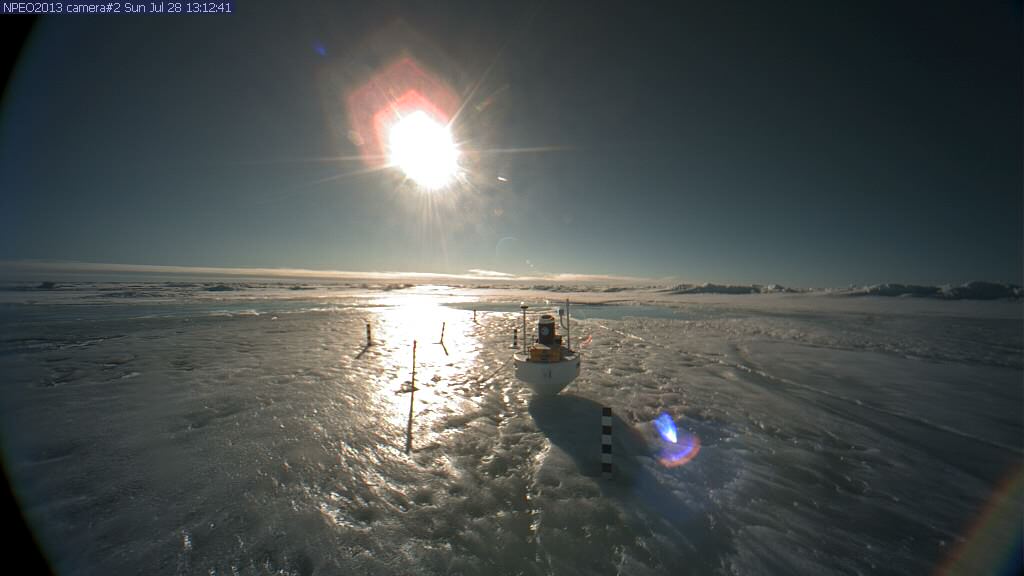
The pool drained away the next day, as I expected, and soon the water-polished ice was covered by snow, which was slightly unusual for mid-summer, as were the sub-freezing temperatures, as low as minus-seven Celsius, that followed. The DMI graph showed temperatures remained persistently below normal, and a midsummer gale similar to the gale of the prior summer only shifted ice around, without melting it. Something about 2013 was very different from 2012. This whetted my interest, and I began to pay closer attention.
Immediately I ran into the problem I had vowed to renounce, involving the political side of the Global Warming debate, and the refusal of some to abstain from childish name-calling. It seemed the gloaters were in a very bad mood about the sea-ice refusing to behave as if it was frail and feeble, and in a worse mood about the fact that, as soon as they drew everyone’s attention to the North Pole Camera, it stopped showing a lake and started showing a wind-swept wasteland of wind-driven snow. I could understand why this might be embarrassing, but they didn’t have to take it out on innocent bystanders like myself.
Fortunately I met, on the web, some fellow witnesses. They were more interested in simply watching, and in wondering what was different about 2013. Unlike the gloaters, they hadn’t already arrived at a judgment and weren’t angry at any sign their preconception was incorrect. Instead they alerted me to the fact that, beside the North Pole Camera, there were “O-Buoy” Cameras bobbing about in other parts of the Arctic Ocean, which allowed me to quietly observe a vaster area, without politics.
At this point a pleasant diversion occurred, taking my mind off the name-calling. It involved a Polar Bear.
I’d noticed what looked like polar bear tracks in North Pole Camera pictures from the year before. (Camera 2; October 15, 2012)

but this summer a shot from O-Buoy number 7, (2013-08-04 04:41:14,) showed actual polar bear fur,

Then North Pole Camera number one showed not only polar bear tracks, but what appeared to be a snot from the bear’s nose, left behind when he or she snuffled the camera lens. (Note the black UFO in sky)

(Even though I’m supposedly a mature adults when it comes to the subject of nasal phlegm, the polar bear booger led to some ribald hilarity on other sites that made me chuckle.) The next view from that camera demonstrated that it lay flat on its side.

That vandal bear apparently had no respect for the taxpayers funding the research.
The comic relief was welcome, but the incident underscored the blunt truth: The fellows who deploy such cameras do so at risk. I know the risk of sea ice from my youth on the coast of Maine, but one thing I did not need to worry about in Maine was meeting a 1600-pound bear.
Refreshed by this diversion, I felt ready to get back to studying. One thing I could clearly see involved the Navy extent maps, which continued to show the cracks from the February storm, but never showed these weaknesses expanding. If anything they were being compressed and vanishing. As I had a bit of spare time, I decided to research the creation of those cracks more deeply. As I went through the various sites produced by my search engine, I found myself visiting Joe Romm’s site, “Climate Progress,” and reading an article authored by Neven Acropolis titled, “Ice Breaking News: This Is Your Arctic Freezing Season On Crack.”
The article itself was decently written, with some good links to excellent satellite footage of the Beaufort Sea splitting up into huge leads. It avoided making blatant pronouncements that use the words, “this proves,” and instead made insinuation a high art by using words like “this suggests.” Then it concluded the ice was disintegrating and there would be significantly less ice the summer of 2013. In other words, it was a botched forecast. (I myself do this all the time, and see no terrible shame in it, as long as you are humble and admit your errors.)
I scrolled down through the comments, to see if anyone shared any insights suggesting they had the foresight to suggest that the ice might not melt. Most commentators were gloaters rejoicing that the ice was melting and the world was going to come to an end, but abruptly I came to a screeching halt. There, on Joe Romm’s site, was a comment by the noted skeptic “Tallbloke.”
The comment itself was quite interesting, suggesting open water might lose heat, however I was sidetracked by amazement, stunned by the phenomenon of a skeptical comment going un-snipped. Perhaps Joe Romm only allowed the comment to deride it, however at least some sort of communication was occurring. Perhaps it was a sign of better days. Perhaps cats and dogs could be friends.
Filled with goodwill and a sense of brotherhood I visited Tallbloke’s site and mentioned how wonderful it was times were changing and we could all be friends. Tallbloke himself was stunned. Apparently he enlightens Joe Romm fully expecting Joe Romm alone will see his messages, and his messages will be snipped without the public ever seeing them. He hurried to Joe Romm’s site to read Joe’s response, which began, “Care to make a wager on that? I say it’ll be obvious in the 2015 to 2019 time frame the ice is in the last throes of the death spiral.”
Tallbloke promptly offered to bet 3000 euros, which wasn’t really fair, for Romm offered the bet in March and it was now the end of August and the sea ice obviously had made a remarkable recovery. Joe Romm didn’t take him up on the offer, which made me sad. Here I had been trying so hard to promote communication and to foster brotherhood, but all we heard from Mr. Romm was a deathly silence.
After that second pleasant diversion I tried to get back to the business of being a witness, only to find myself midst a third diversion, wherein I strangely found myself in the position of an authority.
I try to make it clear I am not an authority on sea-ice. I’m a witness, dang it all, a witness. However I had no one to blame but myself for being mistaken as an authority. I signed up for it.
It happened back in the heat of spring, when the word “farm” is synonymous with “hectic.” I was displaying great willpower by keeping my computer shut off, for I have learned the web is an excellent way to fall behind schedule. However after a hard morning I was eating a vast plate of pasta for lunch, and thought I’d just quickly scroll through Anthony Watt’s website to see the headlines, as I ate. Among other items I noted it was the last day to vote on what the arctic sea-ice minimum would be. Most of the voter’s predictions seemed low to me, subscribing to the view that the record-setting minimum of the year before was a sign the ice was thin and weak. My view was different, because as a mere witness I was noting various things I thought were indicative of increasing ice. (In fact the prior year had astonished me.) I figured things would get back to increasing ice, and the minimum extent would be only slightly below normal, around six million km2. So I clicked some tabs to make my vote.
To my surprise a long form appeared on the screen. For the life of me I couldn’t see why Anthony was making his poll so difficult, but in a hurry I began to fill it out, standing as I typed with my toes pointed towards the door, and glancing anxiously at the clock. By the time I got down to a section where you had to give your reasons for choosing as you chose I was muttering a few choice words impugning Anthony’s good name, but at long last I could hit the “submit” key, and rushed off to get a tongue-lashing from my wife.
Around two weeks later I was checking to see what the authorities had predicted, and there, sticking out like a sore thumb, was my name. Apparently, rather than voting in Anthony’s poll, I had somehow clicked the wrong tab and filled out a submission form. I looked like a total idiot, nearly a million km2 above what even the high-side authorities were predicting, (and more than two million above the UK Met.) I winced, and wanted to creep cringing from all notice, but the web never forgets.
Then, as the summer passed and the ice was slow to melt, I didn’t look so bad. There was even a brief period where I stopped creeping and developed a bit of a swagger. It seemed remotely possible, if the winds would only shift, that the sea ice, which was jammed up in a way that reduces extent, might spread out in a way that increases extent (even if the actual area remains the same.) In fact I might even be the winning prediction!
This was fun, because as I worked on my farm I could pause and contemplate what in the world I would say, if I won. I could imagine the admiring throngs at my press conference, and my wife’s face as she was forced to admit my time spent goofing off at the computer was well spent. However it was also vaguely alarming, because I really have no time for trips to Bali. However the winds didn’t shift, the ice didn’t disperse, and in the end my guess was way too high, (though my guess did beat some prestigious authorities, such as the UK Met.)
This ended my brief career as an authority, and with a sense of relief I could go back to being a happy-go-lucky witness, simply sitting back and observing how unusually the ice behaved.
The sea-ice did seem to be behaving differently, if not “unusually.” It is difficult to say what “usual” is, as our records don’t cover the full cycle of the AMO. The men who are now silver-haired authorities were young students in the 1970’s, back when I walked the ice in Maine and we were just starting to gather our satellite data. What we call “ordinary behavior” for sea-ice may in fact only be ordinary for the warm phase of the AMO.
I myself have even more limited experience, but the movement of the North Pole Camera last summer struck me as strange. “Ordinary” movement would have the camera nudged along by the Transpolar Drift towards Fram Strait, and then sucked down the east coast of Greenland to where the ice breaks up down towards Denmark Strait, between Greenland and Iceland. However this year the camera crossed 84 degrees latitude, turned around, and crossed 84 degrees going north. Then it turned around and did it again…And again, and again. If you include the first time it crossed 84 degrees latitude, brought north by men, it crossed 84 degrees latitude twelve times, and was well behind schedule. There was far less ice than usual down in Fram Strait, while up towards the Pole the cracks that had been visible all summer in the Navy ice-thickness maps sealed themselves up. Rather than being flushed out of the Arctic Sea through Fram Strait, the ice seemed to be being jammed into the Beaufort Gyre, where thicker multi-year ice was increasing. The Navy drift map even made it appear as if the Transpolar Drift was at times moving backwards.

As a witness, I felt a little like Balboa crossing Panama and seeing the Pacific for the first time. A whole new landscape was appearing. I felt like I might have discovered something, and decided to make a statement, as a mere witness. However this just demonstrated how attempting to predict sea-ice offers unparalleled opportunities for making a chump of yourself. No sooner had I stated my discovery, (before the ink had even dried,) the autumnal gales began exploding in the North Atlantic, and all the ordinary winds and currents kicked into gear, and the North Pole Camera went whisking south past 84 degrees, on its way to being rescued by the icebreaker Svalbard as the sun went down for the winter.

This shows you it can be dangerous to even report your observations. Even when you have actually witnessed things going one way, things can change in a hurry, and when things go the other way it makes your report look stupid.
I saw this happen a second time before the season of watching ice melt ended. Formerly the season ended when the camera sunk, but more recently they have taken to saving the camera, while leaving other instruments behind to continue reporting from the site where the camera once stood. (Those cameras must be darn expensive; is it is really cost-effective to rent an icebreaker to pick them up?) Therefore, though you are blind without a camera, you can now continue to track the camera site, and note the temperature and wind speed and wind direction of that site, until the berg dissolves. The watching-ice-melt season is extended.
Further north the melt season is over, and things are already freezing up, but as your former-camera-site moves south of Fram Strait you can run into milder Atlantic air and slightly warmer waters, and the melting continues hand in hand with refreezes. Temperatures can range up and down between five above and thirty below, Celsius. When temperatures are thirty below you can surmise little melting is occurring, yet the grinding bergs of ice continue to move steadily south in the predominantly north wind. It is not a matter of if, but rather when, your camera site will crumble to slush in the stormy North Atlantic.
This autumn the ice, which had been held north as a sort of clot when summer winds blew, all came down through Fram Strait as a big wad of white.

It bulged out from the shore of Greenland in such a way that ice extents went from below normal to above normal as it passed. Smashed and bashed by storms and winds over fifty mph, the bulge persisted. As the bulge approached Davis Strait I began to wonder if we might witness a rare phenomenon.
From my reading I knew, (I neglected to save links,) that on rare occasions, perhaps every hundred years, such huge wads of ice were flushed down through Fram Strait that the ice jammed up in Davis Strait, and it was briefly possible to walk from Iceland to Greenland. I began to wonder if this might be one of those years.

No sooner had I wondered this wondering aloud in print, (again before the ink had even dried,) the Icelandic Low shifted and hit the area with screaming winds from the east, shoving the ice away from Iceland with such speed, and cramming it so close to Greenland, that now it is an embarrassment to say I ever wondered about walking from Iceland to Greenland. (But the web never forgets.)

I do have a bit of consolation. Iceland did snag a trophy, before the winds blew all the ice east.
As the ice the North Pole Camera stood upon began to break up it happened to involve two GPS reports, for apparently it is so expensive to deploy such collections of equipment that organizations as unrelated as the North Pole Environmental Observatory and the US Army join up, and deploy together. Some of their equipment is hundreds of yards apart, and there is some duplication of equipment, including GPS’s. For months the GPS’s reported hand in hand, but as the berg fractured there was a parting of the ways, as the two GPS reports began to come in from farther and farther apart, until they were roughly a hundred miles apart. Then one stopped reporting, likely sunk into the stormy waters north of Davis Strait. The other abruptly stood still, for it had beached on an east-facing coast of the most northwestern peninsula of Iceland.
Distance that the GPS associated with the North Pole Camera had moved from the North Pole? Over 1600 miles. Conclusion? Sea ice is not static stuff.
Nor do extremely low temperatures make sea-ice immobile. The two GPS’s I followed kept right on moving through temperatures as low as thirty below. (Also the big cracks that formed in the Beaufort Gyre the prior February occurred when temperatures were as low as forty below.)
In other words, what I observed in Maine in 1977 is still true. Air temperatures may have a lot to do with the freezing of salt water, but the motion of the ice comes from the wind, and much of the melting comes from below.
Considering I already knew what last summer’s study of Ice-melt taught me, back when I was a young poet walking sea-ice in Maine, the question then becomes: “Was the study worth it?” Probably not, if you are materialistic. It took a lot of time and didn’t pay me a red cent. It wasn’t even worthwhile, in terms of seeing past media hype and becoming an educated voter, for I had already seen through the hype. However I did get a very big paycheck, simply in terms of sheer fun.
(photo credits for above B&W photographs: Joe Nichols)
RE: Joe Prins says:
January 25, 2014 at 4:19 pm
Good point. Fortunately I am humbled on a regular basis. Did you notice every prediction I make about sea-ice in my story is wrong, “before the ink is dry?”
RE: Leon Brozyna says:
January 25, 2014 at 4:07 pm
The young will be foolish, but don’t be afraid to give them a word-to-the-wise. They may scoff and scorn and roll their eyes, and be ungrateful, but they are glad some old geezer is paying attention.
Sometimes the young simply need to learn things the hard way. However a word-to-the-wise might just lodge somewhere in the whirlwinds of their disorganized thought, and be there for them when they are just about to do something truly and astoundingly dumb.
I myself have no business being alive, after some of the stupid stunts I pulled. Blame the angels.
RE JBJ says:
January 25, 2014 at 3:33 pm
The sinking of the Hood is utterly off topic, but a wonderful sidetrack. The battle with the Bismark is a great history lesson. (I did notice a bit of sea-ice in that video, which barely keeps it on topic.) Thanks for sharing it.
Thank you, Sir. Enjoyed.
RE: Eugene WR Gallun says:
January 25, 2014 at 9:49 pm
I haven’t given up on poetry. I just think it rarely is a way to make a living.
I hate to admit it, but I agree with you about college professors of poetry. It is likely unfair of me to say so, but I think professors strangely miss the point of poetry, and in some cases are about the most un-poetic people alive. To shelter in a university and talk of poems is like living off mother and talking of working men. Not that Robert Frost didn’t shelter in a university, but it was only after life as a farmer made his fingers bleed.
You suggest that professor of poetry are victims of “the mediocrity that bureaucracy always
promotes.” I’m not sure bureaucracy gets the blame as much as being a little too safe, a little too sheltered, a little to willing to move in with mother. I think the better poets are too crazy to stay where it is safe. Shakespeare could have stayed home in Stratford on Avon. What bee got in his bonnet that sent him off to London? There are some suggestions his first job at the theater was
“parking cars.” (Actually leading rich royalty’s horses to the stables.)
Safety and security are all well and good, but you cannot relish them unless you’ve been through some sort of danger. Without danger they are deadly dull.
IMHO real poetry gives you that sense of standing on a verge, a frontier. You are not safe at home, but rather on the edge. Strangely, I also think real poetry is surrounding all people at all times, but it is too much to take, so most prefer to remain blind to it.
There are some decent poets around, mostly young and writing folk-music at college coffee shops. The chances of them making a living at it are rather slim. (That doesn’t mean it isn’t worth while.)
Tommy E says:
January 25, 2014 at 4:16 pm
“….By just being a “witness” to history, I can usually eviscerate the low information warmists I meet in my everyday life….”
I totally agree history is the tool to use, but am not sure I want to ” eviscerate” (disembowel) anyone. Not that a few don’t deserve it, (but how can you disembowel someone who is gutless?)
Most people don’t need anything quite that drastic, and knowing your history is very helpful. Sometimes a question works better than a statement, if you know your history. For example, “Oh? CO2 caused Sandy to be an unprecedented storm? I wonder what caused the hurricane of 1938?”
The other person may not admit they know nothing about the 1938 hurricane, however as soon as you have left the room they will Google it on their smartphone.
RE: vigilantfish says:
January 25, 2014 at 4:27 pm
“…This raises the question of how much blindness is in fact involved. Is it blindness, or self-interest?”
Each case is different. If a person is simply naive, it is simply a form of blindness you can cure. However if they stand to gain from carbon-taxes, and are willing to make a mantra of the-ends-justify-the-means and know darn well they are lying, but do so licking their chops eagerly for their share of carbon-taxes, then it is self-interest. Furthermore it is sleazy, evil, and at least twenty other unflattering words.
Judge each case on its merits.
Caleb says:
January 26, 2014 at 1:46 pm
I live in the Arctic … can send you some ice in the summer if you want 🙂
RE: Lloyd Martin Hendaye says:
January 25, 2014 at 6:08 pm
Nice.
Caleb says:
January 26, 2014 at 2:23 pm
You’re welcome. My comments on Denmark Strait oceanography also improve its relevance.
The 1415 souls who perished on Hood rapidly disappeared without a trace, but the three survivors lasted two hours in the water without suffering death by hypothermia.
As I mentioned, Admiralty’s records of the ice edge off Greenland during the war should be instructive.
RE: Michael D Smith says:
January 25, 2014 at 10:22 pm
Interesting ideas. Please don’t ask me to verify your math, but I have wondered a lot about heat being clamped in by ice and released by open water.
Something goes on during the warm AMO that keeps the area north of Scandinavia open, and the moment the AMO shifts to cold the ice advances up there in Barents Sea. Judging from old ice-maps and old data, there was a one-year-spike, a sort of freak AMO event, around 1938-1939, and the ice immediately responded even in that short time period. (Then WW2 made collecting such data not so important, as people in Scandinavia were busy staying alive.)
This winter Barents Sea is very open, so far. I am curious about the effect that has on Atlantic water entering the Arctic Sea. My guess would be the water would be colder.
Don’t tell anyone, but I have a hunch that we’ll see ice advance very quickly at the very end of this winter, on the Barents Sea. I don’t imagine it will hang around long, but, if it occurs, it may be a hint of changes. Now forget I ever said that. (Unless, of course, it actually happens.)
If we can afford it, we should deploy a lot more equipment up there to measure water temperatures and better understand the AMO. Food-producers (farmers and fishermen) could benefit if we had a clear idea what the AMO was up to. To be quite honest, I don’t think we really have a clue at this point. People talk about a sixty-year-cycle, but there is a huge plus-or-minus involved. The AMO might switch to cold next year, or ten years from now. Try planning a garden on that!
RE: milodonharlani says:
January 26, 2014 at 4:11 pm
Your comment about the world’s tallest (underwater) waterfall did whet my interest. I’ve heard it mentioned before, and it does suggest that there are layers of water under the sea, and that there could be maps of undersea conditions just as we have maps of various layers of the atmosphere over our heads. Just as we have meteorologists who have the genius to look at a 500 mb map and immediately expect a storm will develop down here on earth, we could have geniuses who could look at undersea water-maps and immediately know where up-welling water might make the fishing good, or create warm surface water that might fuel a gale center. (The problem is that deploying the equipment to create such maps costs far more than sending up a weather balloon.)
During the Battle of Denmark Strait they sure didn’t have time to take water temperatures, however the fact the three surviving sailors of the Hood didn’t die of hypothermia is indeed a sort of thermometer. Fascinating.
When I was young I decided, incredibly, that I would understand all the levels. Not only all the levels of the atmosphere, and all the levels of the sea, and the levels of the earth’s crust and core the continents float upon, but also the levels of human mind psychologists study. If I had a dream I attempted to study it from Freudian, Jungian, and Gestaltian views, just to begin with, to warm up. I wound up cross-eyed and had a hard time getting out of bed.
For me it is safer to just be resigned to one level, the one I walk about on. When I was younger I spent half my time with my head in the clouds, and the other half of the time I was over my head, and it made it hard to pay the bills. Becoming level-headed became a matter of survival.
I still like to look at clouds and waves and volcano’s fountains of lava, and speculate about levels I do not reside upon, however when push comes to shove I know where my feet are, and confess this:
I am sixty years old, and have become disgustingly pragmatic.
RE: RACookPE1978 says:
January 26, 2014 at 12:22 am
It might be possible to test your calculations with satellite data from Hudson Bay, as it freezes over. I skip the math, and just eyeball the situation, and watch the isotherms of satellite maps, and it is clear a skim of ice makes the Bay less able to warm arctic air passing over. However the air is still warmed to a lesser degree, despite the ice over the water. As the ice gets thicker the warming gets less and less, but it never stops.
There likely would be an argument about whether this heat comes through the ice, or around the ice via “leads” in the shifting ice. However the presence of ice doesn’t entirely stop the Bay from warming arctic air masses passing over.
I sure am glad it isn’t my job to do the math.
Mac the Knife said at 11:20 am:
Thanks for the skate sailing pictures! It was an ‘old timers’ musings about ice boating and a few people even skate sailing that stirred my brother and I to ‘give it a go’! Where in Wisconsin were those pictures taken?
Almost certainly one of the lakes in Waukesha County. Nagawicka was a favorite. I still have two of the sails in those photos, but I haven’t done it in over twenty years now.
I feel like I have only started to reply to all the kind comments, but it is bedtime for me, with a Monday ahead.
I especially liked the comments about sailing over ice wearing skates (and the pictures.) It surely is dangerous to go too fast, but zooming over a lake or pond is a great cure for cabin fever. Also skating is something old geezers can do. (Gordie Howe was playing professional hockey past age fifty, with his sons.)
Most especially I’d like to thank Anthony Watts for creating this marvelous site where minds can meet.
Good night, and I hope your next week is prosperous.
What a great essay. And the recurring them: “I am only a witness.” Don’t know if anyone noticed but this is very New Testament. The same recurring them: “We are witnesses” A lesson for all who claim to be Christian or religious or authoritative or whatever. Maybe it is a lesson for all, It is not about ego or power period. You can only witness, only suggest, only propose a different way of looking at things. You cannot make someone see what you see or believe or accept what you do. It is like the crazed egotistical drivers on the highway, just set an example, that is a most powerful thing to do. In this day and age, that is all that honest folk have left whether the Climate controversy or whatever.
Caleb says:
January 26, 2014 at 5:42 pm (replying to RACookPE1978)
A tough analysis, that Hudson Bay.
Hudson Bay is 1.230 Mkm^2 in area, and is a rough circle 1000 km across centered at 60 north latitude. As such, it is actually just about the most southern of ANY Arctic “sea ice” – and is actually closer to the equator than even almost all of the Antarctic Sea ice: even at the Antarctic’s sea ice maximum in late September-early October each year. Thus, Hudson Bay exhibits more closely the “dreaded” CAGW-Arctic amplification than any other large body of water.
Nonetheless, Hudson Bay does entirely freeze over each by November each year, and DOES melt again completely by early July. (Both of these current dates show a longer melt season than what was first recorded when it was discovered in 1650-1700 – Thus, yet again, confirming the worldwide existence of the Little Ice Age minimum temperatures between 1650-1700!) So, what is the impact globally on a heat balance if it freezes one week later than normal: week two in November for example, rather than week one in November. What is the difference in heat balance in the center of Hudson Bay’s water between one sq meter covered by ice November 5, or covered by open water November 5? For convenience, we’ll temperature data from Churchill, on the west side of the bay near latitude 60 North.
Now remember, the entire much-publicized “arctic amplification” holds that ice-covered, high-albedo sea water reflects MORE energy than does the “darker” open ocean water exposed to the same sunlight, right? The darker water absorbs more solar SW radiation, heats up more, the warmer water melts more sea ice around the dark water, that melts faster, which absorbs more solar energy, which heats up more ….
So, we should be able to show that effect at latitude 60 north, November 5, right?
For convenience, let’s look at the symmetric odd-number hours on Nov 5 for a clear day with “fresh” ice albedo – not the dirty “low albedo” of Arctic ice between June and September: 7:00 and 17:00, 9:00 and 15:00, 11:00 and 13:00 will each be equal around the local solar peak, so we won’t have to repeat the numbers too many times. (We could just look at that fleeting maximum exposure of the sun at local apparent noon, but the real value from 11:00 through noon to 13:00 is more informative. )
Nov 5 is Day-Of-Year = 305, the DECL (declination) that date = -0.275 radians.
Atmospheric attentuation factor = 0.85 (Bason, 2007, for clean arctic air)
For annual TSI = 1361 watts/m^2 (per Lief Sval, 2014) TOA Nov 5 = 1386 watts/m^2
07:00 Hmmmn. First problem: Sunrise is 8:00, sunset is 16:00 that evening. There is no direct radiation striking the surface at 7:00 am or 17:00 pm. Guess there are only convection losses into the air, long wave radiation losses into the air, and evaporation losses for 16 hours each overnight period. No solar heating at all.
09:00 (and 15:00)
Solar elevation angle = 6.00 degrees, air mass = 8.80, direct attenuation factor = 0.239 of what radiation arrives at TOA = 332 watts/m^2 (perpendicular) x 0.104 (for a horizontal surface, use the sin of 6 degrees ) => only 35 watts/m^2 hits the ocean water. But, for an atmospheric clarity (transmittance = 0.85) Payne, 1972 measured a open ocean albedo = 0.386 at 6.0 degrees SEA. Thus, of the 35.0 watts hitting the ocean surface, 13.5 watts are reflected back into the atmosphere, and 21.5 are absorbed.
If that 35.0 watts/m^2 direct radiation hit newly frozen ice, (albedo ~ 0.50 – 0.70 per the common references, so we’ll use 0.60) now 13.5 watts are absorbed, and 21.4 watts are reflected. Some, but not really much of a difference, but this is at only 6.0 degrees SEA.
11:00 (and 13:00) The sun is higher in the sky, and that changes everything – for these short few hours of the 24 hour day.
Solar elevation angle now = 13.3 degrees, air mass = 4.00, direct attenuation factor = 0.522 of what radiation arrives at TOA = 723 watts/m^2 (perpendicular) x 0.235 (for a horizontal surface, use the sin of 13.6 degrees ) => now 178 watts/m^2 hits the ocean water. And, for that same atmospheric clarity (transmittance = 0.85) Payne, 1972 measured a open ocean albedo = 0.200 at 13.6 degrees SEA. Thus, of the 178.0 watts now hitting the ocean surface, 54 watts are reflected back into the atmosphere, and 124 watts are absorbed.
Now, closer to noon, if that 178.0 watts/m^2 direct radiation hit newly frozen ice, (albedo ~ 0.50 – 0.70 per the common references, so we’ll use 0.60) now 63.5 watts are absorbed, and 114.5 watts are reflected.
We have NOT taken into account the 24 hour losses from either surface (open ocean or ice-covered ocean), but you can clearly see that: The closer to the equator the melting sea ice is, the higher the solar elevation angle each hour of exposure yields, the greater the difference between open ocean and sea ice yields.
Hudson Bay, as I mentioned above, is NOT typical of any other sea ice in the northern hemisphere: almost all of the Arctic sea ice melts and re-freezes between 72 north and 83 north each year. However The heat absorption and heat reflection in Hudson Bay at 60 north latitude IS typical of ALL of the sea ice surrounding the Antarctic continent! The greater the sea ice anomaly around the Antarctic continent, the more energy is lost from the planet. And, last year, the Antarctic sea ice anomaly ALONE (at 1.5 million sq kilometers above average for all of August-September-October), was GREATER than the entire area of Hudson Bay!
To repeat, Antarctica ADDED the entire area of Hudson Bay to its ice-reflective area across all of last year …. and the CAGW community (deliberately) ignored it.
That was a pleasure to read. Excellent work Caleb.
Caleb says:
January 26, 2014 at 5:24 pm
Not during the battle, but the belligerent navies did observe the ice edge in the strategic strait during WWII & the Cold War before satellites. Unfortunately, maps & data from the prior PDO warm phase in the 1920s & ´30s are apparently sketchy, but show conditions similar to now.
Some wonderful Danish maps from that period were posted here. Naturally CACA adherents can’t be bothered to study the history of Arctic ice, since it doesn´t support the beliefs of the cult faithful.
RE: milodonharlani says:
January 27, 2014 at 8:38 am
Yes, those old Danish maps are wonderful to look at and ponder about. It does look very much like we were here before. Anthony ran a story on those maps, with the maps available to look at, here: http://wattsupwiththat.com/2012/05/02/cache-of-historical-arctic-sea-ice-maps-discovered/
I’d advise anyone who is interested in sea-ice to pour over those old maps.
Back to WW2. The convoys to Russia must have had to deal with sea ice. The one summer “midnight sun” convoy they attempted was a disaster, so they stuck with convoys during the arctic night. The sea-ice information was likely top secret back then, but it is ancient history now. I wonder if it is sitting around in some old military file. I don’t even know where to start the search, but perhaps there are people who do.
Started to read and could not stop. You have a knack of taking us there and making us think about what happens around you. I did have motivation of course because I had published an article about the cause of Arctic warming. It is warming about four times as fast as the models predict and they still don’t want to admit that their models are wrong. They are wrong because greenhouse warming is the only warming built into their models and there is no such thing as greenhouse warming. If you did not know that, the fact that there is more carbon dioxide in the air than ever before but there has been no warming for the last 16 years should convince you. Arctic warming of course is an exception but that is because it is not greenhouse warming. It all started at the turn of the twentieth century with a re-arrangement of North Atlantic currents that started bringing warm Gulf Stream water into the Arctic Ocean. Prior to that there was nothing in the Arctic but two thousand years of slow, linear cooling. Warming stopped for thirty years in mid-century, then resumed, and is still active. It is likely that this hiatus was caused by a temporary return of the former flow pattern of currents. But what has happened in nature can happen again. Arctic temperature cycles now are as follows: first, starting with the twentieth century, we had 40 years of warming, then thirty years of cooling, followed again by 44 years of warming. What next? If there is a cycle, it could be another cooling, if not, just continued warming. I wonder whether the unusually icy year 2013 means anything there – we just have to watch what comes. If you want my article about all this you can download it from Judith Curry’s blog.
There’s a list of all the WW2 Arctic convoys here: http://en.wikipedia.org/wiki/Arctic_convoys_of_World_War_II
I mentioned above that the 1.0 to 1.5 million kilometers of “excess sea ice” around Antarctica all of last year reflected significantly MORE solar energy than the relatively small Hudson Bay area could absorb (due to the Hudson Bay’s 1 week later freezing of sea ice). on the same Nov 5 day.
its worth looking at this same Nov 5 “day” in some detail.
Nov 5 2013: Sea ice extent records around Antarctica show a sea ice total of some 18.5 Mkm^2, surrounding 3.5 Mkm^2 of permanent ice shelves and 14.0 mkm^2 of land ice. Total = 36.0 Mkm^2 of ice. At 6371 km radius, this represents a spherical ice cap centered on the south pole from 90 south latitude to 59.2 latitude. Let’s use 60 south latitude, since that is nicely symmetric with the center of Hudson Bay at 60 north latitude used above.
radiation at TOA = 1386 watts/m^2 on Nov 5. Declination = -0.275 Radians
At 3:00 AM (and 9:00 PM), the southern sun is slightly below the horizon.
At 5:00 AM (and 7:00 PM or 19:00 hours), the sun is 6.4 degrees above the horizon, air mass = 8.415. Only 39 watts penetrate the atmosphere to strike each horizontal surface. If this radiation strikes open ocean, 19 watts are absorbed, 20 are reflected. If it strikes sea ice at that same angle, 16 watts are absorbed and 23 are reflected back into space. Not much difference between sea ice and open water at this angle, but some.
At 7:00 AM (and 5:00 PM or 17:00 hours), the sun is 21.1 degrees above the horizon, air mass is now only = 2.762. Over 318 watts penetrate the atmosphere to strike each horizontal surface. When this direct radiation struck open ocean in years past, 276 watts were absorbed, 42 watts were reflected. But it now strikes sea ice at that same angle, and now only 127 watts are absorbed and 191 watts are reflected back into space. A notable difference between sea ice and open water at this angle: almost 150 watts/m^2 are now lost into space by each extra square meter of Antarctic Sea ice. And it is only 7:00 in the morning!
At 9:00 AM (and 3:00 PM or 15:00 hours), the sun is 35.1 degrees above the horizon, air mass is now only = 1.734. Over 602 watts penetrate the atmosphere to strike each horizontal surface on a clear day. When this direct radiation struck open ocean in years past, 566 watts were absorbed, 36 watts were reflected. Because it now strikes sea ice at that same angle, only 241 watts are absorbed and 361 watts are reflected back into space. A significant difference between sea ice and open water at this angle: 325 more watts/m^2 are now lost into space by each extra square meter of Antarctic Sea ice every second. And it is only 9:00 in the morning!
At 11:00 AM (and 1:00 PM or 11:00 hours), the sun is 44.4 degrees above the horizon, air mass is now only = 1.427. Over 769 watts penetrate the atmosphere to strike each horizontal surface on a clear day. When this direct radiation strikes open ocean in years past, 739 watts were absorbed, 31 watts were reflected. But it now strikes sea ice at that same angle, and only 308 watts are absorbed and 462 are reflected back into space. A very significant difference between sea ice and open water at this angle: 331 more watts/m^2 are now lost into space by each extra square meter of Antarctic Sea ice. And it is only 11:00 in the morning – there are still 10 more hours of daylight!
Noon. 445 MORE watts are reflected back into space from today’s excess Antarctic sea ice than in year’s past. 445 more watts every square meter (x 1.5 million sq kilometers of new sea ice) lost into space every second than in prior years when open ocean water absorbed the sun’s energy.
And this increased reflection is as the southern sea ice begins its melting season. The Antarctic summer maximum solar flux is yet to come, the southern sun is not yet at its highest point.
So, which is more important at 60 degrees north latitude and at 60 degrees south latitude on the same day in an “average” November? Freezing the entire 1.2 million square kilometers of the Hudson Bay 1 week later than “normal”? Or seeing “extra” 1.2 million sq kilometers of Antarctic sea every day in every season of every year over a 2-1/2 year span?
RE: RACookPE1978 says:
January 27, 2014 at 7:10 pm
I agree, though I could not be trusted to do the calculations.
It simply struck me as a sort of blindness that some Alarmists could be so upset about decreasing sea-ice way up at 80 degrees latitude when the sun is down near the horizon, and utterly ignore Antarctic sea-ice at 60 degrees latitude when the sun was at a higher angle. That sort of selective focus is actually a form of hypocrisy.
You can see the same sort of selective focus involving snow-cover. There has been above-average snow-cover in March and early April across northern Tundra and Taiga, which is conveniently ignored. By July the snow-cover is below-average, and there is a great deal of focus on that. Then it is above-average again by September and again blindness sets in. (You might want to play with the math involving the snow cover, if you have the time. The snow cover in March is something like ten times the snow cover in July, if not more. Therefore, even though the sun is at a lower angle in March, the total sunlight reflected might be more.)
I am not hearing so much about “albedo” these days. Perhaps it was only alarming when it was a mysterious word no one really understood. Once skeptics sat down and did their homework, it no longer was such a mysterious word, and lost its power to freak people out.
Although the bright sun, 24 hours a day, does make the polar snow slushy, I think the real melting comes from below. What the sun does is stop the freezing of the sea from above for 3-4 months, by warming the air.
Thanks again for your input.
“Tallbloke promptly offered to bet 3000 euros,..”
Lucky for Rog that Romm didn’t take the bet. I think that summers 2016-2019 will be more akin to 2007 and 2012 than 2013, with the NAO/AO on the negative side and a radical loss of summer sea ice.