Guest Post by Willis Eschenbach
In a post here on WUWT, Nils-Axel Morner has discussed the sea level in Kwajalein, an atoll in the Marshall Islands. Sea levels in Kwajalein have been rising at an increased rate over the last 20 years. Nils-Axel pointed to a nearby Majuro tidal record extending to 2010, noting that there’s been no acceleration there. A furor seems to have erupted in the warmosphere over his comments, with folks like Tamino pointing out that we have tidal data for Majuro up until 2013, not just 2010 as Nils-Axel highlighted, and those final three years show higher rates of sea-level rise, so indeed there is acceleration there …
Bemused by the excess of heat over light, and dismayed by the battle over twenty-year sea-level trends, as a long time sailor and commercial fisherman with more than a bit of knowledge about tides, let me say that they’re all wrong, warmists and skeptics alike. Here’s the critical graph for any discussion of sea-level rise and fall:
 Figure 1. Confidence intervals for the estimation of sea-level rise using tidal gauge data. This means that 95% of the results fall between the two extremes. For twenty year trends, these are from a sea-level rise of three mm/year to a sea-level fall of three mm per year. See endnotes for the corresponding equation. SOURCE: Pacific Country Report, Sea Level & Climate: Their Present State Marshall Islands December 2010
The interpretation of Figure 1 is as follows. Let’s consider twenty-year trends in sea level rise. The uncertainty is 2.8 mm per year … which is about equal to the global average sea-level rise itself.
Now, twenty-year trends are convenient because trends of that length are under discussion by Morner and the rest. It’s also convenient because we have twenty years of satellite records, as well as twenty years of SEAFRAME records in Majuro. The uncertainty in Figure 1 says that IF there were absolutely no change in global sea levels over time, about one tide gauge out of every six would show the sea levels as rising between 1.5 and just under 3 mm per year over twenty years. Another one in six tide gauges would solemnly assure us that the sea level is falling between 1.5 and 3 mm per year over the same twenty years.
SO … if you see a couple of twenty-year trends from two tide gauges that differ by say four mm per year, that is an EXPECTED RESULT of the short length of the data. Let me explain why the uncertainty is so large, and then we’ll look at the Marshall Islands sea level data. The problem is the tides. The ocean tides are a driven resonant system. By “resonant” I mean that ocean water “sloshes” back and forth in the ocean basins, just like the water in a wide basin after you set it down. Each ocean basin has natural resonant periods. The driving forces are the gravity of the sun and the moon. They vary in a hugely complex cyclical motion, which sort of repeats only after over fifty years. The basins have long- and short-period “standing waves” on the surface, or rather waves circulating around a wandering “amphidromic point” where there is no tide. There is no known way to predict what the combination of driving force, natural sloshing, and standing waves will look like at any given point for a given ocean basin. As a result, you have to wait for at least 50 years to get an accurate reading of the rate of sea-level rise. With shorter records, the uncertainty rises rapidly, and with 20-year records, the 95% CI is ± 3 mm per year.
With that as a preface, let’s take a closer look at the sea level rise in the area. First, where are these mysterious “Marshall Islands”, and how many tide gauges in the Marshall Islands have records up to the present?
Figure 2 shows the location of the three tide gauge records in the Marshall Islands that extend up to the present. They are at Wake Island, Kwajalein, and Majuro. The Majuro tide gauge is part of the “SEAFRAME” sea-level measurement project.
 Figure 2. Location of Majuro (the capital), Kwajalein, and Wake Island in the Marshall Islands. Australia is at the lower left. Papua New Guinea is the large turkey-shaped island at center-left. The islands in the chain to the right of Papua New Guinea are the Solomon Islands
Now, what do we know about the sea levels at those points? Here are the three records. I’ve spliced together the recent and the previous record at Majuro (Majuro B and Majuro C), as they are nearly identical in their overlap periods. Here are the three records.

Figure 3. All available tidal records which extend to the present, Marshall Islands. Heavy lines show 6-year centered Gaussian averages of the data.
You can see the post-2010 uptick at the end of the Majuro record (red) that Tamino referred to. Now, the whole hoorah has been about the trend of the last 20 years in Kwajalein. The records for Kwajalein and Majuro differ by about 4 mm per year … remember what I said about 4 mm per year above? Not meaningful.
Now, we do have one other source of information about the sea level rise in the Marshall Islands. This is the satellite record. At the time of writing, you could find the satellite sea-level record for any spot on the ocean at the University of Colorado “Interactive Sea Level Time Series Wizard” (it currently says “Under Revision”). Figure 4 shows those results. I’ve left out the annual results this time, and just shown the Gaussian averages, so we can get a sense of the difference between the tide gauge records and the satellite records.
 Figure 4. Gaussian averages of the three tidal gauge records shown in Figure 3. In addition, the satellite records for the same location are shown, aligned to the average of the first five years of the common period of record.
I show the data from 1970 so we can compare recent records (last twenty years, back to the early 1990s) and early records (previous 20 years, early 1970s to early 1990s. Now, there are a few oddities here. First, although the satellite records generally “wiggle-match” the tide gauge records, the agreement isn’t all that great.
Next, of the three dataset pairs (satellite and tide gauge), two of the pairs (Wake Island and Majuro) end up together after 20 years. At Kwajalein, on the other hand, the tide gauge record ends up about 50 mm above the satellite record … the cause of this divergence is unknown. It appears to start in 2003, and it may be something as simple as the dock where the tide gauge is located slowly sinking into the sand … or not.
The most internally consistent data that we have, the satellite records, show little difference between the rise in Majuro and Kwajalein over the last 20 years. One is 6.4 mm, one is 7.4 mm … be still, my beating heart.
So Nils-Axel and Tamino are both wrong. We can’t conclude anything either way by comparing Majuro and Kwajalein. Their records are far too short and too similar.
Finally, how unusual are these three satellite-measured trends at Wake, Kwajalein, and Majuro, of 2.1, 6.4, and 7.4 mm respectively? Well, to answer that, I took the approximately half a million areas of the ocean for which the satellite has measured the trends from the University of Colorad, and made a histogram …
 Figure 5. Histogram of the sea level trends for each 0.25° square gridcell of ocean area from 89.5 North to 89.5 South.
Now, the trends shown in Figure 5 are 20-year trends. Recall from Figure 1 that the 95% confidence interval on tide gauge records was estimated at just under ± 3 mm. The 95% confidence interval on these satellite measured trends in Figure 5 is somewhat larger, at ± 5 mm per year. Note also that about 12% of the gridcells show a decrease in the sea level, and thus they have a negative trend.
Finally, you need to be aware that the trend that is shown by the tidal gauge data is NOT the rate of sea-level rise, for a couple of reasons. First, what you are seeing is the rate of global sea-level rise PLUS the tidal effect from the sun, the moon, and the shape and resonant frequency of the basin. The means used for removing those tidal effects is beyond the scope of this discussion (see Mitchell for details under “Asymptotic Trend Evaluation”). However, generally what has to be done is the 112 different major solar/lunar tidal components are estimated from a tidal record to date at a specific location. Then the “best guess” estimate of the combined tidal effect is subtracted from the observed change in sea level. What remains is the best estimate of the actual change in the underlying sea level, but it still needs to be corrected for the land uplift/subsidence.
So for example, the measured change in the sea level at the Majuro B (SEAFRAME) tide gauge was +5.6 mm/year 1993-2010. But after subtracting the tidal effects, it drops to 4.3 mm/year. And after removing land subsidence effects, the actual trend was estimated by the SEAFRAME folks at 3.8 mm/year.
To complete the circle, here are the Majuro and Kwajalein tide gauge and satellite records, aligned on their 1995-2000 averages.
 Figure 5. As in Figure 4, but with the Majuro records adjusted upwards by 59 mm so that they are all aligned on the average of their 19/95-2000 period.
SUMMARY: TIDE GAUGE AND SATELLITE DATA, MAJURO AND KWAJALEIN
• The early (1973-1993) and late (1993-2013) trends in Majuro were about the same.
• In Kwajalein, the early trend was about flat, and the later trend was quite steep.
• Given the close physical proximity of the two atolls, and the similarity of the two satellite records, one or the other of the tidal records may contain an error.
• After about 2003, the Kwajalein record wiggle-matches with the two satellite records. The Majuro record does not. On the other hand, after diverging from the two satellite records in 2003, the Majuro record ends up agreeing with them, while the Kwajalein record ends up ~ 50 mm higher than the other three. Go figure.
° The post-1993 Majuro tide gauge “B” is a modern design acoustic SEAFRAME gauge, and is presumably quite accurate.
• There is absolutely no statistical significance in the ~4 mm difference between the 20-year tide gauge trends for Majuro and Kwajalein. And the satellite trends, as you can see above, are nearly identical.
• In short, there is no evidence for or against an acceleration in sea-level rise in the three Marshall Islands records.
Best to all,
w.
DATA AND CODE: Spreadsheet is here … enjoy
UNCERTAINTY EQUATION—The empirical equation relating years of record (YR) and uncertainty (one standard deviation) is:
Uncertainty (mm/yr) = 0.102 * EXP( -4.939 * EXP( -0.02 * YR ) )
This says that with a fifty-year record we still have an uncertainty of plus or minus two-thirds of a millimetre per year, or 63 mm (2.5 inches) per century.
MostlyHarmless says:
August 2, 2013 at 6:01 pm
Glad to. I haven’t removed the tidal effects from any of the data. Nor did I claim to have done so. I hope this news finds you enlightened.
w.
That’s not really a “level” issue so much as it is variation in the equipotential surface of mass-attraction gravity due to mass inhomogeneity.
GPS receivers give you lat/lon/alt relative to the reference ellipsoid, which is transformable to ECEF position. Which means: no, there’s no Earth model that bears any relevance, here.
DGPS can give you position accuracies in single-digit centimeters. Survey-grade instruments have only been around for maybe a couple of decades.
See also: here:
As an aside: I’d be shocked if Kwajalein didn’t have DGPS available, given that it’s a major missile testing ground. Ditto Wake.
One last thing: there’s a decent treatment of crustal movement due to lunar and solar gravity here. I’ve always referred to that as “solid Earth tide”, so as not to confuse it with oceanic tidal response.
johnmarschall “It might be a good idea to wait for a reply from Nlis-Axil Morner since he is still the world’s sea level expert.”
Not really, although he seems to have a very high opinion of himself on lots of subjects, from how to use dowsing rods to how to store nuclear waste (he claims it’s impossible to safely store nuclear waste in Sweden since it’s going to have huge earthquakes) to disputing there even is a greenhouse effect caused by greenhouse gases.
Slartibartfast says:
August 2, 2013 at 9:36 pm
…
As an aside: I’d be shocked if Kwajalein didn’t have DGPS available, given that it’s a major missile testing ground.
==============================
Probably does. I’d guess the GPS position(s) are for the tracking radars and launch pads, not the tidal gauge. I’m not sure it makes any difference. We know where Kwajalein is. It’s probably not moving very much laterally, and even if it were, it’s hard to see why that would affect sea level measurement. And any vertical motion is probably similar everywhere on the atoll. (Are soil related phenomena like compaction even possible on a coral atoll?)
Vertical motion is a different issue. It’s harder to measure but much more important. Measuring height of a fixed feature from an elevator is tricky.
Willis said in the post: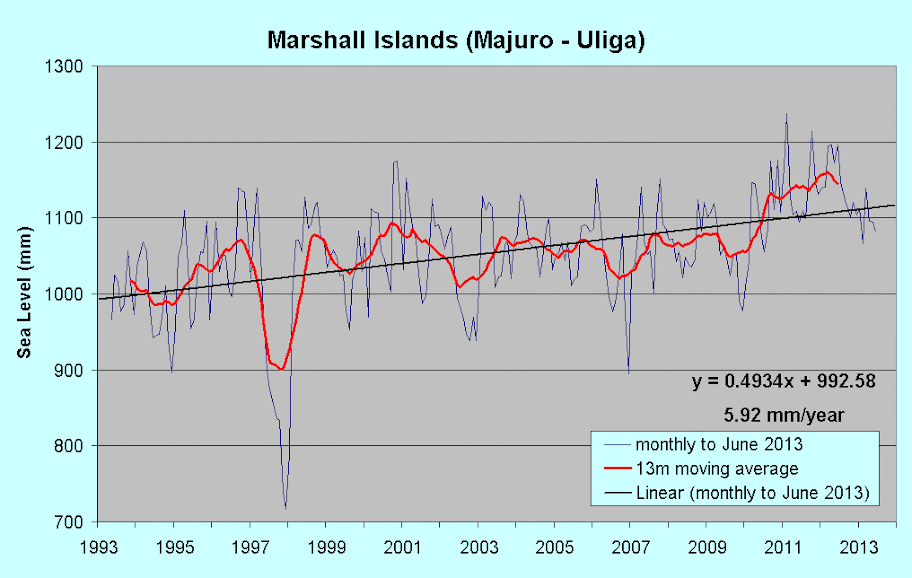
So for example, the measured change in the sea level at the Majuro B (SEAFRAME) tide gauge was +5.6 mm/year 1993-2010. But after subtracting the tidal effects, it drops to 4.3 mm/year. And after removing land subsidence effects, the actual trend was estimated by the SEAFRAME folks at 3.8 mm/year.
I repeat – what “tidal effects” were subtracted?
Here’s the SEAFRAME plot for Majuro to last month – June.
Source:
http://www.bom.gov.au/ntc/IDO70052/IDO70052SLD.shtml
Nothing wrong with Roger Andrews composite chart – I have spreadsheets for most of those stations to 2012., and data and charts for almost all are accessible on PSMSL.
I repeat what I said before – it’s ENSO at work, with a rebound from the early 1990s low caused by two El Ninos – 1991-2 and 1994-5. On the other side of the Pacific, sea-levels have been largely static over the period under discussion, and for the same reason – ENSO. Between 1980 and 2012, sea-level at San Francisco rose at just 0.03 mm/year, and since Oct 1992 (satellite era) has dropped at -1.02 mm/year.
thomas.
There is no empirical evidence for the GHE it is just s construct to overcome a poorly understood model.
And thanks for misspelling my name.
DonK
Actually island lateral movement will make a difference. As the tectonic plate moves away from the spreading center the sea depth increases due to plate local cooling but this movement is centimeters per year so would not make any difference in this case over such a short time.
The warmists have connected ocean level changes with the increase in planetary temperature. If the planet is cooling and does significantly cool (due to the solar cycle 24 change) based on that hypothesis and the mechanisms ocean levels should drop. It will be interesting to see how the sea level data is changed (climate gate type changes, climate war explanation) and how sea does change (physical change and pure science attempts to explain the physical change).
There are multiple unexplained sea level anomalies (the data and analysis is not consistent) if one starts to look for mass and volume changes to explain the sea level rise and constraints the analysis with rotational changes. Significant unexplained anomalies often indicate that there is either a fundamental error in the analysis/theory or there is missing parameter/mechanism.
I believe in this case there is a missing parameter/mechanism that affects both ocean level and satellite altitude (this missing mechanism/parameter explains the GRACE anomalies). If that belief is correct ocean level will fall more than predicted if and when the planet cools. The missing parameter/mechanism also explains why the solar wind speed dropped by a factor of two during the Maunder minimum.
The satellite give sea level rise of 3.2 mm/yr is not correct and is due to adjustments. I believe the tidal gauge analysis gives 1.5 to 2.0 mm/yr (no change in rate of increase). Mass and volume changes based on temperature changes and ice sheet melting give 0.5 mm so there is an unexplained the 1.0 mm/yr to 2.0 mm/yr.
ftp://www.grdl.noaa.gov/pub/laury/nature.pdf
Mass and volume contributions to twentieth-century global sea level rise
The rate of twentieth-century global sea level rise and its causes are the subjects of intense controversy1–7. Most direct estimates from tide gauges give 1.5–2.0mmyr21, whereas indirect estimates based on the two processes responsible for global sea level rise, namely mass and volume change, fall far below this range.
Estimates of the volume increase due to ocean warming give a rate of about 0.5 mm yr (ref. 8) and the rate due to mass increase, primarily from the melting of continental ice, is thought to be even smaller. Therefore, either the tide gauge estimates are too high, as has been suggested recently, or one (or both) of the mass and volume estimates is too low.
Here we present an analysis of sea level measurements at tide gauges combined with observations of temperature and salinity in the Pacific and Atlantic oceans close to the gauges. We find that gauge-determined rates of sea level rise, which encompass both mass and volume changes, are two to three times higher than the rates due to volume change derived from temperature and salinity data. Our analysis supports earlier studies that put the twentieth-century rate in the 1.5–2.0 mm yr range, but more importantly it suggests that mass increase plays a larger role than ocean warming in twentieth-century global sea level rise.
http://anquetil.colorado.edu/~archie/publications/Mitrovica_etal_2006.pdf
Reanalysis of ancient eclipse, astronomic and geodetic data: A possible route to resolving the enigma of global sea-level rise
johnmarshall, sorry, I didn’t realize you were one of the “dragonslayers”.
http://wattsupwiththat.com/2013/08/02/the-most-important-sea-level-graph/#comment-1378833
vukcevic,
(if it’s ok to reply to his comment)
Are you implying that that only CO2 forcing incurs feedbacks and not solar forcing (or any other)? That seems to be your position when you subtract solar-forced changes to determine climate sensitivity. I would have thought that establishing climate sensitivity would include any forcings. This would be complicated by any differences in efficiency of various forcings.
Also, your ‘model’ is a TCR (Transient Climate Response Model) and should be compared with TCR (not ECS) estimates. Mean TCR estimate is 2.1C for a doubling of CO2 – the response at the time of doubling. ECS is the changed climate state after reaching equilibrium.
A vigorous ‘skeptic’ at a forums I used to inhabit ginned up a graph based on TCR and this was the result for the instrumental record.
http://i1006.photobucket.com/albums/af185/barryschwarz/TCR21.png
(Blue line is TCR derived from linear CO2 increase, and red line is TCR from observed CO2 increase)
arthur4653,
As Willis pointed out, local sea level change is highly variable (even negative), even though sea level rise has occurred on average. There are all sorts of local factors at play, and a changing global climate brings change to patterns in the climate system (with different sign) across many indices.
Willis,
I would say the same if the local tide gauge was used as a proxy for global, but I don’t see any problem with limiting the cliam to that location. Error bars should be included for the claim to apparoach any kind of rigour.
johnmarshall,
Never mind AGW – you are saying that the greenhouse effect is bogus? That if you removed all greenhouse gases from the atmosphere (including water vapour), global temps would not change?
Oh dear. Thankfully, most people here will dismiss that instantly for the nonsense it is.
there is no DGPS in the islands, gps with its standard 2 meters is good enough for navigation and flight. There are requirements that make it difficult to set up a proper DGPS site. The equipment for GPS survey equipment is quite expensive and is only used to determine a fixed objects position and centimeter accuracy is quite awful compared to the cost. So you might use it to fix the position of your tide guage but not the tides which move too fast for that particular type of surveying. Also I believe the marshalls are still using WAKE-ENIWETOK 1960 – Marshall Islands, for their surveying which makes it even more unlikely they will build their own DGPS site.
Eustace,
Not so, the primary cause of sea level rise is attributed to thermal expension (warer expanding as it is heated).
Robert of Ottawa,
“The fatuity of short-term trends” – excellent note to engrave in the top bar of climate blogs. But it’ll be *forgotten* in a day or two.
Looking at the seaframe equipment, they do have a static GPS install to try and determine what the land Is doing. However their expectations of the accuracy of that equipment (installed in 1993 and used continuously to 2010) is a bit over the top. Static equipment requires weekly checks for errors from a separate system, one of the reasons I personally would not use GPS equipment in a study like this. If your measuring millimeters, centimeter accuracy isn’t going to cut it.
The oceans have been warming in the time of relatively flat surface temperatures. Sea level should rise correspondingly.
http://sealevel.colorado.edu/
@Dave Wendt
“http://tinyurl.com/msltrends92-12” Thanks.
It looks like the sea level changes are wind-driven. It’s a bit ridiculous. You have one island in the Aleutian chain that has 1 cm/yr rise over 20 years, but it’s so spatially confined that by the you get to the island itself, there is no sea level rise.
Does local sea level reflect average water temp (think El Nino), thus average local air pressure driving sea level change? Sorry Dave, I don’t have the wherewithal to do this, but, if you look for spatial correlation of 20 yr average ocean temp with mean sea level rise, is there significance?
Bill Illis — possibly the most sensible WUWT commentator — has illustrated here countless times the relationship between trade winds & enso.
See figure 2 here for some related insights:
http://www.per.marine.csiro.au/staff/ming.feng/Publications/2004FengGRL.pdf
Also figure 1 here:
http://www.per.marine.csiro.au/staff/Ming.Feng/Publications/2011FengGRL.pdf
One thing that makes the 90s changepoint interesting is that it’s shared with secular ozone (i.e. once you filter off annual, semi-annual, QB, & solar components).
Tides aren’t the main thing going on.
excellent NASA video (h/t Bob Tisdale) makes coupled temperature, mass & velocity crystal clear
How can any fool put a tide guage on a volcanic island sitting on a magma chamber and figure out the sea level rose X mm per year? How stupid!
Willis:
Thanks for your response of 3.46 pm yesterday and apologies for the delay in replying. Here are my comments on your comments:
1. “(Y)ou say (the rate of sea level rise) is “evidence” but that you don’t know whether the change is statistically significant. It doesn’t become “evidence” until it is actually shown to be statistically significant. I’ve shown that the difference in the two trends is NOT statistically significant, so it is not evidence.”
Sorry, but it’s still evidence. Just not enough to convict.
2. “Whether the average of the 19 (sic) records is significant remains unanswered. The uncertainties in even long tidal records are large. Many of the records you cite are only 30 years long. From Figure 1, that gives them a ± 1.5 mm/year 95%CI.”
The error of an estimate typically decreases as the inverse square of the number of data points, so when we average 18 records together we should get a number which is considerably less than the +/-1.5 mm/year you cite. But even this 1.5 mm/year estimate is still less than the difference between the pre- and post-1990 sea level rise trends (0.8 vs. 4.7 mm/year), so I think you have to consider the possibility that this trend difference IS statistically significant.
3; “Finally, you need to bear in mind that not one of the records you accessed has had the tidal effect filtered out.”
As I mentioned earlier, I’m estimating sea levels relative to coastlines, not absolute (or geocentric, or eustatic) sea levels, and if you want robust relative sea level estimates it’s a good idea not to start “correcting” the tide gauge records.
4. “So what we are looking at in your graph may be just the tidal action and the standing waves.”
Well yes, it may be. But what if it is? It doesn’t make the acceleration go away.
Willis Eschenbach
Another humdinger Willis. Great treatment of a complexity.
Confusion abounds due to the accepted misusage of the term “mean sea level” which is a misnomer. The Sea is not level, it is CURVED. Additionally, any plumber will tell you that water runs down hill. Old timers refered to it as the Bounding Maine because it is a moving target. /sarc.
It is a logical falacy of missplaced precision to try to measure to a milimeter of accuracy something that constantly moves up and down in meters and tens of meters, with ripples superimposed upon waves, upon swells, and upon tides all moving differently. I think I’ll chunder now.