A number of readers have commented about the story from Sunday about NOAA’s experiment at Oak Ridge Laboratory to determine the warming effects of siting suggesting that the experiment was long overdue. many found it surprising that it has taken NOAA this long to get serious about the issue that Dr. Roger Pielke Sr. and I have been working on since 2007. You may find it even more surprising that that issue goes back even further than that.
Well before the current debate over the value of the near surface temperature record and its many possible biases, and well before David Parker’s non empirical UHI studies sought to minimize the effect based on windy -vs- non windy days (which now appear to be falsified by the new NOAA experimental work), J. Murray Mitchell published a paper in 1952 titled: On the Causes of Instrumentally Observed Secular Temperature Trends.
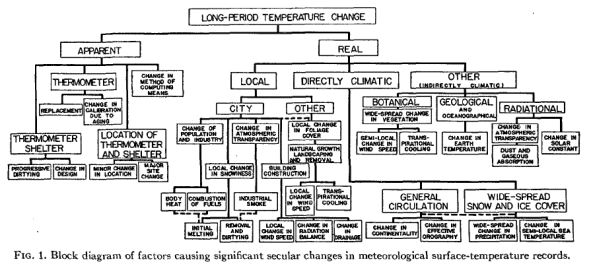
Mitchell’s study was a quality study on the numerous possible effects of localized micro-site effects, as well as broader UHI effects related to population growth in cities. He created a tree chart of the known influences at the time:
He looked at a variety of possible influences, and attempted to quantify them, both for rural and urban stations. Curiously, he discovered an effect that I’m sure many of you have never heard of before, the day of the week effect:

While this was not a fully comprehensive study, it did hint at the fact that in the USA, there was a greater percentage of the population and business at the time that observed Sunday as a day of prayer and rest.
This paper is actually a summary of three different studies, examining New Haven, CT, and the Blue Hill Meteorological Observatory for UHI related issues, plus a broader study of 77 stations examining the effect of UHI on those stations then.
It’s a good read, and provides some grounding for the current discussions on the issues.
Here’s my anecdote. Anyone who doesn’t have a good understanding of UHI needs to take a trip to a second world country and live in a developing area.
When I was in high school and involved with my local church, I went on a mission trip to Mexico. We went to a poor area of Monterrey to help build a church. In reality, we spent a whole week in a dusty, empty lot, picking up trash and pulling weeds, and then digging holes in the ground. And when I say digging holes, I mean using pickaxes to bust rocks and then shoveling rock bits out of holes. On the last day we finally made some rebar frames to lay in the holes and laid some concrete – eventually these would be the primary support pillars for the structure, which would be built with many more mission trips over the years.
Anyway, while we were there, we ate and slept at another local church compound, which had been built by previous missions. The lot had three buildings – the church itself, a bathroom/shed, and an activity room (imagine a small restaurant dining section). Being high schoolers, boys were kept separate from girls at night. The girls got to sleep in the activity room, which had electricity and ceiling fans, and was mostly constructed of wood. Boys slept in the sanctuary on pews.
The entire compound was paved with concrete. The church itself was also made entirely of concrete. The floors, walls, ceiling, everything. Now, we would wake early, and head to the site to work from about 6am until 11, break for lunch, then work until about 2 or 3 and go home. It was just too hot then to bother – we retired for a siesta in our separate buildings, and believe me, sleeping in a concrete box when it’s 110+ is not so great. It was damn hot in that church, and our nap consisted of tired boys sleeping until they couldn’t sweat anymore, and waking to slake their thirst.
The problem is when night came. The girl’s building cooled off with the ambient air, and they had fans to boot. But that big concrete church, which had soaked up the sun all day long, kept radiating heat. Halfway through the week I went to a store and bought a thermometer out of curiosity. At 3am, it was still 104 degrees inside that church, despite being a balmy 85 in the driveway just outside.
Of course, I had never heard the words “urban heat island” before, nor did I think about such a thing happening on a large scale, such as for a whole city. But it makes perfect sense. All I knew at the time was, that was one hot church to stay in. It was hot all day in the sun, and hot all night sloughing the heat off into the cooler air. I really doubt the interior of that building, which had plenty of windows, and the giant double door left open at all times, ever dipped below 95 degrees between the months of May through August. Perfect for congressional hearings on global warming.
We also happened to be right across the street from a very large glass plant, which was rather loud. And the air pollution in the city was so bad you got black rocks for boogers every day. But I did learn the Mexican way to mix concrete. And my 18 year old self earned the respect of a middle aged man who could suck down a 1 liter glass-bottled Coca-Cola in 7 seconds flat (which, when you’re 18, is pretty cool).
There’s my Willis-style story.
journals.ametsoc.org/doi/pdf/10.1175/1520-0469%281953%29010%3C0244%3AOTCOIO%3E2.0.CO%3B2
Cut and paste into browser address field.
clipe says:
January 21, 2013 at 12:01 pm
If that doesn’t work then try Google’s “I’m feeling lucky” button.
Yes, it’s a beautiful paper. It was published in 1953, though – Journal of Meteorology, 10(4), 244-261.
I confess mild surprise at a Day of Week anomaly. If you put yourself back a couple decades where there were more coal-fired boilers and fewer industrial processes that ran 7 days a week, I can see how there would be a difference. Blue Laws were much more common in earlier decades. Texas had blue laws until 1985.
Is there a Month of the Year Anomaly? Or a Week of Year Anomaly?
Or specifically, has the BEST scalpel process created such an Anomaly? If we take the tens of thousands of scalpel points and plot them over the time of year, will the cuts be distributed randomly? Or will they tend to non-randomly clump around holiday periods like Christmas — New Year’s, Memorial Day, July 4th, Labor Day?
Suppose the distribution of scalpel points does fail a random test. What then? Do I have to show a bias? No. It is BEST’s scalpel, they wielded it. BEST needs to show that the scalpel does not bias the data. By it’s nature as a low cut filter, the BEST scalpel process biases the data by removing low frequency content in the original data. Has the BEST process passed a Peer Review, particularly one that analyzes the Fourier space, and if so, what is the link?
I posted something like this of this a few years back when I sampled the Highs for a region about 60 km around DC.
http://strata-sphere.com/blog/index.php/archives/12246
On the one day I looked at the data the standard deviation was 3°F and the average deviation over this region was 2°F. I wagered then you could see the same response in this 60 km region on any summer day of any year, and that this meant local temps (and records) vary quite more than people (or climate ‘scientists’) have admitted. Basically, if one or two of the outlier sites are not included, then the regional diversity in temps drops way down giving a false result. If rural sites (which tend to be cooler and closed on weekends) are left out, you would see a more unified, UHI-driven record because the suburban and urban sites would be inside the UHI bubble.
So I am not surprised in the 1950s, when sampling was not consistent, there are issues. Which also goes to prove CRUs initial assessment of accuracy for an given grid for a yearly temp value is +/- many degrees:
http://strata-sphere.com/blog/index.php/wp-content/uploads/hadcrut3_gmr_defra_report_200503.pdf
Not tenth of degrees, as the IPCC and Hockey Team want to claim when they calculate a statistical accuracy (verses the accuracy of their global mean temperature model to reality).
ENSO meter now in La Nina territory.
The Weekend Effect is well know and studies go back 30 years. And every one of those studies in the last 30 years only reports changes to diurnal temperature range. Never changes to minimum or maximum temperatures.
The Weekend Effect is caused primarily by aerosols and aerosol seeded clouds. Aerosol levels at a particular location can be easily measured as can minimum and maximum temperatures. Therefore, aerosol direct and indirect effects on temperatures can be accurately quantified.
Why aren’t these studies done?
I can only conclude accurate aerosol – temperature quantification would force downward revision of the CO2 forcing in the models. And no climate scientist who values his career would dare to do that.
Rhys Jaggar “one index for urban thermometers and another for rural ones“.
Why not just one index for well-sited thermometers? (“well-sited” virtually implies “rural”, see Watts(2012)).
The problem with the UHI boogeyman is that it is a one-time systematic change. That does not explain away the long-term upward trend in temperatures.
Paul:
At January 21, 2013 at 4:22 pm you mistakenly assert
No, Paul, you seem to get your misinformation from warmunist propaganda sites.
The magnitude of UHI increases with degree of urbanisation so the UHI of a town or city increases as its population increases. Population is increasing so the total magnitude of UHI at measurement sites is increasing.
If you don’t believe the reality then do a simple check using your vehicle’s temperature indicatoe when you approach a small town and when approaching a larger city.
Richard
Paul says:
January 21, 2013 at 4:22 pm
The problem with the UHI boogeyman is that it is a one-time systematic change. That does not explain away the long-term upward trend in temperatures.
Without getting into the complexities of UHI, and relevant to the thread, Cities worldwide have been growing outward and upwards. The outward growth causes more and more sites to be influenced by UHI. Thus it is not necessary for UHI to increase for it to cause increasing global average temperatures.
Concerning upward growth. as I mentioned earlier, the Urban Canyon Effect is a major cause of UHI and pretty much every city in the world has seen more and higher buildings and thus an increasing UCE.
You may find it even more surprising that that issue goes back even further than that.
I am not one bit surprised as this issue was raised with a group of climate scientists in the late sixties here in the UK when the first studies on so called global warming came out. The ill will it created led to some of the engineers who did voluntary data collection and management for them when the issue was acid rain leaving in disgust.
Yes, and admittedly I was conflating the issues of station siting versus local/regional changes due to UHI. I’m versed in both, just got ahead of myself. Proceed with the dismantling.
You will search in vain in the IPCC & BEST analyses for an honest “one-time” UHI adjustment, even. Such an adjustment would require downward revision of recent measurements. Not acceptable. An increasing downward adjustment even less so.