A number of readers have commented about the story from Sunday about NOAA’s experiment at Oak Ridge Laboratory to determine the warming effects of siting suggesting that the experiment was long overdue. many found it surprising that it has taken NOAA this long to get serious about the issue that Dr. Roger Pielke Sr. and I have been working on since 2007. You may find it even more surprising that that issue goes back even further than that.
Well before the current debate over the value of the near surface temperature record and its many possible biases, and well before David Parker’s non empirical UHI studies sought to minimize the effect based on windy -vs- non windy days (which now appear to be falsified by the new NOAA experimental work), J. Murray Mitchell published a paper in 1952 titled: On the Causes of Instrumentally Observed Secular Temperature Trends.
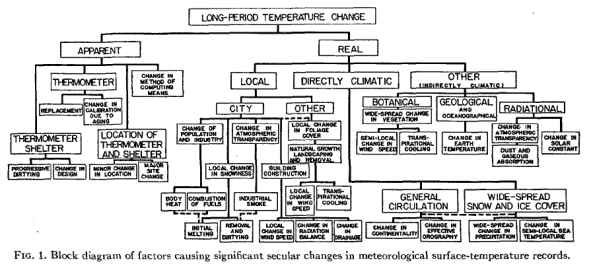
Mitchell’s study was a quality study on the numerous possible effects of localized micro-site effects, as well as broader UHI effects related to population growth in cities. He created a tree chart of the known influences at the time:
He looked at a variety of possible influences, and attempted to quantify them, both for rural and urban stations. Curiously, he discovered an effect that I’m sure many of you have never heard of before, the day of the week effect:

While this was not a fully comprehensive study, it did hint at the fact that in the USA, there was a greater percentage of the population and business at the time that observed Sunday as a day of prayer and rest.
This paper is actually a summary of three different studies, examining New Haven, CT, and the Blue Hill Meteorological Observatory for UHI related issues, plus a broader study of 77 stations examining the effect of UHI on those stations then.
It’s a good read, and provides some grounding for the current discussions on the issues.
On David Parker’s non-empirical work: Chatting at work one day an empirical physicist commented on theoretical physicists joking “It’s the job of the empirical physicist to prove the theoretical physicist wrong.”
We chuckled, since our theoretical guys were pretty good, but the spirit of competition showed through. Fortunately, there’s a good portion of scientists who are just plain curious, and those that thrive on the competition.
Unfortunately, there are plenty who have to thrive on funding…. since universities across the land that have adopted the agenda of publish or perish.
The human static affect, look at the global temperature chart from 2008 when the economy came to a standstill, temperatures dropped and sunspots were very low. Good one is to look at temps few days after 9/11 when all flights across USA were shut down and people did not travel much. Human static was slower for a short time just like in 2008.
I have long noticed that a car parked close to a building overnight will collect less dew on the side of the car nearest the building, indicating a warmer influence. Gardeners use this effect too, the warmer micro climate near brick walls and such. The same goes for weather stations.
Now, will someone please do a study based on latitude/average temperature. Radiation effects must increase as the temperature goes down. All the cold region warming is due to this.
The alarmists will now be accusing you of turning to religion for help to support your thesis.
@Colin Huh?
The link to the 1952 report comes up page not found, for me.
Its always worse than I would have suspected, this govt climate science.
The balance of information seems to indicate fraud rather than incompetence.
And thats even with personal experience of the incompetence the bureaus perpetuate.
REPLY: link fixed, thanks -Anthony
The other question with station bias is geographical: which regions of the globe have a greater density of stations and which are under-represented?
This is important. Let’s say, for arguments’ sake, that the East Coast of the USA has a very high density of urban stations, which have undergone UHI effects in general and, for example this year, have a very mild winter going on.
Let’s say that rural Siberia is rather lacking in stations, due to the fact that it’s inordinately cold, there’s not much for humans to do out there and it costs a lot more to maintain them than one at Moscow airport.
What happens to ‘global temperature’? Well, that depends how you calculate it, doesn’t it?
If you load the index with stations in ‘the Old World’, namely the Eastern US and Europe, your index will reflect to a greater degree what goes on there than what may be happening in the Australian interior, Mongolia, Siberia, Kazakhstan and the upper reaches of the Amazon river.
The principle should be that there should be one measuring station per unit of geographical area, unless prior measurements have shown a clear ability of one representative station to predict, over decades, the temperature in a wider conjoined region.
Now is all that true about our ‘current’ measurement network??
Until it is, I would be skeptical about it’s value.
I’d prefer one index for urban thermometers and another for rural ones. That’s the way to determine whether ‘global warming’ is mostly UHI or whether rural places are warming as well.
Time for a global CERN for temperature measurement, me thinks.
Anthony Watts says:
January 21, 2013 at 8:17 am
@Colin Huh?
He’s talking about the sunday pray comment it was sarc
In 1952, airports were “rural” in comparison to city centers. This was approximately the time the Columbus OH primary station, for example, was moved from downtown out to the airfield (1948). Other stations were probably moved about the same time. But since 1950, aviation has grown to where airports are now urban themselves. So how much of the observed warming since 1950 is just due to the growth of aviation?
GHCN and therefore GISS and CRU are dominated by airports — in Ohio there are 26 USHCN stations, some of which are pretty bad, but not a one of which is an airport. But there are 10 GHCN stations, 8 of which are airports (if you count Cincinnati as being in OH, that is). It would be useful to compare US warming since 1950 as measured by CRU/GISS stations to US warming measured by relatively good USHCN stations.
Getting an AMS website page not found error on the link to the paper.
REPLY: Refresh, the link has been fixed – Anthony
Another fact? that I did not know until reading a Snapple cap fact yesterday at a dinner is a full grown oak tree emits 7 tons of water vapor a day through it’s leaves,(1555 gallon of water a day). That water vapor has been replaced be pavement and parked cars that dry out the surface air.Think about this also on Sundays, many people wash their cars, water lawns, play in pools, are outside releasing water vapor by breathing and children playing under sprinklers releasing water water vapor into the atmosphere cooling it some.
Pressure differences in car tires parked next to a brick wall on one side and an open green yard on the other reflect UHI temperature differences quite accurately on a cold morning. Now give me my grant money to study the terrible AGW UHI affect of human constructed barriers. And you know that will be the end game. Once it is shown that human built structures have caused much of the temperature trends, we will all have to endure a UHI tax to fight the blight of UHI on Earth’s delicate nature.
John Bell says:
January 21, 2013 at 8:10 am
I have long noticed that a car parked close to a building overnight will collect less dew on the side of the car nearest the building, indicating a warmer influence. Gardeners use this effect too, the warmer micro climate near brick walls and such…..
>>>>>>>>>>>>>>>>>>>>>>>>>>>>>>>>>>>>
Yes it is how you grow good peaches up north.
What’s especially scary about the Oak Ridge study is that (with a relatively low budget) an 8th grade science student could have performed their study.
The UK used to have a Sunny Sunday effect.
“Overall, statistically significant intraweek
variations in winter sunshine occurred at
60 of the stations, with Sunday the most
common day for the maximum (23 sites), and
Wednesday for the minimum (32 sites).”
http://onlinelibrary.wiley.com/doi/10.1002/j.1477-8696.2000.tb04064.x/pdf
Less pollution from factories/commuters etc on Sunday.
The effect has mostly disappeared because of clean air legislation.
Brings to mind those two recent bulls-eye plots…the first on Antarctica, the next on Australia…seeming contours around….one data point of questionable value. Egad.
A few years ago, WUWT reported on an American teenager’s research project, which showed almost no upward trend in temperatures over the last 50(?) years in rural stations, and with significant temperature increases only being reported by urban stations. I think it was about 25 stations in each instance.
I have often thought about this. Here is someone totally innocent about the byzantine ways and practices of ‘climate science’, producing research which is probably much more accurate than that of professional ‘climate scientists’.
It might be worth reproducing this again. Anything to embarrass NOAA into doing whatever is required to begin accurately reporting on the UHI effect, should be done..
The static effect of buildings and suchlike on nearby temperature is, I think, well understood by now. But the debate on the UHI impact on the statistics of global warming is more related to changes in the UHI over time. This has been generally interpreted as changes in population density around the met station, but that is not the whole story; if a rural station remains rural but the field in which it is located is turned into a paved parking lot, that would produce changes in the temperature measured by the station.
Some studies have looked at such trends, but information about the exact date of events (e.g. when the field was paved) is often scarce or inexact.
Here is a search engine entry for PHX (Sky Harbor)
from IX Quick search:
“National Weather Service – NWS Phoenix *
http://www.wrh.noaa.gov/psr/general/history/ – Proxy – Highlight
(Note):”The ASOS weather sensor has always been located near the Sky Harbor runway “… Phoenix Weather Forecast Office. P.O. Box 52025. Phoenix, AZ 85072. Tel: ( … ALL NOAA. Get Local Forecast for:… ”
Try that for accurate temps on hot day…
REPLY: Refresh, the link has been fixed – Anthony
Still getting:
We are sorry, the page was not found.
The page you have requested is unavailable.
REPLY: Try a different browser, as the AMS simply doesn’t know how to runa website. The link contains characters that will cause issues with some browsers, see below:
http://journals.ametsoc.org/doi/pdf/10.1175/1520-0469%281953%29010%3C0244%3AOTCOIO%3E2.0.CO%3B2
– Anthony
Day of the week effect is even more pronounced in a place like tokyo. Essentially if you look at the urban surface energy balance the day of week difference can give you some insight into the factor that anthropogenic heating plays.
So, you have UHI that is due to changes in albedo ( absorbing more SW during the day )
And you have changes due to sky view factors .
Then you have changes that are due to cities using materials with different heat capacity than the rural surroundings and different emissitivity than the rural surroundings.
This is all the UHI that will remain if all the people leave.
Finally, you have the UHI that is directly due to the activity of people ( which will change based on day of the week )
Put another way, if all the people leave a city it will still be warmer ( on average) than the rural areas. ( however not in all cases in some cases cities are cooler because of the specific characteristics of the rural surrounding– )
In the case of wind, the NOAA test is one location. the effect of wind on UHI is known to vary by location. In some cases a wind of less than 2meters/sec is known to reduce UHI to nothing, in other cases winds above 10 meters/sec are required. Wind direction is also a key variable as Oke has shown.
Parker’s problem is that he didnt classify the winds according to wind speed but rather according to wind ranking. See my comments on the long Parker thread we held at CA years ago.
Thanks for fixing link, thats old school science, dry, full of qualifications,reasoned conclusions, references and acknowledgements clearly made.
The present climatology professors of team UN-IPCC (TM), and I mean that unkindly, are an embarrassment .
What I get is the uncertainty from each site, is site specific making separating a national signal a very time consuming task, of recreating site history, regional growth and equipment variations, with a likely error bar of greater than useful when finished.
If this was the 1959 conclusion, small wonder NASA, NOAA just make up their corrections, there is no real way to check their work, so they knew that they could not be held accountable, by the data.
That flow chart fig 1 says it all.
After all a painstaking reconstruction of any one station, will be greeted with, who knew? and any obvious errors excused by “lack” of that data.
Claims of accuracy greater than 2 degrees F, from this data, are essentially false certainty.
REPLY (by Anthony): Try a different browser, as the AMS simply doesn’t know how to runa website. The link contains characters that will cause issues with some browsers, see below:
Right! The link doesn’t work with Firefox, but it does work with Internet Explorer.
Well, thanks for the information. It must be frustrating, at times, to keep at this topic and I think you do a wonderful job of exposing the permanent obfuscation by our beloved gatekeepers. Just today, further scraps of evidence of liberals’ closed-mindedness trickled through their wall of camouflage: apparently, Boris Johnson falls no longer for the alarmist folly as his city moans under the clout of a cold front not seen in a lifetime. Yesterday, Forbes revealed one more egregious attempt at silencing sceptical inquiry when mainstream science forced Science Fraud to shut down. I could go on and on – and this is just evidence from the last 24 hours!!
Anyway, skewing surface temperatures to indicate warming (that for some mysterious reason stubbornly refuses to materialize) is a trick exposed so often by now that I cannot help but marvel at the jawdropping chutzpah of the warmist crowd. How many more papers presenting counterevidence can they ignore? How much longer can they insist on basing their agenda on phony data that have been shown to be so wrong as to make even the most reckless politician shudder in utter disgust?
But nothing compares to Germany when it comes to climate hypocrisy – they are willing to literally wreck Europe’s economy in order to mollify their climate gods with pathetic bird shredders. I think you will be delighted to learn that Horst-Joachim Ludecke, one of the few sain voices left in that Green dystopia, linked to your paper with Stephen McIntyre (you pre-published here in July) that Roger Pielke sr. rightly referred to as game changing. So all those efforts finally bear fruit and we get to talking about real data rather than illusions. (By the way, may I ask to which journal you have submitted it, or when it is due to publication?)
“First they ignore you, then they laugh at you, then they fight you, then you win.”
Mahatma Gandhi
Well 1952 was before records began so it’s easily ignored.
/sarc