Last week I asked Bob Tisdale to take a hard look at potential correlations between the AMO and Arctic sea ice extent, and he rose to the challenge – Anthony
Guest post by Bob Tisdale
This post presents reference graphs and a discussion of the effects of the Atlantic Multidecadal Oscillation on Arctic sea ice loss.
I was asked to show if and how well the Atlantic Multidecadal Oscillation (AMO) Index data correlates with the NSIDC Northern Hemisphere Sea Ice Extent data. I decided to carry the comparisons farther by also including high-latitude Northern Hemisphere temperature variables: land surface temperature anomalies, lower troposphere temperature anomalies, and a couple of sea surface temperature anomaly subsets. It should really come as no surprise that the high-latitude sea surface temperature anomalies in the Northern Hemisphere correlate best with Arctic sea ice extent anomalies. When the ice melts, it exposes the ocean surface. The surface temperature of the Arctic Ocean is warmer than ice so it will present a positive anomaly in areas where the sea ice hasn’t melted in the past. That is, where the freezing point of sea water serves as the base-period temperatures for anomalies, the surface temperature anomaly of any newly exposed water will be positive.
And I elected also to discuss the Atlantic Multidecadal Oscillation, its impacts, how it’s influenced by major El Niño events and how it’s misrepresented.
WHAT’S ALL THE HUBUB, BUB?
In a warming world, there are many expected responses. Among them, sea level will rise, glaciers will melt, and seasonal Arctic sea ice extent, area and mass will dwindle. Regardless of the source of the warming, those things will happen as global temperatures rise. I’m always amazed with the frenzy that accompanies a “new record” level in some variable, like the recent happenings with Arctic sea ice. While there is no proof mankind is responsible for the warming Arctic temperatures and loss of sea ice, there are, nonetheless, the typical baseless claims that we have caused it and we have to do to something about it.
The only place anthropogenic global warming definitely exists is in climate models. They must be FORCED by greenhouse gases in order to make the simulated oceans and atmosphere warm. The instrument temperature record shows the oceans and surface temperatures have warmed, but those records cannot be used to prove manmade global warming exists. On the other hand, as I have been showing for more that 3 ½ years, the instrument temperature record can be used to show that most if not all of the warming was caused by natural variables, and as a result, the observational data can be used to invalidate the climate models. If you’re not familiar with my work, refer to my recent post titled A Blog Memo to Kevin Trenberth – NCAR.
With that in mind, all of the following graphs show that high latitude surface temperatures have warmed and that sea ice extent has decreased, but there is no evidence that mankind is responsible for it. More on that later. And that brings us to…
POOR CORRELATION DOES NOT MEAN THERE IS A LACK OF CAUSATION
Of the variables we’ll compare to sea ice extent, high latitude land surface air temperatures correlate worst. Does this mean that warming land surface air temperatures don’t contribute to the variations in sea ice extent? No. Does it mean the loss of sea ice does not cause changes in land surface air temperatures? No. It simply means sea ice extent and land surface air temperatures are varying on different schedules to the many variables the impact them.
On the other hand, does the relatively high correlation between Arctic sea ice extent and Arctic sea surface temperature indicate the loss of sea ice is more closely related to the warming sea surface temperatures? No. The higher correlation, as noted earlier, is also caused by the fact that sea ice loss results in a greater surface area of open ocean where sea surface temperatures can be measured, and since that water is warmer than the freezing point of sea water, the anomalies in newly opened areas of ocean will have positive anomalies compared to the freezing point, which is the reference for the anomalies.
However, since water has more mass than air, a one deg warming of adjoining sea surface temperatures will have a greater impact on sea ice than a one deg warming of Arctic air. Therefore, since Arctic sea ice is exposed to the North Atlantic, the additional warming of the North Atlantic associated with the Atlantic Multidecadal Oscillation is a major contributor to Arctic sea ice loss regardless of the correlation between the two datasets.
DATA PRESENTATION
All monthly anomaly data in the sea ice comparisons have been standardized; that is, each dataset has been divided by its standard deviation. Since we’re using satellite-based Reynolds OI.v2 for sea surface temperature data, all of the graphs start in November 1981. All of the datasets end in August 2012. The temperature data have also been inverted to accommodate the inverse relationship between sea ice extent and temperature. Base years of 1982 to 2011 were used for anomalies to better align the sea ice data and temperature data when the latter were inverted—the exception is the AMO data. The title blocks of the graphs include the correlation coefficients of the NSIDC Northern Hemisphere sea ice extent and the respective temperature dataset. They have been determined with no lags between the datasets.
ATLANTIC MULTIDECADAL OSCILLATION INDEX
The NSIDC sea ice extent anomalies are compared to the inverted ESRL Atlantic Multidecadal Oscillation Index data in Figure 1. The correlation coefficient is poor at -0.57. There are some periods when the two curves align, and there are others when they don’t. Why doesn’t it correlate better? Arctic sea ice is impacted by North Atlantic sea surface temperatures along one exposure. Sea ice loss on the other side of the Arctic basin is impacted by other variables. Also, the Atlantic Multidecadal Oscillation represents the sea surface temperature anomalies of the entire North Atlantic, not just the portion that comes into contact with Arctic sea ice. We’ll discuss the impact of the Atlantic Multidecadal Oscillation on temperatures in the high latitudes of the Northern Hemisphere and on sea ice extent later in the post.

Figure 1
HIGH LATITUDE LAND SURFACE AIR TEMPERATURE AND LOWER TROPOSPHERE TEMPERATURE ANOMALIES
Figures 2 and 3 compare sea ice extent anomalies to GHCN-CAMS land surface air temperature (LSAT) anomalies and UAH lower troposphere temperature (TLT) anomalies, for the latitudes of 60N-90N. Like the AMO index data, some of the annual and seasonal variations in the curves align, and there are others that don’t. Keep in mind that lower troposphere temperature anomalies represent the temperatures at about 3,000 meters above sea level. Also, the TLT data does stretch across as far north as 85N over the Arctic Ocean, while the land surface air temperature data does not. The correlation coefficient for the land surface air temperature anomalies and sea ice extent is about -0.49, while for the lower troposphere temperatures it’s slightly higher at -0.57. Neither one is very good.

Figure 2
[removed]

Figure 3
HIGH LATITUDE SEA SURFACE TEMPERATURE ANOMALIES
As noted earlier, the best wiggle match presented in this post occurs between the high latitude (60N-90N) sea surface temperature anomalies and the Arctic sea ice extent, Figure 4. The correlation coefficient is -0.85. That’s pretty good for two climate-related variables.

Figure 4
For those interested in that hotspot in the Northwest Atlantic that’s been happening for the past few months, refer to Figure 5. It represents the sea surface temperature anomalies for that portion of the North Atlantic and Arctic Ocean, with the coordinates of 45N-90N, 80W-25W. The best we can say, though, is that the hotspot in the North Atlantic coincided with the high seasonal ice loss this year.

Figure 5
Referring back to our discussion of the Atlantic Multidecadal Oscillation, if we look at the sea surface temperature anomalies for the high latitudes of the North Atlantic (60N-90N, 80W-40E), we see a much improved correlation (-0.71 instead of -0.57 for the AMO). See Figure 6. And again, the North Atlantic directly impacts only one exposure of the Arctic sea ice. With that in mind, the correlation is very good.

Figure 6
NOTES ON THE ATLANTIC MULTIDECADAL OSCILLATION AS PRIMARY CAUSE OF HIGH LATITUDE WARMING AND SEA ICE LOSS
Note: The data is not standardized in the following graphs. They present temperature anomalies.
Many of the posts I’ve written about the Atlantic Multidecadal Oscillation (aka AMO) include a link to the RealClimate glossary about it, where they write:
A multidecadal (50-80 year timescale) pattern of North Atlantic ocean-atmosphere variability whose existence has been argued for based on statistical analyses of observational and proxy climate data, and coupled Atmosphere-Ocean General Circulation Model (“AOGCM”) simulations. This pattern is believed to describe some of the observed early 20th century (1920s-1930s) high-latitude Northern Hemisphere warming and some, but not all, of the high-latitude warming observed in the late 20th century. The term was introduced in a summary by Kerr (2000) of a study by Delworth and Mann (2000).
GISS climate models indicate the majority of the total warming of global surface temperatures over the past 30 years, about 85% (Figure 7), is in response to the warming of the oceans, so one might conclude the additional variability of the North Atlantic has played a major role in the warming of the high latitudes of the Northern Hemisphere. Figure 7 is from Chapter 8.11 of my book Who Turned on the Heat? The data presented in it is from the NASA Goddard Institute for Space Studies (GISS) ModelE Climate Simulations – Climate Simulations for 1880-2003 webpage, specifically Table 3. Those outputs are based on the GISS Model-E coupled general circulation model. They were presented in the Hansen et al (2007) paper Climate simulations for 1880-2003 with GISS modelE.

Figure 7
With that in mind, and referring back to the RealClimate glossary discussion, can we then assume that the multidecadal variability of the North Pacific could also be used to describe “some, but not all, of the high-latitude warming observed in the late 20th century”? Refer to Figure 8. Both datasets in it have been detrended and smoothed with 121-month running-average filters. The intent of Figure 8 is to show that there is a multidecadal signal in the North Pacific, north of 20N, that is not represented by the Pacific Decadal Oscillation index data—that the multidecadal variations in the North Pacific can run in and out of synch with the Atlantic Multidecadal Oscillation—and that the strength of the multidecadal signal in the North Pacific is almost as strong as in the North Atlantic. The multidecadal variations in the North Pacific are normally presented in abstract form as the Pacific Decadal Oscillation, so they are typically overlooked in discussions of the multidecadal variations in Northern Hemisphere land surface air temperatures.

Figure 8
The normal misconception, misinterpretation, misunderstanding, misrepresentation of the Atlantic Multidecadal Oscillation is that it is a form of natural variability that occurs on top of the manmade global warming of the rest of the oceans. The Wikipedia definition of the Atlantic Multidecadal Oscillation begins:
The Atlantic multidecadal oscillation (AMO) was identified by Schlesinger and Ramankutty in 1994.
The AMO signal is usually defined from the patterns of SST variability in the North Atlantic once any linear trend has been removed. This detrending is intended to remove the influence of greenhouse gas-induced global warming from the analysis.
There is no “influence of greenhouse gas-induced global warming” evident in the sea surface temperature records for the past 30 years. We’ve discussed and illustrated this in numerous posts here at Climate Observations over the past 3 ½ years. After the processes El Niño-Southern Oscillation, this was the primary topic of discussion of my book Who Turned on the Heat? – The Unsuspected Global Warming Culprit, El Niño-Southern Oscillation. Here’s an overview:
We know that the East Pacific has not warmed in 30 years. Refer to Figure 11 from the post A Blog Memo to Kevin Trenberth – NCAR. I’m going to borrow a few graphs from my recent book.
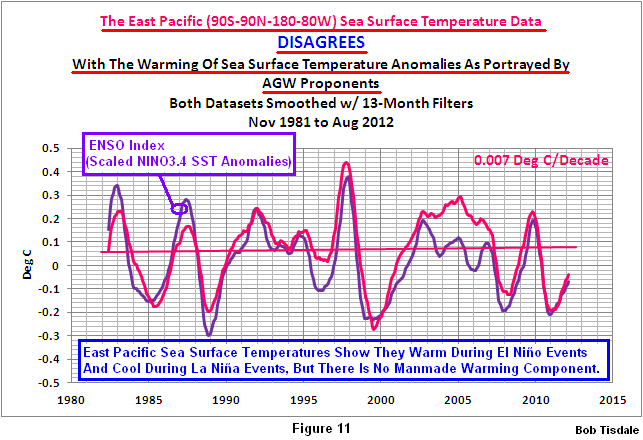
The South Atlantic-Indian-West Pacific dataset covers the ocean basins not represented by the East Pacific and North Atlantic. The sea surface temperature anomalies of the South Atlantic-Indian-West Pacific only warm during and in response to the strong El Niño events of 1986/87/88 and 1997/98. See Figure 9. There may also have been an upward shift in response to the 2009/10 El Niño but it’s a little early to tell. As you’ll note, the South Atlantic-Indian-West Pacific data cools between the major El Niño events. The trends are negative.

Figure 9
Why are there upward shifts in response to those major El Niño events? Because the South Atlantic-Indian-West Pacific sea surface temperature anomalies do not cool proportionally during the La Niña events that followed them. We can show this by detrending the South Atlantic-Indian-West Pacific data and comparing them to NINO3.4 sea surface temperature anomalies, which are a commonly used index that represents the frequency, strength and duration of ENSO events. Figure 10 is from the blog post here. If the South Atlantic-Indian-West Pacific data cooled proportionally during those La Niña events, its curve would be similar to the East Pacific data, which shows no warming in 30 years.

Figure 10
So far, we have found no evidence of an “influence of greenhouse gas-induced global warming” in the ocean basins that are outside of the North Atlantic. Would the “influence of greenhouse gas-induced global warming” exist only in the North Atlantic? That’s extremely unlikely. Therefore, we can dismiss the consensus opinion that the global oceans are warmed by anthropogenic greenhouse gases.
Let’s take a look at the North Atlantic data. As expected, it shows warming trends between the major El Niño events, Figure 11. But notice how the trend line for the latter period is located above the trend line for the earlier period. That means there was an upward shift in response to the 1997/98 El Niño event.

Figure 11
We can also detrend the North Atlantic sea surface temperature anomalies and compare them to scaled NINO3.4 data to illustrate the cause. The North Atlantic sea surface temperature anomalies also do not cool proportionally in response to the La Niña events that follow the major El Niño events. So the non-linear response of the North Atlantic (and the AMO) to ENSO is a significant portion of the additional warming of the North Atlantic and the subsequent natural sea ice loss in the Arctic.

Figure 12
SHAMELESS PLUG
I’ve referenced my recently published e-book (pdf) a number of times in this post. The book is about the phenomena called El Niño and La Niña and its long-term effects. It’s titled Who Turned on the Heat? with the subtitle The Unsuspected Global Warming Culprit, El Niño Southern Oscillation. I do not specifically discuss the loss of Arctic sea ice in the book, but as discussed in this post, those losses are primarily a response to the natural warming of the global oceans.
The book is intended for persons (with or without technical backgrounds) interested in learning about El Niño and La Niña events and in understanding the natural causes of the warming of our global oceans for the past 30 years. Because land surface air temperatures simply exaggerate the natural warming of the global oceans over annual and multidecadal time periods, the vast majority of the warming taking place on land is natural as well. The book is the product of years of research of the satellite-era sea surface temperature data that’s available to the public via the internet. It presents how the data accounts for its warming—and there are no indications the warming was caused by manmade greenhouse gases. None at all.
Who Turned on the Heat? was introduced in the blog post Everything You Every Wanted to Know about El Niño and La Niña… …Well Just about Everything. The Updated Free Preview includes the Table of Contents; the Introduction; the beginning of Section 1, with the cartoon-like illustrations; the discussion About the Cover; and the Closing.
Please buy a copy. (Paypal or Credit/Debit Card). It’s only US$8.00.
SUMMARY
Since there is no evidence of a manmade component in the warming of the global oceans over the past 30 years, the natural additional warming of the sea surface temperature anomalies of the North Atlantic—above the natural warming of the sea surface temperatures for the rest of the global oceans—has been a major contributor to the natural loss of Arctic sea ice over the satellite era. Add to that the weather events that happen every couple of years and we can pretty much dismiss the hubbub over this year’s record low sea ice in the Arctic basin. Personally, I’d find it comical—if the desperation on the parts of AGW proponents wasn’t so evident. That makes it sad.
SOURCES
With the exception of the ESRL Atlantic Multidecadal Oscillation Index, the data presented in this post is available through the KNMI Climate Explorer.
Discover more from Watts Up With That?
Subscribe to get the latest posts sent to your email.
Could there be another factor warmng the ArcticOceans? Such as a change in the subduction of magma near Alaka’s “rim of fire” Kurile island chain? Would the possible rise of magma closer to the undersea side of the seabed, like a tiny fire on the underside of a tea kettle, possibly cause a slow rise in the surface temperatures?
See http://en.wikipedia.org/wiki/Submarine_volcano
OOPs!!! I meant to say “Alaska’s Aleutian Islands”
… although Japan’s Kurile Islands may also qualify for the effect.
P. Solar says: “That is a significant temperature gradient, you cannot just arbitrarily remove it just because Excel has a ‘detrend’ button.”
I did not arbitrarily remove it. I detrended the data to show why a portion of the trend exists. If the North Atlantic responded linearly to ENSO, the offset between the trend lines in Figure 11 would not exist.
For the South Atlantic-Indian-West Pacific data, the only reason there is any trend at all is because that dataset fails to cool proportionally during the La Nina events. Without those offsets, the South Atlantic-Indian-West Pacific data actually cools.
sunshinehours1 says: “Under Figure 2 I think you misspelled HHHHHHHHHHHHHHHHHHHHHH.”
The repeated H’s are provided as a separator. They should have been centered.
MarkW says: “How can this possibly be real science. Bob Tisdale is not an officially accredited climate scientist.”
Ah, but my posts pass most of the requirements for the “new” peer review being promoted by Richard Muller: “In science, peer review means you give talks to the public. You send your papers to colleagues around the world. That’s what I did. Before I wrote my op-ed, we put all of our papers available on the Web.”
My blog posts are read by colleagues around the world. I make my papers available on the web. Yup. That’s what I do. I just haven’t given talks to the public. Maybe I should. I could charge the venues $100k per presentation just like Al.
Don V: In looking at Willis’s post here…
http://wattsupwiththat.com/2010/12/29/prediction-is-hard-especially-of-the-future/
…he was not stating that volcanic eruptions did not impact surface temperatures; he was noting how the models overestimated the response. The two graphs with detrended sea surface temperatures and scaled NINO3.4 data above are simply another way to show the actual changes caused by the volcanoes.
Dr. Tisdale
I will try one last time. I have a hard time reading any volume off computer screens. Therefore I want to buy a hard copy of your book if available. Can you please tell me if one is or will be available.
Thank you
Should be a good chance of pumping “record increase of Arctic sea ice extent” 6-7 months from now presented as “proof of global cooling”.
Guaranteed to cause some heads to explode.
RobW – It would be possible to buy Bob’s pdf and get it printed professionally, though understandably it adds quite a bit to the price. (If Bob were to get a batch done, it would work out slightly cheaper per book, but then you’d have to add postage, of course.) For example, InkyLittleFingers in the UK can do 50 (A5) pages in B/W for a shade under 20 UKP, delivered to the UK. Or, teach yourself basic bookbinding and make one at home – I’ve seen some quite nice examples.
I agree re screens, btw, they’re ok to ‘scan’ but wearing for a good read. One of the ‘electronic books’ might also be a practical solution, if you can find one that suits you. A friend of mine has a Kindle, which looks okay to my aging eyes – certainly better than a screen (LCD or CRT).
Bob, thanks for your cordial response. Forgive me for being unclear in my comment. I wasn’t doubting your attribution of the divergences to major volcanic activity. Your hypothesis seems plausible, so I agree with you. Instead I was questioning whether you or anyone else can (or has) provided any other evidence to support this hypothesis with data (ie. increase in SO2, increase in particulate, decrease/increase in storm activity etc.). And has anyone used that data then, to successfully and accurately “predict” a near future climate trend such as is suggested by the “divergences” you note? For expample, did the volcanic activity recently from Iceland produce sufficient particulate to affect a long term climate trend? Did anyone measure and determine what the “threshold” level of particulate needs to be to have a predictive value? Also, what would you consider to be evidence to disprove this hypothesis?
More importantly, where you have provided an alternative hypothesis as to the reason for the “divergence” as being non-cooling of the Southern Oceans during a La Nina period, I was wondering whether tropical storm activity, specifically the tracking of whether large tropical storm make landfall or stay over the ocean, might give insight into where the energy harvested from the ocean was transported and where it ended up. Since the evidence to support the hypothesis that water, (liquid, air born aerosol, gas, and in the case of the poles, as a solid) is by far the largest transporter (and source/sink) of heat throughout the livable spaces on our planet, I was also just wondering whether anyone had ever attempted to “track” the major movements of heat energy as it has moved with the water around the planet (large oceanic storms, warm and cold ocean currents, El Nino events etc.)
For instance, has anyone ever attempted to measure and quantitate the increase in radiative energy transfer into space that surely must occur at the tops of thunderstorms as phase change occurs and gas turns to vapor turns to liquid, (and even ice!)
LazyTeenager said: (September 25, 2012 at 4:14 am)
“…Cobblers! It’s not about logical proof. It’s about a scientific theory, a prediction that arises from that theory, the observation that is consistent with the prediction and the conclusion that this represents evidence to support the theory…”
Theory: That CO2 causes GLOBAL warming.
The prediction: Here is what the IPCC AR4 SPM says, page 15: “…Sea ice is projected to shrink in BOTH the Arctic and Antarctic under all SRES scenarios…”
Observation: The Antarctic sea ice has seen it’s highest three values in the past 5 years – 2007, 2012, 2010 (since satellite observation started), and the Antarctic sea ice anomaly has been ABOVE zero since 1992 – about 20 years.
That kinda shoots out your last part: “…the conclusion that this represents evidence to support the theory…”
So let’s move on to your next diatribe:
LazyTeenager said (September 25, 2012 at 4:29 am)
“…Does this mean that Bob believes the oceans are warmed by natural green house gases and are not warmed by green house gases produced by man?…”
Please, tell us exactly how much of the current 392.41 parts per MILLION of global CO2, as measured at Mauna Loa (http://co2now.org) is determined to have been made by man?
Common measurements use the C12/C13 ratio, and even there, you wouldn’t be able to tell the difference between coal used for heating, and natural coal seam fires (some of which have burned for decades). From Wiki: “…Across the world, thousands of underground coal fires are burning at any given moment. The problem is most acute in industrializing, coal-rich nations such as China. Global coal fire emission are estimated to include 40 tons of mercury going into the atmosphere annually, and three percent of the world’s annual CO2 emissions…”
So, to paraphrase your question, then: Does this mean that you believe the oceans are warmed by emissions from coal fired power plants and are not warmed by green house gases from global coal fire emissions?
Your turn.
GeoLurking says:
September 24, 2012 at 9:38 pm
I have been meaning to ask a question. This is about as good a time as any.
With the really shallow angle of the Sun at high latitudes, radiant warming of the region is pretty low compare to the tropics. When sea-ice is lost, and the water is open to the sky, how fast is energy radiated to space as compared to when there is an insulating cover of ice? Does that have an impact on the overall energy budget? My gut feeling says it does, but that’s outside my field of knowledge.
Your observation is correct, most strikingly for the period of the time at minimum sea ice extent in mid-September for the Arctic. In today’s Arctic, minimum sea ice extent is approximately 4 million km^2, which corresponds to a “cap” over the pole extending from 90 north (the pole) to 80 north latitude. Minimum sea ice extent occurs n mid-September, very, very close to the equinox when the sun is over the horizon only 12 hours per day.
A typical value used by Curry and others for heat loss due to evaporation is 105 to 117 watts/meter square.
At the MAXIMUM solar angle of 10 degrees at noon at the equinox at the southernmost boundary of the average sea ice extents, approximately 23 percent of the solar radiation is reflected, and 75% absorbed. Sounds like a lot, except, at 10 degrees solar incidence, the air mass that solar ray must transmit is 6-11 times what it is at the equator (depending on turbity, etc.) A time-weighted “average” solar angle is between 2-3 degrees (6:00 AM to 8:00 AM, 4:00 PM to 6:00 PM) with some 85% reflected, and 8:00 AM to 10:00 AM (2:00 PM to 4:00 PM) of 3-6 degrees when some 65% of the incident solar energy is reflected from rough waters, etc. Under cloudy conditions, approximately 65% of available solar energy is reflected from the high altitude and mid-altitude accompanying clouds typical of stormy conditions and higher wind conditions.
Therefore, at the region where minimum Arctic sea ice extents occur, at the time of minimum sea ice extent, you are correct: When additional sea ice is melted in today’s Arctic Ocean, significantly more energy is lost from the newly exposed ocean surface by evaporation than is absorbed from the newly exposed ocean from the sun.
Thus, you will typically find that maximum Arctic sea ice extents are higher in the winters immediately AFTER a low summer minimum, and a lower sea ice maximum occurs in those winters after a high sea ice minimum. Polar amplification (a positive feedback from higher ocean temperatures in the Arctic causing more sea ice melting from season-to-following-season, does not occur.
Bob,
wonderful post, thank you for the information!
I know that you disclaim paleo knowledge, but I would like to ask you again or someone else, to consider researching a paper/blog on what the Atlantic ocean temperature response would have been to the closing of the Isthmus of Panama about 2.5 million years ago that stopped direct communication between the Pacific and the Atlantic and initiated the current ice age. The premise seems to be that if the Pacific El Ninio had continued to have direct communication with the Atlantic at the point of Panama, that the Atlantic would have had a different response to temperature influences than today.
Now we have a long standing Ice Age and periodic glaciations (100,000 yrs) and Interglacial periods (20,000 yrs) that is said in other papers to last as long as there is a continent on either pole. Sorry for the lack of links, but this information comes from my earliest forays into the AGU Paleo Oceanagraphic papers and Paleo Climate papers of approximately 6 – 10 years ago and I didn’t collect links, for most papers I was reading hard copy that I didn’t keep.
Bob, are you or anyone else up to this puzzle? I think it would be quite enlightening.
Thanks again.
Bob says: “I did not arbitrarily remove it. I detrended the data to show why a portion of the trend exists.”
That’s just saying it’s not arbitrary because it fits your argument. I detrend it because I like the result.
You are not answering my question. What was the magnitude of the trend you removed (you do not even seem to know), and what does it represent physically. If you cannot attibute physical meaning to the trend you are removing, you can not attibute physical meaning the what remains.
You are suggesting ENSO produces step changes (which I’m inclined to give some credance to ) so why are you removing a linear trend?
“…he [Willis] was not stating that volcanic eruptions did not impact surface temperatures; he was noting how the models overestimated the response. The two graphs with detrended sea surface temperatures and scaled NINO3.4 data above are simply another way to show the actual changes caused by the volcanoes.
”
No, he was very much stating that the impact of volcanoes could not be seen if you did not where it was to start with. ie there is no visible effect on climate. Your very confident claims that these discrepancies can be attributed to volcanoes is without foundation. You are just assuming that is the case not proving it.
As I pointed out last time you posted all this , the huge deviation you are attributing to Mt Pinatubo is to a large extent due to the fact that YOU have cooled the planet by removing the trend.
I think you have demonstrated an important point of how ENSO can , by cooling the oceans, warm surface temperatures. This can be argued without detrending.
I ask again, how big is this trend and what do you attribute it to physically?
RobW, thanks for the title, there’s no Dr. in front of my last name. Only my first name Bob.
My apologies, but due to the costs, I have no plans to produce hardcopy versions of my book. That does not keep you from buying a copy in pdf form and having one printed. However, please look into the costs of printing a 550+page color document. They are extremely high
Don V says: “Instead I was questioning whether you or anyone else can (or has) provided any other evidence to support this hypothesis with data (ie. increase in SO2, increase in particulate, decrease/increase in storm activity etc.).”
There are satellite-based aerosol optical thickness datasets. There’s the TOMS project dataset:
http://toms.gsfc.nasa.gov/aerosols/aot.html
And there’s the GISS GACP dataset:
http://gacp.giss.nasa.gov/data_sets/
Both are available through the KNMI Climate Explorer on a gridded basis.
http://climexp.knmi.nl/selectfield_obs.cgi?someone@somewhere
Somewhere along the line I animated maps of the GACP data, using 12-month averages to accompany temperature maps, but posted them. Here’s one for the Mount Pinatubo eruption:
http://bobtisdale.files.wordpress.com/2012/09/gacp-aerosol-optical-depth-12-month-smooth.gif
Prior to the satellite era, they rely on proxies. And as you’ll note, I only occasionally look at data before the satellite era.
Alan Robock has written numerous papers on the impacts of volcanic eruptions and on proxy datasets.
Policy Guy: I hope someone else on this thread can respond to your paleo questions. It’s likely the wrong thread to find someone, though. Hopefully, there will be a post on the subject soon where you can find someone who may have investigated it.
Regards
regarding RACookPE1978 says:
September 25, 2012 at 8:13 pm
===================================
Thank you for the post. Some more thoughts to consider. Antarctica sea ice is at lower latitudes then artic sea ice. As such it is reflecting more insolation. Additionally from Sept on, as we enter the SH spring and summer, the earth moves ever closer to the sun, until at max the earth is recieving seven percent more insolation then during the NH summer max. So SH sea ice recieves both more direct and more intense solar energy.
However, I have not seen this quantified.
P. Solar, you must’ve got up on the wrong side of the bed because it appears you’re simply arguing for argument’s sake. I was in a good mood this morning. Past tense.
I have explained the processes that cause the trend in numerous posts. You’ve read those posts and commented on the threads. You state now that you give credence to ENSO causing the step changes, which means you have read the earlier posts and understood them. With that in mind, I do not understand your need to belabor this. If you want detailed explanations of the processes that cause the shifts and hence the long-term trend included in every post I write about the subject along with every graph that details every possible question you might have, it’s not going to happen. My book includes more than 380 illustrations. Which ones should I chose in anticipation of your question de jour, P. Solar?
Of course I know what the trends are for the datasets that I’ve presented detrended in this post. You very well understand that I had to determine the trends in order to detrend the data. I’ve presented graphs of the data with trend lines in past posts. You’ve read those posts. I can’t include every graph in every post simply because you might think I need to provide more detail in every post. If you insist on knowing the trend for the South Atlantic-Indian-West Pacific data, it’s about 0.093 deg C/decade:
http://i49.tinypic.com/301d6c5.jpg
We appear to have a difference of opinion on Willis’s post. Nothing new there. If you now want me to perform regression analysis with an ENSO index and aerosol optical thickness data to explain the dips and rebounds in the sea surface temperature data in the early 80s and 90s with every post I create, it’s not going to happen. But if you like, feel free to do it on your own. There are a couple of gridded AOD datasets available on the KNMI Climate Explorer if you really need to investigate the relationships for the individual ocean basins. Good luck.
Why do I include the detrended graphs in the post, P. Solar? It’s not just to cause you distress. I can see quite clearly that the South Atlantic-Indian-West Pacific dataset linked above does not respond proportionally to El Nino and La Nina events. Maybe you can see what’s obvious too, but there are others who have in the past stated that the graph simply shows a long-term warming trend with a volcanic aerosol component and an ENSO signal that’s responding linearly to El Nino and La Nina events. The detrended graph counters that argument because it shows without a doubt that the data does not respond to El Nino and La Nina events proportionally.
I certainly hope you’re done on this thread, P. Solar.
Great thread, anyway, Bob. Thanks for your post.
Not just more mass, but a far higher specific heat (keeping mass constant for comparison), so the impact is multiplied.
@Policy Guy (September 25, 2012 at 8:43 pm)
The WUWT commenter you should ask if you get a chance is Bill Illis.
—
Bob, thanks for giving us something to think about. You’ve given some valuable leads here.
Hi Bob
You are expert on the ocean currents.
Is it possible that surface currents from the south of England reach Australia in 5 months?
This was an item on the British tv, see also the link
http://www.thisistamworth.co.uk/Tamworth-girl-s-message-bottle-reaches-Australia/story-16998934-detail/story.html
Shortest sea route would imply average speed of about 1.5m/sec.
Bob. If I upset you by my phrasing of questions about El Nino etc on a blog last week, it was not my intent to do so. There were 2 main points. With each event (which I will not name a cycle) the global SST seems to increase. Like several people, I asked why it does not seem to decrease. From whece the added energy? Perhaps the sampling period is too short to get a proper pattern yet. I also mentioned Australia’s BOM doing work from islands to the north of Australia, some of which are in water too shallow for Argo floats. I refer you to a map which might have sites in deep enough water, but might not for some. The region appears a popular place to start the description of an El Nino event. From memory, there is another current network to the west of this, but don’t rely on that. See http://www.bom.gov.au/oceanography/tides/MAPS/pac.shtml