Readers may recall my reports on the CME’s from massive sunspot group 1429, seen below.

It seems the sunspot group continues to live, and has unleashed another massive Coronal Mass Ejection. It will rotate into Earth view again soon.
NASA’s Spaceweather writes:
ANOTHER CME FROM SUNSPOT AR1429: Transiting the farside of the sun, never-say-die sunspot AR1429 erupted during the late hours of March 26th, producing its 11th major CME. The Solar and Heliospheric Observatory (SOHO) photographed the cloud flying over the sun’s eastern limb:

According to a forecast track prepared by analysts at the Goddard Space Weather Lab, the CME will hit two spacecraft, STEREO-B and Spitzer, on March 28th. Earth is not in the line of fire.
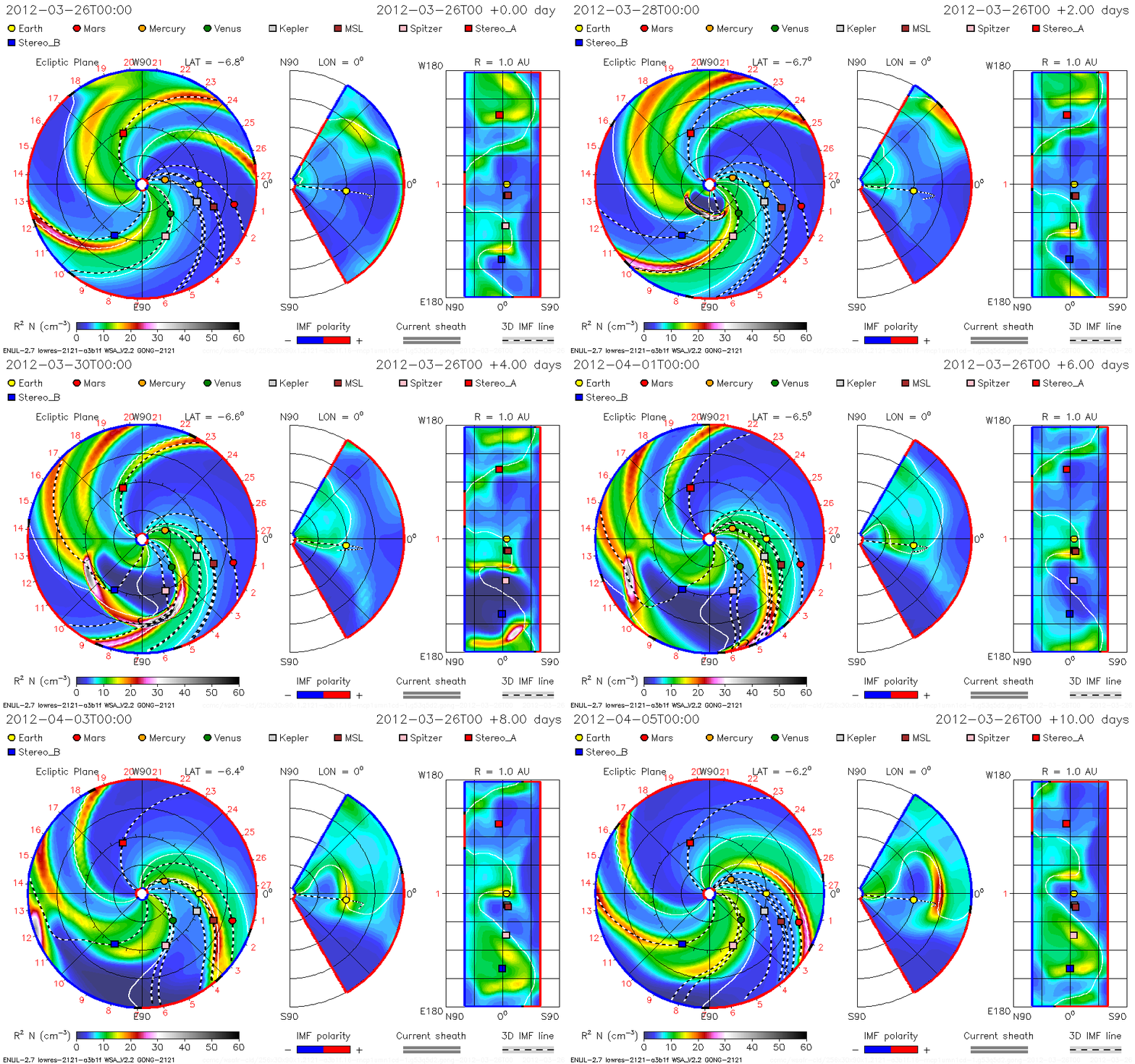
This event shows that AR1429, the source of several strong geomagnetic storms in early March, is still active. It will begin turning back toward our planet about a week from now. Stay tuned.
==============================================================
RETURN OF THE SUNSPOT: Sunspot AR1429, the source of many strong flares and geomagnetic storms earlier this month, is about to re-appear following a two-week trip around the backside of the sun. Magnetic loops towering over the sun’s NE limb herald the sunspot’s approach:

Earlier today, NASA’s Solar Dynamics Observatory photographed plumes of plasma rising and falling over the limb: movie. Moreover, a pair of solar flares (C5– and C7-class) in the sunspot’s towering magnetic canopy caused waves of ionization to ripple through the high atmosphere over Europe. These events suggest the region is still active.

Why is that limb of the Sun called the North East limb, it looks like the North West limb to me Are Seattle and California now to be found on the East of the USA ?
Or is there some explanation for this apparent confusion ?
No. It conforms with projection methods for the sun-spot count.
http://www.petermeadows.com/stonyhurst/blank100mm.pdf
More details
here
We’re talking about the 3rd picture down, the dark yellow picture. That’s the top left which is shown and therefore the North West limb, surely.
Either that or North West South East are determined from the side of the sun opposite to planet Earth.
Or the guy at NASA who labelled it the North East limb has an Australian’s view of geography.
@vuk
OK. Thank you for that explanation. I suppose it is reasonable that NASA might be able to tell left from right and East from West, even if they do struggle somewhat with predictions. eg. sunspot numbers.
SPACE WEATHER: THE INTERNATIONAL JOURNAL OF RESEARCH AND APPLICATIONS, VOL. 10, S02012, 12 PP., 2012
doi:10.1029/2011SW000734
On the probability of occurrence of extreme space weather events
Key Points
Probability of a Carrington event occurring over next decade is ~12%
Leif Svalgaard says:
March 31, 2012 at 3:50 pm
SPACE WEATHER: THE INTERNATIONAL JOURNAL OF RESEARCH AND APPLICATIONS, VOL. 10, S02012, 12 PP., 2012
doi:10.1029/2011SW000734
On the probability of occurrence of extreme space weather events
Key Points
Probability of a Carrington event occurring over next decade is ~12%
========================
How many “Carrington events”, have been identified lately.
Probability just lost me the mega-millions jackpot, now percentages matter again ?
u.k.(us) says:
March 31, 2012 at 4:24 pm
“Probability of a Carrington event occurring over next decade is ~12%”
How many “Carrington events”, have been identified lately.
The abstract:
By virtue of their rarity, extreme space weather events, such as the Carrington event of 1859, are difficult to study, their rates of occurrence are difficult to estimate, and prediction of a specific future event is virtually impossible. Additionally, events may be extreme relative to one parameter but normal relative to others. In this study, we analyze several measures of the severity of space weather events (flare intensity, coronal mass ejection speeds, Dst, and >30 MeV proton fluences as inferred from nitrate records) to estimate the probability of occurrence of extreme events. By showing that the frequency of occurrence scales as an inverse power of the severity of the event, and assuming that this relationship holds at higher magnitudes, we are able to estimate the probability that an event larger than some criteria will occur within a certain interval of time in the future. For example, the probability of another Carrington event (based on Dst < −850 nT) occurring within the next decade is ∼12%. We also identify and address several limitations with this approach. In particular, we assume time stationarity, and thus, the effects of long-term space climate change are not considered. While this technique cannot be used to predict specific events, it may ultimately be useful for probabilistic forecasting.
It seemed pretty obvious to me from the heliocentric configurations in early March 2012 that there would be a peak in flare activities around the 5-7th March.
This is pretty interesting, do you think these solar flares affected weather patterns? Where I am from (Southern Alberta, Canada) it went from -8C to over 18C in a span of a few days when these solar flares hit.