An X-5 class solar flare just occurred from region 1429, the large active sunspot group seen below.

NOAA Bulletin from the Space Weather Prediction Center:
2012-03-07 01:03 Strong Solar Eruption; Earth-Directed CME Likely
An R3 (Strong) Radio Blackout is now in progress, beginning about 7:00 p.m. EST today. The site of the eruption, previously active Region 1429, is now near center disk, so there’s high-potential of an earth-directed CME (coronal mass ejection). In addition, expect the imminent beginning of a Solar Radiation Storm. Analysis now occurring on both fronts, watch here for updates.
2012-03-07 04:24 CMEs: One Arrives, Another Likely Tomorrow
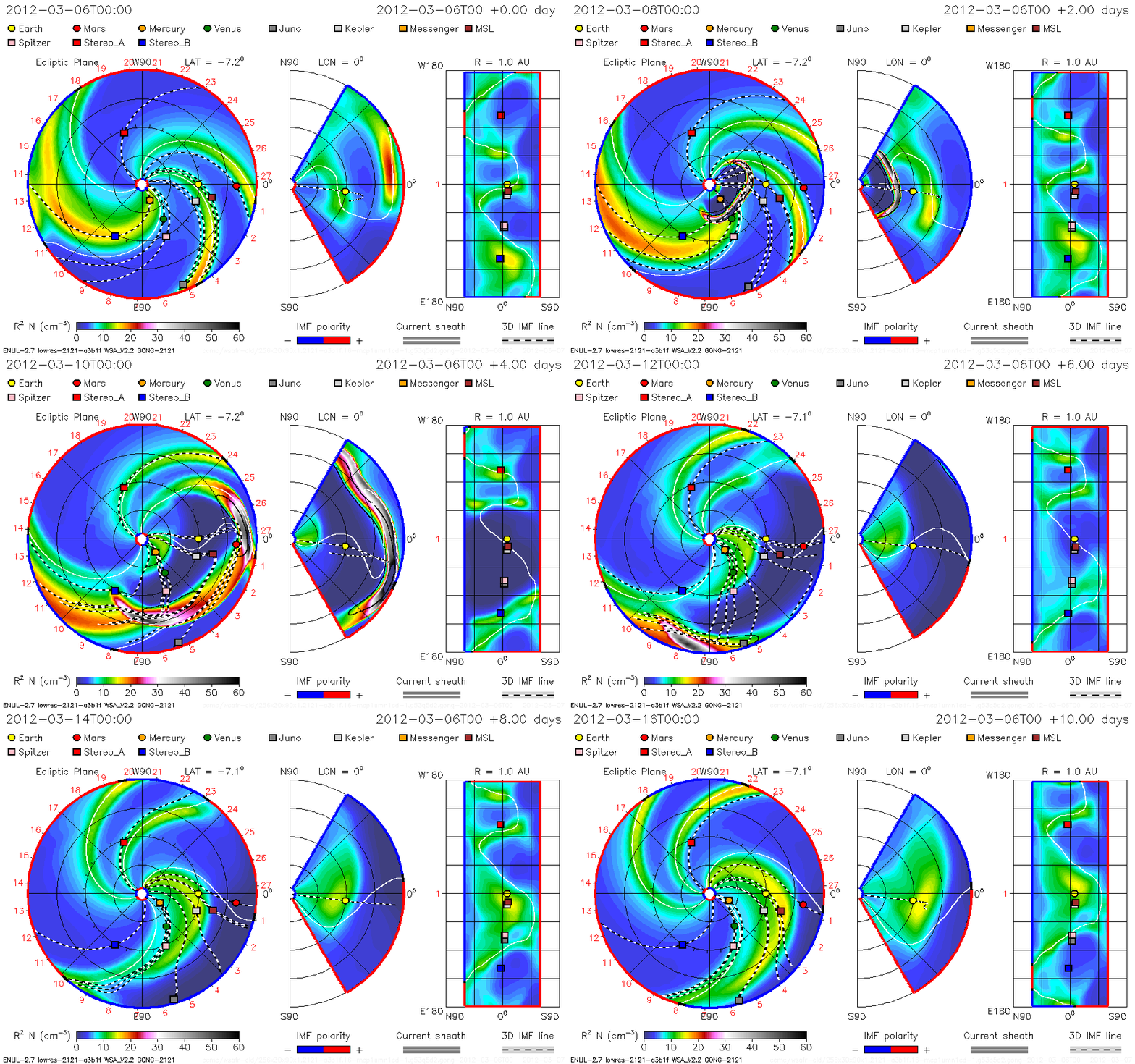
The CME that erupted late on March 4 passed ACE around 0400 UTC March 7 (11:00 p.m. EST March 6). Look for G1 (minor) Geomagnetic Storm activity in the next few hours. Another CME, part of the recent R3 (strong) Radio Blackout event at 0024 UTC March 7 (7:24 p.m. EST March 6) is forecast to pass ACE about one day hence. Predictions are still being refined on this one. Finally a Solar Radiation Storm is now building as the higher energies are showing a response to the recent eruption. The S1 (minor) threshold should be surpassed in the next few hours. Updates here as conditions warrant.
Here’s the GOES x-ray flux plot capturing the event:

Here’s the event captured on SAM

Here’s the group 1429 close up from SDO HMI:

NASA’s Spaceweather.com reports that:
MAJOR SOLAR FLARE: Earth-orbiting satellites have just detected an X5-class solar flare from big sunspot AR1429. The blast peaked on March 7th at 00:28 UT. Radiation storms and radio blackouts are possible
High-latitude sky watchers should be alert for auroras on March 6th and 7th. Sunspot AR1429 has hurled two CMEs into space since it emerged over the weekend. Neither cloud is heading directly toward Earth, but both could deliver glancing blows to our planet’s magnetic field. NOAA forecasters say there is a 30% to 40% chance of polar geomagnetic storms during the next 24-48 hours.
NASA’s Solar Dynamics Observatory recorded the extreme UV flash:
This eruption hurled a bright CME into space. First-look data from STEREO-B are not sufficient to determine if the cloud is heading for Earth. Our best guess is “probably, yes, but not directly toward Earth.” A glancing blow to our planet’s magnetosphere is possible on March 8th or 9th.

Looks like we dodged the bullet for the major bullseye from those, but some disruption is likely from this last X-5 event. We’ll monitor and report as needed.
WUWT’s Solar reference page has all the latest images and data here
h/t to Roger Sowell
UPDATE from spaceweather.com:
GEOMAGNETIC STORM UPDATE: A CME propelled toward Earth by this morning’s X5-class solar flare is expected to reach our planet on March 8th at 0625 UT/725EST/1025PST (+/- 7 hr). Analysts at the Goddard Space Weather Lab, who prepared the CME’s forecast track, say the impact could spark a strong-to-severe geomagnetic storm. Sky watchers at all latitudes should be alert for auroras.
MAVukcevic says:
March 7, 2012 at 9:45 am
http://www.n3kl.org/sun/images/noaa_kp_3d.gif
It is an unusual and rare event.
No, Kp = 6 or more occurs on 600 times [on 360 days] during a solar cycle: http://www.swpc.noaa.gov/NOAAscales/
Leif Svalgaard says:
March 7, 2012 at 10:01 am
No, Kp = 6 or more occurs on 600 days during a solar cycle
I don’t know how this one [which I submitted first] has a later time stamp, but never mind, the correct statement is “No, Kp = 6 or more occurs 600 times [on 360 days] during a solar cycle”.
Kevin says:
March 6, 2012 at 7:49 pm
Also, things suddenly seem pretty blurry. Is that happening with everyone, or just me?
—————————————————————————
Yep, just you. Course, I blame you for everything. Might as well jump on the bandwagon. 🙂
Leif Svalgaard says:
…………..
Comparing two eruptions
http://www.swpc.noaa.gov/rt_plots/Xray.gif
the second and stronger storm expected on Friday morning (UTC), appears it may hit head on. Any idea of its polarity, it would make lot of difference.
MAVukcevic says:
March 7, 2012 at 10:49 am
the second and stronger storm expected on Friday morning (UTC), appears it may hit head on. Any idea of its polarity, it would make lot of difference.
The neutral line in the middle of the region is East-West, so the field should be North[white]-South[black], so the leading edge of the CME should have southward HMF, so large effect is expected. Whether the storm continues large depends on how the trailing edge [of northwards polarity] behaves. A strong North field there will squash the storm:
http://sdowww.lmsal.com/sdomedia/SunInTime/2012/03/07/l_HMImag.jpg
” Solar Storms – The Threat to Planet Earth”
http://www.bbc.co.uk/iplayer/episode/b01d99vb/Horizon_20112012_Solar_Storms_The_Threat_to_Planet_Earth/
was on last night.
MAJOR SOLAR FLARE: Earth-orbiting satellites have just detected an X5-class solar flare from big sunspot AR1429. The blast peaked on March 7th at 00:28 UT. Radiation storms and radio blackouts are possible
There is a memorandum from C.C Hung:
“Apparent Relations Between Solar Activity and Solar Tides Caused by the Planets
Abstract: A solar storm is a storm of ions and electrons from the Sun. Large solar storms are usually preceded by solar flares, phenomena that can be characterized quantitatively from Earth. Twenty-five of the thirtyeight largest known solar flares were observed to start when one or more tide-producing planets (Mercury, Venus, Earth, and Jupiter) were either nearly above the event positions (<10° longitude) or at the opposing side of the Sun. The probability for this to happen at random is 0.039 percent. This supports the hypothesis that the force or momentum balance (between the solar atmospheric pressure, the gravity field, and magnetic field) on plasma in the looping magnetic field lines in solar corona could be disturbed by tides, resulting in magnetic field reconnection, solar flares, and solar storms. Separately, from the daily position data of Venus, Earth, and Jupiter, an 11-year planet alignment cycle is observed to approximately match the sunspot cycle. This observation supports the hypothesis that the resonance and beat between the solar tide cycle and nontidal solar activity cycle influences the sunspot cycle and its varying magnitudes. The above relations between the unpredictable solar flares and the predictable solar tidal effects could be used and further developed to forecast the dangerous space weather and therefore reduce its destructive power against the humans in space and satellites controlling mobile phones and global positioning satellite (GPS) systems.”
(Hung, Ching-Cheh, NASA/TM—2007-214817)
There is a solar tide configuration from Mercury and Venus of <1.6° while solar flare.
http://www.volker-doormann.org/images/2012_03_07_cc_hung.gif
BTW. The solar tide dynamic of Mercury/Earth is phase locked to the sea level oscillations on Earth.
V.
Volker Doormann says:
March 7, 2012 at 11:46 am
There is a solar tide configuration from Mercury and Venus of <1.6° while solar flare. […]
BTW. The solar tide dynamic of Mercury/Earth is phase locked to the sea level oscillations on Earth.
sigh… and my car had a flat tire too.
Current geo-magnetic storm 600nT (and still rising) on each of the components is stronger than one on the eve of Japan’s quake:
http://flux.phys.uit.no/cgi-bin/plotgeodata.cgi?Last24&site=tro2a&
on 10th March 2011 (nearly a year ago).
NASA got only a single frame of this mornings X-class flare:
http://sohowww.nascom.nasa.gov//data/REPROCESSING/Completed/2012/c2/20120307/20120307_0036_c2_512.jpg
MAVukcevic says:
March 7, 2012 at 12:47 pm
Current geo-magnetic storm 600nT (and still rising) on each of the components is stronger than one on the eve of Japan’s quake
You should not [cannot in good conscience] use Tromsoe as a measure of a geomagnetic storm. Tromsoe measures mostly local currents in the ionosphere just above. Those can be thousands of nT even without a major storm going on. To track a storm use a mid- or low-latitude station, like Kakioka, Guam, Furstenfeldbruck, or Hermanus: http://kogma.nict.go.jp/cgi-bin/geomag-interface
As long as we’re doing a solar thread and Leif is kind enough to offer his knowledge here, I’m curious about hot flow anomalies.
Are the effects of HFA’s visible from Earth as exceptional strong aurorae? Were they recently discovered, or have they been known about for a long time? I wouldn’t expect that there’s any connection between HFA’s and Earth’s climate, but are there any regional weather effects, or do these events take place too far outside the atmosphere?
Auroras in Norway:
http://www.vg.no/bildespesial/spesial.php?id=8645
JohnH says:
March 7, 2012 at 2:20 pm
Are the effects of HFA’s visible from Earth as exceptional strong aurorae?
What is an HFA?
Hot Flow Anomaly: http://www.nasa.gov/mission_pages/sunearth/news/venus-explosions.html
It seems that they are not rare phenomena, but there is precious little information online about their effects, if any, here on Earth.
JohnH says:
March 7, 2012 at 2:20 pm
I’m curious about hot flow anomalies
Ah, I see: HFA
A non-standard term, used to describe “disruptions of the solar wind flow, lasting a few minutes” [ http://www.leif.org/EOS/2008_grl_L17S03.pdf ]. As they only last a few minutes and are intermittent, then, although they do have a short-lived influence on the magnetopause, their effect is minor and won’t affect the climate.
JohnH says:
March 7, 2012 at 2:20 pm
Are the effects of HFA’s visible from Earth as exceptional strong aurorae? Were they recently discovered, or have they been known about for a long time?
I forget the rest of your questions. HFA’s are not visible as aurorae, but can be seen as small excursions on ground-based magnetograms. They occur up to a handful of times per month when solar wind speed is very high [above 600 km/sec] and are sudden changes of the direction of the magnetic field in the solar wind, but are otherwise not dependent on solar activity [e.g. the sunspot cycle]. HFAs have been known for more than 20 years, but it is only in the last few years that we have a good explanation for them.
Leif Svalgaard says:
March 7, 2012 at 11:52 am
Volker Doormann says:
March 7, 2012 at 11:46 am
“The solar tide dynamic of Mercury/Earth is phase locked to the sea level oscillations on Earth.”
sigh… and my car had a flat tire too.
Irrelevant and OT.
There was a sea level high peak on September ~28th 2011 and an opposition of Mercury and Earth on the Sun.
There was a sea level high peak on December ~4th 2011 and a conjunction of Mercury and Earth on the Sun:
http://www.volker-doormann.org/images/sea_level_vs_solar_tide.gif
This proves nothing more than that a solar spring tide is in phase with global high sea level.
V.
Volker Doormann says:
March 7, 2012 at 3:45 pm
This proves nothing more than that a solar spring tide is in phase with global high sea level.
Mercury is as relevant as my flat tire.
Has no effect whatsoever.
Or, you could come to love weak signal modes like JT65, WSPR (Goog: WSPRnet) as used on HF …
(I could add a link or two, but, I don’t want to overload any servers given Anthony’s volume of readership)
.
Leif, Many thanks for letting them know, and for your numerous other trustworthy scientific contributions here. With regards, Larry Kirk.
I know the answer is likely the same, but just in case I want be a little more specific. Is the impact on earths magnetic field bigger (does polarity and location of impact matter), and does it change the visibility of aurora when the solar magnetic field is generally weak?
Leif Svalgaard says:
March 7, 2012 at 11:15 am
MAVukcevic says:
March 7, 2012 at 10:49 am
the second and stronger storm expected on Friday morning (UTC), appears it may hit head on. Any idea of its polarity, it would make lot of difference.
The neutral line in the middle of the region is East-West, so the field should be North[white]-South[black], so the leading edge of the CME should have southward HMF, so large effect is expected. Whether the storm continues large depends on how the trailing edge [of northwards polarity] behaves. A strong North field there will squash the storm:
http://sdowww.lmsal.com/sdomedia/SunInTime/2012/03/07/l_HMImag.jpg
=================
If Svalgaard and Vulcevic are going to discuss the topics in this thread, then I need to know more to follow the discussion. You got my attention.
Please describe the relevant facts that the N – S polarity of the CME has to do with regards to effect on the Earths magnetasphere.
Links to detailed explanation and theory would be greatly appreciated. Maybe a little coverage from ‘newbie’ to good understanding. Like I said, you got my attention.
Anthony, the “UV flash” picture shows up on the post at the Gleick tragedy thread together with this text:
“NASA’s Solar Dynamics Observatory recorded the extreme UV flash:”
Wordpress foul-up?
aaron says:
March 7, 2012 at 5:43 pm
I know the answer is likely the same, but just in case I want be a little more specific. Is the impact on earths magnetic field bigger (does polarity and location of impact matter), and does it change the visibility of aurora when the solar magnetic field is generally weak?
See below [partly]. Even if the sun’s magnetic field is weak you can have very bright aurorae, but perhaps not so many of them.
eyesonu says:
March 7, 2012 at 6:03 pm
Please describe the relevant facts that the N – S polarity of the CME has to do with regards to effect on the Earths magnetosphere…
Links to detailed explanation and theory would be greatly appreciated. Maybe a little coverage from ‘newbie’ to good understanding. Like I said, you got my attention.
almost 40 years old, but still valid: http://www.leif.org/research/Geomagnetic-Response-to-Solar-Wind.pdf
A bit more technical version is here: http://www.leif.org/research/suipr699.pdf
and some modern reflections: http://www.leif.org/research/IAGA2008LS-final.pdf
In a few words: the solar wind is magnetic; the magnetic field comes from the sun; if the field is pointed in the opposite direction of that of the Earth’s magnetic field where it impacts [on the sunward side] the two fields can connect and the solar wind drags the Earth’s field onto the nightside and into a long ‘tail’, thus storing energy in the tail. This configuration is unstable and when it ‘snaps’, particles are accelerated towards the Earth, where they create electric currents and aurorae. the effect of the currents can be felt on the ground. if the changes are fast enough, new currents are induced in power lines, pipelines, and other linear conductors, with all kinds of bad effects.