An X-5 class solar flare just occurred from region 1429, the large active sunspot group seen below.

NOAA Bulletin from the Space Weather Prediction Center:
2012-03-07 01:03 Strong Solar Eruption; Earth-Directed CME Likely
An R3 (Strong) Radio Blackout is now in progress, beginning about 7:00 p.m. EST today. The site of the eruption, previously active Region 1429, is now near center disk, so there’s high-potential of an earth-directed CME (coronal mass ejection). In addition, expect the imminent beginning of a Solar Radiation Storm. Analysis now occurring on both fronts, watch here for updates.
2012-03-07 04:24 CMEs: One Arrives, Another Likely Tomorrow
The CME that erupted late on March 4 passed ACE around 0400 UTC March 7 (11:00 p.m. EST March 6). Look for G1 (minor) Geomagnetic Storm activity in the next few hours. Another CME, part of the recent R3 (strong) Radio Blackout event at 0024 UTC March 7 (7:24 p.m. EST March 6) is forecast to pass ACE about one day hence. Predictions are still being refined on this one. Finally a Solar Radiation Storm is now building as the higher energies are showing a response to the recent eruption. The S1 (minor) threshold should be surpassed in the next few hours. Updates here as conditions warrant.
Here’s the GOES x-ray flux plot capturing the event:

Here’s the event captured on SAM

Here’s the group 1429 close up from SDO HMI:

NASA’s Spaceweather.com reports that:
MAJOR SOLAR FLARE: Earth-orbiting satellites have just detected an X5-class solar flare from big sunspot AR1429. The blast peaked on March 7th at 00:28 UT. Radiation storms and radio blackouts are possible
High-latitude sky watchers should be alert for auroras on March 6th and 7th. Sunspot AR1429 has hurled two CMEs into space since it emerged over the weekend. Neither cloud is heading directly toward Earth, but both could deliver glancing blows to our planet’s magnetic field. NOAA forecasters say there is a 30% to 40% chance of polar geomagnetic storms during the next 24-48 hours.
NASA’s Solar Dynamics Observatory recorded the extreme UV flash:
This eruption hurled a bright CME into space. First-look data from STEREO-B are not sufficient to determine if the cloud is heading for Earth. Our best guess is “probably, yes, but not directly toward Earth.” A glancing blow to our planet’s magnetosphere is possible on March 8th or 9th.

Looks like we dodged the bullet for the major bullseye from those, but some disruption is likely from this last X-5 event. We’ll monitor and report as needed.
WUWT’s Solar reference page has all the latest images and data here
h/t to Roger Sowell
UPDATE from spaceweather.com:
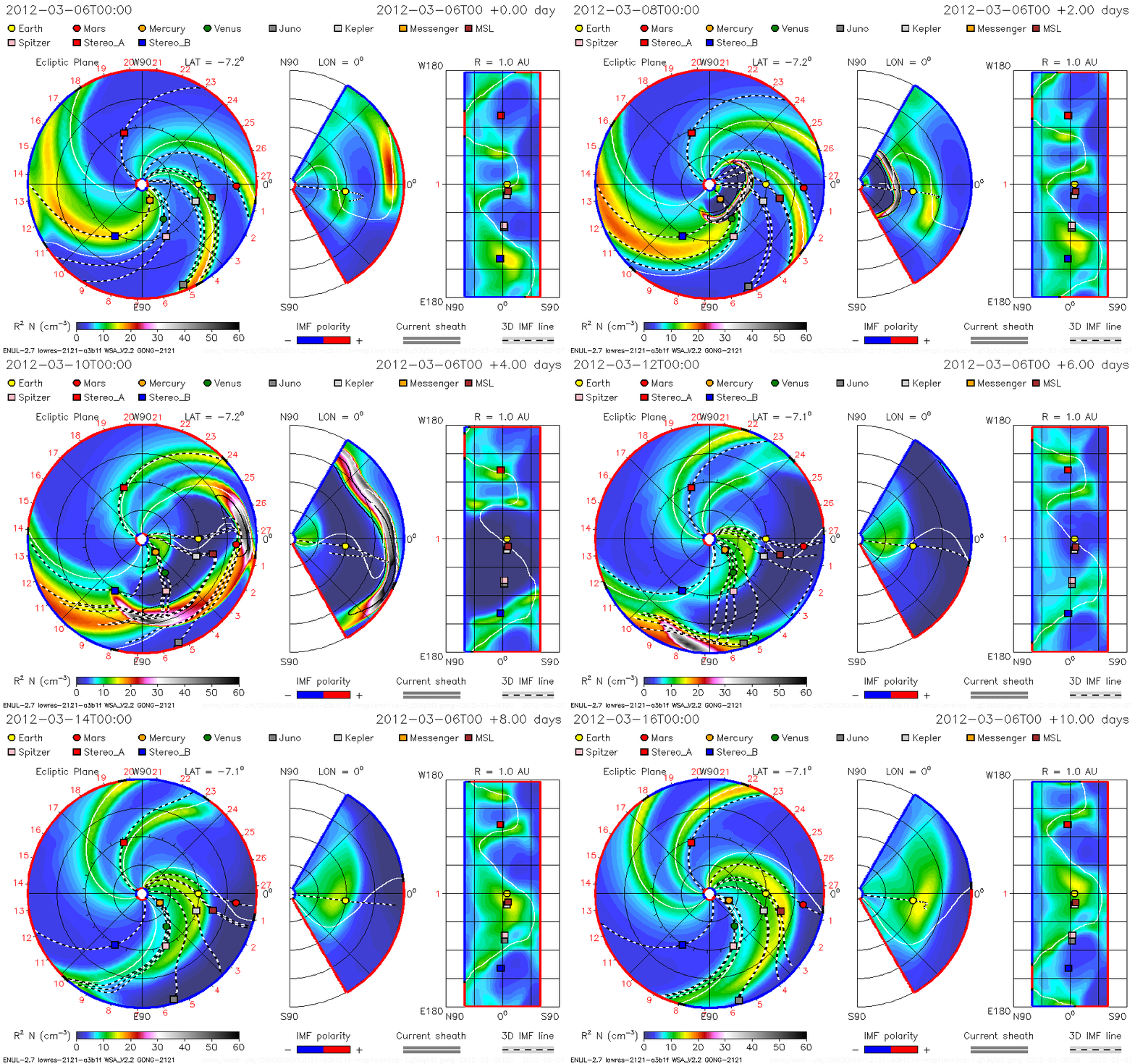
GEOMAGNETIC STORM UPDATE: A CME propelled toward Earth by this morning’s X5-class solar flare is expected to reach our planet on March 8th at 0625 UT/725EST/1025PST (+/- 7 hr). Analysts at the Goddard Space Weather Lab, who prepared the CME’s forecast track, say the impact could spark a strong-to-severe geomagnetic storm. Sky watchers at all latitudes should be alert for auroras.
Maybe it’s just coincidence, but earlier this evening I managed to catch sight of a brilliant green wisp of aurora that was clearly visible even above the street lights while I was driving. I pointed it out to my passenger and she was amazed. Unfortunately the clouds seem to have descended now.
Kevin says:
March 6, 2012 at 7:49 pm
My bad. This is totally my fault. My Mom always told me, “Don’t stare at the sun or bad things will happen.” Well today, I ignored her, and did. I’m pretty sure that’s why it’s sending us a solar flare.
Also, things suddenly seem pretty blurry. Is that happening with everyone, or just me?
Have you got spots before your eyes? Changing from yellow to green?
Can you still see the sun with your eyes shut?
Oh dear.
From the image on your side bar, it looks like it blew half the sun away. We’re doomed!
LC Kirk, Perth says:
March 6, 2012 at 8:54 pm
~~~~~~~~~~~~~~~~~~~~~~
Well spotted. It does look different.
Is the polarity of 1429 the opposite of sunspots in the NH in Cycle 24 (the magneto image shows t he ‘white’ area leading the black) or is that the result of some process between 1429 & 1430?
Last night’s BBC Horizon program about solar storms was definitely on the alarmist side – what a surprise! Still, I suppose solar scientists need ever-increasing government funding, just like climate scientists. Much of the program gave the impression that solar storms would increase over the next few years. I assume they were simply referring to the fact that we’re approaching solar max – but without mentioning the small factoid that the sun is in fact in a state of very low activity.
However, right at the end, one scientist did mention this and remarked that possibly there would be a reduced danger of solar storms in coming years. So, overall, there was a reasonable balance, although there was still no shortage of alarmism.
.
I wonder if someone could answer this obvious question. What is the correlation between the overall state of solar activity and the likelihood and magnitude of solar storms? Does low solar activity mean less severe solar storms, as one might expect? On the other hand, there have been some major storms despite very low overall activity, this current one being a case in point.
Chris
“……sun (which) will propel billions of tonnes of superheated gas and pulses of energy towards our planet.”
Don’t worry about it. You see we have this protective belt of CO2 which is going to back radiate that lot right back where it came from. Isn’t physics wonderful?
Chris Wright
The Dst index of magnetic activity (only solar storms that affect the Earth’s magnetosphere) has good correlation with solar cycle, but strong CMEs and X-class flares can occur at any time.
http://www.leif.org/research/Dst-Positive-Negative-1905-now.png
Negative portion has to be inverted to see the relationship
http://tallbloke.files.wordpress.com/2010/11/dst-ssn1.jpg
and of all the times for Noaa to decide to go offline and tidy up their system?
damned INconvenient in truth!
lasts weeks blurt sure made for really cranky bees downunder, we sure dont need even bigger doses to upset them more:-(
anyone else noticing the quakes occurring as the CMEs do.
.been a few over 5 in the last 4 days
2012-03-07: A strong blast of propaganda was observed to be emitted from the surface of NASA in Boulder, Colorado. It is expected that this propaganda stream will impact plasma screens all over America. When the impact occurs, susceptible people will exit their residences expecting to see Northern Lights; other susceptible humans will panic and sell all their worldly goods.
LC Kirk, Perth says:
March 6, 2012 at 8:54 pm
If I am not mistaken, here appears to be something wrong with the plotting of the latest point on NASA’s Spaceweather sunspot count graph. The point seems to have been inserted prior to the previous point, instead of after it.
Yes, that is a clerical error, I’ll let them know.
littlepeaks says:
March 6, 2012 at 9:31 pm
As an amateur sun watcher, I would take a stab that the Carrington Event was at least X100 or so (no kidding)– we haven’t seen anything like it again (yet).
We estimate X10+, see Table 1 and text in http://www.leif.org/research/1859%20Storm%20-%20Extreme%20Space%20Weather.pdf
The Carrington event had a large influence on the Earth because [by chance] there was a very large southward component in the solar wind blob that hit us.
AJB says:
March 6, 2012 at 9:39 pm
“solar experts expect violent solar storms over the next two years” but no explanation why.
The next two years will be the maximum of cycle 24.
Bill Marsh says:
March 7, 2012 at 3:26 am
Is the polarity of 1429 the opposite of sunspots in the NH in Cycle 24
Sometimes active regions rotate and twist and wind up their magnetic field resulting in production of many flares. 1429 is an example. 3% of all spots have reversed polarity.
Chris Wright says:
March 7, 2012 at 3:30 am
I wonder if someone could answer this obvious question. What is the correlation between the overall state of solar activity and the likelihood and magnitude of solar storms? Does low solar activity mean less severe solar storms, as one might expect? On the other hand, there have been some major storms despite very low overall activity, this current one being a case in point.
In our prediction paper http://www.leif.org/research/Cycle%2024%20Smallest%20100%20years.pdf we note: “Average space weather might be ‘milder’ with decreased solar activity, but the extreme events that dominate technological effects are not expected to disappear. In fact, they may become more common. Two of the eight strongest storms in the last ~150 years occurred during solar cycle 14 (Rmax = 64) [Cliver and Svalgaard, 2004], while three of the five largest 30 MeV solar energetic proton events since 1859 [McCracken et al., 2001] occurred during cycle 13 (Rmax = 88).
Ken Harvey says:
March 7, 2012 at 3:41 am
“……sun (which) will propel billions of tonnes of superheated gas and pulses of energy towards our planet.”
Nevertheless, the mass of the solar wind hitting the Earth’s magnetosphere per second to cause magnetic storms in only that of a good sized turkey. For a large storm, perhaps two or three turkeys … One could, perhaps, devise a ‘turkey index’ to quantify such events 🙂
MAVukcevic says:
March 7, 2012 at 4:27 am
The Dst index of magnetic activity (only solar storms that affect the Earth’s magnetosphere) has good correlation with solar cycle, but strong CMEs and X-class flares can occur at any time.
http://www.leif.org/research/Dst-Positive-Negative-1905-now.png
What is also of interest is the positive part of Dst that measures the strength of the CME ‘blast’ [by its compression effect on the magnetosphere]. That strength is very constant over time: no solar cycle, no long-term variation. This makes sense because the CME happens on the Sun when things get wound up enough to explode, so CMEs don’t grow too big.
L.S.:One could, perhaps, devise a ‘turkey index’ to quantify such events
you may to change, already taken:
http://quotes.ino.com/chart/?s=INDEX_DJIMTR
MAVukcevic says:
March 7, 2012 at 6:51 am
L.S.:One could, perhaps, devise a ‘turkey index’ to quantify such events
you may to change, already taken: http://quotes.ino.com/chart/?s=INDEX_DJIMTR
Now waiting for you [or some other turkey] to claim there is a strong correlation between the too turkey indices.
amicus curiae
anyone else noticing the quakes occurring as the CMEs do.
.been a few over 5 in the last 4 days
==================================================
Piers Corbyn does – he’s been predicting long-range weather and earthquake activity for some time now as there is a strong link.
http://www.weatheraction.com/docs/WANews12No12.pdf
Dramatic changes on the sun get headlines and BBC programmes but the sun is always interacting with our upper atmosphere, and I don’t just mean by TSI.
It’s that interaction that drives our climate, moves the jet stream location and in conjunction with ocean temperature transfer causes our climate variations.
Co2 is a bit player, but it’s small effect is swamped by the sun’s slightest cough.
LS:
Now waiting for you [or some other turkey] to claim there is a strong correlation between the too turkey indices.
Obviously you are not well informed on the stock market trading models. Should read up on William Delbert Gann, one of the most respectable financiers and also history of your adopted homeland.
Benjamin Franklin: For the Truth the Turkey is in Comparison a much more respectable Bird, and withal a true original Native of America… He is besides, though a little vain & silly, a Bird of Courage, and would not hesitate to attack a Grenadier of the British Guards who should presume to invade his Farm Yard with a red Coat on.”
Do these things have a bigger impact on earth when the solar magnetic field is generally weak?
MAVukcevic says:
March 7, 2012 at 8:39 am
“Now waiting for you [or some other turkey] to claim there is a strong correlation between the too turkey indices.”
Obviously you are not well informed on the stock market trading models.
If they use geomagnetic data, no wonder the markets get it wrong and crash from time to time. May I suggest Tea Leaves…
Anthony,
FYI: There are several broken links on the solar data page: to the Ace data.
Wow did the sunspot number sure drop…
Dr S.
Is the proton flux much higher than for the recent CMEs
http://www.swpc.noaa.gov/rt_plots/Proton.gif
aaron says:
March 7, 2012 at 8:57 am
Do these things have a bigger impact on earth when the solar magnetic field is generally weak?
short answer is ‘No’.
Hourly Ap index >100, classified as severe storm.
http://www.geomag.bgs.ac.uk/images/aphisto.png
Kp index around 6 most of the day
http://www.n3kl.org/sun/images/noaa_kp_3d.gif
It is an unusual and rare event.
MAVukcevic says:
March 7, 2012 at 9:15 am
Is the proton flux much higher than for the recent CMEs
No: http://hirweb.nict.go.jp/dimages/gpa1day/proton/20120123.gif
http://hirweb.nict.go.jp/dimages/gpa1day/proton/20031029.gif
MAVukcevic says:
March 7, 2012 at 9:45 am
http://www.n3kl.org/sun/images/noaa_kp_3d.gif
It is an unusual and rare event.
No, Kp = 6 or more occurs on 600 days during a solar cycle: http://www.swpc.noaa.gov/NOAAscales/