Guest post by Bob Fernley-Jones by Bob Fernley-Jones AKA Bob_FJ
CAUTION: This is written in Anglo-Oz English.
Here is the diagram as extracted from their 2009 paper, it being an update of that in the IPCC report of 2007 (& also 2001):


The unusual aspect of this diagram is that instead of directly showing radiative Heat Transfer from the surface, it gives their depiction of the greenhouse effect in terms of radiation flux or Electro-Magnetic Radiation, (AKA; EMR and a number of other descriptions of conflict between applied scientists and physicists). EMR is a form of energy that is sometimes confused with HEAT. It will be explained later, that the 396 W/m^2 surface radiation depicted above has very different behaviour to HEAT. Furthermore, temperature change in matter can only take place when there is a HEAT transfer, regardless of how much EMR is whizzing around in the atmosphere.
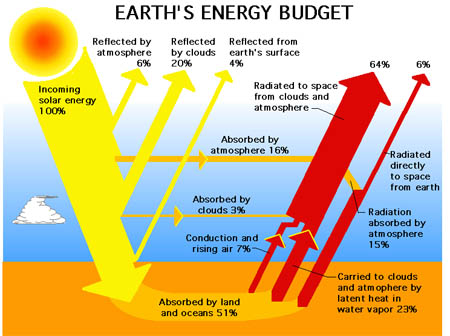
A more popular schematic from various divisions around NASA and Wikipedia etc, is next, and it avoids the issue above:
- Figure 2 NASA
Returning to the Trenberth et al paper, (link is in line 1 above), they give that the 396 W/m2 of EMR emitted from the surface in Fig.1 is calculated primarily by using the Stefan–Boltzmann law, and global year average conditions. Putting aside a few lesser but rather significant issues therein, it is useful to know that:
1) The Stefan-Boltzmann law (S-B) describes the total emission from a flat surface that is equally radiated in all directions, (is isotropic/hemispherical). Stefan found this via experimental measurement, and later his student Boltzmann derived it mathematically.
2) The validity of equally distributed hemispherical EMR is demonstrated quite well by observing the Sun. (with eye protection). It appears to be a flat disc of uniform brightness, but of course it is a sphere, and at its outer edge, the radiation towards Earth is tangential from its apparent surface, not vertical. It is not a perfect demonstration because of a phenomenon called limb darkening, due to the Sun not having a definable surface, but actually plasma with opacity effects. However, it is generally not apparent to the eye and the normally observed (shielded) eyeball observation is arguably adequate for purpose here.
3) Whilst reportedly the original Stefan lab test was for a small flat body radiating into a hemisphere, its conclusions can be extended to larger areas by simple addition of many small flat bodies of collectively flat configuration, because of the ability of EMR waves to pass through each other. This can be demonstrated by car driving at night, when approaching headlights do not change in brightness as a consequence of your own headlights opposing them. (not to be confused with any dazzling effects and fringe illumination)
4) My sketch below demonstrates how radiation is at its greatest concentration in the lateral directions. It applies to both the initial S-B hemispherical surface radiation and to subsequent spherical radiation from the atmosphere itself.

5) Expanding on the text in Figure 3: Air temperature decreases with altitude, (with lapse rate), but if we take any thin layer of air over a small region, and time interval, and with little turbulence, the temperature in the layer can be treated as constant. Yet, the most concentrated radiation within the layer is horizontal in all directions, but with a net heat transfer of zero. Where the radiation is not perfectly horizontal, adjacent layers will provide interception of it.
A more concise way of looking at it is with vectors, which put simply is a mathematical method for analysing parameters that  possess directional information. Figure 4, takes a random ray of EMR (C) at a modestly shallow angle, and analyses its vertical and horizontal vector components. The length of each vector is proportional to the power of the ray, in that direction, such that A + B = C. Of course this figure is only in 2D, and there are countless multi-directional rays in 3D, with the majority approaching the horizontal, through 360 planar degrees, where the vertical components also approach zero.
6) Trenberth’s figure 1 gives that 65% of the HEAT loss from the surface is via thermals and evapo-transpiration. What is not elaborated is that as a consequence of this upward HEAT transfer, additional infrared radiation takes place in the air column by virtue of it being warmed. This initially starts as spherical emission and absorption, but as the air progressively thins upwards, absorption slows, and that radiation ultimately escapes directly to space. Thus, the infrared radiation observable from space has complex sources from various altitudes, but has no labels to say where it came from, making some of the attributions “difficult”.
DISCUSSION; So what to make of this?
The initial isotropic S-B surface emission, (Trenberth’s global 396 W/m2), would largely be absorbed by the greenhouse gases instantaneously near the surface. (ignoring some escaping directly to space through the so-called “atmospheric window”). However, a large proportion of the initial S-B 396 surface emission would be continuously lateral, at the Trenberth imposed constant conditions, without any heat transfer, and its horizontal vectors CANNOT be part of the alleged 396 vertical flux, because they are outside of the vertical field of view.
After the initial atmospheric absorptions, the S-B law, which applied initially to the surface, no longer applies to the air above. (although some clouds are sometimes considered to be not far-off from a black body). Most of the air’s initial absorption/emission is close to the surface, but the vertical distribution range is large, because of considerable variation in the photon free path lengths. These vary with many factors, a big one being the regional and more powerful GHG water vapour level range which varies globally between around ~0 to ~4%. (compared with CO2 at a somewhat constant ~0.04%). The total complexities in attempting to model/calculate what may be happening are huge and beyond the scope of this here, but the point is that every layer of air at ascending altitudes continuously possesses a great deal of lateral radiation that is partly driven by the S-B hemispherical 396, but cannot therefore be part of the vertical 396 claimed in Figure 1.
CONCLUSIONS:
The vertical radiative flux portrayed by Trenberth et al of 396 W/m^2 ascending from the surface to a high cloud level is not supported by first principle considerations. The S-B 396 W/m^2 is by definition isotropic as also is its ascending progeny, with always prevailing horizontal vector components that are not in the field of view of the vertical. The remaining vertical components of EMR from that source are thus less than 396 W/m^2.
It is apparent that HEAT loss from the surface via convective/evaporative processes must add to the real vertical EMR loss from the surface, and as observed from space. It may be that there is a resultant of similar order to 396 W/m^2, but that is NOT the S-B radiative process described by Trenberth.
~~~~~~~~~~~~~~~~~~~~~~~~~~~~~~~~~~~~~~~~~~~~~~~~~~~~~~~~~~~~~
ADDENDUM FOR AFICIONADOS
I Seek your advice
In figure 5 below, note that the NIMBUS 4 satellite data on the left must be for ALL sources of radiation as seen from space, in this case, at some point over the tropical Pacific. The total emissions, amount to the integrated area under the curve, which unfortunately is not given. However, for comparison purposes, a MODTRAN calculator, looking down from 100 Km gives some interesting information for the figure, which is further elaborated in the tables below. Unfortunately the calculator does not give global data or average cloud/sky conditions, so we have apples and pears to compare, not only with Nimbus, but also with Trenberth. However, they all seem to be of somewhat similar order, and see the additional tabulations.

| Compare MODTRAN & “Trenberth”, looking down from 2 altitudes, plus Surface Temperature | ||||
| Location | Kelvin | 10 metres | 100 Km. | (Centigrade) |
| Tropical Atmosphere | 300K | 419 W/m^2 | 288 W/m^2 | (27C) |
| Mid-latitude Summer | 294K | 391 W/m^2 | 280 W/m^2 | (21C) |
| Mid-latitude Winter | 272K | 291 W/m^2 | 228 W/m^2 | (-1C) |
| Sub-Arctic Winter | 257K | 235 W/m^2 | 196 W/m^2 | (-16C) |
| Trenberth Global | 288K ? | 396 W/m^2 | 239 W/m^2 | (15C ?) |
| Compare MODTRAN & “Trenberth”, looking UP from 4 altitudes: W/m^2 | ||||
| Location | From 10 m | From 2 Km | From 4Km | From 6Km |
| Tropical Atmosphere | 348 | 252 | 181 | 125 |
| Mid-latitude Summer | 310 | 232 | 168 | 118 |
| Mid-latitude Winter | 206 | 161 | 115 | 75 |
| Sub-Arctic Winter | 162 | 132 | 94 | 58 |
| Trenberth Global | 333 Shown as coming from high cloud area (= BS according to MODTRAN) | |||
Bob Fernley-Jones says: October 27, 2011 at 8:12 pm
” Are you now saying that although Trenberth shows the 396 & 333 arrowed up at the high cloud level, (and adjacent clear skies), that this is the net result at the surface from all of the above? In other words, the arrows are in the wrong place, and the columns depicting the EMR transmission should really taper-off towards the higher levels?
Not all that hard to draw it that way is it?”
Yes, that is pretty much what I am saying. This diagram is the simplest possible diagram to try to get across the points he is making. The atmosphere is being treated as a single object, and any of the arrows anywhere in or out of the atmosphere simply mean the energy is entering or leaving the atmosphere as a whole. It is not intended to mean that the back-radiation only occurs from the middle of the atmosphere or that it only occurs on the “right side” of the atmosphere.
But actually, it would be considerably more difficult to draw “correctly”. He could have drawn an arrow down from high (altitude) clouds and from low clouds and from middle clouds and from high O3 and low H2O and middle CO2. But soon the diagram would have 100+ arrows distinguishing flows to and from land and ocean and clouds and CO2 and sun and ….
The cartoon is what it is – a vast simplification to highlight major overall energy flows. People who want more detail need to actually read the papers in the field.
Myrrh says:
October 28, 2011 at 5:40 am
You are of course fully entitled to take yourselves seriously.
http://www.leif.org/EOS/unskilledandunaware.pdf
Michel says:
October 28, 2011 at 1:08 am
The major air components O2, N2, and Ar don’t absorb in the IR range.
———————–
Sure they do.
About 0.00000000015 seconds after a CO2, H2O, or CH4 molecule absorbs a photon in the IR range.
Myrrh says:
October 28, 2011 at 5:36 am
http://hyperphysics.phy-astr.gsu.edu/hbase/chemical/watabs.html
Your own link shows that the absorption of visible light by water is a million times weaker than that of infrared, but that only means that you need a layer of water a million times as thick, i.e 100 meters instead of a fraction of a millimeter. Since the oceans are more than 100 meters deep they will absorb all the visible light falling on them. The mechanism involves overtones of vibrational stretching as you have been shown many times.
Surely the real con in the diagram is that it treats clouds as static and not a variable and fails to show that the Latent heat rising causes cloud formation which then modulate the amount of solar radiation reaching earth and back radiation.
Or to translate from Sceptish: when the sun shines, the ground dries and this moisture rises up causing clouds. These clouds hide the sun during the day making it cooler and keep us warm at night.
Both the atmosphere and the oceans delay the incoming heat from being radiated out to space. We are living on the surface of the earth and probably this is why we think atmosphere first, but is it not in reality ruled by the oceans?
As Leif explained a couple of times the oceans are heated by visible light up to 200 m and more. The warming is distributed as water is almost 100% transparent to visible light.
As on the other side water is completely opaque to IR radiation, the deeper levels will not lose heat by radiation. Furthermore any IR from the atmosphere will hit the only the surface and not have any warming effect on the deeper levels.
As Stephen WIlde explains the oceans get themselves in equilibrium through evaporation & radiation at the surface.
“Importantly both the atmosphere AND the oceans delay the incoming solar heat from being radiated out to space.”
http://climaterealists.com/index.php?id=1487&linkbox=true&position=5
Myrrh, thank you for your reply however I think you seem confused. I was talking about radiation not whether it is visible or invisible. The 2nd law of thermodynamics is often brought up to prove that CO2 cannot cause warming because heat does not travel from cold to hot, and the surface of the earth being hotter would not receive the heat CO2 apparently sends back to the surface to cause global warming. If it were heat, this would be true, however, radiation unlike heat can travel in any direction including back down to the surface. I believe it is important for it to be understood that heat is controlled by the Laws of Thermodynamics, radiation isn’t. I’m sorry if my explanation was too simple. I often get lectured about that but I believe the KISS theory much more effective than the complicated gobbledygook scientists use.
I’m still trying to work out how long wave radiation can produce a higher temperature than short wave radiation.
Bob_FJ
I linked to this image earlier in the thread and it might be worth repeating now: http://homepage.mac.com/williseschenbach/trenberth_mine_latest_big.jpg
It is a slightly more detailed version of the Trenberth diagram. For people who understand the original diagram, this one helps show a bit more detail by splitting the atmosphere into an upper layer and a lower layer. For those who don’t understand the original, it only makes things more confusing.
Bob FJ
“Yes, indeed, and I was wondering at one stage if I should include an observation in the article that if the TOA could be treated as a surface, (which is a tad conceptual), then the idea of surface integration at “that level” might be applied.”
To quote the silly movie, Night Shift, “I am a Big Picture, kinda guy.”
I don’t do complicated though, so I keep it as simple as possible, which is a challenge in atmospheric physics.
This article, http://redneckphysics.blogspot.com/2011/10/330-watt-weirdness.html could use a little better grasp of the Queen’s English. You may find it humorous and enlightening once you go back to the basics then work toward the true relationships. Besides the dig that Lindzen and K.Kimoto seems to be playing on K&T, the Arrhenius relationship based on perfect blackbody is illuminating.
Feel free to edit as you wish.
I am working on some Tropopause posts that explain the impact of the inversion more clearly. Fun stuff.
“”””” Hans says:
October 27, 2011 at 6:12 pm
George E. Smith; says:
October 26, 2011 at 11:11 pm
“”””” CRISP says:
You CANNOT transfer heat from a colder body (the upper atmosphere) to a hotter body (the lower atmosphere and Earth surface) without doing work. The 2nd Law of Thermodymanics avbsolutely forbids it. “””””
EM radiation knows absolutely nothing about either “heat” or “Temperature.”, and it can go wherever it darn well pleases .
—————————————————–
George I hope you don’t want to imply that the 2nd Law doesn’t hold for radiation, Planck and Einstein surely build on it when they dug into the BB-radiation problem. “””””
Well Hans, I just had a lengthy answer blown away, by an inadvertent key push.
so a shorter response.
1/ “Heat” as a noun or “heat” or “heating” as a verb has NO MEANING in the absence of real physical materials; atoms/molecules, because it is the kinetic energies (mechanical energy) of those atoms/molecules that defines what “heat” (noun) is. Absent, materials, NO HEAT !
Likewise “Temperature” has NO MEANING in the absence of atoms/molecules, since it is the mean kinetic energy per particle which defines Temperature.
2/ Radiation requires NO MATERIAL; it exists, and propagates, in the complete absence of atoms/molecules; which is why it is able to get to earth from the sun. “Heat” on the other hand CANNOT travel from the sun to the earth, because there is no material (atoms/molecules) to transport it.
3/ Radiation understands NOTHING about Temperature, so radiation has no way of knowing whether some destination (sink) has a higher or lower Temperature, than where it came from (source). So I’ll leave it up to you to explain, just how “Radiation” could possibly comply with the second law of Thermodynamics.
I would recommed to you the second law as phrased by Gustav Clausius; and probably preferrably in the original German.
“Thermal radiation” has nothing much to do with “heat” or “heating” , EXCEPT that the ORIGIN of thermal radiation, is the acceleration of electric charge; AS A DIRECT CONSEQUENCE of the interparticle collisions of a collection of particles that have a Temperature higher than zero Kelvins. All materials above absolute zero emit “Thermal radiation” or “Planckian ” radiation if you like, with a limiting (envelope) (continuum) spectrum given by the Planck Radiation formula.
4/ Note that the second law says nothing about ENERGY; just “heat” and remember “words have meaning”.
Readersa need to stop confusing the resonance lines/bands of molecular spectra, which are a consequence of, and characteristic of the particular molecule structure; with the quite separate continuum spectrum that arises (at the atomic and molecular level) solely due to the Temperature of those materials.
The 15 micron bending mode emissions of the atmospheric CO2 molecule don’t have anything to do with the Temperature of the CO2, other than the molecular collisions that arise as a consequence of that Temperature will alter the width of those spectral lines, due to Doppler and other effects.
The reason that SOLIDS and LIQUIDS appear to emit “Thermal Radiation” and not GASES, is simply that the atomic/molecular density numbers are such, that many more molecules are emitting in a given volume.
The reason that solids can absorb strongly and appear “black” at least in some spectral range, is there simply are more molecules to do the absorbing. A big enough volume of gas, eventually would look quite black too. So we don’t usually talk about gases as being good sources of near black body radiation, but each and every single gas molecule is emitting, and absorbing its fair share, according to the Planck formula.
For a particle Physicist, the cause is acceleration of electric charge (over some non zero distance or time interval) whereas the Radio-Physicist would simply say you need a varying electric current in some non zero length antenna. Well the physical antenna is superfluous, so long as the current can flow somehow (stream of charged particles). For our molecular sources; we would simply say, we need a non-zero electric dipole moment; and then we can emit or absorb to our heart’s content.
We get ENERGY from the sun (via radiation); we get NO HEAT from the sun; and we don’t need to because we can make all the heat we need right here on earth by simply wasting most of the energy we get from the sun. And remember ; WORDS HAVE MEANING, so use the right words.
On SW absorption in water. With a ;long enough path, it is absorbed. The more interesting part is suspended particulates at varing depths greatly impact the depth and degree of absorption. Woods Hole has quite a few interesting links. As a fisherman, this is something nice to know, in case you wonder why fish stocks and climate seem to correlate.
Smokey says:
October 28, 2011 at 3:14 am
Bob Fernley-Jones says:
“BTW everyone, may I suggest that regardless of what his relationship with Trenberth might be we should listen to R. Gates…”
Since R. Gates was actively trying to manipulate Anthony into a public meeting, I suspect a setup. Gates was doing what he was told, and I have no doubt that some kind of dog and pony show was planned to make Anthony look bad. Trenberth and Muller are two peas in a pod. Neither one can be trusted, and Gates is their water boy, even offering here to personally bus people from the airport to the meeting.
_____
This is so laughable as to be hardly worthy of a rebuttal, suffice to say that it indicates why perhaps you should consider a career as fiction writer…perhaps novels involving complex conspiracies. Rather than ‘manipulate” Anthony, I was trying to accomodate and act as a mediator or go-between to try and get these two men together. As far a “dog and pony” show being planned, Dr. Trenberth was asking exactly what we wanted him to talk about. Really Smokey, there are honest people in the world…get rid of your paranoia.
REPLY: I’ll have to back up R. Gates here. I saw no evidence of anything like that in his dealings with me. – Anthony
Tim Folkerts:
“So enlighten us, JAE.
What do you consider to be “the Atmospheric GHG theory” and in what specific ways is it “proven to be toast” ?”
Multiple lines of evidence. I’ve linked to this twice in this thread alone:
http://theendofthemystery.blogspot.com/2010/11/venus-no-greenhouse-effect.html
If it’s wrong, why do you keep ignoring it?
tonyb,
Do you agree or disagree with the trends and uncertainty shown in this chart:
http://www.appinsys.com/GlobalWarming/GW_Part1_HistoricalRecord_files/image010.gif
And if you agree, then how can you dispute the accelerated warming of the 20th century versus what we saw from 1600 to 1800? Seems the curve over the past century is far more steep than the previous 300 year average. It seems that temperatures starting warming in general about 1690-1700 (end of the Maunder), and continued a gradual warm-up, with a pause of course for the Dalton Minimum dip in the early 1800’s, which of course was the reason for the cold winters that influenced Dickens so greatly. At least to my eye, the warming accelerated in the later half of the 20th century.
In general of course (with some notable exceptions) , global temps have pretty much followed this curve of solar activity:
http://en.wikipedia.org/wiki/File:Sunspot_Numbers.png
With exceptions of course being during periods of strong volcanic activity, and also since about 1980, when global temps and solar activity begin to diverge greatly. I would welcome any evidence that shows conclusively that the divergence of global temperatures from solar activity since 1980 as not been caused, at least in part, by anthropogenic greenhouse gases.
Gates,
I stand by what I wrote. No one else but you tried to push Anthony and his supporters into a meeting controlled by Trenberth, with no agenda or rules. If it was naive innocence on your part I understand. But those of us who are wise to the ways of the world and human nature would naturally have deep reservations when someone with reason to be hostile invites them onto their home territory with no pre-agreed ground rules. Anthony was smart to decline under the circumstances.
Sorry, but I disagree strongly with much of what has been said about heat lately.
In classical thermodynamics, “heat” refers to the net flow of energy from one object to another due to a temperature difference. The 2nd law states that the net flow of energy is always from a warmer object to a cooler object. This applies to conduction and convection and radiation.
It is valuable to recognize that the modern definition is stated in terms of statistics and probabilities. There is a chance during any given time interval that the net flow is actually from cool to warm. But the larger the objects, the longer the time and the greater the temperature differences are, then the lower the probability is of heat going from cool to warm. If you look at objects with only a few atoms, or look for nanoseconds, or look at objects within microkelvins of each other, you might actually have a good chance of seeing a net transfer of energy from the warmer object to the cooler object
For typical objects, the probabilities are so vanishingly small of net energy flow from cool to warm, that we can conclude it never happens = 2nd Law.
This does NOT require that zero energy moves from the the cooler object to the warmer object. For example, if a 350 K coffee cup is placed in a 300 K room, the net flow of energy is going to be from warm coffee to cool air. However, individual air molecules could be traveling much faster than average, and when they hit the coffee, they could easily transfer energy FROM the cool air TO the warm coffee. There will simply be many more collisions each second that transfer energy TO the cool air FROM the warm coffee.
Same for photons. Photons from a 270 K atmosphere can and do transfer energy to 300 K ground. But the 2nd Law requires that MORE energy be transferred from the ground to the atmosphere, so there are more photons with more average energy moving from the warm ground to the cool air than vise versa. Yes — the 2nd law DOES apply to heating via radiation.
Even though the net flow of energy must be from warm ground to cool air, the cool air can still help keep the ground warm. The reason for this is simple. The warm ground would still radiate its ~ 395 W/m^2. Without an atmosphere radiating ~ 330 W/m^2 toward he ground, the ground would instead be receiving ~ 0 W/m^2 from the 3 K background radiation of outer space. Even though there is a net loss of energy to the atmosphere, there is a much SMALLER net loss than there would be for an IR transparent atmosphere. If we magically made the atmosphere transparent to IR, the surface would suddenly start cooling dramatically because it would be receiving ~ 330 W/m^2 less energy!
Ask why is it so? asks:
October 28, 2011 at 8:05 am
I’m still trying to work out how long wave radiation can produce a higher temperature than short wave radiation.
Try this – the long wave energy is absorbed in a few millimeters of water, but the short wave energy is absorbed over 100 meters. Assuming that each group of frequencies carries the same amount of energy, the energy absorbed in the smaller volume will produce the greater temperature rise. If this case several million to one.
In the case of a solid surface – the absorptivity is frequency based. As a result, many more long wave photons are absorbed than shortwave. This is one of the main failings of the KT diagram – it does not indicate that the reflected radiation has a different spectrum than the absorbed radiation.
Tim Folkerts says:
October 28, 2011 at 9:03 am
[This] is a slightly more detailed version of the Trenberth diagram.
http://homepage.mac.com/williseschenbach/trenberth_mine_latest_big.jpg
Please provide a reference. Was this created by Willis? That images significantly disagrees with how I understand the atmosphere. In particular, what does “Lowest Stratosphere” mean. In some sources (including the IPCC documents), that actually means the tropopause, in the others, it is the layer above the tropopause.
At any rate, that image makes no sense at all.
Tim Folkerts says:
October 28, 2011 at 12:56 pm
Sorry, but I disagree strongly with much of what has been said about heat lately.
Same for photons. Photons from a 270 K atmosphere can and do transfer energy to 300 K ground.
Mr. Folkerts please show me where in the this formula I can do what you say can or does happen.
W/m^2 = sigma*SB*(T1^4-T2^4)
If T1=T2 then the W/m^2 equal ZERO. If you can show me where ZERO equals some other number or amount please do.
Robert Clemenzi @ur momisugly October 28, at 1:09 pm, & Tim Folkerts @ur momisugly 9:03 am
I recollect that Willis launched his version over at Steve McIntyre’s site several years ago, based on K&T97.
I’m a bit surprised that he has not joined in, in this here.
I’m not a scientist, just an old Air Force photo interpreter with 20+ years’ experience. I’ve worked with about every kind of photography imaginable, from B&W, Color, false-color IR, regular IR, Radar, and a few others I can’t talk about. I’ve physically SEEN that the atmosphere isn’t equally transparent to all wavelengths of EMR. LOTS of different things can degrade reflectivity (photography being the recording of reflected energy, regardless of the type). You can sometimes see quite well through very thin clouds, other times those same types of clouds are virtually opaque. The resolution of IR imagery is directly affected by the ambient-environment temperature in which it’s being recorded – the greater the difference in temperature, the better the resolution. RADAR has no-return zones, either caused by blocking the radar energy from a given area (building “shadow”, etc.), or in the case of relatively calm water, the majority of the reflected energy isn’t returned to the recording site (the angle of incidence is equal to the angle of reflection. Visible light has a greater variety of angles of incidence than other types of imagery). Dust and smog can also affect any imagery negatively.
The atmosphere works the same way for solar radiation. Some of the radiation is allowed through, some of it’s blocked, some of it is absorbed or reflected away in odd angles. Since the atmosphere is a constantly-changing soup of elements, chemicals, and aerosols, some of which exist in more than one phase, I can see no way to develop a direct measurement of its’ overall transparency for any given location, much less for the earth as a whole. The best we can do is come up with what we in the business call a SWAG – a ‘Scientific’ Wild-A$$ Guess”. Even that would require taking a constant, highly-accurate, 24/7/365 measurement of the transparency (both ways – receiving and emitting) from multiple points on the earth to develop that. Until then, all of this is just an exercise in futility, proving nothing.
Ask why it is so? says:
I’m still trying to work out how long wave radiation can produce a higher temperature than short wave radiation.
Well, the short-wave radiation isn’t really changing, and the long-wave is increasing. This is based on the fact that different types of radiation are more readily trapped than others (in systems like Earth’s), at least until the system equilibriates.
The sun is radiating in shortwave. A general recipe for creating a greenhouse effect in something (in a car, a planet, whatever) is as follows:
Find a material that’s transparent at the incoming radiation frequency, but opaque to the outgoing radiation (the outgoing radiation being the blackbody radiation). When you add a layer of this material to your system, the incoming short-wave radiation will still get through, but now the outgoing longwave radiation will be absorbed by the covering layer, and some of it will be back-scattered/back-emitted. The heat will take longer to escape, so the average temperature will increase. In essence, you’re not changing how your system absorbs heat, but you’re slowing down how quickly it loses heat.. so it will heat up.
For Earth, water vapor is also an excellent greenhouse gas, and in the lower atmopshere its concentration is so much higher than that of CO2 that adding a little CO2 doesn’t change the absorption of long-wave radiation much. But at higher altitudes, the water vapor condenses out, and other greenhouse gases dominate the back-emission of long-wave radiation. And by slowing down the loss of heat through the stratosphere, the troposphere will also become warmer.. and thus the overall global warming effect.
Of course, we’re not breaking any laws of thermodynamics.. just moving our average temperature a bit closer to that of our heat source (the sun) and a bit further from that of our heat sink (the rest of the universe).
Mkelly requests:
Mr. Folkerts please show me where in the this formula I can do what you say can or does happen.
W/m^2 = sigma*SB*(T1^4-T2^4)
I’m not sure how it could be more obvious in the equation.
(Net Power/Area) = (Rate of heat from 1 to 2) / Area
= sigma*SB*(T1^4-T2^4)
= sigma*SB*(T1^4) – sigma*SB*(T2^4)
= (power/Area leaving 1) – (power/ Area arriving from 2)
The first half of the equation is the “radiative flux” leaving object 1. The second half is the “radiative flux” arriving from object 2. These are measures of the photons heading in and out.
If T1 > T2, more energy leaves Object 1 than arrives from Object 2
** ie heat flows from Object 1 to Object 2.
**ie more photons with higher energy flow from 1 to 2 (but some still flow from 2 to 1)
If T1 = T2, the same energy leaves Object 1 as arrives from Object 2
** ie no heat flows
If T1 < T2, less energy leaves Object 1 than arrives from Object 2
** ie heat flows from Object 2 to Object 1.
(This version of the equation requires both objects to have emissivity = 1 (which you seem to call “SB”). Also, either Object 1 and Object 2 should be large and flat, or Object 2 should be surrounding Object 1 and “A” would be the area of Object 1. For a more general version, see http://en.wikipedia.org/wiki/Thermal_radiation)
kuhnkat @ur momisugly October 26, at 8:30 pm, you wrote:
The surface is a sphere. The adjoining points would NOT cancel. Surface irregularities will confuse this so that the surface is irradiating itself just as the surface of the water does. One of the requirements for S-B to apply is that the surface geometry does NOT allow it to irradiate itself. OOOPS!!!!
I doubt if this is a significant issue; for instance water that is wave affected only has a fairly momentary oopsy, because what was concave alternates with being convex, at which time, it will radiate to below the horizontal. (= radiate more than S-B). Also, on land, (even on collectively flat ground), vegetation might at first seem to be an issue, but broadly speaking it’s all in equilibrium. (Well, according to Trenberth anyway). Thus that vegetation will simultaneously radiate to below the horizontal in more or less isotropic fashion.
Smokey says:
October 28, 2011 at 12:26 pm
Gates,
I stand by what I wrote. No one else but you tried to push Anthony and his supporters into a meeting controlled by Trenberth, with no agenda or rules.
_____
Smokey, read Anthony’s last reply when I said you’d make a good fiction writer. You are off base on this in a serious way, so let it go. It was a meeting that was completely above board and it simply didn’t work out. No one tried to push anyone into anything, and the Dr. Trenberth was willing to talk about any climate issue we wanted him to, and answer Q & A. After BEST, Anthony (understandably) became a bit gun-shy. Can’t blame him, but that’s all there was to it. End of story.