Guest post by Bob Fernley-Jones by Bob Fernley-Jones AKA Bob_FJ
CAUTION: This is written in Anglo-Oz English.
Here is the diagram as extracted from their 2009 paper, it being an update of that in the IPCC report of 2007 (& also 2001):


The unusual aspect of this diagram is that instead of directly showing radiative Heat Transfer from the surface, it gives their depiction of the greenhouse effect in terms of radiation flux or Electro-Magnetic Radiation, (AKA; EMR and a number of other descriptions of conflict between applied scientists and physicists). EMR is a form of energy that is sometimes confused with HEAT. It will be explained later, that the 396 W/m^2 surface radiation depicted above has very different behaviour to HEAT. Furthermore, temperature change in matter can only take place when there is a HEAT transfer, regardless of how much EMR is whizzing around in the atmosphere.
A more popular schematic from various divisions around NASA and Wikipedia etc, is next, and it avoids the issue above:
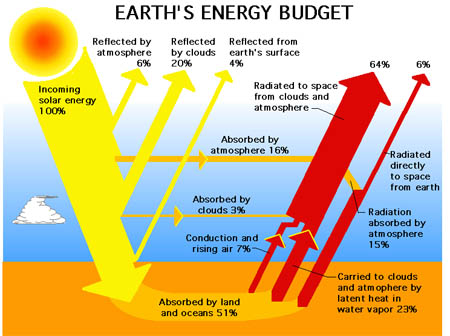
- Figure 2 NASA
Returning to the Trenberth et al paper, (link is in line 1 above), they give that the 396 W/m2 of EMR emitted from the surface in Fig.1 is calculated primarily by using the Stefan–Boltzmann law, and global year average conditions. Putting aside a few lesser but rather significant issues therein, it is useful to know that:
1) The Stefan-Boltzmann law (S-B) describes the total emission from a flat surface that is equally radiated in all directions, (is isotropic/hemispherical). Stefan found this via experimental measurement, and later his student Boltzmann derived it mathematically.
2) The validity of equally distributed hemispherical EMR is demonstrated quite well by observing the Sun. (with eye protection). It appears to be a flat disc of uniform brightness, but of course it is a sphere, and at its outer edge, the radiation towards Earth is tangential from its apparent surface, not vertical. It is not a perfect demonstration because of a phenomenon called limb darkening, due to the Sun not having a definable surface, but actually plasma with opacity effects. However, it is generally not apparent to the eye and the normally observed (shielded) eyeball observation is arguably adequate for purpose here.
3) Whilst reportedly the original Stefan lab test was for a small flat body radiating into a hemisphere, its conclusions can be extended to larger areas by simple addition of many small flat bodies of collectively flat configuration, because of the ability of EMR waves to pass through each other. This can be demonstrated by car driving at night, when approaching headlights do not change in brightness as a consequence of your own headlights opposing them. (not to be confused with any dazzling effects and fringe illumination)
4) My sketch below demonstrates how radiation is at its greatest concentration in the lateral directions. It applies to both the initial S-B hemispherical surface radiation and to subsequent spherical radiation from the atmosphere itself.

5) Expanding on the text in Figure 3: Air temperature decreases with altitude, (with lapse rate), but if we take any thin layer of air over a small region, and time interval, and with little turbulence, the temperature in the layer can be treated as constant. Yet, the most concentrated radiation within the layer is horizontal in all directions, but with a net heat transfer of zero. Where the radiation is not perfectly horizontal, adjacent layers will provide interception of it.
A more concise way of looking at it is with vectors, which put simply is a mathematical method for analysing parameters that  possess directional information. Figure 4, takes a random ray of EMR (C) at a modestly shallow angle, and analyses its vertical and horizontal vector components. The length of each vector is proportional to the power of the ray, in that direction, such that A + B = C. Of course this figure is only in 2D, and there are countless multi-directional rays in 3D, with the majority approaching the horizontal, through 360 planar degrees, where the vertical components also approach zero.
6) Trenberth’s figure 1 gives that 65% of the HEAT loss from the surface is via thermals and evapo-transpiration. What is not elaborated is that as a consequence of this upward HEAT transfer, additional infrared radiation takes place in the air column by virtue of it being warmed. This initially starts as spherical emission and absorption, but as the air progressively thins upwards, absorption slows, and that radiation ultimately escapes directly to space. Thus, the infrared radiation observable from space has complex sources from various altitudes, but has no labels to say where it came from, making some of the attributions “difficult”.
DISCUSSION; So what to make of this?
The initial isotropic S-B surface emission, (Trenberth’s global 396 W/m2), would largely be absorbed by the greenhouse gases instantaneously near the surface. (ignoring some escaping directly to space through the so-called “atmospheric window”). However, a large proportion of the initial S-B 396 surface emission would be continuously lateral, at the Trenberth imposed constant conditions, without any heat transfer, and its horizontal vectors CANNOT be part of the alleged 396 vertical flux, because they are outside of the vertical field of view.
After the initial atmospheric absorptions, the S-B law, which applied initially to the surface, no longer applies to the air above. (although some clouds are sometimes considered to be not far-off from a black body). Most of the air’s initial absorption/emission is close to the surface, but the vertical distribution range is large, because of considerable variation in the photon free path lengths. These vary with many factors, a big one being the regional and more powerful GHG water vapour level range which varies globally between around ~0 to ~4%. (compared with CO2 at a somewhat constant ~0.04%). The total complexities in attempting to model/calculate what may be happening are huge and beyond the scope of this here, but the point is that every layer of air at ascending altitudes continuously possesses a great deal of lateral radiation that is partly driven by the S-B hemispherical 396, but cannot therefore be part of the vertical 396 claimed in Figure 1.
CONCLUSIONS:
The vertical radiative flux portrayed by Trenberth et al of 396 W/m^2 ascending from the surface to a high cloud level is not supported by first principle considerations. The S-B 396 W/m^2 is by definition isotropic as also is its ascending progeny, with always prevailing horizontal vector components that are not in the field of view of the vertical. The remaining vertical components of EMR from that source are thus less than 396 W/m^2.
It is apparent that HEAT loss from the surface via convective/evaporative processes must add to the real vertical EMR loss from the surface, and as observed from space. It may be that there is a resultant of similar order to 396 W/m^2, but that is NOT the S-B radiative process described by Trenberth.
~~~~~~~~~~~~~~~~~~~~~~~~~~~~~~~~~~~~~~~~~~~~~~~~~~~~~~~~~~~~~
ADDENDUM FOR AFICIONADOS
I Seek your advice
In figure 5 below, note that the NIMBUS 4 satellite data on the left must be for ALL sources of radiation as seen from space, in this case, at some point over the tropical Pacific. The total emissions, amount to the integrated area under the curve, which unfortunately is not given. However, for comparison purposes, a MODTRAN calculator, looking down from 100 Km gives some interesting information for the figure, which is further elaborated in the tables below. Unfortunately the calculator does not give global data or average cloud/sky conditions, so we have apples and pears to compare, not only with Nimbus, but also with Trenberth. However, they all seem to be of somewhat similar order, and see the additional tabulations.

| Compare MODTRAN & “Trenberth”, looking down from 2 altitudes, plus Surface Temperature | ||||
| Location | Kelvin | 10 metres | 100 Km. | (Centigrade) |
| Tropical Atmosphere | 300K | 419 W/m^2 | 288 W/m^2 | (27C) |
| Mid-latitude Summer | 294K | 391 W/m^2 | 280 W/m^2 | (21C) |
| Mid-latitude Winter | 272K | 291 W/m^2 | 228 W/m^2 | (-1C) |
| Sub-Arctic Winter | 257K | 235 W/m^2 | 196 W/m^2 | (-16C) |
| Trenberth Global | 288K ? | 396 W/m^2 | 239 W/m^2 | (15C ?) |
| Compare MODTRAN & “Trenberth”, looking UP from 4 altitudes: W/m^2 | ||||
| Location | From 10 m | From 2 Km | From 4Km | From 6Km |
| Tropical Atmosphere | 348 | 252 | 181 | 125 |
| Mid-latitude Summer | 310 | 232 | 168 | 118 |
| Mid-latitude Winter | 206 | 161 | 115 | 75 |
| Sub-Arctic Winter | 162 | 132 | 94 | 58 |
| Trenberth Global | 333 Shown as coming from high cloud area (= BS according to MODTRAN) | |||
We are just waiting for a very “cool” cooling….enjoy it!, it will be better than in the Maunder Minimum 🙂
You might like more writing on the paradox summarized quite nicely here:
http://www.tech-know.eu/uploads/Copernicus_Meets_the_Greenhouse_Effect.pdf
and a more lengthy version here:
http://www.tech-know.eu/uploads/The_Model_Atmosphere.pdf
Leif Svalgaard says:
October 27, 2011 at 8:24 am
Myrrh says:
October 27, 2011 at 5:15 am
For example, visible LIGHT cannot heat water because it doesn’t have the mechanism to do so, water is a transparent medium for visible LIGHT and so visible light is transmitted through without being absorbed, visible light cannot move the molecules of water into the vibrational state which is heat.
“Yet it does. 100 meters of water absorbs all the visible light falling on it, so heats it. Visible light move water molecules into overtones of symmetric and anti-symmetric vibrations.”
A great deal of the ocean has greater clarity and a small percentage, about 1% goes deeper. (sometinmes called the bad light zone) However this 1% may be in a spectrum that varies more then most over solar cycles. The intensity of visible light transmitted through water decreases rapidly with
increasing depth. Roughly 60 percent of incoming light is attenuated in the first meter (3.3 ft), 80
percent in the upper 10 meters (33 ft), 99 percent at a depth of 150 meters (500 ft) in
very clear water, and there is essentially no light penetration below 1000 meters.
http://www.google.com/url?sa=t&rct=j&q=solar%20radiation%20penetrates%20bad%20light%20zone%20oceans%20800%20meters&source=web&cd=3&ved=0CDQQFjAC&url=http%3A%2F%2Fwww.mhhe.com%2Fearthsci%2Fgeology%2Fduxfund4e%2Fstudy%2Fchap5.pdf&ei=dYapTuCMHoKhsQLUtonmDw&usg=AFQjCNGnVOSvWJbH6orsFOLUGmjjve5hMQ
Leif, a second reference for you…
http://www.google.com/url?sa=t&rct=j&q=bad%20light%20zone&source=web&cd=10&ved=0CHUQFjAJ&url=http%3A%2F%2Fwww.scienceclarified.com%2FMu-Oi%2FOcean-Zones.html&ei=CIepTrzlLsHnsQKqy52vDw&usg=AFQjCNHtNuybbpchX9S35Pp8IywjkMq8hQ
From 660 to 3,000 feet (200 to 900 meters), only about 1 percent of sunlight penetrates. This layer is known as the dysphotic zone (meaning “bad light”). Below this layer, down to the deepest parts of the ocean, it is perpetual night. This last layer is called the aphotic zone (meaning “without light”). At one time, scientists thought that very little life existed within the aphotic zone. However, they now know that a variety of interesting organisms can be found living on the deepest parts of the ocean floor.
Read more: Ocean Zones – body, used, water, process, Earth, life, plants, chemical, form, energy, animals, carbon, oxygen, parts, primary, plant, surface http://www.scienceclarified.com/Mu-Oi/Ocean-Zones.html#ixzz1c06eJJzu
Bob, thank you for the article! It is clear that you “ruminated” some time on it give us some time to digest the information. Here my two cents:
As you correctly showed – in divergence to T&All (F1 diagram) – the radiative exchange does not happen between the “floor” and a “ceiling”, but between “floor” and all levels of the atmosphere. The 333 W/m2 “back radiation” from a high ceiling is an erroneous number leading to misunderstandings – this is clearly showed in the tables – high cloud area is above 7 km – looking up from 6 km in the table we have between 58 and 125 W/m2 pointing down. There is no “back radiation” but energy transfer through radiation in all directions.
Figure 2 is a much more clear and without bias overview of the energy budget.
Furthermore the second point was that radiation results also in heat transfer between various strata of the atmosphere, especially with warm air raising up.
The third point I retained was that the outgoing radiation seen by Nimbus 4 is a result of radiation from several strata. The use of S-B formula is of limited help and should be used very carefully.
Finally I think there are bigger problems with the F1 diagram as pointed out by Mydogsgotnonose says: October 27, 2011 at 3:03 am, Myrrh says: October 27, 2011 at 5:15 am (is any radiation equally transferred into heat?), George E. Smith; says:October 26, 2011 at 10:00 pm (bogus flat world asumption etc) and others.
David says:
October 27, 2011 at 9:35 am
Leif, a second reference for you…
You are missing the point completely. The point is that the oceans eventually absorb all the visible light falling on them [minus that small part that is reflected] and hence is heated by that.
Mkelly, we are a bit off topic, but let me say a couple quick things
>>Mr. Folkerts says: “Even if all sunlight is blocked, the IR radiation
>>would heat the sun tea to ~ 300 K.”
>Balderdash. The IR given off by CO2 cannot do this.
The ~ 333 W/m^2 of IR we are talking about comes partly from CO2, but also from H2O (both gas and liquid). (In addition, the sides of the sun tea will be exposed to both the atmosphere and the ground, further raising the incoming IR). On a cloudy day, the IR spectrum will be nearly black body, and would warm the sun tea to ~ room temperature without any input from the sun or from conduction.
>The 15 micro emission has an associated temperature via
>Wien’s Law of -73 C.
No, Wien’s Law specifically applies to BB radiation. You can’t conclude that a non-BB like CO2 emits most strongly at 15 um has an effective temperature of (2.90 E-3 K/m) / (15 E-6 m) = ~ -73 C.
>Also, please let us talk of the earth and the atmosphere and not of space.
>I don’t live in space beyond the atmosphere.
The connection to space cannot be ignored. In fact, that is precisely the reason that CO2 by itself could not heat the sun tea to ~ 300 K as you correctly concluded above. CO2 by itself only emits in certain bands, leaving large “windows”. These “windows” connect space to everything on the ground, so we are all “connected” to space, just as we are connected to the sun. This is why the tops of cars are often frosted when the sides are not.
>The KT diagram says 161 W/m^2 at the earth’s surface that is where
>I put my sun tea and the sun heats it, CO2 cannot.
Actually, that is not what the diagram says. It says that during an average 24 hour period, the average solar energy is 161 W/m^2. During the night the average is 0 and during an average the day the average is 2 * 161 W/m^2 = 322 W/m^2. Assuming you are making tea not too early or late on a sunny day, the solar energy at that time could be up to about 1000 W/m^2. This is one other reason that sunlight is more effective.
The Sun does not surround the Earth, illuminating and heating it from the vertical all day long at all points on the surface. The Sun illuminates/heats the dayside of the Earth as if it were 1/2 a circle the size of the Earth….from the vertical. So, the Earth’s dayside gets, at most, 1/2 of the 1366 W/m^2. 1366/2 = 683.
rbateman says:
October 27, 2011 at 10:45 am
The Sun does not surround the Earth, illuminating and heating it from the vertical all day long at all points on the surface. The Sun illuminates/heats the dayside of the Earth as if it were 1/2 a circle the size of the Earth….from the vertical. So, the Earth’s dayside gets, at most, 1/2 of the 1366 W/m^2. 1366/2 = 683.
And because the Earth is round, you can cut that number in half as well, getting to the 342 W/m2.
Anyway, shouldn’t it be A^2 + B^2 = C^2 for that little vector diagram, not A + B = C?
A black body emits W/m2 AT A POWER according to it’s temperature.
A gray body emits AT A LOWER POWER than a black body (at the same temperature) for many well known reasons.
THAT, is NOT an energy flow, for a gray body IT IS the power the energy flow is emitted at…….
The volume of the energy flow IS NOT DESCRIBED.
So, as the gray bodies depicted in the K&T budgets are all different sizes and temperatures,
the diagram CAN NOT be correct (for power or volume),
UNLESS THEY ARE ALL (EQUAL) BLACK BODIES….
This also applies to all present explanations of GH “theory”.
Did you realise K&T and GH is ALL explained in “black body”???
It has taken me ages to realise the above, and it’s importance. It’s all imaginary.
http://www.globalwarmingskeptics.info/forums/thread-1071-post-10470.html#pid10470
(Particularly post 21 onwards.)
I doubt I am alone in that.
K&T depicts a black body world, in all it’s parts, AND, with no life, as does GH “theory”.
Makes me wonder how they “measure” the figures supposedly from (gray body) “reality”….
It’s a scam, plain and simple. A politically convenient, imaginary hobgoblin.
The world ain’t flat, and CO2 does not drive, nor even measurably influence, climate.
Wake up people.
There can not possibly be a “greenhouse effect” as presently hypothesized,
IN ANY OF IT’S PRESENTLY TOUTED “FORMS”.
Rich says:
Anyway, shouldn’t it be A^2 + B^2 = C^2 for that little vector diagram, not A + B = C?
If you assume he meant that as a vector equation (with the little arrows over the letters), then (vector A) + (vector B) = (vector C).
But if they represent the magnitudes, then you are right, the Pythagorean theorem would apply.
Leif Svalgaard says:
October 27, 2011 at 8:24 am
Myrrh says:
October 27, 2011 at 5:15 am
For example, visible LIGHT cannot heat water because it doesn’t have the mechanism to do so, water is a transparent medium for visible LIGHT and so visible light is transmitted through without being absorbed, visible light cannot move the molecules of water into the vibrational state which is heat.
Yet it does. 100 meters of water absorbs all the visible light falling on it, so heats it. Visible light move water molecules into overtones of symmetric and anti-symmetric vibrations.
Utter codswallop. Water is a transparent medium to visible light, visible light is transmitted through without being absorbed because that’s what what transparent means. Visible light isn’t capable of moving molecules of water into vibration, it ain’t big enough and doesn’t have the power to do so, it works on electron scale, electronic transitions, and doesn’t even get in to play with electrons in water (as it does in the atmosphere where the electrons of the molecules oxygen and nitrogen absorb it. It takes real power, the power of heat, thermal infrared, to move molecules of water. And this is what it does, direct from the Sun, the land and oceans are heated by thermal infrared.
The AGW/KT/NewScienceFiction is a nonsense. The Science Fiction department of AGWInc has given the properties of heat, the thermal energy from the Sun, to light, and, then says that the Sun’s real thermal energy thermal infrared, doesn’t get to the surface to heat it, and takes it out of the budget! To claim the actual heat from the Sun doesn’t heat the world is bad enough, but for anyone here calling calling himself scientist who thinks visible light is capable of doing this, needs to go back to primary school, in the real world, there are still some teachers left…
….
Tim Folkerts says:
October 27, 2011 at 9:04 am
Myrrh,
Without going in to the rest what you wrote, let me simple state that the source you choose as “real world physics” gives two completely contradictory definitions of “heat”.
1) “Heat is thermal energy in transfer.”
2) “Heat is always the thermal energy of some system.”
“Heat” cannot be both always within a system and always between two different systems.
If you base your posts on a source that is clearly inconsistent, then there is a good chance that any of your conclusions will also be inconsistent.
No contradiction – “Using the word heat helps physicists to make a distinction relative to the system they are talking about” It’s all of those things in context, because “thermal energy and heat are the same thing.”
What I am talking about here in context is the Sun’s heat, the Sun’s thermal energy on the move, thermal infrared which is this heat energy, this heat from the Sun travelling to us here and heating land and oceans and us. Or simply, heat from the Sun is thermal infrared, it is invisible, but we can feel it as heat because it warms us up from the inside. Because it is heat and that’s what heat does.
Visible light cannot heat us up.
You have excluded the primary means of heating of the Earth, it is missing from your energy budget, this is the real travesty of the missing heat.
Man Bearpigg says:
October 26, 2011 at 11:54 pm
.. and they call us skeptics ‘Flat Earthers’ when their calculations are based exactly on that notion.
A blast from the past:
“NASA covered up for forty years proof that the greenhouse gas theory was bogus. But even worse, did the U.S. space agency fudge its numbers on Earth’s energy budget to cover up the facts?”
http://sppiblog.org/tag/stefan-boltzmann-equations
“What ignited this latest Climategate-linked rumpus is a sensational new research paper, ‘A Greenhouse Effect on the Moon?’ otherwise called the ‘Moon Paper.’
Researchers for the paper scientifically proved that since at least 1997 climate scientists knew that guesswork was underpinning the whole greenhouse gas theory. In fact, so flaky are these numbers that they can be rendered to show a GHG effect on Earth’s moon, where no greenhouse gases exist! Thus, skeptics argue, the burning embers of political heat generated by the discredited theory should now finally and unequivocally be extinguished.
But more sinisterly, it turns out that NASA climate scientists, with access to better climate equations used for the Apollo Moon mission, forsook those in favor of dodgy Dr. Schmidt’s ‘back of an envelope’ numbers.”
http://usactionnews.com/2010/06/nasa-charged-in-new-climate-fakery-greenhouse-gas-data-bogus/
NASA knew how to calculate it properly, it had to junk Stefan-Bolzmann to get accurate figures for the moon landing.
Mr. folkerts says: “Assuming you are making tea not too early or late on a sunny day, the solar energy at that time could be up to about 1000 W/m^2. This is one other reason that sunlight is more effective.”
This I fully agree with the 1000 W/m^2 is why the diagram is not correct. However, you obfiscate on other issues, but on this we are in total agreement. You are coming along my little padawan.
climatereason says:
October 27, 2011 at 9:15 am
R Gates
I have asked you this many times and perhaps you have answered but it got lost within the deluge of comments.
When do you believe the globe started warming? (we shall leave aside the one third of stations that are cooling that we pointed out in our article ‘in search of cooling trends’
I believe it started warming from 1607/8 albeit it has been in fits and starts with numerous serious reversals and astonishing advances (such as around 1700.)
Berkely appear to partially support my view with a rise from their start date of 1800.
Supplementary question; Who do you believe, Michael Mann or the Berkely study?
tonyb
_____
Tony, by your question, I take it you mean when did human activity (specifically the burning of fossil fuels) begin to warm the climate? I think the issue would be one of measureability of the signal through any natural background fluctuations. Certainly, IMO, most of the decadal, century scale, and even 1500 year cycles in climate (i.e. non-Milankovitch) can be traced back to the sun. They may be reflected in ocean cycles, but the oceans themselves are not the cause of the cycles, but only a resultant effect. Then there are the shorter term cycles in climate linked to events like ENSO, volcanoes, etc. So in trying to find an anthropogenic signal amongst all this other natural background climate noise is a difficult proposition. For example, there can be times when the natural cycle is toward cooling (i.e. a Maunder or Dalton Minimum), but there could be human influences which make the cooling less severe or deep than it might have been. Identifying that type of effect (a less intense cooling) as in indication of warming is certainly quite a challenge. However, not to dodge your question, in my opinion the first really visible signs of human warming of the planet would be early in the 20th century, with the signal growing progressively stronger throughout (even though there were periods of natural cooling). I think for certain by the early 1980’s we could see temperatures begin to deviate from the natural solar influenced cycle, meaning that the influence of human GH forcing became greater than the solar influence. As to who I believe, Mann or Berkeley, I find that an odd choice. For example, I think the MWP was probably a bit warmer and bit more global than Mann might like to posit, but I also think that in general, the trend of global temperatures increases over the past century as reflected by Berkeley et. al, are pretty much on target, give or take some inconsequential adjustments. Based on natural cycles plus human forcings, we are due for continued warming (despite the AGW skeptics excitement over the flattening of the upward trend over the past decade). So we are due for warmer, not cooler times ahead…and the next glacial period by Milankovitch cycles is not due for more than 10,000 years.
One final note, of course human influences on the climate go both ways , with some leading to cooling and some leading to warming. So even these can be competing signals against the background of natural forcings.
Bob_FJ,
As to the last section where you claim “333 W/m^2 Shown as coming from high cloud area (= BS according to MODTRAN)”
First, the 333 W/m^2 is coming from the atmosphere as a whole, not “high clouds”. It includes CO2 and humidity and high clouds and low clouds.
And following up on that point, the calculations you have are all for clear skies. If you model a cumulus cloud base, the numbers are much higher. For example, the first line for looking up from 10 m in a clear tropical sky was 348 W/m^2 in your table, but 418 W/m^2 when cloudy. Arctic winter goes from 163 W/m^2 to 243 W/m^2. All the other numbers will also be higher for cloudy weather. As such, you would have to average not only the different zones, but also cloudy and clear for each zone.
Given that the downward radiation with cloudy conditions is so much higher than the clear conditions you quoted, it is now plausible that the average from MODTRAN (all areas, all cloud covers) would agree with trenberth’s 333 W/m^2.
Leif Svalgaard says:
October 27, 2011 at 11:11 am
rbateman says:
October 27, 2011 at 10:45 am
The Sun does not surround the Earth, illuminating and heating it from the vertical all day long at all points on the surface. The Sun illuminates/heats the dayside of the Earth as if it were 1/2 a circle the size of the Earth….from the vertical. So, the Earth’s dayside gets, at most, 1/2 of the 1366 W/m^2. 1366/2 = 683.
And because the Earth is round, you can cut that number in half as well, getting to the 342 W/m2.
And surely the same argument goes for backradiation, only 1/4 of it will reach the surface of the earth?
mkelly says:October 27, 2011 at 12:03 pm
“This I fully agree with the 1000 W/m^2 is why the diagram is not correct.
This seems like a non-sequitur. We seem to agree that sometimes sunlight is bright (1000 W/m^2 on a sunny noon); sometimes it is sort of bright (~200 W/m^2 later in the afternoon); sometimes it is gone (0 W/m^2 at night or under clouds). A weighted average that comes out to 161 W/m^2 would certainly be possible — how does this invalidate the Trenberth diagram?
Kelvin Vaughan says:
October 27, 2011 at 12:27 pm
And surely the same argument goes for backradiation, only 1/4 of it will reach the surface of the earth?
No. The IR comes from all directions, not just from one direction. There is no “night side” where IR from the atmosphere does not shine.
Don’t forget the Venus comparison: http://theendofthemystery.blogspot.com/2010/11/venus-no-greenhouse-effect.html
@Leif Svalgaard says:
October 27, 2011 at 8:24 am
Just to be clear, are you talking about pure water, or the soup that is sea water?
Tonyb;
Congrats on getting a response from R. Gates… well, sort of.
Me he continues to ignore entirely because the only answer he has left is to admit that he was totaly wrong and welched on his bet with me.
R gates
Thanks for your answer. So the observed 400 year warming trend only became a warming trend influneced by humans in the last 20 years or so? So for 380 years it was natural and then it switched to being man made. Is that correct?
tonyb
Myrrh;
Utter codswallop. Water is a transparent medium to visible light, visible light is transmitted through without being absorbed >>>
In various threads you demanded experimental proof, and when it was provided to you, declared it impossible. You demanded text books, and when reffered to same, declared them irrelevant. You demand that others read and understand your blather, but when confronted with facts, you scream “codswallop”.
Tell me please. Since it gets dark at about 100 meters in the ocean, where did the light go? If it wasn’t absorbed, where did it go? Did it make a U turn and head back to the surface? One would think the casual observer would notice light shining up from the bottom of the ocean? Did it come to a stop and just sit their in suspension in the water? Did it turn into flying pigs? Where does the light go if it wasn’t absorbed by the water? Maybe it just disappeared?