NOTE: This post is important, so I’m going to sticky it at the top for quite a while. I’ve created a page for all Spencer and Braswell/Dessler related posts, since they are becoming numerous and popular to free up the top post sections of WUWT.
UPDATE: Dr. Spencer writes: I have been contacted by Andy Dessler, who is now examining my calculations, and we are working to resolve a remaining difference there. Also, apparently his paper has not been officially published, and so he says he will change the galley proofs as a result of my blog post; here is his message:
“I’m happy to change the introductory paragraph of my paper when I get the galley proofs to better represent your views. My apologies for any misunderstanding. Also, I’ll be changing the sentence “over the decades or centuries relevant for long-term climate change, on the other hand, clouds can indeed cause significant warming” to make it clear that I’m talking about cloud feedbacks doing the action here, not cloud forcing.”
[Dessler may need to make other changes, it appears Steve McIntyre has found some flaws related to how the CERES data was combined: http://climateaudit.org/2011/09/08/more-on-dessler-2010/
As I said before in my first post on Dessler’s paper, it remains to be seen if “haste makes waste”. It appears it does. -Anthony]
Update #2 (Sept. 8, 2011): Spencer adds: I have made several updates as a result of correspondence with Dessler, which will appear underlined, below. I will leave it to the reader to decide whether it was our Remote Sensing paper that should not have passed peer review (as Trenberth has alleged), or Dessler’s paper meant to refute our paper.
by Roy W. Spencer, Ph. D.
While we have had only one day to examine Andy Dessler’s new paper in GRL, I do have some initial reaction and calculations to share. At this point, it looks quite likely we will be responding to it with our own journal submission… although I doubt we will get the fast-track, red carpet treatment he got.
There are a few positive things in this new paper which make me feel like we are at least beginning to talk the same language in this debate (part of The Good). But, I believe I can already demonstrate some of The Bad, for example, showing Dessler is off by about a factor of 10 in one of his central calculations.
Finally, Dessler must be called out on The Ugly things he put in the paper.
(which he has now agreed to change).
1. THE GOOD
Estimating the Errors in Climate Feedback Diagnosis from Satellite Data
We are pleased that Dessler now accepts that there is at least the *potential* of a problem in diagnosing radiative feedbacks in the climate system *if* non-feedback cloud variations were to cause temperature variations. It looks like he understands the simple-forcing-feedback equation we used to address the issue (some quibbles over the equation terms aside), as well as the ratio we introduced to estimate the level of contamination of feedback estimates. This is indeed progress.
He adds a new way to estimate that ratio, and gets a number which — if accurate — would indeed suggest little contamination of feedback estimates from satellite data. This is very useful, because we can now talk about numbers and how good various estimates are, rather than responding to hand waving arguments over whether “clouds cause El Nino” or other red herrings. I have what I believe to be good evidence that his calculation, though, is off by a factor of 10 or so. More on that under THE BAD, below.
Comparisons of Satellite Measurements to Climate Models
Figure 2 in his paper, we believe, helps make our point for us: there is a substantial difference between the satellite measurements and the climate models. He tries to minimize the discrepancy by putting 2-sigma error bounds on the plots and claiming the satellite data are not necessarily inconsistent with the models.
But this is NOT the same as saying the satellite data SUPPORT the models. After all, the IPCC’s best estimate projections of future warming from a doubling of CO2 (3 deg. C) is almost exactly the average of all of the models sensitivities! So, when the satellite observations do depart substantially from the average behavior of the models, this raises an obvious red flag.
Massive changes in the global economy based upon energy policy are not going to happen, if the best the modelers can do is claim that our observations of the climate system are not necessarily inconsistent with the models.
(BTW, a plot of all of the models, which so many people have been clamoring for, will be provided in The Ugly, below.)
2. THE BAD
The Energy Budget Estimate of How Much Clouds Cause Temperature Change
While I believe he gets a “bad” number, this is the most interesting and most useful part of Dessler’s paper. He basically uses the terms in the forcing-feedback equation we use (which is based upon basic energy budget considerations) to claim that the energy required to cause changes in the global-average ocean mixed layer temperature are far too large to be caused by variations in the radiative input into the ocean brought about by cloud variations (my wording).
He gets a ratio of about 20:1 for non-radiatively forced (i.e. non-cloud) temperature changes versus radiatively (mostly cloud) forced variations. If that 20:1 number is indeed good, then we would have to agree this is strong evidence against our view that a significant part of temperature variations are radiatively forced. (It looks like Andy will be revising this downward, although it’s not clear by how much because his paper is ambiguous about how he computed and then combined the radiative terms in the equation, below.)
But the numbers he uses to do this, however, are quite suspect. Dessler uses NONE of the 3 most direct estimates that most researchers would use for the various terms. (A clarification on this appears below) Why? I know we won’t be so crass as to claim in our next peer-reviewed publication (as he did in his, see The Ugly, below) that he picked certain datasets because they best supported his hypothesis.
The following graphic shows the relevant equation, and the numbers he should have used since they are the best and most direct observational estimates we have of the pertinent quantities. I invite the more technically inclined to examine this. For those geeks with calculators following along at home, you can run the numbers yourself:
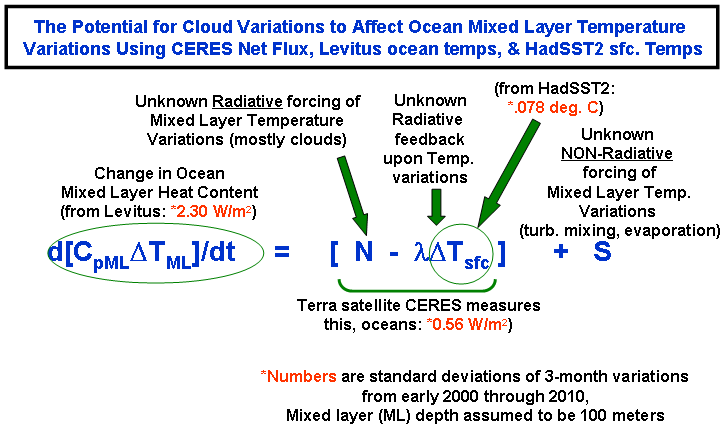
Here I went ahead and used Dessler’s assumed 100 meter depth for the ocean mixed layer, rather than the 25 meter depth we used in our last paper. (It now appears that Dessler will be using a 700 m depth, a number which was not mentioned in his preprint. I invite you to read his preprint and decide whether he is now changing from 100 m to 700 m as a result of issues I have raised here. It really is not obvious from his paper what he used).
Using the above equation, if I assumed a feedback parameter λ=3 Watts per sq. meter per degree, that 20:1 ratio Dessler gets becomes 2.2:1. If I use a feedback parameter of λ=6, then the ratio becomes 1.7:1. This is basically an order of magnitude difference from his calculation.
Again I ask: why did Dessler choose to NOT use the 3 most obvious and best sources of data to evaluate the terms in the above equation?:
(1) Levitus for observed changes in the ocean mixed layer temperature; (it now appears he will be using a number consistent with the Levitus 0-700 m layer).
(2) CERES Net radiative flux for the total of the 2 radiative terms in the above equation, and (this looks like it could be a minor source of difference, except it appears he put all of his Rcld variability in the radiative forcing term, which he claims helps our position, but running the numbers will reveal the opposite is true since his Rcld actually contains both forcing and feedback components which partially offset each other.)
(3): HadSST for sea surface temperature variations. (this will likely be the smallest source of difference)
The Use of AMIP Models to Claim our Lag Correlations Were Spurious
I will admit, this was pretty clever…but at this early stage I believe it is a red herring.
Dessler’s Fig. 1 shows lag correlation coefficients that, I admit, do look kind of like the ones we got from satellite (and CMIP climate model) data. The claim is that since the AMIP model runs do not allow clouds to cause surface temperature changes, this means the lag correlation structures we published are not evidence of clouds causing temperature change.
Following are the first two objections which immediately come to my mind:
1) Imagine (I’m again talking mostly to you geeks out there) a time series of temperature represented by a sine wave, and then a lagged feedback response represented by another sine wave. If you then calculate regression coefficients between those 2 time series at different time leads and lags (try this in Excel if you want), you will indeed get a lag correlation structure we see in the satellite data.
But look at what Dessler has done: he has used models which DO NOT ALLOW cloud changes to affect temperature, in order to support his case that cloud changes do not affect temperature! While I will have to think about this some more, it smacks of circular reasoning. He could have more easily demonstrated it with my 2 sine waves example.
Assuming there is causation in only one direction to produce evidence there is causation in only one direction seems, at best, a little weak.
2) In the process, though, what does his Fig. 1 show that is significant to feedback diagnosis, if we accept that all of the radiative variations are, as Dessler claims, feedback-induced? Exactly what the new paper by Lindzen and Choi (2011) explores: that there is some evidence of a lagged response of radiative feedback to a temperature change.
And, if this is the case, then why isn’t Dr. Dessler doing his regression-based estimates of feedback at the time lag or maximum response? Steve McIntyre, who I have provided the data to for him to explore, is also examining this as one of several statistical issues. So, Dessler’s Fig. 1 actually raises a critical issue in feedback diagnosis he has yet to address.
3. THE UGLY
(MOST, IF NOT ALL, OF THESE OBJECTIONS WILL BE ADDRESSED IN DESSLER’S UPDATE OF HIS PAPER BEFORE PUBLICATION)
The new paper contains a few statements which the reviewers should not have allowed to be published because they either completely misrepresent our position, or accuse us of cherry picking (which is easy to disprove).
Misrepresentation of Our Position
Quoting Dessler’s paper, from the Introduction:
“Introduction
The usual way to think about clouds in the climate system is that they are a feedback… …In recent papers, Lindzen and Choi [2011] and Spencer and Braswell [2011] have argued that reality is reversed: clouds are the cause of, and not a feedback on, changes in surface temperature. If this claim is correct, then significant revisions to climate science may be required.”
But we have never claimed anything like “clouds are the cause of, and not a feedback on, changes in surface temperature”! We claim causation works in BOTH directions, not just one direction (feedback) as he claims. Dr. Dessler knows this very well, and I would like to know
1) what he was trying to accomplish by such a blatant misrepresentation of our position, and
2) how did all of the peer reviewers of the paper, who (if they are competent) should be familiar with our work, allow such a statement to stand?
Cherry picking of the Climate Models We Used for Comparison
This claim has been floating around the blogosphere ever since our paper was published. To quote Dessler:
“SB11 analyzed 14 models, but they plotted only six models and the particular observational data set that provided maximum support for their hypothesis. “
How is picking the 3 most sensitive models AND the 3 least sensitive models going to “provide maximum support for (our) hypothesis”? If I had picked ONLY the 3 most sensitive, or ONLY the 3 least sensitive, that might be cherry picking…depending upon what was being demonstrated. And where is the evidence those 6 models produce the best support for our hypothesis?
I would have had to run hundreds of combinations of the 14 models to accomplish that. Is that what Dr. Dessler is accusing us of?
Instead, the point was to show that the full range of climate sensitivities represented by the least and most sensitive of the 14 models show average behavior that is inconsistent with the observations. Remember, the IPCC’s best estimate of 3 deg. C warming is almost exactly the warming produced by averaging the full range of its models’ sensitivities together. The satellite data depart substantially from that. I think inspection of Dessler’s Fig. 2 supports my point.
But, since so many people are wondering about the 8 models I left out, here are all 14 of the models’ separate results, in their full, individual glory:
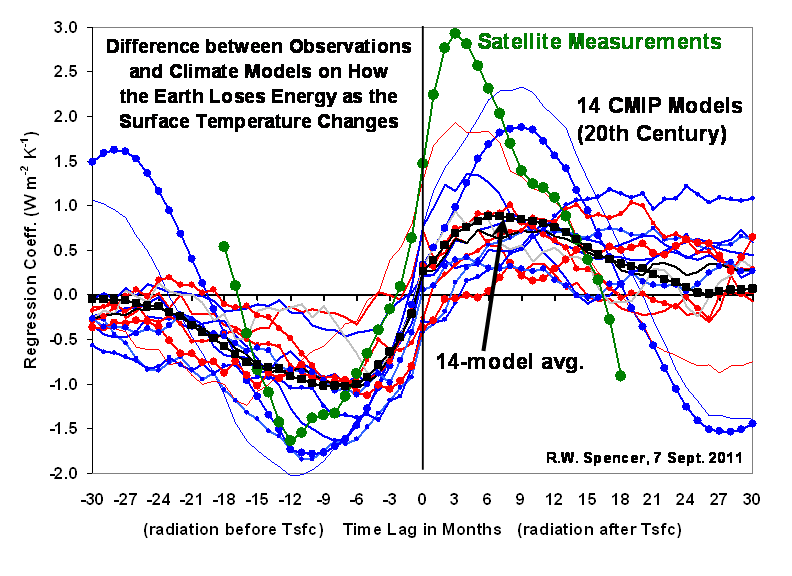
I STILL claim there is a large discrepancy between the satellite observations and the behavior of the models.
CONCLUSION
These are my comments and views after having only 1 day since we received the new paper. It will take weeks, at a minimum, to further explore all of the issues raised by Dessler (2011).
Based upon the evidence above, I would say we are indeed going to respond with a journal submission to answer Dessler’s claims. I hope that GRL will offer us as rapid a turnaround as Dessler got in the peer review process. Feel free to take bets on that. 
And, to end on a little lighter note, we were quite surprised to see this statement in Dessler’s paper in the Conclusions (italics are mine):
“These calculations show that clouds did not cause significant climate change over the last decade (over the decades or centuries relevant for long-term climate change, on the other hand, clouds can indeed cause significant warming).”
Long term climate change can be caused by clouds??! Well, maybe Andy is finally seeing the light!  (Nope. It turns out he meant ” *RADIATIVE FEEDBACK DUE TO* clouds can indeed cause significant warming”. An obvious, minor typo. My bad.)
Magnus Olert says:
September 8, 2011 at 1:15 pm
Spencer has updated his post:
UPDATE: I have been contacted by Andy Dessler, who is now examining my calculations, and we are working to resolve a remaining difference there.
======================================================
LMAO!!! Thanks for the update Magnus. I usually don’t go back to the top of the thread for quite some time in these long winded debates.
@ur momisuglyAnthony…….. this is a landmark occasion. You should pop a bottle of bubbly.
@ur momisugly all of the commentators here and other threads pertinent to this issue. This is a landmark occasion and you should pop a bottle of bubbly. Even you KR!
Me, I’m sipping on a beer, like I usually do. 🙂
While, as noted above, not even Spencer or McIntyre will likely see many accolades, and probably not much gratitude, a paper, in print, was altered, because of what I can only assume was written here on WUWT and ClimateAudit. (And at TB’s and Lubos’!!) There may have been some instances of some similarities, as far as I know, this is a first! Warm fuzzies for everyone!
James Sexton
PS…… likely that warm fuzzies end when final publication is actually finalized. Screen shot everything!
I realize that Dr Spencer is providing this post as a curtesy to WUWT, but it would be nice if he ever came back and provided feedback to some of the more serious criticisms/questions. Hopefully these types of questions do get answered at his own site, I will check on that.
Theo Goodwin says:
September 8, 2011 at 3:37 pm
……………
If anyone has doubted that the peer review process has not been controlled and corrupted by Warmista, surely this event is the concrete proof that must open their eyes.
============================================================
It seems there is a new review process(sheriff) in town. (To steal from a quote) I’ve seen the reviewers, and it is us! We (the skeptic blogosphere) just smoked the reviewers of GRL before it even got printed! I’m presuming all of the official reviewers held PhDs, and were climatologists.
Interesting… In their haste to demonstrate the problems with peer review regarding S&B they have highlighted problems in their own, as if that was their goal. Another own goal? Corrections already before publication. Must be a record.
Mark
Brian says:
September 8, 2011 at 3:33 pm
“There’s a lot of noise coming out of WUWT at present.
Could it be because of the “ugly” news coming out of the arctic?”
No, you won’t believe it! Because of stumbling by one of Trenberth’s minions, Wagner, Trenberth is likely to lose editorial control of AR5! Amazing, huh! Read all about it above! You won’t read it anywhere else, especially not in the MSM.
Dr. Roy, I always felt that Dr. Dessler was one of the good guys. He seems to want to get the science right, which is always encouraging. Wouldn’t it be ironic if your next paper was by S&B&D?
Thanx for being open and honest to both of you.
Brian says:
September 8, 2011 at 3:33 pm
There’s a lot of noise coming out of WUWT at present.
Could it be because of the “ugly” news coming out of the arctic?
Extent is now below the median prediction – area is equal to record (probably now below 2007) and volume is a new record set by crash last year.Still some melting left this year.
It would appear to be a matter of whose SWAG you choose to embrace. Most of the metrics on the Sea Ice Reference page are still above 2007. I would also point out that most all of those lovely graphics are maps not photos and despite the tendency of nearly all of them to quote their data out to the nearest km2, it’s hardly justified to trust any of them for better than +/- a couple hundred thousand km2 based on the self admitted flaws in their methodologies. You seem to anticipate further melting, but temps in the Arctic have moved to well below freezing and any declines in the ice from this point are likely to be limited to ice exiting out the Fram.
Even if the decline should lead to a number below 2007, what remains will still constitute an area of ice approximately the size of one half of the lower 48 states. And finally if at some future point the summer minimum should actually drop to zero, SO WHAT?
Theo Goodwin
Regarding physical hypotheses, cause and effect, I would point you at (among other resources found with a few seconds of Google time) http://www.aip.org/history/climate/co2.htm for an overview. Forcings, feedbacks, observations, mechanisms, etc., developed over the last 190 years.
Plate tectonics wasn’t accepted until a testable physical mechanism was proposed, one which accounted for all the data better than previous explanations. I await such a proposed new mechanism from skeptics like Spencer. But I’m not holding my breath.
The rest of your postings are rant and rhetoric – not worth replying to. I believe readers can make that judgement for themselves – if they disagree, they can comment. Otherwise I’m not going to waste time with a response until/unless you say something worth talking about.
I think it’s entirely possible that one of these days a paper by Spencer will actually hold up under scrutiny. I’m not overly optimistic about this one, but you never know.
In any case, just because a scientist has a world view that includes the Earth being created by God for man to subdue, and there being enough and to spare, and Jesus coming back to the rescue, doesn’t disqualify him from being a self-proclaimed political advocate with his science.
UPDATE: Dr. Spencer writes: I have been contacted by Andy Dessler, who is now examining my calculations, and we are working to resolve a remaining difference there.
======
Good to hear.
Let’s get it right.
This has been quite an intense peer review here on WUWT! The turnaround for the paper (Dressler) was unpresidented in terms of speed/time for corrections.
I think this has been a decisive battle in the march for the truth involving many fronts. Congratulations to all involved!
Unfortunately there will be a few sore/sour losers.
TLM says: September 8, 2011 at 6:27 am:
“Two planets in the same star system in the same orbit. One has air of pure nitrogen and no water or other gases, the other has liquid water seas and air composed of oxygen, nitrogen and greenhouse gases (water vapour, methane, CO2 etc). Both have the same energy budget, 1365 watts in, 1365 out. Both in approximate steady state. The one with the thick and complex atmosphere with the water vapour etc has a much higher surface air temperature than the one with a thin atmosphere.”
Lets run that experiment shall we?
The first order reaction rate for the non-biotic reaction chemical and photochmical reaction of O2 with rocks and with N2 (via lightening) is about 4.7×10^-8, which gives oxygen a half-life of only 14.5 million years. this ignores ocean buffering. It also 7 10^19 of hydrocarbon sitting around in the form of dead biotic material.
We only have an oxygen right atmosphere because of the biosphere.
Shelama says:
September 8, 2011 at 5:34 pm
Your bigotry is your most prominent feature.
KR says:
September 8, 2011 at 4:55 pm …
___________________________
Are we then to assume that the whole CAGW hypothesis is based on testable physical mechanisms which account for all the data?
I’m not holding my breath, either.
KR says:
September 8, 2011 at 4:55 pm
You introduced the topic of physical hypotheses. I questioned you about them and you have nothing to say. Just another Warmista. Everyone here can see that.
Of course you think I am ranting and raving. You have not a clue what I am talking about. Just another Warmista. Wouldn’t know a physical hypothesis or an example of good scientific method if they were staring you in the face. Actually, they are. Svensmark and Kirkby have both.
Shelama says:
September 8, 2011 at 5:34 pm
==========
And, just out of curiosity, from under what rock did you crawl ?
Brian says:
September 8, 2011 at 3:33 pm
“There’s a lot of noise coming out of WUWT at present.
Could it be because of the “ugly” news coming out of the arctic?
Extent is now below the median prediction – area is equal to record (probably now below 2007) and volume is a new record set by crash last year.
Still some melting left this year.”
____________________________________________
Why do you ascribe any sort of relevance to Arctic ice extent?
Shelama says:
September 8, 2011 at 5:34 pm
I think it’s entirely possible that one of these days a paper by Spencer will actually hold up under scrutiny……..(And then a bunch of anti-Christian bigotry……..)
On the scientific note, can you, or anyone else, refute his findings? I’m breathlessly awaiting something of more substance than Dessler’s pathetic response.
On a personal note…… you should thank God there are people that are taught to love, even bigots such as yourself.
Theo Goodwin says:
September 8, 2011 at 6:40 pm
KR says:
September 8, 2011 at 4:55 pm
You introduced the topic of physical hypotheses. I questioned you about them and you have nothing to say. …..
——————————————————————–
You have not a clue what I am talking about.
=======================================
Theo, physics are tricky things….. you have to Bing-search and everything to find physical laws. One may even have to observe stuff to understand!!
Best to avoid talking about such stuff. It’s much easier to bag on Christians.
I certainly hopes that you get mentioned as being extremely helpful in preparing the article.
Shelama;
Nice drive by shooting there. You managed to denigrate Dr. Spencer’s religious and political beliefes in just a couple of sentences. I note Wolfgang Wagner works out of the “Christian Doppler” laboratory at Vienna University of Technology. Being given the name it has, I suppose that discredits Wagner’s work, the laboratory, and Doppler’s as well? How about shutting your bigotry off for a moment and tell us something of relevance to the SCIENCE?
Brian; Nice try. I couldn’t care less if the arctic ice is down 1% or 20%. Do you Know why? Because we have no clue why it is or isn’t happening, or if it should be or not. Do you know why? BECAUSE TYRANNICAL DICTATORS IN THE SCIENCE WORLD LIKE JONES AND TRENBERTH HAVE BEEN ACTIVELY SUPPRESSING THE ACTUAL SCIENCE WE WOULD NEED TO MAKE ANY SENSE OUT OF IT. ARE YOU OK WITH THAT?
KR; Nice bunch of half truths, a straw man proposition that is irrelvant to the discussion, followed by the contemptuous sneer that clearly ends the argument – you’re not even going to respond anymore unless Theo answers your nonsense position. Sort of being shot at by a guy who’s gun goes bang!, bang!, click, click, click, click, click, click, click… and then the guy says “stop or I will shoot!” Not much to worry about when the first two shots were fired directly at the guy’s own feet and he’s now out of actual ammunition. I’ll tell you what KR. You post under your real name, because if you are so high and might and RIGHT, you should have nothing to fear by doing so, post under your owqn name, and THEN you’ll have enough credibility for your comments to be taken with at least a grain of seriousness. Following which I, or someone else, will answer you properly and expose your foolishness for what it is.
S. Geiger says:
September 8, 2011 at 4:02 pm
I realize that Dr Spencer is providing this post as a curtesy to WUWT, but it would be nice if he ever came back and provided feedback to some of the more serious criticisms/questions. Hopefully these types of questions do get answered at his own site, I will check on that.
——————-
You should really go to the same thread on his own blog. I see that he responds to a majority of criticisms/question. Always go to the source first, I don’t know why people address him directly with questions on other peoples sites all of the time.
http://www.drroyspencer.com/2011/09/the-good-the-bad-and-the-ugly-my-initial-comments-on-the-new-dessler-2011-study/
Dr. Spencer,
While I applaud you for even being willing to communicate at all, at any level, let alone cooperation, with someone like Dessler…. I have to say also:
When someone who has repeatedly been my detractor, a known confident of those who have done me harm in the past and swear to do so again in the future, suddenly reaches out the hand of friendship… a little voice in the back of my head whispers:
shields up. don’t take your eyes off him for a moment. and watch your back. he’s got friends circling around somewhere…
Sorry, but I just don’t buy Dessler’s outreach.
I would like to encourage everyone who posts here to first research the difference between Dr. Andrew Dessler of Texas A&M (http://atmo.tamu.edu/profile/ADessler) and someone named Dressler.
Brian says:
September 8, 2011 at 3:33 pm
There’s a lot of noise coming out of WUWT at present.
Could it be because of the “ugly” news coming out of the arctic?
==============
Ugly news, is Dresden gets fire bombed, in spite.
Do you want to play this game.
It’s been played before.