NOTE: This post is important, so I’m going to sticky it at the top for quite a while. I’ve created a page for all Spencer and Braswell/Dessler related posts, since they are becoming numerous and popular to free up the top post sections of WUWT.
UPDATE: Dr. Spencer writes: I have been contacted by Andy Dessler, who is now examining my calculations, and we are working to resolve a remaining difference there. Also, apparently his paper has not been officially published, and so he says he will change the galley proofs as a result of my blog post; here is his message:
“I’m happy to change the introductory paragraph of my paper when I get the galley proofs to better represent your views. My apologies for any misunderstanding. Also, I’ll be changing the sentence “over the decades or centuries relevant for long-term climate change, on the other hand, clouds can indeed cause significant warming” to make it clear that I’m talking about cloud feedbacks doing the action here, not cloud forcing.”
[Dessler may need to make other changes, it appears Steve McIntyre has found some flaws related to how the CERES data was combined: http://climateaudit.org/2011/09/08/more-on-dessler-2010/
As I said before in my first post on Dessler’s paper, it remains to be seen if “haste makes waste”. It appears it does. -Anthony]
Update #2 (Sept. 8, 2011): Spencer adds: I have made several updates as a result of correspondence with Dessler, which will appear underlined, below. I will leave it to the reader to decide whether it was our Remote Sensing paper that should not have passed peer review (as Trenberth has alleged), or Dessler’s paper meant to refute our paper.
by Roy W. Spencer, Ph. D.
While we have had only one day to examine Andy Dessler’s new paper in GRL, I do have some initial reaction and calculations to share. At this point, it looks quite likely we will be responding to it with our own journal submission… although I doubt we will get the fast-track, red carpet treatment he got.
There are a few positive things in this new paper which make me feel like we are at least beginning to talk the same language in this debate (part of The Good). But, I believe I can already demonstrate some of The Bad, for example, showing Dessler is off by about a factor of 10 in one of his central calculations.
Finally, Dessler must be called out on The Ugly things he put in the paper.
(which he has now agreed to change).
1. THE GOOD
Estimating the Errors in Climate Feedback Diagnosis from Satellite Data
We are pleased that Dessler now accepts that there is at least the *potential* of a problem in diagnosing radiative feedbacks in the climate system *if* non-feedback cloud variations were to cause temperature variations. It looks like he understands the simple-forcing-feedback equation we used to address the issue (some quibbles over the equation terms aside), as well as the ratio we introduced to estimate the level of contamination of feedback estimates. This is indeed progress.
He adds a new way to estimate that ratio, and gets a number which — if accurate — would indeed suggest little contamination of feedback estimates from satellite data. This is very useful, because we can now talk about numbers and how good various estimates are, rather than responding to hand waving arguments over whether “clouds cause El Nino” or other red herrings. I have what I believe to be good evidence that his calculation, though, is off by a factor of 10 or so. More on that under THE BAD, below.
Comparisons of Satellite Measurements to Climate Models
Figure 2 in his paper, we believe, helps make our point for us: there is a substantial difference between the satellite measurements and the climate models. He tries to minimize the discrepancy by putting 2-sigma error bounds on the plots and claiming the satellite data are not necessarily inconsistent with the models.
But this is NOT the same as saying the satellite data SUPPORT the models. After all, the IPCC’s best estimate projections of future warming from a doubling of CO2 (3 deg. C) is almost exactly the average of all of the models sensitivities! So, when the satellite observations do depart substantially from the average behavior of the models, this raises an obvious red flag.
Massive changes in the global economy based upon energy policy are not going to happen, if the best the modelers can do is claim that our observations of the climate system are not necessarily inconsistent with the models.
(BTW, a plot of all of the models, which so many people have been clamoring for, will be provided in The Ugly, below.)
2. THE BAD
The Energy Budget Estimate of How Much Clouds Cause Temperature Change
While I believe he gets a “bad” number, this is the most interesting and most useful part of Dessler’s paper. He basically uses the terms in the forcing-feedback equation we use (which is based upon basic energy budget considerations) to claim that the energy required to cause changes in the global-average ocean mixed layer temperature are far too large to be caused by variations in the radiative input into the ocean brought about by cloud variations (my wording).
He gets a ratio of about 20:1 for non-radiatively forced (i.e. non-cloud) temperature changes versus radiatively (mostly cloud) forced variations. If that 20:1 number is indeed good, then we would have to agree this is strong evidence against our view that a significant part of temperature variations are radiatively forced. (It looks like Andy will be revising this downward, although it’s not clear by how much because his paper is ambiguous about how he computed and then combined the radiative terms in the equation, below.)
But the numbers he uses to do this, however, are quite suspect. Dessler uses NONE of the 3 most direct estimates that most researchers would use for the various terms. (A clarification on this appears below) Why? I know we won’t be so crass as to claim in our next peer-reviewed publication (as he did in his, see The Ugly, below) that he picked certain datasets because they best supported his hypothesis.
The following graphic shows the relevant equation, and the numbers he should have used since they are the best and most direct observational estimates we have of the pertinent quantities. I invite the more technically inclined to examine this. For those geeks with calculators following along at home, you can run the numbers yourself:
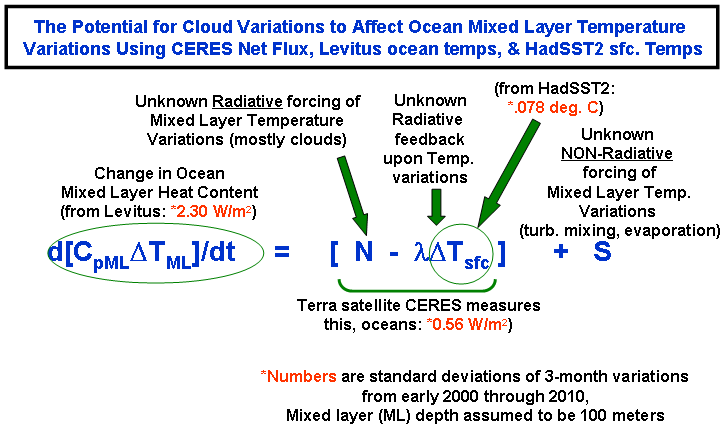
Here I went ahead and used Dessler’s assumed 100 meter depth for the ocean mixed layer, rather than the 25 meter depth we used in our last paper. (It now appears that Dessler will be using a 700 m depth, a number which was not mentioned in his preprint. I invite you to read his preprint and decide whether he is now changing from 100 m to 700 m as a result of issues I have raised here. It really is not obvious from his paper what he used).
Using the above equation, if I assumed a feedback parameter λ=3 Watts per sq. meter per degree, that 20:1 ratio Dessler gets becomes 2.2:1. If I use a feedback parameter of λ=6, then the ratio becomes 1.7:1. This is basically an order of magnitude difference from his calculation.
Again I ask: why did Dessler choose to NOT use the 3 most obvious and best sources of data to evaluate the terms in the above equation?:
(1) Levitus for observed changes in the ocean mixed layer temperature; (it now appears he will be using a number consistent with the Levitus 0-700 m layer).
(2) CERES Net radiative flux for the total of the 2 radiative terms in the above equation, and (this looks like it could be a minor source of difference, except it appears he put all of his Rcld variability in the radiative forcing term, which he claims helps our position, but running the numbers will reveal the opposite is true since his Rcld actually contains both forcing and feedback components which partially offset each other.)
(3): HadSST for sea surface temperature variations. (this will likely be the smallest source of difference)
The Use of AMIP Models to Claim our Lag Correlations Were Spurious
I will admit, this was pretty clever…but at this early stage I believe it is a red herring.
Dessler’s Fig. 1 shows lag correlation coefficients that, I admit, do look kind of like the ones we got from satellite (and CMIP climate model) data. The claim is that since the AMIP model runs do not allow clouds to cause surface temperature changes, this means the lag correlation structures we published are not evidence of clouds causing temperature change.
Following are the first two objections which immediately come to my mind:
1) Imagine (I’m again talking mostly to you geeks out there) a time series of temperature represented by a sine wave, and then a lagged feedback response represented by another sine wave. If you then calculate regression coefficients between those 2 time series at different time leads and lags (try this in Excel if you want), you will indeed get a lag correlation structure we see in the satellite data.
But look at what Dessler has done: he has used models which DO NOT ALLOW cloud changes to affect temperature, in order to support his case that cloud changes do not affect temperature! While I will have to think about this some more, it smacks of circular reasoning. He could have more easily demonstrated it with my 2 sine waves example.
Assuming there is causation in only one direction to produce evidence there is causation in only one direction seems, at best, a little weak.
2) In the process, though, what does his Fig. 1 show that is significant to feedback diagnosis, if we accept that all of the radiative variations are, as Dessler claims, feedback-induced? Exactly what the new paper by Lindzen and Choi (2011) explores: that there is some evidence of a lagged response of radiative feedback to a temperature change.
And, if this is the case, then why isn’t Dr. Dessler doing his regression-based estimates of feedback at the time lag or maximum response? Steve McIntyre, who I have provided the data to for him to explore, is also examining this as one of several statistical issues. So, Dessler’s Fig. 1 actually raises a critical issue in feedback diagnosis he has yet to address.
3. THE UGLY
(MOST, IF NOT ALL, OF THESE OBJECTIONS WILL BE ADDRESSED IN DESSLER’S UPDATE OF HIS PAPER BEFORE PUBLICATION)
The new paper contains a few statements which the reviewers should not have allowed to be published because they either completely misrepresent our position, or accuse us of cherry picking (which is easy to disprove).
Misrepresentation of Our Position
Quoting Dessler’s paper, from the Introduction:
“Introduction
The usual way to think about clouds in the climate system is that they are a feedback… …In recent papers, Lindzen and Choi [2011] and Spencer and Braswell [2011] have argued that reality is reversed: clouds are the cause of, and not a feedback on, changes in surface temperature. If this claim is correct, then significant revisions to climate science may be required.”
But we have never claimed anything like “clouds are the cause of, and not a feedback on, changes in surface temperature”! We claim causation works in BOTH directions, not just one direction (feedback) as he claims. Dr. Dessler knows this very well, and I would like to know
1) what he was trying to accomplish by such a blatant misrepresentation of our position, and
2) how did all of the peer reviewers of the paper, who (if they are competent) should be familiar with our work, allow such a statement to stand?
Cherry picking of the Climate Models We Used for Comparison
This claim has been floating around the blogosphere ever since our paper was published. To quote Dessler:
“SB11 analyzed 14 models, but they plotted only six models and the particular observational data set that provided maximum support for their hypothesis. “
How is picking the 3 most sensitive models AND the 3 least sensitive models going to “provide maximum support for (our) hypothesis”? If I had picked ONLY the 3 most sensitive, or ONLY the 3 least sensitive, that might be cherry picking…depending upon what was being demonstrated. And where is the evidence those 6 models produce the best support for our hypothesis?
I would have had to run hundreds of combinations of the 14 models to accomplish that. Is that what Dr. Dessler is accusing us of?
Instead, the point was to show that the full range of climate sensitivities represented by the least and most sensitive of the 14 models show average behavior that is inconsistent with the observations. Remember, the IPCC’s best estimate of 3 deg. C warming is almost exactly the warming produced by averaging the full range of its models’ sensitivities together. The satellite data depart substantially from that. I think inspection of Dessler’s Fig. 2 supports my point.
But, since so many people are wondering about the 8 models I left out, here are all 14 of the models’ separate results, in their full, individual glory:
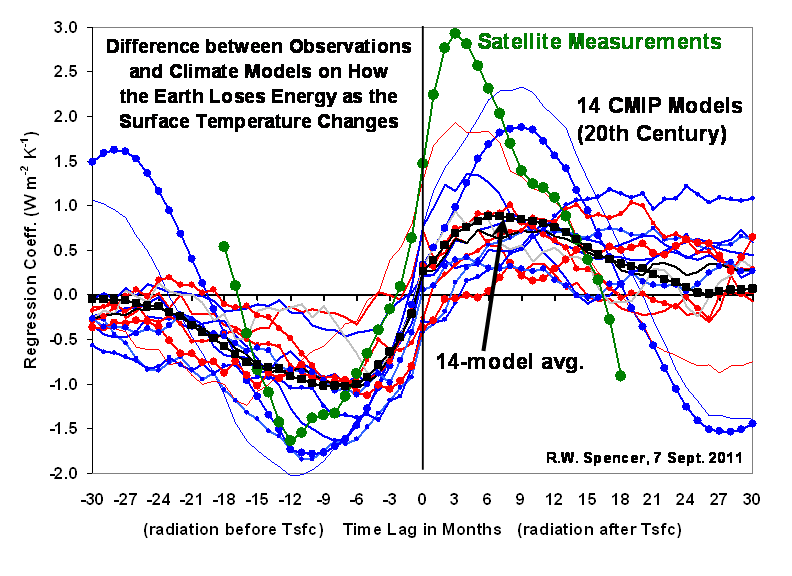
I STILL claim there is a large discrepancy between the satellite observations and the behavior of the models.
CONCLUSION
These are my comments and views after having only 1 day since we received the new paper. It will take weeks, at a minimum, to further explore all of the issues raised by Dessler (2011).
Based upon the evidence above, I would say we are indeed going to respond with a journal submission to answer Dessler’s claims. I hope that GRL will offer us as rapid a turnaround as Dessler got in the peer review process. Feel free to take bets on that. 
And, to end on a little lighter note, we were quite surprised to see this statement in Dessler’s paper in the Conclusions (italics are mine):
“These calculations show that clouds did not cause significant climate change over the last decade (over the decades or centuries relevant for long-term climate change, on the other hand, clouds can indeed cause significant warming).”
Long term climate change can be caused by clouds??! Well, maybe Andy is finally seeing the light!  (Nope. It turns out he meant ” *RADIATIVE FEEDBACK DUE TO* clouds can indeed cause significant warming”. An obvious, minor typo. My bad.)
Bill Parsons says:
September 8, 2011 at 9:59 am
I liken the cloud forcing/feedback to a chicken/egg discussion. And you’re right, it isn’t as important as the fact that this may account for the “Travesty’s” missing heat. Like the Dr. Seuss character, they “could not find it any where.” Logically, that would be because its gone.
I should think the real travesty is that we are heating the rest of the universe. In so doing, we’re setting the worst kind of bad example for other civilizations. The Guardian warned us about this kind of thing. Did we listen? No – o – o – o…
===================================================
HAHAHAHAHAH!!!!! Very nice.
@KR,
I just read Dessler’s paper again. Neither “statistical” nor “significance” appears to be in the paper that I noticed. Nor is there any type of statistical test in Dessler et al. Regression means nothing without an F-test or some other test to tell you if the regression is significant; as all random data will show regressions at some level.
This alone means his paper says.. well.. nothing. Those statistical tests tell you if something is real or not, and they are absent, so his entire paper is, in my view, void. As is ANY paper comparing data that lacks statistical tests for significance. That goes for Dr. Spencer as well if he fails to include some type of accepted statistical testing. There are no ifs, ands, or buts about this.
davidmhoffer says:
September 8, 2011 at 9:32 am
———————-
🙂 Humor, a joke (good one if I may say so), satire, etc. Seems some of the populace has a shoulder chip or doesn’t appreciate humor, satire, sarcasm, etc. 🙂
Does Penn State vs State Penn ring a bell? Disclaimer: the previous comment regarding Penn State was satire, pun, made in jest, not to be taken seriously, not ment to inflect emotional harm or duress, not to be taken seriously in the literal sense, not meant to suggest any wrong doing by any person, entity, organization, penal system, or other, or to suggest anything that would make any sense at all about anything that anyone could conjuncture up in their wildest dreams of/or imagination or to offend in any way one whom may by sensitive in their emotional state or any other mental capacity that would/could be perceived as not exibiting total respect and admiration to the afore words, whether they be misspelled or not presented in a proper literary fashion, subject not only to capitalization, punctuation, etc. as may be defined in a standard dictionary that a reasonable person could be expected to consult, or to have any meaning at all. 🙂
There have been a number of posts directed towards me – I think I can summarize my answers, though.
* Dr. Spencer compared models to one of the temperature data sets, and concluded that the models didn’t match well over a 10 year period. From this he concluded that model climate sensitivities are extremely off.
* He did not, however, show the results for all the models he studied. Several of those are known to model the ENSO quite well, and over a 10 year period you’re really looking at short term variations like the ENSO and not equilibrium or even short term climate sensitivity. Hence his test is more a test of ENSO modeling than sensitivity. He instead showed the results of the models that deviated the most from the data, without (in my opinion, and the opinions of a great many other folks) justifying that selection. Your hypotheses need to stand up to the strongest evidence, not just a (cherry-picked?) selection of the weakest evidence.
* Those three best matching models, which are known to model the ENSO well, are as close to the single observational data (HadCRUT3) as other temperature records such as GISTEMP. In fact, HadCRUT3 deviates the most from the models – another outlier.
* Dessler found that data such as ARGO indicate ~20:1 times the energy for short term (10 year) fluctuations coming from ENSO variations rather than cloud radiative forcing, which is observational data. Spencer (1:2) and Lindzen (2:1) have used assumptions for those numbers. There may be grounds to debate this, but that should be based upon data rather than guessing. This goes straight to the question of whether clouds are a forcing or a feedback.
* Dr. Spencer also, in his equations, assumes that clouds are a forcing, and his computations reflect that inherent assumption. Assuming your conclusion is not good practice.
* Regardless of the eventual conclusions (and cloud effects are an ongoing area of research), the cherry-picked results, short time frame, assuming his conclusions, etc., simply look bad, and detract from his work. I really wish that he had written a paper without these issues.
Now as to the requests for “physical hypotheses”, I’ll note that the original request (to Dr. Spencer) came from me. Dr. Spencer seems to be the outlier, in that he is postulating effects without a matching cause.
—
At the end of the matter, however, it’s up to Dr. Spencer to defend his work. I’m still waiting.
On an OT, but fairly interesting in this context topic I came across this
http://marginalrevolution.com/marginalrevolution/2011/09/how-good-is-published-academic-research.html
It’s a economics blog column commenting on this
http://www.nature.com/nrd/journal/v10/n9/full/nrd3439-c1.html
From the column
“Bayer halts nearly two-thirds of its target-validation projects because in-house experimental findings fail to match up with published literature claims, finds a first-of-a-kind analysis on data irreproducibility.”
“People take for granted what they see published,” says John Ioannidis, an expert on data reproducibility at Stanford University School of Medicine in California, USA. “But this and other studies are raising deep questions about whether we can really believe the literature, or whether we have to go back and do everything on our own.”
“The unspoken rule is that at least 50% of the studies published even in top tier academic journals – Science, Nature, Cell, PNAS, etc… – can’t be repeated with the same conclusions by an industrial lab. In particular, key animal models often don’t reproduce. This 50% failure rate isn’t a data free assertion: it’s backed up by dozens of experienced R&D professionals who’ve participated in the (re)testing of academic findings.”
This is about studies relating to the pharmaceuticals industry and probably isn’t directly comparable to climate works, but we are quite often told that the “consensus” about CAGW extends across “science” generally and in that context it seems interesting indeed.
There’s a new post up at Climate Audit which everyone here should see:
http://climateaudit.org/2011/09/08/more-on-dessler-2010/
Seems you get different results depending on how you create a cloud forcing series.
davidmhoffer says:
September 7, 2011 at 9:31 pm
“The system will arrive at a steady state temperature which radiates heat to space that equals the total of the energy inputs. Complexity of the system being unknown, and the body spinning in space versus the radiated energy source, there will be cyclic variations in temperature, but the long term average will not change.”
For a perfect blackbody, only. See this.
SethP says:
September 7, 2011 at 8:10 pm
Has anyone done a study on what atmospheric gasses the increased C02 is displacing? Could this work out to be a net negative forcing if it displaces mainly water vapor? It would have to displace more “less effective” greenhouse gasses to create a net positive forcing, no?
well, is CO2 not replacing O2, molecule for molecule?
Alan Clark of Dirty Oil-berta says:
September 8, 2011 at 8:56 am
The internet has changed media profoundly. Few people watch TV news anymore and even fewer read print, electing to get information from the `net instead. I can’t imagine why science is clinging to this peer-review system of submitting papers to scientific journals when what is patently evident from reading this site, is that each and every idea, theory and treatise could simply be posted to a blog such as this and receive absolute critical review within hours from some of the best and most knowledgeable minds on the planet. Peer-review needs to come into the 21st century.
I quite agree with you on this one, but with the current bigotry in certain branches of science (health and climate change to be precise) “peer review” means review by peers who happen to agree with you. This is confirmed by the Michael Mann and University of Virginia not wanting to publicise their data. If peer review could be carried out on a neutral basis rather than on a snout in the trough basis then it would be a fantastic system.
Spencer has updated his post:
UPDATE: I have been contacted by Andy Dessler, who is now examining my calculations, and we are working to resolve a remaining difference there. Also, apparently his paper has not been officially published, and so he says he will change the galley proofs as a result of my blog post; here is his message:
“I’m happy to change the introductory paragraph of my paper when I get the galley proofs to better represent your views. My apologies for any misunderstanding. Also, I’ll be changing the sentence “over the decades or centuries relevant for long-term climate change, on the other hand, clouds can indeed cause significant warming” to make it clear that I’m talking about cloud feedbacks doing the action here, not cloud forcing.”
http://www.drroyspencer.com/2011/09/the-good-the-bad-and-the-ugly-my-initial-comments-on-the-new-dessler-2011-study/
Gras Albert says:
September 7, 2011 at 1:05 pm
“* by the way, might I suggest that an appropriate collective noun for such an eminent group of climate scientists might be a ‘cloud’”
Please note that Apple Computer Corporation is beginning proceedings against climate scientists for the use of the term ‘cloud’. Apple maintains the term ‘cloud’ conflicts with their iCloud trademark, which is used to describe specific Apple Computer Corporation products simulating virtual computing within the virtual public network, and as such implore the Courts to issue cease and desist notices, or in some cases penalties for damages, versus climate scientists. Further, Apple has evidence showing that the term ‘cloud’ was formed within Apple Computer Corporation for marketing and research purposes related to said current product offering, and as such Apple Computer Corporation implores the Courts to also validate Copyright claims of Apple Computer Corporation on the term ‘cloud’ in all use and meanings, in all jurisdictions.
TLM says:
September 8, 2011 at 6:27 am
davidmhoffer says:
September 7, 2011 at 9:31 pm
…..
Energy is NOT temperature!! Physics 101 (GCSE to us here in blighty).
….
I make no comment on your examples but you are right to point out that energy is not temperature., Likewise, temperature is not energy, so what exactly do the various temperature anomaly sets establish? They do not establish that there has been any change in the energy budget, nor even an internal distribution of the budget. The only data set of any real value is sea temperature sets since they potentially measure energy.
My money says that your rebuttal will never be published in GRL, unless you toe the line.
Roy,
Don’t expect to get your rebuttel to get published in time to be included in the IPPC report, but if any Journal fails to publish it before November,2012, they won’t have much more credibility than the IPPC. Submit it to several Journals along with a news release and see what happens. This is going to be a hot political topic and a lot of jobs are at stake.
Such a small pin head, yet so many dancers.
More pins needed, and a better fiddler.
Note to Steve McIntyre and Roy Spencer: if you guys continue to help Dessler write his paper, perhaps you should request co-authorship or at least be included in the acknowledgement section with regards to specific points! Really as much as it is making science progress, it is naive at best to kindly serve people who have done everything in their own power to demean and attack you! in the end it also shows how peer review sceintific journals are obsolete means of doing science since blogosphere is doing it much faster and with more agility.
And for strategizing the next step, which should be to multiply the fronts on which our side engages with the enemy. Here’s what I suggested a few days ago, in response to another of Theo’s comments:
In another comment I added:
Did Apple miss my post of yesterday or the day before? I explained that no Warmista model contains the primitive predicate “___is a cloud,” known also as the term ‘cloud’.
KR says:
September 8, 2011 at 12:12 pm
“Now as to the requests for “physical hypotheses”, I’ll note that the original request (to Dr. Spencer) came from me. Dr. Spencer seems to be the outlier, in that he is postulating effects without a matching cause.”
Yeah, why did you give it up? Something I predicted. Care to discuss scientific method?
Spencer is an outlier? You know very well that Warmista have no physical hypotheses relevant to this discussion and not one of any sort beyond Arrhenius’ ancient hypotheses. Arrhenius’ hypotheses cover neither forcings nor feedbacks. If you believe that they have them then bring them here in your own words.
Do you even know how to describe a physical hypothesis? Some data points taken from an unknown population of events and a few statistical inferences from them do not a physical hypothesis make. A physical hypothesis is a universally quantified conditional sentence that implies the data that count as its evidence or it is an objective statistical hypothesis over a known population. Aside from Arrhenius, there is not one Warmista who has ever created a physical hypothesis that implies the data that count as its evidence. And that is why Warmista have no physical evidence for their claims, none beyond Arrhenius.
Magnus Olert says:
September 8, 2011 at 1:15 pm
Spencer has updated his post:
UPDATE: I have been contacted by Andy Dessler, who is now examining my calculations, and we are working to resolve a remaining difference there. Also, apparently his paper has not been officially published, and so he says he will change the galley proofs as a result of my blog post; here is his message:
“I’m happy to change the introductory paragraph of my paper when I get the galley proofs to better represent your views. My apologies for any misunderstanding. Also, I’ll be changing the sentence “over the decades or centuries relevant for long-term climate change, on the other hand, clouds can indeed cause significant warming” to make it clear that I’m talking about cloud feedbacks doing the action here, not cloud forcing.”
That last bit made me laugh. I posted this comment at Roy’s site:
Lol. Cloud feedbacks during centuries which are feeding back to what forcing? Not co2, which allegedly bimbled along at a nice steady 270ppm.
So, if the feedback was causing warming, can’t have been volcanos… must be solar then? But if that’s the case, then why would clouds have stopped feeding back to solar variation when co2 started to increase? Hmmm?
Maybe Andy Dessler should read Nir Shaviv’s JGR paper ‘Using the oceans as a calorimeter’.
http://sciencebits.com/calorimeter
Roger Knights says:
September 8, 2011 at 3:08 pm
I am with you totally, Roger. Though I would not restrict the panel to the retired. You might want to write your congressman about this matter.
Wagner’s blunder started this and Trenberth’s boasting added to the speed. I wonder just how far down Trenberth’s *hit list Wagner is at this point?
There’s a lot of noise coming out of WUWT at present.
Could it be because of the “ugly” news coming out of the arctic?
Extent is now below the median prediction – area is equal to record (probably now below 2007) and volume is a new record set by crash last year.
Still some melting left this year.
I am amazed that an unforced error (baseball term) on the part of the Warmista, Wagner, and the resulting panic on the part of other Warmista, Trenberth and Dessler, which led to predictable over-reach from the Warmista, Dessler’s hurried and pal reviewed reply, are what finally opened a little dialogue between Warmista and some of the critics of their science.
If anyone has doubted that the peer review process has not been controlled and corrupted by Warmista, surely this event is the concrete proof that must open their eyes.
Did this actually get through peer review with all these mistakes? How? What idiot(s) reviewed it?
KR:
So… you’re incapable of coming up with plausible hypotheses on your own?
Seriously, this younger generation needs their hand held with everything.