NOTE: This post is important, so I’m going to sticky it at the top for quite a while. I’ve created a page for all Spencer and Braswell/Dessler related posts, since they are becoming numerous and popular to free up the top post sections of WUWT.
UPDATE: Dr. Spencer writes: I have been contacted by Andy Dessler, who is now examining my calculations, and we are working to resolve a remaining difference there. Also, apparently his paper has not been officially published, and so he says he will change the galley proofs as a result of my blog post; here is his message:
“I’m happy to change the introductory paragraph of my paper when I get the galley proofs to better represent your views. My apologies for any misunderstanding. Also, I’ll be changing the sentence “over the decades or centuries relevant for long-term climate change, on the other hand, clouds can indeed cause significant warming” to make it clear that I’m talking about cloud feedbacks doing the action here, not cloud forcing.”
[Dessler may need to make other changes, it appears Steve McIntyre has found some flaws related to how the CERES data was combined: http://climateaudit.org/2011/09/08/more-on-dessler-2010/
As I said before in my first post on Dessler’s paper, it remains to be seen if “haste makes waste”. It appears it does. -Anthony]
Update #2 (Sept. 8, 2011): Spencer adds: I have made several updates as a result of correspondence with Dessler, which will appear underlined, below. I will leave it to the reader to decide whether it was our Remote Sensing paper that should not have passed peer review (as Trenberth has alleged), or Dessler’s paper meant to refute our paper.
by Roy W. Spencer, Ph. D.
While we have had only one day to examine Andy Dessler’s new paper in GRL, I do have some initial reaction and calculations to share. At this point, it looks quite likely we will be responding to it with our own journal submission… although I doubt we will get the fast-track, red carpet treatment he got.
There are a few positive things in this new paper which make me feel like we are at least beginning to talk the same language in this debate (part of The Good). But, I believe I can already demonstrate some of The Bad, for example, showing Dessler is off by about a factor of 10 in one of his central calculations.
Finally, Dessler must be called out on The Ugly things he put in the paper.
(which he has now agreed to change).
1. THE GOOD
Estimating the Errors in Climate Feedback Diagnosis from Satellite Data
We are pleased that Dessler now accepts that there is at least the *potential* of a problem in diagnosing radiative feedbacks in the climate system *if* non-feedback cloud variations were to cause temperature variations. It looks like he understands the simple-forcing-feedback equation we used to address the issue (some quibbles over the equation terms aside), as well as the ratio we introduced to estimate the level of contamination of feedback estimates. This is indeed progress.
He adds a new way to estimate that ratio, and gets a number which — if accurate — would indeed suggest little contamination of feedback estimates from satellite data. This is very useful, because we can now talk about numbers and how good various estimates are, rather than responding to hand waving arguments over whether “clouds cause El Nino” or other red herrings. I have what I believe to be good evidence that his calculation, though, is off by a factor of 10 or so. More on that under THE BAD, below.
Comparisons of Satellite Measurements to Climate Models
Figure 2 in his paper, we believe, helps make our point for us: there is a substantial difference between the satellite measurements and the climate models. He tries to minimize the discrepancy by putting 2-sigma error bounds on the plots and claiming the satellite data are not necessarily inconsistent with the models.
But this is NOT the same as saying the satellite data SUPPORT the models. After all, the IPCC’s best estimate projections of future warming from a doubling of CO2 (3 deg. C) is almost exactly the average of all of the models sensitivities! So, when the satellite observations do depart substantially from the average behavior of the models, this raises an obvious red flag.
Massive changes in the global economy based upon energy policy are not going to happen, if the best the modelers can do is claim that our observations of the climate system are not necessarily inconsistent with the models.
(BTW, a plot of all of the models, which so many people have been clamoring for, will be provided in The Ugly, below.)
2. THE BAD
The Energy Budget Estimate of How Much Clouds Cause Temperature Change
While I believe he gets a “bad” number, this is the most interesting and most useful part of Dessler’s paper. He basically uses the terms in the forcing-feedback equation we use (which is based upon basic energy budget considerations) to claim that the energy required to cause changes in the global-average ocean mixed layer temperature are far too large to be caused by variations in the radiative input into the ocean brought about by cloud variations (my wording).
He gets a ratio of about 20:1 for non-radiatively forced (i.e. non-cloud) temperature changes versus radiatively (mostly cloud) forced variations. If that 20:1 number is indeed good, then we would have to agree this is strong evidence against our view that a significant part of temperature variations are radiatively forced. (It looks like Andy will be revising this downward, although it’s not clear by how much because his paper is ambiguous about how he computed and then combined the radiative terms in the equation, below.)
But the numbers he uses to do this, however, are quite suspect. Dessler uses NONE of the 3 most direct estimates that most researchers would use for the various terms. (A clarification on this appears below) Why? I know we won’t be so crass as to claim in our next peer-reviewed publication (as he did in his, see The Ugly, below) that he picked certain datasets because they best supported his hypothesis.
The following graphic shows the relevant equation, and the numbers he should have used since they are the best and most direct observational estimates we have of the pertinent quantities. I invite the more technically inclined to examine this. For those geeks with calculators following along at home, you can run the numbers yourself:
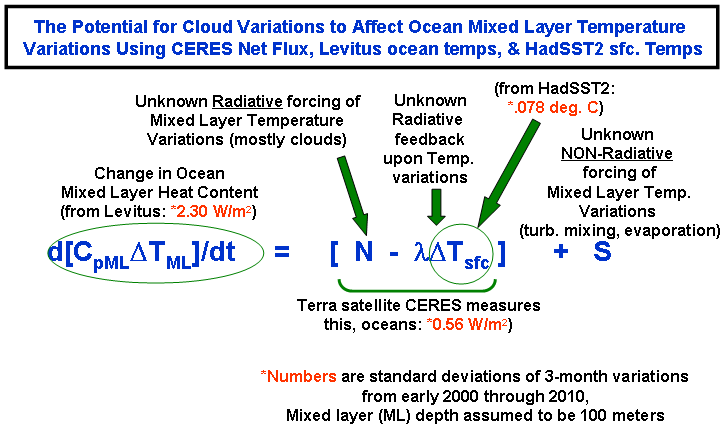
Here I went ahead and used Dessler’s assumed 100 meter depth for the ocean mixed layer, rather than the 25 meter depth we used in our last paper. (It now appears that Dessler will be using a 700 m depth, a number which was not mentioned in his preprint. I invite you to read his preprint and decide whether he is now changing from 100 m to 700 m as a result of issues I have raised here. It really is not obvious from his paper what he used).
Using the above equation, if I assumed a feedback parameter λ=3 Watts per sq. meter per degree, that 20:1 ratio Dessler gets becomes 2.2:1. If I use a feedback parameter of λ=6, then the ratio becomes 1.7:1. This is basically an order of magnitude difference from his calculation.
Again I ask: why did Dessler choose to NOT use the 3 most obvious and best sources of data to evaluate the terms in the above equation?:
(1) Levitus for observed changes in the ocean mixed layer temperature; (it now appears he will be using a number consistent with the Levitus 0-700 m layer).
(2) CERES Net radiative flux for the total of the 2 radiative terms in the above equation, and (this looks like it could be a minor source of difference, except it appears he put all of his Rcld variability in the radiative forcing term, which he claims helps our position, but running the numbers will reveal the opposite is true since his Rcld actually contains both forcing and feedback components which partially offset each other.)
(3): HadSST for sea surface temperature variations. (this will likely be the smallest source of difference)
The Use of AMIP Models to Claim our Lag Correlations Were Spurious
I will admit, this was pretty clever…but at this early stage I believe it is a red herring.
Dessler’s Fig. 1 shows lag correlation coefficients that, I admit, do look kind of like the ones we got from satellite (and CMIP climate model) data. The claim is that since the AMIP model runs do not allow clouds to cause surface temperature changes, this means the lag correlation structures we published are not evidence of clouds causing temperature change.
Following are the first two objections which immediately come to my mind:
1) Imagine (I’m again talking mostly to you geeks out there) a time series of temperature represented by a sine wave, and then a lagged feedback response represented by another sine wave. If you then calculate regression coefficients between those 2 time series at different time leads and lags (try this in Excel if you want), you will indeed get a lag correlation structure we see in the satellite data.
But look at what Dessler has done: he has used models which DO NOT ALLOW cloud changes to affect temperature, in order to support his case that cloud changes do not affect temperature! While I will have to think about this some more, it smacks of circular reasoning. He could have more easily demonstrated it with my 2 sine waves example.
Assuming there is causation in only one direction to produce evidence there is causation in only one direction seems, at best, a little weak.
2) In the process, though, what does his Fig. 1 show that is significant to feedback diagnosis, if we accept that all of the radiative variations are, as Dessler claims, feedback-induced? Exactly what the new paper by Lindzen and Choi (2011) explores: that there is some evidence of a lagged response of radiative feedback to a temperature change.
And, if this is the case, then why isn’t Dr. Dessler doing his regression-based estimates of feedback at the time lag or maximum response? Steve McIntyre, who I have provided the data to for him to explore, is also examining this as one of several statistical issues. So, Dessler’s Fig. 1 actually raises a critical issue in feedback diagnosis he has yet to address.
3. THE UGLY
(MOST, IF NOT ALL, OF THESE OBJECTIONS WILL BE ADDRESSED IN DESSLER’S UPDATE OF HIS PAPER BEFORE PUBLICATION)
The new paper contains a few statements which the reviewers should not have allowed to be published because they either completely misrepresent our position, or accuse us of cherry picking (which is easy to disprove).
Misrepresentation of Our Position
Quoting Dessler’s paper, from the Introduction:
“Introduction
The usual way to think about clouds in the climate system is that they are a feedback… …In recent papers, Lindzen and Choi [2011] and Spencer and Braswell [2011] have argued that reality is reversed: clouds are the cause of, and not a feedback on, changes in surface temperature. If this claim is correct, then significant revisions to climate science may be required.”
But we have never claimed anything like “clouds are the cause of, and not a feedback on, changes in surface temperature”! We claim causation works in BOTH directions, not just one direction (feedback) as he claims. Dr. Dessler knows this very well, and I would like to know
1) what he was trying to accomplish by such a blatant misrepresentation of our position, and
2) how did all of the peer reviewers of the paper, who (if they are competent) should be familiar with our work, allow such a statement to stand?
Cherry picking of the Climate Models We Used for Comparison
This claim has been floating around the blogosphere ever since our paper was published. To quote Dessler:
“SB11 analyzed 14 models, but they plotted only six models and the particular observational data set that provided maximum support for their hypothesis. “
How is picking the 3 most sensitive models AND the 3 least sensitive models going to “provide maximum support for (our) hypothesis”? If I had picked ONLY the 3 most sensitive, or ONLY the 3 least sensitive, that might be cherry picking…depending upon what was being demonstrated. And where is the evidence those 6 models produce the best support for our hypothesis?
I would have had to run hundreds of combinations of the 14 models to accomplish that. Is that what Dr. Dessler is accusing us of?
Instead, the point was to show that the full range of climate sensitivities represented by the least and most sensitive of the 14 models show average behavior that is inconsistent with the observations. Remember, the IPCC’s best estimate of 3 deg. C warming is almost exactly the warming produced by averaging the full range of its models’ sensitivities together. The satellite data depart substantially from that. I think inspection of Dessler’s Fig. 2 supports my point.
But, since so many people are wondering about the 8 models I left out, here are all 14 of the models’ separate results, in their full, individual glory:
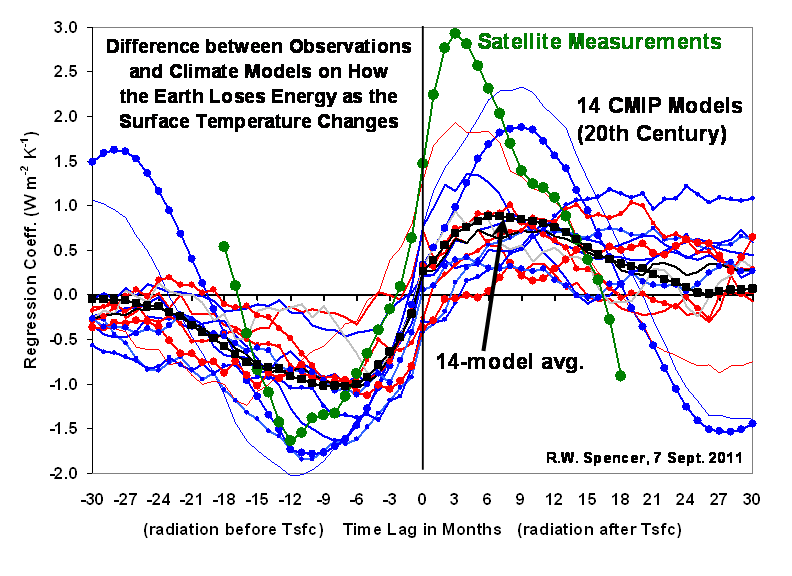
I STILL claim there is a large discrepancy between the satellite observations and the behavior of the models.
CONCLUSION
These are my comments and views after having only 1 day since we received the new paper. It will take weeks, at a minimum, to further explore all of the issues raised by Dessler (2011).
Based upon the evidence above, I would say we are indeed going to respond with a journal submission to answer Dessler’s claims. I hope that GRL will offer us as rapid a turnaround as Dessler got in the peer review process. Feel free to take bets on that. 
And, to end on a little lighter note, we were quite surprised to see this statement in Dessler’s paper in the Conclusions (italics are mine):
“These calculations show that clouds did not cause significant climate change over the last decade (over the decades or centuries relevant for long-term climate change, on the other hand, clouds can indeed cause significant warming).”
Long term climate change can be caused by clouds??! Well, maybe Andy is finally seeing the light!  (Nope. It turns out he meant ” *RADIATIVE FEEDBACK DUE TO* clouds can indeed cause significant warming”. An obvious, minor typo. My bad.)
I am absolutely delighted to hear that Spencer and Dessler are working together like professionals. After all the political wrangling, editor quitting and badmouthing left an absolutely horrible atmosphere around these two individuals – to see them actually co-operating is a staggeringly positive step in the right direction.
What a great day. I just hope that this trend continues.
@KR,
Nice job ignoring me and the whole issue of significance. Which is, after all, at the heart of this issue scientifically!
Also, I am so bemused reading your posts. You talk about waiting for Spencer’s reply, and do so in a thread that is about Spencer’s reply. Have you not read the above article this comment tread is attached to? Your comments make me believe you have not. Spencer shows all 14 models right up there, and you can see none are “significantly” similar to observations, even without having to do the calculations (but you could, yourself, do them if you would actually participate in science instead or parroting things that have already been addressed in the actual body of the article).
You should also notice that Spencer’s calculations, the equation listed right here in this article, are using directly measured numbers. Have you even read and understood the equation and each of its parts? There are three OBSERVATIONAL measurements in the equation, from which everything is based.
Please read the article, and get back to me with actually valid scientific points. Use statistics and tests of significance to back up your claims. Otherwise you’re just cluttering this thread with your repeated fluff.
Lucy Skywalker says:
September 9, 2011 at 2:00 am
Tallbloke: I’m all for people coming over the wall
Yes, this really feels like a Berlin Wall Coming Down moment. I remember how I watched the signs in those days, and could see the likelihood of this approaching, even before Gorbachev and glasnost, as attitides while “in captivity” matured… yet when it actually happened, it was still a miracle.
James Sexton, keep a razor-sharp MIND by all means, use Occam’s Razor, keep the pressure on for upholding fair practice, and watch for double-dealing… but please be gracious to welcome as far as possible.
====================================================
Lucy, you know I love your writings and deem your opinions as very weighty. Indeed, I hold you in high regard. However, graciousness is a luxury only afforded to victors. And we’re not there, yet. We’ve advanced, but we must stay relentless.
Our raison d’être isn’t to be accepted by climatology, it is to have the world reject these people. Lucy, on your page, you listed some, but not nearly all, of the commonly known transgressions of these people. Their transgressions weren’t just toward science, but towards all of humanity. And they’ve done so repeatedly, throughout the years, and without remorse. Dr. Dessler has been there for all of it. Indeed, their impunity and transgressions are the reason for our presence. Their defeat is sine qua non for our victory. (If you would excuse the butchered use.)
Lucy, you, me, and many on this page, have been around long enough to know this hand, extended in an offer of cooperation, is left-handed. We shouldn’t sully our hands in acceptance of theirs. This event was unprecedented (heh) and truly monumental. We shouldn’t let it simply become a footnote.
davidmhoffer,
I mostly agree with your comments of 11:52 pm Sept 8… except on one point. I do not consider Dessler an attack dog. Dessler was mostly courteous in his communications with Spencer, at least back in 2010, even though they disagreed. (Dessler was discourteous in the video, but I think this was out of character for him.) In addition, Dessler provided his data to Steve McIntyre and he joined McIntyre in calling for the IPCC to put the review comments online rather than their first plan to store them in Harvard Library. Dessler has behaved better and upheld the standards of science better than most on The Team.
Richard S Courtney says:
September 9, 2011 at 1:27 am
James Sexton:
……..
KR thinks Spencer’s recent paper is climsci. Hence, he looks at illustrations in that paper with a view to discerning what those illustrations misrepresent.
But Spencer’s recent paper is a scientific report and, therefore, its illustrations present the reported work in a clear manner.
=====================================================
Sigh, I keep forgetting to try and think like a warmista. Thanks for the reminder.
James
The question was asked above:
“When does the editor in chief of GRL resign?”
Am I missing something since in the update it says:
“Also, apparently his paper has not been officially published.”
It seems likely that the editor in chief saw many of the rebuttals in the blogs before it was even published and decided not to publish it after all until revisions had been made. I could be wrong, but it seems to me that the editor is between a rock and a hard place. If he DOES publish problematic work, he may get fired for that. But if he does NOT publish the Dessler paper, could Trenberth extract an apology and have the editor fired for not publishing the flawed paper?
Crispin in Waterloo says:
September 9, 2011 at 8:14 am
____________
I loved it! I can relate to that.
S Basinger says:
September 9, 2011 at 9:05 am
________________
When did you arrive here? Media matters?, Huffpo? Damage control? You sound like spam.
I must take exception to be people writing specifically that “it is so wonderful to see Spencer and Dessler working together.” That does not reflect the reality. Spencer was always doing the right thing as scientist and professional. Dessler had the problems, among which just might be serving The Team ahead of science and professionalism. Let us not lose perspective.
I can see how a long and frustrating history of ‘so-called independents’/’so-called skeptics’ dealing with the ‘so-called consensus’/’so-called settled’ climate scientists (and vice versa) would tend to breed mutual cynicism, however, we do not need any cynicism only courteous skeptical discourse.
With Spencer’s and Dessler’s recent public dialog there is some hope to see some of the courteous skeptical discourse take place and less of the cynicism thing.
John
I wonder if there is a second shoe to drop here. Dessler 2010 criticises not just S&B2011, but also the Lindzen and Choi 2010 paper. I wonder if Dr Lindzen is planning on making a response?
Prof. Spenser: Thanks for keeping us informed about your conversations with Dessler. It’s interesting to see real science being done in real time. I suspect that your lively argument might result in the best possible conclusions. It looks to me like you and Dessler are getting more done in a week than the old-fashioned peer review process gets done in a year. Keep your emails and correspondence. I bet future science historians will find them interesting.
Anthony, I’m a long-term reader of your blog. You must feel very proud that it’s become a forum for cutting edge scientific discussion. Well done sir!
dT
If your Aunt had balls, she would be your Uncle!
One should never extinguish all hope, but who are we really kidding. Dessler is merely trying to extract his own pubic hairs from his own zipper. GK
What account of his actions in the Spencer affair will Trenberth give? What will he say about his denunciations of Spencer’s work and his strong actions against Wagner? What will he say about GRL’s pal publication of Dessler’s work? What will he say about his poor judgment of the relative merit of Spencer’s work and Dessler’s work? I believe that he will do everything in his power to say nothing at all. Whatever he does, this sordid affair makes his integrity as scientist and professinal more questionable than that of Mann or Gore.
Will the MSM ask Trenberth for his account of this sordid affair? If not, then how can they present themselves as credible journalists who report the major developments in climate science? Will they ask the editors at GRL and the other editors at Remote Sensing for their accounts of the matter? Will they interview Spencer and Dessler? I believe they will attempt to hush up the matter. In doing so, they will achieve the same level of believability as Pravda enjoyed in 1980.
Will the MSM interview Anthony Watts and give WUWT the credit it deserves as the medium which spotlighted this amazing development and served as the forum in which much of it unfolded and the aftershocks continue?
Will Congress begin hearings on the monopoly that Trenberth and his followers hold on journals that publish climate science? Will they question Trenberth about the Wagner affair?
I hope others will add their questions and answers.
Ged – “Nice job ignoring me and the whole issue of significance. Which is, after all, at the heart of this issue scientifically!”
Sorry, I did not mean to make you feel left out…
“Use statistics and tests of significance to back up your claims. Otherwise you’re just cluttering this thread with your repeated fluff.”
I don’t see any signs of statistical significance testing in Spencer, oddly enough. Comparing the lead/lag runs in SB11 Figure 3a (six models, averaged to two lines, compared to HadCRUT3 observational data) with D11 (13 models of Spencer’s 14 compared to HadCRUT3 data, along with MERRA, ERA-Interim, GISTEMP temperatures), it’s clear that climate sensitivity is not the appropriate measure of lag correlation between models and observations. Why? Because the models with mid-range sensitivity follow the temperature lag data the closest. Not perfectly, which points to potential areas of investigation, but better than models with extrema sensitivities.
Plotting all the models simply does not lead to Spencer’s conclusions. The three models among those best known for reproducing ENSO are the closest to the observational data, particularly at the 3-5 month lag range. And the short (10 year) time frame used emphasizes ENSO variations, which makes this more a test of ENSO match than climate sensitivity.
“There are three OBSERVATIONAL measurements in the equation, from which everything is based.”
The 25m mixed layer Spencer assumes is far too small. The ARGO data, along with computations by both Dessler 2010 and Lindzen and Choi 2011 (see D11, http://geotest.tamu.edu/userfiles/216/Dessler2011.pdf, lines 65-86) strongly supports Dessler’s factor of 20:1 between ocean and cloud response, as opposed to Spencer’s 0.5:1. An order of magnitude difference?
—
Dessler supplied as much statistical analysis as Spencer (not much for either of them, quite frankly), but he did show all the data. And the full set of data that Spencer analyzed does not support his contentions, either that models fit the data poorly, or that climate sensitivity must be very low.
@G. Karst says:
September 9, 2011 at 11:03 am
“Balls! Said the Queen! If I had to, I would be King! The King laughed, he had to.”
Aint the english language grand?
Theo Goodwin says:
September 9, 2011 at 11:1
“Will the MSM ask Trenberth for his account of this sordid affair? If not, then how can they present themselves as credible journalists who report the major developments in climate science? Will they ask the editors at GRL and the other editors at Remote Sensing for their accounts of the matter? Will they interview Spencer and Dessler? I believe they will attempt to hush up the matter. In doing so, they will achieve the same level of believability as Pravda enjoyed in 1980.
“Will the MSM interview Anthony Watts and give WUWT the credit it deserves as the medium which spotlighted this amazing development and served as the forum in which much of it unfolded and the aftershocks continue?”
Got that, Mr. Revkin? Step up. You’ve done it before.
Wonder when we can expect to see Trenberth’s apology now that it is apparent the poorly reviewed paper by Spencer was reviewed better than the refutation by Dessler.
Oh, c’mon people… It is Dessler, not Dressler.
Mark
Crispin in Waterloo says (September 9, 2011 at 8:14 am): [snip]
Heh. i first heard that story in freshman physics, 1966.
KR, you really are not that good st the debate thing.
Mark
I admit to still being lost by the left hand side of Dr. Spencer’s equation. d(Cpml deltaTml)/dt
As Cp is a mass function (J/kg*K) how can 2.3 W/m^2 be correct?
Q=Cp*m*(T1-T2) or J= J/kg*K * kg * K
The units don’t cancel.
Heat is a mass property and radiation is a surface property.
KR, a hair can only be split a limited number of times.
You seem to be lost in the details with regards to Desslers 14 current models, none of which were produced by Spencer.
Perhaps you should step back a bit and notice that they were all a miss. Do you understand that a miss is not on target. That is 14 attempts and still no score. You are trying to argue that a group of models that miss the least have signifiicance. Ony one of the models was even remotely close. This appears to be something Spencer was pointing out. Desslers misses, as well as yours, continues to be a miss in any practical sense of the word. Hell, you’re trying to argue that Wednesday is almost Sunday. Let it go. Dessler may appreciate your silence.
@KR
Dessler is revising down the 20:1 figure, as it is indeed wrong, and calculated incorrectly. How much closer to Spencer it’ll be, as Dessler is using now the 700 m depth, we’ll have to see. But the 20:1 is completely fictitious and bad math, Dessler himself as reported that, and his next paper revision is changing that.
“The three models among those best known for reproducing ENSO are the closest to the observational data”
KR, that means nothing. It doesn’t matter if it seems like it’s close. Until you do a statistical test, it means -nothing scientifically-. It could look close, but be significantly off, and thus NOT a reflection of reality what so ever. That’s the point I am trying to make. If Spencer didn’t do statistical tests, then he is failing just as much as Dessler in this matter. There are no ifs or buts, you can say -nothing scientifically- until you do a statistical test.
On the other hand, Steve McIntyre has done some statistical tests on the data, just not the models versus observations data from what I’ve seen. Take a look at what it actually looks like when you do real, quantitative science: http://climateaudit.org/2011/09/08/more-on-dessler-2010/ Notice the p values that are listed.
Finally, another point I’ve been trying to make and which you keep ignoring, is that SB11’s point was to show that model climate sensitivity did not conform close to observations. Do you see that? That was the point, and that is what was illustrated. All other data was spurious compared to that PARTICULAR experimental test. I still feel he failed if he did not to show statistics, and so has Dessler in his reply, all the same!
Think again too at what it means if climate sensitivity is not the correct factor for matching a model to reality. This goes back to the IPCC report, and all the hooplay about ENSO not being important and the only factor that mattered was climate sensitivity.
Crispin in Waterloo says:
September 9, 2011 at 8:14 am
The kid should not have gotten any credit for any of his answers as they all required more than a barometer for them to work. Even the answer of using it as a yardstick and making marks on the wall would have required a marker of some sort. FAIL
The correct answer required nothing more than the barometer. Read the barometric pressure at the base of the building, read it at the top, and the difference can be converted to the height of the building through a simple formula. This is exactly how standard aircraft altimeters work – the are simple dial-gauge barometers with the face marked in feet above mean sea level instead of millibars. They’re calibrated to the instant local barometric pressure by adjusting them before takeoff so the reading matches the known MSL of the runway – such adjustment is is an item on the pre-flight checklist.
700m for the mixed layer? Wow! My own personal experience (from deep diving) is, you start to get into the realm of 10 deg C water at something between 20 and 30m, and into the 6 deg C realm down around 50m, and after that you have the transition into true abyssal uniformity.